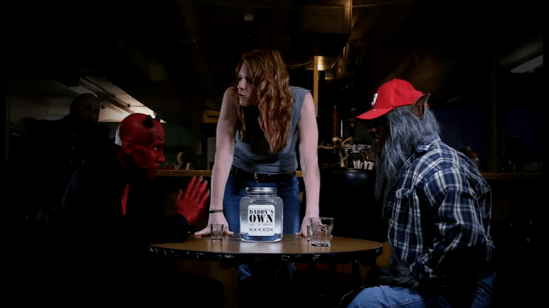
Seeking the luxuries of peace and quiet in order to fulfill the work of an important academic theory, a young student rents out the basement of an old bunker converted into a family home. Surrounded by the solitude of snow and trees, the bunker is the perfect place for the student to concentrate on his work. Until the couple renting the bunker basement decides the student must continue the unorthodox home-schooling of their eight-year-old son to put him on the path of becoming the President of the United States. The student becomes mixed up in a peculiar family’s ambitious affair twisted far from normalcy and teetering on the borderline on insanity.

“Der Bunker” is the first feature film from writer-director Nikias Chryssos and Chryssos delivers an artistically abstract film about the modernistic conventional ways of growing up through childhood told through an obsolete perspective. Produced in Germany, the film makes light of how parents raise and shelter their children, especially their sole child. The home setting is literally a bunker, a fallout shelter from the age of war. “Der Bunker” particularly points out the American child raising culture with Klaus, the eight-year-old son of mother and father, going through semi-strict tutoring of memorizing the every nation’s capitals in efforts of becoming, one day, the President of the United States. Chryssos overkills the symbolism column with continuously displaying the staleness of a stuck-in-routine in over-parenting from the outdated 1950’s style of the clothes and retrofitted bunker to the eight-year-old Klaus being depicted by a 30-something actor Daniel Fripan.

Fripan is one of four cast members to star in Chryssos film and the only actor portraying a named character with Klaus, leaving all others generically labeled with father, mother, and the student; however, Klaus and the Student are essentially the same person, a dual presence who start off polar opposites that are trapped inside the bunker and looking to break free from it’s buried confines when their individual identities begin to blur. Fripan’s key to “Der Bunker” working conceptually as the ‘man-child’ with Fripan’s attributed short stature, innocently mature face, and a well-performed immature persona that solidifies the Klaus role as nothing more than child forced to grow externally, but not internally. Pit Bukowski’s more of an automaton when we first meet him wondering through the snowy terrain in search of the bunker. His Student character starts to dwindle as he literally becomes a fixture of the bunker as Klaus starts to shine and thrive in not only his studies but in his maturity, confronting his Mother’s will. Bukowski’s internal switch goes dynamically well with Fripan even though their physical façades remains intact. Mother and Father are portrayed by Oona von Maydell, daughter of “Das Boot’s” Claude-Oliver Rudolph, and David Scheller and both compliment each other by donning an opposite reversal of roles where Mother is the stern, firm hand of the family and Father stays home to clean and be a teacher for Klaus.

Chryssos’ telling of the family and the Student’s psychosexual relationship between the story’s bookends goes above and beyond the Oedipus complex. Oona von Maydell’s Mother has a power fastening all the male characters in an intriguing way despite her minor, yet undesirable, physical deformity plaguing as a patch on her right leg and also despite that her rational stemming from a grave voice, connected to her deformity, comes from beyond their world. As if destined to play the part, Maydell acts the lead as the family’s matriarch while also being subtly coy and provocative to bluntly upfront about her sexuality as a means of control; Maydell seemed very comfortable with her onscreen upper torso nudity in some awkward and uncomfortable scenes. Her onscreen husband, David Scheller, deems himself an academic, an educated man with knowledge more vast than that of the outside world because of this thirst for literature. Yet, Scheller plays a scattered Father whose torn between being a literal mentor, the punisher, and the glue to keep the bunker from being engulfed by giving into Mother’s symbiotic celestial being. Father copes with heavy medication that literally warps his mind when he can’t seem to control everything from the Student’s appetite to his convincing of the Student to take on the tutoring role for Klaus, even if it’s not plainly displayed. Scheller does a remarkable performance breaking down his character to a crumbling lame duck.

“Der Bunker” and the bizarre go hand-in-hand. Only a unique mindset with skewed vision could have pulled together such a twisted dark comedy tale of the mortal coil in holding your children to your hopes and dreams for them. Colorfully unapologetic, “Der Bunker” canisters another world sluggishly revolving through multiple levels of layers of psychosexual and frustrating concepts that flaunts a conventional cinema defiance attitude to establish bold filmmaking possibilities. In short, director Nikias Chryssos shoots high and doesn’t miss with his first run. The Artsploitation Blu-ray release features a vividly clear anamorphic widescreen 2.35:1 presentation of the Kataskop Film Production. Audio options include a Dolby Digital German 5.1 Surround sound with very detailed optional English subtitles. An abundant of bonus material is hard to pass up, especially with a director’s commentary and deleted scenes that expand more about the character’s traits and backgrounds. Rounding the extras are outtakes and trailers from Artsploitation film arsenal. This Blu-ray release is meticulously thought out to deliver a high caliber video and sound quality for such as odd German film concerning one youngish boy’s progressional path of self-reliance from a sheltered life style.
Evil Goes Silent! “The Unspoken” review!

In September of 1997, the Anderson family vanished from their remote home on Briar road, leaving behind scores of scattered blood, a lynched dead body, and a house keeper in mental shambles. Seventeen years later, Jeanie and her son Adrian move into the Briar home with the legendary and infamous reputation for being ghastly haunted. Living on hard times with her father being laid off from the region business, Angela reluctantly accepts a good paying caretaker position for Adrian at the notorious Briar home. When a local drug runner gets wind that his stash’s repository is no longer vacant, a dangerous game of retrieval pits the desperate small time dabblers against a supernatural force living inside the home that puts Angela, consequently, in the middle of a terrifying standoff.

Sheldon Wilson. A name that’s under the horror radar for most horror fans, but for this particular reviewer, this particular fan, Sheldon Wilson has had a major influential role in bringing a wealth of horror to my life. The director’s 2004 film “Shallow Ground” was the first domino piece to fall that a started landslide of independent horror cinema to come flooding into my presence and opening up my world, my eyes, to the many facets of the genre. I fell hard for “Shallow Ground” that led to the foundation of a grand and glorious horror collection that would be acknowledged Rob Zombie, who’ve I’ve heard, has an extensive film collection. Wilson’s latest venture “The Unspoken” has reminded me that horror can live in the restraints of the past and can be bold with an unforeseen twist.

Now, “The Unspoken” epitomizes the very definition of generic titles, but the premise goes far beyond being geriatric with similarities, but not on the same elaborate scale, to the 2012’s “The Cabin in the Woods” by exploiting the genre’s familiar tropes but shifting, at the very last moment, to an ending that’s well received and a breath of fresh air. From the Wilson films that I’ve experienced, his story structure is orchestrated in a detailed manner making the subtleties pop with saturated intensity. With “The Unspoken,” Wilson’s indirect jump-scare style is very much engrained and effect goes without diluting the entire film as some, examples such as some of the recent Halloween films, have done in the past to the point of tiresome and ungratifying.

A satisfying cast genetically makes up the captivating story with young and upcoming scream queen Jodelle Ferland in as the lead role of Adrian’s desperate caretaker Angela. Ferland has quite the stint in horror starring in such memorable films as the recently referenced “The Cabin in the Woods,” “The Messengers,” and as the young child in 2006’s strong video game adaptation of “Silent Hill.” Ferland possesses that scared and innocent persona and she leaves nothing on the table when forcing to battle against a supernatural danger that can animate a decaying, jaw-severing dog corpse. Pascale Hutton, Anthony Konechny, Chanelle Peloso, Lochlyn Munro (Freddy Vs. Jason) and a passing-through role for “The Hitcher” remake’s Neal McDonough as a local sheriff rounds out the rest of the “The Unspoken” cast. Sunny Suljic, who portrays the unspoken Adrian, solidly performs as the creepy and mute, Damian resembling child even with his bad young Elijah Wood haircut. Together, the ensemble plays their respective roles with as much as earnest as the next film with more of the focus on Angela and Adrian throughout with supporting characters driving much of the storyline, funneling toward a surprising catalytic event.

For the majority of the film, “The Unspoken” meets the harsh criteria fans need and desire from their horror films with some solid practical effects, no CGI effects, a story-driven plot, and a haunted house full of good scares with tidbits of blood and gore in between them all. There’s even a little nod of respect for the “Amityville” series. Only insignificant character underdevelopments raise a few unanswered questions about situations perhaps more pertinent to the motivation of the story such as the forbidden relationship between Angela and best friend Pandy which floundered a bit out of place within the confines of the plot and went stagnant when more about the Briar home became revealed or when Pandy’s more-or-less boyfriend Lutheran and his drug scheme goes through the sharp blades of a blender.

The Lighthouse Pictures produced and Arrow Films UK distributed paranormal disturbance feature “The Unspoken” hit retail shelves and online markets September 5th. I’m unable to review video and audio quality with a region 2 DVD-R and there were no bonus material available from the static menu. However, Wilson’s film fairs with a sharp and clean appearance without the bedazzling of a Hollywood budget; the director’s use of the slow panning method and focusing on unsettling camera angles to transform an ordinary mountain home into a menacing dark presence doesn’t require much touchup in order to terrify audiences. If you’re a fan of quiver inducing, nail biting horror with a good M. Night Shyamalan twist at the end, “The Unspoken” will leave you completely terrified and utterly speechless.
Family’s First Night in an Evil House! “The Purging Hour” review!

Providing his dysfunctional family with new hope of rekindling, Bruce Diaz ditches the hectic grind of the city for the quiet surroundings of a mountainous Californian resort town. As they settle into their new abode, Bruce tries his hardest to piece together a shattered family. From his scared younger son Manny, to his angst-filled teenager daughter Kacie, to his distraught wife Jennifer, Bruce can only find solace in his daughter’s coasting through life boyfriend Mark. After the first 24 hours, nobody really knows what had happened to the Diaz family until an anonymous source leaks a distorted and violence recorded video tape from the dark corners of the world wide web. With new evidence at the table, a documentarian interviews family and friends of the Diaz family, local residents, and officials associated with the case in hopes to determine the whereabouts of the Diaz family that seemingly went through a violent disappearance and expose that disappearances like these can’t just be quickly covered up.

Vicious Apple Productions and Ruthless Studios add their entry amongst an overcrowded found footage market. More recently in the golden age of independent cinema, found footage films have incorporated faux interviews to add upon an artificial authenticity, but, in reality, these one-on-ones with the closest people to the victims just fill the voids to compensate for a lack of story and “The Purging Hour” plays right into that shortfall story mold. Director Emmanuel Sandoval’s sophomore 2015 feature leads into being a first time venture into horror for the young California director and Sandoval’s potential needs refinement from his also co-authored feature with Robert Trezza and Zaidal Obagi.

Developmental pacing puts the hurt on the story. I’m not sure how much more Steve Jacques moving of Bruce’s lowbrow attempt to lightheartedly get this family to bind together over this new home I could stomach. If I was Bruce with all of Jacques’ beefiness, not one smart and ugly remark from his ungrateful daughter Kacie would be taken lightly. Kacie’s family trampling is the biggest elephant in the room to the point that’s an exploited archetype in many independent projects. On top of Kacie’s entrenched battle with her family, she’s able to sustain a firm grip over her weak parents by letting her boyfriend Mark stay with them way after the move was completed. Through the muffled sidebar conversations, Mark’s fixture status amongst the family, and an unclear picture of a the family between their personas on the video tape and the their personas through the eyes of the interviewees, which creates a totally different family, speculations fly wildly toward the next steps into what happens next.

About a little over an hour after being subjected to interviews and multi fits of family bickering, Sandoval begins his HI-8 fright flight and thats where the director soars slightly by casting a muddled look into the family’s last known status. Purge, by the very definition, is to physically remove completely and “The Purging Hour” stays true to that moniker with one hour of purging and 23 hours of family turmoil and in the midst of that hour of purging, either a supernatural force or a violent bunch of heathens do the so said purge. One theory for the latter, a loose one at that, falls upon the introduction of a local resident spooking upon one of Kacie and Mark’s muddled conversations in the outside darkness. The local proceeds to explain that he’s meeting up with friends, which he does every year, and to do what, is not explained. Could this be part of a purging group? Perhaps, but there’s more of an malicious supernatural force at work upon the Diaz family that includes no physical body ever in the scene with the main characters who become main victims.

Ruthless Studios is the same production studio that also delivered “All Hallows Eve” and, frankly, nothing has tickled the distinctive quality from either film. “The Purging Hour” is a low end rental that fails to blend suspenseful drama with suspenseful thriller. Dabbled with touches of key fear elements that does not rendition a bold new of horror, “The Purging Hour” waits until the very last hour to divulge into the subject matter with anything prior to being a waste of reel. The MVDVisual distributed widescreen 1.78:1 presentation has great retro coloring through the purposefully installed Hi8 format while being clear, with little electronic interference, through the interviews and the 2.0 audio mix is muddle through the Hi8 experience, but should be cleaner for more subversive effect. No bonus material included on the static menu. The DVD cover makes you believe the film centers a supernatural entity with a dead cold hand with razor fingertips upon gnarled fingers grasping a door through the jamb. “The Purging Hour” raises too many questions to satisfy a complete and coherent story that relies too much on fake interviews to provide infamy amongst the characters and instead of letting the characters conjure a force reconstructed through their imbalance, an unknown entity, human or otherwise, randomly select their residence to even more obliterate their family coherency.
Everything’s Chill at the Beach Until Evil Crashes the Party! “Dark Cove” review!

Since the age of ten years old, four lifelong friends, Quinn, Jen, Joey, and Ian, camp on the outlying coast of Vancouver Island, Canada. Quinn’s girlfriend, Rachel, tags along for a trip filled of booze, drugs, and beach lounging. When at first the group of friends meet up with two gung-ho surfing Australians and a drunkard Brit, a night of relaxation and hallucinogenic tripping follows until one of the Aussie’s makes a fateful move on Jen that begins a series of unfortunate and murderous events turning the fun camping getaway into a unbelievable nightmare for all.

“Dark Cove” is a Canadian thriller from first time director Rob Willey that feasts upon the versatile and volatile nature that is aggressively human. The Vancouver Island beach backdrop is a serene, isolated stretch of sand, water, and forest rolled up into a coastal woodland. A perfect gathering point that serves suitably for “Dark Cove’s” remote needs and the aside from the roar of the surf, the tranquility becomes polluted by the wants of man that goes to prove the notion that one rotten apple can spoil the entire batch, including a peaceful beach, without needing to dump the likes of grisly viscera all over.

Whereas “Dark Cove” conveys the underlying human aggression ready to explode at any given gas-lit spark, the film also conveys a hefty amount of breathy hot air. When building up toward the momentum-turning event, one would first wonder if anything would ever go array with no sense of a violent storm upon the horizon. Before everything spirals out of control, the centric group of characters find themselves amongst an endless cavern of talking points about the woes and the joys of their young lives growing up and being adults. Quinn quickly dismisses his recently earned university degree because he can’t find a job in his liberal arts field and has to work as a server, Joey’s immature mission in life is to have sex with a girl of every nationality, and Jen departs from a two year relationship that quickly has her jumping into the arms of strangers. The latter being more relevant to the story than all the other campfire jawing with Jen’s encounter with one of two Australian surfers. Its as if “Dark Cove” tries to become more of a film trying to make a statement about the uselessness of a higher education and that one out of five will be successful.

From then on, the series of unfathomable events go from chill, a term Quinn constantly uses when he’s obviously not, to maximum carnage and confusion in a split second. The effect resembles the shock of going flat-out cold turkey, a sudden forced change that’s so terribly unbelievable it puts a wrench into the situational outlook afterwards. The backstory behind characters starts to quickly unravel to a point where they’re severely different characters than before. Quinn is somehow a master genius of hiding evidence, the professionally successful friend Ian snaps and goes bananas after the altercation between the Aussie and Jen, and Quinn’s girlfriend Rachel transforms into a cold person from a visibly warm and loving partner. Dean and Chase, the two Aussies, also suffer underdevelopment. Dean hints at their risky bohemian habits with their expired Canadian visas, but don’t exactly emit a bad vibe up until the moment of truth. Chase is the most interesting character with this most disappointing exposition about his history with a large Irezumi-like tattoo on nearly his entire back and his shows an enormous amount of aggressive power typical of hard life experiences.

Rob Willey committed to a one-man filmmaking machine. Willey proved he can tell a coherent story through writing and directing the story while serving as also the lead actor in Quinn, producer, editor, and providing some original scores. His surfer “brah” attitude for Quinn stood out his character from the rest of his childhood friends who deemed more down to Earth with their raunchy “American Pie” sex jokes and philosophical debates. Co-producer Rob Abbate saddled up as sex hound Joey and his performance was filled with over saturated sex comedy that overwhelms, but his timing and delivery was on point, kicking up some chuckles here and there. I can’t say too much about the rest of the cast as they felt just too flat. Ty Stokoe is a bi fella who I wouldn’t want to meet in a dark alley, but when his character Chase removes his shirt in anger and starts to gorilla yell at the sky, the passion didn’t quite fit the scenario and felt out of sync with the tone. Moments like this are prevalent throughout and do affect the raw appeal of “Dark Cove.”

“Dark Cove” is a 2015 Hot Springs International Horror/Thriller film festival premier film that’s currently only available on iTunes, Digital HD, and Cable VOD. Also, the film is available on Canadian platforms Shaw, Bell, and MTS. I’m unable to critique the video and audio quality of the release since I was provided a DVD-R, but the 84 runtime feature stars Rob Willey, Rob Abbate, Ty Stokoe, Eliot Bayne, Cameron Crosby, Montanna McNalley, James Anderson, Jules Cotton, and Alexandra Brown. In conclusion, “Dark Cove” is an unimaginative, run-of-the-mill thriller we’ve seen before this time set on a Canadian sandy beach and accompanied with some jabs at their North American brethren. No offense taken, but “Dark Cove” is a tired premise done half-cocked.
The Counselors Face an Evil Murderous Rage. “Summer Camp” review!

Four camp counselors prepare a woodsy, dilapidated living quarters a couple of days before their anxious campers arrival. As the preparations seem to be going as scheduled, a sudden violent rage takes over the head counselor with the eyes turning severely bloodshot and a bloody-black ooze seeping from the tightly grit mouth. The isolated camp structure that should bring joy and excitement to young children becomes an unescapable labyrinth for the counselors when the local transient residents fall also to the murderous madness. Trust between the terrorized counselors thins as none of them have an idea how the infection transmits. Without an operational phone or vehicle, the surviving counselors can only count on themselves to flee and fend from a fury seeking to massacre them all.

When first hearing of Alberto Marini’s inaugural co-written and directed film entitled “Summer Camp,” a vivid portrait of radiant sunshine, lake canoes, bow and arrow games, and lots and lots of children campers naturally come to the forefront of mind – basically, “Salute Your Shorts” pops right into the old “cabeza,” even in front of slasher genre fave “Friday the 13th” that culturally Hollywood-ized camp counselors, transforming them into unlimitedly horny teens, subjecting campers into hapless victims, and demonizing campgrounds as death camps. And while “Summer Camp” resonates good times in the season’s solstice heat, Marini’s version of camp weaves a craft basket of intense fear.

“Summer Camp” opens to a newscasters voice over reporting that three American counselors have vanished in the wilderness of Spain and are unlikely to be alive at this point of search. The setup already denotes no resolution to the counselors’ fate who make their on screen appearance in the following scene engaged in a trust game the Italian filmmaker had constructed to appear as every horror trope imaginable – a woman running through the woods with a blindfold and hands tied behind her back, a lurking ruffian peeping the counselors from the dense tree lot, and etc. The possibility of horror themed scenarios trickle at the top of a hill, snowballing until Marini decides to sudden plop down a massive, unbreakable brick wall in front of soccer ball size snowball before reaching critical speed, size, and strength for massive destruction. Marini’s a magician by convincing viewers to believe the trick in one hand, yet subtly revealing the real trick in the other and by doing this, a flare of confusion immerses the counselors and the audience in order to keep them guessing at every step of the way.

Continuing with Marini’s script co-written with Danielle Schleif, a contrived portion of many possible triggers that causes the violent behavior almost as if Marini and Schleif used satire to highlight the absurdity of previous zombie or infected films and their numerous infected origins. “Summer Camp” leads you to believe that one of the following three, or perhaps a combination of all three, possible culprits are responsible for spawning deranged and violent behavior. Characters are purposefully shown to be unprotected to the transmission of external blood or saliva, seen drinking the mysteriously broken and recently fixed well water pipes, and being exposed to an unusual after spring pollen buildup that seems to be everywhere. Which element prompts an outbreak? Or is it all three?

When the characters are aggressively possessed, a crossbreed between an “Evil Dead” Kandarian demon possession and a hybrid-rabies strain infected from “28 Days Later” sum up a “Summer Camp’s” possessed state of being. The actors themselves wholeheartedly accepted the role, doubling and switching themselves between normalcy and lunacy with ease. While the story prides itself on being quick to action and fast paced like Danny Boyle’s 2002 film, the characters’ depth burdens no viewer and their ultimate fate will raise no brows. The bare bones character backgrounds only affix their red shirt destiny; yet, Marini has already doomed his own characters for on script stupidity and whether intentionally or not, written to be cursed never qualifies a character to be a likable hero or heroine. When Will knocks out a possessed Michelle, he quickly unlatches his belt that holds up his pants to tie her legs with it and while that seems like a smart idea in the beginning, Will stills needs a way to keep his pants up from falling to his ankles in order to run through a dark dense forest from the numerous possessed individuals lurking about, screaming their lungs out. Will also attempts to unlace one of his shoes to bound Michelle’s hands. Why?! You’re going to need a tight fitting shoe to run through the forest and…oh forget it.

Diego Boneta portrays the unluckiest of the luckiest counselors. As Will, he’s accused of murder and along with being bitten, battered, incised, and even drilled; yet, he manages to still lead the surviving charge even if the odds are against him. The physicality of the role contrasts with Boneta’s character whose short and has a vision disadvantage, but Boneta underneath the skin of his character sports an athletic build as shown from one gratuitous shirtless scene. The dynamic between Boneta, Jocelin Donahue as Christy, and Maiara Walsh as Michelle couldn’t have been any better with decoding the group’s trust issues even until the very end, especially between the tomboy with a mysterious past Michelle and the prissy and uptight Christy. Dynamics stands out as the bright point of Marini’s skeleton script that doesn’t involve many complexities as it does debunking horror tropes.

The Lionsgate distributed the rated-R DVD release of the Spanish horror film has a 16:9 widescreen presentation with a Spanish and English 5.1 Dolby Digital audio complete with Spanish and English subtitles. With an average film runtime of 84, “Summer Camp” maintains just enough endless terror to suffice an entertaining haphazard horror-comedy and that’s about all the entertainment delivered from a DVD with thin extras including only trailers and a digital ultraviolet. The lightweight nature of this release should definitely not deter a viewership, but rather “Summer Camp” should be embraced as an intense and scary gauntlet of escape and survival. A well-fought first time feature from director Alberto Marini and a good showing of faith for a talented young group of actors seeking to imprint their names into horror.
Buy “Summer Camp” at Amazon.com!