EVIL Just Wants Their Heads Back! “The House of Lost Souls” reviewed! (Cauldron Films / Standard Edition Blu-ray)

Don’t Lose Your Head in “The House of Lost Souls” on Blu-ray!

A group of geological fossil hunters spend their time researching in what is supposed to be the ideal climate of the Italian mountains but inclement, rainy weather has produced all kinds of inconvenient havoc and challenges that have slowed down their darting research.  Mudslides caused by the constant rain makes mountain roads impassable.  They encounter such a mudslide impasse on the way to their next research grounds and do an emergency detour to a remote, vacant hotel to spend the night out of the cold damp night.  Greeted without a single word from their unusual host, they’re given room keys get some rest before the next day’s hike up the cleared mountain road, resuming course toward the fossil hunt, but the geologists quickly discover something isn’t right with the hotel that has a dark history.  Trapped inside the abandoned hotel, murderous spirits appear and aggressively seek more souls to fill the hotel’s vacancy.
The fourth and final entry in The Houses of Doom series produced from Italian television in 1989, “The House of Lost Souls” is the second Umberto Lenzi (“Nightmare City,” “Ghosthouse”) film of the Lucio Fucli and Lenzi stint from the coproduction of Dania Film and Reteitalia with producers Massimo Manasee and Marco Grillo Spina, behind Lenzi’s “The House of Witchcraft” and Fucli’s “The House of Clocks” and “The Sweet House of Horrors.”  Lenzi also created the story concept and wrote the script that feels like a blend of the American-produced, supernatural thrillers “House on Haunted Hill” and “13 Ghosts” but with more bloodshed, color encoded and has that Italian violence flair too graphic for public television.  Italian-titled “La casa delle anime errant,” the film is also a production of the National Cinematografica that produced other Italian Umberto Lenzi cult classics “Seven Bloodstained Orchids,” “Eaten Alive,” and “Cannibal Ferox.” 

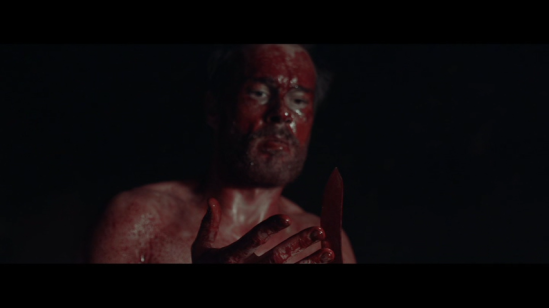
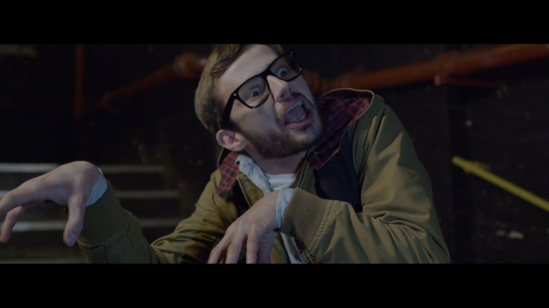
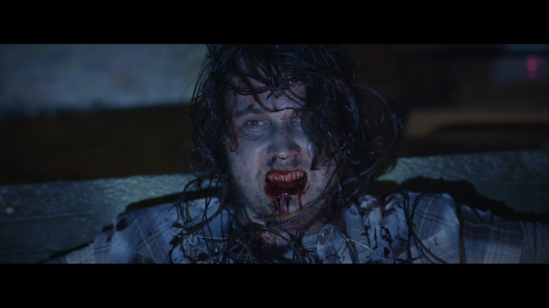
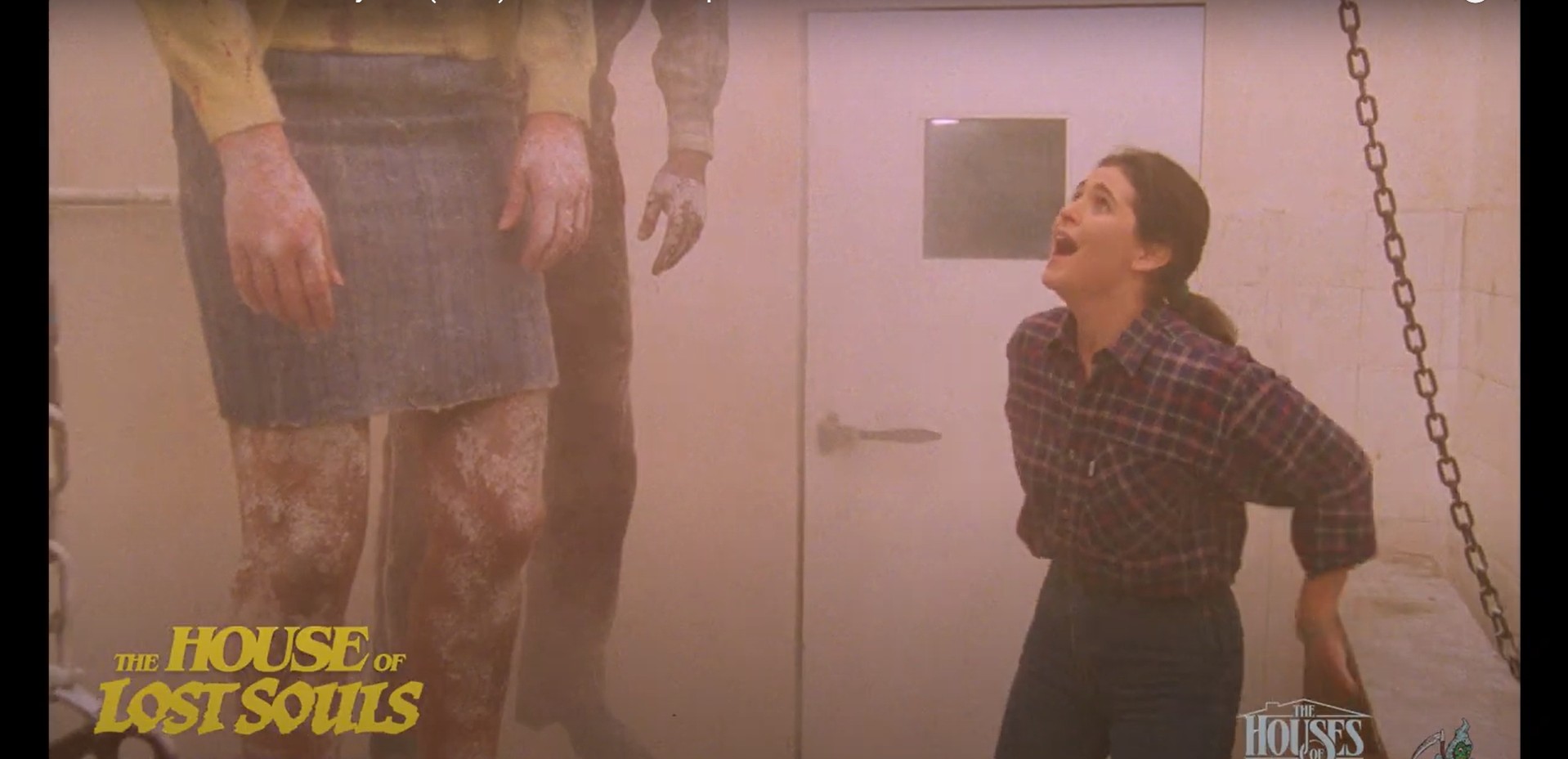
Trapped inside the gruesome lore of the hotel’s deadly history and as the focus of the overall dilemma is the group of geology students and friends, plus one adolescent boy tagging along with his older brother.  Further more concentrated on inside the group is Carla who’s been diagnosed, yes – medically identified, as having clairvoyancy with her psychic nightmare visions, sporadic and jumbled frightening images that yet don’t make sense, but guess what?  To no surprise, they will soon! Stefania Orsola Garello, who went on to have a role in the Antoine Fuqua’s period epic “King Arthur,” played the third eye sensorial Carla investigating the hotel’s sordid past along with quasi-boyfriend Kevin, donned by “The Slumber Party Massacre” American actor Joseph Alan Johnson.  Johnson is the extent of international casting, unless you count the hotel host, or rather head ghost who we’ll touch upon later, and the distinct facial features and the significant height of Japan-born Hal Yamanouchi (“2019:  After the Fall of New York,” “The Wolverine”) as a zombified Hare Krishna ghost, one of his many Italian roles while residing within the country since mid-1970s.  The remaining fill out with Garello countrymen counterparts with Matteo Gazzolo (“Specters”) as the group leader, Constantino Melon (“Who Killed Pasolin?”i as the leader’s little brother Giancarlo, and young lovers Guido and Mary, played by Gianluigi Fogacci and Laurentina Guidotti (“Dark Glasses”), as the victimized geologists being hunted down and tricked into slaughter by, too, victims of a hotel proprietor madman, the key perpetrator to all this madness but reduced to only a reflected role through Carla’s flashbacks.  Aside from Yamanochi, there are a handful of former guests and voiceless ghosts, some stuck in a bloodied stasis at the time of their death, some pristine as if nothing happened at all, haunting and hunting down the warm bodies, including Scottish actor Charles Borromel (“Absurd”), Marina Reiner, Dino Jaksic (“Little Flames”), and Beni Cardoso (“Barbed Wire Dolls”).
A different ghost house picture than Lucio Fulci’s “The Sweet House of Horrors’ but still contributes the same inhuman intensity of one person (or one ghost person) can against another person.  Yet, for Umberto Lenzi, his story thrives through the house’s, or rather hotel’s, ability to dispatch the innocent with household items.  Decapitating dumbbell waiters, a cabinet with a ripping chainsaw blade, a head-eating washing machine, and almost even a walk-in freezer become the tools of fatal terror.  Lenzi depicts little in the way of person-on-person violence with only implied deaths at the hands of another person; instead, the personification of ghost house miscellany is definitely more exciting, very unexpected, and a lot of fun to watch the hapless have their heads fall prey to household items that are supposed to be helpful, not hurtful.  Perhaps, Lenzi’s intentions were to explore the negative dependency of gadgets or appliances and how easily we’re allured by their safe nature marketing and profound assistance to our daily lives that it makes us easy targets with our guard down.  Lenzi also doesn’t believe in nepotism when casting young actors as the two child characters become fair game for the house’s thirst for slaughtered souls, dooming them with an equal risk to a brutal death.  The storied hotel’s notoriety serves as the vessel that drives ghosts to go berserk but the story’s miss is bringing back to the killer hotel owner who chopped the heads off of his guests to rob them, stowing them away to hide his transgressions, only for them to be the root of the ghosts’ reason for revenge against any and all who trespass through the lobby.  As the origin of the ordeal, the omitted owner serves as just flashback fodder that fuels the floor-by-floor fiends. 
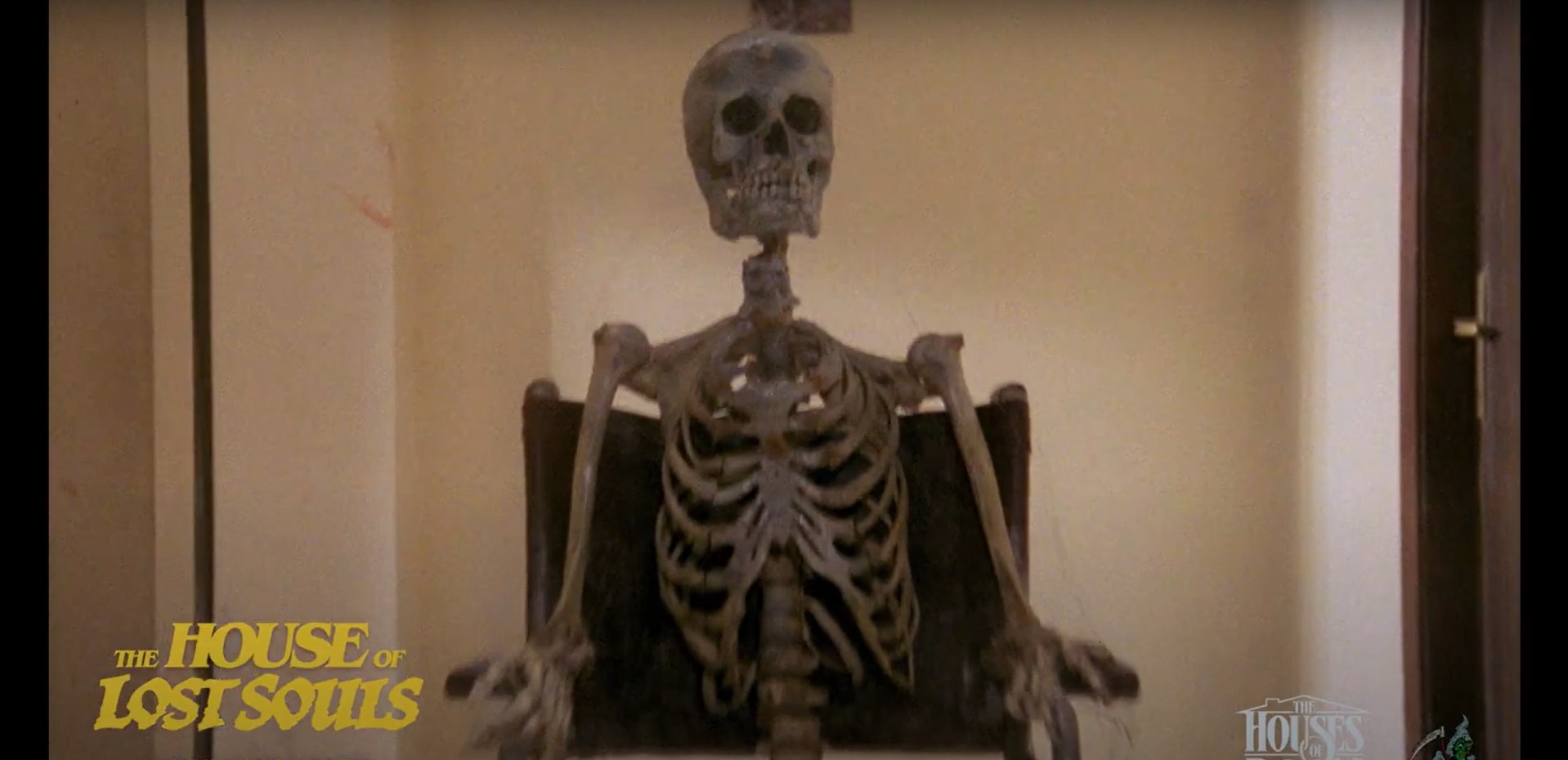
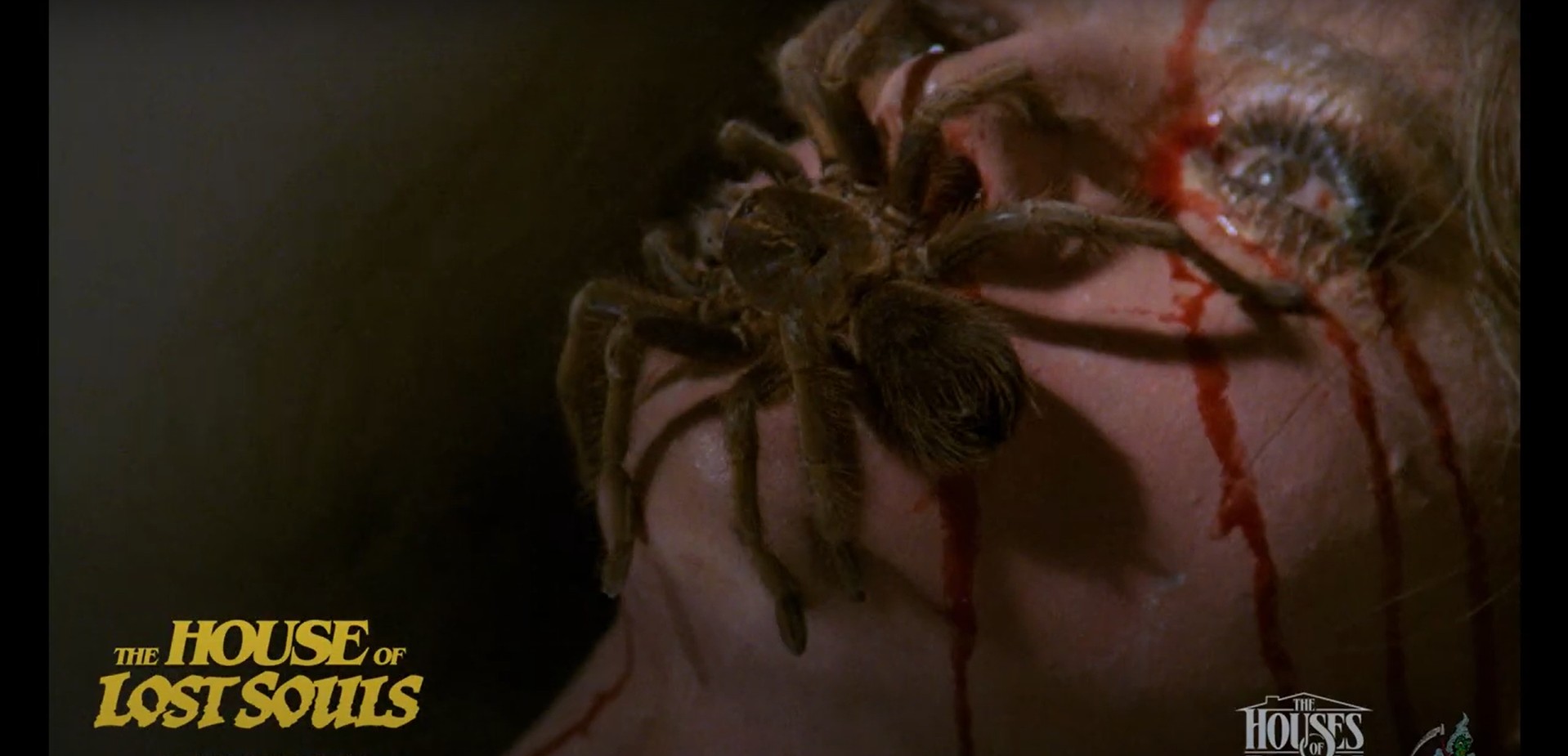
Spiders, skeletons, and severed heads make up, but are not limited to, Umbero Lenzi’s “The House of Lost Souls” now on Blu-ray as the last The Houses of Doom release from Cauldron Films.  Presented in the European widescreen aspect ratio 1.66:1, the new 2K scan was restored and released uncut from the original film negative, inviting a clean and beautifully vibrant pictures for a dark, haunted hotel feature.  However, like with many Lenzi pictures of the time, the final product has softer image detail that’s brilliant for producing color but relaxes the stringent textures to a still better than mild palpability that’s more than enough beyond the bar of image quality.  There are no compression anomalies to speak of as Cauldron Films, again, produces an excellent high-definition encoding, much like with the other three Houses of Doom installments.  Audio setup includes an encoded English and Italian 2.0 mono with optional English subtitles for the English track and forced English subtitles on the Italian.  The ADR hits and misses the mark with vocal ranges seemingly too mismatch with the actors, such as with Massimo who looks like a tenor but has a bass voice, or the boy Giancarlo with an unsettling falsetto and you can lipread those who are actually speaking English compared to those who are not native English speakers.  The overall track has no compression issues with a powerful dialogue projection and an adequate ambience that hits every keynote to bring the composition together.  “Demons” and “Tenebrae” composer Claudio Simonetti produces a charming little synch rock trap-threat and of a score that becomes essential to “The House of Lost Souls” snare and stalk of the geologists caught in the wrong place at the wrong time.  Special features include Cauldron Films’ exclusive interviews with FX artist Elio Terribili Working with Umberto and composer Claudio Simonetti The House of Rock along with two audio commentaries, one with Samm Deighan and the second with Rod Barnett and Adrian Smith, and bringing up the rear is a 2001 interview with Lenzi going through points in his lustrous independent career of exploitation, poliziotteschi, and giallo contributions to Italian cinema in The Criminal Cinema of Umberto Lenzi.  The not rated, region free Cauldron Films standard Blu-ray release, encased in a clear Scanova Blu-ray case with original Matthew Therrien and Eric Lee illustration cover art and logo design, has a runtime of 87 minutes.

Last Rites: That’s a wrap on the fourth and last film on The Houses of Doom collection from Cauldron Films and it’s a beauty scanned onto a new high-definition transfer that brings doomed television features back to life, to live again, to breathe its hot breath of death all over a new generation of viewer unfamiliar to Lucio Fulci, Umberto Lenzi, and even Italian horror!
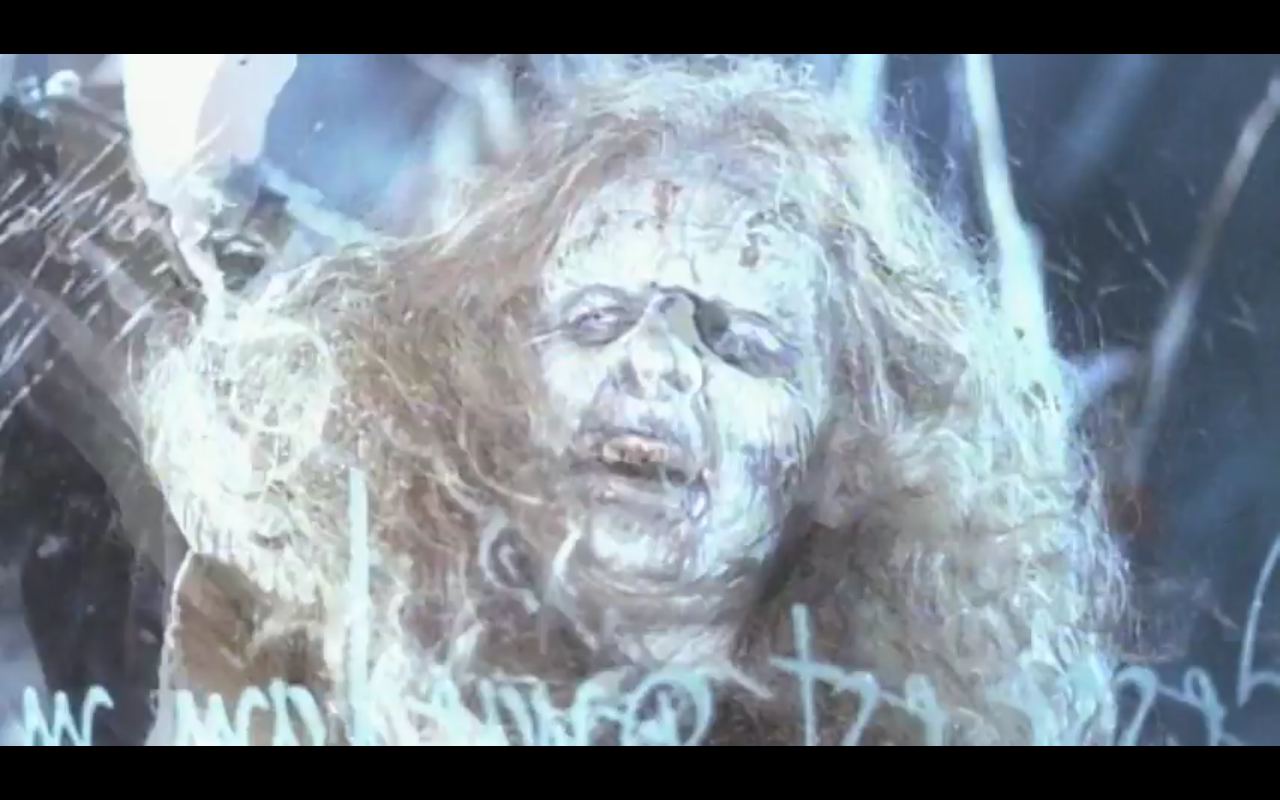
Don’t Lose Your Head in “The House of Lost Souls” on Blu-ray!

To Be EVIL, You Must Capture EVIL! “Thir13en Ghosts” reviewed! (Blu-ray / Scream Factory)

Screen shot 2020-07-24 at 9.53.06 PM
A maniacal and obsessed ghost hunter, Cyrus Kriticos, traps 12 tormented and violent spirits with the help of an avaricious, but anguished psychic, Dennis Rafkin, but when trapping the last ghost, the worst of the worst, a barbaric mass murder in life and in death named Juggernaut, Cyrus is killed in the process. His death leads to the inheritance of a one-of-a-kind house to his widowed nephew, Arthur, and his two children who are barely scraping by after the unexpected fiery death of their beloved wife and mother. When they enter what seemingly feels like a godsend house, immaculately structured entirely out of glass and metal, they find themselves trapped inside after tripping a series of mechanism that turn the isolated and elegant abode into a labyrinthic machine. Stuck inside with Arthur and his family are Dennis Rafkin and a ghost friendly liberator, Kalina Oretiza, who explain that the house is actually an evil machine with a goal of opening the eye to Hell and that the ghosts, imprisoned in the basement, are components that are being set free one-by-one in order to fulfill the ritual.
Screen shot 2020-07-24 at 9.52.18 PM
In the world of remakes, only a select few ever surpass the original. In fact, on rare occasions, do remakes actually replace the original due in part to being beyond respectful as well as masterful amongst critics and genre fans that have bestowed the reimagining an untouchable rendition to which no one can find anything wrong with it; this films include John Carpenter’s “The Thing,” David Cronenberg’s “The Fly,” and Chuck Russell’s “The Blob,” with Zack Synder’s “Dawn of the Dead” and Tom Savini’s “Night of the Living Dead” receiving well-deserved honorable mentions, because let’s face it, topping George Romero’s original work can be said to be blasphemous slander. What about those remakes in between? Those just above the pile of awfulness that generally makeup remakes? I consider Steve Beck’s “Thir13en Ghosts” to be one of this mid-level remake films that registers well with fans, but on the flips side of that coin, doesn’t ascend to total prominence over its predecessor. Written by longtime Full Moon Entertainment writer Neal Marshall Stevens (“Hideous!” and “The Killer Eye”) and Richard D’Ovidio (“The Call”), “Thir13en Ghosts” is a 2001 near-total rework of the 1960 William Castle directed and Robb White scripted “13 Ghosts” that used gimmicks like 3D specter glasses to draw audiences into the theater. “Thir13en Ghosts” was the second film after another William Castle remake, “House on Haunted Hill,” of the newly formed, William Castle nod-to, Dark Castle Entertainment, a division of Joel Silver’s Silver Productions formed by Silver, Robert Zemeckis (“Back to the Future”), and Gilbert Adler (“Bordello of Blood”) that honed initially on producing stylishly modern takes on classic gothic horror, such as “Ghost Ship,” the remake of “House of Wax,” and “Orphan.” What came out of this collaboration between Steve Beck and Dark Castle Entertainment is a complete dismantling of the wood paneling and lament flooring story for a modern marvel to emerge of unique terror that hasn’t been duplicated since.
Screen shot 2020-07-24 at 9.52.11 PM
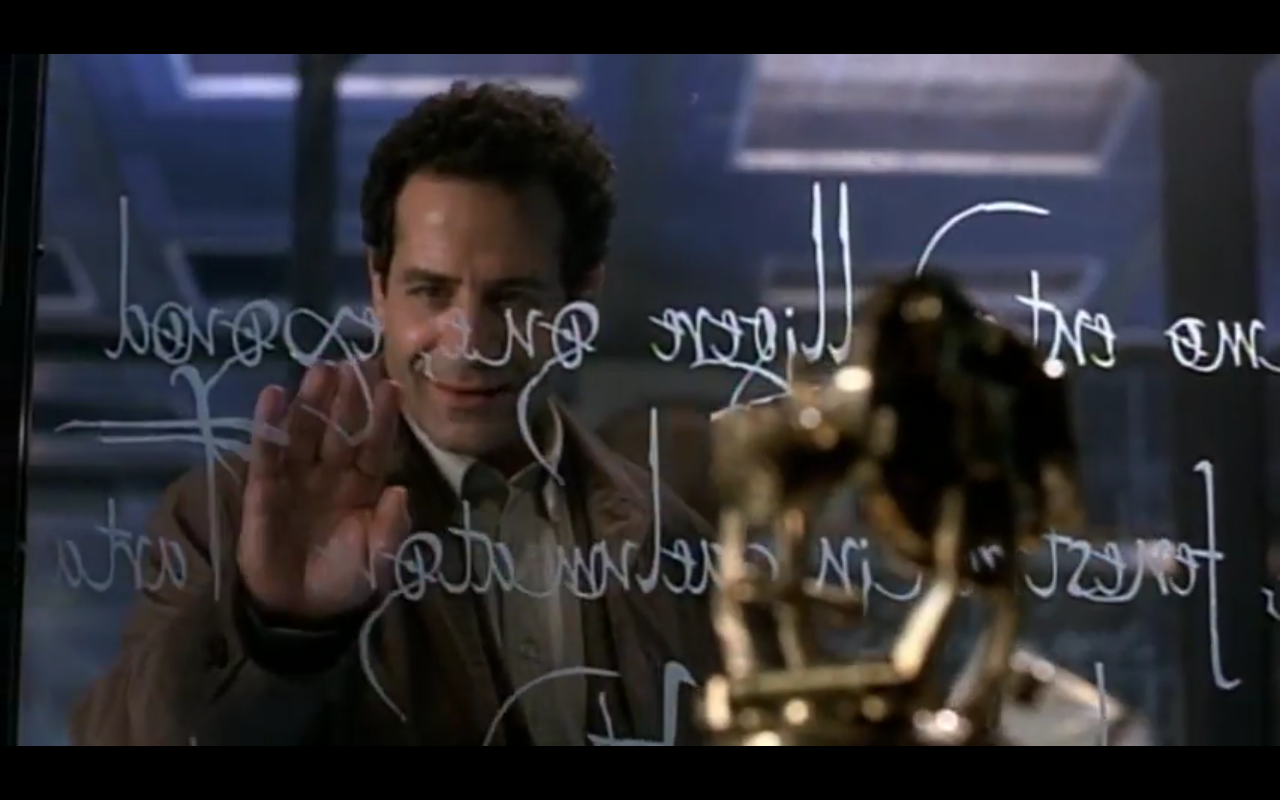
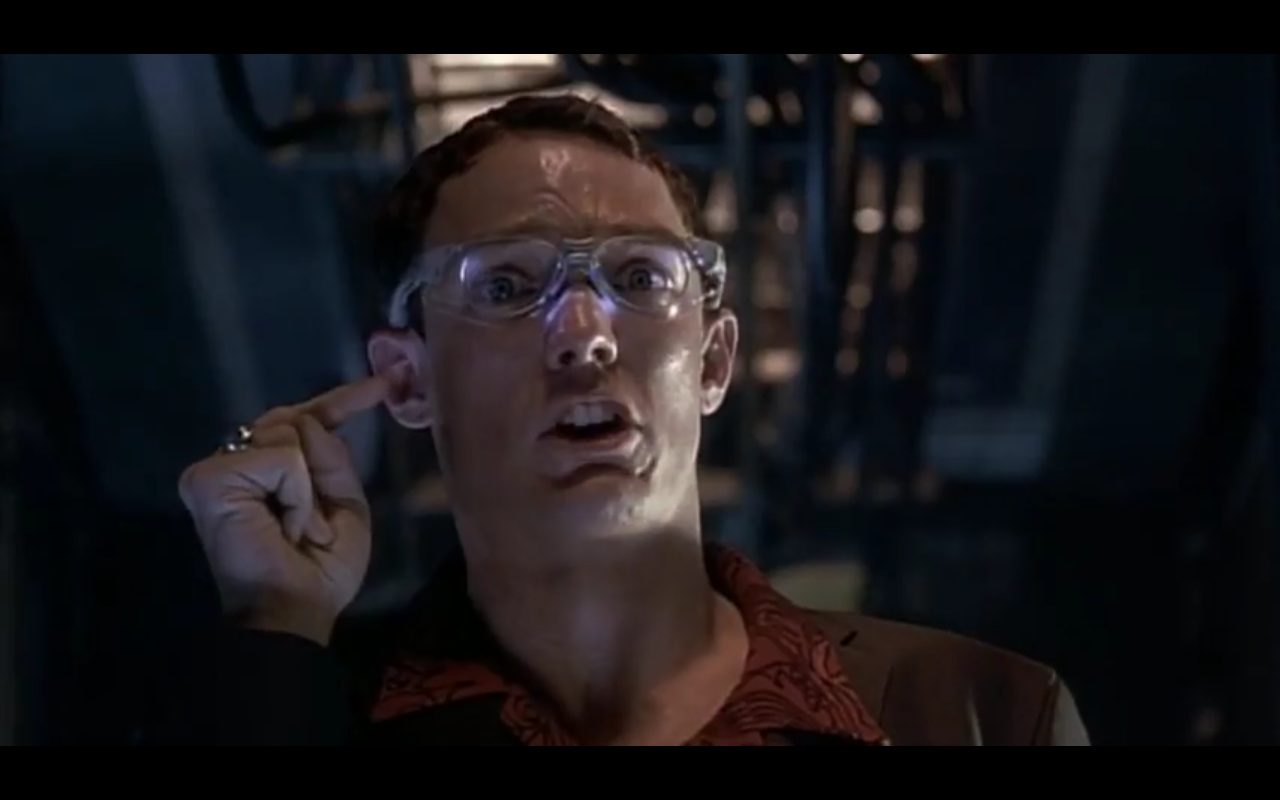
“Thir13en Ghosts” has an impressive, if not all-star, cast with diverse range of styles and experiences that it’s almost dumbfounding on how the filmmakers were able to contract some of these talents, including F. Murray Abraham, who has had an already eclectic credit list with “Amadeus,” “Surviving the Game,” and Mimic, and Tony Shalhoub who hand standout performances in “Addams Family Values,” “Men in Black,” and “Galaxy Quest.” Abraham and Shalhoub bring a sense of classical and methodological structure in a stark contrast between rationality and irrationality built upon an indifference of solitude and a sense of family. Then, there’s the comedic relief in the midst of danger, Matthew Lilliard (“Scream”) as the suffering psychic who uses his wit tongue to spur others and introducing hip-hop artist, Rah Digga, in one of her only motion picture performances to alleviate suspension with more tongue-and-cheek moments. Lilliard and Digga offer up two different comic styles while sustaining the underlying severity of being trapped inside an evil machine full of violent ghosts. Shannon Elizabeth, who we all know by now as the stunning “American Pie” girl, Nadia, or as I know her as the unfortunately raped and murder victim of a killer snowman in “Jack Frost,” plays Arthur Kriticos daughter, Kathy, who still a fresh faced newcomer to Hollywood despite being a hot commodity after her topless role in “American Pie.” The superb support roles don’t end there with notable roles from JR Bourne (“Ginger Snaps Back: The Beginning”), Matthew Harrison, Alec Roberts, John DeSantis, and EmBeth Davidtz, Sheila from “Army of Darkness,” as the ghost liberator.
Screen shot 2020-07-24 at 9.52.48 PM
It’s hard to believe that “Thir13en Ghosts” is nearly 20-years old. I still recall my 17 year old self sitting in for a theatrical showing, remembering the opening gargoyle growling as the Dark Castle Entertainment logo reveals itself during the opening title credits, and coming out of the maze-like, gory-ghost film having experienced something special, even if then I didn’t understand why, only to years later realize that I’ve never seen something like “Thir13en Ghosts” before in my life. How does a remake reinvent itself so much that it can separate itself from the original film while also beguile with fresh ideas and no take a slew of browbeating chirps from those who holdfast that the original is the one and only? Most remakes cheaply throw gore to the wind, adding buckets of blood in hopes to satisfy horror buffs, but what winds up happening is that we ultimately get bored, having experienced blood and guts from singular storied films. “Thir13n Ghosts’” premise isn’t the only worthwhile experience that deserves praise, but also the spectacular production design by Sean Hargraves that thrusts the glass house concept into new heights with the house actually becoming an interestingly steampunk character itself and the prosthetic effects from a team spearheaded by a trio of the best special makeup effects artists in horror today, such as Howard Berger, Robert Kurtzman, and Gregory Nicotero., turning ghoulish encounters to ghastly visions that convey truly a tormented soul in the 12 ghosts. Though the story itself isn’t perfect, flawed at times with static character development and a few plot holes involving the ghosts and sequences of events, “Thir13en Ghosts” remains a cult favorite gaslit by frightening imagery, a solid cast, and unforgetting production design that started 21st century horror off brazenly strong.
Screen shot 2020-07-24 at 9.52.36 PM
Collect all “Thir13en Ghosts” on the Collector’s Edition Blu-ray courtesy of Scream Factory sheathed in a cardboard slip cover and has a reverse artwork liner that has the original poster artwork and new vivid illustration by Joel Robinson. Presented in a 1080p, high definition widescreen, 1.85:1 aspect ratio, from the original 35mm negative, “Thir13en Ghosts” shares a consistent image and vibrancy layer with the DVD version with an enhanced color stability. No edge enhancement or cropping adjustments rendered or any other blemishes to speak of, but the softer details could have been sharpened to gave a hard edge around the non-spiritual energy. The English language DTS-HD Master Audio 5.1 boosts the already hefty soundtrack that’s full of explosions and ghostly swooshes and moaning hums, finished off with grand, orchestra soundtrack by John Frizzell It’s been said that audience had to excuse themselves from the film due in part to the overbearing noise coupled with the strobe-like imagery, but the overall audio and visuals are a combined one-two punch of sensory power that works well. The Scream Factory release has new interviews in the bonus material, including sit downs with actors Shannon Elizabeth, Matthew Harrison, and John DeSantis and producer Gilbert Adler. There’s also a audio commentary with director’s Steve Beck, production designer Sean Hargraves, and special effects artist Howard Berger. There’s also an in-depth look at the creation of the thirteen ghosts in a small featurette, their backstory profiles, and the theatrical trailer. However you want to call it, whether it’s “Thir13en Ghosts,” “Thirteen Ghosts, or “13 Ghosts,” this new century remake still holds up to today’s horror lot with spellbinding phantom pandemonium in a glass box!

“Thir13en Ghosts” on Blu-ray on Amazon.com

Jack’s Back for an Evil Good Time! “Razors: The Return of Jack the Ripper” review!


London’s infamous 19th century serial killer, Jack the Ripper, was never caught and the specialty knives he used to fillet his victims were never recovered, but in the darkly lit maze of an abandoned Victorian warehouse located in present day London, the spirit of the mysterious murderer of prostitutes lingers within the bricked up walls or so goes the urban legend. Six aspiring writers are invited to a screenwriters workshop at the Victorian warehouse for inspiration and orchestrating the event is an eccentric arts professor Richard Wise. The goal is write the most horrifying, potentially box-office busting horror story for a chance at penning a major movie deal. One of the six writers, Ruth, had received an enigmatic case full of old knives prior to her invitation, placing inspiration in her to write a terrifying script involving Jack the Ripper. When the knives go missing, the writers become trapped inside the warehouse as their involuntarily actions result in the return of Jack the Ripper to continue his unholy work of slaughter and the only way to stop him from carving his way into their ill-fated story is to solve the mystery of why they were specifically chosen to attend this particular workshop.

“Razors: The Return of Jack the Ripper” is the interesting first installment of a British horror movie franchise from writer-directors Ian Powell and Karl Ward. The co-filmmakers reach into the 19th century to bring Jack the Ripper into the present day, but Jack’s not the same; He’s a variant of him old self that involves the murderer being a pissed off malicious ghost in a concoctive tale that blends the modern-day remakes of “House on Haunted Hill” and “13 Ghosts” from near the turn of the century. Other than a physically present, if not more of a flickering presence, manifestation with a link to his prey of frightened writers, I won’t delve too much into details of Jack’s return and what he means to accomplish in hopes of not spoiling the story for you, but I have a sneaking suspicion that that won’t be a problem. The independent film attempts very little to bring the Victorian era swag into the fold. Even Jack the Ripper solely dons a dark wide brim hat and cape, that loosely associates him with the time period. Powell and Ward focus more on the group of bewildered writers and their conflicting dynamics on how they deal with their predicament – i.e. one character is very poignant on the dangers while one other brushes off superstitions and unnatural occurrences – but the pair of filmmakers fail to work the character Professor Wise into the mayhem and by not attributing purpose to the character, the professor inarguably becomes one of the many loose ends of a sunk horror franchise before it’s even set afloat.

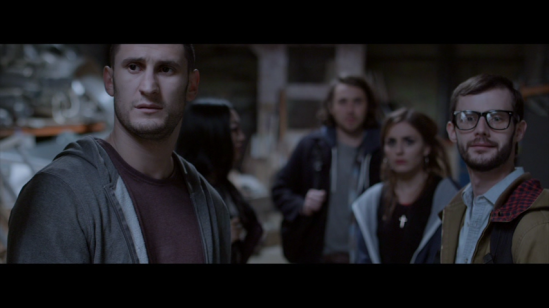
The 2016 film stars Kelby Keenan as Ruth, the only character to have any damn sense, but won’t just leave even though she repeatedly states how much danger their in. Kelby’s the lead actress with Josh Myers (“Zombie Diaries 2”), Georgia Mcguire, Kunjue Li (who oddly enough have a bit part on an unrelated Jack the Ripper television series entitled “Ripper Street”), Jack Brown, and Ian Weichardt (“Freak of Nature”) to round out the group of writers. Together, their plight doesn’t come across potently enough; instead, Thomas Thoroe’s Professor Richard Wise strew them through the warehouse corridors in an unbelievable performance of the professor not having a clue about the turmoil that’s afoot. Jack the Ripper goes virtually silent, much like a ghost should, under the unkempt performance of Andrew Shire. In short, the cast haphazardly walks through the storyboards, overkilling reactions and not reacting enough during called upon scenes to the relative cause of action.

So far, in this review, you might conclude that Powell’s and Ward’s inaugural franchise film may be a dud and not spawn sequels. Honestly, I personally would like to see closer for the open ended characters and story; however, I preferably would not like Powell and Karl in the director chairs. Their style could only be described as spastic with way too many edited in interjections of arbitrary spook house filler. The body of work has the sheer tenacity of being more like a 92-minute music video that’s abundantly chorused with haunted house ambiance. Literally, interlaced cuts made more than half the film, barely leaving any story for the actors, and the back-and-forth edits could crisscross your eyes into a strabismus.

Breaking Glass Pictures and Magic Mask Pictures Limited present “Razors: The Return of Jack the Ripper” on DVD home vide. Usually the pride of indie LGBTQ films, Breaking Glass Pictures has a fair share of horror as well and, typically, do right by the release. In this one particular, the DVD is presented in a widescreen 16:9 aspect ratio that’s very detailed. The color hues are a bit dull, more so grey, than hoped. The English language stereo dual channel stereo track had no part in being saved. Layers upon layers of unfinished audio snippets run rampart throughout to the point where you can pick out the flaws at will. Dialogue is wish-washy with the full power of the voice being reduced to no more than a mumble of hearing every other third word from every character. The DVD does come with some special features, such as clips and interviews in a segment entitled “Lights, Camera, Speed!,” “Behind the Walls” is a short featurette about the film, and you can also play the film with commentary from the directors and cast. The film is dedicated to the late Khan Bonfils, who had a minor part in the introduction, after his untimely death on a separate project. “Razors: The Return of Jack the Ripper” is clunky at best. Poor Jack couldn’t rise from the dead to reclaim his infamy in this ghost show of scatterbrained storytelling.

“Razors: The Return of Jack the Ripper” is available at Amazon.com!