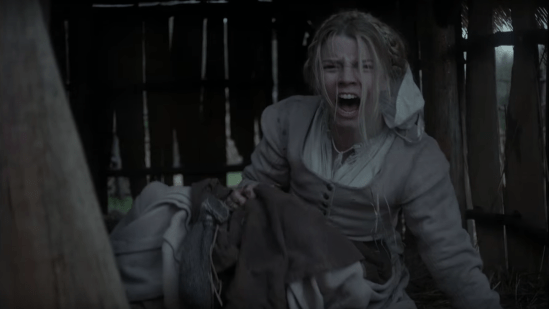
EVIL Says Talk to the Hand. “Talk to Me” reviewed! (Lionsgate / Blu-ray)

“Talk to Me” on Blu-ray/DVD/Digital!

The two-year anniversary of the death is a solemn time for Mia to mourn the hard loss of her beloved mother who took her own life, or at least that is what her father tells her.  Feeling uneasy by her father’s account that circulates doubt uncontrollably, Mia pries her way into her best friend Jade’s family for comfort and becomes equally amiably with Jade’s younger brother, Riley, as like another sister.  When social acquaintances post viral videos of peers supposedly being possessed by an embalmed hand of a psychic for party games, Mia is eager to participate.  All is fun and games with the dead inhabiting and speaking through the hand holder for a limited time until Riley’s spirt takes a violent turn, leaving the boy severely injured and in a comatose state after exhibiting Mia’s mother possessing him.  Obsessed to speak again with late mother, Mia uses the hand to talk to the dead and learns Riley’s soul is stuck on the other side and being tortured by the countless, malign spirits. 
Grief can be so powerfully self-destructive that holding an embalmed hand, becoming connected with the grotesque spirit, and letting the shadow world possess you can be addictive and even as far as a parlor game to pursue answers or a desperate release from suffering.  The 2022, breakout Australian production “Talk to Me” explores that forced hand of grief, literally, with a socially pressuring aspect that can be contagiously engrossing and collaterally harmful if unchecked.  The Southern Australian-born brothers Danny and Michael Philippou come out swinging on their debut feature-length film penned by Danny alongside Bill Hinzman based on a concept by “Bluey” executive producer of all people, Daley Pearson.  “Talk to Me” is a coproduction between The South Australian Corporation, Screen Australia, Head Gear Films, and Causeway Films with Christopher Seeto (“The Flood”), Samantha Jennings (“Cargo”), and Kristina Ceyton (“The Babadook”) producing.  The film is released theatrically by A24.
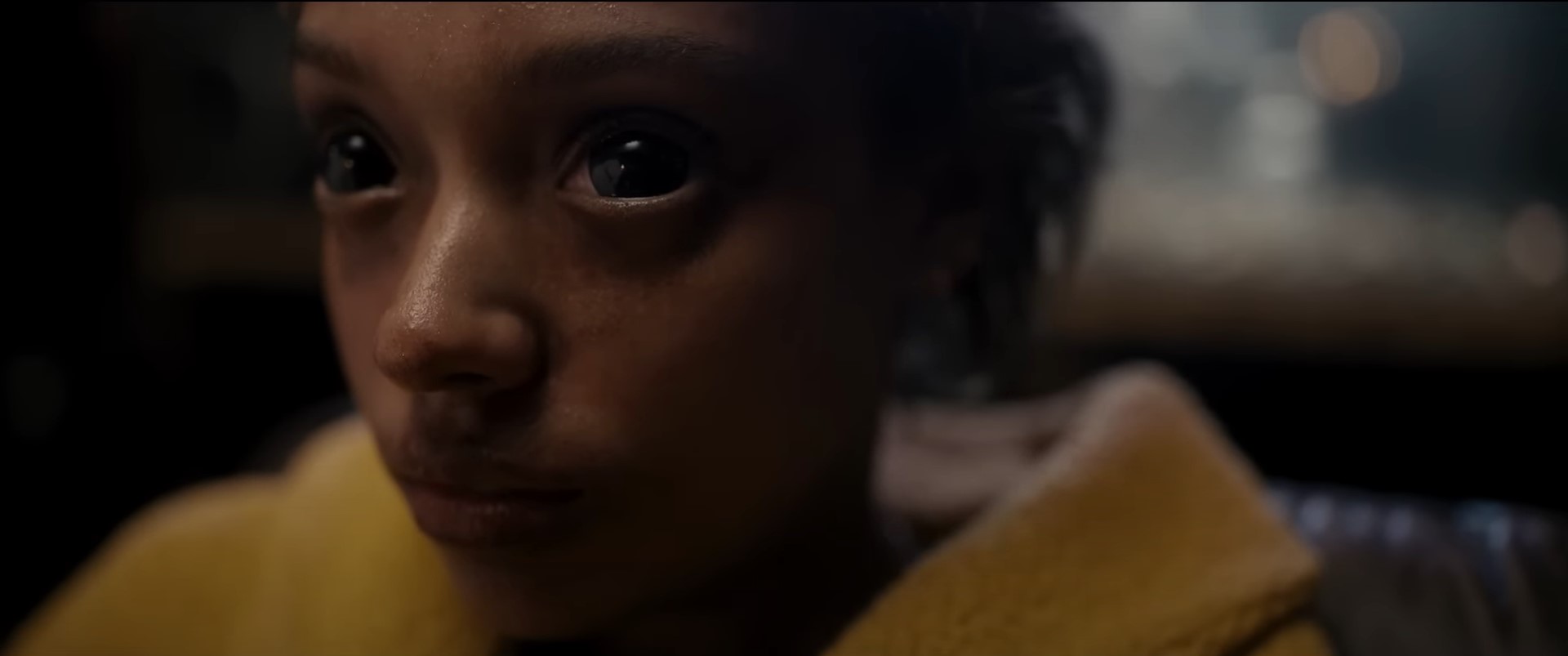
“Talk to Me” opening with a young, shoulder length haired man desperately searching for his younger brother through a sea of people at a house party.  The scene sets the film’s take-no-prisoners tone with begins with compassion as the older brother comes to the rescue of his disturbed, shirtless kin, trying to display the flashlight gleaming phone camera sharks who smell viral video blood in the water, when in a surprising turn of events the younger brother stabs his sibling before ramming the chef knife into his own skull.  “Talk to Me” segues into the cast of teenage characters, spanning the age spectrum of 14 to 20, letting us know right off the bat that youths are on the chopping block and no one will be safe.  The mostly untried cast pulls through with a trypanosome performance that gets under your skin, festering in its linger.  Sophie Wilde helms being the principal lead Mia still shell shocked by the sudden death of her twinning mother two years after later.  Suspicious of her father’s role in the death, Mia escapes and integrates herself into best friend Jade’s family, a role resting in between two uncomfortable rocks of being the new girl beside Mia’s onetime ex.  Alexandra Jensen as Jade floats carefully portraying Mia’s friend and a pursuant tiptoe toward the relationship with Daniel (Otis Dhanji) that passively irks Mia in the form of playful jokes, side glares, and inner demons becoming fruition ones expressing desires.  Sophie Wilde, on the other hand, spans the gamut with a flip of a switch soul spectrum polarized by spirit madness, grief over loss, and a fallback friendship.  When Wilde turns on the darkest light of possession, when her character lets the spirit into her body, the disheveled whole of Mia lives up to the actress’s surname becoming an uninhibited periapt for the spirit within that lusts over the youngest in the room, Riley (Joe Bird), for his childlike purity and when the spirits have control of over his soul in what is an orgasmic suffering that neither is parlous fun or exciting.  “Talk to Me’s” cast rounds out with Zoe Terakes, Chris Alosio, Marcus Johnson, Alexandria Steffensen, Ari McCarthy, and “Homeland’s” Miranda Otto. 
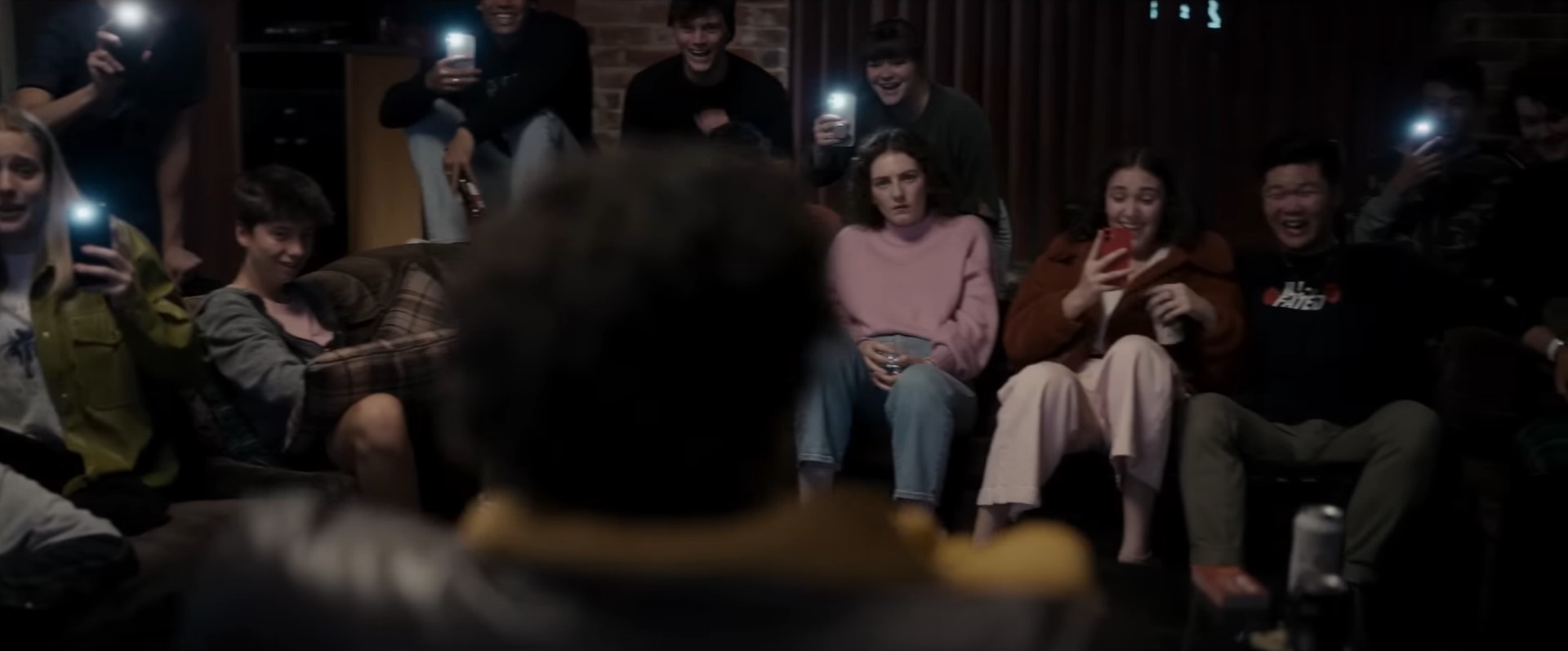
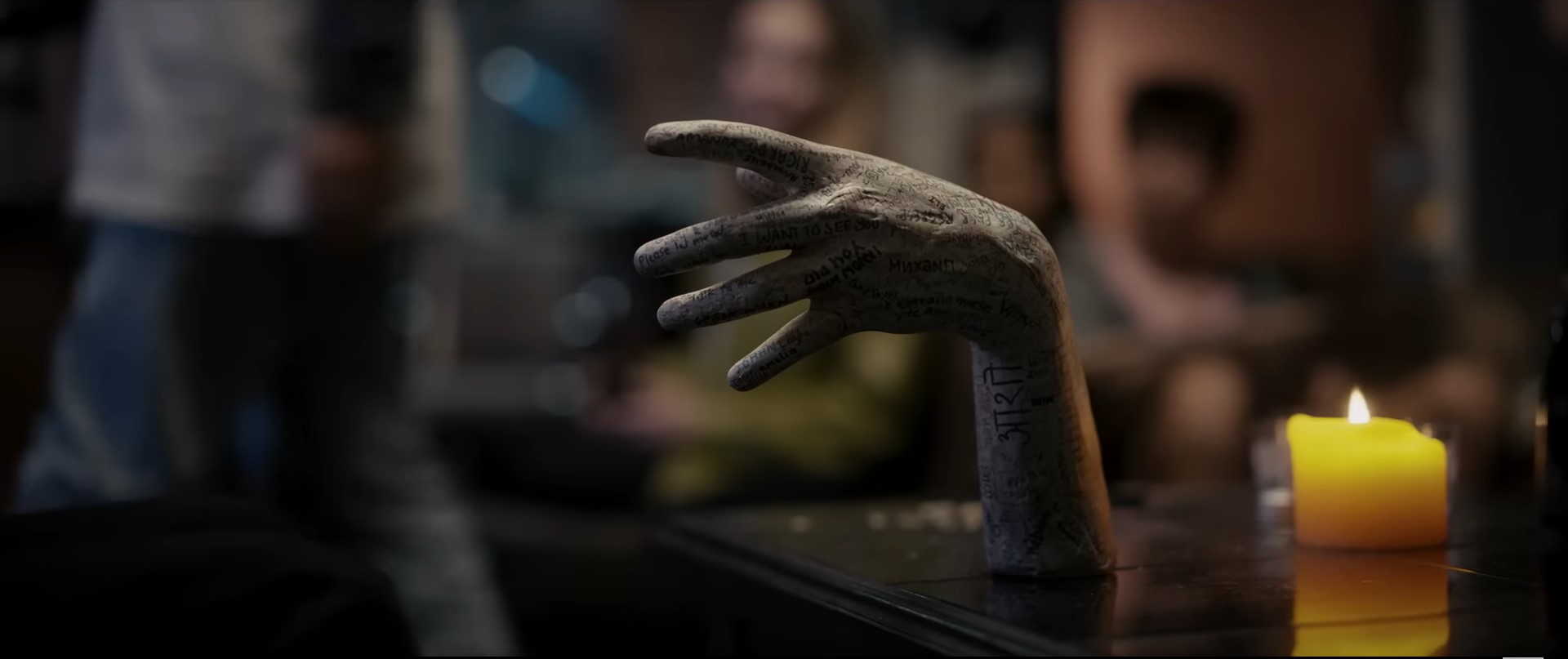
“Talk to Me” is an original byproduct stemmed from the cursed fetish genre.  The inexplicable mummified hand with unknown origins, thought to be once the hand of a medium, falls into the hands of a difference kind of representation.  Not to be bestowed conventional tropes like an inanimate object to be feared, the mirror in “Oculus” comes to mind or the cenobite unleashing puzzle box of “Hellraiser,” the persevered curled open hand doesn’t hold that sort of malevolent power, at first.  Despite its powerful connection to the purgatorial other side with frightening results of classic possession cases – levitation, catatonia, dissociative profanity and behavior, etc. –  these more-or-less new generational children treat something they don’t completely understand, such as ancient, mystical artifacts and in this case, human remains to be exact, without respect and humility, using the hand as if an additive drug, parlor game, or write to go viral amongst peers.  Directors Danny and Michael Philippou use the peer-pressuring viral video social commentary of their film as a sensationalized stern warning that has equal cause-and-effect results.  Ostentatiously showcasing more of the adolescent revelry spree rather than the mangled, decaying, and water-bloated entities in front of them or recklessly inhabiting their bodies once let corporeally inside.  For someone like the character Mia who continues to process close loss and has troubling thoughts, or maybe even delusions, regarding her father’s role in her mother’s untimely demise, she yearns for answers and when Mia receives a glimpse into what she believes is her kindred spirit mother through the vessel that is her friend Riely, aching impulses take over already crumbling judgements and she goes down the rabbit hole despite the consequences to herself, to her father, and to her adopted family.
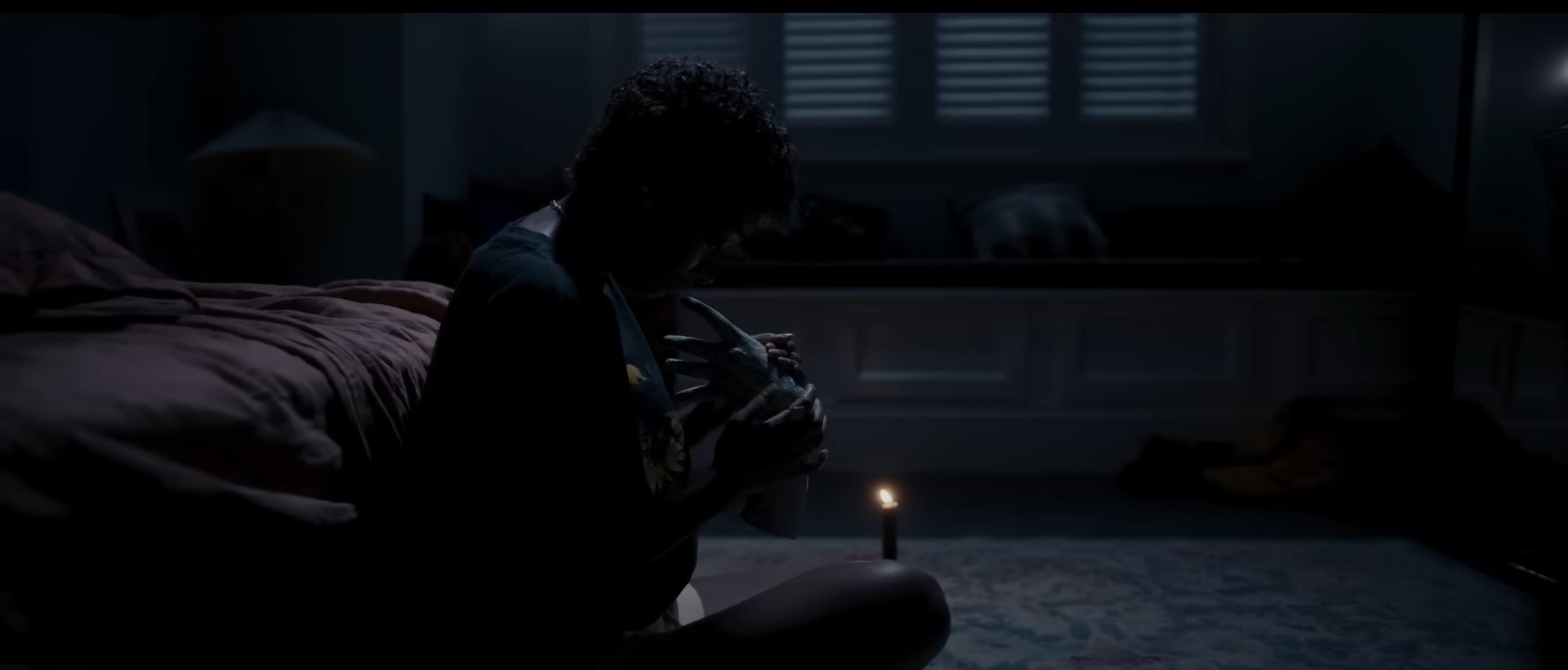
Get a grip and take “Talk to Me’s” hand to experience the possessively powerful Philippou brothers’ debut film on a Lionsgate 2-disc Blu-ray/DVD/Digital release.  The AVC encoded, 1080p high-definition, BD50 and the MPEG-2 encoded, upscaled standard definition, DVD are presented in a 2.39:1 widescreen aspect ratio.  What’s achieved out of the Aaron McLisky’s through-the-looking-glass visual vignette is focus driven, claustrophobic, and engaging to be present of a reality teetering the line between two worlds.  Details inarguably shine, casting a great deal of deep shadows within the hard lighting to set the ominous tone.  Skin textures gleam within the light as well as coarse change with the vapid and pale makeup adjustments of the dead-entered body or even when we do brief see a condemned soul, the greatly applied contusions, decay, or bloating is reflected with great care from the infinite image detail.  The release has an English Dolby Atomos output reaching the difficult crevices of the inaudible dark holes and exposing them to immense carousal and haunting zeal that makes the experience more palpable. Dialogue renders nicely through albeit a heavy-handed score that relentlessly attempts to knock down the channel-leveled door and a strong Australian accent on most of the cast may sway those who don’t have a keen and distinct diverse ear away from the film or may find discerning a challenge to channel from beginning-to-end. While most of the camera’s frame stays in medium closeup to closeup, McLisky’s able to find depth where advantageous to bring a creep building dark cloud after Mia’s one minute over willing but felt forced possession participation. English SDH and Spanish subtitles are optionally available. Special features include an audio commentary with brothers Philippou, a featurette with the cast and crew in their experience and thoughts on the film, entitled In the Grip of Terror, deleted scenes, and theatrical trailer. Behind a rigid O-slipcover imaged with the centerpiece un-ensepulchered, plaster anoint, and sanskrit-esque-ladened hand upright and in the forefront with phone flashlights dully lit in the background. The typical Blu-ray snapper houses the same slipcover image slipped in between the plastic sheeting whilst the two discs are held on snapper locks on each side of the interior accompanied by an insert for the digital download. Both discs are pressed with the same font and coloring on in reverse with a baby blue stark against white. The 95-minute minute feature is region A locked and is rated R for strong bloody violence, some sexual material, and language. “Talk to Me” is utterly and terrifyingly fresh and freakish in more so with the naturality toward the touching and the facetious ways with an embalmed hand that’s a one-way personal radio to the dead as a means to be engaged in popular, peer-pressuring social activity and as something to prove with reckless naivety.

“Talk to Me” on Blu-ray/DVD/Digital!

It’s in Human Nature to be Evil. “It Comes At Night” review!


Set in an infectious diseased post-apocalypse world, Paul, his wife Sarah, and their son Travis have fortified themselves in a dense forested and isolated house to ride out the easily spreadable disease. Always prepared and ever suspicious, Paul expects everyone to follow a rigorous routine, following procedures in order to avoid becoming infected, but when a young family, seeking supplies and refuge, enters their lives and their home despite Paul’s hesitations. Paul’s family’s routine and order face disruption that opens themselves up to the ever present danger outside and inside their home.

“It Comes at Night” is an intense, heart-pounding mystery thriller set inside the close quartered confines of a desolate house where trust doesn’t come without auspicious interrogation and teeth clinching suspicion. Writer-director Trey Edward Shults’ sophomore feature has layers upon layers of underlying human nature undertones when people are put up against an unsurvivable situation inevitably with their backs against the wall, literally, when confronted to whether to implement the good will nature of their humanity or not, to take that risk to help others or to save their own skin, and to attempt to reconnect with other people or stay separate from the masses. Even the “it” in “It Comes at Night” isn’t as simple as one would first think. Most unfamiliar audiences would assume “it” is a snarling, brooding, oozing, and grotesque creature, or perhaps even a devilishly grinning clown, that comes around when the sun falls; instead, the “it” is an occurrence, an event sparking nightmares inside the human mind that formulates fear and a tall order of exemplary caution.

The Australian born Joel Edgerton (“The Thing” remake) stars as Paul, the father of the family he’s trying to protect at all costs. Edgerton perfectly pitches as a, supposed, American voice, since the story doesn’t exclaim a locality, but the assumption is the setting is nowhere, U.S.A, and plants a firm foot down as a rugged resident of wilderness survival accompanied by his wife Sarah played by Alien: Covenant’s Carmen Ejogo. Ejogo’s offering to her character gives Sarah a powerful will to do what’s necessary and to support Paul in his determination to protect their only son Travis (Kelvin Harrison Jr.). Edgerton, Ejogo, and Harrison opposite up well against the foreign element, another family with their performer genetic makeup of Christopher Abbott, Riley Keough, and Griffin Robert Faulkner as Will, Kim, and their just above toddling son, Andrew. Each actor embraces the role in their respective family and at first, the interactions are genuinely jovial, but then the uncomfortable thick tension evolves from the point of an extreme pivot into the folds of deception and fear.

Shults maintains an ominous atmosphere of overwhelming strain amongst the characters and “It Comes at Night” has a unique perspective set inside an already apocalyptic ravaged population despite the lack visual expositions. Yet, the finished project feels incomplete. Pacing is the biggest concern with the timing of events between the introduction of Will’s family and their destined downfall that results in a climax that’s so bellied-up in an sorely anti-climatic fashion that the notion of being cheated out of a more gut-punched ending pulls at the core of the cinematic soul. That’s not to say that the film has one, if not more, interpretations; in fact, Shults’ entire feature is or could be considered open for interpretation, with examples from the duly noted “red door” to the Travis’ child-like personality, and usually those types of heavily subtext films stick around more way after the credits roll, but also, in a slightly bittersweet cause and effect, leaves more of a foggy formulation of events during the unfolding of the story. Also, an aspect that didn’t help the cause was shying away from a powerful scenes that should have left an impact, but R-rated feature delivered no acute moments of remembrance and leaving much to the imagination with only the majority of the rating pie being flavored with tasteless language.

Lionsgate Entertainment presents the Animal Kingdom and A24 produced “It Comes at Night” on a 1080p resolution in an aspect ratio of 2.39:1. The imagery lavishes in a gritty, woodsy detail that organically defines the sea of trees and natural flesh tones, but as the title suggests, most scenes are shot at night that are moderately blanketed, yet ineffectively intrusive, in digital noise. The English DTS-HD Master Audio 5.1 mix definitely has more girth during the livid nightmares and vigorously tense scenes, but, surprisingly, the dialogue track lacks gusto in the wake of a more lively surround quality. During exchanges of hushed tones, dialogue is rendered nearly inaudible and the option English subtitles had to be deployed. Spanish subtitles are also available. Special features include an audio commentary by writer-director Trey Edward Shults and actor Kelvin Williams Jr and a cast and crew discourse in a segment entitled “Human Nature: Creating ‘It Comes at Night.'” Overall, the psychological and humanity breakdown of the characters of “It Comes at Night” is worth the price of admission along with the teachings that family is key and to never rely on the goodwill of strangers, but finishes with a weak sense of direction that ruptures an unsavory cyst that doesn’t conclude coherently.

Own It Comes at Night on Blu-ray!

Hither Cometh Evil! “The Witch” review!

Screen shot 2016-05-17 at 6.43.26 PM
Set a few years after the 1620 arrival of the Mayflower ship, a faith-entrenched Puritan family becomes ostracized by a tightly knit plantation community and leave their home to settle near a woodland landscape. The family of seven build upon their quaint home, growing crops for food and for trade, but when the youngest child, an infant, disappears into the depths of the dark woods, the family slowly starts to unravel at the inexplicableness of their loss. The once tranquil and beauty of the woods dreadfully alter into a coven for dark and fear inducing figures that root themselves between the family binds, untying their sanity and faith that once held them close and separating them toward a Godless path of destructive witchery.

Writer-director Robert Eggers’s “The Witch” steps into a time machine and travels back in time to the New World era and delivers an American Folklore horror film that’s honestly genuine and deeply haunting. Eggers constructs a mood and tone stripped of comfortable commodities from the moment the family takes on the New World for the very first time away from the plantation. The isolation is immense, the tension is thick, and the cast and crew dynamic squeezes tight around the heart, ripping out every raw emotion and turning the display into a gut-wrenching performance. Eggers had done the appropriate leg work by researching various diaries, folklore tales, and recorded accounts of the time to achieve elaborate detail; even the dialect is true to the period.
Screen shot 2016-05-17 at 6.40.47 PM
The film’s devil worshipping namesake ghastly conjures a simple, yet legendary form. Without the use of glossy special effects, “The Witch” mesmerizes with practical makeup, slight of hand editing, and implied black enchantment while pulling at our internal sinful desires of the flesh, lust and deceit. Eggers kept the mainly nude Bathsheba Garnett in the shadows to give the menacing Witch a closing-in threatening appeal that corners an easy prey, such as children. The Witch’s power, a contractual perk with the devil, is vast and unholy that becomes a fierce antagonist to the family’s unnerving, yet powerless faith.
Screen shot 2016-05-17 at 6.42.02 PM
Eggers and his team uses a sepia visual to devoid much of the color as possible from a naturally bleak mid-17th century community style that’s more binary and cramped, setting the stage for doom and gloom. To continue with the adverse affect, an everlasting current of formidable abstracts are implemented for uneasiness. These signs of inauspiciousness can be as obvious as Ralph Ineson’s sonorous voice as the family’s patriarch and resonating religious leader William or can be as opaque as their corn crop turning suddenly rotten or the reoccurrence of a toying hare and an unsteady, long-horned goat named “Black Phillip, who may or may not be the devil himself.
Screen shot 2016-05-17 at 6.43.01 PM
In the midst of the family being torn apart, the eldest daughter Thomasin (Anya Taylor-Joy) desperately tries to keep her family together, but with her mother Katherine (Kim Dickie) in severe grief after the loss of her newborn son, Thomasin absorbs the blame and disdain from her mother. Thomasin’s abuse doesn’t end with her mother, which the story mainly touches upon with each of Thomasin’s parents and siblings, in one way or another, demeaning her. The oldest brother Caleb (Harvey Scrimshaw) under the spell of hormones repeatedly stares at his sister’s chest, lusting after the female form. Thomasin’s sibling twins Mercy and Jonas remorselessly believe her and label her a witch from the time of Samuel’s disappearance. Even her father, who stood up for her honor and her dignity when neither her mother or siblings would, eventually broke with a misguided view of trust. Thomasin’s world of faith, family, and, basically, everything she once believed in has been stripped away and without that barrier of ideals, a contract with the devil tempts her weakened will.

Lionsgate home distribution releases the horror sub-genre reviving “The Witch” on DVD and Blu-ray. This review covers the Blu-ray release that consists of a MPEG-4 AVC encoded disc that delivers a stunning high definition 1080p picture in a rare 1.66:1 original aspect ratio. The intentional reddish-brown coloring properly dates the era the film is set and the picture is detailed to display the grit, the dirt, and the muck that further enhances the foreboding of calamity. The DTS-HD Master Audio 5.1 is crisp and clear, favoring more on the shocking and slightly experimental soundtrack, but still manages to place the dialogue in the forefront, steering clear from the cacophony. Still, I found the dialogue hard to follow because of the puritanical dialect of that time. Bonus features include an audio commentary with director Robert Eggers, the featurette “The Witch: A Primal Folklore,” Salem Panel Q&A, and a design gallery.
TheWitch_BD_3DSkew
Folklore horror hasn’t died just yet. In fact, the sense of a witchcraft resurrection is on the horizon, possessing now a new high profile inside the horror community that’s sure to pick up steam. Newcomer Robert Eggers puts new life into gothic, despondent horror with contrast characters living in a stark reality. “The Witch” will launch Eggers into horror orbit and keep Lionsgate as a friend to the genre.