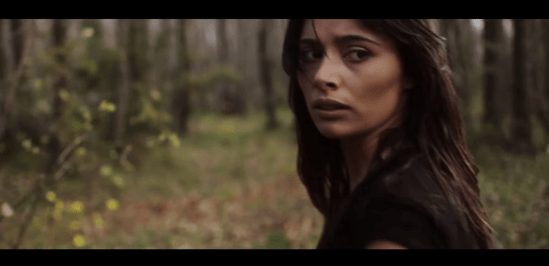
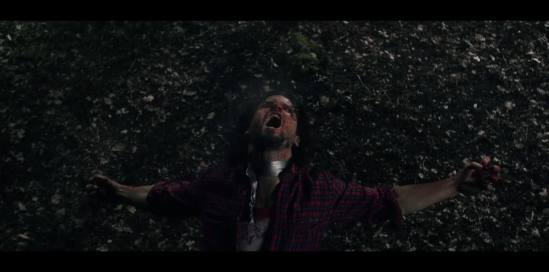
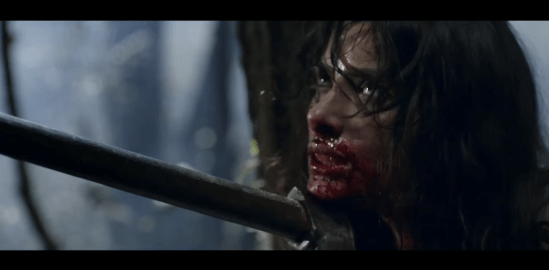
Seeking the luxuries of peace and quiet in order to fulfill the work of an important academic theory, a young student rents out the basement of an old bunker converted into a family home. Surrounded by the solitude of snow and trees, the bunker is the perfect place for the student to concentrate on his work. Until the couple renting the bunker basement decides the student must continue the unorthodox home-schooling of their eight-year-old son to put him on the path of becoming the President of the United States. The student becomes mixed up in a peculiar family’s ambitious affair twisted far from normalcy and teetering on the borderline on insanity.

“Der Bunker” is the first feature film from writer-director Nikias Chryssos and Chryssos delivers an artistically abstract film about the modernistic conventional ways of growing up through childhood told through an obsolete perspective. Produced in Germany, the film makes light of how parents raise and shelter their children, especially their sole child. The home setting is literally a bunker, a fallout shelter from the age of war. “Der Bunker” particularly points out the American child raising culture with Klaus, the eight-year-old son of mother and father, going through semi-strict tutoring of memorizing the every nation’s capitals in efforts of becoming, one day, the President of the United States. Chryssos overkills the symbolism column with continuously displaying the staleness of a stuck-in-routine in over-parenting from the outdated 1950’s style of the clothes and retrofitted bunker to the eight-year-old Klaus being depicted by a 30-something actor Daniel Fripan.

Fripan is one of four cast members to star in Chryssos film and the only actor portraying a named character with Klaus, leaving all others generically labeled with father, mother, and the student; however, Klaus and the Student are essentially the same person, a dual presence who start off polar opposites that are trapped inside the bunker and looking to break free from it’s buried confines when their individual identities begin to blur. Fripan’s key to “Der Bunker” working conceptually as the ‘man-child’ with Fripan’s attributed short stature, innocently mature face, and a well-performed immature persona that solidifies the Klaus role as nothing more than child forced to grow externally, but not internally. Pit Bukowski’s more of an automaton when we first meet him wondering through the snowy terrain in search of the bunker. His Student character starts to dwindle as he literally becomes a fixture of the bunker as Klaus starts to shine and thrive in not only his studies but in his maturity, confronting his Mother’s will. Bukowski’s internal switch goes dynamically well with Fripan even though their physical façades remains intact. Mother and Father are portrayed by Oona von Maydell, daughter of “Das Boot’s” Claude-Oliver Rudolph, and David Scheller and both compliment each other by donning an opposite reversal of roles where Mother is the stern, firm hand of the family and Father stays home to clean and be a teacher for Klaus.

Chryssos’ telling of the family and the Student’s psychosexual relationship between the story’s bookends goes above and beyond the Oedipus complex. Oona von Maydell’s Mother has a power fastening all the male characters in an intriguing way despite her minor, yet undesirable, physical deformity plaguing as a patch on her right leg and also despite that her rational stemming from a grave voice, connected to her deformity, comes from beyond their world. As if destined to play the part, Maydell acts the lead as the family’s matriarch while also being subtly coy and provocative to bluntly upfront about her sexuality as a means of control; Maydell seemed very comfortable with her onscreen upper torso nudity in some awkward and uncomfortable scenes. Her onscreen husband, David Scheller, deems himself an academic, an educated man with knowledge more vast than that of the outside world because of this thirst for literature. Yet, Scheller plays a scattered Father whose torn between being a literal mentor, the punisher, and the glue to keep the bunker from being engulfed by giving into Mother’s symbiotic celestial being. Father copes with heavy medication that literally warps his mind when he can’t seem to control everything from the Student’s appetite to his convincing of the Student to take on the tutoring role for Klaus, even if it’s not plainly displayed. Scheller does a remarkable performance breaking down his character to a crumbling lame duck.
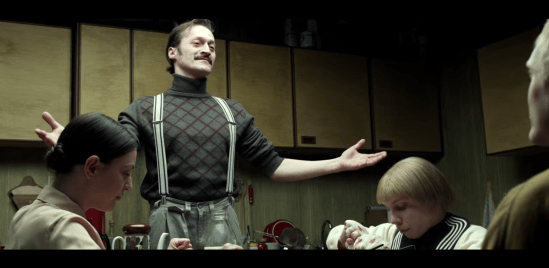
“Der Bunker” and the bizarre go hand-in-hand. Only a unique mindset with skewed vision could have pulled together such a twisted dark comedy tale of the mortal coil in holding your children to your hopes and dreams for them. Colorfully unapologetic, “Der Bunker” canisters another world sluggishly revolving through multiple levels of layers of psychosexual and frustrating concepts that flaunts a conventional cinema defiance attitude to establish bold filmmaking possibilities. In short, director Nikias Chryssos shoots high and doesn’t miss with his first run. The Artsploitation Blu-ray release features a vividly clear anamorphic widescreen 2.35:1 presentation of the Kataskop Film Production. Audio options include a Dolby Digital German 5.1 Surround sound with very detailed optional English subtitles. An abundant of bonus material is hard to pass up, especially with a director’s commentary and deleted scenes that expand more about the character’s traits and backgrounds. Rounding the extras are outtakes and trailers from Artsploitation film arsenal. This Blu-ray release is meticulously thought out to deliver a high caliber video and sound quality for such as odd German film concerning one youngish boy’s progressional path of self-reliance from a sheltered life style.
Tag Archives: Artsploitation Films
A Romantic Getaway Turns Evil! “The Perfect Husband” review!

Nicola and Viola attempt to escape their dismal past involving losing their child at birth, traveling to an isolated cabin in the woods to rekindle and reconcile their bitter relationship. Once there, Viola feels a menacing presence lurking amongst the trees ever since arriving. As the strain on their past and present union becomes nearly too much to bare, tensions overflow with jealously and bewilderment that turn the delicate situation into an explosion of violent behavior. A cat and mouse game of carnage and death follows the couple through the dark woods toward a bizarre and psychological ending that reveals the true nature of their disturbing affliction.

Director Lucas Pavetto’s “The Perfect Husband” is an Italian psychological horror film from 2014 starring “Nightmare Code’s” Bret Roberts and Gabriella Wright and based off Pavetto’s short film of the same title. Even though “The Perfect Husband” is an Italian birthed film from Italian production company DEA Films, “Il Marito Perfecto,” the Italian title of “The Perfect Husband, has a crew, aside from Pavetto hailing from Argentina, that maintains the country’s native ethnicity. London born Gabriella Wright, who masks her English accent very well, co-stars alongside the Alaskan-American Bret Roberts; both actors could certainly pass having Italian heritage with their olive skin tone and dark features elsewhere and with filming location set in Catania, Sicily, the actors fit right amongst the rugged and mountainous Sicilian landscape. Roberts has a low-raspy articulation that makes him seem always out of breath that transitions beyond the catalyst, but Roberts plays villainy insanely well. Wright maintains a cryptic temperament from start to near finish. However, the duo’s dynamic is quirky at best as the couple treat themselves more a boyfriend and girlfriend than husband and wife, which might be a product of the writing.

Lucas Pavetto and Massimo Vavassori go fairly formulaic with their script, writing about strife-stricken couple working out their marital issues alone in a remote cabin surrounded by a dense forest. The setup screams horror premise clockwork and attempts to shift gears after lengthy character development that takes some time to build into something concrete, or at least halfway tangible. The shift in disposition is, however, so rapid and so sudden with unwarranted ferocity, that the effect goes from a scale of a tense filled two to a run-for-your-life ten in a matter of microseconds. The series of events portray Bret Robert’s character Nicola as a jealous misogynistic ready to snap at any given moment while Viola’s mysteriousness and her unconscious readiness to break with reality puts an undisclosed strain on her psyche that what she experiences may or may not be real. A twist ending tries to fill in the Nicola and Viola omissions, but misses the mark that still leaves gaps here and there, especially conveying more about the events that took place at the refugee station between Viola and the Ranger, played by “Apocalypse Z’s” Carl Wharton. Perspective becomes surreal; a fantastic journey that terminates toward a twisted unveiling, leaves more questions than answers about Viola and Nicola prior to their weekend getaway.

Plausibility. Probably “The Perfect Husband’s” fiercest enemy as the story tries to turn itself upside to throw the audience for a loop. The disillusion feels cheaply thrown together to try and wrap up, what could have been, a thoughtful psychological thriller and that’s where plausibility doesn’t formulate, frustratingly feeling like an square box with only three sides and a gap left carelessly open. I wanted to like “The Perfect Husband” because I thought the mayhem was present at the beginning moment of the snowball effect. Everything went down, fast and furious style, with unforgiving brutality that was surprisingly gory at times.

“The Perfect Husband” has been honored an unrated Blu-ray release in a 1030p transfer presented in a 2.35:1 aspect ratio from the ever bold Artsploitation Films. The video has a slight grayscale imbalance that contrasts scenes a bit heavily, but other than that minor issue, the image looks solid. The English 5.1 surround with optional English subtitles is also solid with a balancing the appropriate tracks. Bonus features include a behind the scenes segment that exhibits the takes of scenes in and outside of the cabin. The original short “Il Marito Perfecto” is included along with trailers for upcoming films from Artsploitation Films. Turns out “The Perfect Husband” wasn’t perfect, but raw, exploitive barbarity is a must see for any violent hound in need of a good scratch.
An Ageless Evil Takeover! “Children of the Night” review!

Alicia, a reporter working tirelessly on reports of missing children, receives a letter from Erda of Limbo, a haven for unwanted children located in an isolated area of Argentina. When Alicia arrives, she can’t shake strange inklings that the children’s faces seem familiar to her. Come to find out, all the children are vampires, created shamelessly by adult vampires, and now some of the vampires, some elder in age who are stuck in the body in which they were turned, live under the care of their human caretaker Erda. However, the children are not safe as vampire hunters have assembled around their serene community, lying and waiting to drive a stake into each of the timeless vampires. Their survival depends on Erda, Alicia’s reporting, and the 90-year-old grandson of Dracula himself. Though the community of vampires seek to reap the world of mortals as they have an apocalyptic plan to put in motion.
“Children of the Night,” also known under the original title “Limbo,” is written and directed by Ivan Noel and under the thumb of numerous Argentinian producers and actors, the mythology of Dracula lives yet again on screen. The film uniquely puts a different spin on the old Prince of Darkness tale, creating a jutting story that surrounds a scenario with Dracula’s bloodline kin. While the idea touches on the rarity of vampire children, contrasting with “Interview with the Vampire” or more recently “Let The Right One In”, there arguably lies missing pieces to Noel’s film to properly complete a story of this size and, perhaps, the microbudget hindered and faltered under financial stress rather than just becoming a medium of storytelling. For instance, much of the background on Erda’s writing to Alicia’s to travel to Limbo isn’t necessarily forthright and that feels neglected not on purpose, but rather feels neglected absentmindedly and financially.

Secondly, the children characters vary in age and the girth of their long lives should have been explored more to develop more meaningful characters. Noel’s version bypasses many valuable characters and their traits to make the children of the night more likable, or hated, or something, because in Noel’s version, the children could live or die and not an emotion would be concerned. Noel does bring a certain enigma to children’s position in the world as we’re not totally convinced their evil or well-intentioned. Children caregivers are similarly forgotten when regarding their attributes. Alicia’s and Erda’s hemophilia condition is suppose to echo the children somehow, but the idea barely misses the cutting room floor completely and is only mentioned briefly upon Erda’s and Alicia’s initial meeting.

The specials effects are minor, but effectively garnered. The majority of the effects shine through the second and third acts, especially during the all out bloody vampire hunter and children vampire brawl in an open field where children will be children and play with their food before slicing and sinking their teeth right into the necks in a blood splattering type fashion. I also thought the wooden stake on a rotating drill was a fascinating, if not very phallic. Along with this gruesome play yard greet and eat, comedy is sprinkled in throughout the duration, but some of the material falls flat; the comedy feels dated or obsolete, offering nothing new to that side of the genre. “Children of the Night”, simply put, is a vampire film with a feat of a concept, but the film lies at the fringe of being a horror-comedy that stirs up calamity with my critique about Ivan Noel’s semi-serious take on the Dracula mythology.
The performances are little to be desired for with the inclination that the actors, mostly involving the children, are being spoon fed dialogue or given cue cards, especially in more serious toned scenes. Dracula’s grandson The Count becomes the poor performance scapegoat. Child actor Lauro Vernon portrays The Count and his naturally sculpted ominous almond shaped and gloomy eyes, protruding upper lip, bronze skin, and lanky thin features creates a stereotypical creepy child archetype, but Vauro’s attempt to execute a Dracula-esque character, waning the powers of Dracula, is less expressive and more passive in deliverance. The Count in the script is powerful; one who oversees the children as a protector and a worthy warrior against a vast superior, well armed vampire hunting band of men, but instead the character weakly wanders from scene-to-scene even when his flock is being picked off and staked one-by-one.

“Artsploitation Films” releases this 2014 Spanish-languaged Argentinian film on Blu-ray and DVD. The Blu-ry is presented in a widescreen 1.87:1 aspect ratio and looks fairly decent during daytime or lighted scenes with slightly noticeable ISO noise. However, with a film titled “Children of the Night,” night scenes more common and also reek more havoc on the quality as many of the night scenes maintain a blocky posterization with the digital film. Digital noise also plagues the digital film produced during low lit scenes, creating undefined shadows and blob-like shapes. Overall, “Children of the Night” has a fair share of budgetary quirks and flaws and the story loosely presents itself with an unclear and oddly edited lineage. Totally ignoring this release would be a mistake as producer, writer, and director Ivan Noel has fain under the limitations and manages to technically achieve a few great medium and long shots, though Noel seems to be attached to the closeup. Check out “Arsploitation Films” Blu-ray or DVD release of “Children of the Night” for another take on the mythology of Dracula!
Anybody and Everybody Can Be Evil! “The Summer House” review!

Markus lives the perfect life: a lucrative job in construction management, an adoring and faithful wife, and a beautiful and smart daughter about to tend a prominent English school. Yet, Marcus finds solace in a double life by living his true self as a bi-sexual man with a secret, younger male lover from one of his construction projects, leaving his wife frustrated and destructive in their foundering marriage. When Markus’s construction colleague Christopher finds himself being squeezed by the taxing agency, Marcus offers to help out a little. Christopher asks his 12-year-old son Johannes to be nice to and to spend time with Markus’s 11-year-old daughter Elisabeth in a show of good faith towards Markus’s good will. With Johannes around most of the time, Markus tries to keep grounded his uncontrollable desires for Johannes, but invites Johannes to Markus’s family’s summer house. Through the summer, Markus and Johannes form a relationship, but not everything is as it’s seems when hidden agendas and surprising outcomes could potentially destroy everyone involved.

An intense psychosexual, “The Summer House” zips straight out of Berlin from writer-director Curtis Burz who touches upon more taboo subject material than one might be able to withstand without feeling guilty, dirty, or rotten. Burz’s pen weaves through one man’s constant struggle between maintaining a barely afloat marriage to a wife he loves because of their daughter and his secretive bi-sexual life in an affair involving a much younger man. Burz also remarks on Markus’s wife Christine and her battle with near tragic depression; she’s complicit in Markus’s affair by allowing him, with only little resistance, to continue, yet Christine wants Markus to rediscover his love for her on his own. The pen continues to weave through the stories of the children, Johannes and Elisabeth. The very nature of a child feels exploited here in more ways than one, but the film’s end game takes an usual twist, one I can’t spill here without spoiling the finale fun. Burz continues to drop dark material presented and staged in a glowing-like and vividly colorful mise-en-scene throughout that would suggest happiness or perfection for all involved; however, the nagging, gloomy undertone remains behind the scenes and unseen and that’s the kind of sadistically gratifying contribution added by director Curtis Burz.

“The Summer House” is a socially controversial film without being overly in your face with it. Nothing is explicit with the subtleties being just enough to make your stomach feel uneasy and to make your jaw clench with anticipation. The scenes with Markus (the then 40-year-old Sten Jacobs) and Johannes (a certainly under 18-year-old Jasper Fuld) kept building the tension between them and Jacobs portrayed a creepy, over-anxious and over-persistent pedophile uncomfortably well whereas Fuld plays his part just as convincingly as a seemingly tolerable young boy who may or may not be curious about Markus’s intentions toward him. The vexation Christine discharges is all due in part, greatly toward, of the leading lady Anna Altmann’s performance. Altmann captures a wife in marriage limbo, looking to rekindle a broken family stuck in stalemate due to her husband’s mid-life sexual crisis while maintaining her daughter’s precociousness. Nina Splettstößer feeds off Atlmann’s motherly performance by portraying Elisabeth as quiet and intelligent, yet passive and conniving who sees her mother as someone who hates her because of how stringent her mother is toward her.

The story’s complex web becomes stickier and the spider draws even closer when Markus’s secret sleepovers become exposed, creating a twist ending not even M. Night Shyamalan could conjure up. However, the story behind Markus’s colleague Christopher and his wife Anne feels ignored and neglected. Aside from Christopher incidentally being the catalyst between Markus and Johannes, Christopher and Anne’s scenes seem unnecessary. One scene has the both adult couples seemingly in the early wine and dine stages of a swinger party, but once most of the kissing between Anne, Christopher and Christine is out of the way, the scene falls short with a quick cut to just Markus finishing off with his wife Christine with all their clothes still on. Christopher and Anne come and go in barely a handful of other scenes that don’t tie into much of the story and would have either been better if either explored further into their adventurous lifestyle to get a better understanding of Johannes or leave them out all together.

Overall, “The Summer House” is deserving of it’s numerous film festival awards and a solid release for not only Artsploitation Films, but also as a film that has been Berlin born even if the film released nearly 3 years ago. Certainly very relevant to today’s modern multi-societal problems including the dissolving of families, behavioral issues with not only pedophilia, but with depression, and to round out the pleasantries with scrofulous affairs. The Artsploitation Films, in a metaphorical broken and cracked pane glass over a solemn Markus family DVD cover, has a widescreen 1.85:1 ratio release with a German and English 2.0 audio track is accompanied with bonus features that include deleted scenes, cast and crew interviews, and a trailer; all content clocks in at around 195 minutes total – not bad all around for an independent feature.
Evil Gets Wild! “Cub” review!
A troop of cub scouts set out on a camping trip in the deep forests near an abandoned bus factory. At the helm are three scout masters overseeing a handful of lively young cub scouts. One of children, Sam, has been through a troubled and violent past and has been labeled the outcast amongst the rest of the troop. Sam encounters a feral young boy, who has been trained by a murderous psychopath whom has made the woods his deadly home. As nobody believes Sam’s run-in with the wild boy whose been stealing around camp, the troop hastily concludes that Sam is lying and stealing, resulting in the trop disliking him even more all the while setting up their fate for something far much worse: a killer camping trip.

Booby traps. Children vs. Children. Outside nude showering. An ingenious killer. Fun and newfangled horror has made it’s grand return since “The Collector!” Freshman director Jonas Govaerts, with a boat load of crowd funded money, has brought a keen eye to the campy, wooded survival genre with his independent film “Cub” aka “Welp” in the films original French/Flemish language. Going through the motions of setting up character development and moving the characters seamlessly into a ominous situation is what seems to come natural to director Govaerts. Unnaturally, Govaerts doesn’t explore the psychotic background of such an interesting, yet mysterious killer, leaving everything about the antagonist’s intentions to the imagination. This villain, only known as the “psychopathic mentor” on the Artsploitation Films Blu-ray back cover, maintains a dated, yet marathon technique killing spree operation underground in the dark woods, setting up crafty and deadly traps for those who embark on his land. There’s a little tidbit of setup on the killer from an officer explaining to the scout masters that the vacant nearby factory has made some previous employees disgruntled, making the land a cursed hotspot.

“Cub’s” success mainly stems from it’s actors. Gill Eeckelaert, who has only “Cub” credited under his name, phenomenally creates a superbly feral and masked boy, surviving on the land and in the trees. With a scrawny physique and zero dialogue, Eeckelaert has formed a eerily scary character, more so than the actual menacing mentor. In all honesty, the feral boy should have been the main antagonist pitted against the troop. This character’s counterpart, Sam, played by Maurice Luijten is the epitome of good, yet something is off with the character as told with seldom sharing of the information about his past, his foster parents, his damaged photograph, and the list goes on. While a clear picture of Sam never fully emerges until the finale, the good that bubbles up from his character couldn’t be any more prominent as he’s contrast next to the constant bully shadow of a scout master named Baloo and his mindless troop of followers, looking to be cool in the Baloo’s perverted and unorthodox eyes. With only a handful of ally accompaniments on this trip, those who wish Sam harm outweigh those who want to protect him.

With the “Lord of the Flies” similar attitude and with more than half your cast under the puberty requirement age, Govaerts ruthlessly places every single person in danger and places every single character on the chopping block. There’s no sugar-coated dancing around the innocent minors, making them actually part of the organic story instead of pussyfooting around them as if they’re made of fragile, non-tempered glass. However, I do feel the opportunity was completely wasted or missed to take out each individual character one-by-one with a signature death scene, but I don’t believe the effect of certain character or characters being dispatched watered down the “oh my god” value.

The Artsploitation Blu-ray has a beautiful 2.35:1 ratio, widescreen presentation with only very little aliasing detected and the night scenes just as clear as the day scenes. The 5.1 Dolby Digital mix flawlessly contributes to the overall impact of the story, creating a great balance between LFE and HFE, dialogue, soundtrack, and ambient tracks while providing accurate and well-timed English subtitles. The superb giallo-esque score by Steve Moore, who goes under the pseudo name of Gianni Rossi and worked on “Gutterballs”, delivers an intense, on the edge of your seat synth rendition of danger and chase. “Cub” director Jonas Govaerts and his crew earns their merit badges for constructing a bloody and innovative film. Another winning release for Artsploitation Films and another recommendation from this reviewer.