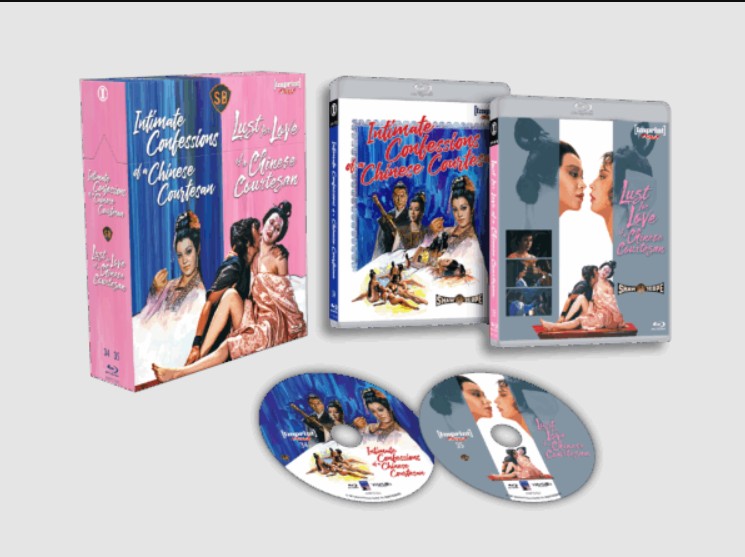
Ai Nu the Most Beautiful Woman to Capture the hearts of both Men and Women’s but EVIL Has Other Plans for Her. “Intimate Confessions of a Chinese Courtesan” and “Lust for Love of a Chinese Courtesan” reviewed! (Imprint Asia / Blu-ray)

Order the #34 and #35 of a “Chinese Courtesan” from Imprint Asia’s Boxset!

Taken against her will while living off the streets, Ai Nu’s kidnappers take her and other snatched girls to the Four Seasons Brothel where the once homeless young girl is greeted by the elegant Chun-yi, the brothel head mistress whose cold and ruthless, but Chun-yi, despite letting Ai Nu be whip beaten and raped by her prestigious paying clients, falls for Ai Nu’s beauty.  The two women form a close, sexual relationship while Chun-yi continues to sell Ai Nu’s body to the wealthiest bidder.  All the while, Ai Nu plans her revenge, slow and steady to get back to those who exploited her.  That’s the harrowing and melodramatic exploitation premise, streaked with reality-defying Kung-Fu, from a Shaw Brothers production and its reenvisioned remake that diverges itself from the original story with additional elements that influence what type of revenge Ai Nu is plotting and provides alternate emotional context to the principal characters. 

“The Intimate Confessions of a Chinese Courtesan” and “Lust for Love of a Chinese Courtesan” are the 1972 original and the 1984 remake violent martial arts and brothel underbelly love, rape-revenge narratives brought together by Via Vision’s Imprint Asia sublabel.  These films pushed the moral fiber envelope with prostitution decadence, scandalous lesbian themes, and sexual violence displayed on Hong Kong’s cinematic screen.  “Haunted Tales’” Yuen Chor, credited as Chu Yuan, helmed the Kang-Chin Chiu (“Finger of Doom”) script of “The Intimate Confessions of a Chinese Courtesan” with Chor returning over a decade later to sit back in the director’s seal for the remake, “Lust for Love of a Chinese Courtesan” in which he wrote the script that keeps most of the core similarities that mildly varies yet significantly differs the emotive motivations that affect the finale and character outcomes.  Both films are a production of Shaw Brothers with Runme Shaw producing “Intimate Confessions” and Mona Fong, wife of Runme’s brother Run Run Shaw, produced the “Lust for Love” sequel of the “Chinese Courtesan.” 
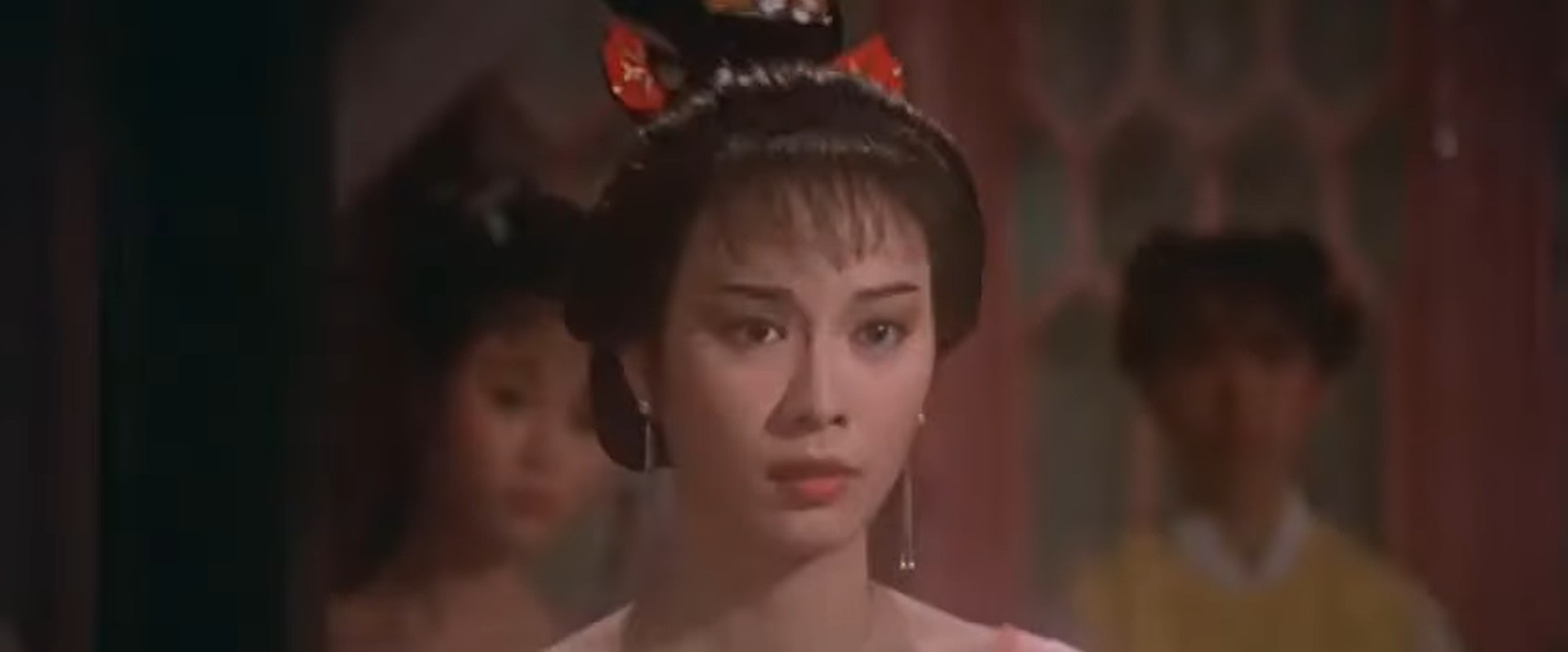
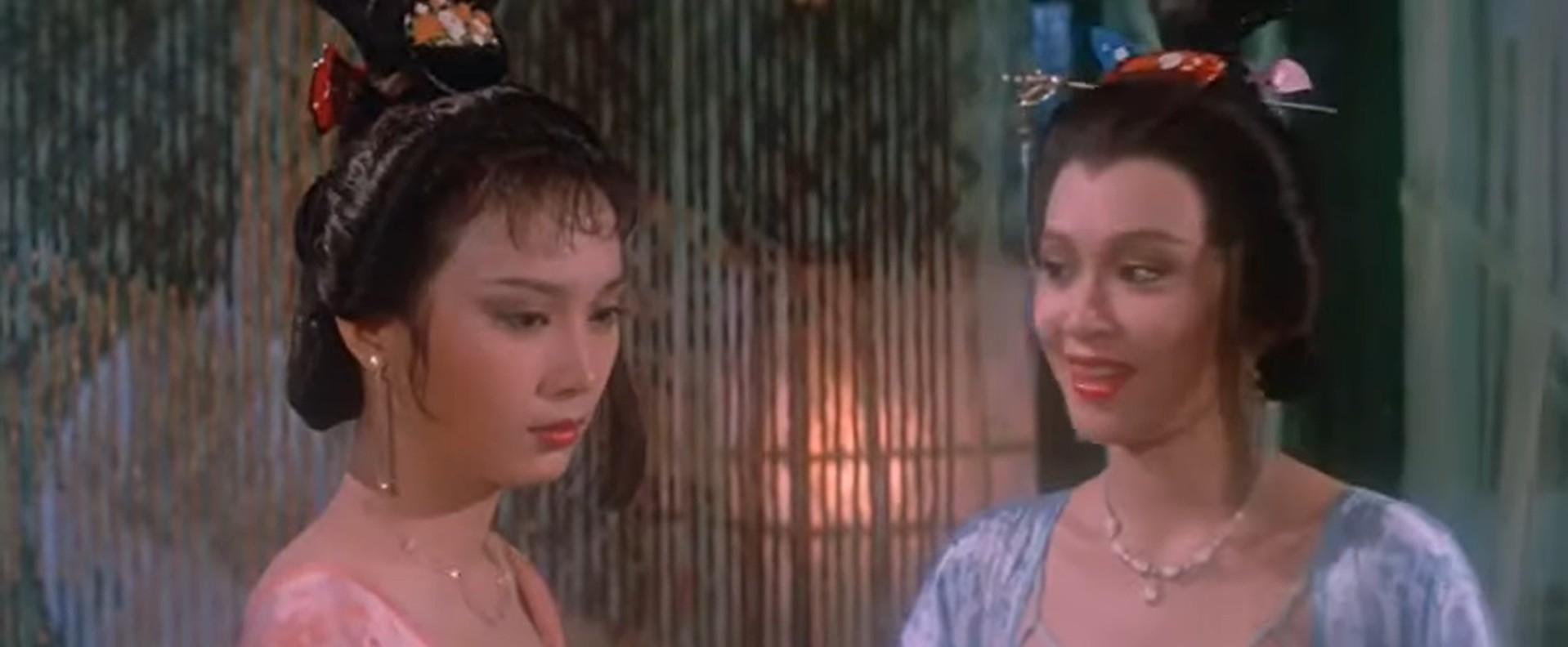
Power, under an affluential and admired ruling thumb backed by the wielding of Kung-fu arrogance, is what Chun-yi of “Intimate Confessions” embodied and, eventually, is what blinded her to her undoing.  In her debut role, Betty Pei Ti creates an unforgettable impression that cements Chun-yi as a fierce and fixated force being a corruptor of young women and a criminal kingpin with her deadly mitts in just about every provincial authority and lawmaking body.  The “Police Woman” and “Succubare” actress seizes one-half control of the story with her beauty, acting command, and dynamic and complicated relationship with on screen actress Lily Ho as Ai Nu, a homeless young woman with equally fierce fight in her but not backed by any kind of authority or station.  Ho, a veteran actress with stardom success as the titular character from Chih-Hung Kuei and Akinori Matsuo’s female fatale picture “The Lady Professional” the year prior, brings a vulnerable ferocity to Ai Nu.  Like a scared cat back into a corner, Lily Ho claws the character through a no-win-scenario of survival in a tough role that involves multiple men thrusting themselves onto her but like a switch, Ho’s able to turn off Ai Nu from being an erratic rebel to save her life to actually saving her life by calmly weaponizing love.  Kuan-Chen Hu portrays the Ai Nu character a little bit different in the 1982 version.  Not as feisty and more brittle, Hu’s uno card reversal on the brothel mistress turns into a ménage à trois of greed in it’s underlaying of revenge.  Chun-yi, too, has varying traits to the “Intimate Confessions” counterpart as On-On Yu (“Black Magic with Buddha”) gives the brothel mistress, who goes by Lady Chun, a softer harshness when it comes to delicate and delegating dastardly business and personal affairs.  Lady Chun also doesn’t have a martial arts bone in her body unlike Betty Pei Ti’s fighters-of-death Chun-yi who is a more of a typical well-rounded, boss-level antagonist, but what Lady Chun does come with more is contextual backstory, a woman who rose from power but sees much of herself in Ai Nu and makes promises of reciprocal care with fellow orphan and childhood friend, and skillful hired sword assassin, Hsiao Yeh (Kuo-Chu Chang, “Killer Rose”).  On-On Yu’s version can be cruel but be cruel while exacting a tender heart to her fixation on Ai Nu, adding a deeper and different complexion to what we’ve seen Chor produce before more than decade before.  The cast of each film round out with kidnapping scoundrels, crooked officials, and one lone decent constable within a supporting cast that includes Yueh Hua, Lin Tung, Wen-Chung Ku, Fan Mei-Sheng, Chung-Shan Wan, Shen Chan, Alex Man, Miao Ching, and Kuo Hua Chang.

Watching the two films back-to-back can throw one for a loop as the remake is not a carbon copy of the original, but there is a lingering familiarity that can’t be shook as it hooks itself to “Intimate Confessions’” key plot and forcibly exclaims its remake existence.  Like many things that have a sense of duality, there are also stark and contrasting differences between them.  If personally favoring sadist measures, rougher sexual confiscating, and a confident villainous vixen, the original “Intimate Confessions” will be more to your like.  If personally favoring a slow-and-steady wins the race melodrama, brewed and stewed in romance and storytelling, with more wuxia fighting and swordplay, the “Lust for Love” checks the boxes.  Compositionally, Chor’s vivid backlighting through a hazer fog with different spectrum colors is evident in both films but “Intimate Confessions” has profound designed objects and background combinations that work with the choreography that tells the mood of the story:  the windy and hazy night of Ai Nu and the good natured constables first meet that tells of a foreboding fate, the the bright and joyous revelry of exciting patrons of on the verge of copulating with exploited, kidnapped young women, or the darker streaked toned of betrayal and death in the finale showdown between principal players.  “Lust for Love” also has a tone about it that’s more in tune with the melodrama with expensive looking sets accompanied by a delicate palette of gold, white, and softer reds and yellows.  Plenty of third act loving making from the love triangle showcase told through a sequence of surrealism and teeing up fantasy desires heightened by the glisten outdoor tub water sloshing side-to-side in their passion, on the dewy moss the half-naked roll in, and in the gold rimmed adorned bedrooms where lesbianic lovers flirt.  Chor first ventures the rough rape-revenge thriller only to chuck the indelicacies of the original film and replace with swirling succulence of sex and self-indulgence, a contrasting brilliance formed and reshaped only a dozen years apart.
Imprint Asia knows all about courtesans, or at least about the Yuen Chor courtesans, in “Intimate Confessions of a Chinese Courtesan” and “Lust for Love of a Chinese Courtesan” with a new 2-disc Blu-ray boxset from Australia.  The 1080p high-definition transfers are pulled from the original 35mm negatives and are AVC encoded onto a BD50s and presented in their original aspect rations of 2.40:1 (“Intimate Confessions”) and 2.35:1 (“Lust for Love”), compressed by spherical anamorphic, widescreen lens with the noticeable curvature in the image.  Both presentations offer an ideal image experience with neither damage showing signs of damage or age, palpable textiles of the silk-spun and cotton blend garbs that sheen as expected and absorb a gratifying amount of reflected light within its respective fabric.  Grain appears light yet organic with skin tones and textures with an organic display, unlike in the Shaw-Shock Volume 2 set where skin coloring appeared orange in quite a few scenes.  The spherical lends offers depth despite its slightly warped edging as if looking in a corner convex mirror.  The audio formats include a Mandarin LPCM 2.0 Mono mix with burned-in English subtitles.  There’s also a Cantonese language option of the same spec but the English subtitles are optional.  Subtitles synchronization is on point with the ADR track that’s retains a clear and discernable dialogue albeit the gurgling quality of recording interference present through. The over exaggerated transcript on top of its equal over exaggerated performances, especially with the googly-eyed and giddy older village officials looking to score handsomely with the courtesans, is present in every inch of a less-than-seductive prostitution rendezvous.  Soundtracks boast a melodramatic and action pack score with an extremely westernized design only fiddling slightly with traditional Chinese melodies and with Fu-Liang Chou adding some harsh guitar during the spicier segments of Ai Nu’s lesbian grooming.  Chin-Young Shing and Chen-Hou Su provide a more classic and harmonically sound for “Lust for Love” to exact more passion and heart and less depravity.  Special features or “Intimate Confessions” include a new audio commentary by author Stefan Hammond and Asian film expert Arne Venema, a new informational and highlight discussion from film historian Paul Fonoroff, an archived featurette directed by Frederic Ambroisine Intimate Confessions of 3 Shaw Girls takes the female perspective and review from journalistic critics and actresses including one actress for the films, an archived interview featurette with critic and scholar Dr. Sze Man Hung, critic Kwan King-Chung, and filmmaker Clarence Fok, and rounds out with the original theatrical trailer and DVD trailer.  “Lust for Love,” in comparison, is more barebones in bonus content with an audio commentary by film historian Samm Deighan and the DVD trailer.  The physical presentation is similar to Shaw-Shock Volume 2 but just a slightly be slimmer with a jagged tooth topped, rigid slip box with a line split down the middle of the front cover depicting illustrations of characters for each film in either a contrasting blue or pink background.  The backside has a compilation of melded together pictures from both films.  Inside, two clear case Amaray, complete with their own original one sheet as cover arts with a reverse side having pulled a scene from their respective film, sit snug inside the slip box.  The boxset has a total run of 3 hours and 6 minutes, is not rated, and is region free.

Last Rites: Yuen Chor’s dichotomy of the two films is an odd and rare accomplishment of the filmmaker’s re-envisioning of his own work but “Intimate Confessions of a Chinese Courtesan” and “Lust for Love of a Chinese Courtesan” have idiosyncratic merit despite the same underlining premise and now it’s showcased in a brilliant boxset from Imprint Asia for you to decide Ai Nu’s revenge and motivations in the fray of brothel captivity.

Order the #34 and #35 of a “Chinese Courtesan” from Imprint Asia’s Boxset!

A Snapshot Celebration, Averting the EVILs of Typecasting, for the Iconic Actress “Sylvia Kristel: The 1970s Collection” reviewed! (Cult Epics / Blu-ray)

The “Sylvia Kristel:  1970s Collection” Available on Blu-ray and DVD at Amazon.com!  Currently on Sale!

Sylvia Kristel.  A name that is synonymous to eroticism.  Kristel paved the way in mainstreaming seductive romances of softcore exploits, helping to elevate the provocative genre out of the depths of sleaze and into a more exotic trashy novel for the big screen.   In her titular role in the “Emmanuelle” franchise coursed an arousing path of sexual freedom, uninhibition, and became the sumptuous and worldly window in private fantasies. Playing the role for nearly two decades didn’t stop Kristel from other high profile and lucrative projects with an array of filmmakers as well as her roles pre-“Emmanuelle” that molded the Netherlands actress into a sexual icon rather than object of male fantasies. Cult Epics acquires four films – “Playing with Fire,” “Pastorale 1943,” “Mysteries,” and “Julia” – that even though didn’t have Kristel set as a principal lead still showcased her range within the constraints of a minor, but certainly not insignificant, performance.

“Playing With Fire”

In a madcap Paris where sex trafficking is something of a sport, a wealthy French banker learns his daughter has been kidnap and threatened to be tricked out or burned alive if the kidnappers’ ransom isn’t paid.  Quickly learning that another woman has been mistaken for his daughter, a wave of relief bestows him to be cautious about future attempts on his daughter’s safety.  The banker hires a private detective to protect his loveliest of assets, offering to escort her to a local safehouse with the promise of sanctuary, but the P.I. is operating incognito being really one of the leaders of a surreal and lavish brothel who now has the banker’s beautiful daughter in his possession.  Or is it her who possesses him? 

Unlike any other exploitation-comedy you’ve likely ever seen, the 1975 released “Playing with Fire,” aka “Le jeu avec le feu,” is a wacky deep-dive of surrealistic sex trafficking from French writer-director Alain Robbe-Grillet whose obsession with prostitution rings and other filmic eroticism pursuits extends back within a decade later with “L’Immortelle,” aka “The Immortal One,” and “Successive Slidings of Pleasure.”  A French production of Arcadie Productions, Madeleine Films, and Cinecompany, “Playing with Fire” masters the avant-garde art of making light of a grim topic that results in a pull of emotions.  Robbe-Grillet draws out the shocking aspects of sex slavery while also encouraging a smirk or a chuckle at the whimsical characters and shooting techniques weaved throughout a burlesque narrative.  Robbe-Grillet also plays with the theme of dualities with a number of the principal characters having two or more versions of themselves:  Philippe Noriet plays not only the banker father Georges de Saxe but also a voiceless sleaze erotically interacting with the banker’s daughter in a very Freudian concept between father-daughter relations.  His daughter, Carolina (Anicée Alvina), disguises herself as the thin-mustached private detective to thwart future any attempt at an abduction and there’s also the identity mishap with the similar looking woman mistakenly kidnapped by the ringleader.  Leading us into Jean-Louis Trintignant as the ringleader Franz constantly in a revolving door switch-a-roo façade into the private detective.  The presence of duality doesn’t stop being a present throughout, continuing with the banker’s butler who is also a whorehouse patron without affirmation that they’re the one and same person.  Before their illegal banishment in the mid-20th century, Brothels were widely dispersed throughout Paris, but not until the Nazi occupation absorbed the houses of ill-repute that seared a bad taste of deviant humiliation and sordid disgust into the mouths’ of the French populace and Robbe-Grillet taps into that once time of unrest by splicing in a pair of isolating scenes of goose-stepping Nazi soldiers with one of the moments garmenting Anicée Alvina in uniform and marching in the ranks, suggesting a more sinister subplot afoot in the storyline.  Kristel plays one of the women snatched by Trintignant’s efficiently devious Franz with virtual a voiceless performance in what’s only a symbol of strength and beauty that sets perversion ablaze as she’s taken through the motions of essentially onboarding her into slavery whoredom. “Playing With Fire” can be at times difficult to keep up with the Alice in Wonderland-like surrealism and the character dualism but persists unwaveringly with a multi-faceted narration of deceit, eroticism, and comedy full of perversions and random outbursts akin to satirical skits that make this film unpredictable yet enjoyable to behold.

Pastorale 1943

During the Nazi occupation of the Netherlands, a quaint Dutch farming village lives day-to-day alongside soldiers and German sympathizers known as National Socialists (NSB) to the Nazis, traitors to their fellow Dutch countrymen.  When the Nazis learn of and round up all the dissidents and Jewish heritage people living in hiding on an adjacent, ferryboat island, a small band of unorganized resistant fighters determine the local pharmacist, a NSB member, to be the Nazi collaborator responsible for the treacherous leaking of information because his son impregnates an island village girl, teetering toward the fascist movement when mocked by her peers for her involvement with the pharmacist’s son.  Inexperienced in the execution of traitors, the bungling resistance fighters learn just how difficult planning a murder can be when their scheme falls apart in a small village where everybody knows everybody.

On this second of four Sylvia Kristel features is the Spieghel Filmproductiemaatschaappij of “Pastorale 1943” which makes more prominent the Nazi regime, is set with a backdrop of a Nazi occupied Netherland town and has a cameo role of young and dashing Rutger Hauer (“Blind Fury,” “The Hitcher”).  Netherland writer-director Wim Verstappen, whose had a few titles released previously from Cult Epics, such as “Obsessions” and “Blue Movie,” develops a script out of the World War II drama novel from author Simon Vestdijk with black comedic undertones and a tinge of corrosive sexuality and released the film in 1978.  Pastorale, or Pastoral, refers to the typically calm and idyllic country life which the complete opposite in 1943 Netherlands with all of Europe and East Asia engulfed in war; however, this story takes place in its own corner of the world with a mini, damn near microscopic, war waged between the Nazis occupation along with domestic NSB collaborators and the inhabitants resisting against the encroaching fascism that has plagued revenue crops and instilled an authoritarian culture, such as mandating the teaching of the German language to students in Dutch schools. Kristel’s involvement with Verstappen’s “Pastorale 1943” is about as much as her involvement in “Playing With Fire” with a minor role that’s still a keystone piece to the narrative. She plays Miep Algera, a local schoolteacher disparaged by her neighbors and colleagues for having romantic relations with a Nazi officer, but has she really fallen for the officer or is she secretly conducting counterintelligence for the resistance? “Pastorale 1943’s” two-part story plays heavily embroiling and embroidering characters in the first half to the point of instituting a cornerstone character but when the narrative pivots, to the darker side of implied Nazi exterminations and the fumbling through the execution of a rightfully innocent man, Verstappen homes in on Frederik de Groot as the artist Johan Schults whose Germanic surname causes him much strife amongst his Dutch brethren but to prove himself, Schults takes charge, along with an equally green execution squad of resistance politicians, to murder the NSB collaborator, a local pharmacist Poerstamper (Bernard Droog). The Academy Award submitted “Pastorale 1943” can be light and funny then turn quickly on a dime into wartime darkness and director Wim Verstappen’s vision pops with epic World War II fascism atrocities, confined to one part of the world and without the explicit voyeurism of genocide.

“Mysteries”

After the strange suicidal death of a man named Karlson, Johan Nagel arrives to the coastal town where the death occurred.  Immediately, Nagel stands out from the supercilious eccentric residents with his mustard yellow suit and fur coat, dispensing small cigars and money to everyone and every service as if they were infinite, and exhibits his own brand of strange behavior, especially with amorous feelings between two women and an unlikely friendship with a dwarf who has accepted his neighbors’ belittling jabs for humorous pleasure.  As his behavior declines, Nagel’s presence unravels the coiled, seemingly impenetrable, barriers around his friends, his enemies, and his romantic pursuits that reshape their properties for the better at the dangers of his own sanity and life.

Finally, we’re at a point in the Sylvia Kristel collection where the titular star is in a lead role with this demolition of concrete idiosyncratic personalities melodrama entitled “Mysteries” from Dutch filmmaker Paul de Lussanet, based off a novel “Mysterier” by Knut Hamsun, with Sigma Film Productions as the production company.  Kristel plays the steely Dany Kielland who becomes the infatuation of Nagel in an oppositional performance beautifully deranged and conducted by Rutger Hauer.  The hot-and-cold and on the brink of frustration relationship between Kielland and Nagel is as resolved as an unfinished breakfast left to waste and void of complete nutrition as both characters digest morsels of desire only to explode in a frenzy of loathsome disgust in an unsavory, brittle dynamic only Hauer and Kristel could produce on screen.  The other love interest involved, yet hardly feels as such until the last half hour, is an aged and more humble Martha Gude portrayed by “Last Night in Soho” British actress Rita Tushingham complete with a poor-looking frosty-colored wig.  Kielland and Gude represent the two-side of society – rich and poor respectively – stuck mastering a stanch stance of an indeterminate state that Nagel barrels into and knocks down the status quo, like a bowling ball to ten pins, for the better of the coastal town.  None of what Nagel does seemingly makes any sense and that’s very true to Hamsun’s novel in the unconventional, and probably unintentional, methods of Nagel’s erratic influence.  “Time Bandit’s” David Rappaport debuts in his first feature film as Grogard, an achondroplasia character bulled by most of the town’s residents due to his disorder.  Grogard anecdotally tells the story as “Mysteries” narrator, as if reading straight from Hamsun’s novel, the recollection of Nagel’s dichotomic behavior and, at the same time, Nagel also being a mentor, protector, and a friend that pained Grogard to watch his friend whither to death in fit of emotional exhaustion.  “Mysteries” borders arthouse cinema, adaptive faithfulness, and pristine melodramatic performance that sound good in theory but not always translate well to the screen, leaving more of a perplexing impression on the whole purpose of rendering Knut Hamsun’s novel into film in the first place.

“Julia”

Every year, Patrick departs his boarding school for a short holiday with his father and relatives at his grandmother’s idyllic lakeside house.  While riding the train en route to his grandmother’s, he encounters an older, yet beautiful, blonde woman inside the passenger carriage car and before he can firm up courage to act upon his sexual brimming hormones, the blonde is swept up by an older gentleman right from under his nose.  Come to find out, the blonde woman is actually his father’s girlfriend in a completely open relationship when it boils down to sex.  Anxious about his own insecure sexual appetite, Patrick finds himself surrounded by the perversions of his family and friends, leaving the young man hesitant and nearly impotent in bedding the woman he actually cares about, a longtime friend Julia who lives next door to his grandmother.

On the heels of “Emmanuelle,” Sylvia Kristel follows up with another licentious freedom film in Sigi Rothemund’s “Julia.” Also known as “Summer Girl” or “Die Nichte der O,” the German production from the Lisa-Film company is the earliest film on the 1970s collection with a release in 1974 and is the only other screenplay on the collection next to “Playing with Fire” that is not adapted from literature. Instead, “Julia” is a wild romp ride of young sexual exploration and the anxieties that accompany it from an outlandish and witty script by Wolfgang Bauer. “Julia” might not be based off a book, but the story is certainly an unapologetically open book about the insignificance of virginity, polyamorous affairs, lesbianism, voyeurism, and the sexual rite of passage into adulthood with the young and naive principal Patrick, or Pauli as credited, played by the late Ekkehardt Belle who passed away in January of this year. Opposite Belle, Sylvia Kristel obviously dons the titular role of Julia. Inexplicably voluptuously different from the other three films on the collection, Kristel radiates a sexual aurora perhaps infected by proxy of its release soon after “Emmanuelle” as Kristel obvious branches out to more sensible dramatic roles rather than the decor of a German sex comedy such as “Julia” that galvanized by its free-for-all eccentric caricatures including an operatic, overweight, and perverse uncle Uncle Alex (Peter Berling, “When Women Were Called Virgins”), a highly aggressive lesbian in Aunt Myriam (Gisela Hahn, “Devil Hunter”), the house maid Silvana who Myrian seduces with whipped cream and has piano-top sex (Christine Glasner), and his polyamorous father Ralph (Jean-Claude Bouillion, “The Sextorvert”) and girlfriend Yvonne (Teri Tordai, “She Lost Her…You Know What”). Comparatively flimsy next to “Emmanuelle” as a sexual journey and coming of age film but “Julia” is a hot-to-trot sex comedy with funny bits as well as sultry naught bits too.

Beautifully curated for the first time ever release in the United States of all four films is Cult Epics’ “Sylvia Kristel: 1970s Collection” on Blu-ray and DVD. The 4-disc, uncut Blu-ray, which was provided for coverage, is region free, limited to 2500 copies, and perfectly packaging to extol praise upon the robust early career of Sylvia Kristel. Presented in European widescreen 1:66:1 (with the exception of “Playing with Fire” which is displayed in an anamorphic 2:35:1), each film is newly scanned in 2K from the original 35mm elements as well as been restored. Transfers for the most part are exquisitely pristine, each harboring their own mise-en-scene mélange, but some are better than others with “Mysteries” sitting at the bottom rung of showing slightly a few more scratches and one-or-two single frame damages that flame up through the reel briefly. “Julia” also has minor scratches, but that’s really the extent of the issues with the image quality on this restored visual released with a rich color palette and textures redefined for a better palpability. Compression issues are virtually non-existent and there are no tinkering enhancements or cropping used to skirt transfer limitations. I am in awe of the audio output of the 1920kps bitrate, transmitting the highest audio quality possible for each release through either DTS-HD Master Audio 2.0 or a LCPM 2.0. Dialogue clarity comes through cleanly with French in “Playing with Fire,” Dutch and German in “Pastorale 1943,” and German in “Julia.” “Mysteries” sounds a bit muddle sometimes due to the consistently background popping interference, but the Dutch language still pulls through strongly and discernibly. Each film comes with optional English subtitles. Special features are aplenty with audio commentaries by Tim Lucas, Jeremy Richey, and Peter W. Verstraten, new and vintage interviews and promotional footage with cast and crew on ‘Playing with Fire,” “Pastorale 1943,” and “Mysteries,” a poster and still gallery on each release, and original theatrical trailers. Outside the disc contents, the collection’s rugged cardboard boxset housing unit consists of a 4-disc snapper case with vintage-still collage cover art, a 40-page illustrated booklet with color pictures and an essay on all four films written by Jeremy Richey, and a cover art poster by Gilles Vranckx. Total runtime is 429 minutes, enough to get your Syliva Kristel fill and then want more…much more. The “Sylvia Kristel: 1970s Collection” lauds the actress’s versatility of performances and ability to work with any director from any country and fans who love “Emmanuelle,” or of just Kristel, will undoubtedly fall in love with this Cult Epics comprehensive look at the Dutch icon’s outermost filmography.

The “Sylvia Kristel:  1970s Collection” Available on Blu-ray and DVD at Amazon.com!  Currently on Sale!