Pandemic EVIL Is Just Not For Dry Land Only! “Virus Shark” reviewed! (SRS Cinema / DVD)


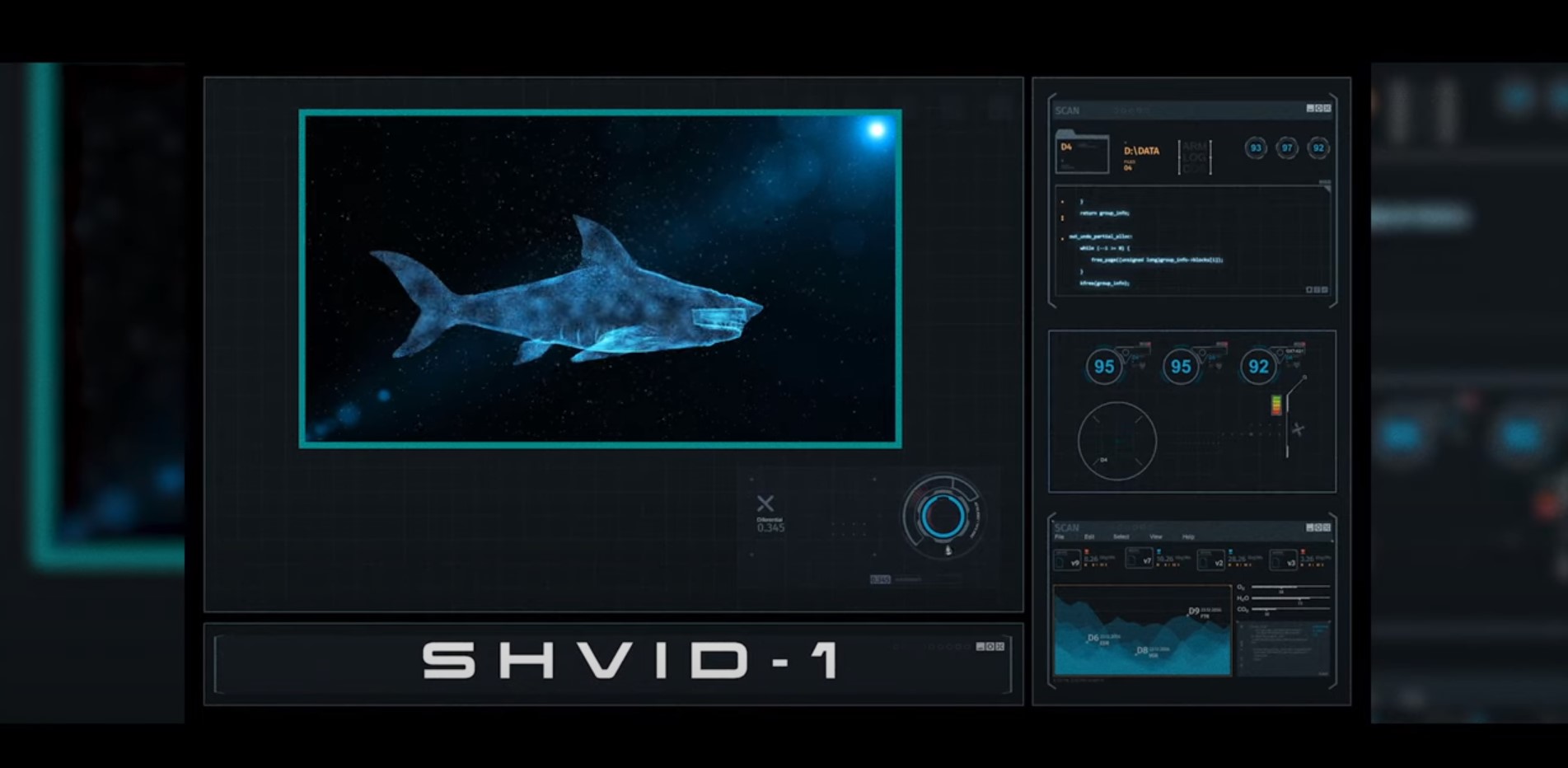
Deep at the bottom floor of the ocean is CYGNIS, a research laboratory retrofitted to be a race against the clock in finding a cure for a world devasting virus called SHVID-1.  Spread by infected oceanic sharks, a handful of shark attacks on unheeding beachgoers turns the world’s populace into mutated marauders and blood thirsty, zombified killers.  Running quickly out of time, the handful of scientists, a maintenance chief, and a security guard find themselves under pressure, literally, as the 30-year-old antiquated CYGNIS station is beginning to show signs of buckling under the ocean’s immense weight.  Factor in virus-mad sharks chomping at the station’s life sustaining systems and a betrayal by the project leader looking for cure glory in greed, a perfect storm brews 1000 leagues down overshadowing the severe global pandemic that has swallowed the world whole.  Survivors must surface topside with the cure before all hope comes crumbling down on top of them.

Okay!  I’m pretty sure director Mark Polonia parallels or exceeds my own unhealthy obsession of the sharksploitation genre with his own series of outrageous D-flicks dedicated to the gross profit of the monstrous shark rampage stigma seen in the Pennsylvania born filmmaker’s previous works in “Sharkenstein,” “Land Shark,” “Amityville Island,” “Shark Encounters of the Third Kind,” and the soon-to-be-released, the vampire and shark alliance, “Sharkula.”    Polonia’s latest, “Virus Shark,” is written by Aaron Drake and echoes the pro-Trump public ideology of willful ignorance in snubbing governmental official warnings about staying away from large crowds unmasked during the COVID-19 pandemic.  Polonia throws Megalodon-sized shade at partygoers and right wing conspiracists with SHVID-1, an obvious play on the real virus, and the sun and sand worshippers who venture into the shark infected and infested waters despite the recommended counsels to stay on shore.  Aside from the social commentary lampooning, the rest of “Virus Shark” is in shambles as a super low-end indie production from Polonia Bros. Entertainment and produced by SRS Cinema’s Ron Bonk. 

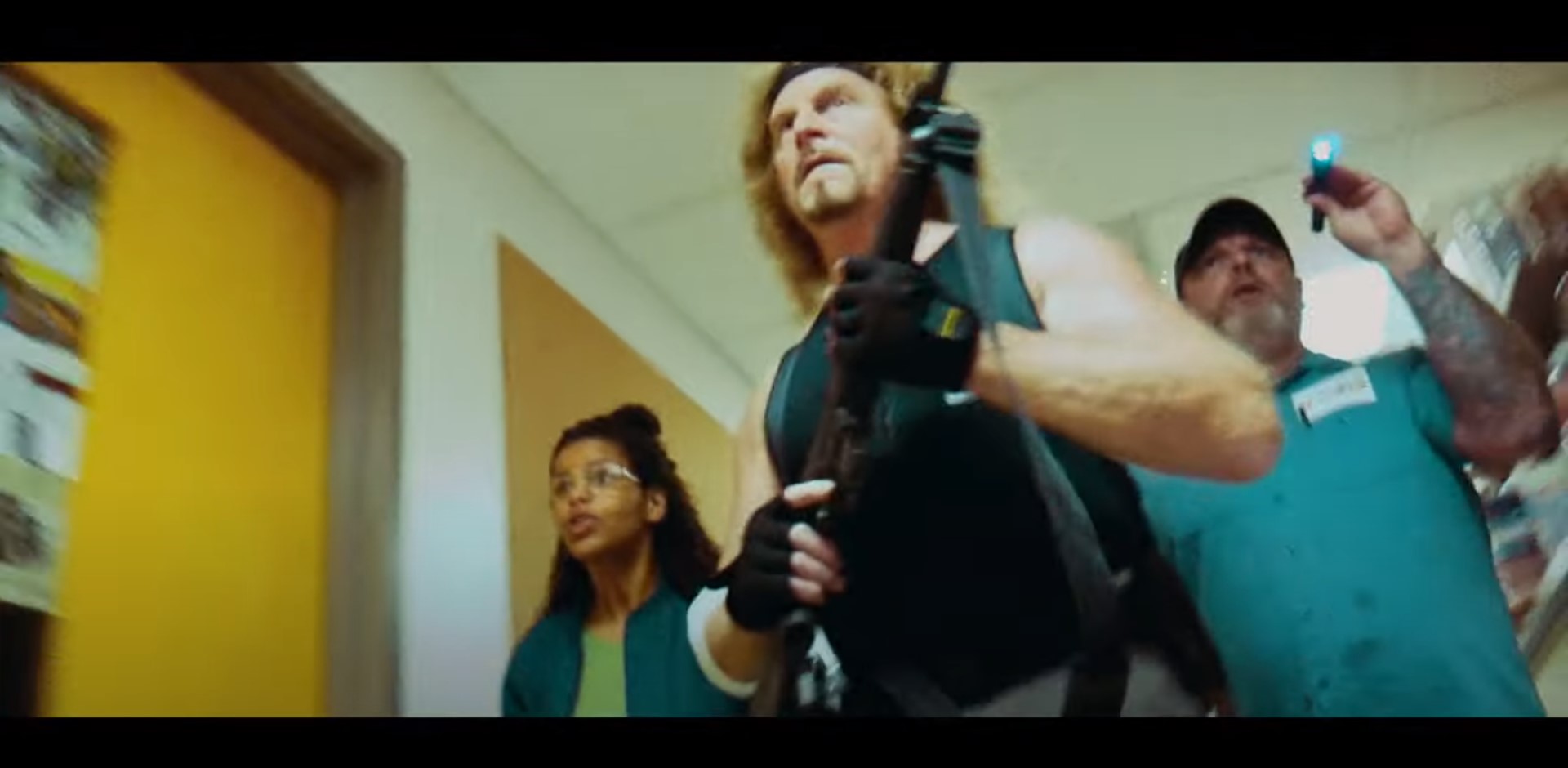
Served up as chum for contagious sharks are a troupe of regular independent staples beginning with lead actress Jamie Morgan entering her second bout with a killer shark after surviving another SRS Cinema gem, “House Shark.”  In the role of marine biologist Kristi Parks, Morgan is not free diving into the vivarium pens and wrangling or bareback riding the maneaters like “Deep Blue Sea’s” Thomas Jane; instead, the actress has a more meek stance as her limiting character transforms into a protective shield over mankind’s last known hope – a cure for the virus.  Fellow scientists Anne Satcher (Natalie Himmelberger, “Shark Encounters of the Third Kind”) and Gregory McLandon (Natalie’s real life husband, Titus Himmelberger, “Sharkenstein”) don the lab coats and spectacles to look the researcher part without actually seemingly doing anything of importance, or anything that makes sense anyway.  The team is rounded out with “Queen Crab” actors Steve Diasparra as the maintenance man Rickter D’Amato, an homage to Joe D’Amato who has helmed a trashy sharksploitaiton film himself with “Deep Blood” (read our recent coverage review here!), and the awesomely 80’s hairdo’d Ken Van Sant the dated commanded-cladded security guard and horn ball, Duke Larson.  Deliveries and any sense of conveyed emotions are a smidge above forced as if reading straight from a cue card.  The off camera stare has to be my favorite gaze into space moments, especially when an aggressive Great White beelines right toward them and the reactions are nothing more than a gaping mouth.  Van Sant wins top prize for at least giving a half-hearted attempt at empathy for a character completing a character arc.  “Virus Shark” fleshes out with Yolie Canales, Noyes J. Lawton, and Sarah Duterte who are also a part of the tight knit celluloid circle of deep-six cinema. 

Speaking of deep six, as in “DeepStar Six,” a semblance toward notable underwater horror films of the deep really do crest through “Virus Shark’s” stagnant flat surface.  Little bits of adulation toward “”DeepStar Six” with the jettisoned escape pod, “Deep Blue Sea” with the shark pool, and “Leviathan” with the topside communication sans Meg Foster sprinkle a blanket of welcoming derivativity amongst a cheaply endeavor.  When I say cheaply, I mean “Virus Shark” scrapes the bottom of the barrel with embarrassingly bad shark hand puppets, interior locations of the underwater sea lab are about as realistic as the innards of your run of the mill High School building, and every single gunshot is the same soundbite stuck on repeat, no matter the gun or the caliber.  I do admire the innovation at times.  An example I would pull would be the two miniaturized pincers matted on top of a live-action still frame used as hydraulic clamps to pickup the rather rigid shark figurine from the “pool.”  You can call it sloppy, but on a pea-sized budget, I call it thinking outside the box.  Much of the story felt underdressed, missing parts pivotal to the impelling actions that either progress cataclysmically or just drop off the face of “Virus Shark’s” malfunctioning sonar.  Under the table deals and sexual innuendos made between project head Dr. McLandon and topside liaison Shannon Muldoon are skimpy at best as well as Kristi Parks’ all for naught endgame to saving the world.  Everything seemed and felt pointless, senseless, and without merit that the “Feeders” and “Splatter Farm” director shouldn’t be totally judged by as we’ve seen much better on much lower budgets from Polonia who he and his late twin brother, John, have been around for decades making movies up until 2008 when John passed away.  Mark Polonia continues to carry the torch but the lack effort has seemingly been replaced with chugging out one scab film after the next to the tune of tone deaf gratification.

Wash your hands, wear your mask, and maintain a social distance of 6-feet from the television when swimming with the “Virus Shark,” that has beached itself onto DVD home video courtesy of SRS Cinema.  The unrated DVD is an AVC encoded single layer DVD-5 and presented in a widescreen, 1.85:1 aspect ratio.  The image quality appears relatively sharp without a hefty loss from compression, especially around the spectrum of low-cost effects that range from rigidly clean to absolutely warped and absurd, but what do you expect from a release that has the cameraman’s reflection visible in the shot and spells region with an extra I – reigion 0 – on the back cover?  Underwater sea lab shots filtered through an oceanic blue hue make due the illusion of a domed research station on the sea floor bed whereas the insides lack a production manager’s personal touch as much of the interior scenes look to be a school with an obvious swimming pool setting and many insipidly sterile hallways and rooms.  Extras on the 74 minute film include a commentary track and SRS trailers with no bonus scenes during or after the rehashed intro credits for the end credits.  The English language 2.0 mono track isn’t the peak of fidelity with the lossy audio compression and inadequate mic placement made apparent by the limited depth and range in  dialogue tracks.  The overlaid narrow foley remains on one level from start to finish finished by stock soundboard snippets.   As far as Sharksploitation goes, “Virus Shark” ranks near the bottom of the food chain.  Of course, there have been far worse killer shark films threshing in the genre pool, but the COVID parodied subaqueous actioner wades underneath the skills of Mark Polonia.

Get Infected by the “Virus Shark” on DVD Home Video!

To EVIL, Just Another Slab of Meat for the Butchering. “The Slaughterhouse Killer” reviewed! (Breaking Glass Pictures / Digital Screener)


The local swine slaughterhouse perfectly suits the solitude of Box, barely sating the fervent urge of his killer spirit, but when a young ex-con, Nathan, who is trying to walk the straighten arrow with his girlfriend, falls under Box’s wing at work, keeping that urge at bay is proving more difficult with a likeminded companion.  When the workplace bully pushes Nathan too far, Box orchestrates a killer opportunity to murder the bully in his own home as a gift to the young parolee.  The death of their intimidating colleague solidifies an unique relationship between the men, opening Pandora’s box in their small town where no one is safe from their lust for blood.  As the bodies pile up and their corpses are ground up into chuck at the slaughterhouse, their relationship is tested when a child becomes the unintended next victim, severing the unspoken principles of their bond. 

“The Slaughterhouse Killer” is director Sam Curtain’s entry into the minds of bloodlust wolves living in sheepskin day-to-day amongst the clueless flock.  The senseless violence-laden thriller out of Tasmania, Australia is the sophomore feature from the “Blood Hunt” writer-director and is co-written with Benjamin Clarke.  The pair harness their continued onslaught for aggression from “Blood Hunt’s” human race cruelty with a rumbling storm brewing, waiting, for the right conditions when two very different people find a common interest by setting a little part of their world on fire.  The indie picture is streamlined through Curtain’s Stud Ranch Films entertainment banner and is backed by Black Mandala, a big and upcoming label showcasing an expertise in extreme low-cost horror, under the producer’s eye of Nicholas Onetti who has supported a number of genre fan favorites under his banner such as “The Barn,” “Aquaslash” and has even collaborated with brother, Luciano, on the 70’s giallo inspired  “Abrakadabra” and “Francesca.”  If Onetti is attached, prepare yourself for merciless and bloody circumstances in this particular ozploitation maniac thriller. 

You obviously can’t shoot a film titled “The Slaughterhouse Killer” without the slaughterhouse setting garnished with meathook strung up and process gutted livestock much in the same way the killer can’t fall into the average-looking joe category.  In steps Craig Ingham, a Sydney born 6’4” big fella with distinct facial features that includes a gleaming bald head and an angry sneer delineating fiercely from his bulbous, pink-as-a-pig cheeked face.  Ingham has an uncompromising maniacal approach of being large and in charge under a lame façade of a daft abattoir employee.  To balance out the oversized archetype antagonist, usually from one that lumbers around in slashers genre circles, hacking away at sex-crazed teens, James Mason buoys “The Slaughterhouse Killer” from capsizing in that humdrum trope of tasteless, flat water by adding a pretty face to the madness that is equally as ugly on the inside in character in what becomes the Laurel and Hardy of exploitation horror.  However, there’s nothing remotely funny about the performances of two men becoming unlikely best buds, drinking beer, and making hamburger out of the sheila from next door, but they do act like a pair of chuckleheads searching for motivation with their roles and instead come up empty handed in the arbitrary of Curtain and Clarke’s headway halting story.   “The Slaughterhouse Killer” is simply a two man show that aims to cycle through their unusual connection with Kristen Condon (“Sheborg”) as Nathan’s girlfriend, Tracey, and Dean Kirkright (“Cult Girls”) as the unfortunate workplace bully rounding out the small cast of collateral damage characters.

One of the biggest problems with “The Slaughterhouse Killer,” a tale that’s supposed to be driven by the characters’ dysfunctional ties to society and their knack for violence, is that very lack of purpose Box and Nathan get out from the random bloodlust.  Nathan, on parole for we don’t know what, easily falls bewitched by Box’s gore giddiness and willingness to let Nathan into his little big secret.  Without Nathan’s incarcerated backstory, a sentence served that proved nothing but his ability to still land a job, doesn’t age well as the film progresses and just seems to be there in a glint of development substance that never circles back.  Box falls onto the same static line of where the hell is his arc heading as the film opens with Box resting sweaty in his whitey-tighty inside his ramshackled shack.  There’s not much too Box’s creepy disposition other than keeping his squinty eyes glued to a rather attractive woman’s behind and taking abusive orders from the abattoir boss, but what he sees in his new guy to take him on a journey of bloodletting is something of a mystery that never pans out.  Even Box’s bound and blinded plaything in a padlock trunk transcends every act met, creating a glass ceiling of knowledge to the inner workings of his warped thinker.  Box and Nathan’s nihilism and madness unleashed is the purest part of Curtain’s film as the sensation is like a fat kid in a candy store where the two men can just go to town by butchering the residents of their own town by any means seen fit to them, but in the grand scheme of cinema, there are far superior violent films to consider.

As if it was destined to be, “The Slaughterhouse Killer” finds friendship with a kindred, malignant soul to carry out dark fantasies and Breaking Glass Pictures brings us this tale of two treacherous serial killers onto VOD and DVD this month of April. Digital platforms will include Vudu, iTunes, Google Play, Amazon, Fandango, and more. Presented in a widescreen, 1.78:1 aspect ration, and recorded in 4K, cinematographer Leuke Marriott rejoins Curtain on the director’s second feature, providing 78 minutes worth of intimate imagery invasive on Box’s grimy lifestyle and Nathan’s furrowed brow by corralling much of the action directly in front of the camera. Marriott might not employ novel angles and techniques but makes up with holding tight and fast on the brutality and the meatgrinder of Box and Nathan’s vile run while also supplying a few bold filters, such as a rich blue and a light yellow, in more unsettlingly taut moments and capturing some of Tasmania’s landscape with aerial drone shots of Arthur’s Lake with the trees seemingly floating up out of the tenebrous water. “The Slaughterhouse Killer” has the title of a 80’s printed VHS SOV and leverages the ogre villain to the max, but can’t muster a rooted sense of purpose, not even a simple reason such as pure, unadulterated evil, to drive a span of violent behavior to be a worthwhile token to the viewer.

Own on DVD or Watch on Amazon Prime Video!

Family Tree Rooted by Grounded EVIL. “Sator” reviewed! (Umbrella Entertainment / DVD)


Living alone deep among the tall trees and the dark and deafening foliage around him, a tragic past involving the disappearance of his mother haunts the very core of Adam’s broken spirit as he wanders the forest he grew up in and that has also been an afflicting mystifying presence of family lore.  His grandmother, Nani, for a long time has been commenting being the receptor of a dark forest entity named Sator who internally speaks to her and has her write down unintelligible messages; Sator’s words have also whispered in Adam’s ears as well as his vanished mother’s.  Adam ceaselessly searches the clues daily, even setting up a night vision deer cam and ringing out into the woods with a homemade calling flute.  As Adam and his family struggle to rebuild their once strong bond, Sator emerges with an intent to sever what’s left of the tattered strings of family ties, bearing down on the isolated Adam in attempt to insidiously claim more of his kindred for the forest.    

Rich in personal family indispositions that trickle down to unravel everything dear, Jordan Graham’s sophomore supernatural film of a sinister spirt, “Sator,” is much better than my attempt at an alliterated sentence structure.  The 2019 film, hailing out of California, with the forest sequences from Yosemite National Park, is a blend of pristine splendor as it is a nocturnal nightmare in an allegory of mental illness and the distortion of family because of the effects.  For the “Specter” director and screenwriter, particulars of “Sator” intertwine the authenticity of the filmmaker’s ancestry with the ominous unknowns of horror in a DIY production that looks bigger and grander in worth than in actuality.    Graham’s production banner, Mistik Jade Films, and in association with Yellow Veil Pictures, the company behind the colorful demonically intrusive thriller, “Luz,” funds the film with Jordan Graham serving as executive producer alongside Jennifer Graham and Elias Adamopoulous.

“Sator’s” a family and friends affair that opens with Gabriel Nicholson silently, patiently, and near aimlessly wandering through the woods as Adam walking alongside his mutt and carrying a hunting rifle. Jordan Graham’s childhood friend since early teens, Nicholson fills adequately the role’s achy privation and does so without saying so much as a paragraph in the full 85 minute runtime. While “Sator” snuggles up to Adam’s incessant need to check deer cams and conduct daily searches around every rock, tree, and bush, the character isn’t the nucleus essential to Sator’s generational influences that spread like a cancer over Adam’s lineage and he’s where the buck stops. Instead, Jordan Graham’s grandmother, June Peterson aka Nani, bears unwittingly and unimpressed brunt of the actor’s burden to perform due to Peterson’s longtime battle with dementia. Her scenes are authentic and natural in discourse with the recollective ramblings of Graham’s family’s resident topical presence – Sator. Peterson holds all the cards for her grandson’s inspiration from the very name of the entity that speaks to her to the automatic writings set in motion during a stint of Sator’s sometimes hours upon hours of inner ear verbal instructions. Graham doesn’t exploit his grandmother, but rather tells her story in a way dementia allows her not to with recording her experience, with the papers of her automatic writings, and with extending Sator into a metaphor for family strife and mental illness. Rarely are Nicholson and Peterson on screen together, but they come in proxy of one another through the supporting characters played by Michael Daniel as Adam’s troublesome brother, Pete, Rachel Johnson as an unusual relative, Evie, and Wendy Taylor as the bygone mother only remembered in flashbacks and Adam’s documentary memories.

There are movies out in cinema land released for the sole purpose of dishing out entertainment complete with exorbitant special effects and a high profile cast surely to make good on bank statement returns and then there are some with a more somber, but well-crafted, personal story.  “Sator” is the very epitome of that latter category as director Jordan Graham’s profoundly personal story that is tailored to his specifications without the temptation of commercial success.  With dividends on the backburner, “Sator’s” arthouse quality stamps a staid dread of distressing imagery and stillness emblematic from an imprinted personal experience that has been dissected and dispersed to give the entity known as Sator a fluid corporeal form.  What also scores high marks is the ideology of Sator created by, or perhaps more accurately channeled through, June Peterson, forming the breadth of life out of an unseen concept glamourized with unimaginable abilities and attributes that can foraged out of Paganism or Satanic scriptures and have nature be the embodiment of its unholy divinity.  Graham not only unnerves you as passenger looking into eerie family history with “Sator’s” transmissions at the narrative core, but also serenades with serrating stridency in his audio and visual compositions that includes some fantastic gore and torching.  The one thing to point out that “Sator” falls short on is understanding the next jump in the narrative as Graham leaves unclear wide gaps unexplained with only a bit of passive dialogue to gnaw on to get caught up.  In a story that’s already subversive on the plainspoken, “Sator” could use some straight talk to get more inside the dissonance of the entity’s inimical ways.

Let “Sator” whisper into your ear on an Umbrella Entertainment home DVD release. The region 4 DVD comes standard in a NTSC format, like of the Australian distributor’s releases do, and is presented in a widescreen, 2:35:1 aspect ratio. Image quality is paramount for a downbeat psychological horror set inside the absence of noise of a pin drop forest and the release delivers a stunning transfer with elaborating details in the forest setting. Perhaps slightly on the darker on the scale, the engulfing blackness of the cabin, the woods, and Nani’s home add to the surrounding cryptic presence notwithstanding the absence of a body to call the villain. The darker shadows Graham creates sees better contrast in dreamlike sequences with the deep blue sky with a moon over head, the silhouette of the trees, and Adam standing small against the tall trees in his white skivvies, creating stark poetry in the image alone. Graham also incorporates a documentary style, through the mind’s eye of Adam, to replay events like flashbacks that set the stage for the present. The English language Dolby Digital 5.1 surround sound is works inline with the rubato score that creates a pulls and tugs on the emotions. The dialogue isn’t so lucky as actors can only be heard mumbling the lines with the exception of Nani with her natural, genuine talk. Like many of the Umbrella DVD releases, there are no bonus features includes and there are also no bonus scenes during or after the credits. “Sator” thrives as holistic horror with the insurmountable belief that there are far worse things out in the world than mental deterioration that spur random acts of equivocality.

Own Sator on DVD from Umbrealla Entertainment (Region 4)

EVIL Wears a Mask, Has Sex Parties, and Likes to Watch. “X” reviewed! (Cinedigm / Digital Screener)

Christian King was handed the philanthropic The Foundation once was directed by her mother Lynda, a legendary singer with powerful vocals who is now on the decline with onset dementia.  Christian, along with her business partner and friend, an equestrian stable hand named Danny, uses The Foundation as a façade for monthly masquerades of elaborate dinners and afterhours sex parties that rake in substantial donations from her clients, but Christian, who clads no mask, doesn’t partake in the normal debauchery of the orgiastic stage.  Her perversions are more privately invasive as she gets off on voyeurism with a hidden camera recording every thought-to-be discreet act her clients are doing in the bathroom.  When a Stella, a familiar face from Christian’s High School past, crashes one of the parties, forgotten secrets bubble to surface that lead to nail-biting paranoia.  Compounded with the seemingly recorded rape of Stella in her bathroom, Christian King’s money and monarchy threaten to expose her peeping Tom habits to the world. 

Sex, lies, and video tape.  “X” is the Generation X’s response to Stanley Kubrick’s “Eyes Wide Shut” doused in cynicism and a disaffection spray.  “X’s” carnality of deceits is the edited and directed work of LGBT+ advocating filmmaker and music artist, Scott J. Ramsey, who co-wrote the 2021 released film with Hannah Katherine Jost.  Ramsey and Jost previously collaborated on Ramsey and producer, Kevin De Nicolo’s short music videos, “Knave” and “Queen,” for the duo’s queer electro goth-pop band, The Major Arcana; the shorts inspired the feature films voyeuristic qualities, majestically medieval terminologies, and, of course, a queer theme.  A garnered support sees “X” as a family produced suspense thriller from not only Kevin De Nicolo, but also Alex serving as producer with Susan and Tazio De Nicolo as executive producers for the self-funded production under Ramsey’s indie banner, The Foundation, completing the filmmaker’s trifecta of multi-media storytelling.

Following polar oppositely a minor role in her first feature film, “Sleep Away, a family comedy, Hope Raymond quickly jumps the rated for everyone shark and right into the complex titular character a melodrama sexcapade and illicit perversion. Raymond plays a King, a character named Christian King, who employs the definition of her name by applying the real world as her kingdom, or at least her lavish home, to used for the monthly orgy shindigs. Christian King was probably name more suited for a male lead, and was at one point most likely written for such, but tweaking the role for a female actress gave Christian King new meaning, a new perspective, and a whole new depravity intrinsically worked into a system that’s thrives off of identity anonymity, ambiguity, and gender reversal. While Raymond plays the royal King, her business partner, Danny, plays the royal Queen under the sexuality masking by Brian Smick, also making his sophomore feature film appearance. Raymond and Smick comfortably indulge themselves into roles of pansexuality without having the lifestyle be the crux of “X’s” core. Zachary Cowan and, introducing, Eliza Bolvin play the, whether intentional or not, monkey wrenches thrown into the King and Queen’s perfect, cash-cow machine. “X” endows Bolvin’s Stella as a threat to the King’s illicit Kingdom, but Stella provides strategic publicity as a renowned cam girl in certain circuits to which the Queen aims to market for new members. When Stella invites her boyfriend, Cowan’s Jackson, that’s when things get complicated with misperception and mistaken identities. Rounding out “X’s” cast is Valerie Façhman, Hans Probst, Ashley Raggs, Vickey Lopez, Mira Gutoff, Miyoko Sakatani, and Wendy Taylor.

The five act chaptered narrative, described a Shakespearean tragedy and a Hitchcockian thriller, continues the regal motif all along the way, exploiting the means to sound ritzy, refined, and provocative and to show the power of sovereignty with Christian King’s thumb over every single orgy participant’s dirty little bathroom secrets or as she puts it, “I know them better than anyone else,” as she shamefully masturbates to what should be the privy of relinquishing the bladder. The idea of getting off on watching people in the bathroom isn’t just a twisted, one-off fetish, but also symbolizes a power aspect against the unaware, leading to self-serving and self-induced loneliness because of the one-up she holds over them. “X” tries to justify King’s rationale for exploiting her sexually engorging guests with flashbacks of sexuality shaming by the snarky high school boys, which in my opinion, dilutes the LGTB+ perception of you are who you are because something terrible happened to you. However, on the other side of the spectrum, you have Danny who is also taken advantage of in more than one way and in a different and separate context, but doesn’t react in the same regards as his King. Their dichotomy exposes true personalities and gives audiences a defined line of ego and humble attributes to experience different perceptions and events that speak to who they are as an individual. “X” circulates around the titular King of self-proclaim monstrous perversions in a dicey cinematic case study in vanity, arrogance, and the sexy manipulation power.

From being entirely shot in Northern California to the five year, labor-intensive production, “X” marks a spot with a digital and DVD release from Cinedigm with digital platforms including VUDU, Google Play, Amazon, and iTunes. “X” runs a lengthy, but well entertaining pace of 127 minutes and is presented in a widescreen 2.35:1 aspect ratio. In a little buyers beware tidbit, the dialogue track might feel dubbed and that’s because it is. Director Ramsey has noted that due to the constant crashing waves in the background, much of the the three year post production included re-recording all the dialogue as well as creating a 11-track score album accompaniment entitled “At the Devils Ball” from his band The Major Arcana. Chantel Beam’s first feature credit is a good solid effort with a slew of medium closeups and framing of multiple actors in a single scene while tip-toeing outside the box and into another world with a playful black and white sequence and the hidden bathroom camera reel that’s spun like a kinky comedy, but renders into the realm of diabolical depravity. As a pillar of anonymity, X has always served as the wild card for anything goes and the same rings true for Scott J. Ramsey’s autarkic ball room blitz between sex and perversion film.

Buy “X” on DVD or Stream from Amazon Prime Video!

In a Remote Australian Town, EVIL Can Hear You Scream. “The Dustwalker” reviewed! (Umbrella Entertainment / DVD)

A quaint, outback town become the epicenter of a mysterious, otherworldly contagion that infects lifeforms to become mindless carriers, targeting loved ones for senseless, uncontrollable violence.  In her last days as sheriff of the town she grew up in before moving to the big city, Jolene must piece together the puzzle of last night’s mysterious meteor that crashed on the outskirts of town having an correlating connection between the town’s sudden communications blackout and the unknown epidemic that has physically and mentally transformed the townsfolk into a vicious, violent horde.   Jolene bands together the remaining survivors when the town is overrun by the zombie-like residents and tries to organize an escape, but a large dust storm walls them in not letting them flee to safety, while a large subterranean creature burrows through the dusty landscape intent on searching for the infected.

Sandra Sciberras’ “The Dustwalker” brings big universe problems to small town Australia as an alien tainted corruption courses violence through the veins of secluded outback locals with a humungous extraterrestrial on a raging prowl.  Shot in the shire of Cue, Western Australia, Sciberras’ written-and-directed Sci-Fi terror cataclysm of zombies and monstrous creature showcases some of Cue’s unique historical and architectural buildings and natural landscapes landmarked around the microscopic population of a few hundred people of the dust bowl region, creating a isolating apprehension of endless nothingness when hell breaks loose on Earth.  “The Dustwalker” is the first thrilling genre film outside the drama and comedy context for the director, creating new challenges for the seasoned director to incorporate monsters and mayhem into the fold, while also serving as co-producer, alongside Megan Wynn and Grace Luminato, in this female steered production under Sciberras and Luminato’s Three Feet of Film banner and financed by a conglomerate of Head Gear Films, Kreo Films, Metrol Technology, and SunJive Studios.

With a strong female contingent behind the camera, there is also one in front of the camera beginning with Jolene Anderson (“Prey”) as longstanding Sheriff Joanna Sharp who’s ready to leave her hometown in the dust, but before disembarking on her new big city adventure, the municipal officer has a showdown with a plague not of this Earth.  Anderson is sided by “The Hunger Games’” Stef Dawson and “Wolf Creek’s” Cassandra Magrath, playing the roles of little sister, Samantha, and the local geologist, Angela, respectively.  Aside from the sheriff rounding up an uninfected posse to arm and fight their neighbors plagued by an insidious infection, Samantha and Angela rarely contribute to the cause with their subtle character terms.  Samantha cowers mostly behind her big sister’s shield and gun, never adding substance to the sibling dynamic, sidelining Dawson’s confident performance.  Subjecting Samantha’s young son, Joanna’s nephew, into harm’s way would have affably weaved an obligatory edge-of-the-seat motivation toward family tension and desperation into the story that’s very honed in on a small town framework.   On the opposite side, Angela runs wild around town and is continuously depended upon by the story to be the scientific expert, though displays very little scientific knowledge, who discovers the crash site crater in solid rock and is willing risktaker with experimenting driving into the dust storm wall.  Despite her character’s poor introduction and setup who literally appears out of nowhere, Magrath’s outlier enthusiasm forces her character more into the narrative than otherwise innately.   The poorly written Samantha and Angela character are completely overshadowed by Joanna’s second in command, and the town’s only other cop, Luke, played with a righteously thin long mustache and scruffy mullet on Richard Davies.  Davies entrenches a consistency that’s present throughout “The Dustwalker’s” fluid scenario as the causal, yet dedicated, man of the law that compliment’s Anderson’s butt out the door Sheriff who has to stick around a few hours more to see the disturbance come to a head.  A miscellany of townsfolk partition side stories for the sheriff to investigate, involving a portion of the film’s remaining cast with Talina Naviede, Harry Greenwood, Ben Mortley, Ryan Allen, and Oscar Harris.

I have a very big problem with Sciberra’s “The Dustwalker.”  A problem that is approx. 16 years the film’s senior and has invaded a portion in my brain that is already occupied, trying to evict the current and rightful tenant that has paid, in full, dues of being the blend of sci-fi and horror I want domiciling my mental vacancy.  “The Dustwalker” follows nearly an identical story path as the 2003, Michael and Peter Spierig film, “Undead,” that follows a small Australian town under siege by a meteorite brought plague that turns residents into flesh eating zombies with something more obscure transpiring around them.  Sounds familiar, right?  If not, scroll up to the top and re-read the synopsis for “The Dustwalker” once again.  Now, I won’t slip spoilers into this review to explain exactly how “Undead” and “The Dustwalker” are undoubtedly two peas from the same pod, but minor tweaks here and there issue obvious differences in names, places, and villainous traits, but the rudimentary bone structure mirrors strongly “Undead” so conspicuously that “The Dustwalker,” after some contemplative comparisons, leaves a sour taste.  As for the film itself, the first 20 minutes of “The Dustwalker’s” first act compellingly sets up caught off guard characters being mixed into an unknown and threatening situation that is well-crafted with bread crumb clues provided to the characters as well as the audience, but the second acts staggers through principle character awareness with a stillness in their too-little-too-late reactions from being completely ignorant of the facts that something terribly wrong is happening and this leads into the unfolding of the third act which divulges the “Undead” echo.  The mindless local horde have a malformed screech producing from an abnormal elongated jaw, are speedier than Speedy Gonzales, and jump higher than a professional basketball player, but their purpose for at first targeted then randomized violence has an unclear schematic other than being driven by the ooze from the space. Correlation between the substance controlling the townsfolk and the oversized camel cricket with a scorpion tail and can breath fire fails to materialize purpose, especially when great dust walls, expanding as far as the eye can see, are formed to keep things nicely contained that provides one certainty – there is an alien intelligence at work here.

From out of this world and into your living room, Umbrella Entertainment releases “The Dustwalker” onto DVD home video. The NTSC formatted, region 4 release runs at 95 minutes and is rated MA15+ for strong horror, themes, and violence (and language if you’re easily offended by “what the fuck was that?” line stuck on repeat by the principle characters). Presented in a widescreen, 2.35:1 aspect ratio, image consistency holds throughout and really develops that dusty, outback setting with a bunch of aerial shots of the rocky terrain and spread apart shanties to tune up the isolation factor. David Le May’s blend of hard and natural lighting adds to emptiness as long shadows have no structures to bounce off on. However, some of May’s shooting techniques on filming the running infected tilted into being too cleanly staged that often downplayed the tingling fear from the organic full speed sprint of a crazed person. “The Dustwalker” standalones as a feature without any bonus materials on the DVD which isn’t atypical of many Umbrella Entertainment releases. There were also no bonus scenes during or after the credits. Supporting Sandra Sciberras’ “The Dustwalker” has been nothing less than controversial for the soul due chiefly against the derivative storyline from a better assembled modern classic that’s full of gore, fun, and, at that time, an ingenious concept, but “The Dustwalker” clone feels pieced together by the leftover scraps of an august predecessor.

Own “The Dustwalker” on DVD!