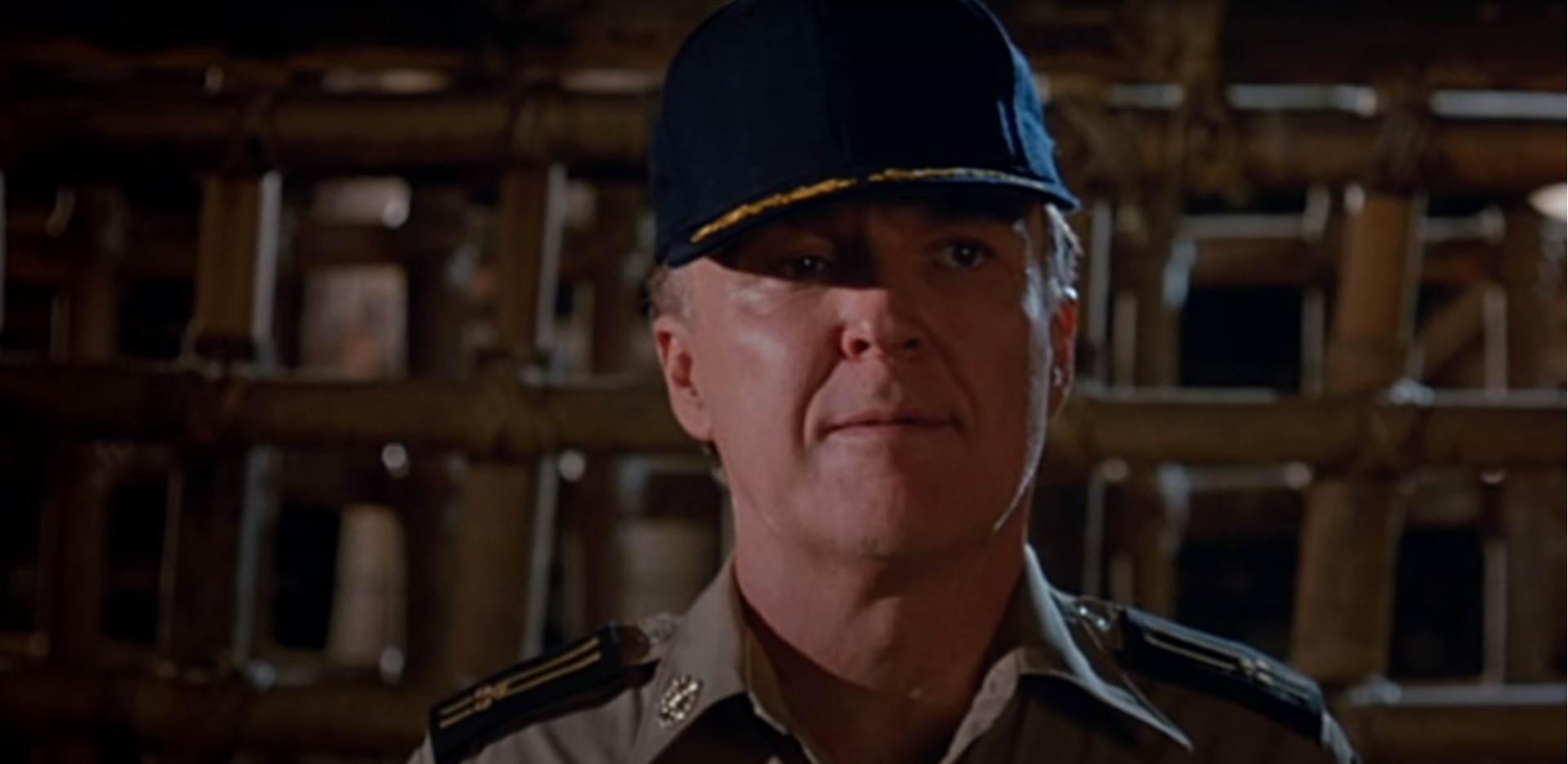
The Slammer is Full of Correctional Officer EVIL in “Lust for Freedom” reviewed!

The Jailed Chicks “Lust for Freedom” on Blu-ray!

Broken by the violent death of her partner, who she was also engaged to marry, after a drug bust goes south, undercover officer Gillian Kaites abandons law enforcement and drives across country in an internal turmoiled mess.  She’s pulled over by a Georgia County cop after she aids a frantic woman fleeing to escape two men in a black van.  Framed for narcotics possession by the corrupt officer, Gillian is drugged and locked away in the County’s women’s penitentiary overseen a strong-handed matron and an unscrupulous warden who dabbles in prostitution trafficking, drug smuggling, and even the occasional snuff filmmaking.  Back into a cellblock corner, Gillian must defend herself against the warden’s goons, protect other girls also falsely incarcerated, and lean into the sympathetic ear of the same corrupt cop that framed her after voicing his years of disgust with the warden’s malfeasance.

Part II of our bamboozled behind bars and following the 1986 examination of Eric Karson’s military simulation turned enslavement “Opposing Force,” is our next feature helmed by another director named Eric, notably Eric Louzil, with “Lust for Freedom.”  The debut film of Louzil, who went on to helm “Class of Nuke ‘Em High Part II and Part II” for Lloyd Kauman and Michael Herz of Troma Entertainment as well as slaving over standalone horror and sleazy schlockers in “Bikini Beach Race” and “Night of the Beast,” was also the first feature penned by the American-born, UCLA grad with a penchant for low-budget lewidies, cowritten alongside the “Shadows Run Black” writing duo, Craig Kusaba and Duke Howard.  With the working title of “Georgia County Lockup,” which in actuality the film was shot in various California and Nevada locations, such as Ely, Nevada, “Lust for Freedom” is an 8 x 8 cell of nudity, violence, and corruption under the co-production companies of Mesa Films and Troma Entertainment, with the latter reediting the original script and adding ADR adlibs to apply a sexed up and Troma-fied integration of product into their independent collection.  Louzil and Laurel A. Koernig produce the film with Troma bigwigs Lloyd Kaufman and Michael Herz as executive producers.

“Lust for Freedom” has many eccentric characters with many assorted plotlines in what is essentially an all women battle royal brawl in the cat-scratchin calaboose.  Stirring up trouble like a piece of scrap metal lodged in the gears of a well-oiled machine is tall and beautiful former cop, Gillian Kaites.  Played by Melanie Coll in her only known role, Kaites is only the bear in the bees’ nest, forced into confinement under false pretenses and to be subjugated by the likes of a wayward officialdom with lust in their eyes, greed in their pockets, and a disdain for disobedience.  Coll’s a bit flat footed with her performance and her Karate Kokutsu Dachi stance could use some improvement, but the tall, muscular, curly haired and light blonde actress can wield a multi-round popping automatic rifle with authority.  Stark against her Amazonian physique, not in a hard pressed and sexualized way, is main antagonist is the unbecoming Southern gentleman Warden Maxwell under the balding and overweight guise Howard Knight, but Kaites is more in tune against the procrustean penitentiary matron Ms. Pusker and Judi Trevor gives a Hell in a cell pastiche of early fascist women of Roger Corman produced WIP films, enforcing her will with prison muscle in the miscreant tough Vicky (Elizabeth Carlisle, “Evil Acts”) and the oversized guerilla (professional wrestler Dee “Matilda the Hun” Booher, “Spaceballs,” “DeathStalker II”).  Ultimately, Kaites sees her only path to escape through the very same person that wrongly confines her in the first place.  William J. Kulzer (“Class of Nuke ‘Em High Part II:  Subhumanoid Meltdown”) doesn’t quite fit the corrupted bill of Sheriff Coale, a mild manner and seemingly reasonable officer who goes with the despicable flow of sex trafficking amongst other indelicacies.  Yet, maybe that’s the purpose in Kulzer’s character, to be conflicted by the choices he and his callous cohort has made that made him stick out as the least repulsive individual behind the concreate and metal barred big house.  “Lust for Freedom” rounds out the cast with Donna Lederer, John Tallman, George Engelson, Rob Rosen, Shea Porter, Rich Crews, Raymond Oceans, Elizabeth Carroll, Lor Stickel, and Joan Tixei.

Gratuitous, full-frontal lesbian sex.  Yes, “Lust for Freedom” appeals to the very definition of its own title, like many other WIP productions and though a core element to the integrity of the subgenre, the creamy smoothness of two curvaceous, naked bodies getting it on shouldn’t always be the main selling point.  Luckily, Louzil ponies up more salacious material for his pinks in the clink caper.  An elaborate spiderweb of activity balloons and pulsates outward from the moment Kaites crosses path with an evening-dressed escapee being chased by a scary looking Native American and his sociopathic hooligan partner in a black van.  “Lust for Freedom” may be hammy and cheesy but what it’s definitely not is dull in its multifaceted approach to expose character layers.  Some characters grade more toward deviancy, such as Warden Maxwell and Ms. Pusker, while others are lifted toward a more redemptive means, such as with Sheriff Coale; that shepherd “Lust for Freedom” into a culminating jailbreak.  The narrative doesn’t necessarily focus around Kaites but she’s on a redemption arc to dig her out of a despair pit and into a fight worth fighting for purpose after the death of her finance, set up in the opening act.  As she evades the Vickey’s directed infringement to rough up the new girl, Kaites takes under her wing a fright clink chick named, another wrongly accused prisoner after being taken wandering the road, a theme that is a reoccurring motif from Kaites to Donna in thinking the young women can manage the world and their problems on their own accord but at a cost. However, whatever semblance is left of Louzil’s original script has likely been lost once Troma revamped it into the finished product you see today. Riddled with choppy cuts and incoherent segues, we have to wonder about Kaites’ role that may have been transmuted into a lesser core commodity in the final product.

Troma Entertainment releases a high-def, Blu-ray release of “Lust for Freedom.” The AVC encoded, 1080p resolution, widescreen release, in a 1.78:1 aspect ratio, compressed from its original aspect ratio of 1.85:1. Lloyd Kaufman mentions Louzil had shot the film on 16 mm and Troma subsequently blew up the negative to a 35 mm print that reframes the transfer for projection. Image-wise, the picture appears relatively clean albeit a plush grain and a few visible 16 mm cigarette burns with little-to-no age wear or exposure issue and the BD25 storage format has capacity aplenty to render an adequately compressed image with hardly any loss to the quality. Since the quality is heavily granulated, definitely no DNR implemented, the compression doesn’t suffer from a lack of a sharper, restored image. The audio is an English language Dolby Digital 2.0 Stereo can be echoey at times, as if the boom is catching warehouse reflection, but dialogue does topple in an appropriately laid out track mix that’s intertwined with hair metal band Grim Reaper’s titular “Lust for Freedom” single. We don’t get a ton of depth in the close quarters of the prison set but neither do we receive any depth in the exteriors either, sustaining most of the volume in a forefront stasis. Troma adds spotty ADR to kitschy up to Troma’s ludicrous level and its quite evident like a sore thumb that doesn’t quite match the ingrained audio mix. There are no subtitles available. Extras include the original DVD intro by Lloyd Kaufman, which also plays automatically at the startup of the feature, a directory’s commentary by Eric Louzil that is asynchronous with the feature in what is an approx. one-minute delay behind the Louzil’s retrospect, the original theatrical trailer, an interview with Lloyd Kaufman, a brief, brief clip of Eli Roth’s encouragement to just go and do a movie to the best of your ability, a Troma-themed showcase of one of their more modern Tromettes – Mercedes the Muse, the Radiation March, Gizzard Face 2: The Return of Gizzard Face, which has been on a slew of Troma’s releases over the past year, and coming attractions from the independent company. The Blu-ray comes in a tradition snapper with a guard tower, barbed wired, and Gillian Kaites with a semi-auto in her grip and barely cladded and torn clothes. No insert inside the case and the disc pressed art is the same as the cover illustration. This Troma release comes unrated, is region free, and has a runtime of 94 minutes. Plenty of desire for “Lust for Freedom,” busty babes behind bars barely bores and this vintage Troma keeps the WIP lacquer wet with self-satisfactory sadism and sexual spiciness.

The Jailed Chicks “Lust for Freedom” on Blu-ray!

Beckerland Fosters Deranged EVIL Upon POWs! “Opposing Force” reviewed! (Scorpion Releasing / Blu-ray)

“Opposing Foce” now in Control of Blu-ray Home Video!  

Air Force Lieutenant Casey has initiative, determination, and something to prove being the first woman to be approved for a special and notorious evasion and escape course on a remote U.S. base Philippine island.  The course simulates downed Air Force pilots behind enemy lines where they either have to evade capture or escape as POWs without divulging U.S. secrets.  The simulating is meant to break down the individual physically and mentally through psychological and physical torture that nearly blurs the regulation guidelines of the United States military, but has been proven to be an effective training to withstand the most brutal of POW conditions despite the course’s infamous reputation.  Casey joins the ranks of participants, a young group of eager male officers and one experienced Major Logan looking to requalifying for action, and are dropped into the simulated enemy combat zone controlled by General Becker, a calculating commanding officer who has succumb to his opposing force role.  Becker’s unconventional and illegal tactics exploit Casey’s gender in the name of training her, but his knowingly criminal activity puts the rest of the trainees in danger and it’s up to the Logan and Casey to stop him and his opposing force in an all hell breaks loose war.

POW exploitation has been missing in modern day cinema.  A subgenre that is a dark, degrading note of unscrupulous and vengeful action has been exclusive to the 1980s for far too long, barely being reprised throughout the proceeding decades.  Not to be restricted to the popularization films of Chuck Norris of the “Missing in Action” franchise or of Sylvester Stallone’s Rambo II and III, these camp from Hell films run the money and production gamut, pulling inspiration on conflict wars before the decade, such as Korea, Cambodia, and even as far as World War II.  For mainstream, the jungle entices with harrowing heroism that glorifies determined, strong-arming patriotism while showcasing America’s enemies as Geneva Convention ignoring villains who deserve every ounce of blow’em up, shoot’em up at the hands of escaped captees or an elite team, or a one-man, rescue mission.  Nazis saw more action in the low-budget Eurotrash market with sexploitative women-in-prison camps ran by the sleazy, inhumane, and experimenting Gestapo mostly.  American filmmaker Eric Karson, director of Jean-Claude Van Damme actioners “Black Eagle” and Lionheart,” moves away from the Muscles from Brussels and into Tom Skerritt’s mustache behind bamboo bars in the 1986, American-versus-America military-thriller “Opposing Force.”  Penned by Linda J. Cowgill, under the pen name of Gil Cowan in what’s likely a name change spurred by sexism in the industry, originally titled the script as “Hell Camp” but took the name “Opposing Force” based off the antagonistic enemy labeled as OPFOR right on their chest.  “Opposing Force” is coproduced by “Skinner” and “Final Mission” producer Tamar E. Glaser and “Sometimes They Come Back… for More” producer Daniel Zelik Bert under the theatrical distributors of Orion Pictures. 

We already know Tom Skerritt’s world-renowned mustache is in the movie and is the star of the show, but Tom Skerritt is in there as well as the man behind the stache as the seasoned boot Major Logan.  The “Alien” and “Contact” actor become the patriarchal figure to a bunch of figurative sons in younger course participants and overprotective of one figurative daughter in Lt. Casey in a wildly uncharacteristic situation brazenly exploited in unconventional mainstream means in the uncomfortable skin of Lisa Eichhorn (“Deus”).  What Lt. Casey goes through is more on familiar ground with the low-budget sleaze of women-in-prison grindhouse and while it’s certainly jarring and unexpected, It’s a welcoming chance for an upper tiered independent film with big names attached.  A couple of the other big names attached are Anthony Zerbe (“The Omega Man”) and Richard Roundtree (“Shaft”) as Commander Becker and his staff sergeant Stafford.  Becker and Logan mirror each other as veterans that have graded into either being corrupted by power or to be righteous in doing what’s right.  Yet, but Zerbe and Skerritt play into what the experienced actors know best, their trademark stoicism.  Tack on Eichhorn’s equally endurable fortitude and a three way standoff erects a monumental solemn stalemate of relatively the same attitudes until the last straw breaks the proverbial camel’s back and war erupts.  Roundtree at least develops Stafford’s internal conflict when the job bites at his conscious, becoming the connection needing convincing of Becker’s crossing over to the darker side of power like a Sithlord in public face disguise.  The narrative physicality aspects piece together a grueling atmosphere that each actor undertakes appropriately by their determined military rank, but as eloquently as Lt. Casey puts it to the aging Major Logan, “You got a limp and I got tits; these aren’t great things ot have in the military,” sets up themselves as misfits-to-heroes that were being crapped on all their careers for their antithetical military image.  “Opposing Force” rounds out the cast with a bunch of moaning male air force participants in the middle of it all with performances from Paul Joynt (“Echos”), Robert Wightman (“Impulse”), George Cheung (“Rambo:  First Blood Part II”), and John Considine (“Circle of Power”).

Influenced by the U.S. Military’s real life training program known as S.E.R.E. (Survival, Evasion, Resistance, and Escape.), Cowgill uses the program to formulate “Opposing Force’s” principle groundwork in setting up the jungle POW scenario on a remote island that goes through the motions of no chance of a rescue and aid of any kind.  Participants are throw into a survivalist gauntlet that turns surprisingly rough aggressive when physical and mental tortures are instilled upon those thinking the training would be a walk in the park.  This particular training simulation is unique to the OPFOR team with an aging officer looking to requalify for combat and the first woman to ever be accepted into the course due to a loophole, throwing new challenges to an embedded far too long commander who can easily break a man’s spirit but tiptoes around the possibilities of what to do with a woman until his insidious power and authority blurs right from wrong and takes the torturous tactics and enhanced interrogation techniques too far, beyond the limits of what’s necessary and beyond the limits of human decency all in the name of reinforce training.  The grueling torture and bush action is palpable enough to contrast the naked, sweaty, and battered bodies with the M1A1 bursts and munition explosions galore.  Only one aspect adds an out of place measure in the narrative and that is of the rest of the POW contingent and their seemingly wishy-washy decision on whether to escape, stay put, or join in the fight against Becker and his live-round shooting island battalion; the group disperses into the jungle only to fade from the climatic third act Major Logan, Lt. Casey, and Botts defending their lives against a treacherous throng and their wicked commanding warden.  Their disappearance doesn’t allow for closure for the acts against them during the entire ordeal and becomes a fizzling distraction.  Another distraction is the severely cut ending that freeze frames on Eichhorn’s final act with her voiceover exposition post-battle in what feels sorely rushed to complete.  The Blu-ray bonus features has an extended ending that’s more completist approach in wrapping up the story sutibly.  For a POW film, “Opposing Force” is an archetype of its originating decade that sates the subgenre’s need to pit an overreaching and ruthless camp head against the resiliency and determinate of the America fighting spirit. 

A re-release from the 2019 Scorpion Releasing Blu-ray comes “Opposing Force” reprising a presence on online retail shelves.  The AVC encoded, high-definition, BD25 is presented in 1080p resolution with a widescreen 1.78:1 aspect ratio.  Identical to the earlier Blu-ray 4 years prior, the image quality is freshened up quite a bit from the likely 35 mm print source into a detail-laden HD transfer that offers a lush jungle-scape to be in juxtaposition against the camp from within its center, a large guerilla compound bathed in browns and greens make for good POW-themed pageantry.  Skin tones and individual features flesh out nicely, adding detailed levels of salubrious status over the course of the day-to-day detainment. The English language DTS-HD master audio 2.0 leans toward a softer dialogue mix that, for the majority, is discernible despite favoring “Opposing Force’s” selling points: large explosions, pepper potshots, and militant vehicles running rampant around and above the island terrain. Dialogue’s clear enough to emerge without much hinderance with enough depth to provide a sense of position and the audio layer is remarkably clean with no hissing, popping, or static. English subtitles are an available option. Special features include an audio commentary with director Eric Karson, the trailer, and that extended ending I mentioned, and noted preferred, earlier in the review. The traditional Blu-ray snapper casing includes a rendition of the alternate titled “Hell Camp” poster with a more titillating illustrative lookalike of Lt. Casey in shredded rags and ride-up shorts with hands tied above her head and looking over her shoulder. The warm yellow with a hint of white stirs in an element of jungle heat ramped up by also providing the cage accommodations in the background to let it be known you’re about to watch an exploitation POW film. Locked on a region A playback, “Opposing Force” has a runtime of 98 minutes and is rated R. Eric Karson manages to find a place amongst a serrating subgenre that takes an ostentatious, yet not entirely fictious look, at prisoners of war with his “Opposing Force” actioner that goes to convey that not every unethical and malintent camp leader is a foreigner; evil can also be domestically grown.

“Opposing Foce” now in Control of Blu-ray Home Video!  

One Tough Cop Taking on Evil Cyborgs! “Nemesis” review!


In the year 2027, enhanced humanistic cyborgs virtually run the planet with the renowned L.A.P.D. being no exception. Alex Rain, one of L.A.’s finest brute cops, is partially cyborg himself, but the essence of his soul remains human intact while his synthetic flesh cloaks the icy machine beneath. After tracking down suspected cyborg terrorists and almost losing his life in the struggle to stop them, Alex questions his dwindling humanity, leading him down a path of unfulfilling revenge and botched smuggling before his former employer, the L.A.P.D. commissioner named Farnsworth, tracks him down and uses deadly coercion to force Alex as a pawn in dangerous covert mission. The burnt out cop is thrusted back into the fray of his former life when Farnsworth orders him to retrieve data from the treacherous female cyborg, Jared, who was once Alex’s partner and lover, before she hands over the sensitive information to a group of cyborg terrorists who call themselves The Red Army Hammerheads. With a micro bomb implanted near his heart as insurance, Alex has no choice but to accept the assignment before detonation in 3 days and with his time running out, finding Jared isn’t the problem as Alex comes to realize that deception has convoluted the stakes and nothing is who or what they seem.

Albert Pyun’s 1992 cyberpunk action-thriller “Nemesis” is an explosive-heavy, science fiction existentialism film never before seen, or even aware of, by this reviewer, but the ground-worked narrative has remained a constant piece of foundation in being the byproduct of inspiration extracted from other cyberpunk films of its kind, such as “Robocop,” “Blade Runner,” and “The Terminator.” “Nemesis” has a presence much to the tune of another film, “Cyborg,” starring John-Claude Van Damme and that inclination would inevitably make a world of sense when the awe-striking epiphany lands that Pyun also directed that film, also utilizing some of the same actors for his early 90’s cybernetic dystopian feature. In reviewing Pyun’s credits, the assumption can be made that the filmmaker has a sturdy hard-on for the intertwining of mankind and machine as not only did the director write and direct “Cyborg” and helmed “Nemesis,” but went on to be a part of, whether director, writer, or producer, of four more “Nemesis” sequels with a fifth being produced and shot, but scrapped in post-production due to Pyun’s flailing mental health. Rebecca Charles fed the scribal beast as “Nemesis’” screenwriter, along with penning “Nemesis 2: Nebula” and “Nemesis 3: Time Lapse.”

Alex Rain is a cold cut character, sliced thick like a cool cucumber on top of a hard to wedge salad. Rain’s iciness symbolizes his downtrodden humanity status and with each part of his body shattered from destruction, he becomes one step closer to being an automaton with eye brows. B-movie action star Olivier Guner essentially make a big career breakthrough with “Nemesis” as his sophomore feature. Guner’s military background suitably solidifies his physique as a workaholic cyborg cop while also presenting a rough cut speech impediment that’s very straight forward and without emotion. Some would say that Gruner’s approach fits his half-human, half-toaster oven character and I would say that would be correct. The 80’s and 90’s saw a crowded entry list of action stars, including Jean-Claude Van Damme, Chuck Norris, Steven Seagal, Sylvester Stallone, Arnold Schwarzenegger, and many others in various degrees of success – and Olivier Gruner became one of those faces that had since then been lost over the years; Gruner’s performance in “Nemesis” lacked pizazz which could have been the contributing factor to his success, but the monotonic, unflattering one-liners and blank face stare didn’t spark any fires on top of his average muscular frame. His performance, to keep with the fire motif, didn’t provide the oxygen, a combustible, or a flammable source to quickly set ablaze a trail for semi-popularity amongst his peers and that’s where “Nemesis” falters in entertainment value. Comparatively, “Trancers” franchise actor, Tim Thomerson, is full of range and vigor as an concealing Commissioner Farnsworth. Thomerson, in his early 40’s at the time of filming, displayed an impressive physicality to his role, keeping up nicely with his onscreen rival. Farnsworth, from the get-go, reeks of desperation when pressuring Alex to do his bidding and Thomerson really nails the part and can switch on the proverbial dime as an egocentric field operative when chasing Alex through the jungles on the Hawaii set. The night and day performance is a stark contrast between the two actors. What’s mostly disappointing about “Nemesis’” cast that favorable characters come and go; some the characters a pinned with terrific actors such as Shang Tsung himself, “Mortal Kombat’s” Cary-Hiroyuki Tagawa, as the leader of The Red Army Hammerheads and the late, great Brion James (“Red Heat”) chirping a lousy German accent of the Commissioner’s right hand man. The cast has many other recognizable names that, again, come and go, including a strung out looking Merle Kennedy (“Night of the Demons 2”) as Max Impact, Marjorie Monaghan as the algorithmic beauty Jared, Vincent Klyn (“Cyborg”) as a disposable bodyguard, an extremely fit and nude Deborah Shelton (“Body Double”), voice actor Nicholas Guest (“Dollman”), brief cameo by Jackie Earle Haley (“Watchmen”), a fresh faced version of “The Predator’s” Thomas Jane, and Thomas Jane’s bare ass.

The financial backing was obviously designated for a particular department in the “Nemesis” workshop and that department was special effects. Explosions, rotoscoping, stop-motion, sculpture, implosions, practical effects and makeup are just the tip of the iceberg. Frayed wires and eye ball cannons are the elegant touch that makes “Nemesis” a cult favorite and bring substance to a clunky storyline and divisively dynamic acting. However, not all the specials are pinpoint precision and grounded by reality. The one scene that stands above the rest when Farnsworth is hot in pursuit of Alex and Max and he’s shelling off rounds of a shotgun, standing relatively still, blasting away without moving the barrel around to compensate for his prey’s length of distance gained or even when they decided to make quick pivots in direction. Somehow, the rounds hit very close to Alex and Max and that’s not all, they even explode like a single stick of TNT. ACME must have had a hand in the special effects department because the scene sure was loony. Yet, the implosion of a monolithic silo was uber-impressive, well-executed, and really ritzy for the silver screen.

Imperial Entertainment’s “Nemesis” infiltrates onto another home video release, a region free, dual DVD and Hi-Def 1080p Blu-ray format release, from MVDVisual under their MVD Rewind Collection series. Sheathed by a slick, retro-grade slipcover with familiar art, reminiscent of the now decade old Sterling DVD release, the special collector’s edition provides two aspect ratios, an anamorphic widescreen 2.35:1 and a widescreen 1.78:1. This MVDVisual Release has stellar detail in the texture and in framing that are exhibited in various tint shades, such as yellow and blue, and eventually cough up toward a more natural look into the second act when Alex reaches the rough neighborhood of Shang Loo, Java. Even though the visual compositions and mold work doesn’t pop with color and are a bit fuzzy, “Nemesis” is a product of it’s time, the early 1990’s and you can’t fault Pyun’s film for that. The English 5.1 surround sound is beautiful. So beautiful and potent, in fact, that you can actually understand Olivier Gruner’s mumbling, putting dialogue for all characters right into the front row while offering a stimulating range and depth of ambience sound, an unlimited variety of explosions, and plenty of miscellany cyborg hubbub. Other language are available, including French, German, as well as English in 2.0 stereo and there are English and German SDH subtitles available The Blu-ray bonus features include new interviews with producer Eric Karson and director Albert Pyun, “Nemesis 2.0” the director’s cut with Albert Pyun audio commentary, and original theatrical trailer. The DVD is the director’s cut and also includes the Japanese cut with Japanese subtitles burnt-in. Bonus features for the DVD include introductions by the director Albert Pyun and star Olivier Gruner, an afterword by Albert Pyun, a behind-the-scenes featurette, an interview with star Olivier Gruner, the making of segment involving the hefty special effects, stunt work, and visual effects, a featurette entitled “Killcount,” a behind-the-scenes photo gallery, TV spots, Key Art Photo gallery, and, top it all off, a mini-poster inside the casing. Inside a killer definitive, two-format and disc set from MVDvisual, “Nemesis” hones in on the existentialism notion of what being human actually means to each and every one of us through the bombardment of gun fights and jumbo explosions on top of a conglomerate cyborg coup that peaks with hard bodies and even harder viewer contemplation.