Digging Up the EVIL Disentombs the Past! “Exhuma” reviewed! (Well Go USA Entertainment / Blu-ray)

Open the Blu-ray Coffin on “Exhuma” Today!

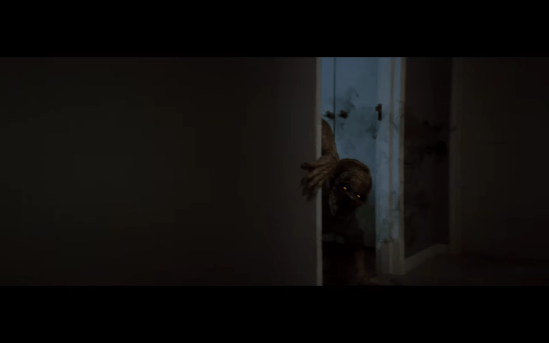
A shaman and her assistant recruit a geomancer and a mortician to investigate the case of an American newborn boy’s distressing grave calling that has also haunted every patriarch member of the family for generations.  The large paying job sends them to remote forest where the unmarked grave of the boy’s great, great grandfather lies beneath the dirt.  For the geomancer, all signs point to not disturbing the grave but the father’s eagerness to cure his son’s troubles and the shaman’s persistence for a big payday goes against the wise geomancer’s better judgement.  All is seemingly well after exhuming and transferring the ancestral coffin to be cremated at a nearby hospital the next day until a greedy, hospital official pries open the sealed casket, releasing a long-awaited evil, and digging up out of the same burial ground another malevolent and mysterious ancient force that reaches far beyond the borders of Korea. 

Here as of late, ItsBlogginEvil.com’s last three reviews have taken readers on a genre-diverse tour of Asia, from Japan with Yu Nakamoto’s meta-slashers in “Ikenie Man” and “Harawata Man,” to Hong Kong with David Chung’s affrayed police actioner “Royal Warriors,” to conclude in South Korea with the supernatural horror in the realm of cultural superstitions of P’ungsu, or geomancy, in Jang Jae-hyun’s latest written-and-directed thriller “Exhuma.”  The 2024 film follows a string of religious related, supernatural themes Jae-hyun has put out in his prior two directed projects with “The Priests” and “Svaha:  The Sixth Finger,” and like “Ikenie Man,” “Harawata Man,” and “Royal Warriors,” a portion of Jae-hyun’s films are touched by Japanese culture.  “Exhuma” amounts to the same standard of crisscrossing the two cultures with dangerous results with “Exhuma” digging up a past better left alone.  Park Hyeong Jin and Kwon Ji Yong (“Ghost Mansion”) produce the spiritually turbulent story under Showbox Entertaiment and Pinetown Productions. 

“Exhuma” encircles four culturally inclined characters that entrench themselves into an unorthodox means of exhuming a disturbed essence for what is essentially an exorcism variant to alleviate living perturbation beyond the grave.  The superstition here revolves around the land temperament.  Geomancers find good sites to lay people to rest, ones that exert extrasensory, or grave call, troubles onto family members that place upon them a grief, anxious, and other mentally uneasy state, and it’s the “Exhuma’s” Geomancer who has story predominance, shared only with the young and beautiful shaman woman with tagalongs who resemble more of assistants than coequals.  In an age-old and cautionary tale of wisdom and inexperience, Choi Min-sik (“Oldboy”) and Kim Go-eun (“Monster”) play the respective roles of the reluctant and experienced Geomancer Kim Sang-deok and the naïve eager yet gifted shaman Lee Hwa-rim.  Receiving character voice over monologue introductions and becoming the ultimate deciding factors of this new job is worth the pay, they completely overshadow the Shaman apprentice (Lee Do-hyun,) and the mortician (Yoo Hae-jin) who works with the Geomancer.  Pivotal as these support characters are to the story, not only buffers for the evil that beleaguers them but also as latched on friends and family of the isolating weird and strange subculture to most but normalized in Korea, the shaman apprentice and mortician definitely take a back seat to the more prominent players to the point where they almost seem contributorily worthless to the task.  As a whole, the dynamic works because the shaman and geomancer alone would not be sufficient for diabolical misadventures of an exhumation gone wrong and supplement only when necessary to aid the fight against an ancient evil twice over.  The cast fills out with Hong Seo-jun, Jeon Jin-ki, Kim Jae-Cheol, and Lee Jong-goo.

The wafting back and forth between Korean and Japanese culture, the fraternization of beliefs and superstitions, tells “Exhuma” differently than most hilltop haunts and horrors.  Themes of a haunted past and inexplicable guilt riddle holes through family lineage, resulting rancorous ripples in the form of mental illness, and devised as a story vehicle device of supernatural subverting trauma from the sins of the father.  In America, Shamanism and Geomancy don’t exist, especially in the history, but for Korea and its people, the country is rich in transcendent ritual and mythology that shapes society, even in their cinematic culture as regularly do we see period films of feudal Korea.  History also dictates “Exhuma’s” need to be a representation of purging the long Japanese occupation of Korea for nearly three and half decades from 1910 to 1945.  The occupation was a disruption in Korean way of life with oppression and war machinations stitched into Korean’s fabric, hence the Korean plot of land being very spoiled with vileness in “Exhuma’s” tale of one historically troubled family’s course to remove that uneasiness that has plagued and followed them to America.  Yet, the past is rooted deep and Jang Jae-hyun’s understands the difficulty of eradicating a sullied ancestry by dichotomizing his darkly toned, folklore valued, and occult twisted story into two parts with sublayers as deep as the dirt surrounding the coffin, or rather, coffins with a formidable presence created and conjured by malicious Japanese Yōkai and represented in one of the most iconic Japanese figures as remnants of an Imperial Japan occupation.

Lying in wait underneath the high-definition terra firma is Well Go USA Entertainment’s “Exhuma” on an AVC encoded, 1080p resolution, BD25, presented in a widescreen 1.78:1 aspect ratio. Accompanied by no information on the video vehicle, IMDB.com lists Jang Jae-hyun and cinematographer Lee Mo-gae shoot with an Arri Alexa Mini which offers the ease of use of multiple lenses, and that shows here with a vast stretch to encompass the Korean mountains into the frame as well as keeping tight on characters while keeping in focus the immediate surroundings. Details are sharp under a flinty tone of saturated grays and blacks with spot pops and glows of in-scene lighting and under the capacity’s umbrella, finer textural elements suffuse through the darkness and into the fold. Audio options include the original Korean language DTS-HD 5.1 and an English dub DTS-HD 5.1. Crystal clear dialogue runs through parallel with the visual counterpart and is well timed and potent, touching the side and back channels with the eerie callings of the grave and its inhabited spirits running rampant free while harnessing focus on the character on scene to create a ranging discarnate of deep, ominous sounds that stalk and haunt the principals. English translation paces well and appears to be translated grammatically and is error free. Well Go USA Entertainment releases are feature focused and this one too containing only a making of featurette in the bonus content along with the trailer. The interior of the traditional Blu-ray Amaray comes with a disc pressing of the four principal characters peering into a dug grave. The exterior has a two-tone, subsoil profile forming a face out of a grave with the four principals on the topsoil and the same image also graces the cardboard O-slip that has a pseudo-lenticular sheen. Authored to have a region A playback, “Exhuma” runs just over two hours long at 135 minutes and is not rated.

Last Rites: The addition of learning authentic, practiced rituals benefits “Exhuma’s” folklore frights tenfold and with neat, grounded performances and a superb blend of visual and practical effects, this original, supernatural thriller raises the Korean movie industry up a notch on the global scale.
Open the Blu-ray Coffin on “Exhuma” Today!

Evil Hate Trumps Good Love! “The Hatred” review!


In 1968, former Nazi occult officer, Samuel Sears, runs a strict farm in rural America, restricting his only daughter Alice from the corruption of the outside world with an infinite workload, and Alice violently rebels against her tyrannical father, Samuel kills her with rage. Hidden deep in the dark basement of his plantation home, a powerful Nazi-occupied amulet, charged by fear and hate, feed on his rage and fear and curses him to do the unspeakable. In the present day, four college girlfriends retreat to a friend of the family’s recently purchased foreclosure farm house, the abandoned and forgotten Sears farm, for a relaxing weekend getaway, but after night of drinks and games, the amulet reignites an ominous and dark cloud, reviving long forgotten, evil spirits who search for an endless quantity of fear and hate and will stop at nothing to swallow the souls of each and everyone inside the Sears’ estate home.

“The Hatred” is the 2017 haunting thriller from writer-director and Brooklyn native Michael Kehoe and produced by long time “Halloween” franchise producer Malek Akkad. Kehoe tells the story in two parts with the first delving in the Sears family, getting a first hand look at the hardworking German mennonite character that is Samuel Sears whose a former war time Nazi that’s settled down and raised a family in America’s backcountry. From what can be gathered about Samuel Sears, the farmer protects his past identity and isn’t ashamed of yet, but rather proud of his accomplishments alongside the Führer. All of the attributes of a proud countryman come suddenly alive when he receives a mysterious package containing the amulet, a photo of him in full Nazi dress standing with Adolf Hitler, and a signed letter personally acknowledged by the Nazi leader himself offering him the amulet as a gift for his fine work during the War and that ultimately becomes his downfall, pitting him against his family. The second part of the film tells a more uncharismatic story of four young girls staying at the Sears farm in present day. One of the girls, Regan, just finished college and is about to start a new job and what’s her ideal getaway with her girlfriends? An old (haunted) farmhouse.

“Wishmaster” himself, Andrew Divoff, gives “The Hatred” much more life despite his joyless character Samuel by somehow giving the former Nazi, now American farmer personality traits that are haunting in an unforgettable performance during the first act. The same can not be said about the four girls – Regan (Sarah Davenport), Layan (Gabrielle Bourne), Samantha (Bayley Corman), and Betaine (Alisha Wainwright). There’s no comparison as Samuel is a superiorly written and finely performed character than those he stalks beyond the afterlife. The gaggle of women offer no substance in the face of adversity or just plain ole progression of their character. Numerous times does Regan’s sick grandmother have scenes and Regan passively forgets about her poor grandmother’s health or Samantha’s uncanny interesting in history that really goes no further than the random facts that she spews. Regan and Betaine seem to have this close knit relationship, yet it founders and is suddenly cut short when all hell breaks loose. There are no personal connections established, offering little-to-no worth to their lives when Samuel comes calling for their souls, and leaves “The Hatred” in the take-it or leave-it column in the second and third act. Darby Walker, Nina Siemaszko, and Shae Smolik complete the cast.

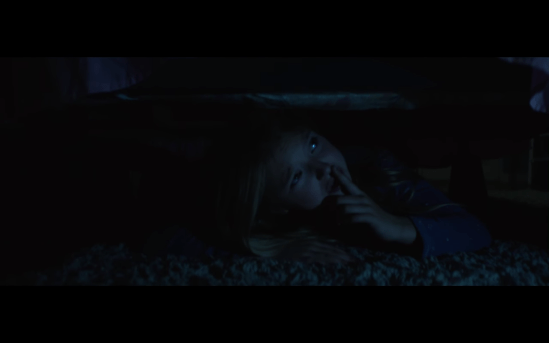
Kehoe does display intense, nail-biting visuals with the materialized embodiment of fear and hate as well as sly editing with a scene involving Shae Smolik’s Irene, a little girl whose friends with Regan, who asks Regan to check under her bed, for supposed shadowy figure. When Regan pulls back the skirt to look, she sees another Irene putting a finger to her mouth, hushing Regan, and saying, “that’s not me,” as she points upward toward Regan’s impending doom. The heart-stopping moment will tear eyes away from the screen in anticipation of what Regan will see atop of Irene’s bed. However, that’s the sad truth in the extent of Kehoe’s story; a story riddled with plot holes and underdeveloped subtexts in which one in particular pertains to the aforementioned subplot of Regan’s ill stricken grandmother that goes undercooked when attempted to connect with the supernatural portal that of the Sears farm home. Characters disappear to never be seen again, character motivations go unexplained, and backstories are like a hazy dream and the entire ensemble is a mismatched, muddled mess in a premise that should have continued with the motif of the Nazi infiltration into America and less about scaring the wit out of witless girls with the creepiness of an alternate dimension seeping out of an unholy amulet.

The Lionsgate Films’ “The Hatred” is presented by Anchor Bay Entertainment on Blu-ray and UltraViolet home video in a 2.40:1 aspect ratio from an encoded AVC 1080p transfer that’s sleek and well lit, especially capture Samuel’s earthly and grim nature. The overall atmosphere doesn’t particular hone in a horror palette design, but offers realistic ventures into brightly lit areas of dark scenes. Details are fine in more of the natural aspects of the film whereas the CGI goes soft at times, but still very well detailed. The English language Dolby TrueHD 5.1 keeps Kehoe’s film buoyant with a leveled mix through and through with clear fidelity and good, if not great, surround sound output. Instilled with conventional horror schemes, burdened with design flaws, and unfocused in it’s inability to pin down an narrative identity, Malek Akkad and Michael Kehoe’s spook house feature “The Hatred” requires much tender loving care to uplift this unkempt cliche horror into a coherent thriller.

“The Hatred” on Blu-ray+UltraViolet!

Feeding Off on the Evil Energy! “The House on Pine Street” review!

the-house-on-pine-street

Married couple Jennifer and Luke move to Jennifer’s small hometown in Kansas suburbia after an incident with Jennifer’s pregnancy at their city home in Chicago causes concern for the baby from both Luke and Jennifer’s mother Meredith. Feeling not at home and isolated, Jennifer quickly detaches herself from everyone around her, but when spooky occurrences start to slowly reveal in their new home, Jennifer desperately needs her family and friends to eagerly believe that the house is haunted. When everything firmly believes that Jennifer might be suffering from another pregnancy episode like in Chicago, the young woman experiences a psychological horror that drives her into a blurred line of what’s she seeing is either frighteningly real or a nightmarish psychosis.
vlcsnap-2016-01-13-21h48m33s9
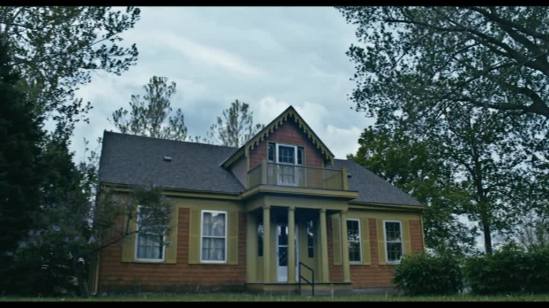
“The House on Pine Street” is a chilling, effective thriller helmed by twin brothers Aaron and Austin Keeling, who both also co-wrote the film with newcomer Natalie Jones. The Keeling twins, along with numerous short film cinematographer Juan Sebastian Baron, were able to capture alluring framing and uncomfortable camera angles, consisting of the use of medium and close up shots, that suit the film’s unsettling and haunting nature. The poetic beauty of the vibrant exterior contrasted with the bleak and rundown features inside the Luke and Jennifer’s home tell the harrowing story of where the dread begins and lingers to languish and the brothers were really able to set the entire pace of the film, prolonging out the story’s suspense, and able to create an engaging tale within about a two month time spatial difference and have it laid out logically.
vlcsnap-2016-01-13-21h27m55s176
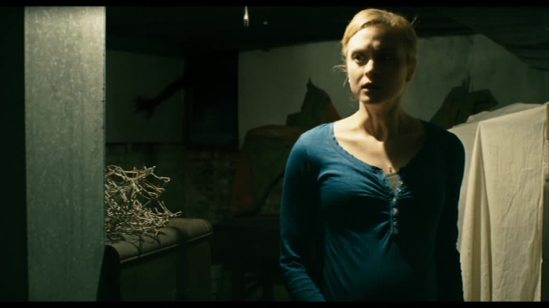
Aside from the obviously talented crew, the phenomenal cast ranks this lesser known 2015 ghost film near the top. Emily Goss embodies Jennifer’s loneliness and fear through the subjection of constant ghastly occurrences. Whereas Jennifer’s husband Luke played by Taylor Bottles, even with the slick and enduring hipster hairdo, feeds off Goss’s non compos mentis situation, making the character Jennifer drown in darkness without any compassion. Personally, Jim Korinke captured my favorite performance as the neighborly quasi medium. With no acting credit to his name, Korinke’s ability to keep up and maintain with a younger, more experienced acting talent is beyond remarkable on screen and fun to watch.
vlcsnap-2016-01-13-21h46m09s114
Much like the film’s generic title, the story is simplistic; however, the story is without a mind blowing twist which most of Hollywood gets off on. “The House on Pine Street” speaks in underlining messages. The motif of energy keeps reoccurring throughout much of the plot, sparking the conversation that negative or positive energy will be the inevitable karma influence. If a person emits negative energy, bad juju will be the result and visa versa. While the story hovers around Jennifer’s locus, her negative, pessimistic attitude contributes to the tribulations toward other characters. The Keelings were able to subtly convey the energy message without being blatant and expositive.
output_ybEM1X
“The House on Pine Street” works and works well regardless of the overused and lackluster title that has become more repetitive and an unfortunate eyesore to those scouring the retail racks, looking for an engaging thriller, but the Keeling duo are a pair of cinema prodigy twins, who with the right cast and crew can take a smaller project, like this, and polish it into gold. Second Sight distribution is set to release this spin-chilling “The House on Pine Street” thriller onto DVD home video in the UK on February 1st. Just in case you’re not completely sold, take it from me that goosebumps will occupy every inch if your chilled flesh when watching in the dark and the light.

All Evil Needs is Love! “A Cry from Within” review!

vlcsnap-2015-03-14-14h22m25s203
Jonathan and Cecile live in the New York City hustle and bustle lifestyle with their two children and when they suffer a devastating miscarriage, they decide to move to the slower life of a Long Island rental that was owned by a woman and her catatonic mother. As soon as the family starts to settle in, the daughter Ariel starts to converse with whom she calls Sebastian – a manifestation of a young boy who roams the house. When things start to get worse, Jonathan and Cecile desperately try to unravel the secrets of the house in order to save their family from the supernatural occupant.
vlcsnap-2015-03-14-14h26m24s37
So bad it’s good. That’s how I describe my viewing of Deborah Twiss’s “A Cry from Within.” The script penned by Deborah Twiss is solid but the poor execution digs a deep hole of which the film can’t climb out of to save it’s own legacy. Plagued by numerous wacky edits and acting straight out of a Uwe Boll production, “A Cry from Within” needed a slowed pace of production perfection and need to have veteran actor to stop saying “baby” to his wife every other sentence. Don’t get me wrong, I still like Eric Roberts. Best of the Best is still one my favorite martial art films of the late 80’s. As of late, Roberts has been in nearly every damn low budget movie and especially in horror with “A Cry from Within” being just the tip of the iceberg, but his husband role feels more distant and disconnected than the husband should be considering he’s suppose to be the support system to his wife and children.
vlcsnap-2015-03-14-14h26m49s37
Speaking of wife, writer-“supervising” director Deborah Twiss plays the wife Cecile. Her melodramatic take on a woman who just had a miscarriage and is living with a malevolent doesn’t speak to the dire situation. You might remember Twiss from her hot for teacher role in Kick-Ass or more notoriously notably her raunchy blowjob scene in the black comedy, not that space film, television series Gravity. Roberts and Twiss don’t ever seem to connect and they’re equally child-like in their reactions to the situations in, what I thought wasn’t possible, separate mannerism. Twiss also casts her very own children, Matthew and Sydney McCann, as her on screen children who are spellbound victims and tormented by this house-spirit.
vlcsnap-2015-03-14-14h27m30s183
I also expected a little more from “Cop Land” actress Cathy Moriarty though her role as Alice is more down to earth as a annoyed daughter with a devastating secret. Moriarty has a sinister outlook throughout most of the duration, but her character’s intentions are murky at best. We don’t know if she’s suppose to be a good person or a bad person. The cast rounds out with “Max Payne” voice actor James McCaffrey as Father Thomas who unknowingly shares a secret with Alice. McCaffrey is solid up until the end where, basically, ever character becomes a sobbing mess of hopelessness. Robert Vaughn even makes an appearance very briefly as a doctor and I was sold on the “Battle Beyond the Stars” actor as a silver-foxed medical professional and that was only for a minute worth of screen time.
vlcsnap-2015-03-14-14h28m15s126
“A Cry from Within” suffers severely from choppy editing that causes aggravating transitions from scene to scene and this aids in not setting up the film properly for success. I’m still trying to figure out why Deborah Twiss had to be the supervising director over director Zach Miller, maybe because she was one of the stars she had to the right to tell Miller when to cut and when to go into action. Miller seems to be a lame duck in case the film goes south. The Breaking Glass Pictures DVD release, slated for St. Patrick’s Day March 17th, is so bad its good and I’d suggest taking a look because I’m sure you can’t look away.

Nudity Report

Deborah TwissBreasts – Twiss briefly shows off her massive chest while in bed with Eric Roberts who aggressively goes straight for the right nipple. I do feel that through the film Twiss wanted you to notice her best assets by wearing low cut shirts that show her deep-as-the-Mariana Trench cleavage. Also, the temperature must have been constantly cold on set resulting in many scenes of stiff nipple outlines. Her one topless scene in “A Cry from Within” is by no means as good as her full nude scene in the television series “Gravity” but Twiss emits a hot mother aura and that’s the possible reason why one can’t turn away from the screen.

Wan Conjures Evil! The Conjuring trailer is HERE!

James Wan

James Wan

When I see the name James Wan, I think Saw and thats about all that comes to mind. But I do know of, have seen of, and have enjoyed much of Wan’s work. Dead Silence was a solid sophomore film while Insidious gave Wan a second look by not only fans but by studios as well, proof is in the Insidious sequel. Death Sentence strays away from his horror roots yet still delivers a dark and gritty atmosphere and one of my favorite Kevin Bacon movies. Also, Wan is part of the R-rated, low-budget group of filmmakers called the “Spat Pack” which has pretty much dissolved now, but this group consists of Eli Roth, Alexander Aja, Rob Zombie, Darren Lynn Bousman, Neil Marshall, Greg McLean, Robert Rodriguez, and Leigh Whannell.

Today, Wan’s latest venture has been given a trailer and was released to us. The Conjuring which tells the story of paranormal investigators Ed and Lorraine Warren who were hired to help a family against a terrorizing dark spirit in their farmhouse. Sounds simple enough, right? The trailer itself leaves a good taste in your mouth and doesn’t market itself as your run of the mill haunted house film. I, for one, am excited about The Conjuring and movies about hauntings are low on the totem poll for this guy. Lili Taylor, whom I haven’t seen in a movie since…well…1999’s remake of The Haunting, stars along side her on screen husband Ron Livingston (Office Space) and paranormal investigators played by Vera Farmiga (Orhpan) and Patrick Wilson (Insidious).

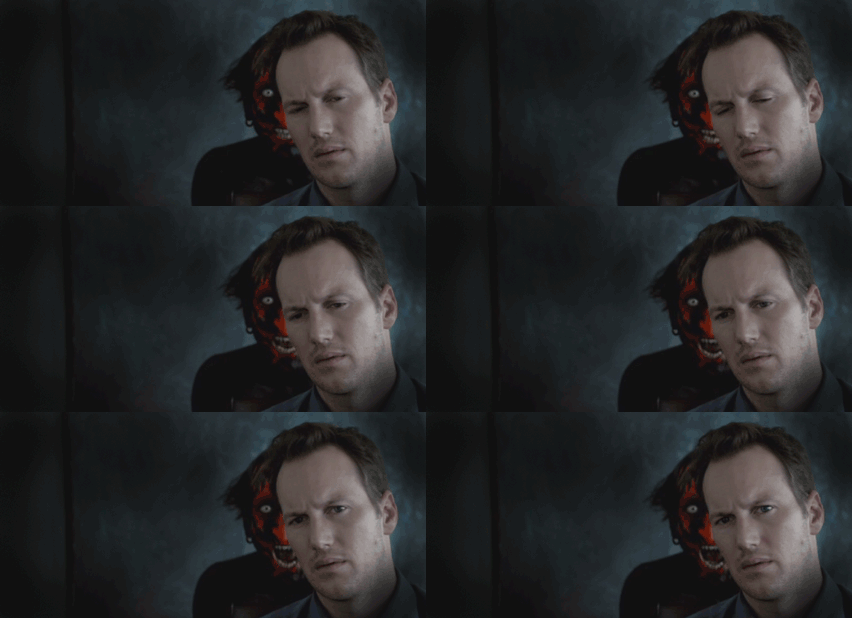
A scene from Insidious

A scene from Insidious

I’d like to say a little something about the spirit in the trailer; though too early to tell how the film will play out, the trailer makes the spirit seem playful yet personally dark. The trailer builds the suspense with long, still, and quiet scenes – which makes every scene on high tension terms.

Warner Brothers is behind James Wan and his film which is penned by Chad and Carey Hayes – the duo behind the remake of House of Wax so we have quite of bit of Vincent Price homagers behind The Conjuring. July 19th is the release date and I’m holding this film in high regard. Can’t wait! #theconjuring http://theconjuring.warnerbros.com/