Fixing the Tracking on Those EVIL VHS Cassettes! “Snuff Tapes” reviewed! (MVDVisual / DVD)

Ready to be Recorded?  “Snuff Tapes” now available at Amazon.com!

Marcela Arkaino investigates a Talca, Chile rapist and murder who has been drugging and abducting women for years to record aberrant tapes of his cruel exploits.  Marcela takes a special eager interest in this particular assignment as she was one of those unfortunate women.  As a silver lining out of an extremely bad situation, she is one of three women left alive by her brutal sex-sadist aggressor.  As the reporter in her garners the difficult stories from the other two survivors, Cataline and Jesus, abused by the same masked man, she inches closer to his whereabouts by triangulating attacks and connecting similarities but her scouring of roadside market, unlabeled VHS tapes became the smoking gun needle in a haystack that produces not just any depraved tape of his victims but of her own ordeal, turning now an inch into a mile in finding him.  Bring the other two women into the fold, Marcela devises a plan of revenge to direct a snuff film of her own, starring their rapist and torturer.  

Hailing from Talca, Chile, the same location where the story is set, comes the shock-slamming, VHS-inspired thriller “Snuff Tapes,” aka “Cintas Tapes,” from the Chilean born independent filmmaker, Vito Garcia Viedma.  The writer-director’s prior two zombie-influenced short films, the 2012 “Bajo el sonido del tren” and the 2017 “Escape from Zombie City,” along with the criminal underbelly 2017 feature, Los culpables,” displays a course change deviation that wouldn’t prepare the average Viedma film fan for his 2020 venture into the dark underworld exploitation of indie snuff.  While the title highlights the concept around videotaping the misuse of a person’s trust and vulnerability for one’s own disturbing profit, in this case to get one’s jolly’s off, much of Viedma’s story skirts around the edge with just mentioning the nixing of captured and consumed of vivacity women, saving the story’s climax for more detailed death dealing in a vengeful perspective rather than a videotaped one. “Snuff Tapes” is created under Viedma’s ZineFilms production company in association with Cabro Chico and Trippas Productions.

“Snuff Tapes” is no “8MM” with a mega-Hollywood budget and Nic Cage doing Nic Cage antics. “Snuff Tapes” is no “Effects” with cult icons Joseph Pilato and Tom Savini helming sordid scenes from fantasy to non-fiction. “Snuff Tapes” isn’t even on the same level as “A Serbian Film” and, to be honest, I don’t think any film anytime soon will ever be on the same level as that twisted picture. What all three of those successful and notorious films have in common and what Viedma lacks in separating itself from the rest are in two very important details: a budget and an array of talent. Viedma’s film humbles in comparison with not only a microbudget but also in a cast makeup of essentially five actors with withering substance. Valentina Soto Albornoz stars as the retribution-reporter, Cataline Ibarra, who for the last decade has been piecing together clues of her kidnapper’s whereabouts by purchasing random video cassettes tapes from Talca street vendors and when Ibarra strikes gold unearthing her own ugly tape, she understandably feels overwhelmed reliving visually the nightmare and subsequently gravitates toward being hellbent for revenge. Ibarra recruits her survivor carbon copies in the tattooed Jesus Mayano (Camila Medina) and aspiring photography model Marcela Arkaino (Camila Carreno Arancibia) for a little payback, but Ibarra, aside from her good friend Esteban (Hugo Villar) providing her a PAL encoded VHS player and rewatching her tape to catch clues missed, she virtually does all the legwork in pinpointing the one responsible, drugging him, abducting him, and committing herself to the nitty-gritty, fantasy plan for whenever she got her hands on him. I’m not sure what roles or business Arkaino or Mayano actually had to just stand there moping other than maybe bear witness to the end of their lifelong torment, to see the boogeyman parish once and for all? Reinaldo Aravena plays the man behind the mask who initially puts up a strong showing as the camera operator and stud of his homemade videos but then quickly fizzles disappointingly on the opposite side of the camera due to a lack of scaled down combating in what becomes just a one-woman show without much to show for it.

Viedma paves an interesting structural path for his film, taking the audience an extended 36-minute introduction of voiced over VHS recordings of survivor stories before entering opening credits to what then becomes a dichotomy narrative between backstory and present day. This also speaks to the visual cinematography as well that jumps back and forth between being shot on the VHS’s boxed-in format (found footage) to a wider lens of the digital world, capturing past and present in two distinct formats as well as capturing the past that isn’t glossy, pretty, and is an inescapable prison where the walls, the horizontal pillars, are closing in on the world.  Appearances, no matter how apt to the subject, do not give the movie soul and “Snuff Tapes” misses that poignant shock value target with poorly written characters and a misaligned connect-the-dots investigation that doesn’t make much sense.  Ibarra examination of the evidence, or really lack thereof, points to one man, but like a cheating slacker in high school, she does not show her work to come up with that result.  Instead, she repeats, at least in a couple of instances, her gut knows she has the right man.  In Viedma’s world, a gut feeling is factual evidence for stringing someone up to face judgement.  In reality, that’s a severe boo-boo case of miscalculation that would get you jail time.  Circumstantial street justice on little-to-no proof separates the empathy from what an audience is supposed feel fired up against an unspoken truth and gives them satisfaction in a just cause to see the obliteration of scum from the face of the Earth. In the first half, “Snuff Tapes” is undeniably graphic and cuts deep with a veridical, degenerate villain, but falters with a lazy second half approach and gratuitous revenge.

MVD Visual in association with Danse Macabre and Jinga Films release “Snuff Tapes” on a North American DVD release. The region free DVD is presented in a VHS format of 1.33:1 when looking cassette camera lens with the rest of the film in a widescreen 1.85:1 aspect ratio. As expected, the VHS quality has semblance of overuse and age with a fuzzy display and muted, boxy sound. Outside of that, the picture quality is not much better in reconstituting a playback on lower end of the DVD spectrum – approx. 3-5 Mbps. Compression artefacts are heavily present with poor clarity around the edging and blacks shimmer and appear blotchy. The lossy Spanish language Dolby Digtial 5.1 Surround Sound loses some of it’s fidelity in the compression but is the overall highlight amongst the DVD’s A/V scorecard; however, the subtitle transcription is the worst I’ve seen in quite some time with duplicated segments, spelling errors, and a timing that equates to a microsecond blip of dialogue on some occasions. The release comes with another version of the film as the sole bonus feature with an entire VHS 1.33:1 (4:3) VHS Cut for an immersive effect. As always, snuff features can be difficult to digest but they are becoming more and more prevalent and popular in a highly accessible home video market and director, Vito Garcia Viedma, tries his creative hand at creating disturbing content only to defile the genre with a subpar entry sullied by deficient storytelling.

Ready to be Recorded?  “Snuff Tapes” now available at Amazon.com!

Southern EVIL Hospitality. “Girl on a Chain Gang” reviewed! (The Film Detective and Something Weird / Blu-ray)

Become Tethered to the “Girl on a Chain Gang” Blu-ray at Amazon.com!

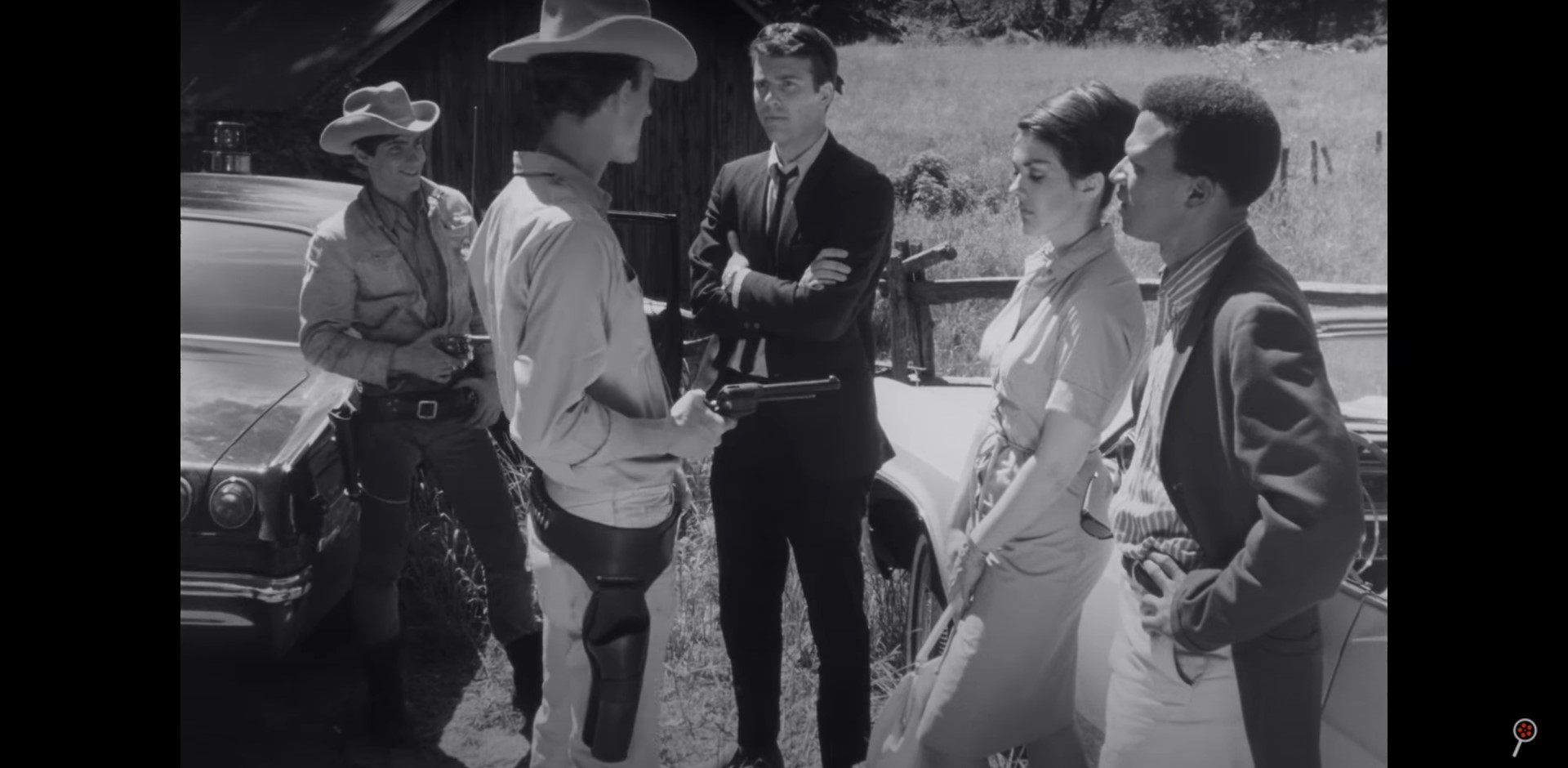
Three young Northerners travel down to the deep South city of Caron’s Landing for Civil Rights improvement on voter registration. Their convertible is pulled over by two sleazy deputies with a hankering to stick the activists with trumped-up charges and accost them with an official arrest that forces them to be before a drunk, aggressive named Sheriff Sonny Lew Wymer, Carson Landing’s very own unofficial head of the municipality between his unwavering loyal kin and those in his pocket with blackmail to gain an indefinite number of favors, for swift money-mulcting and to be the victims of Sonny Lew’s judge, jury, and execution sentencing of segregated injustice. An onslaught of abusive authority sends the lone woman of the three activists to do hard labor on a black chain gang and as she attempts to escape, she must survive Sonny Lew’s hound-led manhunt with intent to shoot-to-kill.

Hard to believe that we still live in a society where the surface level racism has improved over the centuries but systemic racism remains a vein-slithering and venomous asp prevalent still in not only public society but in education, justice system, and, well, just about everywhere you can think of and films like Jerry Gross’s “Girl on a Chain Gang,” though ostentatiously sleazy and exploitative as the title sounds, would still ring smidgens of truth profoundly, yet subtly, engrained across the nation even though the Gross’s film was released over half a century ago in 1966 when that pure hatred and ugliness was at peak efficiency, especially in the deep Southern U.S. The producer from New York City who promoted “I Drink Your Blood” and “Son of Dracula,” with Ringo Starr nonetheless, found a knack in presenting exploitation in his directorial feature debut – “Girl on a Chain Gang.” Originally called “Bayou” before a title and script rework, the Dan Olsen original story was penned by Gross and shot more locally to the auteur in Long Island, New York. Nicholas Demetroules cowrote the edgy-for-its-time script full of malversation under the Jerry Gross Productions banner with a logo that looks the hell of a lot like Warner Brothers.

Part of “Girl on a Chain Gang’s” suffocating sleaze success is due in part to William Watson’s rotten-to-the-core, corruption performance as the devilishly intelligent and despicable Sheriff, Sonny Lew.  The “It’s Alive III” actor, who made a name for himself in indie westerns as mostly playing a character on the wrong side of the law, debuted his forte into villainhood affairs with this particular Jerry Gross production by portraying an alcoholic lawman with dirt on the most townsfolk of Carson’s Landing and can persuade them like pawns or like lemmings to exact his will.  Watson’s good at what he molds for the cigar chewing Sonny Lew by never letting up  his foot off the lewdness gas pedal that drifts around internal state investigations into his distortion of the law and even around his own cronies and county bumpkins with secret banter codes that’s clear to them but ambiguous to the naked understanding.  The three young northerners are chosen to reflect the stereotypical justifications to be oppressed by racists eyes just for the way they look in skin and in dress despite their education and suitable for society behavior.  Because one man is African American and the other two whites consort with him, the activists become relentlessly targeted by the bigoted brigade led by Sonny Lew, colluded his deputies (Ron Charles and Peter Nevard), the town drunk (Matt Reynolds), the see-nothing, do nothing bar own (James Harvey), and the unlicensed town doctor (Phillip Vanyon) who is too frightened of Sonny Lew to act on his conscious.  The woman in the mix, Jean (Julie Ange, “Teenage Mother”) reduces down to being the principal object of exploitation inside the story as the titular girl in the chain gang and out being given illusionary promises of future leading lady roles by Gross yet that undertaking never fleshed out.  Between Watson and Ange, a genuine baseline of power over someone else is greatly disturbing and not terribly far from reality.  Most of the other performances are a bit ostentatiously cliched regarding small town Southerners complete with cowboy hats, being sloppy drunkards, and take with a gimmicky draw.  The cast rounds out with Arlene Farber (“Two Girls for a Madman”) as the town floozy, Sam Cutter as Sonny Lew’s public defender uncle and, also including, Ron Segal, Henry Baker, Horace Bailey, Wolf Landsman, Earl Leake, and Richard Antony.

For 1966, “Girl on a Chain Gang” is pretty dark.  Of course, some explicit and taboo subject material that were not acceptable to show on screen back then must be read between the lines, but nonetheless, there’s enough icky and sordid personalities to get your blood boiling and your palms sweaty because of how purely contentious these themes can strike at the heart of a morally conscious soul.  The hammy acting in the second half almost makes a joke out of the context and one can become caught up and lost in the blinding caricatures spouting off ridiculous renditions of the ignorant South population that isn’t supposed to have one funny bone in its body. Though the title is eye-catching and provocative, “Girl on a Chain Gang” is selling more sexism than racism. Jean is only shackled with the chain gang for the last 10-minutes or so, just enough time for a whipmaster’s disparaging remarks to be heard and for two black men to form an escape plan. The title doesn’t speak to much of the three Northerners as a whole being subjected to bigot atrocities and without reading the back cover, you’d think the 95-minute runtime would be entirely a woman in prison film of this poor and young fresh meat working the pickaxe, sweating, and chained to a row of harden convicts with both convict and guard having their way against her will. No. Jerry Gross knew how to market this film, to catch people’s attention, by selling savage social representation as dressed sexploitation.

The Film Detective and Something Weird Video unearthed the Jerry Gross debut long thought to be inspired by the murder of three civil rights activists in Mississippi in 1964 and gave it the special edition Blu-ray treatment. A well-preserved transfer is now cleaned-up eye-candy for a high-definition look this black and white feature presented in now the fairly archaic 1.37:1 aspect, aka Academy, ratio with only a few lingering thin scratch marks throughout. Trust me, we’ve seen far worse transfers and the scratches here are evident but only if you’re keeping an eye out for them. The high contrast and detail offer a good, delineated view of events on average, pulling an average of approx. 20 Mbps. Certain exterior scenes are poorer than others with a slightly more washed brightness. The English language DTS track wavers between a muted mono and a lossy 2.0 with the dialogue suffering the most and so will you know if you’re not wearing headphones as you’ll be up-and-down on the volume of your remote control. There’s a rife static hissing that does random clean up from time-to-time. The audio tracks are clearly unstable whereas the video files have fared better with Hi-Def upgrade. The not rated disc does come with bonus features including software material of a short history from genesis-to-death on Jerry Gross hosted by film historian Chris Poggiali and hardware material in the form a 14-page essay booklet by Something Weird Video’s head-honcho Lisa Petrucci and a novelty ticket of certification of jury service where you can fill in your own name to state you sat in judgement and witnessed the trail of “The People of Caron’s Landing vs. Miss Jean Rollins.” “Girl on a Chain Gang” abstracts only a fraction of deep-cutting prejudice but that makes this roughie old-timer no less important and still remains satisfyingly excessive in its violence.

Become Tethered to the “Girl on a Chain Gang” Blu-ray at Amazon.com!

Best Friends Trying Their Best to Best EVIL! “The Boy Behind the Door” reviewed! (Acorn Media International / Blu-ray)

Best friends Bobby and Kevin are kidnapped by a stranger and taken to a remote house in the middle of nowhere. After Kevin is removed from the stranger’s trunk and is dragged into the house kicking, screaming, and pleading to be let go, Bobby breaks free of his restraints, but hearing his best friend Kevin’s screams leaves Bobby with no choice but to help him. Working his way through the house and upstairs unnoticed, obstacles stand between him and rescuing Kevin, including the boys’ kidnapper, a paying customer, and Kevin being shackled to the wall, locked inside behind an attic door, but that doesn’t avert Bobby’s intentions from thinking outside the box to save his best friend from a fate far worse than death. However, only a matter time before the kidnapper or the paying customer knows there’s someone else lying low the house and unearthing troubling secrets.

Child sex abuse is, without a double, a disturbing and touching subject to exhibit in cinema.  How to maneuver around the theme with child actors can be a delicate balance of commitment and understanding when considering the cast involved, especially if most would argue that a child’s brain is too immature or not developed appropriately to comprehend the impact of sexual abuse and to expose them indirectly could also be traumatic to their being.  The opposite of that argument has been proved over the decades with child actors having major roles in general with horror films.  Monsters of all shapes and sizes, guts and blood, and violent themes surround them and films such as “The People Under the Stairs” and “IT” have some of the most frightening and disturbing practical effect imagery that would cause sleepless night terrors for months and, yet kids star in them and are key to their success because, as we all know, children are not immune to real world dangers and threats.  So, why should be exempt from the creative imaginary ones? David Charbonier and Justin Powell finesses that line with a massaged contented breakout feature in “The Boy Behind the Door” written-and-directed by the lifelong friends and produced by Ryan Scaringe of Kinogo Pictures. Howard Barish of Kandoo Films, and Rick Rosenthal, Bert Kern, Ryan Lewis of Whitewater Films

***Beware… this section may contain spoilers*** Lonnie Chavis (“This Is Us”) and Ezra Dewey (“The Djinn”) play Bobby and Kevin who find themselves in the worst-case scenario of two unaccompanied pre-teens violently whisked away to an isolated farmhouse near one or two oil well pumps. I commend Chavis and Dewey’s hard fought, emotionally deep performances in battling against the creepiest of odds and feigning injury without being too over-the-top or inauthentic. Either if by being well coached or, more than likely, just good child actors, the level of anxiety maintains a solid 10 throughout with them. Their only scenes together where I thought the fusing of their friendship didn’t quite work was before the abduction where their dialogue and interactions as two young boys drifting across fields and profoundly thinking about their future deemed itself well too mature and far beyond being advanced for boys their age that the moment was a complete misfire for the story. Inevitably, the two friends run into a couple of creeps and exploitative racketeers in Micah Hauptman (“Phobias”) as the paying customer abandoning paid up time to chase down Bobby and Kristen Bauer van Straten (“True Blood”) in a twisted plot point of a white, late 40s to early 50s-year-old woman, who in the film could be someone’s mother, as the ruthless kidnapper of young boys for old man pleasure. Hauptman is more-or-less there in slimy spirit but doesn’t ooze enough egregious behavior to note as that trait falls immensely well upon the shoulders of van Straten with a mean streak that never lets up despite the rather paralleling of a hard R “Home Alone” antics between adults and children.

“The Boy Behind the Door” is a butt-clenching thriller because of the sheer fact children straddle the danger line on either side of spectrum. You have Kevin locked securely away in the summitted play and video room, shackled and waiting in screams, tears, and fears for his sure fate, and then there’s Bobby escaping his restraints and staying in the shadows, out of sight, trying to save his friend before he becomes either chained and exploited like Kevin or executed because of his strong will. Charbonier and Powell offer little-to-no fluff in pretending “The Boy Behind the Door” is anything but a fight for survival, a fight for friendship, and a fight against the utmost evil. The film isn’t full of strong one-liners or momentous moments that keep the story grounded and pure in its vilest state with tiptoeing around the one-woman operated child sex abuse ring without going into the full gross details. Charbonier and Powell’s story has many strengths, but it also has a few weaknesses waned upon the characters’ decision making. For instance, when Bobby has to break into the house, he throws a rock through the mud room door window without knowing where the kidnapper is and if they are in earshot of the window breaking. Later in the film, Bobby is trapped in the upstairs bathroom and when a squad car pulls up, instead of breaking the window he can clearly reach, he tries to yell through it and fiddle with opening the latch. Why does he simply not break the window and then yell for help? That particular scene drove me nuts and there a few other minor instances of the same caliber throughout in a story that well made enough to be compelling, to be horrific, and to be gripping in and around every house interior scene.

Tense, harrowing, and an ugly truth, “The Boy Behind the Door” is defensible horror at its best and a righteous strength of friendship. Acorn Media International distributes “The Boy Behind the Door” onto a region 2 Blu-ray in the UK! The PAL encoded release is presented in a widescreen 2.38:1 aspect ratio and, speaking digitally, the picture renders flawlessly the inkling of low-lit hope inside a world of dark fatalism and cynicism under the cinematography eye of Julián Estrada. The English language DTS-HD Master Audio 5.1 is crystal clear that occupies each channel with the right number of decibels to exact the range of sneaking through a creaky wooden floored house. Dialogue is clean and clear, especially at whisper breath. The Shudder original film comes with a pair of special features including a blooper reel of mostly Lonnie Chavis sneezing and goofing off which is nice to see kids being kids on set and a music video to the film which is more like a trailer with Anton Sanko’s dark synth-gripping score being an apogee of suspense. There’s never sympathy for these types of vile exploitation villains on and off screen and in “The Boy Behind the Door,” that fight back mantra resonates loud and clear in an unambiguous do-or-die between guileless innocence and pure evil.

EVIL Hangs Ten! “Surf Nazis Must Die” reviewed! (Troma Films / Blu-ray)


Check Out the New Price Drop for the New “Surf Nazis Must Die” on Blu-ray!

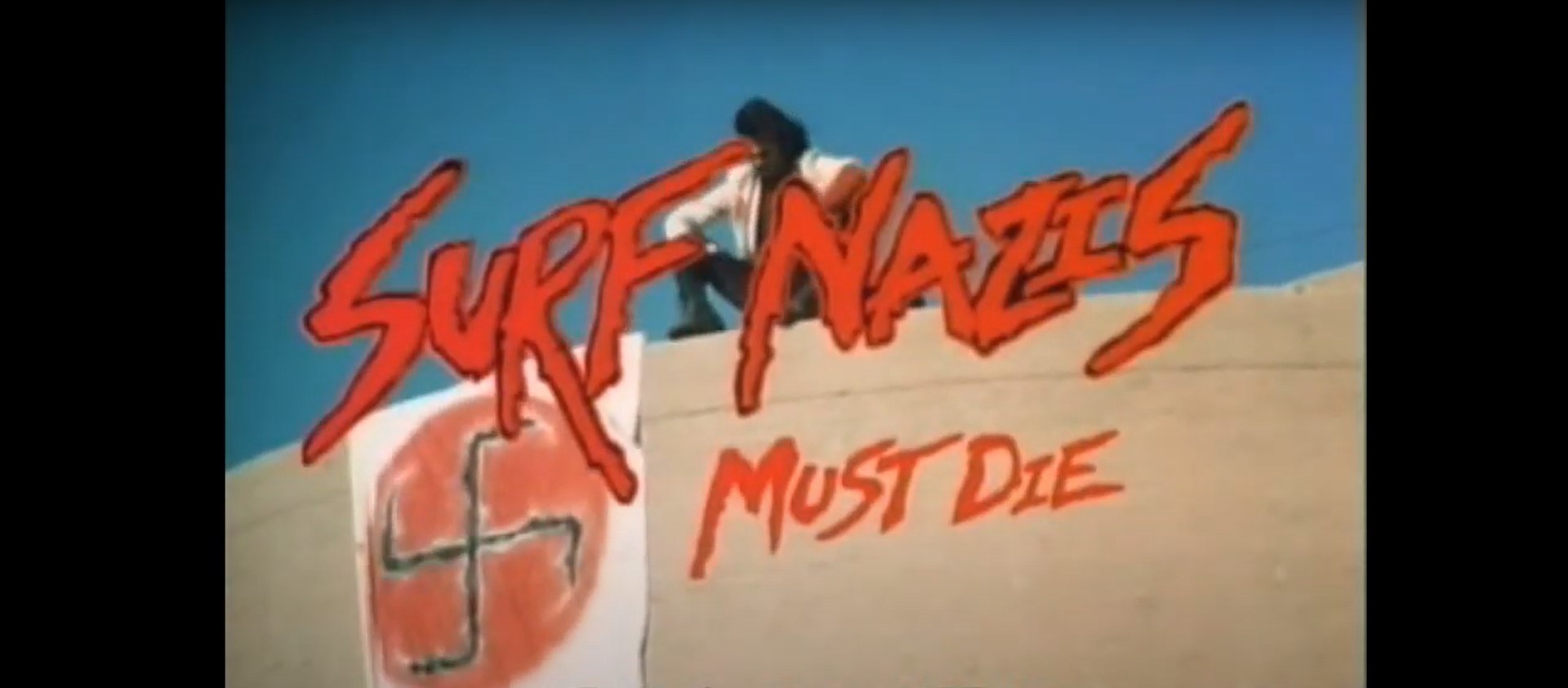
The waves of Power Beach wash ashore red with the blood of territorial gang war.  Wiping out is not an option for the Nazis, the largest and strongest wave riders consisting of new age Neo-Nazis led by Adolf, his lady Eva, and ingenious welding right hand Mengele.  As they surf for turf, the Nazis strong arm the rival gangs into a no choice option of calling a truce amongst themselves to attack and take down the Krauts and regain control over the towering waves and lucrative scores of Power Beach.  Caught in the middle is Leroy, a young black man who becomes gang war collateral damage on the unsafe beaches.  When Eleanor “Mama” Washington gets wind of those responsible for her son’s death, she’s blitzkriegs the surf Nazi’s of Power Beach with her own brand of grenade throwing justice.

Ever since being highly promoted at random on Alex Powers’ wannabe Troma film “Sadistic Eroticism” starring adult film actress Sophie Dee, perhaps as Powers’ favorite Troma release, seeing “Surf Nazis Must Die” tickled the curiosity of the olfactory snout and became one of those must watch titles canonized with outrageous, off-color content that’s routine for the Lloyd Kaufman and Michael Herz independent shock-and-comedy distributor, Troma Films.  Peter George directed his semi-serious, mostly satirical-toned debut film from a Jon Ayre script based off George’s original story idea of incorporating the territorial surfer scene of California with a laying siege, post-apocalyptic, gang and revenge narrative that’s a delectable smorgasbord buffet of low-budget subgenres.  Perfectly situated in front of deep-water oil rigs and the towering smokestacks of power plants and other various manufactories along California’s graffiti-cladded Huntington Beach, “Surf Nazis Must Die” is a production of Peter George’s The Institute alongside company co-owners in editor Craig A. Colton and producer Robert Tinnell (“Frankenstein and Me”).

Tennessee born actress Gail Neely receives her big break in a lead role of a feature film.  Lamentably, that film was full of bad taste and full of punk surfers with red painted swastikas on their black wetsuits who also paralleled nefariously notorious figures of bigotry and war crimes against anyone not white Anglo-Saxon.  Yes, Neely is a black actress pitted against and taking revenge on a group of racist thugs, a narrative we’ve seen before, but the “Naked Gun 2 ½:  The Smell of Fear” actress took an unjust backseat (an unfortunate and unintended Rosa Parks pun) in sharing the lead with the very Nazis she ruthless takes head on.  Trying to understand why Peter George and Jon Ayre decided to focus more on the strategic overthrows of gangland rather than to journey Mama Washington’s revenge in her death wish arch is beyond comprehension in a lopsided narrative that gives more screen time to Nazis and gangs than it does a grieving, nursing home-residing, mother hellbent on avenging her slain son with vigilantism.  The latter is a much better story that breaks up the stagnant gang mentality unwavering throughout.  Neely does her best to pull audiences back into the revenge fold with a grit and attitude that takes us back to 1970’s blaxploitation films of yore, but ultimately, “Maniac Cop’s” Barry Brenner and “Star Slammers’” Dawn Wildsmith and Michael Sonye inadvertently bleed out Neely’s full potential with their respective Nazi counterparts – Adolf, Eva, and Mengele – and their intercompany squabbles and beach brawls against rival gangs.  “Surf Nazis Must Die’s” cast rounds out with Robert Harden (“Dead Girls”) as Leroy, Joel Hile (“Deadly Friend”) as Hook, Gene Mitchell as Brutus, and Tom Shell (“Hard Rock Nightmare”) as Smeg.

With a title like “Surf Nazis Must Die,” the expectation bar was high to bequeath audiences guaranteed politically incorrect exploitation and sizable good versus bad mayhem crashing like a cacophonic wave on the surf.  “Surf Nazis Must Die” does meet that brazen bar that associates surf territorialism to the likes of Nazism by way of excluding outsiders from their surf turf and be nasty about it as well.  Would I compare it to Nazism?  Probably not, but in the heat of control and power over others less fortunate in riding waves might draw a vague resemblance.  In a bit of satire and irony, 1940s Nazi Germany was ruled by an extremely authoritarian people running a tight ship in every facet from the meticulous armed ranks to innovative engineering to the ostentatious decorated halls and buildings of propaganda and flag hoisting pageantry, but Peter George’s Nazis, granted the new age variety, plague themselves about the beach, living off stolen goods while driving around in a makeshift shark modified van, tanning their mostly exposed bodies, or dressed in graffiti stylized wetsuits and trench coats with glitter-face painted swastikas.  The characters are cuter in caricatures than they are in terrorizing tyrants of the beach.  What’s even more interesting about “Surf Nazis Must Die” is that none of the gangs carry firearms despite one of the popular Troma cover arts displaying an archetypal lampooned Nazi riding a wave and wielding an Uzi.  The “Clockwork Orange” gangs meandering about with unprovoked violence carry traditional switchblades, nontraditional switchblade surfboards, nunchakus, staffs, a hook for an arm, and there’s even one guy with a speargun.  Only Mama Washington is armed to the teeth with conventional weaponry of grenades and a handgun that makes this film even more unfathomable at times.

Thirty-five years later, “Surf Nazis Must Die” continues to make waves a war zone with a new Blu-ray released from Troma Films and distributed by MVD Visual. The newly restored, newly remastered, high-definition region free Blu-ray is presented in a widescreen 16×9 aspect ratio from the original 35mm negative and is not quite the fully uncut version, running two minutes short at 83 minutes from the director’s cut that circulates overseas. The color matte lacks bounteous vision that fails to give range to the graffiti art amongst other aspects. The transfer has little-to-no blights with some transparent vertical scratches in a single frame but nothing else more to note. George and editor Craig A. Colton work their magic on a remarkable cutting room performance with splicing in Hawaiian surfing footage with the Huntington Beach narrative in a near seamless manner. The English language lossy LPCM 2.0 track doesn’t hook into you with a linear fidelity with no range or depth but does provide fair dialogue clarity and no impeding audible damage. “Terror Eyes” and “Future Shock’s” Jon McCallum has a fantastic synth score that pulsates life into the overabundance of stagnant moments and the film is worth a watch just for McCallum’s soundtrack alone. Gnarly special features include a new introduction by a locked down stricken Lloyd Kaufman diving into his pool to take a bath, a circa late 80s/early 90s interview with Peter Geoge conducted by the enthusiastic Lloyd Kaufman, another circa late 80s/early 90s snippet interview with producer Robin Tinell, a pair of deleted scenes with Peter George commentary, scenes from the Tromaville Cafe, Radiation March Promo against pollution, a pair of archived Troma NOW PSA announcements that are as sexually titillating as they are meaningful in their message, a Soul of Troma promo trailer,” “Latched” short, and various other Troma promos: Indie artists vs cartels, Lloyd Kaufman gets “fucked” by the Hollywood system, and Lloyd Kaufman’s Audiobiography. There’s also mention of a “Gizzard Face” promo, but I did not see it as an option in the bonus content. “Surf Nazis Must Die” inches along and loses a lot of key momentum along the way building around the striking title. Eventually, the undercutting of gang machoism crumbles away to leave an open path for Mama Washington’s full-blown assault as a true cinematic Nazi hunter extraordinaire.

Check Out the New Price Drop for the New “Surf Nazis Must Die” on Blu-ray!

Meir Zarchi Returns With Another Round of EVIL Exploitation! “I Spit On Your Grave Deja Vu” reviewed! (Ronin Flix / Blu-ray)

Forty long years have passed since the sexual assaulting atrocities of Johnny Stillman and his gang were committed on the young and beautiful Jennifer Hills.  Empowered by her horrific tale of survival with the release of a new tell all book of how she outwitted and took homicidal revenge on her rapists by luring them in with her sexual persuasions, Hills finds herself back in familiar terrorizing territory being kidnapped by Johnny’s devoutly vindictive widow and three living relatives of the gang that once ganged raped and brutally beat her, but she’s not alone.  Captive with her as collateral damage is her famous supermodel daughter, Christy.  Both are caught up in an eye-for-an-eye revenge plot where being lethal is the only means of survival and with a long history of resentment, rooted deep inside Johnny’s kin, fighting back will take every ounce of resilience and strength against a community of hellbent sociopaths. 

Circa 2005-2006 is around the time I first bared witness to Meir Zarchi’s 1978 controversial exploitation shocker, “I Spit on Your Grave.”  Popping in the DVD popped open my eyes to the world of graphic vengeance and the submission to primal, carnal whims inside the human-on-human violence context.  Before Zarchi’s film, which is also known as “Day of the Woman,” and even Wes Craven’s “The Last House on the Left,” this neophyte’s description and knowledge of horror was limited to the stymies of broadcast television that only aired edited and censored slashers like the “Friday the 13th” and “Halloween” series or supernatural presences of “A Nightmare on Elm Street” and “Poltergeist.”  Never has the likes of “I Spit on Your Grave” been a red pill option into the vast horror matrix for this then college kid who glazed over with the façade of sleeping through studies and worrying over trivial matters involving the opposite sex.  In a way, Zarchi was a kind of Morpheus to me when I started purchasing physical media that opened my eyes and my mind to the rape and revenge facet in horror hidden behind the commercial veil.  In 2010, a Zarchi produced reboot saw more light in the commerciality and spawned two sequels in its wake, but not until 2019 did Zarchi get back to writing and sit back in his director’s chair to helm an official, yet less commercial, sequel entitled “I Spit On Your Grave Déjà Vu” or “Day of the Woman Déjà vu” that was produced by his limited company banner, Déjà Vu LLC with son Terry Zarchi and Jan O’Connell producing.

The long-awaited sequel reteamed Zarchi with original lead actress, and also ex-wife, Camille Keaton, distant relative of the famed comedy and stunt actor, Buster Keaton.  Camille Keaton, who looks phenomenal in her 70s during production, steps back into the infamous Jennifer Mills role that made her a household name amongst grindhouse-horror community.  Though completely nude for most of the 1978 film, that part of her performance takes a step back for a new actress to pave a new path in the saga.  Obscure indie scream queen Jamie Bernadette (“Axeman,” “The Bunnyman Massacre”) is ceremoniously passed the torched as the new riches to ragdoll as the Jennifer Mill’s unhappy supermodel daughter, Christy, who becomes haplessly snagged into her mother’s unforgotten past.  Bernadette offers a variable beauty and a diverse poise that doesn’t make Christy a carbon copy of Jennifer Hills, but the actresses deliver the same apathetic venom of a woman scorn.  More of a carbon copy is the four backwoods bumpkins fuming over Jennifer Mills’ vindictive dissecting of their dead relatives.  The gang is spearheaded by Beck, played by Maria Olsen who, like Bernadette, has made a name for herself in low-budget horror having roles in films such as “To Jennifer,” “Starry Eyes,” and “Gore Orphanage.”  Olsen projects Becky as the gas station attendant from Hell, someone you don’t want to interact too long with as you’re pumping gas in the middle of nowhere, but Becky is not a woman of a few words who constantly has to remind us, to the blistering point of annoying, that she must avenge her late husband’s sinful murderess.  The rest of the gang didn’t impress much after that.  Jonathan Peacy has a chance to shine from out of the extra and bit part shadows as the crazed and hyperactive Kevin, brother of Stanley from the original film, and while Peacy channels his best Al Leong look, Kevin is ultimate a big detrimental goof with small dog syndrome than actual menace.    The last two aren’t any better with a lackluster act by Jeremy Ferdman as Andy’s cousin and “Tales of Frankenstein’s” Jim Tavaré’s rather befuddling downplay of Matthew’s mentally disordered father, Herman, who teeters back and forth between morals with a jumbled underlay of piety.  There are not many sane performances in a rather loose and unbridled Zarchi follow up with a cast that rounds out with Alexandra Kenworthy, Roy Allen III, and Holgie Forrester.

Performances aside, “I Spit on Your Grave Déjà vu” is also a cacophony of yelling as the script, from paper to pronunciation, reaches top of the lung levels with every bit of dialogue from every player in this tussle of who’s right and who’s wrong when it comes down to justifications of killing.  Zarchi’s sequel lacks the tact his first film achieves so delicately with Mills post-assault softer approach to lay waste her assailants.  “Déjà vu” satisfies its own revenge kicks with little subtly in trying to be outrageous, outlandish, and off its rocker as the confrontation between Christy and the gang becomes a rancorous grudge match.  What concerns me most about “Déjà vu” is the year in which this sequel takes place.  Between the 1978 original and the 2019 follow up, 40 years have passed, but the characters don’t fit any of Father Time’s natural aging characteristics on the surface.  Becky looks okay as an early to mid-60s woman despite Maria Olsen’s actual age being early 50s at the time of filming and release.  Herman is another one that sneaks into fathomable constructs as a character living a farmer’s life in the latter half of middle age, but I question whether Kevin and Scotty were even born yet.  The two youngsters barely seem to be out of their 30s and the same can be said for Christy where much more of her life is revealed as the story progresses.   If following the script logic, I would assume the story takes place in the 90s, but certain technologic advances, like modern day touchscreen phones, suggests no earlier than late 2000s.  As a whole, time and space don’t appear to exist on any reasonable plane for the film with characters able to bump into each at random intervals despite being a densely wooded and rural location and, for all you cinematographers out there, if your location is supposed to be rural, don’t shoot in at a cemetery with a massive grave footprint with a stream of cars speeding down a busy suburban street.  You instantly lose the illusion.  Zarchi’s intentions were clear to only echo the original while allowing for individuality with a brasher onslaught of right versus wrong, eye for an eye, and misguided righteousness for injustice, but the execution crumbles with excruciating results, never reaching the same poetic justice the first film accomplishes so graphically grafted. 

As far as rape and revenge exploitation is considered, “I Spit on Your Grave Déjà vu” gets about as down and dirty and ugly as they come.  Cult movie curator, Ronin Flix, delivers the Meir Zarchi sequel onto Blu-ray home video, presented in 1080p, full high definition, with a widescreen 2.39:1 aspect ratio.  A+ for natural lighting, skin tones, and overall appeal, Pedja Radenkovic’s cinematography is about as uninspiring as they come artistically, but, as a personal preference, the shots are more organic, raw, and less distracting from the content that’s much more abrasive and interesting.  A more natural framework also more time for Russell FX’s practical effects to be showcased without enhanced imagery.  As long as the details are there (they are), no damage is concerning (there wasn’t), and the framing made sense (for the most part), “Déjà vu” can be considered a win for Radenkovic.  The English language DTS-HD 5.1 Master Audio soundtrack for “Déjà vu” is a blessing and a curse.  Dialogue clarity is excellent and there’s a wide range to exploit, forgive the punned term, each channel with great balance, but remember what I said about all the character yelling?  Also, with the higher bitrate DTS, the quality is too good for some of the applied ambient effects like the exhaust sputtering of an old Ford pickup that sounds way too fake and way too close despite its positioning in the scene. The region A, not rated Blu-ray is stored on a BD50 due in part to the film’s massive 148 runtime and the inclusion of special features that include a new audio commentary with film critic and “The Last Drive-In” host Joe Bob Briggs, select cast interviews, the making of the film, behind the scenes footage from producer Terry Zarchi, and the theatrical trailer. Is “I Spit on Your Grave Deja Vu” the long-awaited sequel to Meir Zarchi’s first film? I’d say they’re two totally different exploitation entities cut from the same cloth with ties only in names and some flashbacks alone, but both films would make for a great double bill that starts with a harrowing, nothing-to-lose, woebegone toned, revenge thriller complimented with a lukewarm and unfocused follow up to help come down off the original’s gripping ultra-violence high.

Ronin Flix’s “I Spit on Your Grave Deja Vu” Blu-ray available at Amazon.com!