New York City hospitals are being terrorized by a crazed maniac or maniacs stealing the body parts of the deceased and local authorities are discovering the half eaten remains of torn apart bodies in the streets. When a medical orderly is caught in the act of cannibalism by nearly devouring a corpse’s heart and then commits suicide by diving out high rise window, the Doctor’s assistant and leading anthropologist Lori Ridgeway recognizes the tattooed symbol of Kito on the orderly chest, a symbol from a long forgotten tribe in the Moluccas Islands. Worshipping a cannibal God, the primitive tribe still practices the form of anthropophagy. Lori’s colleague, Dr. Peter Chandler, has been placed on a research team to root out New York City’s recent cannibal problem and when the Kito symbol clues him and his team of a possible lead, an expedition team forms to travel to the Moluccas Islands in search of the existence of inhabitants. Dr. Chandler rendezvous with a long time acquaintance, Dr. Obrero, whom has lived on the islands for years. When Dr. Obrero arranges a boat and his right hand man to accompany the expedition, Dr. Peter Chandler and team step foot into a hellish nightmare, bloodied with unspeakable and aggressive cannibal acts. Just when nothing could be worse than flesh hungry cannibals, hideously disfigured zombies frighten even the primitive locals. The island holds a dark secret and Dr. Chandler aims to unveil it no matter the cost!

Finally! The definitive 2-disc edition of Aquarius Releasing’s “Doctor Butcher, M.D.” aka the Italian cut “Zombie Holocaust,” from the Flora and Fulva Film production companies, has been released and, oh, how glorious the Severin Films release is with a super sleek Blu-ray reversible cover art – “Doctor Butcher, M.D.” title as the main cover and “Zombie Holocaust” title on the reverse side – and the high definition gore that hasn’t been gooier and oozier than ever and all in thanks to the upscaled 1080p full HD resolution transfer. Uncut with eye-gouging effects, eviscerated and mangled bodies, and packed with a slew of medical terrors and oddities, the Marino Girolami’s directed video nasty from 1980 just might get itself banned once again by the international censorship boards.

The schlock runs thick through a plot that’s eerie similar to Lucio Fulci’s Zombie (aka Zombie 2) with many of the locations and sets repurposed for the Girolami picture involving exotic land cannibalism, a mad scientist, and, you guessed it, zombies. Yet, “Doctor Butcher M.D.” rightfully receives being a detached entity, an “Annabelle” to “The Conjuring” of sorts, even when both films star Scotland-born leading man Ian McCulloch. With uncanny and grisly disemboweling special effects that turn a stomach inside out and give you a reason to make use of that barf bag provided by Severin Films as a bonus insert, some death effects didn’t go quite as planned such as, in example, when the cannibal orderly dives out a multistory window and the stunt-dummy loses an arm when crashing onto the floor. The next scene has the actor, with arm intact, lying in a pool of blood. Another scene involving Doctor Butcher and his cranium saw nearly doesn’t sell the effect when the saw itself isn’t spinning at all during close ups of a cranium cap removal. However, none of these miscues matter as the rest of the special effects trumps any other gore film of this decade.

The American bought rights to “Zombie Holocaust” were destined to be re-edited as the film had to bulk up on Americanized tastes, slightly targeting specific, well versatile audiences of New York City’s infamously sleazy and exploitive 42nd Street, which is now defunct. The additional and pointless scenes that were intercut from a scrapped Roy Frumkes’ horror anthology, “Tales That Will Tear Your Heart Out, at the beginning of the film didn’t transition seamlessly enough to cause an unfavorable reaction, but only added on to the powerful zombie train that spawned from George A. Romero and the Living Dead films. The antics of Terry Levene, an American producer and 42nd Street icon, led to guerilla marketing, an overlapping score from the late “Blood Sisters'” composer Walter Sear, and the superbly cut trailers had guaranteed butts in the seats at Levene’s, amongst others’, circuit theaters. Plus, the T&A from cult Italian actress Alexandra Delli Colli might have had something to do with putting butts in seats as well.

The story hadn’t changed much between the alternate film versions of the Romano Scandariato screenplay and the story itself is wound looser than a turn of a century Gary Busey. Thin motivations drive characters to do the stupidest things possible such as go on an expedition to a cannibal island, go to a cannibal island without state of the art weaponry and more bodies than a modern day NFL football roster, or go straying away from the safety of your group to stroll through the island’s bush alone. The obviousness is aggravating to say at the least, but omit the blatant stupidity of the characters and no one would die a horrible and gruesome death that fastens our morbid tastes to the screen. The story’s spontaneous and adventurous nature appeases thrills of a long-lost culture on an island of hell that’s ready to be explored and re-discovered and ready to taste fresh blood and organs once again.

Severin Films have outdone any previous release of the reconfigured “Doctor Butcher, M.D.” and the original “Zombie Holocaust” when discussing the video presentation. The 1080p performs at a high bitrate with a vibrant display of natural colors that diminish much of the natural grain and negative damage and exhibits finely tuned and leveled darker tones from the original 35 mm negative; a HD presentation that, and this goes without saying, naturally outperforms the the transfer from Shriek Show’s “Zombie Holocaust” DVD release in the early 2000s. The English DTS-HD Master 2.0 audio mix on “Doctor Butcher, M.D.” performs greatly without many given distortions or loss of audio while the “Zombie Holocaust” on disc two has the same DTS-HD Master option, but also gives an alternative with a linear PCM Italian only audio mix without subtitles. Walter Sear’s Stateside score and Nico Fidenco Italiano score tribute their respective nations clearly through the mastered audio mixes with Fidenco’s score surfacing here and there on the Aquarius Releasing edit. Severin Films provides an impressive list of new bonus material on each disc, with the first disc having insightful interviews with Aquarius Releasing’s Terry Levene, editor Jim Markovic, filmmaker and documentarian Roy Frumkes, “Temple of Schlok’s” Chris Poggiali, Gore Gazette editor and Butcher Mobile rider Rick Sullivan, and Gary Hertz all discussing their involvement “Doctor Butcher M.D.” and their ties to 42nd Street. The second disc focuses more on “Zombie Holocaust,” interviewing male lead Ian McCulloch and McCulloch sings “Down by the River” in another segment, FX masters Rosario Prestopino and Maurizio Trani, actress Susan Buchanan, and a look at New York City then and now piece where “Zombie Holocaust” shot certain scenes.
Tag Archives: George A. Romero
Evil is Starving for Your Parts! “Model Hunger” review!

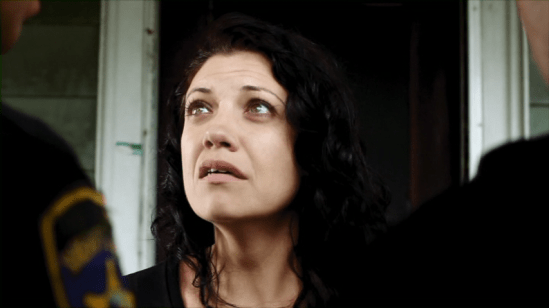
Former pin-up model Virginia “Ginny” Smith lives a solitary life on the street of a quiet Buffalo, New York suburban neighborhood. Her modeling past was prosperous, posing erotically with curves similar to that of pin-up queen Bettie Page, up until a newer, thinner model named Chloe undermines Ginny’s magazine spread career. Feeling abandoned, physically tortured, and seeking revenge throughout the years, Ginny eats up the competition from thin, to the fake, and to the virginal…literally! Sal and his mentally instable wife Debbie move in next door to Ginny. Soon after, Debbie suspects that her elder neighbor might be up to no good as people go into Ginny’s house but never come out. Chalking up her suspicions to psychosis, Sal ignores Debbie’s accusations until he mysteriously perishes in a car accident. Now nothing can stop Debbie from investigating into Ginny’s cold blooded habits.

“Model Hunger” is the long awaited directorial debut from long time scream queen and B-movie horror icon Debbie Rochon that publicly displays the dementedness clinging to the inner walls of her brain. Helming from off the screenplay penned by “Seed 2” producer James Morgart, Rochon quickly denotes the position of anti-supermodel figure, turning the thin, the snooty, and those who encourage that sort of behavior into nothing more than a gloppy stew of human chow. “Model Hunger” parodies the serious nature of young women whom go to extreme lengths of imitating the model beauties of today, but the film isn’t a clear-cut horror-comedy per say; instead, the genre of a bizarre cannibalism life style or social commentary revenge film might better suite the self-centering tone.

The premise most definitely classifies as a film Debbie Rochon would personally headline; Rochon personalized “Model Hunger” to her taste, but this time, Rochon’s sister-in-horror, Lynn Lowry (George A. Romero’s “The Crazies”) headlines as the vengeful, cannibalistic Ginny Smith. Lowry puts the hot in psychotic with a Southern Belle twist, delivering a memorable performance as a cougar-gone-cannibal and her character scores much of the Morgart screenplay dialogue that is overwhelmingly philosophical and ranting compared to a more downplayed principal character in the film’s third horror star – the veteran Tiffany Shepis. Shepis is Debbie next door and though that sounds like a title of a boorish 70’s porn, Debbie struggles with being burned out from a psychosis state that results in plagues of nightmares and prescribed pills. Aside from maybe the pill popping, nothing about Debbie’s persona brings to mind a porn starlet.

Contrary to a pair prominent female actresses who bring talent and experience from cult films such as “Tromeo and Juliet” and “Shivers” and a highlight of co-stars including the wonderful Michael Thurber (“The Sins of Dracula”), Brian Fortune (“Game of Thrones”), Carmine Capobianco (Psychos in Love) and “Chainsaw Sally’s” Suzi Lorraine casted ironically as a voluptuously large television host of “Suzi’s Secret,” the James Morgart script just couldn’t pull all the talent together. Points of unfocused storytelling noticeably stemmed from the first few scenes involving uncouth and dolled up cheerleaders practicing their routine, receiving their fundraiser packet, and going door-to-door soliciting. These segments run a natural course of supposedly setting up Lisa Dee (cheerleader Missy in the film) and Samantha Hoy (cheerleader Katie in the film) as the film’s leads. The squad practice could have been completely omitted and the story would have worked just the same without bamboozling the main players Lowry and Shepis. The script drags to a slow drift during the second act by not proceeding with much character progression other than Ginny slaughtering snared victim-after-victim to fill her icebox of superficial-inspired characters.

Honestly, the expectation of graphic violence had a sky high bar set upon the shoulders of Debbie Rochon’s inaugural film, but the special effects violence was unusually tame to a point, containing nothing too new and too extreme until near the finale that involves a naked Jehovah Witness and a medical grade scalpel. Aside from the lack of gross gratuity, the effects were borderline choppy; a prime example to consider would be the obvious rubber baseball bat, wielded by Ginny, that sprung forward and backward, like something out Looney Toon’s ACME company, when striking against an object, but “Model Hunger” was riddled, subtly throughout, with equipment flaws such as equipment shadows in scenes and a continuously shaky camera.

Wild Eye Releasing’s unrated DVD is presented in a widescreen format with a Dolby Digital 2.0 audio mix. Aside from some awkward framing and a bitrate issue that causes a bit of blotchiness, the digital camera video looks good for the most part with an audio mix from “Friday the 13th” composer Harry Manfredini that’s well balanced. The director commentary, in the bonus features, is a highlight of the extras with Debbie Rochon letting you into her creative side of her film. The commentary is accompanied with deleted scenes, music video, an interview with Aurelio Voltaire, a Babette Bombshell short, trailers, and an Easter Egg! Overall, the underlining point is clear of reverse body-shaming in a very Hatfield versus McCoy scenario and Debbie Rochon, for her cherry-popping film, creates a solid horror entry that displays it’s quality scars and hiccups which the film, nor Rochon, apologizes for and that’s a filmmaker, and actress, I can get behind.
Battle Evil With Friends! “Me and My Mates vs. The Zombie Apocalypse” review!
Joel, Darryl, and Roy are mates who work at an Australian telephone exchange. Joined by Roy’s daughter Emma, her boyfriend Lachlan, and his friend Ryan, the surviving group of six hold out in the exchange while the world crumbles around them from a sudden and vicious zombie apocalypse. Trapped and desperate, the survivors bicker amongst themselves in trying to formulate the best plan of escape and who should be recruited for the company cricket team. One shotgun with eight shells, two paintball guns, a machete, a tiny homemade cricket bat, and a grenade is all that stands between them and a cannibalistic horde of zombified Aussies.

Writer-director Declan Shrubb’s sophomore film stars an eclectic cast of veteran and amateur actors from the 20 years of experience and upcoming TV series “Wolf Creek” actor Greg Fleet to the hilarity of stand-up comedians and radio personalities of Jim Jefferies and Alex Williamson. “Me and my Mates vs. The Zombie Apocalypse” is a tongue-and-cheek zombie comedy straight out of Australia, a country known for it’s intense and respectable homage heavy renditions of America’s video nasties from the 1980’s while also combining brazen wit that hurts so hysterically good. Shrubb’s film nowhere nearly disappoints, living up to the whims and visceral intensity comparable to that of 2007’s “Undead.”

Just in the simply put title alone, “My and my Mates vs. The Zombie Apocalypse,” should warrant that the 2015 film doesn’t take itself seriously, but Shrubb blends together various facets of humor, slipping in countless forms of comic relief from crude sexual humor to the harmless play on words while also sprinkling throughout with off-color dialogue. A majority of the characters initially feel aloof or appear as pot smoking knuckleheads; yet, the characters can rise to the occasion at times seemingly becoming a formidable force against the living dead, labeled by the exchange workers as ‘Rotters.” Surprisingly enough, the characters’ dumb luck practically leaves them unscathed or, if really unlucky, placed in the folds of another hair raising scenario to only escape in a goofy fashion.

Alex Williamson is by far a fan favorite as the hapless company cricket team recruit Darryl who spits out off-the-way quips that make him a likable blockhead much in the same way Goofy is a smart klutz friend to Mickey Mouse. Then Greg Fleet portrays Roy, a pissed off father and cricket coach, looking for the easy way out without his balls turning purple (you’ll have to watch the movie to know what I’m talking about). Fleet’s character grows immensely, withstanding many personal pains from not only the zombies, but from his so-called friends. However, Roy is a tough bird, a real nut puncher when needs to be, bringing his character to the forefront of the film. The third friend, Joel, played by Jim Jefferies was a character that had a role reversal from the actor playing him. Jefferies is an actual stand-up comic, but Joel had to be the most serious and smartest character of the bunch, whipping up communications in a jiffy with meager tools while not being too funny about doing it.

Like always in Australian or New Zealand zombie horror, the special effects realistically pit our heros against a nasty, grotesque bunch of undead and decaying ghouls whom can dig out your innards in no time flat to make a delicacy out of them. The zombies didn’t appear cheap with rotting skin, gnarly gashes, and effective blood smears and were portrayed actively well, even if applied with some brain smarts to be able to get past Darryl’s homemade and shoddy powerful electric fence. The macabre wasn’t too shabby either with a very Romero-Savini-esque death sequences that’ll be stuffed with plenty of pig intestines.

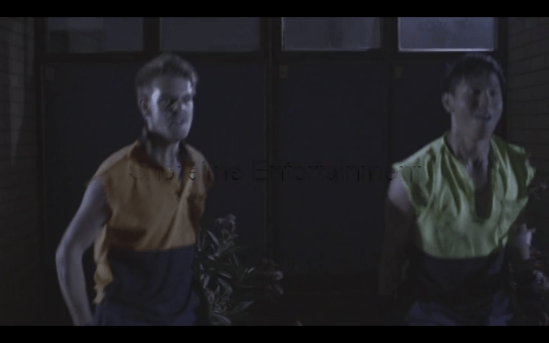
UK home entertainment distributor Matchbox Films courteously releases “Me and My Mates vs. The Zombie Apocalypse” on DVD. The 90 minute film was sent to Its Bloggin’ Evil for review via an online screener link (as you can tell from the watermark on the screen caps) and a review of the audio and video qualities, plus any bonus material, won’t be critiqued. With that being said, the movie itself nails being impressively amusing. Your sides will burst, your throat will hurt, and your eyes will transform into a torrential waterfall as Declan Shrubb’s horror comedy bites hard into becoming an apocalypse of zombie buffoonery.
Buy “Me and My Mates vs. The Zombie Apocalypse” at Amazon.com. Currently on sale! The laughs don’t ever stop!
Acting Evil Isn’t Necessarily Evil. “Sins of Dracula” review!
Billy, a good church-going man, reluctantly leaves his choir to join the community theater at the request of his girlfriend Shannon. What Billy doesn’t realize is that there are all different kinds of characters who partake in the community theater – the nerdy gamers, the anti-establishment antagonizers, the gays, and, of course, Dracula. Yes, Dracula – the Prince of Darkness. The theater’s director is a satanic worshipper who feeds off the sins of his actors to resurrect Dracula and start a whole new world order of vampires.
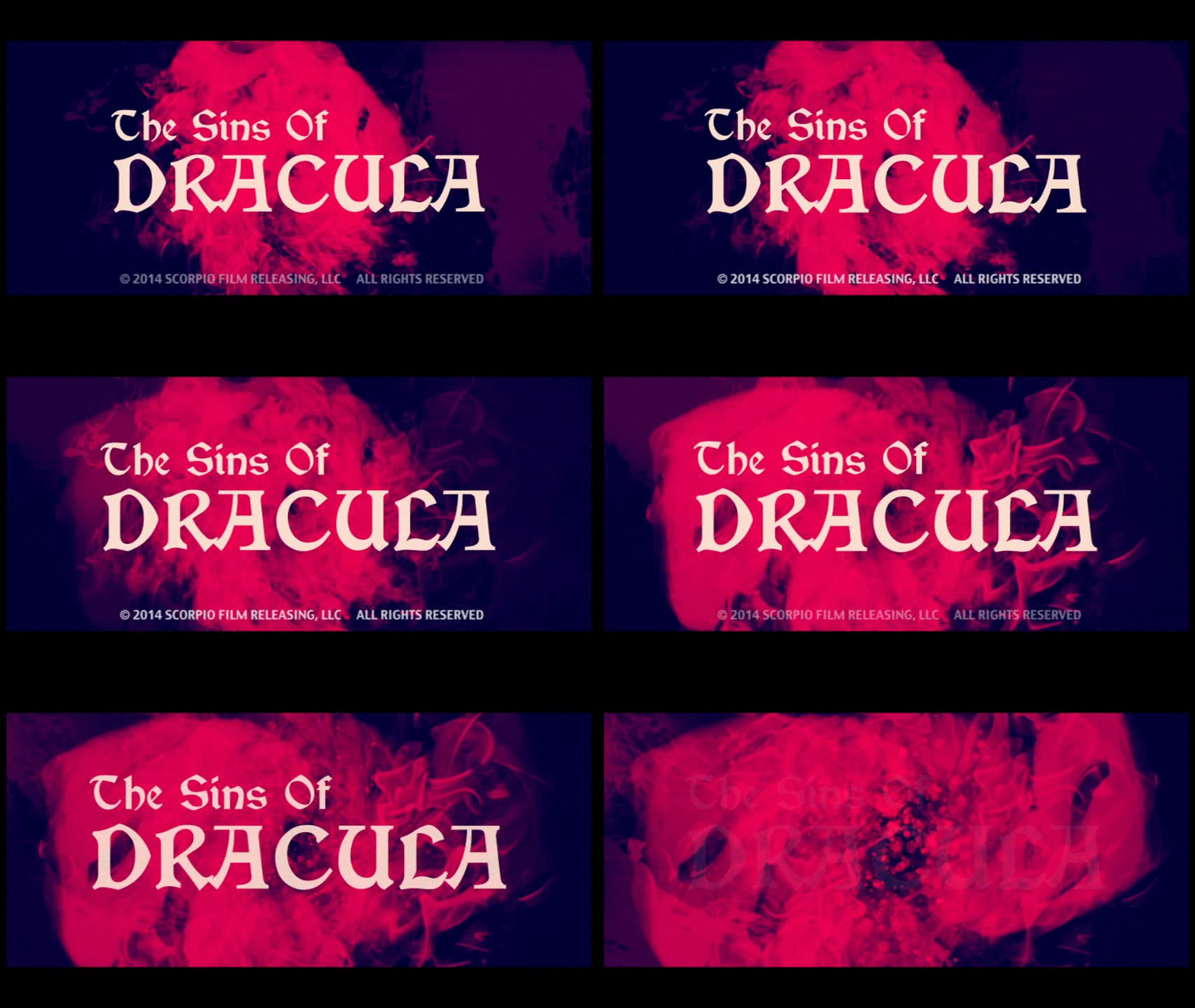
“The Sins of Dracula” film is a homage to multiple horror genre branches. Decades including the 1970s and the 1980s source the brilliantly colored and expression heavy of the Hammer horror era and combine it with the gore of video nasties marking all present and accounted for in this ode to classic horror and that’s the creative style of director Richard Griffin and his Scorpio Film Releasing company which quickly produces many independent films that hit many media platforms. My previous film experience with Griffin includes “The Disco Exorcist” that implements film stock imperfections and the hardcore porn of the 1970’s. The other Griffin film, “Murder University,” aims to create a satirical look at a murderous cult gone collegiate. Lastly, my very first Richard Griffin film was Feeding the Masses wanted to be a social political zombie following in a George A. Romero fashion. So there is no surprise here that Griffin does what he does best, but after seeing “The Disco Exorcist” and “Murder University” both which I liked in previous reviews The Disco Exorcist review here and Murder University review here, “The Sins of Dracula” warranted high hopes for Griffin to do something new and cut ties with the old, regurgitated scenes.
Enough about Griffin, let’s talk about “The Sins of Dracula.” Just from reading the synopsis alone, one can conclude that this horror-comedy will come off as a bit outrageous, delving into and dissecting the sins of certain kinds of people who walk in all kinds of life and exploiting them for the sake of our good boy Scott’s heroic journey and also exploiting them to awake the evil Dracula. The story doesn’t waste any time putting to waste the sinfully deemed characters and going on a Godsend vampire hunting spree. At the end, most peoples’ personal views are made light of in a satirical fashion.
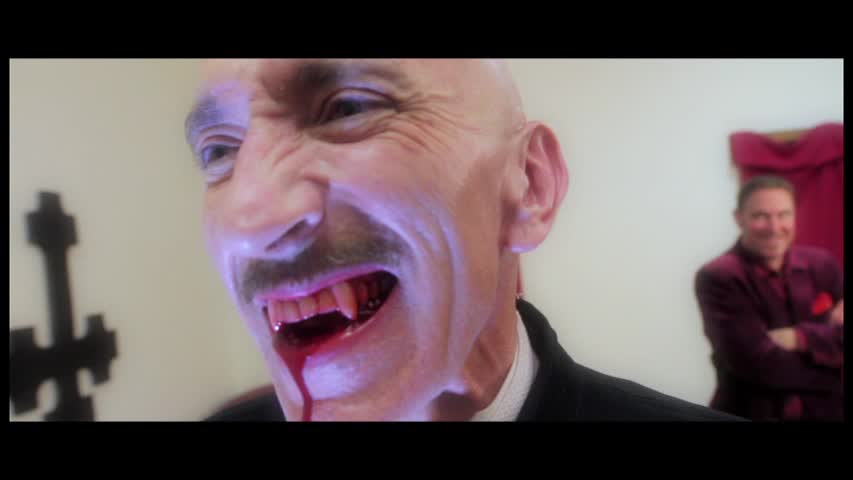
Michael Thurber, a staple actor of Griffin’s, does a solid job as a Hammer horror Dracula mirroring the likes of the vampire exposed Christopher Lee. Steven O’Broin, as Lou Perdition the satanist devotee theater director, had some excellent lines and quips and made his Vincent Price-esque character enjoyable when on screen. Another of Griffin’s minions, Aaron Peaslee pranced around fairly well as a gay theater actor and his raunchy sex scene with fellow actor Johnny Sederquist was the most controversial aspect of the film. I can’t say that about the other characters. Other characters fell a bit flat and didn’t convey their characters intentions well enough to pull off a spoofy-stereotype. The fact that their characters where put to death way too early in the film doesn’t give the character a chance to make their presence more well established.
The blood letting could have been, well, bloodier, but there is enough letting to super soak and saturate one’s thirst. Some of the scenes are restaged from the likes of “Fright Night” and “Buffy the Vampire Slayer” the movie. Like I was saying early in the review about the film’s originality, the lack of new material makes the likelihood of repeating a viewing of “The Sins of Dracula” very unlikely which is difficult to say about a solid homage.
“The Sins of Dracula” is good for a one time single viewing and but lacks new and fresh material to really captivate attention. The MVDVisual DVD cover also doesn’t explicitly want you to go out and rent this title, but the disc art is amazingly detailed and you shouldn’t judge a film’s material by the cover. I do strongly suggest to check out “The Sins of Dracula” if you’re into the Hammer horror scene and into Griffin’s Quentin Tarantino homage style of directing.
An Evil Chessboard of Blood and Guts! “The Demon’s Rook” review!

Young Roscoe is lured to an underground dwelling dimension by an ancient demon of peace. The demon takes Roscoe as his pupil and mentors him for years the ways of the powerful dark arts, but when Roscoe unknowingly opens the gates of hell by releasing three powerful and evil demons from their vessels, his master is killed and Roscoe flees back to his quiet earthly town with the evil demons in tail. Now the three pure evil beasts ascend topside and reek havoc amongst the quaint little town using mind control upon their human prey, re-animating the dead back to life, and conjuring the evil out of innocents’ souls. Roscoe has the only supernatural power to stop them, taught and passed down to him by his late demon master, but will he have enough strength to save what’s left of his humanity?

First off, “The Demon’s Rook” is my first favorite release of the 2015! A freshman film from James Sizemore rises to the top and absolutely destroys, or rather obliterates, any horror release I’ve watched and reviewed the past two months. Sizemore eviscerates the 1980’s and early 1990’s horror, tangles and twists all the elements together, releasing a grotesquely creature-feature of awesomeness.

The detail on the practical effects are so finely tuned and done well that in trying to point out the rubbery, obviously fake demon body parts was seriously pointless. Every thing from costumes, to makeup, to exploding heads were rock hard solid in the results, even the sometimes over-zealous gore scenes in other gory films were exact and on point with camera angles, the right amount of blood, and not too hard to swallow when it came down to suspending disbelief.

The fantastic-driven story combines many horror subgenres from, the obvious, demonology, to the living undead. This doesn’t feel like another “run for your life while we’re being chased” type film as there are various facets and layered tangents to the story. Many characters are introduced and are quickly, but properly, disposed of and, for a film like “The Demon’s Rook,” this type of catch and release is suitable because death becomes a character and without death, in a movie with demons and zombies and black magic, you need death to breathe and live and in order to fully embody that death character you need victims and Sizemore, along with co-write Akom Tidwell, breaks the bank with disposable characters.

Tim Reis’s cinematography is beyond brilliant with the use of prominent coloring. The red, green, blue dense fog settings create an atmosphere like none other while the editing, cut also by Tim Reis, is easy on the transitions and easy to follow. Sizemore tackles the special effects department and seizes the moment to be relentless on the use of fake blood. These Georgian filmmakers will need to be watched closely as “The Demon Rook” is underground gold and I wouldn’t be surprised if we see rush of more films into production from this crew. The dialogue is my only small beef with “The Demon’s Rook” as it’s bit bland and a bit expositional, but I’m really reaching to find a flaw here. Most of the ambiance and dialogue becomes a bit jumbled at the beginning with sudden stops in sounds creating goofy transitions. However, this all seems to clear up fairly early.

Technically, the Cindedigm DVD looks amazing in a clarity sense with only a few blurry moments during forest scenes in it’s 16:9 widescreen format. The sound is balanced and consistent throughout even during the scenes or montages tracks from rock bands come into play. No sign of audio stifling nor hijacking. Plus, a good amount of extras come with the release such as deleted scenes, a making of, a gag reel, and bonus short film from Sizemore entitled “Goat Witch” which is just as amazingly disturbing.

Bringing old time practical monster classiness to the modern age is risky business, but director James Sizemore’s and Akom Tidewell’s passion and thirst for hallmark classic demons and zombies resurrects legends back to the indie scene and by adding in his own terroristic tastes, the Black Rider Productions duo also conjures up something new with the vibrant coloring. I would compare Sizemore to the satanic or cult likes of Rob Zombie, to a young George A. Romero with the zombies, and to a special effects genius such as Tom Savini. Don’t consider Sizemore a hack of icons; he’s certainly not, but he displays his own style by slowly sliding that sharp blade into the stomach with perverseness pleasure and that, my friends, is Sizemore’s contribution to chaos.