You’re Not Going Crazy. EVIL Has Snuck in Its Egg! “Cuckoo” reviewed! (Neon / Blu-ray)

Fresh Horror for the Taking! “Cuckoo” Available on Amazon!

Moving to the Bavarian Mountains can be breathtaking, relaxingly scenic, and peacefully remote.  For Gretchen, however, the involuntary move comes shortly after the death of her mother, and she’s forced to leave the U.S. with her father, stepmother, and half-sister to now live at the base of the German Bavarians where an isolated vacation resort is overseen by Herr König who has hired Gretchen’s father to architecturally design an extension to the resort’s vast campus.  Reluctant to make the best of an undesirable situation, Gretchen attempts to run away with another woman and go back to America but on the way, an accident lands Gretchen in the nearby hospital and the odd, omnipresent and oppressive sensation that has surrounded her upon her arrival begins to unravel around Herr König and the resort grounds.  Disorientating visions and sounds, entranced female guests vomiting in the hotel, and an aggressively cloaked women pursing her in the shadows, a battered and bruised Gretchen can’t convince her family of the oddities around her or the ones that have plagued her mute half-sister without warning like a flash flood but with the help of a police detective, the only other person who believes her, the two investigate the strange threat that’s closing in on Gretchen’s family.

For fans of the 2018 under-the-radar, mighty mite demonic possession film “Luz,” director Tilman Singer helms another inimitable horror that’s literally for the birds.  “Cuckoo” is Singer’s this year’s released production in which he penned the script.  His sophomore feature-length film, a plotted preservation of a quickly diminishing deadly, infiltrating species, keeps in line with his Germanic heritage by filming on site at the base of the Bavarian Mountains around the North Rhine-Westphalia region of Germany.  “Cuckoo” is a production of Neon, Fiction Park, and Waypoint Entertainment, spearheaded by producers Thor Bradwell (“Saint Clare”), Emily Cheung, Maria Tsigka, Josh Rosenbaum, Ken Kao (“Rampart”), Markus Halberschmidt, and Ben Rimmer (“Midsommar”).
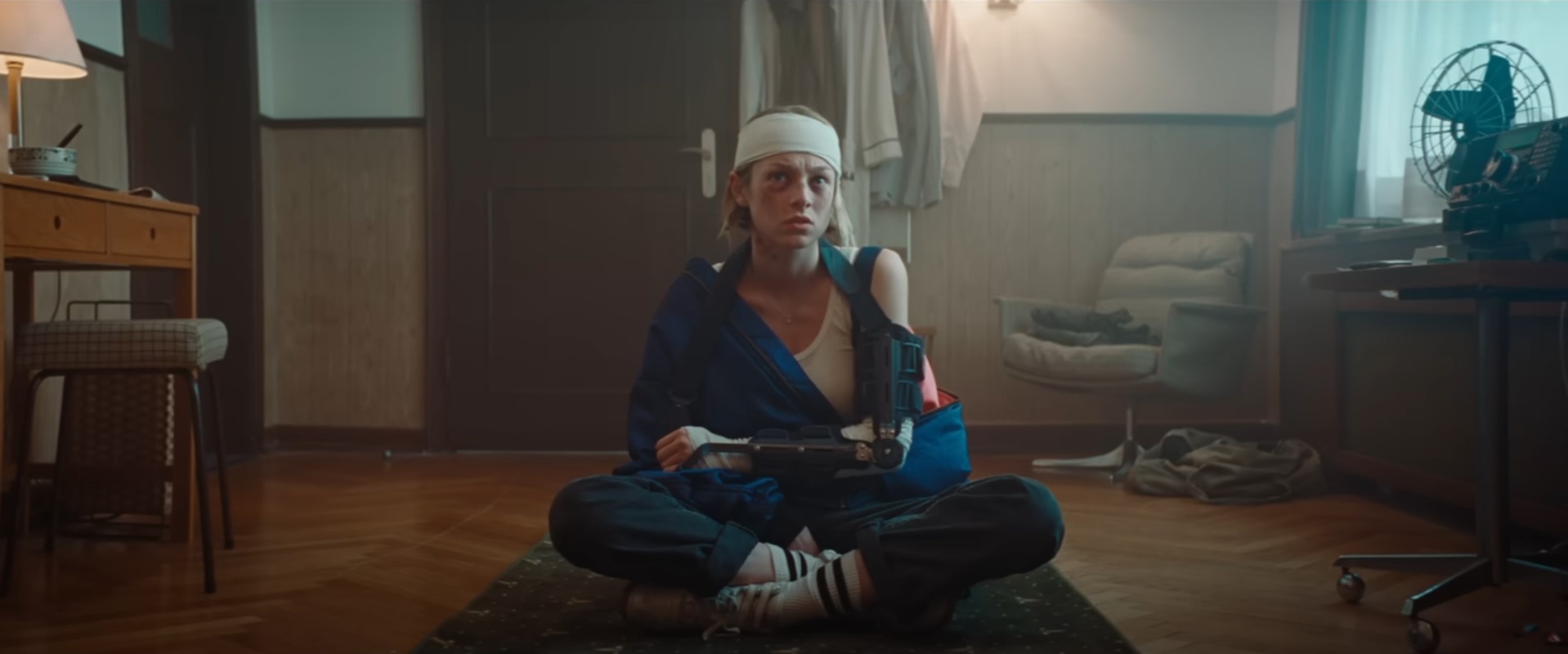
Having established himself as a refined and charming British actor in the widely popular BBC series “Downton Abbey,” Dan Stevens has slowly but surely infiltrated himself in what Lydia Deetz might describe as strange and unusual films.  Shortly after the untimely demise of the Matthew Crawley character, the principal love interest to Lady Mary (for those who know, know), Stevens jumped right into the Adam Wingard thriller “The Guest” where the then slightly over 30-year-old actor proves himself capable of portraying so much more than a stiff socialite.  As resort owner, nature preservationist, and the overall prototype of Zen in Herr König, Stevens displays another side of his deranged splits while showcasing his perfection of the German language.  Opposite Herr König in the teen heroine role is the rising star from “The Hunger Games:  The Ballad of Songbirds & Snakes” and the provocative HBO series “Euphoria,” Hunter Schafer.  As Gretchen, Schafer instills a grappling of grief for a mother she was not ready to let go, institutes steadfast judgements about her father’s new family, and impresses a level of loneliness when having to move away from familiar America to the foreign and alienating grounds of Eastern Europe which all evoke the epitome of teenage angst who can’t see beyond her music, her longing for home, and her new family aversion to see that all those negative, destructive traits innately push her away from what’s important, her family.  Herr König embodies Gretchen’s impediment to move forward while another, Henry the detective (Jan Bluthardt, “Luz”), is stitched to ground Gretchen as the past representation of events you can’t change and the anger it has over you.  Jessica Henwick (“Love and Monsters”), Marton Csokas (“Evilenko”), Greta Fernández (“Embers”), Proschat Madani, Kalin Morrow, Astrid Bergès-Frisbey (“Pirates of the Caribbean:  On Stranger Tides”), and the introduction of Mila Lieu as the mute Alma rounds out the cast.

There are no Coco Puffs to go for here in what will be Tilman Singer’s signature breakthrough hit in the cult genre.  “Cuckoo’s” unique spin on the certain genus of the titular bird is next to none as it radicalizes extreme measures to save a mimicking, infiltrating, surrogate-forcing species from extinction.  The story, which takes on the play God and find out narrative, is a perfect prefect of cutting your nose off despite your face in both the sensationalized horror element and in the rite of passage of teenager squabbles that oxymoronically favors a contrasting parallel.  “Cuckoo” falls into area of weirdness that could be an episode of the “Twilight Zone” in its earthbound peculiarity hidden from public view for decades, if not centuries, blending the once unforeseen man and animal into one and trying to keep that unity intact no matter what the natural process of survival decrees; the story goes between the shadows into its lockbox of nature’s little dirty secrets left in the dark recesses of the forgotten closet and what’s found there is unnatural, wrong, and perhaps even prehistoric.  “Cuckoo” might be too weird.  Understandably, audiences may find “Cuckoo’s” birdy thriller too intractable and maybe too, too far-fetched for a horror film that tiptoes around political hot topics, such as with the violation of women’s bodies and the pregnancy genetics that ensues.  Yet, that controversial conversation starter inside a soupy mixture of on-your-toes tension and the solid acting from Schafer, Stevens, Bluthardt, Bergès-Frisbey, Lieu, Henwick, Csokas, and Morrow develop a much needed off-the-wall and cacophonous-stirring horror that offers a new breed of horror.

The unbelievably scary ordeal arrives onto Neon’s standard Blu-ray set with an AVC encoded, 1080p high-definition resolution, BD50, presented in the anamorphic widescreen aspect ratio 2.39:1 CinemaScope.  Graded with a lower contrast, “Cuckoo’s” antiquated, perhaps wall-to-wall 70’s or 80’s veneer, elevates the finish with bolder conventional colors, enriching wood paneling, gaudy wallpaper, and the like to pop out rather than blend in.  Textures are retained in finer fabrics but appear to be lost on much of the skin surfaces with the revolving door of lighting.  Cinematographer Paul Faltz’s play on light, shadow, and depth creates tension, mood, and a lasting impression.  The lossless English (and some German, which isn’t listed) language DTS-HD Master Audio 5.1 mix provides favorable fidelity, especially when a partial of the film’s story revolves around immersive sound – Gretchen’s music, vibrating vocal sirens, Herr König’s recorder tune, etc.  Depth and range hit on the exact spatial amalgam, diffusing nicely and dynamically into the back and rear channels when scenes play out to a chase or civilly devolve into gunfire.  The second, accompanying audio option is an English Descriptive Audio 2.0 mix that provides same quantity without much of the immersive quality.  English and Spanish subtitles are optionally available.  Bonus features include the making-of “Cuckoo” with snippet interviews and behind-the-scenes look, a video diary series, on-set interviews with actor Hunter Schafer, costume designer Frauke Firl, and production designer Dario Mendez Acosta, a handful of deleted scenes, and a teaser and theatrical trailer.  Neon’s hard-encoded region A, standard Blu-ray comes in the traditional blue Amaray case with the poster art as primary cover design.  Disc is pressed with a black background and “Cuckoo” in red font.  There are no inserts or other tangible features.  The R-rated film, for violence, bloody images, language, and brief teen drug use, has a runtime of 102 minutes.

Last Rites: “Cuckoo’s” a devouringly devilish and deranged nightmare discording from the pattern to breach onto a new form of terror.

Fresh Horror for the Taking! “Cuckoo” Available on Amazon!

Under an Urban Club Scene, EVIL Horrors Connect Us All. “Flesh City” reviewed! (Wild Eye Releasing / DVD)

“Flesh City” Yearns for Connection on DVD!

An insomnious city pulsates with an industrial soundtrack and claws cantankerously at denizens without pity. Under one of the raging night club scenes, enamored raver Vyren follows the beautifully alluring Loquette, an inspiring electronic DJ, down into the club’s labyrinth of old stone corridors. Their coquettish play becomes the monitored study of Professor Yagov, a glowingly cadent and mad experimenter of anthropology. The two lovers are drugged and abducted by the Yogav with the intent of genetic mutating the couple’s anatomy that renders Vyren’s hand displaced with a bulbous nub and Loquette impregnated with an ingestible sludge. What becomes of their affliction insidiously infects the entire city population with a flesh tentacle curling through the city’s underground sewer and drainpipe infrastructure in what amasses to a single connection of brain-invading techno-horror.

“Flesh City” annexes our individuality for the sake of connective solidarity conveyed in an electronically infused and alternatively aesthetic experimental film from Germany’s own jack of all independent media and artistic trades, Thorsten Fleisch. The 2019 released feature is Fleisch’s first and only written-and-directed full-length film depicting his feverish analog avant-garde, reflecting the filmmaker’s menagerie of orthodox-shredding short films, video art, and written and produced music. Overseeing “Flesh City’s” cinematography and special effects, Fleisch has complete and utter autonomy of the visuals to obtain a harshly discordant image melody edited together, which Fleisch also manages, into an agglomerate of acetic aesthetics to shock and stress the audio and visual cortexes. Once under the working titles of “Berlin Blood” and “Zyntrax: Symphony of Flesh,” “Flesh City” is entirely shot in Berlin, Germany, produced by the director and United Kingdom producers Arthur Patching and Christian Serritiello, and is a feature of Fleischfilm and Tropical Grey Features.

One of the film’s coproducers and musical artists, Christian Serritiello (“Streets of East L.A.”), is at the front lines of “Flesh City’s” afterthought cast of characters with Vryen as essentially the naïve and lured-in Alice chasing the white rabbit Loquette, played by Eva Ferox (“Love Songs for Scumbags”), down the twisted rabbit hole of a cellar dwelling doctor.  I say afterthought because the characters take a backseat to Fleisch’s contortion of reality and the analogical subtext generated by Fleisch’s love for analog anomalies, using them as supporting pawns to carry out his visceral vision of vitality.  Music videos, psychedelic montages, and grotesques images of beetles absorb screen time like formless or arthropodal principals.  Even Professor Yagov (Arthur Patching”) is obscured by a rainbow shimmer, never visually seeing his face as an individual seemingly between two dimensions.  “Flesh City” is a very multiverse, multidimensional nightmare-scape of unconventional color that has culminated from Fleisch’s imaginative idiosyncrasies over the years and that’s what being intently showcased here with more evident display of a less-character driven, shapeless story within the technical aspects of the DVD release where the soundtrack drowns the dialogue into a muffled deaf tone, like any good loud music venue would subdue.  “Flesh City’s” urbanites fill out with Marilena Netzker (“Love Songs for Scumbags”), Shaun Lawton (“Possession”), Denis Lyons (“German Angst”), Anthony Straeger (“Call of the Hunter”), Maria Hengge (“Love Songs for Scumbags”), Helena Prince (“12 Theses”), and Thorsten Fleisch in a Max Headroom meets Total Request Live-like host role of Quantum 1337.

“Flesh City” will not be everyone’s approx. 90 minutes of how to spend their time choice.  The experimental film will only speak to a few select souls with a filmic affinity for Lynchian peculiarities, Terry Gilliam’s bold fantasy, David Cronenberg’s body horror, and a hellish capriccio along with an eclectic music palate for noise rock, henpecking alternative, and strident industrial bass.  I wouldn’t go as far as saying Fleisch’s film is akin to nails on a chalkboard but can be boisterously unpleasant to the ears at times while, in the same breadth, be stimulating visually, even if that stimulation may induce a photosensitive epileptic seizure.  Fleisch’s non-traditional narrative design splices in music videos from various underground and indie artists with him providing introduction as an illusionary host in a virtual world, breaking up the Vyren and Loquette’s post-punk-adelic core quandary with a teetering melodic cacophony of feedback rock electronic, a hostile rhythm, and bizarre lyrics and visuals.  Fleisch pushes the taboo envelope with not only liberal nudity, to which Germans are very at ease with their body image, but also within the unconfined stylistic creativity of multi-formats that razzle-dazzles like the innards of radiant plasma globe; the Tesla coil electrons that’s drawn to your conductive flesh won’t hurt you but provide a feeling of captivated wonder.  Yet, don’t expect to be thrilled in a traditional predator-and-prey sense as “Flesh City” appeals more to our disconnect from each other and how to reconnect must be through some kind of inclemency. 

Likely to transmit under the radar, “Flesh City’s” biomorphic body horror arrives onto unrated director’s cut DVD home video courtesy of cult and independent distributing label Wild Eye Releasing in association with Tomcat Films.  The DVD5 presents the transfer in a widescreen 2.35:1 aspect ratio with varying levels of image quality due to different types of equipment and methods used to create Fleisch’s tripped out vision that contains, but isn’t limited to, black and white, color, stylistic lighting, analog equipment, digital equipment, stock footage, and so forth.  This mishmash movie makes for divisible degrees of signal quality that can be look crystal clear in one scene and then heavy noise interference the next, but the overall clarity is remains stable without any scenes being rifted because of visual vagueness.  The audio comes in two formats:  a English Dolby Digital 5.1 surround sound and a English Dolby Digital 2.0.  Frankly, the original English dialogue track is feeble under the tremendously potent soundtrack and sound design that makes comprehending Vyren and Loquette subterranean exchanges under the industrial rumble of the score virtually impossible to discern.  Even Quantum 1337’s cyber-stutter chat softly introduces us into his world, essentially leading the blind into a mound of musical mania. Bonus features only include other Wild Eye Releasing trailers with the physical aspects of the DVD come with a misconception cover art that has a terrifying gaunt and fleshy, humanoid creature front and center, but that creature doesn’t exist in the film until maybe at the climax that’s nebulously discernible at best what viewers are supposed to see. Inside the standard DVD snapper, the disc art is pressed with the same front cover image but with no accompanying insert. The region free disc features the unrated film with a runtime of 84 minutes. “Flesh City” is a delicacy of distortion, but the Thorsten Fleisch film is an acquired taste that general audiences won’t have taste for but, then again, general audiences are not Wild Eye Releasing’s target audience, now are they?

“Flesh City” Yearns for Connection on DVD!

Three Women Murder to Stand Up Against EVIL! “A Question of Silence” reviewed! (Cult Epics / Blu-ray)

“A Question of Silence” Laughs Louder than Words on Blu-ray!

Three different in age and lifestyle women carry on with the routine of their normal lives until police offices arrest them on the charge of murdering a male owner of a clothing boutique.  Having seemingly no motive and have no connection to each other, never having met each other before, the confounded prosecution hire a psychiatrist to determine the women’s mental state for the brutal beating of the shopkeeper.  As the psychiatrist interviews and digs into their personal lives to give rationality to an irrational crime, she finds herself drawn to the women and their heinous act stemmed by a life history that paints a picture of dehumanizing neglect and of providing zero respect.  Subjectively overwhelms objectivity the deeper she looks into their case and her professionalism is put to the test when she has to decide whether being labeled insane fits the accusation or if a more gender bias systemic issue is at play.

After a rousing first part of feminist revenge with “Red Sun” from 1970, we fast-forward slightly over a decade later in 1982, and moving from out of Germany and into the Netherlands, with Marleen Gorris’s acclaimed crime drama “A Question of Silence.”  With little-to-no film prior film experience, Gorris becomes a provocateuse with her debut picture that stirs controversy amongst one side of the sexes.  “A Question of Silence,” natively titled “De stilte rond Christine M,” or “The Silence around Christine M.,” became the best Dutch film of the year with local accolades, including a Golden Calf for best film at the Netherlands Film Festival the year of release.  Along with the Rudolf Thome’s “Red Sun” and the German social commentary on women integrating into equal social and professional positions, Gorris comes at a time where the status of Dutch women were on the lower end of the gender equality scale, especially in the workforce.  Matthijs van Heijningen, who produced polemic features directed by women filmmakers, such as Nouchka van Brakel’s “A Woman Like Eve” and “The Cool Lakes of Death,” risked yet another credit to his name with the virtually unknown writer-director Marleen Gorris and her sizeable undertone story under his company, Sigma Film Productions.

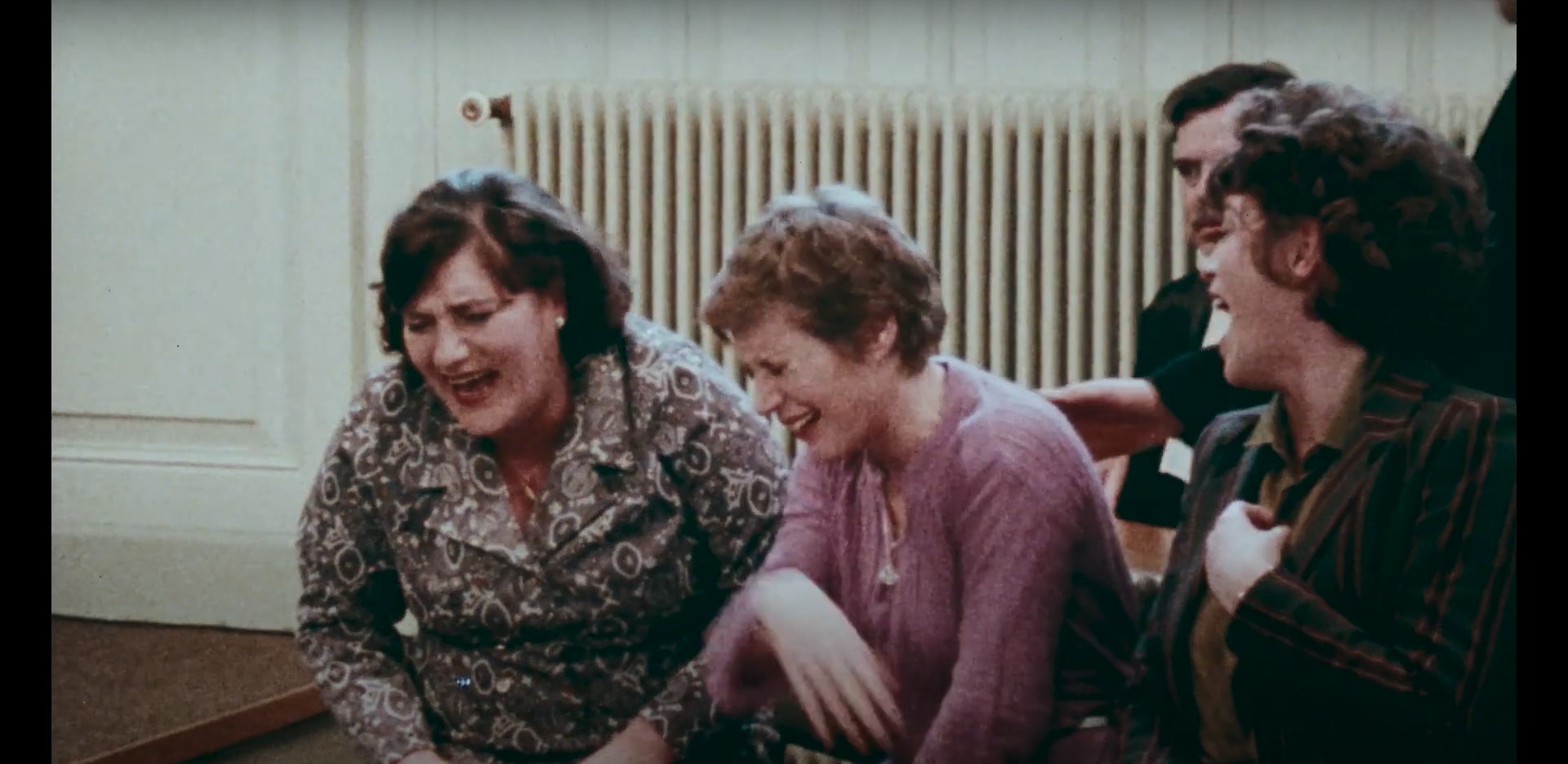
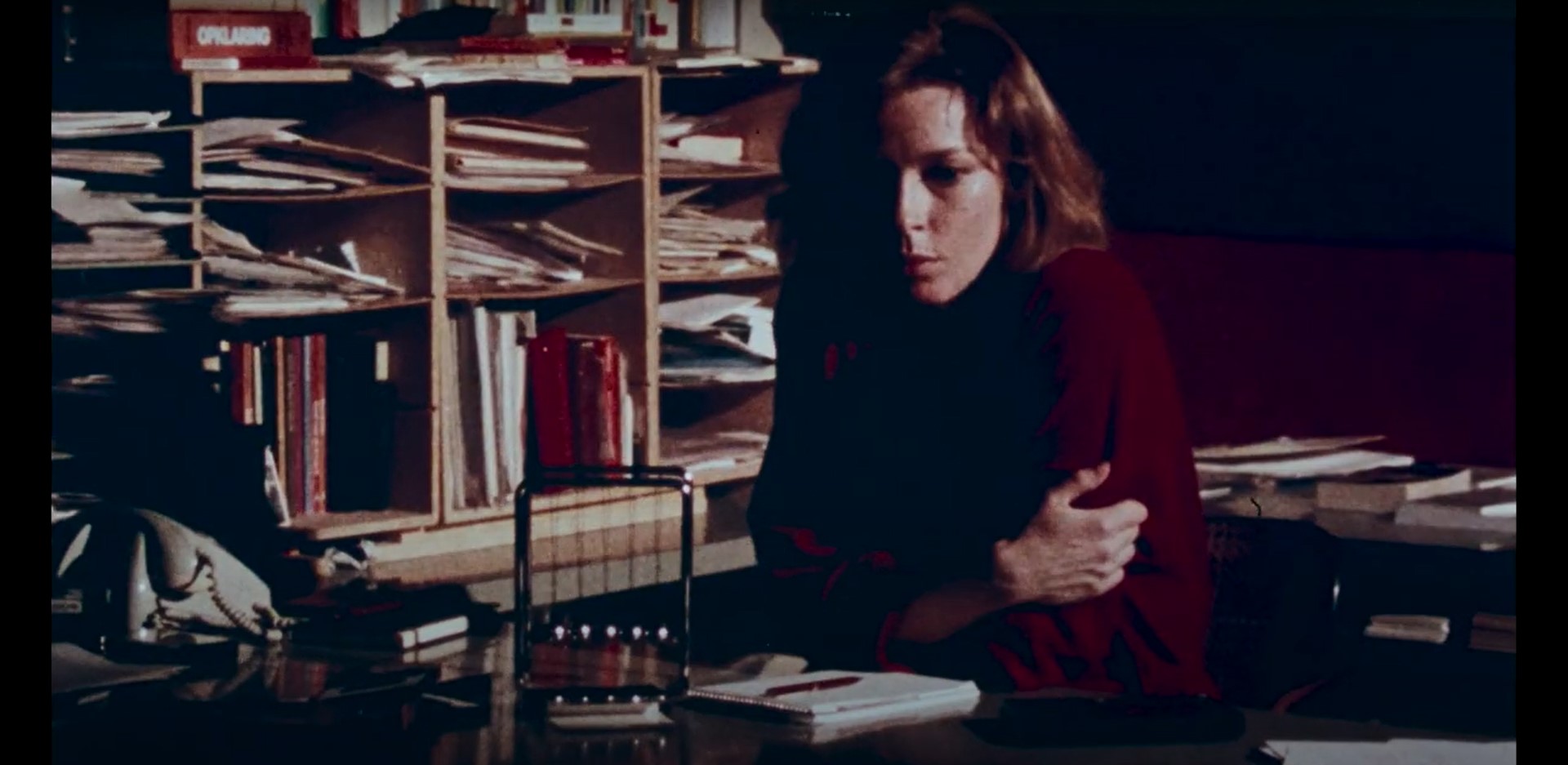
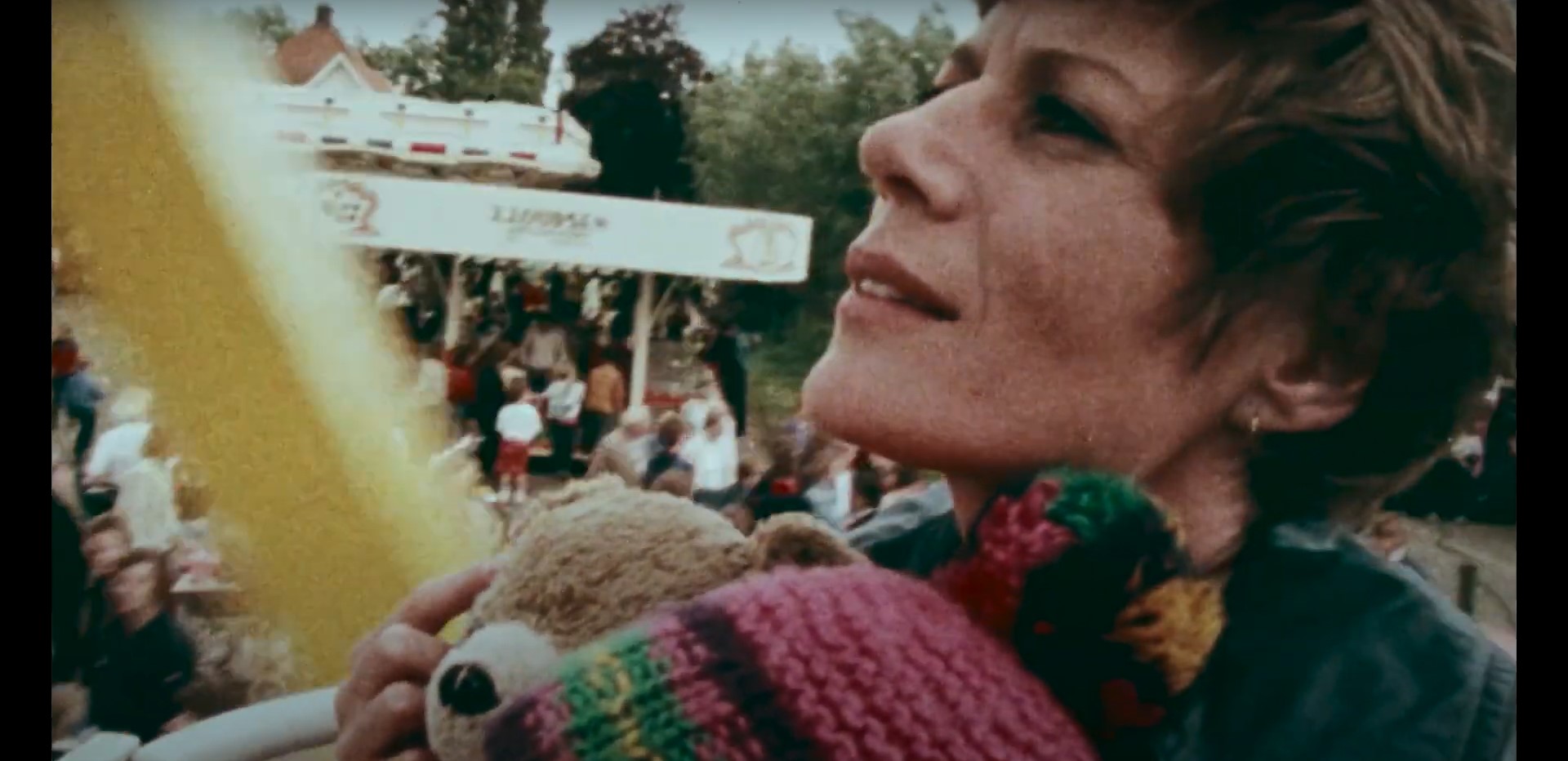
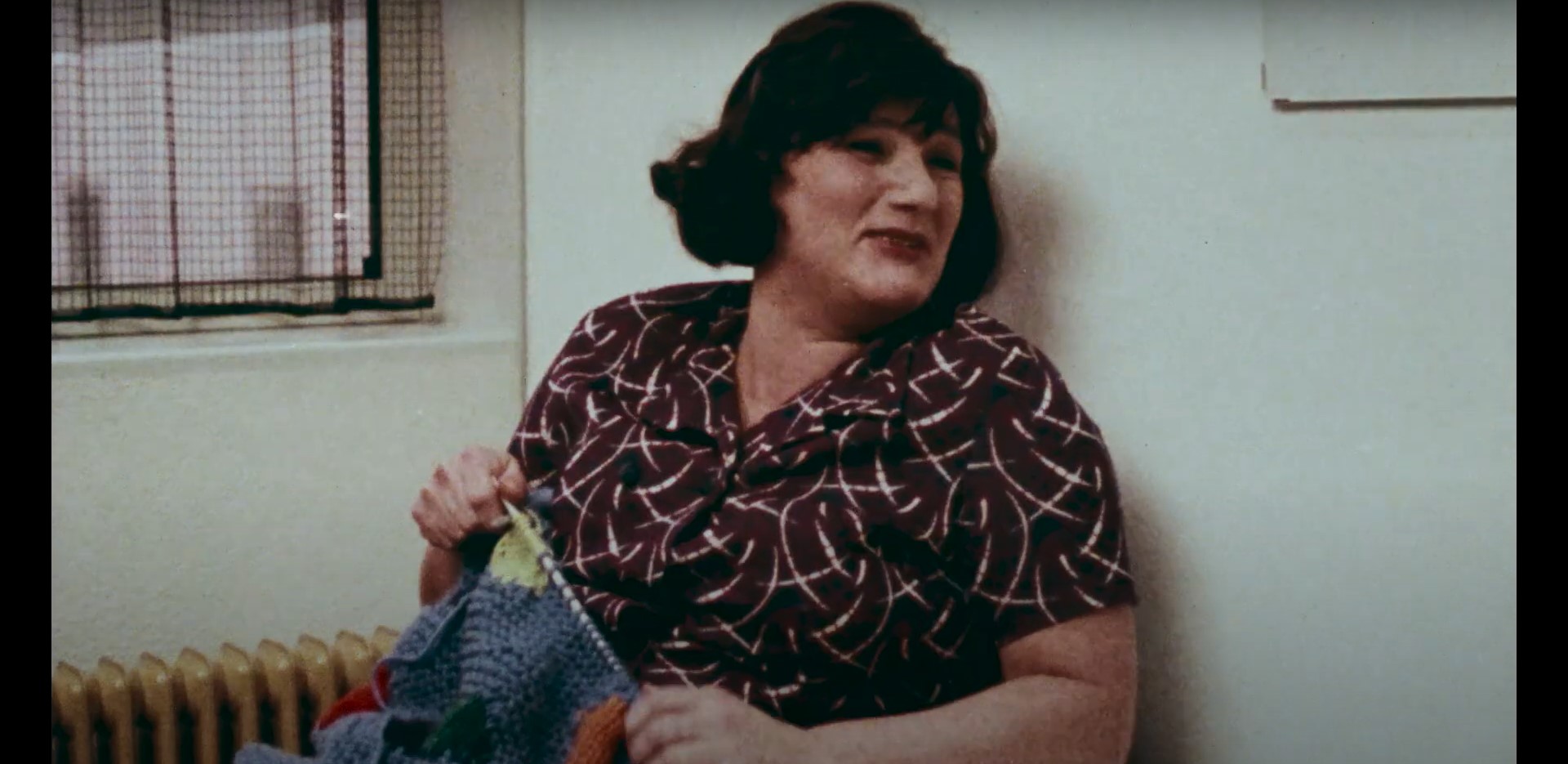
The narrative opens with Janine van den Bos and her husband Ruud having a flirtatious moment on the couch where Janine playfully annoys her book-reading husband with advances sexual foreplay.  Without knowing who these two people are exactly, other than they’re in a version of a relationship, Janine, played by Cox Habbema, and husband Ruud, played by Eddy Brugman setup metaphorically what’s inherently wrong with society with a woman seeking something and the man ignoring her and practically commanding her to stop the foolishness in a dismissive way.  This opening scene then cuts to the three women being arrested, led up to by intercuts of their daily routine before the police confront them.  We’re treated to some of the most idiosyncratic and grounded performances by Edda Barends as the muted housewife Christine, Nelly Frijda as the cackling coffee barista Annie, and Henriëtte Tol as the beautiful and intelligent secretary Andrea.  The three women never met before, never plotted before, and never killed before but a sudden epiphany while shopping became the straw that broke the camel’s back, turning watershed into bloodshed that unveiled something just as sinister as murder.  Cox Habbema engrosses herself into the psychiatric role as an educated woman analyzing and judging other women while also being judged herself by the opposite sex despite a higher-level of learning and professionalism.  Without exposition, characters express themselves through action while being ambiguous through dialogue, working to convey the lopsided gender equality across the screen perfectly without even one ounce of explanatory detail dropped. 

What’s most intriguing about Gorris’s film is it’s mirroring quality to society.  “A Question of Silence” doesn’t fabricate grand futures or alternate universes with eccentric, wily characters to be metaphorical fodder of expression; instead, Gorris remains earthbound, present, and timely by incorporating true-to-form examples that create derogatory silence on women.  The non-linear narrative, cutting back-and-forth from investigative present to the chronicled past visualizes the women’s struggles and frustrations living inside a male-dominated culture.  From being expected to handling all aspects of the household and childcare, to being brushed off and dismissed by colleagues, to forgotten and underappreciated, Gorris forces a frank contemplation on a patternized and patronized patriarchy.  Heightening the tension, Lodewijk de Boer and Martijn Hasebos’s giallo-esque and experimental soundtrack adds a layer of loadstone to see whether these extempore femme fatales executed a crime. 

Cult Epics, in association with the Eye Film Institute, continue their campaign on delivering thought-provoking, provocative, and controversial Dutch masterpieces onto the high-definition stage with their latest release, “A Question of Silence.”  The AVC encoded, 1080p, BD50 stored feature is presented in the 1:66:1 European widescreen aspect ratio.  The 2K HD scanned transfer and restoration is based off the 35mm print; however, judging by the grain levels and very little preserved detail, especially in a HD scan, I’d say the original negative was 16mm and then blown up for 35mm project, which was a fairly common process.  The noticeable enlargement of grain dampens picture details less favorable yet not the image quality is not a total wash with a stable graded rendering, with a natural skin tone and pigment of objects, and the presence of imperfections kept in a minimum – such as the occasional cigarette burns and dust/dirt.  What excels here mostly is the lack of compression issues so we’re only treated to the innate quirks of the original celluloid film.  The release offers two Dutch language audio options – a LPCM 2.0 mono and a DTS-HD MA 2.0.  Toggling between both tracks, there’s not much different between them until Nelly Frijda’s crone-cackle distinguishes itself with robust HD prominence projecting full-bodied through the dual channel.  Again worth noting, Lodewijk de Boer and Martijin Hasebos synthesizing score, coupled with Marleen Gorris’s tense and taut flashback storyline, casts a disquieting tone that’s very fitting for a film entitled “A Question of Silence.”  Dialogue, as well as the score and overall soundtracks, suffer very little from the slight hum of the running camera and some minor hissing but the general result has tremendous.  English subtitles are optional and synch well with error-free translation; however, upon watching the special features, the Cult Epics’ feature translations differ from the copious amount of snippet clips of the interview segments.  Roughly the same interpretation but the phrasing maybe clearer and less wordy in the snippets so I’d be interested in the, what I assume would be, the original English translation.  Special features include an audio commentary by film scholar Patricia Pisters, an archival Cinevise interview with Marleen Gorris from feature release year 1982, a sit-down, one-on-one interview with lead actress Cox Habbema and Cinevise host a year later, a Polygoon Journal Newsreel from ’82 that mentions the Golden Calf award from the Netherlands Film Festival, a promotional gallery, and trailers.  The clear Blu-ray cover comes with the tear-drenched and shadow-obscured face of Cox Hebbema with a reversible still image of the three accused women on the inside.  No insert included and the disc is pressed with the same front cover art.  Cult Epics Blu-ray comes with region free playback and the feature is 97-minutes and unrated.  Marleen Gorris first run as a filmmaker denotes her as a masterful storyteller with a timeless tale of close-quartered and subtle masculine tyranny in an attempt to open the unwilling eyes of the narrow focused. 

“A Question of Silence” Laughs Louder than Words on Blu-ray!

When Men Want More, They Receive More… EVIL! “Red Sun” reviewed! (Radiance Films / Blu-ray)

“Red Sun” on Limited Edition Blu-ray from Radiance Films!

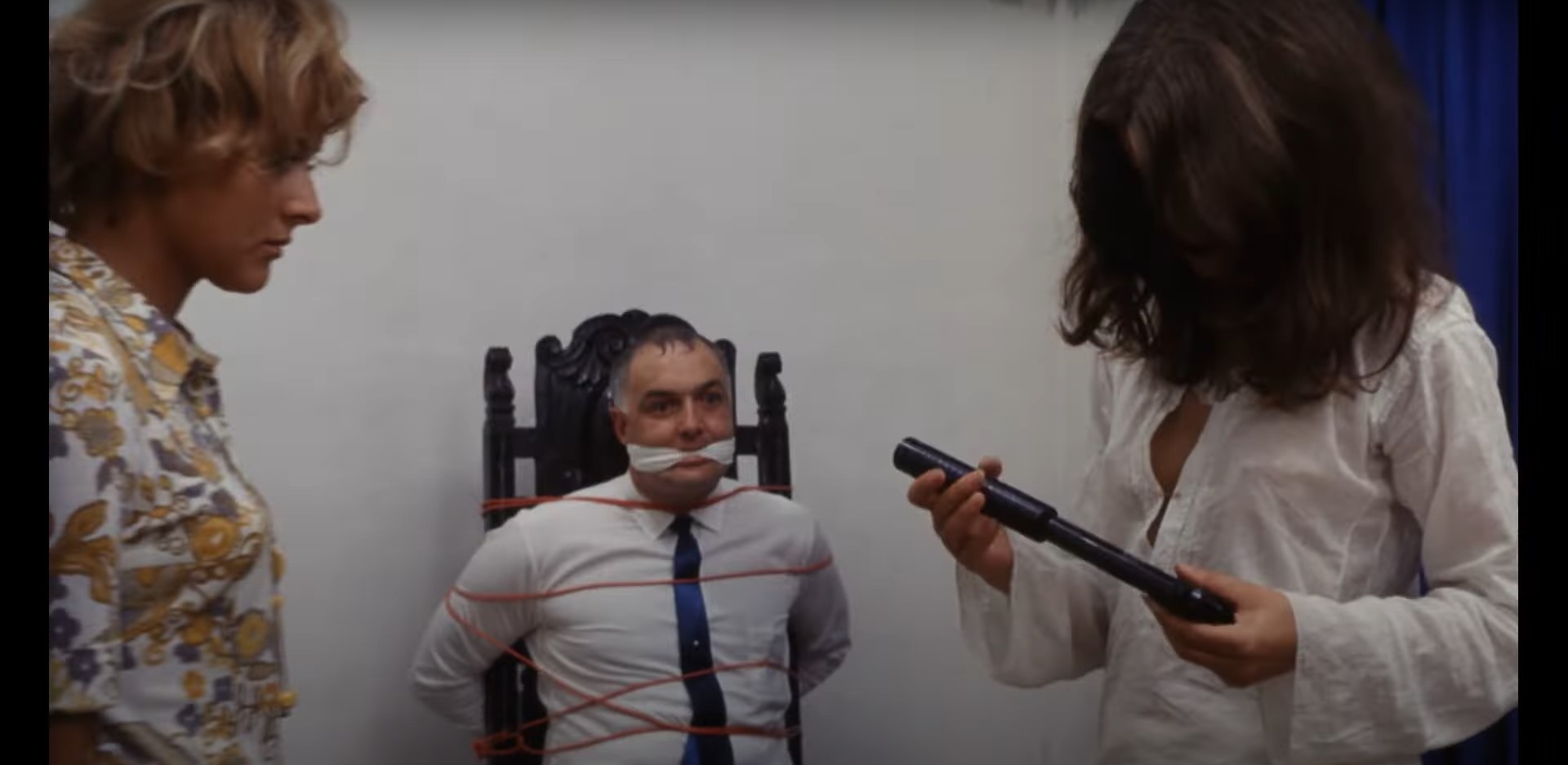
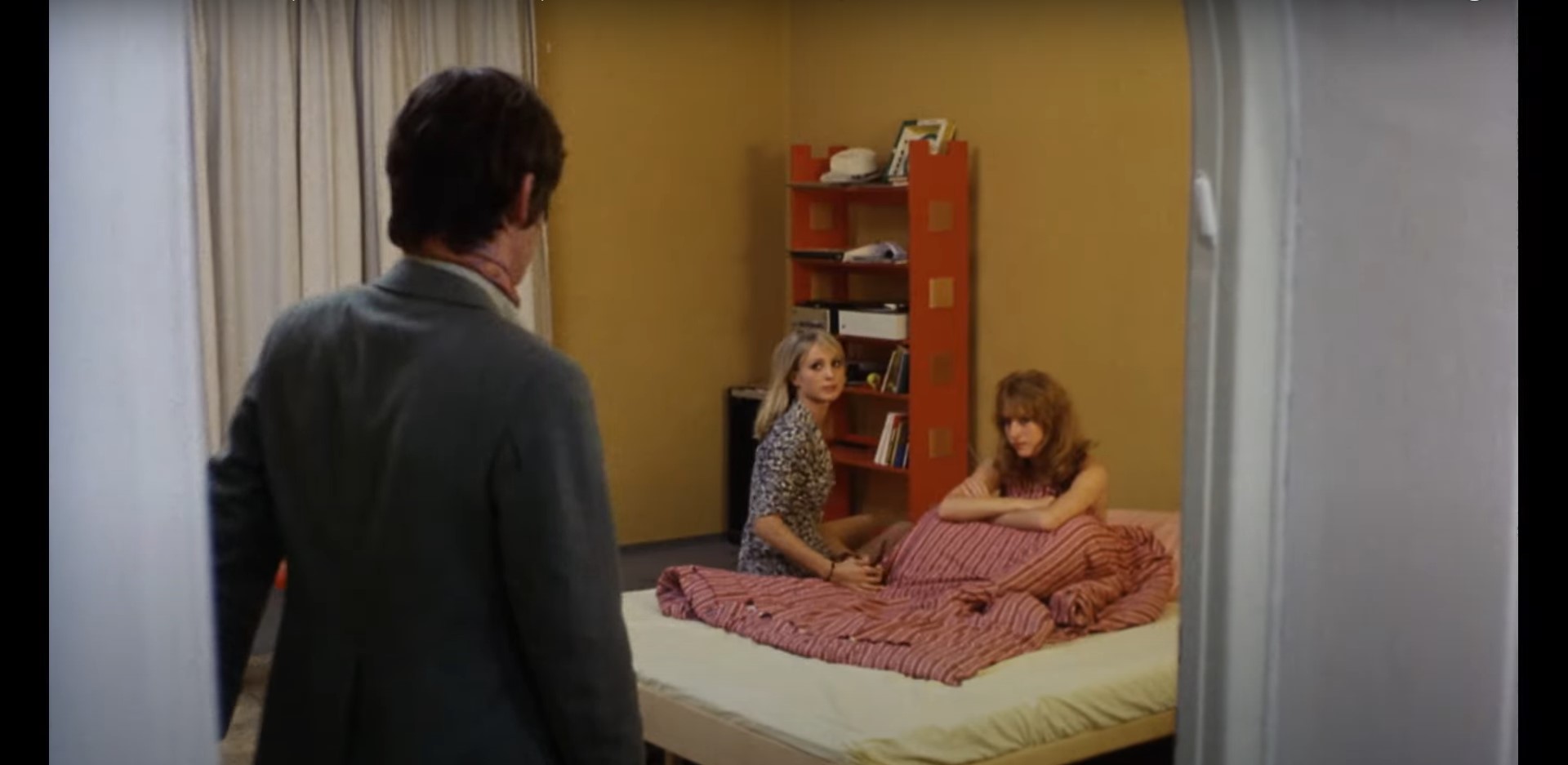
Peggy, Sylvie, Christine, and Isolde have made a mortiferous pact to lure wanton men into their spider’s web before snuffing them out. Armed with guns and homemade explosives, the four women find themselves strapped for cash but managing to get by with their all-in scheme to take out as many licentious men as possible. When the nomadic loafer Thomas re-enters Peggy’s life, she initially sees him as just another mark to relieve from the mortal coil, but Thomas’ uninterest in sexual desires appeal to Peggy’s compassion and care for the man she once loved who just happened to show up in her life one night. As the two become closer, Peggy’s accomplices continue their deadly ideology, working their individual johns, but Christine and Sylvie find Peggy slipping under Thomas’ beguiling draw, an affect she can’t seem to comprehend, and pressures Peggy to be thorough with Thomas to the bitter end.

“Rote Sonne,” or “Red Sun” translated into English, is the 1970 feministic crime drama from German filmmaker Rudolf Thome and penned by the late Switzerland born screenwriter, Max Zihlmann.  Thought-provoking as it is enticingly cold, “Red Sun” tears open a void between lust and violence that separates the sexes of scorned scars.   The pre-European Union film looks at feminism during a highly patriarchal Germany time, West Germany to be specific, when women rights were essentially molded and determined by men.  Wives relied heavily on their husbands to make decisions for them on a permissible granted condition and even some marriage-related abuse crimes we’re not punishable under German law.  Thome helmed a politically anti-conservative and socially anti-inequality picture during the second wave of German feminism of the 1960s with ironfisted and revenge-seeking protagonists as an active cell blending into cultural norm.  “Red Sun” is produced by the director as well as Heinz Angermeyer of Independent Film productions and is part one of our double bill look at radical feminism with Marleen Gorris’ “A Question of Silence” to follow.

At the tip of the cast spear is a Rudolf Thome regular, Marquard Bohm, having had roles in another of Thome’s empowering women feature “Supergirl – The Girl from the Stars” as well as the skin-laden “Detektive,” and the narrative’s focal character stirs confounding interest in that it revolves around a male principal of a women liberation-by-force feature.  As Thomas, Bohm is not a traditionally depicted German man but has all the some of the minuscular familiar qualities of masculine behavior.  Thomas loafs into to life of Peggy, played by fellow “Detektive” star Uschi Obermaier, and her cohort of conniving men eaters – Christine (Diana Körner, “Barry Lyndon”), Sylviie (Sylvia Kekulé) and Isolde (Gaby Go) – simply by being at the right place at the right time or visa-versa, depending on how you look at it.  For Thomas, his nonchalant leeching onto Peggy morphs into something more than just freeloading off of already strapped for cash Peggy and friends, becoming a distraction and an attraction from his previously failed relationship in Munich.  The role is in a mirror reversal of the then current German society with Thomas being a stay-at-home man, running errands at the behest of the woman Peggy as she goes to work and earns to keep their clandestine killing chugging along, but Thomas does what he wants, whether be spending Peggy’s extra cash on cigars or eating all the food in ladies’ fridge.  Opportunistically asserting his needs onto their, often inimical, hospitality, Thomas is the Peggy beloved free-range chicken strutting his stuff around other hungry, more axe-wielding, farmers that put the pressure on Peggy to nix him before he insidiously collapses their pact.  Under the “Red Sun,” the cast fills out with Don Wahl, Peter Moland, and Henry von Lyck.

Unfortunately, Thomas has inadvertently sowed the seeds of destruction within the four women, dividing the group’s cause and on what to do with Thomas.  The women are arranged in a spectrum range of how to handle their contested guest; Thomas has caught the eye of Peggy and Isolde, though active in certain measures of man-slaughter, refuses to partake in the act of killing altogether where Sylvie pushes back against her indifference amiability for Thomas to continue the good fight and Christine just flat out owns her oppositional stance to eliminate the man many would find lackadaisical and nocuous to their friendship and plans, like an usurping boyfriend coming in between two best friends.  What Thomas represents is the potential squash, or delay of, the feminist movement against an arrogant and authoritatively unfair patriarchal society and each woman is a different perspective and reaction to the measures of feministic movement.  “Red Sun” is also a tragic love story that pits rightful duty against the heart’s urges and Thome is able to fashion a path through the commentary to depict both views in a sad, yet heartful conclusion.  What Thome doesn’t do well is the appropriate stitching of time passed.  Perhaps through editing or the within the confined text of the script, what feels like weeks passed is actually only a handful of days, but Thomas’s comfort level is so ingrained, coupled with the brief mentioning of how long he’s been around, the comings-and-goings of time blend into one jerky story that can’t properly materialize a granular tone and “Red Sun” becomes a bit sun blind at times when trying to keep with the characters’ narrative.

“Red Sun” blazes onto a world debut, limited edition Blu-ray release from independent cult film distributor, Radiance Films. The AVC encoded, high-definition release has been scanned in 2K from the original 35mm camera negatives, supervised by director Rulfe Thome, at the Cinegreti Postfactory in Berlin as well as additional touchup restoration work to spruce up the dust, dirt, and scratches. Radiance Films’ presentation features a brilliant quality that has restored to void out any celluloid cankers. Grading appears natural and vivid under the breadth of the welcomed 35mm grain. Aside from a handful of faint vertical scratches here and there, this Blu-ray has none the worse for wear with compression issues as the transfer is stored on an ample BD50 to reduce any compression artefact effects. The original German language LPCM 2.0 mono track vivaciously keeps up with a clean, clear, and robust post-production dialogue recording. No major issues with hissing or popping though minor specimens rear their ugly audibles sporadically to a negligible outcome. Since ADR is used, depth is lost amongst the dialogue track, but the environmental ambience nicely courses through the output with a small explosion and episodic skirmishes to keep the range from being too concentrated. English subtitles are available and are well-synced, well-paced, and are grammatically sound from start to finish. Bonus features include an audio commentary track with director Rudolf Thome and Rainer Langhans and also two visual essays with film academics Johannes von Moltke, in German with English subtitles, on the subject of cultural and social influences on “Red Sun” titled Rote Sonne: Between Pop Sensibility and Social Critique, and Margaret Deriaz exploring the developments on the New German cinema, titled From Oberhausen to the Fall of the Wall. The physical attributes are just as enticing with non-traditional and clear Blu-ray snapper case with a thicket, 51-page color booklet insert featuring the 2022 Guerrilla girls: Radical Politics in Rudolf Thome’s “Red Sun” essay by Samm Deighan, an interview with the director, Letters to the German Film Evaluation Office by Wim Wenders and Enno Patalas from 1969, film review extracts between 1970 and 1991, and transfer notes and full package release credits. Sheathed inside the case is a reversible cover art with a Bond-esque prime cover of Uschi Obermaier in a white, short-skirted outfit holding a revolver in front of a shoreline red sun. Alternate, inside cover notes the original German language title “Rote Sonne” with the 3 of the 4 femme fatales posed around Peggy’s VW bug. The disc press art is perhaps the less exciting aspect with just a plain, off-white disc with red letter of the title. Radiance Films’ release comes region free, has a runtime of 87 minutes, and is not rated. Limited to 1500 copies should not stop a film aficionado from looking directly into the “Red Sun,” a highly provocative and pulpy thriller full of contempt and full of ambivalence curated to pack a punch on a new Radiance Films Blu-ray.

“Red Sun” on Limited Edition Blu-ray from Radiance Films!

Never Tour Mistakenly into an EVIL Murder Bar! “La Petite Mort” reviewed! (Unearthed Films / Blu-ray)

“La Petite Mort” is Orgasmically Gory and on Blu-ray!

Vacationing to Mallorca should have been a relaxing getaway for Simon, his blind girlfriend Nina, and their longtime friend, Dodo, but their flight layover in Frankfurt leaves down idle town to explore the city that’s only a mere two hours from home. Tension between them begin to bubble to the surface when uncertain emotional steps to take relationships to the next level arise and they become inadvertently scammed by a local grifter. Exhaustion sets in and forces them to take refuge in a local dive bar with a specialty for S&M play. The bar is actually a front for the Maison de la Petite Mort, an underground snuff house owned a sadistic woman named Maman who livestreams kink-murders and sells hapless victims to wealthy businessmen with whimsical and perverse deviancies. The flight to Mallorca will be indefinitely delayed as the three friends are now a part of the bloody basement decor awaiting the horrors before them.

“La Petite Mort,” translated from French as literally the little death, is also known as the post-orgasmic sensation, such as a weakness or loss of conscious, that serves as an analogy to death. The phrase is also the title of the 2009 torture-gore film written-and-directed by the German-born Marcel Walz more than a decade before the formation of his now Neon Noir production company. Walz, who later in his career went on to remake the Herschel Gordon Lewis 1963 film, “Blood Feast,” blossoms as a torture porn filmmaker as Walz’s directorial catalogue contains more blood than a blood bank and often stretches the subgenre range of plot machinations from cannibals to dark web to snuff. Made on a few thousand-dollar budget and shot in a real sex club in Mannheim, Germany, “La Petite Mort” touches upon all three plot devices to create a dungeon of splatter and sadism using elements of an unsolved true crime case of a couple gruesomely murdered in an underground murder house as the narrative base. Before Neon Noir, Walz and filmmaker Michael Effenberger, director of “Tortua,” formed Matador Films that became the company behind “La Petite Mort” with Thomas Buresch (“Unrated: The Movie”) and feature actor and director of photography, Andreas Pape (“Toxic Lullaby”) producing.

Films like “La Petite Mort” is a special breed not because of the torture and gore-porn element, which can be an acquired taste for consumers with dark thoughts, fantasies, and morbid curiosities (I fall into the latter category if you’re wondering), but rather the story caters to no singular principal lead nor does is the focus on an ensemble cast.  “La Petite Mort” transitions from one group, the naïve backpacking travelers, to the S&M snuff-makers in a flip-flop of point of view and storytelling.  All the relationship complexities between the out of concern love from Simon (Andreas Pape) to his even keeled blind girlfriend, Nina (Inés Zahmoul, “La Isla”) as well as the insignificant tiffs and spats between Simon and friend Dodo (Anna Habeck, “Popular”) to see who is in Nina’s favor are quickly swept aside when the trio is trapped and tethered to the S&M spider web of Maman’s Maison de la Petite Mort.  While the three travelers produce a mild interest spun out of frivolous dramatics to the like of the normal human population and very much up played by Walz for that very purpose to produce stark contrast against what’s normal for sadomastic pleasure-seekers, Maman, the orchestrator of pain and profit, is the most earnest of principals with a crone-like presence, played inexorably and ruthless by French punk-goth singer Manoush.  The certified gypsy and former bodybuilder has made a name for herself in a plethora of extreme, Germanic horror pictures over the last decade, but “La Petite Mort” came early in Manoush’s career and is exhibits why she’s so good at horror, especially at the sadism brand.  Maman’s schadenfreude business employs two lesbian dominatrixes, Dominique and Angélique, with strong-stomachs and a healthy bloodthirst.  The beautiful femme fatales serve Maman’s unquestionably, almost mindlessly, that only glimpses into possibilities of how the two women became betrothed to do Maman’s bidding.  Annika Strauss, who’s been in the screen queen business about as long as and has starred alongside with Manoush on a number of films, is also a Marcel Walz regular casted actress who fits and transforms into just about every character under the black sun of ghoulish and macabre material thrown her way.  As Dominique, Strauss is provided more depth to why and how the brunette basket case has come under Maman’s greedy and depraved thumb as the actress shows some slither of concern for the captives while explaining she had no choice just they like them and exhibiting more reserve than her blonde counterpart Angélique (Magdalèna Kalley, “Violent Shit 4”) when the cameras are rolling.  Conversations rooted into provocative thought, sympathy, or reason are often few and far in between the constant pleas for help and the screaming matches of pelting threats.  “La Petite Mort” finalizes the cast with Martin Hentschel (“Zombie Reanimation”), Tanja Karius (“Necronos”), and Thomas Kercmar (“Space Wolf”) as Klaus der Kobold, a Napoleon-sized elitist wealthy enough to buy people’s lives and enjoy seeing them horrifically mutilated.

One scene overwhelms the diagnostic side of my brain and that is why Maman is torturing Dodo with needles as Manoush delivers a surprising genuine villainous monologue about sadomasochists being judged by normal people and how her character has a liberated, uninhibited sexuality in a moment that is a powerful argument in favor for sadomasochism to exist without shame.  Thinking about this, I’m not aware of any publicized S&M clubs, especially those that aren’t criticized for being deviant, perverse, and secular.  After that one moment of vulnerability, “La Petite Mort” turns into a choke-down bloodbath with some great and some not-so-great special effects by one of Germany’s gore film greats, Olaf Ittenbach, director and F/X artist of “Premutos:  The Fallen Angel” and “Legion of the Dead.”  Ittenbach brings me to another overwhelming scene, one that churns the contents of your stomach, involving a meat grinder, a hand, and a chalice.   “La Petite Mort” has other notable grisly moments of scalping, castrating, eye-plucking, and disemboweling, all of which are in great gooey-gory detail.  What takes away from the gore scenes is Walz fluttering effect or grindhouse-esque edited framed overlay that, in my wildest guess, is supposed to enhance the extreme acts of violence, torture, and death in conjunction with composer Michael Donner’s industrial rumble and pulsing synth score. Instead, the effect becomes nothing more than a cinematic nuisance, an eyesore that dilutes Ittenbach’s best handywork because that scalping scene is the chef’s kiss of tactual realism. Based on a true story that I can’t seem to find any record of, “La Petite Mort,” for a brief few minutes, becomes a promulgating champion for alternate sexualities and is also a showcase for Olaf Ittenbach to shock and disgust but for what the feature is worth, “La Petite Mort” offers only emptiness in both character conviction and story narrative.

A fitting entry into the shockingly weird and grotesque “Unearthed Films'” independent film catalogue, “La Petite Mort” arrives onto a high definition, 1080p Blu-ray home video. Presented in a 2.35:1 widescreen aspect ratio, Walz bookends his callous-cladded cult film with a yellowish-tan tint while the girth of the story is laced with more gel coloring under no hinderance of tint. Low lighting with low contrast markers, mixed with tropical-warm gel coloring and strobe flashing fabricates the sunless and dank murder basement but any exterior shots, even the bookend act one and act three are rendered with poor resolution for digital recording. Only a single audio track is available with a German LPCM 2.0 with burned-in English subtitles and what’s rendered is likely the best quality to get from the masters from the lossy format. Dialogue is often unrefined, and the levels vary, but for the most part clean and free from obstruction. The track has limited ambience and harps heavily on the gory moments while Michael Donner’s dark industrial score takes the brunt of the overall soundtrack. Subtitle synchronization varies as well with millisecond flashes of translations that are impossible to read or even pause perfectly on, but the translations appear flawless and consolidated from the dialect for easy reading. The Unearthed Films’ bonus content is aplenty with a new commentary and interview with director Marcel Walz. Also included is a feature-length making of “La Petite Mort” with raw handheld camcorder footage, shot by The Bad Boy character in the film, behind-the-scenes footage, and even some 16mm footage that go reel deep into the effects and life of independent filmmakers. An archived interview with special effects artist Olaf Ittenbach, deleted scenes, photo gallery, teaser trailer, official trailer, “La Petite Mort 2” trailer, and the VHS intro that’s essentially a Marcel Walz introduction of the VHS home video release round out the bonus content. The physical attributes are a clear, Blu-ray snapper case with reversible cover art with the inside sleeve containing a more graphic torture not suited for retail shelves. The region A encoded, 77-minute feature is not rated. If invested for the kills, “La Petite Mort” pleases to overindulge the desire and is a solid first torture-porn effort from a then young Marcel Walz who continues to rise in the niche market.

“La Petite Mort” is Orgasmically Gory and on Blu-ray!