

“Malpertuis” Now Available at Amazon!
Jan, a young sailor returns home from a voyage to find his family home gone. After getting into a scuffle with pimp at a night club, he’s knocked unconscious by a blackjack and wakes up to his sister Nancy taking care of him and in the bed inside the Malpertuis home of his draconian uncle, Cassavius, a wealthy, stern, and impatient man on the verge of death with terminal illness. The sailor finds they’re not alone in the large labyrinth estate with peculiar relatives, nearby acquaintances, and longtime servants. Before his death, Cassavius has his will read with everyone present bedside, announcing the distribution of the immense inheritance amongst the close assembly who’ve either worked and slaved hand and foot for Cassavius or have been on the outside clawing up into his good graces for their greed. Yet, to receive their portion, they must abide by one stipulation: they can never leave the Malpertuis. Jan plunges himself into Cassavius’s unfathomable parting will and design, seeking to unearth Malpertuis’s warren secrets, but all a while, a killer begins to pluck away potential beneficiaries.

The 1943 gothic novel of the title by Belgium author Jean Ray serves as the film adaptation source for Harry Kümel’s 1971 gialli-like and surreal maddening “Malpertuis.” Released in the U.S. as “The Legend of Doom House,” the Belgium and Dutch co-production creates phantasmic journey down the rabbit hole that unravels a mystery of pantheon proportions. The “Daughters of Darkness” directing Belgium filmmaker helms the faultlessly fantastical adaptation and script by Jean Ferry, who would also collaborate with Kümel on “Daughters of Darkness” as well as pen original and adaptations of Franco-Italiano melodramas from “The Wayward Wife” to “The Foxiest Girl in Paris.” Pierre Levie (1969 “The Witness”); and Paul and Ritta Laffargue (“The Mushroom”) produce the gothic and Greek movie under Artemis Film and Les Productions Artistes Associés.

“Malpertius” houses an international cast that ranges from the native English-speaking countries of Britain and America to the European republics of France, Belgium, Germany, and the Netherlands. The biggest headliner out of the bunch, and perhaps the biggest drunk at the time too, is none other than “Citizen Kane’s” Orson Welles in the boisterous patriarchal role, Cassasvius, on the brink of death. Welles commands the screen in his short lived but striking hard every note performance that simply overpowers an otherwise Eurocentric cast fashioned with off the wall characters. The narrative circles around the ingenuous Jan freshly off the boat for a little R&R. Played by Mathieu Carrière in one of his earliest performances of his copiously filled career that includes horror-based credits like “Born for Hell,” “Nurse Massacre” and “The Murdered Young Girl,” Jan refrains from mostly having a voice but rather actions his will to discover Cassavius’s secrets within Malpertius’s walls as well as extract his fellow beneficiaries aenigmas, such as why the lovely Euryale won’t ever look him in the eye though she’s destined to be his wife per Cassasvius’ will, his sister Nancy’s inexplicable need to leave Malpertuis with her lover, and Alice, one of three intrusive and gossipy sisters, with her cozy up urge to bed Jan while also sating the sexual desires of his greedy cousin and sneaky creep Charles Dideloo (Michael Bouquet, “The Bride Wore Black”). All three women are played by a single actress. Hailing from the UK, “The Violent Enemy” actress Susan Hampshire goes into complete incognito mode that disguises her physical attributes and character personalities with mere makeup and temperament tonal shifts too genuine to easily notice Hampshire being all three women. Hampshire deserves much of the credit and earns a trifecta win by facing down the challenge without compromising character. Perhaps a little unfair to single out Hampshire as such but the entire “Malpertius” cast deserves recognition for their titan acts, representing humanity-cladded divinity in the most simplistic of human limitation that none of them, apart from one being more recognizable against the others, can be pinpointed definitively who they’re roleplaying. Charles Janssens, Jean-Pierre Cassel, Walter Rilla, Dora van der Groen, Daniel Piol, Sylvie Vartan, Jenny Van Santvoort, Jet Naessens, Cara Van Wersch, Fanny Winkler, and Bob Storm fill out the cast.

There’s nothing quite like a good film adaptation of a novel. Author Jean Ray’s four-part narrative isolates characters more exclusively that delineates the individual storylines of the whole gothic affair inside , and outside in parts, of the crumbling Malpertuis estate. The Harry Kümel and Jean Ferry vision set out to make “Malpertuis” cinematic by collapsing the subset storylines into a single perspective narrative bestowed upon Jan, who is also the main protagonist in Ray’s novel under Jean-Jacques Grandsire, but less involved in comparison to the film version. This forces audiences to see through Jan’s eyes, a curious, naïve and perhaps good nature fellow, a nationalized sailor of sorts who cares more about his home and sister than the depravity of sailors on shore leave, and what Jan experiences is nothing short of exploitation, sexualization, and torment amongst Cassasvius’s most prized collection of heirs. Which brings me to uncle Cassavius who is set up, through the remarks of his nephew Jan, as nothing more than a gruff and stern, ill-tempered man living in the gloomy prison-like structure that is Malpertuis, but Cassavius transforms in a postmortal light as no longer a wealthy grouch but as an omnipotent collector that instills a great power upon him albeit his once feeble condition that took his life. His house is very much like himself, confounding, mysterious, and surreal now pact with peculiar beings that look, sound, and feel human, or at least to Jan, and in appearances to the audiences too. There’s a theme of limitless power over power itself but with the caveat that everything must come to an end and “Malpertuis” has one Mount Olympus-sized end.

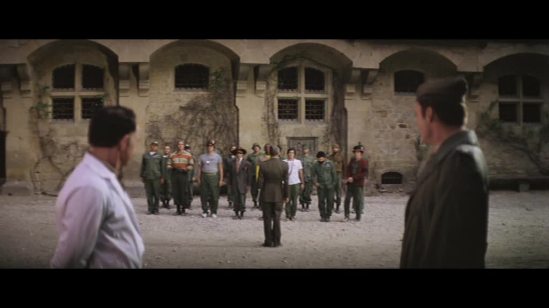
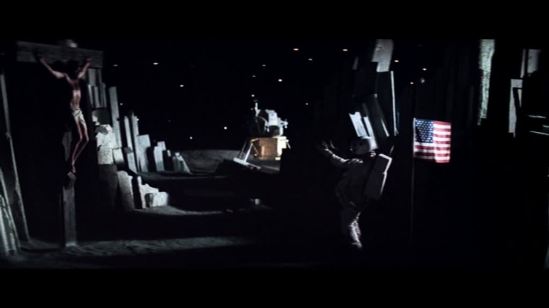
What’s also definitive is the limited-edition Blu-ray set from Radiance Films. A beautifully curated boxset encasing a dedication to the undervalued “Malpertuis” with a AVC encoded, 1080p resolution, BD50 set that’s presented in a 1.85:1 widescreen aspect ratio. In the midst of Malpertuis’s dark corridors and staircases, its classically drab common rooms, and a bleakly deserted grayness to the seaport town that exemplifies the intentionally restored stark and severe grading overseen by director Harry Kümel, the 4K scan, compiled by the shorten Cannes cut and Kümel’s directors cut, depicts quite a bit of localized saturation that pops into play that creates stand out characters in tandem with their eccentric personalities. There’s a meticulousness in the details that greatly heighten Malpertuis into a prison-like character, one that is personified holding the living, breathing characters into a stasis though they’re freedom to leave is unobstructed, the Lamplighter is a good example of this by appearing to be a near skin and bones, unkempt in appearances, and wailing in disquietude about Cassavius putting out the light, as if Cassavius himself was some sort of jailor and, in a way, he is. No compression issue within the dim-lit black areas, the ruckus of various action, or any macroblocking during the decoding. Though there is a language version somewhere in the world, Radiance Films supplies only the original Dutch ADR mono. The post-production dialogue does have an asynchronous measure between picture and sound, especially between the non-native Dutch speakers, but the track is clear and prominent overtop a mysterious and unobtrusive Georges Delerue (“Platoon”) soundtrack, letting the actors and the action take the helm of the narrative with a low-toned menacing as well as hopeful score pieces that drive their curiosity and individual pecularities. The diegetic dynamism denotes a defined design to be character driven rather than creating the immense suspense built by an edge of your score and omnipresent nondiegetic sounds. The faultless and well-paced UK English subtitles are available and can be toggled. Encoded special features include a 2006 audio commentary from director Harry Kümel and assistant director Françoise Levie, new interviews with Kümel and gothic horror writer Jonathan Rigby, an archival and behind-the scenes documentary on the making of the film with interviews Kümel, lead actor Mathieu Carriere, and director of photography Gerry Fisher, archival interviews with Kümel, Michael Bouquet, and Jean Ray with an archival featurette on Orson Wells and actress Susan Hampshire, Malpertuis Revisted takes audiences on location where the movie was shot with Kümel’s descriptions, the Cannes cut of the film, which is approx. 20 minute short than Kümel’s director’s cut and is viewable in the English and French language for selection, Kümel’s short film “The Warden of the Tomb,” and the trailer. Limited to 3000 copies, “Malpertuis’s” physical presence is palpable with a hard cardboard slipbox with Greek themed compositional artwork with a wraparound Obi strip denoting synopsis, bonus features, and technical aspects. Inside, a clear Blu-ray Amary comes primarily with a front and back still image cover given the artistic liberty treatment. The cover can be flipped from more traditional cover artwork, and all artwork provided is by Time Tomorrow. Heavier than the slipbox and the Amaray is the accompanying 78-page booklet with cast and crew acknowledgements, transfer notes and special thanks credits, and 2025 produced essays by Jonathan Owen, Willow Catelyn Maclay, Lucas Balbo, Maria J. Perez Cuervo, and David Flint. The region free release is region free and houses two runtimes with the main feature being the 125-minute producer cut and the Cannes cut, domiciling in the special features, clocking in at 100-minutes.
Last Rites: No one can top Radiance Films’ “Malpertuis” limited-edition Blu-ray set with its comprehensive insight into one of the more original adaptations surrounding Greek mythology, the harnessing and control of great, immense power, and the how that power is transposed and shaped into the human context where greed, sex, and love are the core contentions.




 It's Bloggin Evil!