Heart and Body Reunited Forges Immortal EVIL! “Witchtrap” reviewed! (MVD Visual / Blu-ray)

Get Caught in the “Witchtrap” on Blu-ray!

A motley crew of parapsychologists and private security are hired to investigate the haunted house of powerful warlock and accused serial killer Avery Lauter.  Before the graveyard side home can be turned into a themed Bed & Breakfast by Lauter’s inheriting next of kin, the team is brought in to eradicate the infamous house of any kind of malevolent spirits after the mysterious and gruesome death of a magician who agreed to stay at the house as a test run of the level of malignance.  When the investigators make contact with a confident and evil Lauter, the warlock tricks them by using the team’s physical medium to murder a far-too-inquisitive investigator one-by-one in order to finish a satanic ritual he started before his death that will make him immortal.  It’s up to non-believer, and wise-cracking, private detective Tony Vincente to make sense of the murders and put an end of Lauter’s reign of terror from beyond the grave before it’s too late.
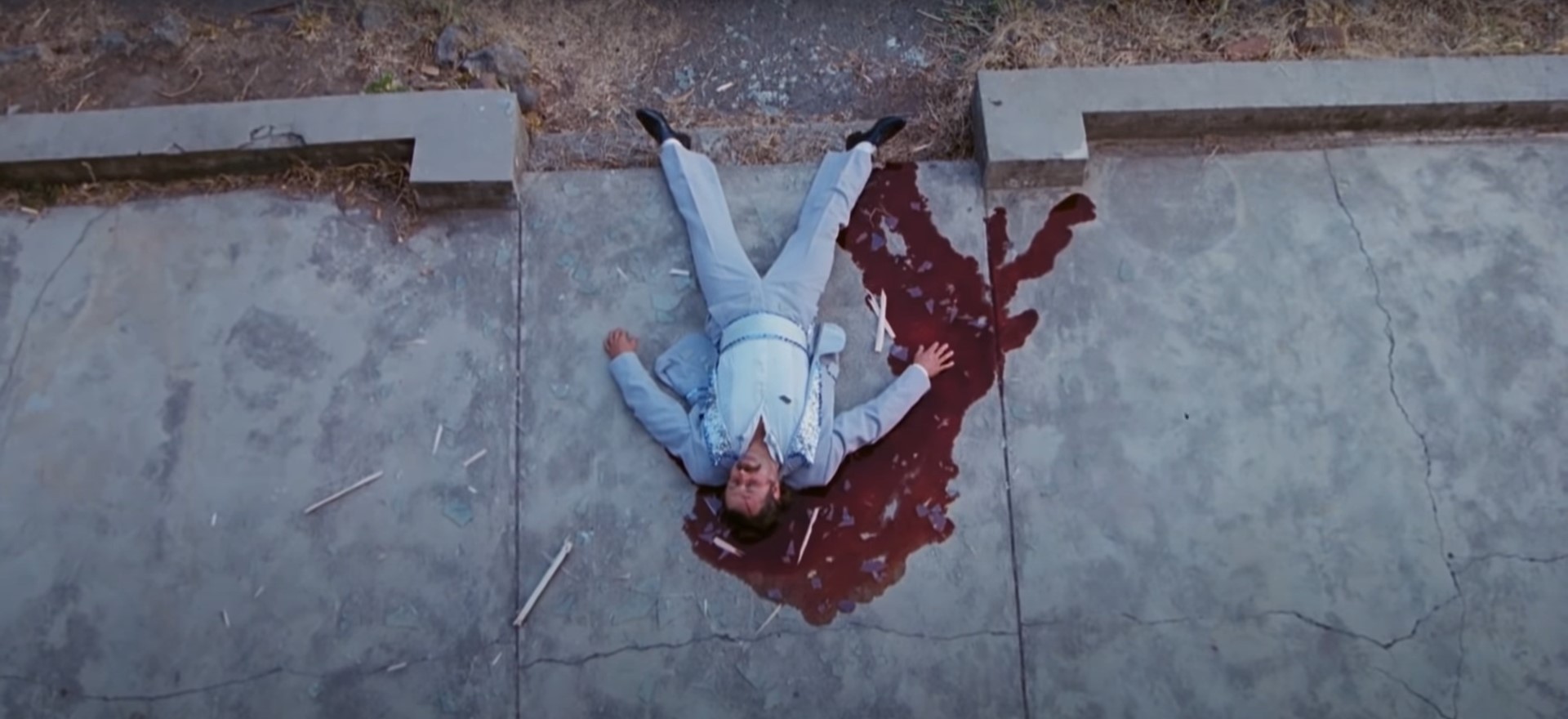
A necromantically-charged slaughterhouse of a film, “Witchtrap” is the 1989 phantasmal thriller of the omnipresent, omni-powerful dead versus a group of clueless living always one-step behind in attempting to make sense of everything.  Also known as “The Haunted” or “The Presence,” the Kevin S. Tenney written-and-directed film succeeds the director’s cult classic “Night of the Demons” and Tenney’s debut film “Witchboard,” which is not a sequel to “Witchtrap” despite a similar title and the hiring of some of the same actors.  Shot in Fairfield, California on a 400K budget, the independence production showcases topnotch gore and pyro effects from makeup artist Judy Yonemoto (“Dance or Die,” “The Newlydeads”) and special effects supervisor Tassilo Baur (“House,” “DeepStar Six”) and is produced by Tenney alongside Daniel Duncan under Mentone Pictures; Duncan also produced Tenney’s “Brain Dead” later in the filmmaker’s career.  Cinema Plus, represented by executive producer Ryan Carroll, serves as the presenting company.
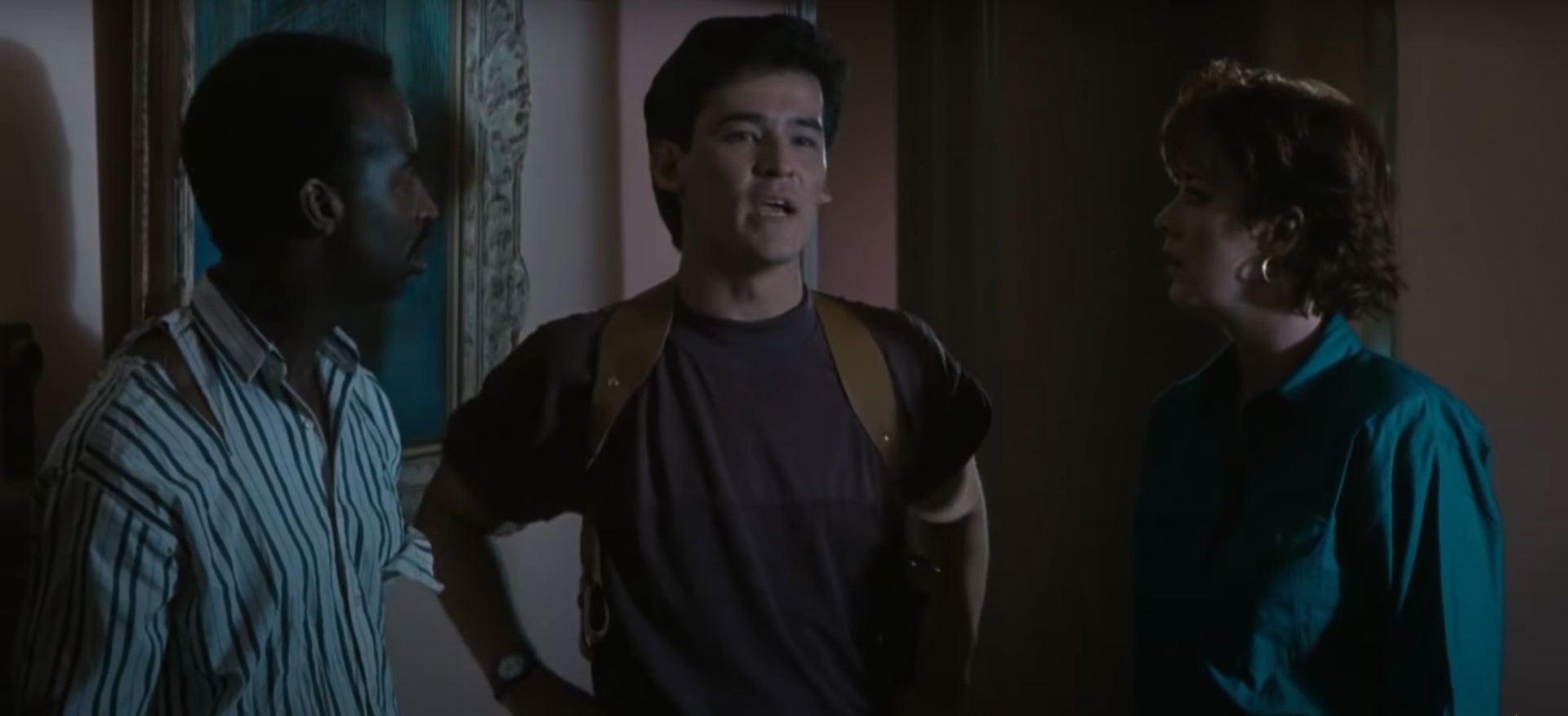
Tenney has been noted saying “Witchtrap” was a gift for the actors who have stuck with him over the years, playing pivotal parts in his student films that pole-vaulted his career into being a cult horror director.  “Witchtrap’s” leading man, James W. Quinn, has worked with Tenny since grade school and was cast in a principal role in “Witchboard” as well as in a minor role in “Night of the Demons.”  Quinn’s Tony Vincente is by far the best dialogue deliverer of the principal ensemble with a smartass ex-cop script that highlights Quinn to be the good guy but while being a complete jerk.  The rest of the cast is painfully flat, with little-to-no inflections, and a severe lack of dynamism or gesticulation that, despite how interesting their character backgrounds are, are just too dull with monotone script-reading.  “Night Visitor’s” Kathleen Bailey is likely the second best to liven up her character of Whitney O’Shea, the religious and reluctant physical medium with shark thrashing spams every time Avery Lauter channels her for to violently wipe out a parapsychologist team member, spearheaded by an eager ghost trapper Dr. Agnes Goldberg (Judy Tatum, “Witchboard”) and her mental medium husband Felix (Rob Zapple), and the accompanying private security forces that also include Vincente’s partner Levi Jackson (Clyde Talley II) and boss man Murphy (Jack W. Thompson).  Dangerous ambitions and irrational greed stir the pot between each of these groupings that side with personal stake over the safety of their existence that make for better character building underneath the rickety performance framing.  And, of course, we can’t neglect mentioning Linnea Quigley bringing up the rear with her rear as the bleached blonde, cropped seater topped A/V technician that can capture ghosts with her ectoplasm detecting gear.  Quigley, and also Judy Tatum, provide a bit of T&A, especially Quigley with an eye-popping full frontal in the prime of her career.  The remaining cast includes Hal Havins (“Sorority Babes in the Slimeball Bowl-O-Rama”) as the creepy groundskeeper and J.P. Luebsen (“Witchboard”) as the cap-wearing and wild-eyed bearded warlock Avery Lauter. 

Oddly enough, what makes “Witchrap” entertainingly great, is Tenney’s attractive and amusing dialogue.  Between the quips, banters, diatribes, and the depth conversations, Tenney formulates a dialogue that can match or even surpass the outstanding special effects that course through the narrative.  Without Vincente’s brutal mockery of the entire paranormal research and investigation scheme as well as an unmercifully, nonstop degrading position toward his contentious boss, left with only the tedious prosaic to hear, “Witchtrap” would be one of those great-gore, dull-dialogue features that force your hand to fast-forward to the good parts in order to not pass out asleep from the in between drag.  Instead, “Witchtrap” is 80’s cult-horror treasure, comfortably embedded somewhere between the cinematic Earth’s lithosphere and asthenosphere layers just waiting for someone to unearth and dust off its sheening crimson colored cabochon.  Definitely not elevated horror that makes one think about the auteur intended message, the feature remains true to Tenney’s previous like-mad credits with an outlandish and mortally fair game theurgy that’s surface-level eye candy and audibly dulcet, despite the audio recording snafu that sent the entire dialogue track to the post-production recording studio.  Though producers and marketing attempted to cash-in on “Witchboard’s” moderate success with a similar, familiar title, “The Haunted” and “The Presence” are no more than generic designation fodder that lacked tremendous flavor; “Witchtrap’s” a kitschy and blunt title that works and literally estimates what audiences should and will expect although Avery Lauter is a Warlock and not necessarily a witch per se. 

A part of the Eric Wilkinson’s throwback video club and Rewind Collection series from MVD Visual, “Witchtrap” arrives a fully restored, high-definition Blu-ray, presented on an AVE encoded, 1080p, BD50 and in a widescreen 1.85:1 aspect ratio.  This transfer essentially mirrors the Vinegar Syndrome release a few years back that had reinstated many of the MPAA cuts the general public hasn’t laid eyes for nearly 30 years until 2016.  Picture quality retains a fresh, renewed look without compromising the natural characteristics, such as grain, of the 35 mm celluloid.  There are sporadic scenes that slip due to generational loss but, for the most part, a solid 2K scan restoration of the interpositive. The English LPCM 2.0 mono track is post-production concomitant due to an inexperienced sound mixer that resulted overbearing hum throughout the dialogue. ADR was introduced in post subsequently diminishing depth and creating an artificial sounding mix with a silver lining being a near perfect match for actor emotionality, inflections, and synchronization. Optional English subtitles are available. Bonus material includes a commentary track with director Kevin Tenney, producer Dan Duncan, Cinematographer Tom Jewett, and actor Hal Havins. Also included are interviews with Kevin Tenney, Linnea Quigley, Tom Jewett, and Tassilo Baur who more-or-less say a lot of the same retrospective accounts regarding “Witchtrap’s” sound issues, pranks on Kevin Tenny, cheap film hints outside of L.A., and how constrained the budget was. This release also comes with the edited VHS version at 92-minutes, same as the Blu-ray, a photo gallery, and the original trailer. Physical features include a sweet throwback cardboard O-Slipcover of the original poster compressed inside a 1-inch, matte red border that’s back and front. The O-slip covers a clear Blu-ray case that holds a reversible Rewind Collection cover art that’s roughly the same as slipcover poster art with cropped out credits for a vivid red filled, white-lined title. On the other side of the cover is alternative European cover art of a puffy white cloud merged with a demonic face hovering over a white picket fenced house, reminiscent of the MGM “Return of the Living Dead” or the original Columbia “Fright Night” DVD covers. Inside the case is a folded mini-poster of the factory-wrapped front cover. MVD’s release is rated R and comes region free. “Witchtrap” epitomizes restless ghost syndrome with a head coup de grace motif and is a seance that conjures potent witty dialogue to hoist Kevin Tenney’s third feature up to another plane of existence.

Get Caught in the “Witchtrap” on Blu-ray!

A Double Dose of Revenge Against EVIL in “Psycho Kickboxer” and “Canvas of Blood” reviewed!


Alex Hunter had all he could ever want. A blooming career as an up-and-coming kick boxer, a successful police chief father on the verge of finally nailing a crime lord, and becoming recently engaged to marry to his long time girlfriend. Yes, Alex’s life fortune was very valuable indeed until it suddenly came crashing down to a fateful end when the ruthless crime lord his father was pursuing, known as Hawthorne, kidnaps and brutally murders his father and finance right in front of him and leaves him to die. Found and rescued by a well-bound special forces veteran, a recovering Alex lives to fight another day, a day for retribution against the a city of evil and crime. The one time kick boxer turns to a life of vigilantism under the guise of the public designated The Dark Angel who cleans up thugs, thieves, and low-lifes with martial art combinations that put Hawthorne in a supply chain bind when drug deals fall through at the result of The Dark Angel’s meddling. Nobody knows the identity of the masked hero, but one Cassie Wells, a journalist, aims to unmask the citizenry protector with the help of a bumbling private detective, but when they become too close to Alex, Hawthorne sets his target on them as bait.

The American 5-time world kickboxing champion, Curtis “The Explosive Thin Man” Bush, stars in his debut leading role performance in the martial arts, action-melee, “Psycho Kickboxer.” Also known as “Psycho Kickboxer: The Dark Angel,” the film had exclusive rights to being born and bred in Southeast Virginia, more specifically in the Hampton Roads area, with a local cast and crew and the opportunity to utilize region locales and business, such as his own, the Curtis Bush Karate Club, and those he was acquainted with at free of charge. Bush, born in Virginia Beach, puts up the cash, along with a slew of family and friends as investors as well, to finally produce his own work without having to be another masked Foot Solider in a “Teenage Mutant Ninja Turtle” sequel or just be another bad guy who can kick real good for the camera. Bush hires TV series and documentary director David Haycox and freshman filmmaker Mardy South to work from a Kathy Varner script. Bush’s career didn’t quite take off to be the next Chuck Norris or Jean-Claude Van Damme of Virginia Beach despite having athletic talent and good lucks, but he lives comfortably now in Hawaii with his family. Instead, the legendary fighter, who retired at the age of 37 in 1999, can look back at 1997’s “Psycho Kickboxer,” a five year project that began filming in 1992, as a crowning cinema achievement outside the square ring and without the confinement of 20.1 x 20.1 ft ropes alongside a heap of localized co-stars Kim Reynolds, Rick Clark, Tom Story (“Metamorphosis”), Rodney Suitor (“Traxx”), Jeffrey Kotvas, and George James.

Personally, “Psycho Kickboxing” round kicks close to my heart, targeting the marshmallow center, and landing a Curtis Bush southpaw punch right (or should I say left) into one of my favorite home town films of all time. You see, this reviewer is a native of the Hampton Roads area and raised in the area for 28 years until becoming a Northerner. Honestly, I’ve never heard of “Psycho Kickboxer” or even Curtis Bush for that matter, not even the mayor honored Curtis Bush Day that’s April 27th, and once I looked past the slew of mullets and mustaches and saw the name of a local bar, Hot Tuna Bar and Grill, briefly observable in a scene, the regional newspaper, The Virginian-Pilot, and a resident country station, 97.3 The Eagle, with a pair of DJs as themselves. Championing “Psycho Kickboxer” as a good film is an enormously uphill one and even being a cult classic wobbles on the bunny hill as filler scenes, specifically the film’s ninja-cladded Curtis Bush tearing through bad guys is more than half the movie as montage segments, run rampant over what should be character exploration of redefining and rediscovering character arc qualities. However, the Haycox and South directorial has some blood red and amorous highlights with a pair of exceptional head rupturing scenes I’ve ever bared witnessed from the special effects of the Creations Unlimited team, Steve Stephens and Clay Sayre, and some tasteful T and A from Kim Reynolds in her bathtub that’s shouldn’t dare be missed.

The accompanying feature on this pyscho-revenger set tells the story of Julia, a young violin prodigy, who feels the extreme pressure weighing her down with an abrasive and abusive boyfriend and the intense passion she has for music that’s literally destroying her gifted hands from within. Her father, an art professor who has a disabled hand himself, quickly rushes her to a doctor for examination and concludes surgery is the only course of action to right the damage, but the coked up, alcoholic of a surgeon botches the job, leaving poor Julia unable to use her hand and diminishing any hope of playing her violin again. A long line of deep engrained corruption integrated inside the justice system is uncovered by her father after a sabotaged lawsuit exonerates the doctor from any wrongdoing. Pissed off with rage, the art professor decides to take justice in his own hands or, rather, his own hand as he fabricates instruments of death to paint his own retribution for physically and mentally injuring his daughter who is now in a semi-catatonic state. Police are baffled by each death that leaves little clues to the man who perpetrated them as one detective continues the investigation of grisly murders.

“Canvas of Blood” is the rightful backseat second feature being inferior of the two films on the double bill release. Set on location in and around the Baltimore, Maryland region, the anomalously rare 1997 revenge flick, that was only released on VHS, was at one time the debut disaster-piece from writer-director Joel Denning, produced by the Post Productions Film Company in association with Bad Credit OK and presented by Michael Mann – no, not the same Michael Mann who helmed Al Pacino and Robert De Niro in “Heat.” Instead of intense gun-blazing battles and gritty dialogue exchanges, Denning’s carnivalized approach to vindictive measures is met with an unscrupulous amount of aberrant sound effects such with a fart track, overweight male strippers with mullets in thongs doing abhorrent dance moves, and exaggerated character travesties in a mishmash plot involving a decorated war vet now art professor painting a trail of blood with his interchangeable cyborg mitt arsenal that includes a flame thrower, bone saw, and a T-800 “Terminator” style hand for massive nutsack squeezing. The most difficult to comprehend about a tale that warrants no deep thought is whether Denning’s intentions are sincere or to make a mockery of the revenge genre with a blatant boorish attempt. As far as actors go, the now radio personality, Jennifer Hutt, does what she can with cheap cinematic artwork and the same thing can be said about Jack Mclernan, who portrays no Paul Kersey, a role tailored by Charles Bronson in “Death Wish”, and while McLernan might strike a resemblance to the “Once Upon A Time in the West” actor, McClernan can only muster about half the set of stoic acting chops to save any kind of face. Lance Irwin, Andy Colvin, Marian Koubek, Mark Frear, Jamie Bell, Michael Mann Reennie McManus, Irena Beytler, and Svetlana Milikouris co-star.

POP Cinema’s Shock-O-Rama banner presents a Psycho Horror Double Feature with “Psycho Kickboxer” and “Canvas of Blood” on a single disc DVD and both films are presented from in a VHS-rip, 4:3 aspect ratio, format that gives no indication of an enhanced or upscale treatment to the transfers. “Psycho Kickboxer,” which was actually shot in 16mm and transferred to Betacam VHS, fairs better with a unscathed negative obtained cleanly without the annoyance of compression artifacts, due to the lower bitrate from the more than likely clean 16mm source. However, don’t expect colors to pop and details to be fine from a VHS transfer that’s has a slightly fuzzy and gray washed tone. Canvas sports much of the same with a more warmer tone and some over-saturation of blue tint, but tracking distortions and analog graded noise are more evident flaws in this presentation. The English Language mono tracks on both features are a composited nightmare of little range and depth. Fight ambience could have been pulled right from the Double Dragon Nintendo game and the subjective overlay of obscurely crude ambient tracks, even an overly synthesized enhanced screaming I would consider as well, dilutes “Canvas of Blood’s” objective plotline. The DVD extras include Shock-O-Rama vault trailers and a 3-page booklet insert containing a 1998 Alternative Cinema Magazine article written by Curtis Bush who provides a humbling anecdote about film’s origin story and the process of making his independent movie dream come reality. There’s no contest. “Psycho Kickboxer” TKO’s “Canvas of Blood” in every round of the Psycho Horror Double Feature, despite the horde of mustaches and mullets and despite both films not really being a horror. Shame that world class kickboxer Curtis Bush’s career didn’t skyrocket afterwards, but thats what makes “Psycho Kickboxer” inherently special and exceptional to behold, just like the fighter himself.

“Psycho Kickboxer” available on DVD! Click the Cover to buy!

More evil than the deadly Firestone blowouts! Rubber review!

As a graduate of film studies, my viewing pleasure has changed to minus “viewing” and adding “analytical” to make it now my viewing analytical.  Taking classes on film sucks the fun at watching Michael Bay and Uwe Boll films which is not really a bad thing, but you’re programmed to pick out the flaws in every little detail.  One thing we learned in class is that there is a purpose for everything in the mise-en-scene; every street lamp as a purpose so says Alfred Hitchcock.  Obviously, these people who expect you to guess the significance of each action and every prop didn’t expect the killer tire film Rubber to ever be created.

Robert wakes up in the desert.  He tries to move only to keep falling down.  As he eventually gets the hang of it, he crosses paths with various objects and creatures in which he destroys…with his mind.  Besides Robert’s murderous telekinetic powers, Robert other’s mysterious issue is that he is also a used vehicle tire.  Robert becomes obsessed with a beautiful young woman and won’t stop killing folks until he gets what he wants.

Continue reading