Entrenched EVIL Sprouts Roots of Hate! “Bunker” reviewed! (Breaking Glass Pictures / DVD)

Go into the “Bunker” and Never Come Out!  Now on DVD!

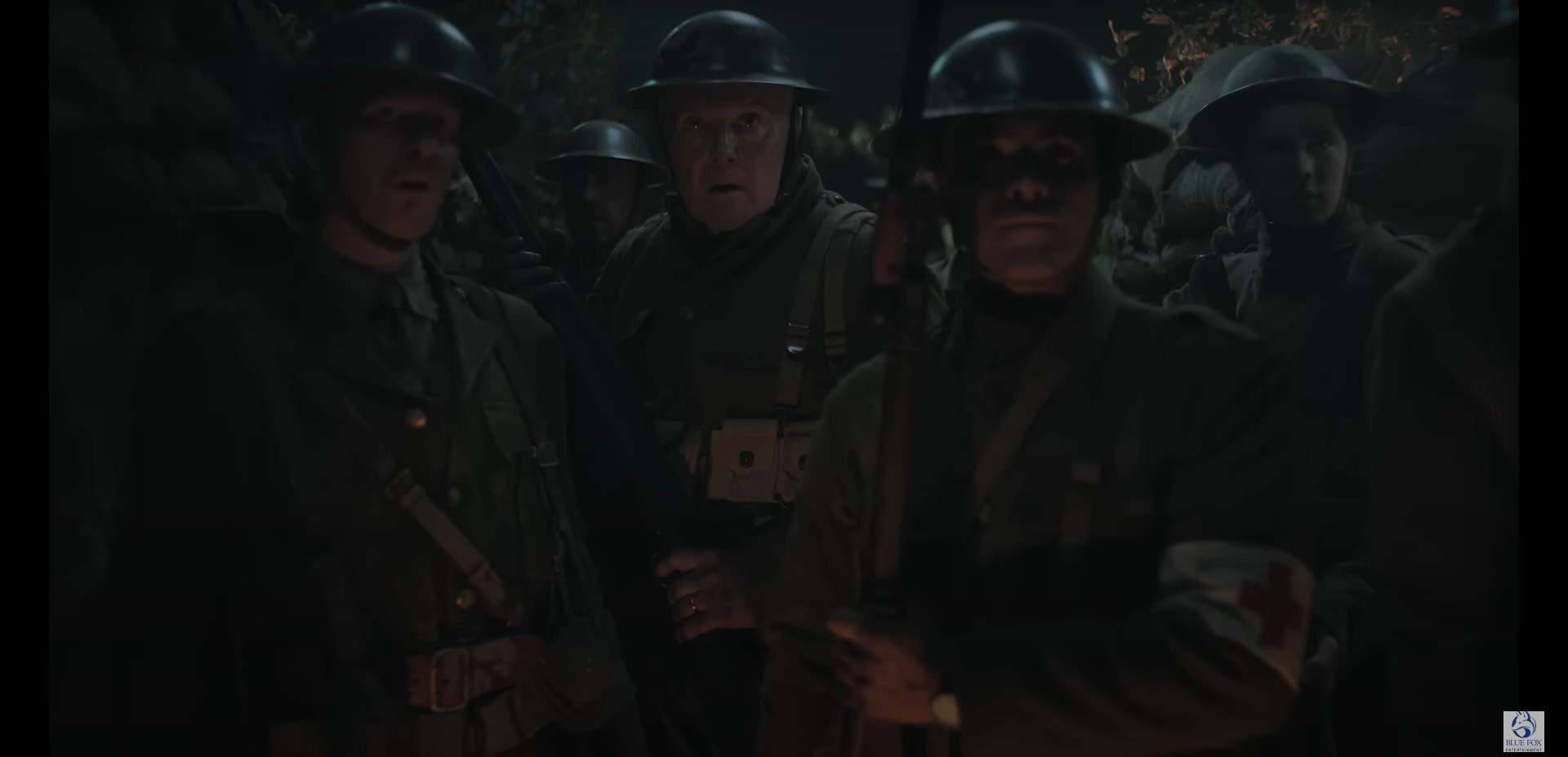
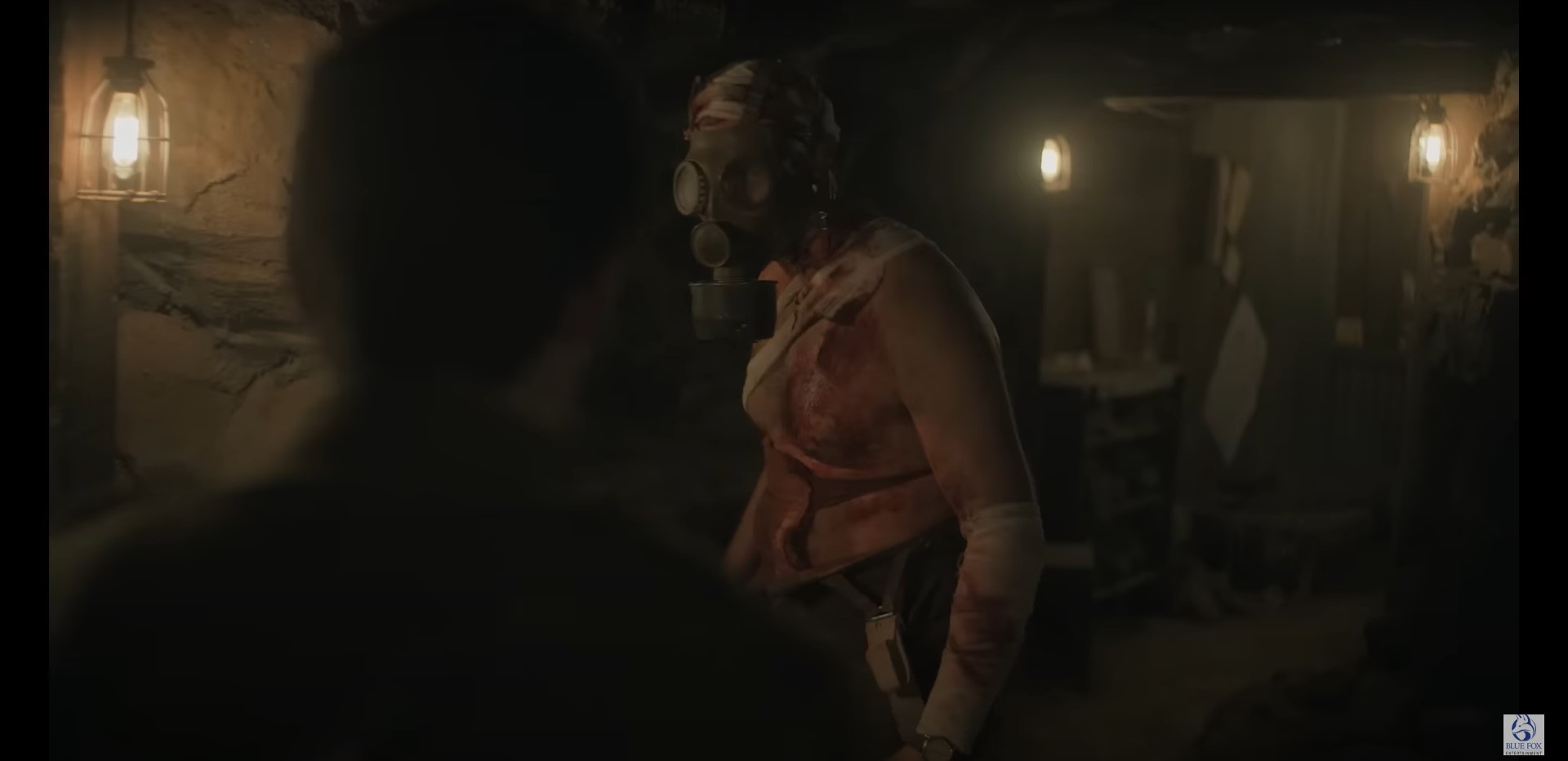
Trench warfare has already been damning for allied forces held in stalemate against the German’s only yards away in their trench.  When the commanding Lt. Turner discovers the German trench has been abandoned, he moves his ragtag team of British and American forces across a barbed wire and cadaver-laden no man’s land in to salvage victory for obtaining a German bunker without a firefight or loss of life.  What they discover is an externally barricaded bunker and inside the vacated stronghold is a barely-breathing German soldier nailed to a cross.  Incoming artillery causes a bunker cave-in, leaving two of the soldiers dead and the others trapped inside.  Slowly, something insidious and omnipresent inside the bunker builds measured madness inside them, turning one-by-one the seasoned and fresh off the boat soldiers to suspect each other’s loyalty, sanity, and hope for escape,  something that has been dwindling every minute with each stale breathe. 
War and horror are unequivocally synonymous.  The atrocities and death seen on the combat field can break a person’s psyche in a matter of an artillery shell explosion.  Trauma can quickly take over as the totalitarian regime and that carnage-induced shock can never be unseen ever.  The wide-speed obliteration of people and towns done in the second Great War, between the Nazi hate-war crimes and the collateral damage caused by Blitzes and tank fire, has been the foundational base for a number of appended horror films.  “Men Behind the Sun,” “Outpost,” “Shockwaves,” and even “Ilsa, “She Wolf of the SS” are just a select few of the many subset horror films to be inspired by World War II.  While the more contemporary “Overlord” joined the bandwagon of one of the world’s deadliest conflicts, overlooked is the first Great War as the backdrop for horror narratives.  When I jog my categorial knowledge and memory of WWI horror movies, only one comes to mind, the 2002 M.J. Bassett mud and rain-soaked supernatural thriller “Death Watch” with Andy Serkis and Jamie Bell.  Now, I know two with 2022’s “Bunker,” the debut feature length script written by Michael Huntsman and directed by Adrian Langley (“Butchers”).  The U.S. production is spearheaded by Crossroad Productions with Buffalo FilmWorks (“A Quiet Place: Part II”) footing the costs by executive producers Lisa Gutbertlet, Andy Donovan, Jennifer O’Neill, Kevin Callahan, George Pittas and Brett Forbes (“The Collector”) with Matt Corrado (“Half Sisters”), Patrick Rizzotti (“The Collector”), Greg Wichlacz, and Michael Huntsman’s father and Blue Fox Entertainment founder, James Huntsman (“The Night Eats the World”) producing.
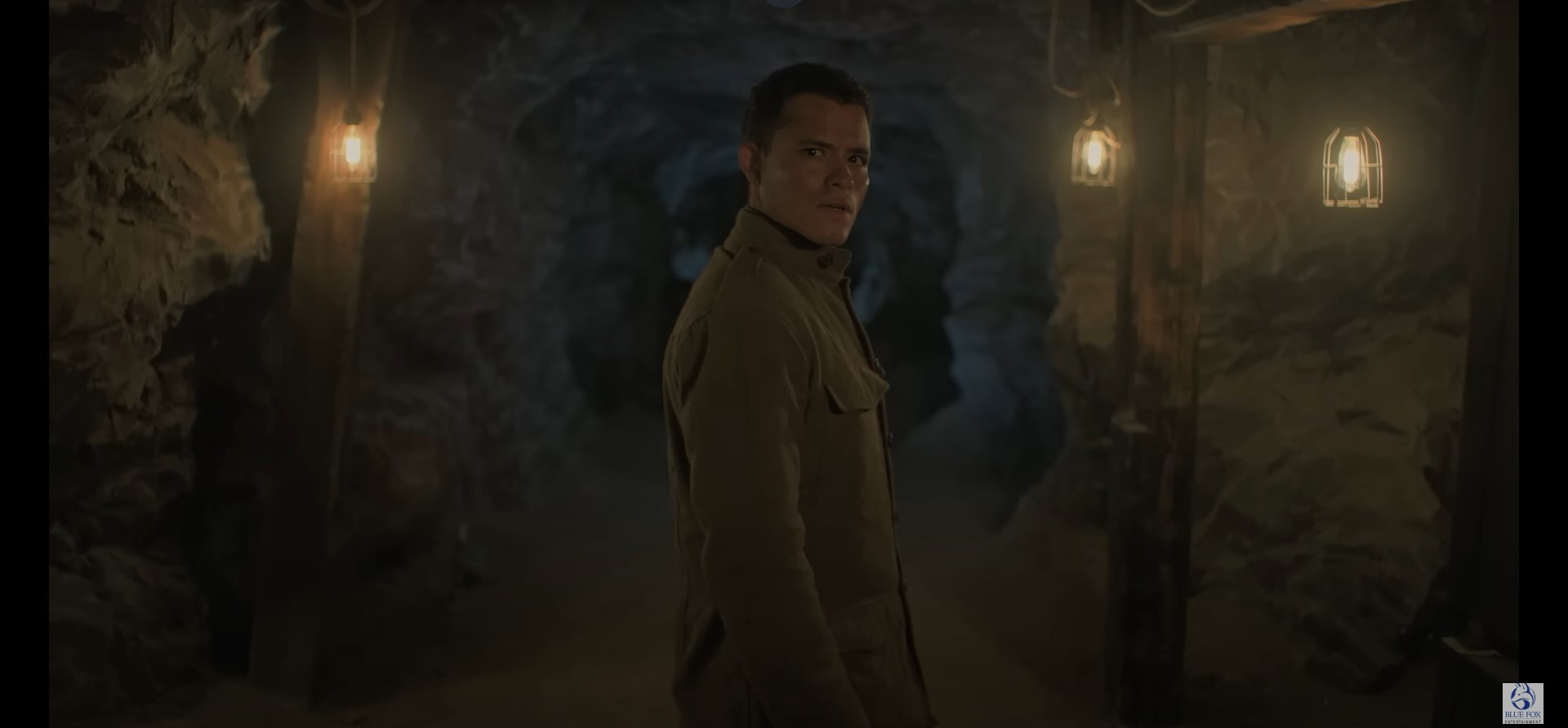
“Bunker” follows a group of allied soldiers unwittingly stumbling upon a supernatural dugout left behind by the enemy.  The U.S. production is fitted with nearly an all-American, all-male cast with the majority playing British soldiers and while accents do justice stressing certain syllables and comes off pronouncedly brisk, the ears can detect subtleties that can make you question the actor’s national validity, such as with stage actor Patrick Moltane’s Lt. Turner.  A very proper English suited from his officer rank, but the act does come off over-the-top and colorful in Lt. Turner’s pithy and lively vocabulary.  “Bunker’s” principal focus is on Pvt. Segura, a Latino-American medic who has answered the call of duty and has served long in the conflict, trying to prove his worth as outsider in his own country.  “Eraser:  Reborn’s” Eddie Ramos helms the character’s drive as an upstanding member of his community and as a military soldier by doing his part, playing the overall even-keeled medic whose goal is to keep soldiers healthy and breathing in a time of war.  “Bunker’s” subtle racism isn’t teeming and poignantly powerful, but the small band are mostly and carefully passive aggressive against Segura, except for one other private fresh off the boat, Pvt. Baker (Julian Feder, “Escape the Field”).  Segura then becomes what he’s yearned for, to be a protector, something he can’t do with minds already set in their ways with the rest of the characters who are either indifferent to his presence or forthright in his face as the root of their problematic situation.  Quinn Moran, Adriano Gatto, Mike Mihm (“Unsane”), Sean Cullen (“Killer Rats”), Roger Clark, and Luke Baines as the crucified Kraut make up the remaining all-male cast.
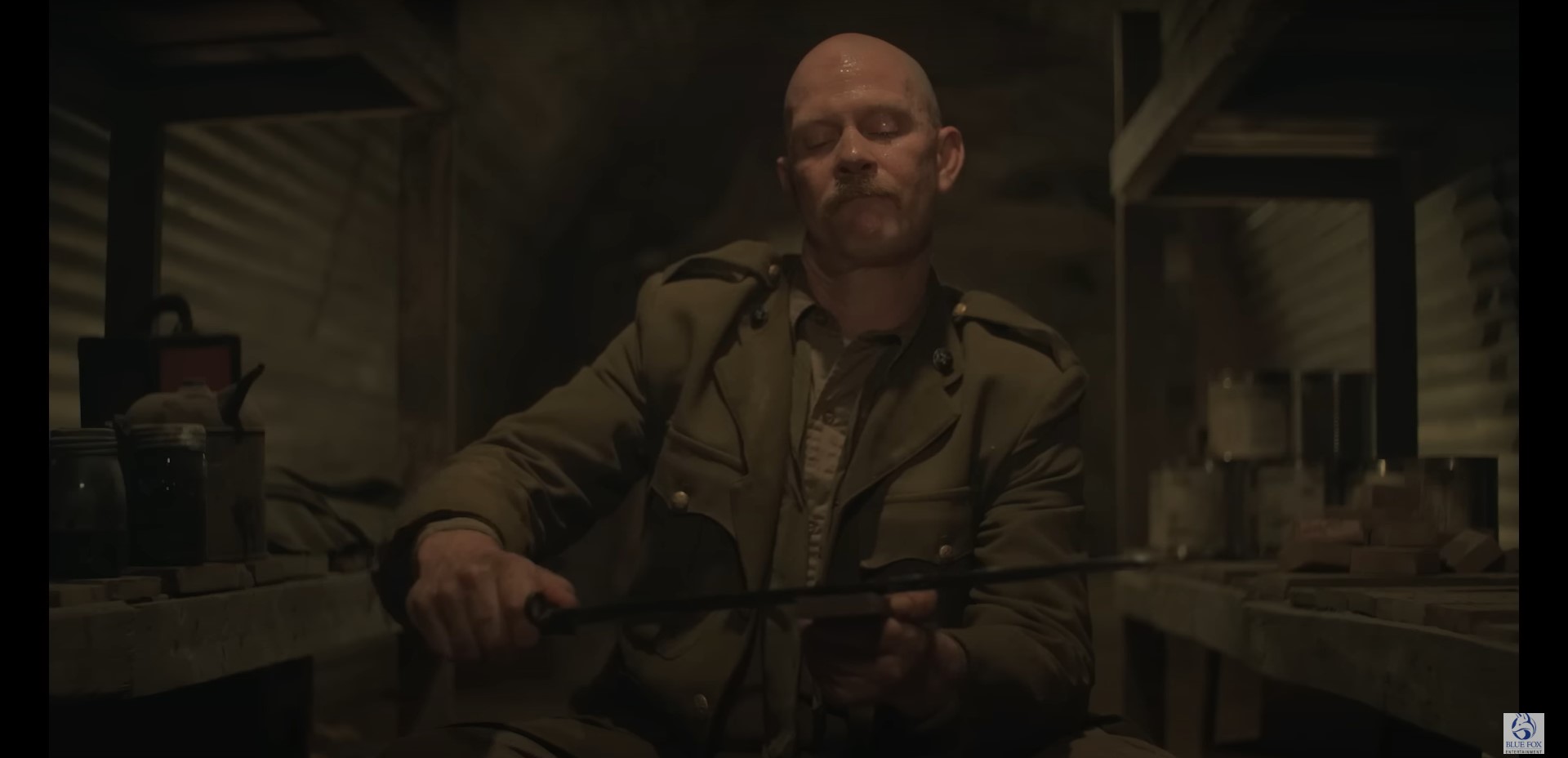
The all-male cast is crucial to the “Bunker’s” undercurrent theme which isn’t a torrent of one-after-another hits on the surface level.  Under the context that soldiers universally believe in comradery, especially during wartime stuck in a trench when relying on the next man to watch your back, Pvt. Segura secretly yearns to belong, be one of the team, and blend into the uniforms of brown and tan, suited mostly for the typical late 1920s white male.  Through the early acts of passive aggressiveness, the commanding officer ordering him to behave when left unattended, scolded for another private’s inability to move quietly across no man’s land, and being a person of mistrust when trapped in the German dugout, Segura ultimately is perceived as the enemy when the ungodly presence causes hallucinations, fear, and self-inflicting injury.  The bunker represents a fermentation of hate and death, deep-rooted distrust through the depictures of white radicles connecting everything around them be shield by the dirt walls that forces ugliness to come to a head by way of messing with the mind.  Being semi-familiar with Adrian Langley’s previous horror “Butchers,” I expected brutality, bloodshed, and groundwork that slowly flourishes as the story progresses and Langley delivers on demand with a chillingly connotative race-horror in an oppressive and melancholy World War I background.  While some period and wartime elements and actualities may frazzle historical war buffs, “Bunker” has otherwise resounding production quality despite its low-fare budget, feeling very much like the horrors of trench warfare and then some.
Philadelphia based, independent film home video distributor Breaking Glass Pictures releases Adrian Langley’s “Bunker” onto DVD.  The MPEG-2 encoded DVD5 is presented in a widescreen 2.35:1 aspect ratio.  Honestly, the compression works well here with the color reduction, a decrease in the hue saturation, leaving behind more neutral tan, browns, and greens, to flourish as an old timey picture that harmonizes with the classic resembling opening credits where the cast and crew are listed as whole.  Details are generally potent, reflecting delineating contours, coarse textures, and all the minor sweat, dirt, and blood strewn about the dugout from the Arri Alexa camera that captures confined spaces with vast depth.  The English language Dolby Digital 5.1 surround sound is the sole audio option and is the really only option needed for a confined, atmospheric film like this that utilizes the back and side channels with crumbling dirt walls and muffled bombardments.  There’s a nice balance between the prominent dialogue and the ambient action with Andrew Morgan Smith’s punchy score that’s like a mix between Joseph LoDuca’s “Army of Darkness” and Alan Silvestri’s “The Predator,” intense, grand, and heart pounding like a classic monster movie soundtrack. There are no subtitles available on this release.  Bonus features only include “Bunker’s” trailer and other Blue Fox Entertainment previews, another World War thriller “Wolves at War,” and Langley’s “Butchers.”  Physical attributes include a tempered chocolate-appearing DVD case with a long ally solder entering a large and foreboding bunker with war and graveyard elements above ground.  Inside, there disc art is pressed with the same image but cropped to just show the soldier entering the bunker.  There is no insert included.  The region 1 locked playback DVD comes not rate and has a runtime of 108 minutes.  “Bunker” is slowly-seeping dread of psychotronic apathy and abiding odium that manifests creaturely out of war’s massive and overwhelming stress and death.

Go into the “Bunker” and Never Come Out!  Now on DVD!

A Double Dose of Revenge Against EVIL in “Psycho Kickboxer” and “Canvas of Blood” reviewed!


Alex Hunter had all he could ever want. A blooming career as an up-and-coming kick boxer, a successful police chief father on the verge of finally nailing a crime lord, and becoming recently engaged to marry to his long time girlfriend. Yes, Alex’s life fortune was very valuable indeed until it suddenly came crashing down to a fateful end when the ruthless crime lord his father was pursuing, known as Hawthorne, kidnaps and brutally murders his father and finance right in front of him and leaves him to die. Found and rescued by a well-bound special forces veteran, a recovering Alex lives to fight another day, a day for retribution against the a city of evil and crime. The one time kick boxer turns to a life of vigilantism under the guise of the public designated The Dark Angel who cleans up thugs, thieves, and low-lifes with martial art combinations that put Hawthorne in a supply chain bind when drug deals fall through at the result of The Dark Angel’s meddling. Nobody knows the identity of the masked hero, but one Cassie Wells, a journalist, aims to unmask the citizenry protector with the help of a bumbling private detective, but when they become too close to Alex, Hawthorne sets his target on them as bait.

The American 5-time world kickboxing champion, Curtis “The Explosive Thin Man” Bush, stars in his debut leading role performance in the martial arts, action-melee, “Psycho Kickboxer.” Also known as “Psycho Kickboxer: The Dark Angel,” the film had exclusive rights to being born and bred in Southeast Virginia, more specifically in the Hampton Roads area, with a local cast and crew and the opportunity to utilize region locales and business, such as his own, the Curtis Bush Karate Club, and those he was acquainted with at free of charge. Bush, born in Virginia Beach, puts up the cash, along with a slew of family and friends as investors as well, to finally produce his own work without having to be another masked Foot Solider in a “Teenage Mutant Ninja Turtle” sequel or just be another bad guy who can kick real good for the camera. Bush hires TV series and documentary director David Haycox and freshman filmmaker Mardy South to work from a Kathy Varner script. Bush’s career didn’t quite take off to be the next Chuck Norris or Jean-Claude Van Damme of Virginia Beach despite having athletic talent and good lucks, but he lives comfortably now in Hawaii with his family. Instead, the legendary fighter, who retired at the age of 37 in 1999, can look back at 1997’s “Psycho Kickboxer,” a five year project that began filming in 1992, as a crowning cinema achievement outside the square ring and without the confinement of 20.1 x 20.1 ft ropes alongside a heap of localized co-stars Kim Reynolds, Rick Clark, Tom Story (“Metamorphosis”), Rodney Suitor (“Traxx”), Jeffrey Kotvas, and George James.

Personally, “Psycho Kickboxing” round kicks close to my heart, targeting the marshmallow center, and landing a Curtis Bush southpaw punch right (or should I say left) into one of my favorite home town films of all time. You see, this reviewer is a native of the Hampton Roads area and raised in the area for 28 years until becoming a Northerner. Honestly, I’ve never heard of “Psycho Kickboxer” or even Curtis Bush for that matter, not even the mayor honored Curtis Bush Day that’s April 27th, and once I looked past the slew of mullets and mustaches and saw the name of a local bar, Hot Tuna Bar and Grill, briefly observable in a scene, the regional newspaper, The Virginian-Pilot, and a resident country station, 97.3 The Eagle, with a pair of DJs as themselves. Championing “Psycho Kickboxer” as a good film is an enormously uphill one and even being a cult classic wobbles on the bunny hill as filler scenes, specifically the film’s ninja-cladded Curtis Bush tearing through bad guys is more than half the movie as montage segments, run rampant over what should be character exploration of redefining and rediscovering character arc qualities. However, the Haycox and South directorial has some blood red and amorous highlights with a pair of exceptional head rupturing scenes I’ve ever bared witnessed from the special effects of the Creations Unlimited team, Steve Stephens and Clay Sayre, and some tasteful T and A from Kim Reynolds in her bathtub that’s shouldn’t dare be missed.

The accompanying feature on this pyscho-revenger set tells the story of Julia, a young violin prodigy, who feels the extreme pressure weighing her down with an abrasive and abusive boyfriend and the intense passion she has for music that’s literally destroying her gifted hands from within. Her father, an art professor who has a disabled hand himself, quickly rushes her to a doctor for examination and concludes surgery is the only course of action to right the damage, but the coked up, alcoholic of a surgeon botches the job, leaving poor Julia unable to use her hand and diminishing any hope of playing her violin again. A long line of deep engrained corruption integrated inside the justice system is uncovered by her father after a sabotaged lawsuit exonerates the doctor from any wrongdoing. Pissed off with rage, the art professor decides to take justice in his own hands or, rather, his own hand as he fabricates instruments of death to paint his own retribution for physically and mentally injuring his daughter who is now in a semi-catatonic state. Police are baffled by each death that leaves little clues to the man who perpetrated them as one detective continues the investigation of grisly murders.

“Canvas of Blood” is the rightful backseat second feature being inferior of the two films on the double bill release. Set on location in and around the Baltimore, Maryland region, the anomalously rare 1997 revenge flick, that was only released on VHS, was at one time the debut disaster-piece from writer-director Joel Denning, produced by the Post Productions Film Company in association with Bad Credit OK and presented by Michael Mann – no, not the same Michael Mann who helmed Al Pacino and Robert De Niro in “Heat.” Instead of intense gun-blazing battles and gritty dialogue exchanges, Denning’s carnivalized approach to vindictive measures is met with an unscrupulous amount of aberrant sound effects such with a fart track, overweight male strippers with mullets in thongs doing abhorrent dance moves, and exaggerated character travesties in a mishmash plot involving a decorated war vet now art professor painting a trail of blood with his interchangeable cyborg mitt arsenal that includes a flame thrower, bone saw, and a T-800 “Terminator” style hand for massive nutsack squeezing. The most difficult to comprehend about a tale that warrants no deep thought is whether Denning’s intentions are sincere or to make a mockery of the revenge genre with a blatant boorish attempt. As far as actors go, the now radio personality, Jennifer Hutt, does what she can with cheap cinematic artwork and the same thing can be said about Jack Mclernan, who portrays no Paul Kersey, a role tailored by Charles Bronson in “Death Wish”, and while McLernan might strike a resemblance to the “Once Upon A Time in the West” actor, McClernan can only muster about half the set of stoic acting chops to save any kind of face. Lance Irwin, Andy Colvin, Marian Koubek, Mark Frear, Jamie Bell, Michael Mann Reennie McManus, Irena Beytler, and Svetlana Milikouris co-star.

POP Cinema’s Shock-O-Rama banner presents a Psycho Horror Double Feature with “Psycho Kickboxer” and “Canvas of Blood” on a single disc DVD and both films are presented from in a VHS-rip, 4:3 aspect ratio, format that gives no indication of an enhanced or upscale treatment to the transfers. “Psycho Kickboxer,” which was actually shot in 16mm and transferred to Betacam VHS, fairs better with a unscathed negative obtained cleanly without the annoyance of compression artifacts, due to the lower bitrate from the more than likely clean 16mm source. However, don’t expect colors to pop and details to be fine from a VHS transfer that’s has a slightly fuzzy and gray washed tone. Canvas sports much of the same with a more warmer tone and some over-saturation of blue tint, but tracking distortions and analog graded noise are more evident flaws in this presentation. The English Language mono tracks on both features are a composited nightmare of little range and depth. Fight ambience could have been pulled right from the Double Dragon Nintendo game and the subjective overlay of obscurely crude ambient tracks, even an overly synthesized enhanced screaming I would consider as well, dilutes “Canvas of Blood’s” objective plotline. The DVD extras include Shock-O-Rama vault trailers and a 3-page booklet insert containing a 1998 Alternative Cinema Magazine article written by Curtis Bush who provides a humbling anecdote about film’s origin story and the process of making his independent movie dream come reality. There’s no contest. “Psycho Kickboxer” TKO’s “Canvas of Blood” in every round of the Psycho Horror Double Feature, despite the horde of mustaches and mullets and despite both films not really being a horror. Shame that world class kickboxer Curtis Bush’s career didn’t skyrocket afterwards, but thats what makes “Psycho Kickboxer” inherently special and exceptional to behold, just like the fighter himself.

“Psycho Kickboxer” available on DVD! Click the Cover to buy!