Unleashed, Nature Inspires the EVIL in All of Us! “In The Earth” reviewed (Neon / Digital Screener)

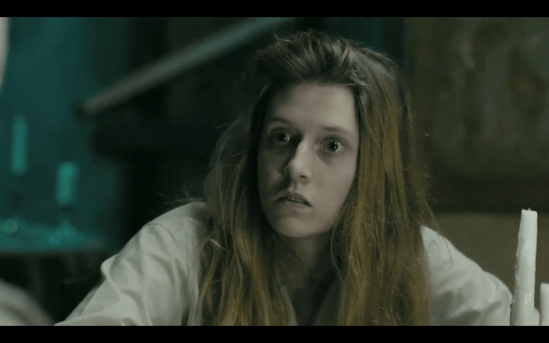
A deadly virus has ravaged the world, placing the inhabitants on a high alert edge of incessant sanitation and relentless paranoia. Martin, a scientist from the city, ventures to an ecological nature preserve to convey equipment for tests being conducted deep in the forest. Park Ranger, Alma, guides him on a two day trek toward a camp in total isolation supervised by Dr. Olivia Wendle, but during the second day of the journey, Martin and Alma are attacked in the middle of the night, left with no gear and a vague sense of what happened. The virus has yet to stake a claim on those living within the woods, but another malicious-driven presence, entombed by superstition and mental manipulation, enacts the forest to come alive around them, forcing them into a direction that presents a summoning of nature’s folkloric revenant.

COVID-19 has brought a tremendous amount of sorrow and an unforgiving plight upon the world, but for a few filmmakers, a global pandemic has been a source of inspiration that been a silver lining amongst the Earth’s population upheaval. Director Ben Wheatley tapped into that filament, you could say ,with his man versus nature mystery horror “In The Earth.” The filmmaker of “U is for Unearthed” short from the “ABCs of Death” and soon-to-be helming the follow up big screen sequel to novelist’s Steve Alten’s widely popular monster shark book series with “Meg 2: The Trench,” Wheatley writes and directs a quarantine start-to-finish feature that also incorporates the pandemic into the story, much to the same likes as Rob Savage’s “Host” that uses the virus as a means to drive the characters into doing something they normally wouldn’t be doing. The UK production is from Wheatley’s founded Rook Films and Neon, who last co-produced Brandon Cronenberg’s violent sci-fi thriller, “Possessor.”

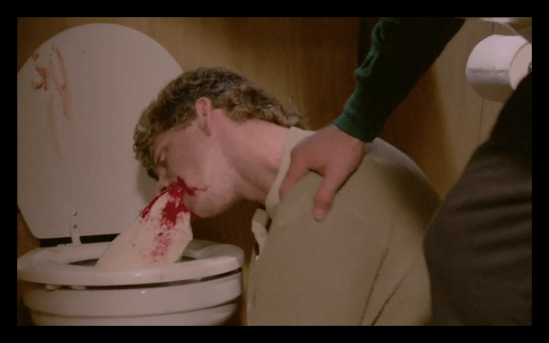
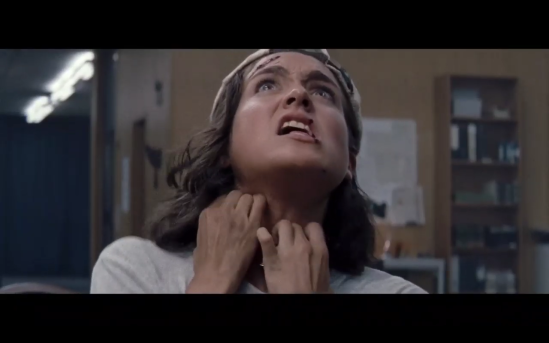
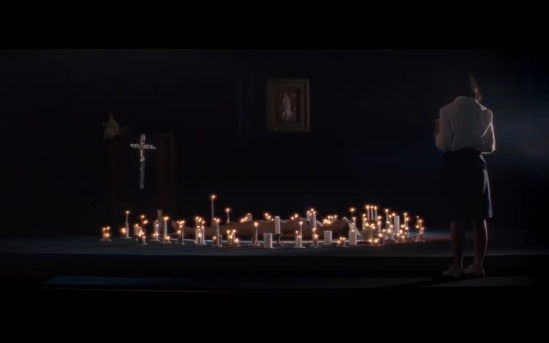
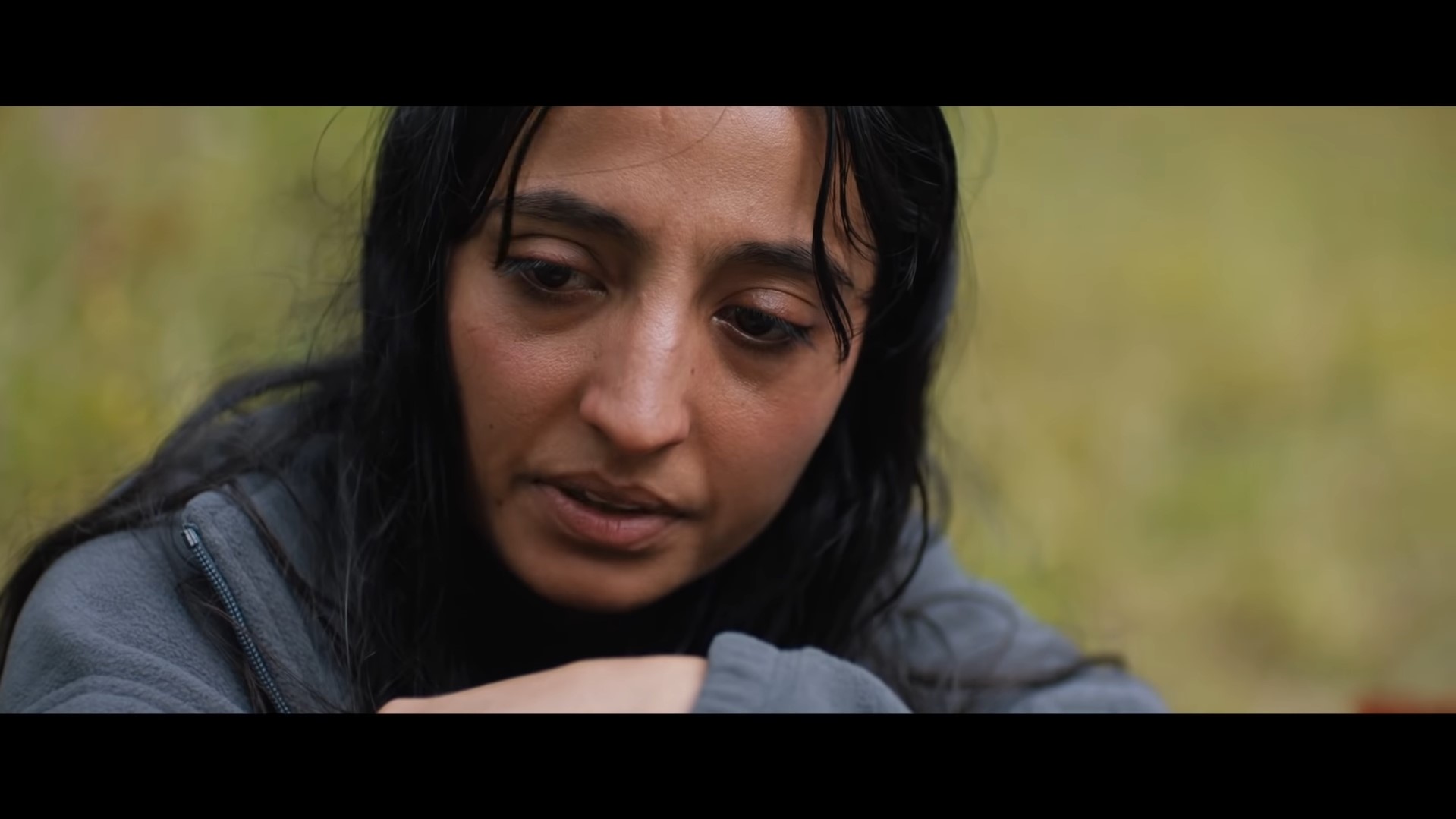
With the pandemic resulting quarantine and a story set in the thicket of woods, “In The Earth” is innately slim around the casting waistline that concentrates the performance zest amongst a few, beginning with the introduction of Martin the scientist walking up to the sentry lodge located at the forest edge. Played by Joel Fry (“Game of Thrones”), the London born actor must endure as a hapless city boy taking woodland shots on the chin without much complaint, but definitely a grimace, a whimper, and a pass out. Guiding Martin through the woods is Alma, a seasoned park ranger under the eye of “Midsommar’s” Ellora Torchia who balances out her travel companion’s near ill-equipped, yet hazardously attempting, roughing the outdoors. Martin and Alma are nearly mirrored by the only other two people they come across in the forest – Zach and Dr. Wendle. Yet, Zach and Dr. Wendle’s similarities channel through how they instrument a link to the forest being, known as Parnag Fegg, that calls them to release it from the timber and foliage prison. Zach (Reece Shearsmith of “Shaun of the Dead”) honors Parnag Fegg with ritualistic images and symbols while Dr. Wendle (Hayley Squires) uses a combination of technological lights and experimental music to speak with the powerfully alluring presence. Shearsmith is devilishly certifiable with Squires backing up his character craziness with her own version that never places Martin and Alma into a safe haven’s circle. “In The Earth” rounds out the cast with Mark Monero and John Hollingworth.
“In The Earth’s” binary coding of nature versus urban, plus sublets of traditions versus technology, runs as a seamless motif to a bigger theme that nature has a global network web of personified communication and reason. I imagine Wheatley succeeded in what M. Night Shyamalan tried to accomplish in the Mark Walhberg’s headlining “The Happening” with bringing nature to the forefront stand against man who continuously seeks to destroy themselves and the world, forcing nature’s hand to take drastic measures, but Wheatley’s film more so tells not the story of a worldwide assault on mankind but rather as the resurrection of a single entity, an archaic necromancer of local legend, eager to walk the Earth once again after being driven to disembody their spirit to the forest. “In The Earth” also provokes a literal meaning toward an age old saying of “nature calling” by using the aforesaid network to unconsciously lure specific individuals into the woods and gather near a gateway relic or stone,. This act of intention calls for a sacrifice of purity and so one of the four individuals – Alma, Martin, Zach, and Olivia – will involuntary be the vessel of Parnag Fegg’s return while the others, under the persuasion of forest spirit, due it’s song-and-dance bidding. Ben Wheatley taps into a very John Carpenter archetype of people on the cusp of unleashing certain doom upon the world, invoking not only a spirit but also that very sense of last stand against damnation as epitomized in “The Thing” and “The Prince of Darkness.” “In The Earth,” however, isn’t so easy to see the forest through the trees with an first act setup that zips through the situation that leads Martin and Alma trekking through the woods and Parnag Fegg is only briefly dappled to be a dangled carrot for bigger things to come.
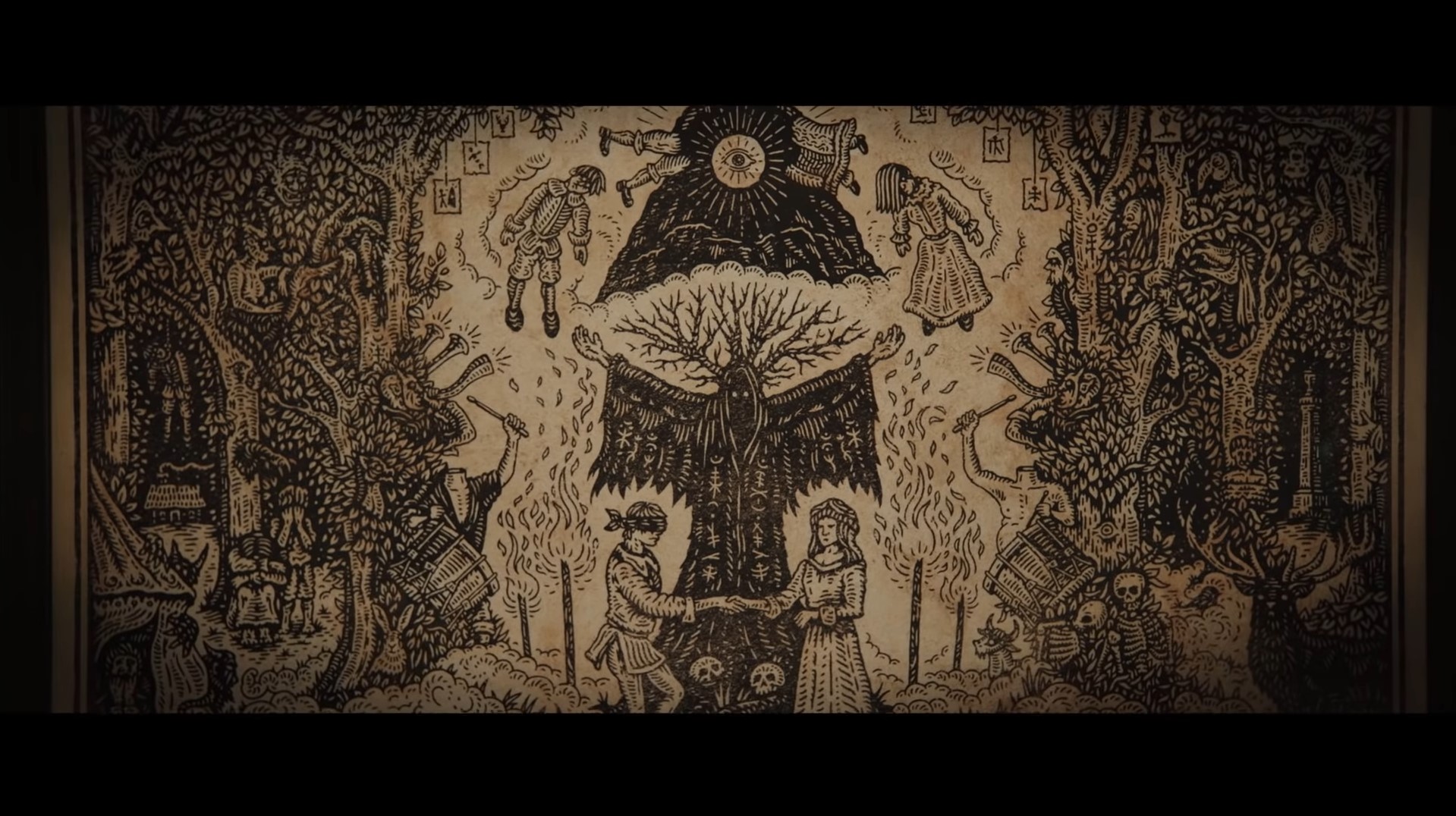
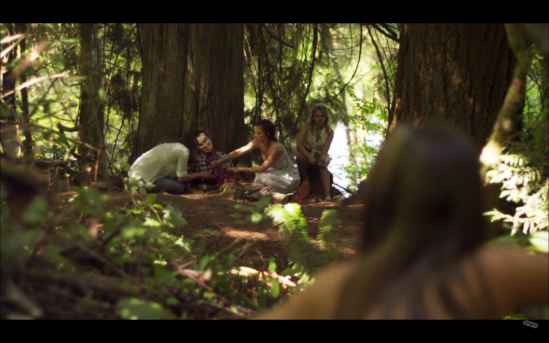
A chiseled, fey story with a dark, ominous cloud of impending doom lingering overhead, “In The Earth” is transcendence horror at it’s finest. Neon is set to release the R-rated, 107 minute film, “In The Earth,” in theaters on April 30th. The scaled down budget didn’t hinder Wheatley’s grand platform and with Nick Gillespie’s sophomore credit as feature film cinematographer, the playbook was unwritten for Gillespie to rework how to shoot a film under the confines of a pandemic with limited cast, a living forest, and still maintain safe social distant practices under strict mandated guidelines. Gillespie formulated wide-angles to capture an expanse of trees diminutively enshrouding the characters, almost like the forest was going to gulp them at any moment. A composition of artful imagery compiled together in a collage of intoxicating colors and feverish styles interprets nothing concrete in the heroines journey of an nearly unknowable presence only knowledgeable by world of mouth, leaving also the audience induced with a psychedelic vision at the whims of Wheatley’s direction. There were no bonus scenes during or after the credits and the perfunctory ending opens the door for interpretation that can be more impacting than a firm resolution. Born and bred from the depths of the coronavirus pandemic, “In The Earth” dispatches a diversion from the immediate, the real world, and the tumult of a virus with a bewilderingly diversion of troubling folk horror sown directly into Mother Nature herself.

Never Poke Isolated EVIL. “Darkness in Tenement 45” reviewed! (Wood Entertainment / Digital Screener)

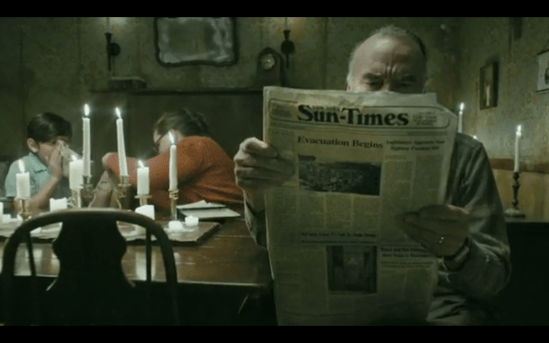
In an alternate reality of the 1950s, the Soviet Union has obtained components for long range biological weapons that threaten United States’ borders.  New York City has been declared as a tangible target and the city is evacuated of all residents, but one tenement, number 45, remains occupied, boarded up by the frightened tenants to shield themselves from the biological threat and from a possible USSR invasion.  Cut off from the outside world and running low on food and supplies, the building’s owner, Felix, ventures outdoors to forage what’s left on the streets of NYC, leaving Martha in charge of the dilapidated building, the anxious children and the terrified adults.  Martha’s adolescent niece, Joanna, arrived just before the evacuation; a measure taken by Joanna’s mother due to her daughter’s “darkness” of violent outbursts, but Joanna’s darkness conflicts with Martha’s authoritarian leadership leading up to a faceoff between children and adults in already tense surroundings.

In August 2017, production finished on “Darkness in Tenement 45.”  In 2019, a Kickstarter campaign was launched to complete the post-production of the Nicole Groton written and directed psychological thriller based off fear and intimidation in the context of a Red Scare backdrop.  As her breakthrough feature film, Groton probably couldn’t have imagined that the release of her quarantine isolating and germ warfare agog could have coincided right in the middle of a current pandemic climate of self-quarantining anxiety and globally enforced lockdowns.  Yet, “Darkness in Tenement 45” can be viewed a sentiment of triumph in a time of actual worldwide darkness for a film with a crew that is comprised of primarily women and with a cast that favors the majority of dialogue roles also for women.  Groton supports her own cause by contributing as producer under her production label, A Flying Woman Productions, a North Hollywood, California based indie picture production company.

While there might be a contingent of characters that could easily be in the vying for lead, Nicole Tompkins is the discernible “darkness” descriptor in the “Darkness in Tenement 45” title.  The Texas-born actress has developed a little darkness of her own in her career corner being a principle lead in the 2018’s nightmares of the netherworld, “Antrum:  The Deadliest Film Ever Made” and also landing a voice role of one of survival horror’s most renowned heroines, Jill Valentine, in the remake of “Resident Evil 3” video game released this year.  Now, Tompkins scales the identity range as a damaged young woman sheltered in place from the elements of war only to be stuck as an afterthought amidst toxic authority that could endanger all tenants, creating a boiling tension culminating into a volatile climax with Martha, a role drenched with an unapathetic interest in children’s opinions, especially from the unstable ones.  Martha is played sardonically by “Blood of Drago’s” Casey Kramer with a seething disdain for anything that isn’t in her interest.  Overall, the performances and characters are grounded enough to development the story along it’s simple narrative lines, but not everything support character, who are supplemented with individual portions of the story pie, are well bloomed to sate their character.  For instance, Tomas, the youngest child of the building owner, Felix, has an undisclosed autistic side him and becomes obsessive with the breast of one of his older sisters, and while that plays out in Groton’s themes of partisan power when Tomas is given authority over his sisters from his venturing father, because of their innate Latina patriarchal culture, Tomas’s motivations fall short of really being dug out from the undercurrent context as an individual arc.  Same kind of broke off development can be said with Emmy Greene and Joseph Culliton’s characters as fellow adults who blindly follow Martha’s do-as-I-say mentality like lemmings toward their self-destructions.  The cast rounds out with a wide range assortment of children and adult actors that include David Labiosa (“The Entity”), Melissa Macedo (“Blood Heist”), Keyon Bowman, Marla Martinez (“Blood of Ballet”), and Anthony Marciona (“Invasion U.S.A.) who provides more of a 1950’s white man NYC accent true to the era.

Revolving around the theme of isolation, “Darkness in Tenement 45” operates under the similar structure of John Carpenter’s “The Thing” by establishing a group of people cutoff from the rest of the world trying to survive a different kind of infection and the antagonist alien, represented as the darkness in Groton’s film, is the villain that tears the remaining survivors apart from the inside, metaphorically in the house instead of their bodies in this case.  “Darkness in Tenement 45” is by no means on tenterhooks or as a molecularly gruesome as John Carpenter’s classic re-imagining of an actual 1950s film, but the basic principles of the story present plenty of suspicion, hegemony, and stir craziness to go around, fueling the dreams and anxiety to Joanna’s snowballing psychosis redlining toward critical.  While I feel that the performances and wardrobe are not the best representation of the 1950s time period, the Caitlin Nicole Williams’ production design shoulders much of that responsibility.  Williams, who worked as the second unit production designer on the satirical-slasher “Dude Bro Massacre III”, creates a delineable vividness out of a bare bone lined tenement setting, appropriate for the depicted social class and period, while exuding the crude shiplap finish that fits the narrative, adding confinement and angst to the space.  “Darkness in Tenement 45” is Groton’s groundbreaking effort that dishes out this disorder of a safe haven in dismay; yet, the story pulls plot point punches that should have landed to knockout a more effective thriller that touches importantly upon the very livelihood and fate of each individual tenant in an alternate universe wartime backdrop.

On the biggest day of every four years, as anxiety-riddled clouds loom over the entire nation as we all wait in the shadows with bated breath of who will be the next President of the United States of Election Day, Wood Entertainment has embraced another kind of tense darkness with their release of “Darkness in Tenement 45” onto various digital platforms, including iTunes; Amazon; Vimeo, Xbox, Google Play, iNDEMAND, FandangoNOW, and more. Continuing the praise of the female-led thriller is with the Carissa Dorson cinematography that deposits two shot styles of the conscious and subconscious. When awake, Joanna and the others are engulfed in a hefty, deep dark and light wood brown scheme that compliments the slummy environment of their tenement. When asleep, Joanna is rendered in a softer image to resemble the hazy or airy atmosphere of her dreams. This style is also complete with a medium scaled purple-pink tint often associated with the hallmark callings of a 1970s-1980’s foreign supernatural horror. Dorson never intertwines the two styles, giving clarity to Joanna’s conscious and subconscious state without going deeper into the character’s easily agitated and short fuse temperament, while also setting up some neatly framed shots that make things look bigger or more menacing than they appear, such as the overly boarded up entrance door or the candle lit supper table that becomes a point of contention. Flashes of incubus imagery and the dissonance of gearworks clanking around an unhinged mind give “Darkness in Tenement 45” a morsel of allure amongst the thematical discord of breaking the chains of restrained individualism and overprotecting those with a firm hand from self-harm and while the film might not be pitch perfect, the spirit is strong in the vanguard of female-driven filmmaking.

“Darkness in Tenement 45” now available for rent on Amazon Prime!

EVIL Gets Loopy in “Welcome to The Circle” reviewed! (Artsploitation Films / Blu-ray)

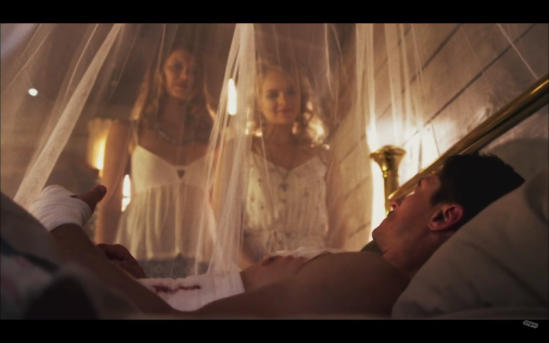
Greg and his young daughter Samantha are turning out the lights on a camping trip in the woods.  When a bear attacks in the middle of the night, Greg awakens in the care of a commune-like camp.  Injured but alive, Greg is given the grand tour of the encampment of a cult known as The Circle where he rejoins with his happy-go-lucky daughter and meets a few other strange and unusual members who worship the legacy and the omnipotent existentialism of The Circle’s creator, Percy Stephens.  What the father-daughter combo don’t realize is that The Circle is a demon worshipping cult bidding on the whimsical demands of Percy Stephen’s rancor and malice.  A group of outsiders led by Grady, a former cult member in his youth, are determined to rescue and reprogram one of the followers close to them, but step into an upside-down world, demonized with smoke and mirrors, set on swallowing their souls for the sake of Percy Stephens delight. 

A diabolical drip of disorienting deception, “Welcome to The Circle” is a roundabout from Hell, cordially ostracizing the love and blessings ideology for more sinister, soul-sucking profit of an unconventional demon film.  “Welcome to the Circle” is a Canadian-made debut independent feature from write-director David Fowler and Fowler, better known for his work on documentaries, knocks on the door of insanity with a tailspin narrative that collides John Carpenter’s “In the Mouth of Madness” with Clive Barker’s “Lord of Illusions” with Aaron Moorhead and Justin Benson’s “The Endless” rapping at the door and the results are an enigmatic nightmare full of stone faced mannequins, body inhabiting occupations, a series of blackhole peculiarities, and being eaten alive by crazed acolytes.  The Vancouver, British Columbia based Canadian company, High Deaf Productions, embarks into the feature film bazaar, with Mack Benz and Michael Khazen serving as company producers, with co-production association from Corvid Arts and Upfront Films.

Broken into two parts, the narrative opens the first portion up to familiarize with the cultist sheep in the stark white attire of wolves’ clothing that throws Greg and his daughter Samantha’s kismet into the uncertain pit of a demon’s impish thirst for souls.  When introduced to Greg (“Dragged Against Concrete’s” Matthew MacCaull), much of the character falls below the waist side as a single father detached from his own child and surrounded by conniving zealots that funnels into becoming weak, if not also immaterial when MacCaull is unable to explore Greg more in depth.  Nothing against MacCaull who performs well enough with an unsympathetic character that has a cold shoulder connection with his insubordinate child and no real background fuel a feed into Greg’s worth as one of the mainstay roles.  I also thought a little more on The Circle’s followers would be constructive to The Circle’s reason for fervor and appeal, but instead, Sky (“Supergirl” television series’” Andrea Brooks), Lotus Cloud (“Pacific Rim’s” Heather Doerksen), Rebekah (“The Wrong Daughter’s” Cindy Busby), and Matthew (“The Unspoken’s” Michael J. Rogers) are members developed only inside a crumbling hierarchy structure obtaining cryptic messages from a demon, Percy Stephens, from beyond their plane of existence.  Percy Stephens is perhaps the best complex character in the fold without having a stable foundational actor in his shoes and is played by various faces of the film’s cast able to reach back toward an immense and mysterious backstory that involves a slew of daring and impressive accomplishments and a demonic tiger shark that may or may not be Stephen’s aquatic damnation to Hell.  The second portion moves greatly away from Greg and his daughter and into a rescue operation, led by the unfiltered and unorthodox Grady, a former The Circle youth who landed in a psyche ward only to be hired to infiltrate the cult to extract Rebekah, paralleling his motives to understand the mechanics of the cult that led to the disappearance of his mother.  “Stan Helsing’s” Ben Cotton delivers a performance that is anything but vanilla as the sharp wit and cool as a cucumber Grady, dominating each and every scene in a disheveled and aloof veneer that becomes Grady’s best defense against Percy Stephen’s engaging entanglements.  The cast rounds out with Taylor Dianne Robinson (The Twilight Saga:  Breaking Dawn Part 2), Hilary Jardine (“Teen Lust”), Matt Bellefleur (“In Their Skin”), Christian Tessier (“Night of the Demons III”) and Jordana Largy (“Rememory”). 

It suffices to say that David Fowler’s topsy-turvy and boundless the fake-fake, a descriptor of the story’s in-between existences, is an alternate universe complete with hope chest portals and wraith approaches that will disrupt the audio and visual perceptions, disconnecting the straightforward wiring only to cross the stepping stones of normalized story structures to fissure what we know into a fractured reality.  The foyer to oblivion, the fake-fake, isn’t an easy one to digest and Fowler is very much aware of the real-real consequences of traversing into the world of the fake-fake.  Fowler forces you to pay a penance for crossing the threshold that will cause dizziness and nausea, the same affects the characters sometimes experience through the compressed spaces of time and planes of The Circle, soldering an unintentionally immersive experience with the combination of simple and natural cinematography infused effects that spun, tilted, and corralled acute fear and isolation from under the DP supervision of Sterling Bancroft. In regards to Fowler’s darkly imaginative story, the script a lively progression of diverse ideas and concepts that construct a little world within a bigger world, especially on a modestly tight budget that can’t afford mind-blowing special effects, but the cohesiveness is heavily reliant on the character’s to explain the actions that are occurring to progress an outline and much of that explanation falls into poetic prose and riddles. Characters Percy Stephens and Grady to much of the grunt work in vocalizing the visuals, but the course is a rocky road and with every bump there’s a meaning within a meaning and to know the meaning is to meaning to know. See what I mean? “Welcome to the Circle” chips away the substantial concrete barrier with a bombardment of incorporeal flak that comes in wave-after-wave of full blown auteur creativity.


To get caught in the loop is to loop in getting caught and that’s what Artsploitation Films has done by acquiring and distributing “Welcome to The Circle” on a Blu-ray home entertainment release. Presented in a widescreen 1.85:1 aspect ratio, the digitally recorded picture is about as immaculate as they come nowadays with tactile textures of grainy log of the cabins, the floral of the forest, and the scruff of Matthew’s bristly beard all looking particular sharply detailed albeit some minor fluctuations of softness seeping into the brush and into more dreamlike sequences and though flat, the colors due run unbridled with the forestry green and the eggshell color of mannequin “skin” that renders subtle differences more distinct. Darker scenes render nicely and smoothly without as much of a flicker of interference and Bancroft’s use of depth forces audiences to focus only on what’s extremely close up or what’s faraway by way of adjusting the focal length. The English language 5.1 DTS-HD Master Audio also has little-to-no complains with a well rounded discernible platter of clear, forefront dialogue, depth and range of vocals and ambience, and a combination score and soundtrack by Reid Hendry with original and haunting folk tracks by Jo Krasevich do an insidious one-two punch that bruises the soul. The not rated, 93-minute film comes with only a theatrical trailer in the bonus features. Despite the dense ambiguity that surrounds the film, the demonic ensnaring doom that accompanies “Welcome to The Circle” is, simply put, psychosis in a bottle that director David Fowler just effortlessly uncorked.

Own “Welcome to the Circle” on Blu-ray!

Sit Back and Enjoy EVIL’s Ride on the “American Rickshaw” reviewed! (Cauldron Films / Blu-ray Screener)


Scott Edwards, a struggling college student, works as a rickshaw runner on the vivacious streets of Miami. When a beautiful woman offers more than just the rickshaw fare for his service, Scott reluctantly accompanies her on a private boat secured at the local harbor for a night of sensual loving, but Scott finds himself in the middle of a voyeuristic scheme by being videotaped behind a two-way mirror and before fully copulating, Scott roughs up the secret cinematographer and the woman escapes. After realizing he forgot the tape, Scott returns to the boat to discover the man dead and all the evidence points to him, framing him for the murder. On the run and being hunted down by Miami PD and the actual killer, Scott embarks on a mission to clear his name, with the help from the woman on the boat, a stripper named Victoria, and a Chinese witch named Madame Luna, during a pivotal time of Chinese mythology that pits good versus evil entrenched sordidly around a renowned televangelist.

Perhaps one of the most offbeat action-fantasy-horror movies to come out of the U.S. in the late 1980’s, the “American Rickshaw” cinematic experience can be a mesmerizing 97 minutes of claptrap theology and clandestine villainy bedim by a witch’s obscured telepathy powers of fire, snakes, and unveiling evil with a human to pig physical transformation. Also known as “American Tiger” in the States and “American riscio” in Italy, the film has the sensation of a blend of various filmmaking abstracts and for very good reason, it is. Notable Italian filmmaker, Sergio Martino (“Torso” and “Slave of the Cannibal God”), helms the cultivation of a big-ticket American production with the ethereal supernatural essence invoked by the Europeans that results into being one of complex whirlwind of a story from a script penned by Martino, Roberto Leoni (“Sex Diary”), Maria Perrone Capano (Beyond Kilimanjaro, Across the River of Blood”), and Sauro Scavolini (Your Vice is a Locked Room and Only I Have the Key”). Dania Film, Medusa Distribuzione, and National Cinematografica serve as the Italian production companies responsible for the “Rickshaw’s” wild ride through Miami heat.

With a premise already on a high bonkers plane, “American Rickshaw’s” curiosity extends to the casting of an American Olympic gold medalist in gymnastics, the perfect 10 recording Mitch Gaylord, is cast as the male lead, Scott Edwards. The physically fit Olympic hero with little-to-no experience or exposure in acting to his name became the story’s prime suspect on the run from not only the law, but a merciless goon embodied by “Elvira: Mistress of the Dark’s” Daniel Greene. Greene already had an established relationship with Sergio Martino, having worked previously with the director on “Hands of Steel” and “The Opponent,” marking “American Rickshaw” as his first collaborated effort in being the story’s villain, Francis, who is seemingly more of the antagonist foe for Scott Edwards than his sect master, Reverend Mortom, a masquerading televangelist seeking to exploit an ancient Chinese relic for nefarious purposes and it’s “Halloween’s” Donald Pleasance to be the face of what would be established as quintessential evil. Pleasance seemingly goes along with the story even when has to snort like a pig during the character’s climatic ending, but is enveloped in a rather mundane, behind-the-scenes puppet master preaching a good biblical hellfire and brimstone game only to be castrated as a backseat bad guy with little to no vice exploration other than swindling the Chinese witch while dolled up in a kimono. The cast rounds out with Victoria Prouty, Darin De Paul, Roger Pretto and Regina Rodriguez and Michi Kobi as the young and old Madam Luna.

I’m one who never likes to research movies before watching them; I believe knowing the film in and out before viewing will more than likely become ruinous toward the quality of perception and cement a foundation of fixed judgement before the opening title credits roll. I don’t even like reading the film’s synopsis for the fear of spoiling too much on too little so I sat down with “American Rickshaw” knowing virtually nothing about the Marino anomaly and coming out relatively pleased, strangely piqued, and from start-to-finished bewildered. Off the bat, “American Rickshaw” could be grossly compared to be the East Coast variation of or, perhaps, the Italian answer to “Big Trouble in Little China” that channels less Chinese mysticism for more mysterious thriller. There are some noticeable similarities between the two films, such as for the obvious uncanny powers of Madam Luna, and then the not so obvious, but maybe more of a referential nod to John Carpenter’s film with the main character sporting a graphic tank top of a tiger that’s familiar with Jack Burton’s graphic yin-yang tank top, the young and old versions of Madam Luna resemble the young and old versions of Lo-Pan, and the scene where a prominent character gets runover by a big, red semi-truck. You know, the kind of rig Jack Burton mows down Lo-Pan with? “American Rickshaw” pales in comparison or, perhaps, shouldn’t be compared at all as Martino’s spellbinds his work by riddling it with cross cuts that attempts to discern solely by optics that swiss cheeses your mind as it tries to fill in the gaps of where the hell did that snake come from? Why did the key burn through his hand? Why is the stripper key to Scott’s Journey? What’s the reason behind Scott’s year of the tiger birth date significance toward his impelled Chinese zodiac destiny? There lies so many questions, but very few are answered; Yet, “American Rickshaw” is the wonderland tour Martino fabricates as some dysfunctional vision quest mapped with spontaneous witchery, horoscope horrors, and a devil pig in human clothing.

As the second half of the inaugural releases of Cauldron Films, “American Rickshaw” receives a limited edition Blu-ray release with a 2k restoration scan from the original camera negative. Since the review is based off a Blu-ray screener and not a physical copy, only 1500 copies being release, the A/V aspects of the package will not be critiqued, but this unrated 80’s hybrid action-fantasy-horror will receive the works, including a limited edition high quality slipcase with new artwork by Mattias Frisk, a reverse covering featuring the Italian artwork, and a booklet inside with writings by grindhouse comics writer and Tough to Kill co-author, David Zuzelo. The picture will be presented in a widescreen, 1.66:1 aspect ratio, with an English language LPCM dual channel audio track with optional English SDH subtitles. Bonus material aplenty with an one-on-one interviews with director Sergio Martino and production designer Massimo Antonello lamenting about the film while as providing a stark difference between Italian and American filmmaking in the late 1980s, a then and now look at filming locations, The Production Booth Podcast, including commentary from Samm Deighan and Kat Ellinger discussing the zaniness of “American Rickshaw,” and an image gallery. Distinct beyond anything else you’ll ever see and indelible with solid practical effects, “American Rickshaw” deserves the upgraded, horror-marketed update set apart from the poorly sultry, softcore porn “American Tiger” U.S. release that stiffens the story’s true self on retail shelves.

When EVIL Gets Inside Your Head…


An immigrant cabby named Luz stumbles dazed into a German police station, repeating a profane distortion of a religious prayer to a couple of baffled detectives. Meanwhile, in a nearby bar, a forwardly chatty woman is diving seductively into a spiel about her Catholic schoolgirl friend who just recently jumped out of her moving taxicab to a psychoanalysis specialist on the edge of his seat. Drunk enough to take advantage of, the Doctor falls for the woman’s alluring trap, beguiling him to do her bidding as an unwilling host. As the now possessed doctor arrives to evaluate Nora for the police, he instigates a hypnosis recreation of the details events leading up to Luz’s ravings and disillusions. What happens next goes beyond human comprehension and rational as the doctor desires more from the stupefied Luz than what meets the eye.

Undoubtedly a strong skiff of demonic peculiarity weathering forth against an unforgiving maelstrom of spiffy-glamourous and yacht-sized counterparts is Tilman Singer’s memorizing tale of demigod deception in “Luz.” As the German born filmmaker’s first written-and-directed full length feature film, a film school project shot entirely on 16mm color negative, Singer dazzles with a throwback grindhouse glow set ablaze with a neon flare that adds to the perilous seduction and violation of the mind and primal infatuation. “Luz’s” was filmed in Cologne, Germany, where Singer studied film at the Academy of Media Arts Cologne, during the production year of 2018 and saw success at various Germany festivals, including it’s debut at the Berlin Film Festival and the Fantasia Film Festival. The Academy of Media Arts Cologne also serves as the production company, as it was, after all, a school project, and listed as Kunsthochschule für Medien Köln (KHM).

“Luz” wouldn’t be what as staggering as it is if it wasn’t for the invested cast who brings Singer’s vision to the spectrum. Luana Velis’s seamless grasp of the editing has remarkable wealth when playing a disoriented cab driver coming in off the street and Velis as Luz, in the ebb and flow of reality when Dr. Rosinni (Jan Bluthardt) entrances her with a blend of hypnosis and psychoanalysis techniques, sustains character through various transitions present inside a large police board room, reality, and the subconscious recollection of places and events inside her mind that Singer constructions for visualization, not reality. Singer melds together places, people, and events, throwing audiences for loops and casting misleading signals and just where the hell our characters are gathered. Bluthardt is equally captivating post transformation, coming off like a calculated maniac, resolved in his wild role. Perhaps, my favorite of the cast list goes to Julia Riedler as Nora Vanderkurt, Luz’s icy former bedfellow from Catholic School who slithers into Dr. Rosinni’s ear like a bewitching asp while seeming like a normal bar patron, but Riedler’s spin on Vanderkurt breaks the construct beyond that of the sleazy barfly and into something more conniving, wicked, and alcohol infused while still steamy with sexual emissions. All three performances are keystones to “Luz” success while fellow cast mates Johannes Benecke, Lilli Lorenz, and Nadja Stubiger, offer some spot on support.

“Luz” summits fear with intrinsic performance art of hazy, but colorful, atmospherics and off-kilter shapes and lines, making the most routine settings feel unsettling. It’s a strong cinematography showcase by Paul Faltz who was able to frame and fright a scene from a sterile and fatigued, wood paneled office environment; essentially put, Faltz turned coal into a diamond while Singer brought a keg of European horror to the party. Unconventional, of course, with a profound arthouse quality about it, “Luz” is very much inspired by the European masters of horror, but pulls quite a bit from the vibrancy of American filmmaking too, pulling inspiration more noticeably from John Carpenter’s overwhelming sense of apocalyptic doom from such a scale down narrative and the terror looms like a chandelier hanging by a single thread just waiting from the startling crash of glass and metal. There are themes related Catholicism, homoeroticism, guilt, and obsession through the venomous innate nature of demon, as if unknowingly leaving an open invitation for evil by way of spiritual clairvoyance and Catholic defiance. Full of abstract visuals and melodious dialogue, “Luz” still burns the scary story lantern with a flickering of imminent existential combustion.

While the theatrical release has been officially canceled, “Luz” will still live on through the digital world, being released by Sharp Teeth Films, who released the POV slasher horror “You Are Not Alone,” on June 1st in the United Kingdom. With this being now a digital release, critiquing the audio and video quality will be limited to the artistic direction. Video-wise, Singer sought the use of a 16mm film stock with the speckle and grain texture of that beloved, yet enveloping imperfection and shooting in an anamorphic widescreen aspect ratio of 2.35:1, using an Arri Alexa and RED cameras that supported an anamorphic lenses. The result is phenomenal to digest with some serious depth when considering how small the sets are, turning mere pockets of space into the likes of grand ball rooms. The German, Spanish, and very little English dialogue tracks are clear and prominently abutted against a well adjusted ambience mix; in all, the audio package has good depth and range. There were no bonus features included with the digital screener. “Luz” is weird, mystifying, and can wriggle into your favor with a chilling essence taking a leisurely stroll along your back, propping up the hairs one strand at a time. Highly recommended.