Good for Mankind is also EVIL for Greed! “Mandroid” reviewed! (Full Moon Features / Blu-ray)

“Mandroid” Blu-ray Now Available!

Scientists Dr. Karl Zimmer and his colleague Ivan Drago work in Russia to invent and perfect a humanoid android that uses the converted energy, labeled as SuperCon, from a unique fungus, that has endless potential and possibilities, to power it while controlling the android through a cerebral VR dashboard.  While Zimmer has plans to help humanity with the SuperCon project, Drago has other greedy plans to sell to the highest bidder, in this case the U.S. Government for military grade weaponization.  When Drago steals the mechanized android, he doesn’t have the SuperCon formula to fully complete the sale.  A CIA operative, Zimmer and his daughter, and a U.S scientist sent to validate the SuperCon and android for US. Government use work together to stop Drago who has gone mad with greed and disfigured by the highly radioactive converted energy as nothing will stop him from obtaining the full mandroid package he helped to create. 
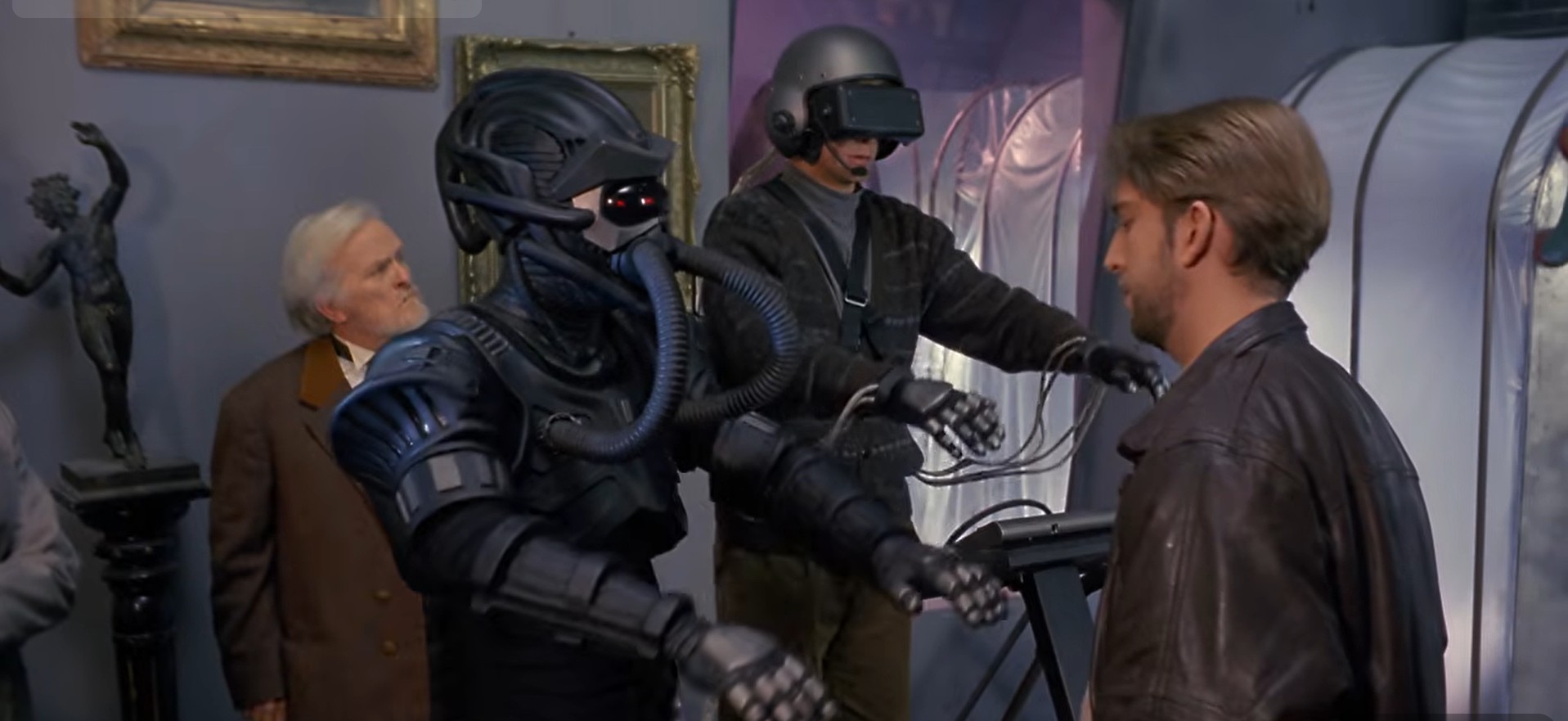
A Full Moon produced science fiction that really tones down the campiness to the point where the film doesn’t feel like a typical Charles Band production.  “Mandroid” is the 1993 mecha action-thriller from Swedish director Jack Ersgård (“The Visitors,) and penned by the Charles Band payrolled screenwriters Jack Cannon (“Robot Wars,” “Seedpeople”) and C. Courtney Joyner (“Trancers III,” “Puppet Master III:  Toulon’s Revenge”) under a pair of pennames, Jackson Barr and Earl Keaton.  “Madroid” would be the first of a two-film arc that uses secondary story elements of the “Mandroid” narrative to setup a parallel sequel or companion pieces entitled “Invisible:  The Chronicles of Benjamin Knight” that’s also directed by Ersgard and written by Joyner, creating a perfect double bill for Full Moon.  Charles Band has sole executive producer credit alongside the Romanian producers, a husband and wife team of Vlad and Oana Paunescu, at their studio and production umbrella of Castel Film, located in Romania and a frequent collaborator with the presenting Full Moon company credited with “Subspecies II and III” and “Trancers 4 and 5” to name a few titles.
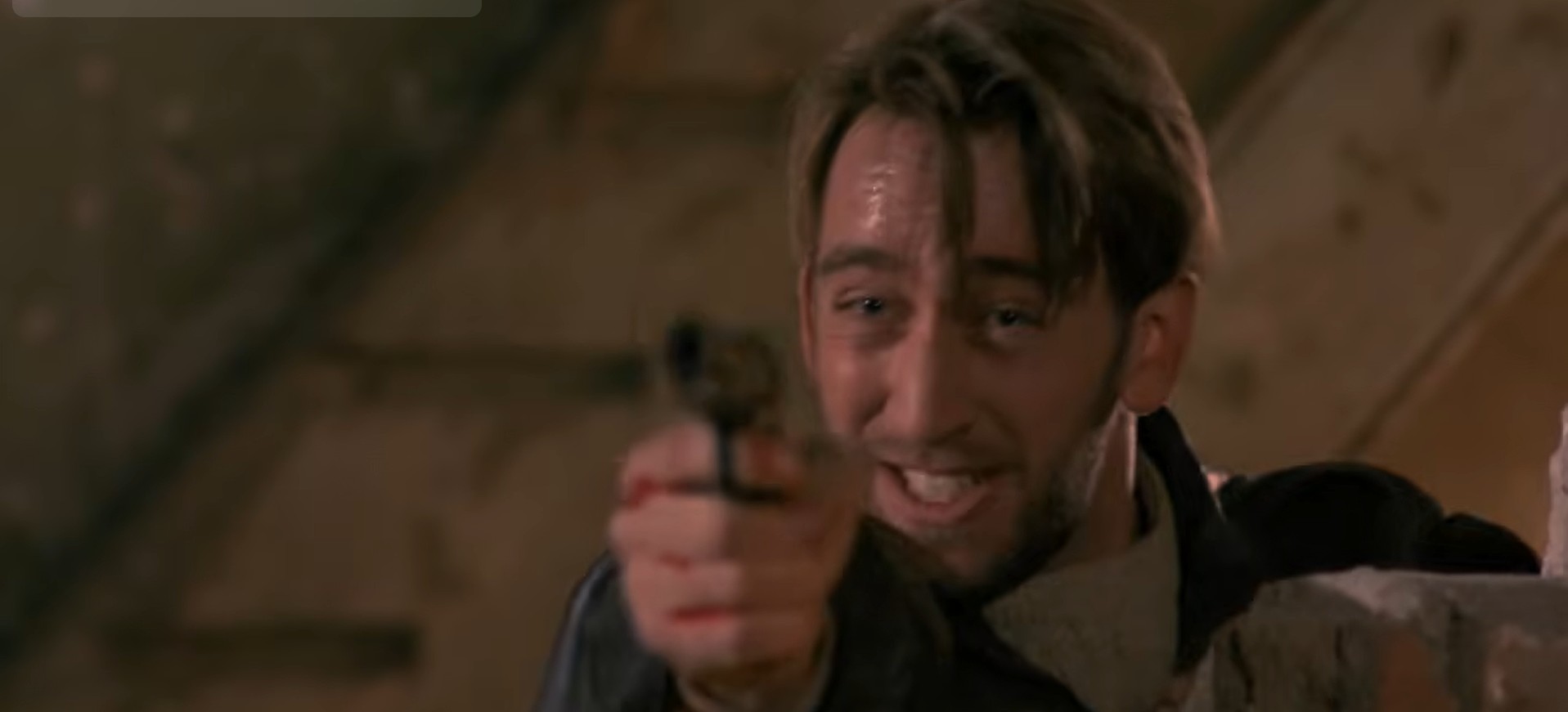
“Mandroid” acting favors more of the no-nonsense and serious tone for as science-fiction VR-controlled super android thriller set in Russia.  Brian Cousins is credited as the lead playing Wade, an American scientist hired by the U.S. Government to validate the SuperCon project under Dr. Zimmer and Drago but I find Cousins’ character lacks the charisma and the screen time to be unrivaled, sharing, or better thought as being oppugn, the feature prominence with the villain Drago who overshadows him considerably with the wonderfully USSR-trite performance by the late “Werewolf in a Girls’ Dormitory” and “The Entity” actor Curt Lowens.  Lowens brings to Drago the quintessential bad guy charm with the quintessential bad guy scarred looks as he exploits opportunities for personal gain and even using fear to evoke a homeless, Soviet-enthusiast mute (Ion Haiduc, “Bloodstone:  Subspecies II”) to be his henchman.  Their flaws inherently make them villains against a team of scientist, consisting of Wade and Dr. Zimmer (Robert Symonds, “The Exorcist”), his daughter Zanna (Jane Caldwell), and assistant Benjamin (Michael Della Femina, “Invisible:  The Chronicles of Benjamin Knight”) working together to achieve greatness for mankind, the benevolent and noble act.  The last principal piece of the puzzle is CIA agent Joe who’s not very tech savvy and may have more dubious reasons for his representation of the U.S. Government.  Cladded in a leather/faux leather jacket and tan slacks, as well as sporting a rugged 5 o’clock shadow, director Jack Ersgård’s brother, Patrik Ersgård (“The Visitor”), does not look like your conventional CIA agent to add a layer of unresolved mystery around him and to make him dangerous to either side of the good vs evil spectrum, but one thing is for certain about Ersgård character is his cunningness and courage.   Costel Constantin, Mircea Albusecu, and Adrian Pintea provide the Romania support cast to flesh out “Mandroid’s” merciless cold attire.
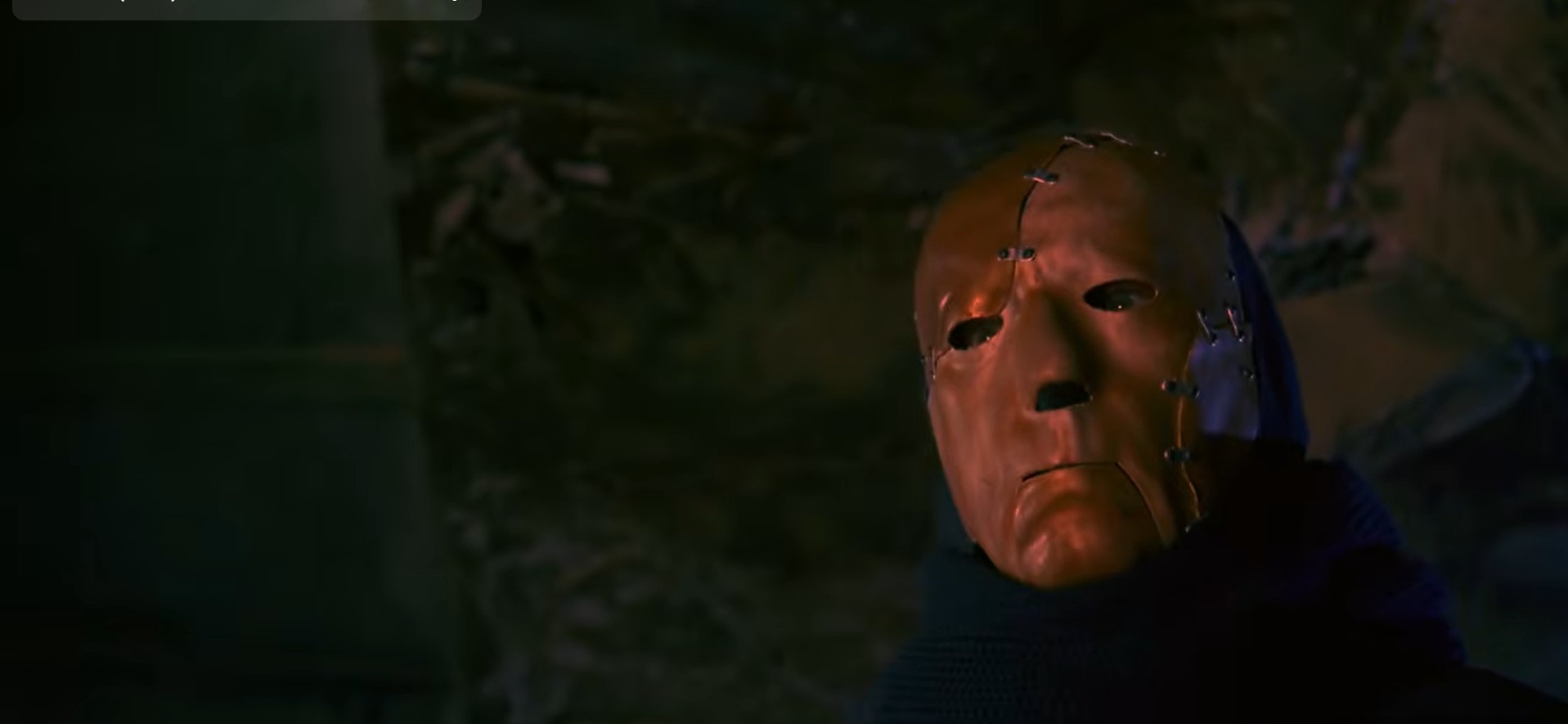
Less carnivalesque, less campy, and light on the pint-sized killers than most Full Moon productions, “Mandroid” has the seriousness of an early Stuard Gordon x Full Moon collaboration, aesthetically backed with darker tones, infused practical bloody imagery with some compositional VFX, and delivered signed and sealed by distinct and solid performances.  The SuperCon plot device is early days  man-in-a-suit backed by radioactive mushrooms that sound trippy when described out loud but Jack Ersgård subverts the idea’s potential faults and creates an atmosphere of intensity that sees large explosions, plenty of period costuming (Cold War era reminiscent) and is even able to secure SWAT armored vehicles and plenty of interesting, dilapidated locations that, from at least the U.S. perspective, feel like Mother Russia.  Whether a progressive highlight or an expectational fault, depending on the kind of person you ask, “Mandroid” does not contain nudity that can be savored from most of Full Moon’s catalogue; sorry readers but super blonde Jane Caldwell is not only the sole woman in the story but she’s very much clothed all the way through without a smidgen of sexy promiscuity.  The whole quasi-biological, man-and-machine affair represents the actual entertaining and creative storytelling side of Band’s company that has veteran actors mixing it up with up-and-comers to square dance around a radiative weapon of mass destruction tale. 
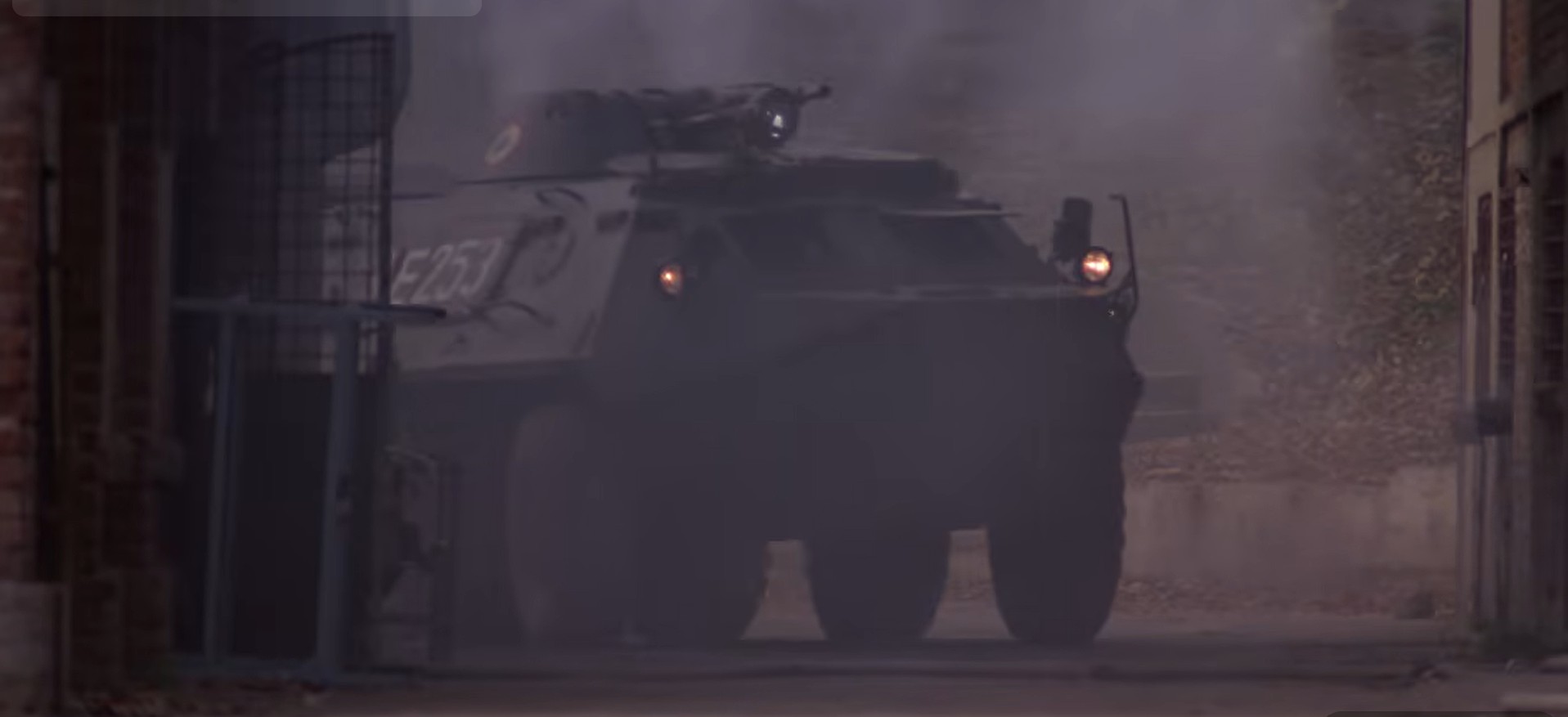
Full Moon Features remasters “Mandroid” from the original 35mm negative, scanned 2K with a high-definition, 1080p resolution, onto an AVC encoded BD25.  The end result is nothing far from an excellence reproduction that cleans up and clears out the inherent nuisances with standard definition DVD and VHS tape.  There’s a bit of a polished look upgrade that enhances great richness to shadows yet still picks up finer detail points that would have been missed through a lower resolution.  The overall detail is soft because of the nature of the lighting aesthetic that casts a soft glow of ethereal in a cold war era scenario while still maintaining an austere and raw sense of soviet times except with a red flare, “Mandroid” graded with blue.  “Mandroid” Blu-ray is presented in a widescreen 1.78:1 aspect ratio.  There are two English audio options available:  Dolby 2.0 Stereo and a Dolby Digital 5.1.  The lossy format is typical compression used by Full Moon and while it offers an adequate soundtrack, it does not boost up reproducing fidelity deserving for “Mandroid” explosive and highly active narrative with plenty of sound effects.  Dialogue is favored nicely and balanced with the action along with the atypical for Full Moon non-carnivalesque score by David Arkenstone (“Murdercycle”).  No compression or original audio track issues with little-to-no interference on the inlaid dialogue.  Special features include the original videozone advert, the original feature trailer, and other Full Moon original releases.  The standard Amaray Blu-ray case contains the original artwork and spined at number 88.  Full Moon’s “Mandroid” is rated R, has a runtime of 80 minutes, and is region free.

Last Rite: “Mandroid” is proof that Full Moon wasn’t always skirting by as they are today with cast, talent, and budget. For fans of Full Moon of yore, “Mandroid” is a serious title to be taken seriously, especially with a new Blu-ray release!

“Mandroid” Blu-ray Now Available!

Never Poke Isolated EVIL. “Darkness in Tenement 45” reviewed! (Wood Entertainment / Digital Screener)

In an alternate reality of the 1950s, the Soviet Union has obtained components for long range biological weapons that threaten United States’ borders.  New York City has been declared as a tangible target and the city is evacuated of all residents, but one tenement, number 45, remains occupied, boarded up by the frightened tenants to shield themselves from the biological threat and from a possible USSR invasion.  Cut off from the outside world and running low on food and supplies, the building’s owner, Felix, ventures outdoors to forage what’s left on the streets of NYC, leaving Martha in charge of the dilapidated building, the anxious children and the terrified adults.  Martha’s adolescent niece, Joanna, arrived just before the evacuation; a measure taken by Joanna’s mother due to her daughter’s “darkness” of violent outbursts, but Joanna’s darkness conflicts with Martha’s authoritarian leadership leading up to a faceoff between children and adults in already tense surroundings.

In August 2017, production finished on “Darkness in Tenement 45.”  In 2019, a Kickstarter campaign was launched to complete the post-production of the Nicole Groton written and directed psychological thriller based off fear and intimidation in the context of a Red Scare backdrop.  As her breakthrough feature film, Groton probably couldn’t have imagined that the release of her quarantine isolating and germ warfare agog could have coincided right in the middle of a current pandemic climate of self-quarantining anxiety and globally enforced lockdowns.  Yet, “Darkness in Tenement 45” can be viewed a sentiment of triumph in a time of actual worldwide darkness for a film with a crew that is comprised of primarily women and with a cast that favors the majority of dialogue roles also for women.  Groton supports her own cause by contributing as producer under her production label, A Flying Woman Productions, a North Hollywood, California based indie picture production company.

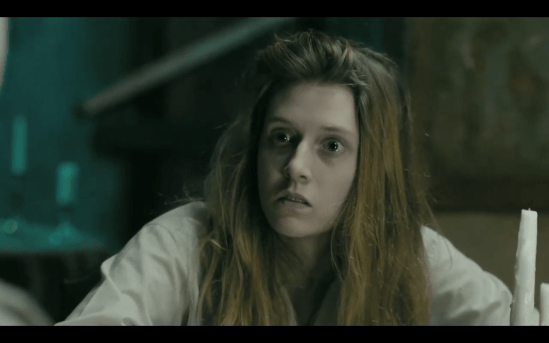
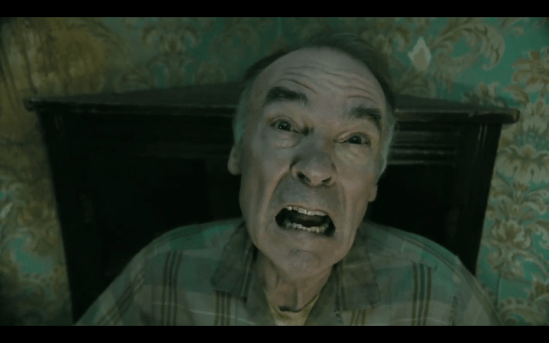
While there might be a contingent of characters that could easily be in the vying for lead, Nicole Tompkins is the discernible “darkness” descriptor in the “Darkness in Tenement 45” title.  The Texas-born actress has developed a little darkness of her own in her career corner being a principle lead in the 2018’s nightmares of the netherworld, “Antrum:  The Deadliest Film Ever Made” and also landing a voice role of one of survival horror’s most renowned heroines, Jill Valentine, in the remake of “Resident Evil 3” video game released this year.  Now, Tompkins scales the identity range as a damaged young woman sheltered in place from the elements of war only to be stuck as an afterthought amidst toxic authority that could endanger all tenants, creating a boiling tension culminating into a volatile climax with Martha, a role drenched with an unapathetic interest in children’s opinions, especially from the unstable ones.  Martha is played sardonically by “Blood of Drago’s” Casey Kramer with a seething disdain for anything that isn’t in her interest.  Overall, the performances and characters are grounded enough to development the story along it’s simple narrative lines, but not everything support character, who are supplemented with individual portions of the story pie, are well bloomed to sate their character.  For instance, Tomas, the youngest child of the building owner, Felix, has an undisclosed autistic side him and becomes obsessive with the breast of one of his older sisters, and while that plays out in Groton’s themes of partisan power when Tomas is given authority over his sisters from his venturing father, because of their innate Latina patriarchal culture, Tomas’s motivations fall short of really being dug out from the undercurrent context as an individual arc.  Same kind of broke off development can be said with Emmy Greene and Joseph Culliton’s characters as fellow adults who blindly follow Martha’s do-as-I-say mentality like lemmings toward their self-destructions.  The cast rounds out with a wide range assortment of children and adult actors that include David Labiosa (“The Entity”), Melissa Macedo (“Blood Heist”), Keyon Bowman, Marla Martinez (“Blood of Ballet”), and Anthony Marciona (“Invasion U.S.A.) who provides more of a 1950’s white man NYC accent true to the era.

Revolving around the theme of isolation, “Darkness in Tenement 45” operates under the similar structure of John Carpenter’s “The Thing” by establishing a group of people cutoff from the rest of the world trying to survive a different kind of infection and the antagonist alien, represented as the darkness in Groton’s film, is the villain that tears the remaining survivors apart from the inside, metaphorically in the house instead of their bodies in this case.  “Darkness in Tenement 45” is by no means on tenterhooks or as a molecularly gruesome as John Carpenter’s classic re-imagining of an actual 1950s film, but the basic principles of the story present plenty of suspicion, hegemony, and stir craziness to go around, fueling the dreams and anxiety to Joanna’s snowballing psychosis redlining toward critical.  While I feel that the performances and wardrobe are not the best representation of the 1950s time period, the Caitlin Nicole Williams’ production design shoulders much of that responsibility.  Williams, who worked as the second unit production designer on the satirical-slasher “Dude Bro Massacre III”, creates a delineable vividness out of a bare bone lined tenement setting, appropriate for the depicted social class and period, while exuding the crude shiplap finish that fits the narrative, adding confinement and angst to the space.  “Darkness in Tenement 45” is Groton’s groundbreaking effort that dishes out this disorder of a safe haven in dismay; yet, the story pulls plot point punches that should have landed to knockout a more effective thriller that touches importantly upon the very livelihood and fate of each individual tenant in an alternate universe wartime backdrop.

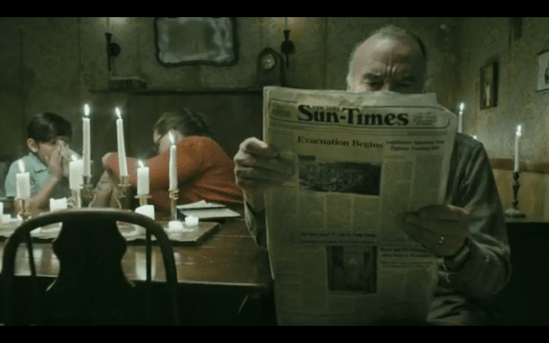
On the biggest day of every four years, as anxiety-riddled clouds loom over the entire nation as we all wait in the shadows with bated breath of who will be the next President of the United States of Election Day, Wood Entertainment has embraced another kind of tense darkness with their release of “Darkness in Tenement 45” onto various digital platforms, including iTunes; Amazon; Vimeo, Xbox, Google Play, iNDEMAND, FandangoNOW, and more. Continuing the praise of the female-led thriller is with the Carissa Dorson cinematography that deposits two shot styles of the conscious and subconscious. When awake, Joanna and the others are engulfed in a hefty, deep dark and light wood brown scheme that compliments the slummy environment of their tenement. When asleep, Joanna is rendered in a softer image to resemble the hazy or airy atmosphere of her dreams. This style is also complete with a medium scaled purple-pink tint often associated with the hallmark callings of a 1970s-1980’s foreign supernatural horror. Dorson never intertwines the two styles, giving clarity to Joanna’s conscious and subconscious state without going deeper into the character’s easily agitated and short fuse temperament, while also setting up some neatly framed shots that make things look bigger or more menacing than they appear, such as the overly boarded up entrance door or the candle lit supper table that becomes a point of contention. Flashes of incubus imagery and the dissonance of gearworks clanking around an unhinged mind give “Darkness in Tenement 45” a morsel of allure amongst the thematical discord of breaking the chains of restrained individualism and overprotecting those with a firm hand from self-harm and while the film might not be pitch perfect, the spirit is strong in the vanguard of female-driven filmmaking.

“Darkness in Tenement 45” now available for rent on Amazon Prime!