

“The Lair” Has a Deadly Secret! Blu-ray Now Available!
Royal air force Captain Kate Sinclair is shot down over the arid planes of Afghanistan. Swarming with Taliban insurgents and her command officer killed, Sinclair takes shelter in an old, abandoned Russian bunker from the Russian Afghanistan invasion of the 1980s. What she stumbles into is an experiment lair housing numerous stasis chambers and dark secrets. Sinclair manages to barely escape with her life when one of the creatures inside the capsules is released, tearing to shreds her well-armed pursuers. Rescued by a ragtag team of U.S. military outcasts based in the middle of nowhere as peripheral punishment and joined up by a trio of British special forces in the area, the Captain attempts to warn her rescuers what’s out in the desert only to be on the receiving end of a monstrous invasion that sees the slaughter of nearly everyone in camp, including the camp commander. Miles from anywhere and not enough supplies to withstand another attack, those soldiers left alive band together to stage their own last stand assault on the creatures’ Russian bunker lair to ensure hostile eradication.
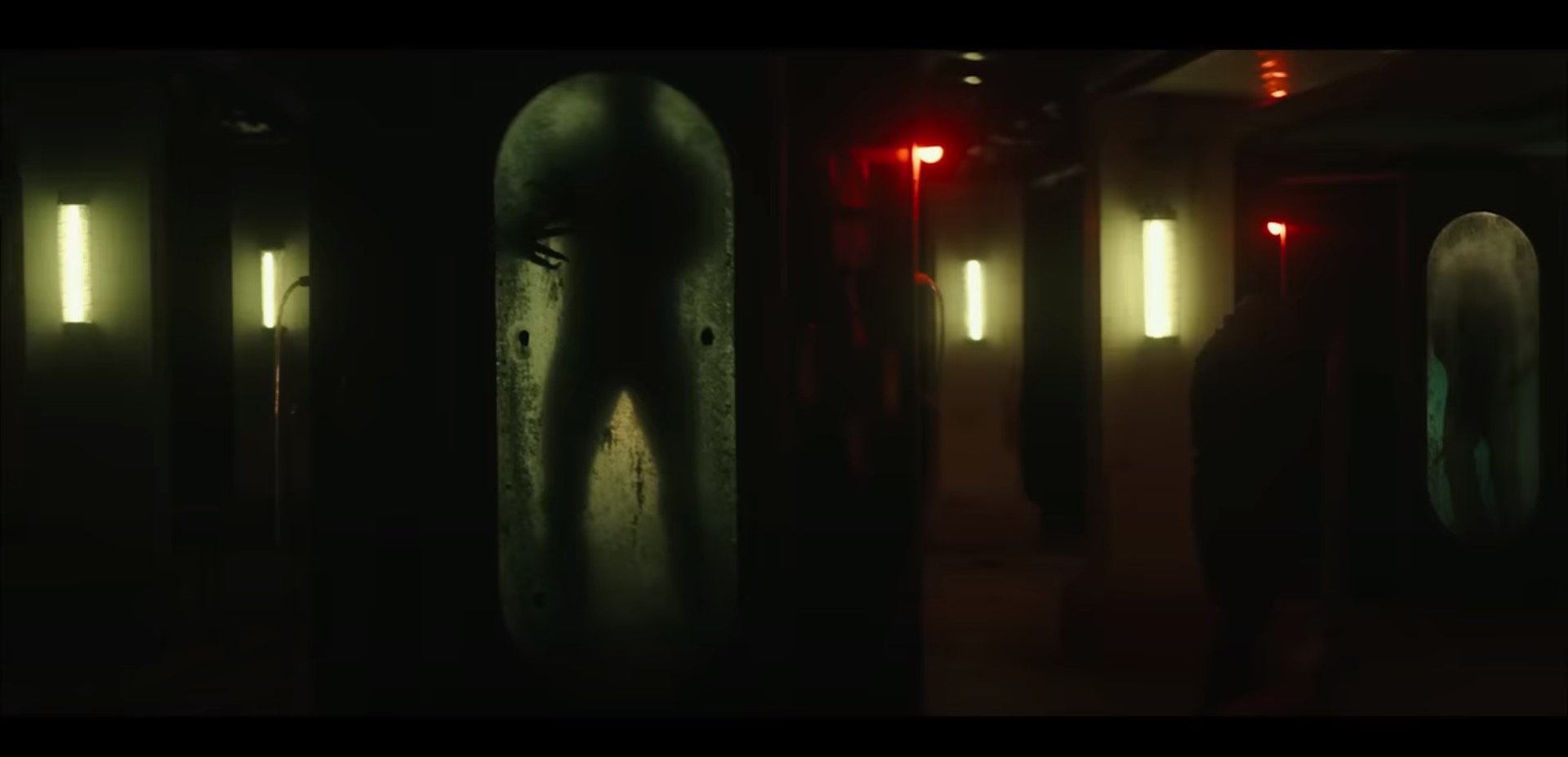
Acclaimed horror director Neil Marshall (“Dog Soldiers”) returns to his roots with a claustrophobic, high-energy, and violent creature feature known as “The Lair.” Having experienced underwhelming success with the fiery Dark Horse antihero “Hellboy” remake in 2019, Marshall returns to independent scene for the 2022 released film having been shot in the barren lands of Budapest, Hungary to create the illusionary Afghanistan territory backdrop. Marshall co-writes the script with “The Lair” star Charlotte Kirk, a reteaming affair from Marshall’s last feature “The Reckoning” from two years prior in which Kirk also produced and starred. Also returning from “The Reckoning” and into the producer’s chair is Daniel-Konrad Cooper along with “Infinity Pool” producers, Jonathan Halperyn and Daniel Kresmery, and “Lords of Chaos’s”, Kwesi Dickson in this Shudder exclusive collaboration from Rather Good Films, Scarlett Productions Limited, Highland Film Group, and Ashland Hill Media Finance with Neil Marshall and Peter Shawyer’s private equity investment group, Ingenious Media, providing financial support.

Star Charlotte Kirk and Neil Marshall have a seemingly natural rapport that has transposed well from their collaboration on “The Reckoning” to the “The Lair,” crossing subgenre that involve the equivocal occult to a more plainspoken physical presence of foreign experiments gone wildly bloodlust. Instead of being hunted by a 17th century witch hunters just for being a woman saying no to man, Kirk steps into a role of authority as military captain with loads of smarts and adept at close combat as she’s being, once again, chased by predators, but these uber-predators are unearthly, unremorseful, and ugly. Marshall provides just enough character backstory for understanding the stakes and strengths of each of them but to reach a little more into their history might have been key to stronger motivations and for something to prove in not just being jarhead screwups. Sinclair finds commonality and sympathy from Sgt. Tom Hook (Jonathan Howard, “Godzilla: King of the Monsters”) who bears the guilt of losing men in battle and punishes himself to do better. Psyche profiles for each soldier makes them rise above being flat by providing depth of flaw but what is vexing and irking about each, and this element may very well be intentional as an international thespian bout of poking fun, is the cast is nearly all British playing Americans with stereotypical drawls, ebonics, and punctuating southern accents so overexaggerated it’s downright sickening to hear, like watching a bad old war film, but what’s even worse and what drives a sharp claw talon into the inane heart of trite-tired audiences is the group slow walk before embarking into the battle of no return. Again, this might be the work of intentional satire. Some accents are gargantuanly worse than others, such as with “Titanic 666’s” Jamie Bamber’s pirate-patched Major Roy Finch and the Mark Arend’s Carolina-born Private Dwanye Everett. From there, the elocution grades get better with less cliché but not by much with a cast rounding out of Leon Ockenden (“The Reckoning”), who I couldn’t understand because his accent was so Scottish-ly thick, Troy Alexander, Mark Strepan, Hadi Khanjanpour, Kibong Tanji, Adam Bond, Harry Taurasi, and Alex Morgan.

Neil Marshall not only returns to his horror origins but he also returns to the heyday of prime practical effects with inset creatures of a spliced appearance between the build, the dark full body achromia, and the facial configural layout of Marvel’s extraterrestrial antihero Venom with the eye-less, tongue-lashings and grabbings of Resident Evil’s staple adversaries, the Lickers. Obvious a man in a prosthetic suit, the simplistic, brawny-framed humanoid basks in nostalgia despite being in a modern day movie, pining for the days when large or small men in full body, head-to-toe, terrifying imagery suits were the antagonists of our youthful nightmares while also providing the cast something to act against for a more realistic and rancorous on screen rendezvous. The smaller scale production limits Marshall’s possibilities with his Kevlar-fleshed and razor-toothed creatures but the veteran director sells every act of “The Lair’s” story with trenchant action with hardly any downtime to catch one’s breath in between because the next blood-laden blitz rollout is upon us in a blink of an eye. Between the action, the anomalous characters, and the pulsating, downbeat synthesizer score that courses through its veins, “The Lair” leans itself toward being a callback to the late 80s-early 90’s last stand dogfight subgenre and you can’t one second cease your attention for a director who appreciates the narrative surprise more than anticipated predictability.

Become lured into “The Lair” now on Blu-ray home video from Acorn Media International, a UK distribution subsidiary of RLJ Entertainment. The AVC encoded, 1080p high definition release is presented in a widescreen 2.35:1 aspect ratio. The BD25 offers sold flexibility for a film with hefty amount of night shoots and action as potential compression problems seem to stay at bay without any severe noticeable banding, blocking, mosquito noise, etc., however, the details are quite flat with a smoother finish, often in the blur of the fast camera workflow and editing because of the action sequences, leaving depth on characters, as well as in the scene, at arm’s length with monocular vision. The warm hint of chartreuse embedded grading offers industrials color tones with a rich grit of oxidized bunker steel. Don’t adjust your audio dial on the release’s English DTS-HD Master Audio 5.1 surround sound track, the dialogue only sounds wonky because its deliberate Americanized dialect set at the forefront and prominent amongst the audio layers which has significant range and depth with explosions, rapid gunfire from different calibers, and the guttural growls of the creatures that echo nicely through the rear and side channels when under the bunker or even affixed in a slightly decreased volume of its form in the attack of the basecamp. There were no interference blights with the audio track, such as hissing, popping, or other discernible issues. Special features included only a making-of featurette with clipped interviews during the shoot with director Neil Marshall, actors Charlotte Kirk, Mark Strepan, Jamie Bamber, Jonathan Howard, Leon Ockenden, and others regarding their admiration for the project in different aspects. Acorn Media’s physical release comes in a slightly larger Blu-ray snapper, typical of the UK releases, with the cover art featuring an up-close and personal look at the creature’s ugly mug. The same art is also on the disc with no insert inside the snapper case. The release comes region B locked with a runtime of 97 minutes and is certified 15 for strong gory violence, language, and threat. If you can stomach the fatuity at times, “The Lair” is a fast paced and staunch creature feature with a bunker full of gore.





 It's Bloggin Evil!