The 90’s Played Videotapes by a Different Set of EVIL Rules. “V/H/S/94” reviewed! (Acorn Media International / Blu-ray)

V/H/S/94 Blu-ray Can be Purchased Here!

A police S.W.A.T. team raid a large warehouse where suspected drug storage and trafficking is being conducted.  Tagging along a camera man for code of conduct review, what the team discovers inside is more alarming than a stash of street narcotics.  The nearly empty warehouse is filled with gruesomely recorded VHS tapes, snowy television sets in every room, and recently deceased bodies with their eyes plucked from their heads.  As the investigation frantically continues through the labyrinth corridors that turns the capture and arrest mission into a mission of escape, the pre-recorded tapes they come across show vivid, nightmare-fueling horrors, including footage of a sewer-dwelling rat man, a near empty funeral home on a dark-and-story night, inhuman surgeries joining man and machine, and a militia preparing themselves to unleash true evil onto the government establishment.  What the officers see can’t be unseen as analog madness ensues them spurred by the motivations of a deadly cult.

The fourth installment of the David Bruckner and Brad Miska created analog-influenced V/H/S horror anthology.  Known as V/H/S/94, as in 1994 to mark the period of social and cultural influence, six new directors take the short movie helm in a new line of videotape terror.  “Night’s End” director Jennifer Reeder tackles the wraparound story “Holy Hell” that fills in between and shepherds in four frightening tales with “Watcher’s” Chloe Okunols “Storm Drain,” “V/H/S/2’s Simon Barrett’s “The Empty Wake,” “May the Devil Take You’s” Timo Tjahjanto’s “The Subject,” and “Lowlife’s” Ryan Prows’ “Terror.”  “Psycho Gorman” and “Manborg” filmmaker Steven Kostanski also directs a mini-pseudo infomercial entitled “The Veggie Masher.”  Together, the filmmakers for a new lot of under-the-radar talent to showcase an eclectic blend of 90’s set scary stories with Josh Goldboom, Kurtis David harder, and Brad Miska producing, Studio 71, Cinepocalypse Productions, and Hangar 18 Media as the production credits, and Bloody Disgusting and Raven Banner Entertainment presenting the production.

With any type of anthology, a variety of roles are laid out for different scenarios.  From newscasters (Anna Hopkins, “Tin Can”) and cameramen (Anthony Christian Potenza, “Bad Dreams”) to body-transfiguring mad scientists (Budi Ross), to greenhorn funeral home attendants (Kyal Legend), “V/H/S/94 reaches into the far corners of world while also breeding home grown terror right into suburban America.  Each episode develops and nurtures layered characters with fast-setting concrete, quickly building who and what they are in a matter of minutes to which some full-length features have to build in a whole act or in all three acts.  The writing of and the colorful depiction of each character sets the tone for the rest of short and whether the short will be a success hit or not.  An example of this would be in Timo Tjahjanto’s “The Subject” with The Creator, played renationalized and crazy by Budi Ross.  An eccentric acute accent in Ross’s Creator apexes the overall expectation of a mad scientist and in that there is an understanding of what’s coming while there’s still a simultaneous shroud of mystery of how batshit crazy things can really become. The episode that didn’t quite flesh out enough, in character and in story, was the wraparound “Hell Hole” segment that sees a S.W.A.T. team (Kimmy Choi, Nicholette Pearse, Dru Viergever, Thomas Mitchell) and ride-a-long cameraman (Kevin P. Gabel) storm a suspected drug warehouse and find nothing but death and VHS.  Tremendous pandemonium as the team charging into the multi-layered complex is roughly cleaved to not smoothly segue in-and-out with the intercut VHS episodes that also hinder the characters from really being built upon to relate any interest in them.  “Holy Hell’s” climatic reveal has little weight to then stand on without that much needed seething of every detailed bubble that pops in between the short films.  However, the wraparound story doesn’t snuff out the rest of eye-gluing terror you’re witnessing with solid, edge-of-your-seat performances from Donny Alamsyah, Tim Campbell, Brian Paul, Conor Sweeney, Devin Chin-Cheong, Juan Blone Subiantoro, Christian Lloyd, Cameron Kneteman, Steven McCarthy, Brenand McMurtry-Howlett, Slavic Rogozine, and Daniel Willston.

Zombies, cults, body horror, vampires, subterranean creatures, and much more are the selected subgenres that invade insidiously into our visual receptors and straight down to shake and scare stiff our stable core, each one idiosyncratically crafted and tailored by the filmmakers tastes to deliver a unique tale under the guise of those beautiful VHS artefacts.  Whether ran through a VHS recorder or filters are applied, each era-idolized short has a distinct visual approach and feel how the 1990s tape decks presented the goods that can be saturated in horizontal noise strips, tracking lines, and image ghosting.  Granted, and likely subjectively by yours truly, some shorts are better than others with a narrative outline and in special effects.  “Holy Hell” doesn’t let time to breath and let the dust setting to effectively lay in fear and frights because of the constant cacophony of the S.W.A.T. team’s frantic ambling through the complex, seeing each disturbing scene as if breezing through a museum and glimpsing at the exhibits.  I’m fully aware of the short film time crunch Reeder was under but breakneck pacing didn’t have time to elicit any type of reaction or setup a story.  “The Empty Wake,” “The Subject,” and “Terror,” reel in and piece together all the components of their tales and find room to make them thriller and terrifying.  Barrett’s is one of the simplest yet most anxiety-riddled shorts to come out of the V/H/S anthology run, creating a couped up Funeral home atmosphere, the background threat of a tornado out of the story night, and a coffin that goes bump-bump with a sole wake service attendant on the edge of fright for fear of what’s inside trying to get out.  Ryan Prows puts a spin on the whole vampire trope by never mentioning the creature as the living dead bloodsucker held captive by a radical, ring-wing militia under the influence of its power to destroy.  Instead, the creature is just plain and pure evil that, as the militia men find out by the flaws in themselves, can’t be contained.

Acorn Media, the United Kingdom subsidiary label of RLJ Entertainment, releases the Shudder exclusive anthology on Blu-ray home video.  THE AVC encoded, 1080p high-definition, BD50 of “V/H/S/64” goes by the oxymoronic details in the videotape artefacts.  Through various VHS filters and VHS recording deck converter, the widescreen 1.78:1 aspect ratio image is purposefully distorted, worn, and in standard definition to meet the standards of the V/H/S series, providing an anomalous analog outer shell so if you’re expect fine delineation, natural skin tones, or any clear details of any sorts, then the V/H/S franchise is not for you.  For the rest of us, “’94” parades the paltry resolution like gold in a true celebratory style, embracing the chroma spectrum for a maximum retro throwback.  However, the color bands on a couple shorts appear too vibrant, creeping more into digital age with flusher hues rather than tape degraded coloring.  The English and Indian language tracks are ran through a lossless DTS-HD 5.1 surround sound mix that offers punchy kbps decoding filtering through the appropriate side and back channels and right into your ears. The sonic palette has great depth and range in the midst of the crackling and warp-pops of damaged tape. Dialogue is clean, clear, and concise and there’s synched-well, error-free English subtitles for “The Subject.” Bonus features include a behind-the-scenes featurette with the directors speaking about how they were approached and crafted each of their respective shorts, a panel interview at the San Diego Comic Con, deleted and extended scenes, the special effects discussed by Patrick Magee, a quick glimpse at “The Wake’s” visual effects piece to the pie, the full-length Steven Kostanski “Veggie Masher” commercial, behind-the-scenes images, and Hail Raatma!, a special look at the sewer-dwelling creature. There are also two commentaries: a feature-length commentary track with the filmmakers and producers hosted by The Boo Crew and a second commentary track on “The Empty Wake” with writer-director Simon Barrett. There is no mid-credit or after-credit stingers. Sheathed inside a thicker UK Blu-ray casing is the “V/H/S/94” blocky cover art of a face screaming while tape emerges from their mouth and eyes. Inside lies bare with no insert but the disc art is different with a snow-static tube televisions outlining a techno-skull. With PAL encoded playback, the Acorn Media Blu-ray comes region free (tested) despite not proclaiming so on the back cover. The UK certified 18 releases has a runtime of approx. 104 minutes.

Last Rites: If anthologies get your horror rocks off, the “V/H/S” franchise continues to disturb, disgust, and dread with new filmmakers, new stories, and new horrors, but with the same amount of thirst-quenching blood shot on video!

V/H/S/94 Blu-ray Can be Purchased Here!

Only EVIL Can Be Constructive Therapy for EVIL! “Dark Nature” reviewed! (Dread / Blu-ray)

Battle Your Inner Demons By Battle The Exterior Ones in “Dark Nature” now on Blu-ray!

Joy walks on eggshells around hot-headed and explosive boyfriend Derek.  Almost having been killed by Derek’s eruption into anger one night, Joy manages to flee his wrath for six months.  Long time good friend and weary ally Carmen convinces the haunted Joy to join a therapy group overseen by a psychologist with unconventional healing methods.  One of those methods is backpacking into the mountain wilderness for a therapeutic getaway to face personal fear with three other women who also experience the familiar paralyzing and manifesting symptoms of towering trauma.  Miles away from civilization, the group treks for two days until an unsettling feeling of being watched and their supplies being stolen forces them into a face-to-face with a mysterious influence that reconjures their individual terror through sight and sound, leaving them incapacitated with anxiety.  When realizing the amount of danger mounding against them, the fear-facing trip through the wilderness will put that aspiration to the survivalist test.

“Dark Nature” is a women-led psychological creature feature surrounded by themes of abuse, trauma, and the handling of the psychosomatic stress when at rock bottom and faced with internal, or external, demons figuratively for traditional storytelling and literally for cinematic storytelling.  Calgary filmmaker Berkley Brady writes and helms her first feature length film in 2022 from a storyteller’s collaboration with Tim Cairo, screenwriter of “Lowlife.”  Shot in the copious thicket of the picturesque and idyllic Canadian Rockies that stretch the provinces of British Columbia and Alberta, Brady’s scenic beauty parallels a skin deep exterior amongst a character group seemingly okay in the open-air while within the wayward withholding of crises becomes too burdensome to bear alone.  Brady and Michael Peterson co-produce “Dark Nature” under Nika Productions and Peterson Polaris in association with the Indigenous Screen Office and Telefilm Canada in this this Dread presentation, the production company subsidiary of Dread Central, and Tim Cairo, Kalani Dreimanis (“Polaris”), Jason R. Ellis (“Mother, May I?”), Patrick Ewald (“Turbo Kid”), and Katie Page (“The Man Who Killed Hitler and Then the Bigfoot”) serving as executive producers.

The cast comprises of five women at the core and one man hovering around the peripheral like a lingering, festering open sore.  At centerstage is Hannah Emily Anderson (“Jigsaw,” “What Keeps You Alive”) in character throes of relationship lamentation and a cracking psyche over the tumultuously violent and rarely passionate ex-boyfriend Derek, played convincingly cynical of his partner by Daniel Arnold (“Even Lambs Have Teeth”).  First meeting Joy, over a stove of a steaming dish and on the phone in an exchange of concerns and pseudo-comforts, audiences will already be in bed with the young woman’s nervous fraught when a sullen Derek steps into the apartment as she tries to appease him with his favorite food and positive inquisitively around his day.  A tense exchange of words turns into a lust entanglement of pre-sex kisses and touches that spirals into a physical aggression that has nothing to do with foreplay or sex.  The abusive opening act sets the tone for Joy’s edgy mindset into the early and middle acts as she’s standoffish and verbally combative and questioning everything about the group’s choice to venture into the wild under the unconventional means of one Dr. Carol Dunnley, casted by an over the years, well-versed television and movie doctor, or authoritative mentoring figure, Kyra Harper (“Hellmington”), with others continuing to rake over an unpleasant past.   Métis raised actress Roseanne Supernault (“Rhymes for Young Ghouls”) joins Helen Belay and “Don’t Say his Name’s” Madison Walsh as the other nature walking companions seeking a renewed lease on life.  While Belay broods in secrecy with a jaggedly defined backstory of a possible abduction or maybe something worse with Tara, Supernault adds a coping comedy mechanism with her former military background that has caused Shaina intense flashbacks.  “Dark Nature” might not be their characters’ exclusive story but certainly they’re components serve a pieces of the psychology behind it as well as fodder for the forest-dwelling fiend as the narrative aims to fragmentally unfold more of Joy’s affliction that not only cull reasons why this trip may or may not be a good idea but also challenges the friendship strength between her and Carmen until Joy can face down and take responsibility for her unprincipled stance on the seared in fear that renders her powerless and controls her.

“Dark Nature’s” adianoeta works excellently to service both the reclusive avoidance in seeking desperately needed help and the sinister presence lurking and stalking through the lush mountain weald.  Yet, audiences will identify more with the latter because like the principal Joy people tend to avoid their own problems and redirect to another pressing issue that has really nothing to do with them or affects those as a whole, turning a person’s dark nature into not a generally relatable theme no matter how intrinsically installed it is into the incorporated picture.  While seemingly sweeping with Joy’s entire circumstances, we’re led to believe the anxious woman remains haunted by her past, her abuser having this hold over her akin to Stockholm syndrome, as while on the trek through the mountainside she can hear his voice, hear the repetitive clicks of his Zippo lighter, and even experience his tight grip around her throat but Brady winds up the narrative with a few vacillating curveballs that pull toward difference directions to swing-and-miss from being squarely hit until the grand reveal of explanation.  Even then, the explanation retains some purposeful vagueness with an antecedent anecdote of an ancient indigenous people once offering sacrifices to a spirit on the very land the group is treading on.  The tale doesn’t offer much detail and certainly isn’t a full-proof explanation of what ensues but adds that comforting layer of setup into what becomes madness erupted from a furtive, cave-dwelling creature shellacked in a black muck and with supernatural abilities of emerging a person’s most personal fear.

A psychological creature feature that offers worse things in the world than one’s own personal demons comes to Blu-ray home video from Dread’s physical distribution partner, Epic Pictures.  The AVC encoded, high-definition 1080p, BD25, presented in a widescreen 2.39:1 aspect ratio, of “Dark Nature” looks undoubted sharp with details even if the color graded is somewhat desaturated.  The decoding of data details nicely around the foliage, skin features, and even in darker scenes with black levels not succumbing to any compression artefacts.  “Dark Nature” has two English audio options with a Dolby Digital 5.1 surround and a Dolby Digital 2.0 stereo of crisp sound design with a surround the wagon barrage of audio cues casting out through the back channels to denote an autonomic attack when alone in the woods.  Dialogue is clean, clear, and sorted out through the chaos with a perfect depth and reverberation from outside-to-cave-to-cave-to-outside.  An eclectic range is spread-out through the tale from the flashbacks adding explosions and whizzing gunfire to the guttural roars and bush movements of the creature that resemble an enclosing chill of being watched.  “Dark Nature” marks the debut score for the Canadian band Ghostkeeper and while the additional of delicate broodiness sweeps over the images, creating an ominous overhang for much of the picture, I wouldn’t say the score adds to the film’s soul in the subtilty of the low, whispery tones. English subtitles are available.  Special features include an audio commentary track, also hidden within the audio setup, with director Berkley Brady, makeup artist Kyra Macpherson (“Red Letter Day”), and costume designer Jennifer Crighton, a handful of deleted scenes cut for timing, Ghostkeeper stop-motion music video (1.33:1), and an oddly incorporated short film from “Dark Nature’s” editor David Hiatt (“Bloodthirsty”) entitled “Peanut Butter Pals,” a Scooby-Doo mystery solving trio comically and melodramatically tracking down a cave monster, “Dark Nature” trailers with a countdown list of a theatrical, 30-second, and 15-second trailer, and Epic Pictures trailers including “Colonial,” “Satanic Hispanics,” “Tomorrow Job,” “The Lake,” and “Woman of the Photographs.” Physical features are slimmer with a traditional snapper and a rather generic cover art of Joy and Carmen covered in blood superimposed in the foreground of a forest. Disc pressing has the two actresses, still covered in blood, reappear but this time within the jaws of a creature. The region free Blu-ray clocks in at 86 minutes and is not rated. Berkley Brady’s woodland set neurosis knot never says die in the face of adversity no matter the form in the filmmaker’s female-driven debut.

Battle Your Inner Demons By Battle The Exterior Ones in “Dark Nature” now on Blu-ray!

Biding Time Can Be Dystopianlly EVIL and Claustrophobic. “Tin Can” reviewed! (Dread / Blu-ray)

“Tin Can” on Sale Now at Amazon.com!

A viral fungus pandemic has plagued the world.  Fret, a parasitologist, has worked toward a cure to stop the spread of a virus that grows Clavaria-like basidiocarps from inside out the body that’ll eventually enclose the victim to death in an organic cocoon.  Before Fret can develop and distribute the recently discovered global cure for the virus, she awakes in a confined metal container constructed to suspend life duration for those who contracted the illness.  Confused and disoriented, Fret learns she’s not alone as others awake around her and able to talk with through the containers, including your infected husband John.  Unaffected by the virus and believed to be encapsulated in error, Fret works desperately on an escape from her well-intended prison in order to save humanity before it’s too late.   

By now, most of us can relate to a pandemic-driven storyline because, well, you know, COVID.  The 2020 sci-fi body horror “Tin Can” is no exception despite having been filmed prior to all the pandemic induced deaths and lockdowns.  Perhaps premise creator and director Seth A. Smith had a little foresight into coming events that inspired the Canadian project co-written with Darcy Spidle.  “Tin Can” is the fourth pen-to-paper collaboration between Smith and Spidle who previously completed two feature films (“Lowlife,” 2010 / “The Crescent,” 2017) and one short (“The Brym,” 2016) along with “The Willows,” the duo’s fourth feature film and revolving once again around preternatural events, that is currently in pre-production. For “Tin Can,” Smith and Spidle entangle a science fictional, dystopian, Hell in a handbasket world with selfish motives that outweigh saving the world. Seth A. Smith’s Nova Scotia based production company, Cut/Off/Tail Pictures, develops the story produced by company producer Nancy Ulrich and financially backed by the executive producing team of Michael Baker, Marc Savoie, Tim Lidster, and Rob Cotterill (“Possessor”).

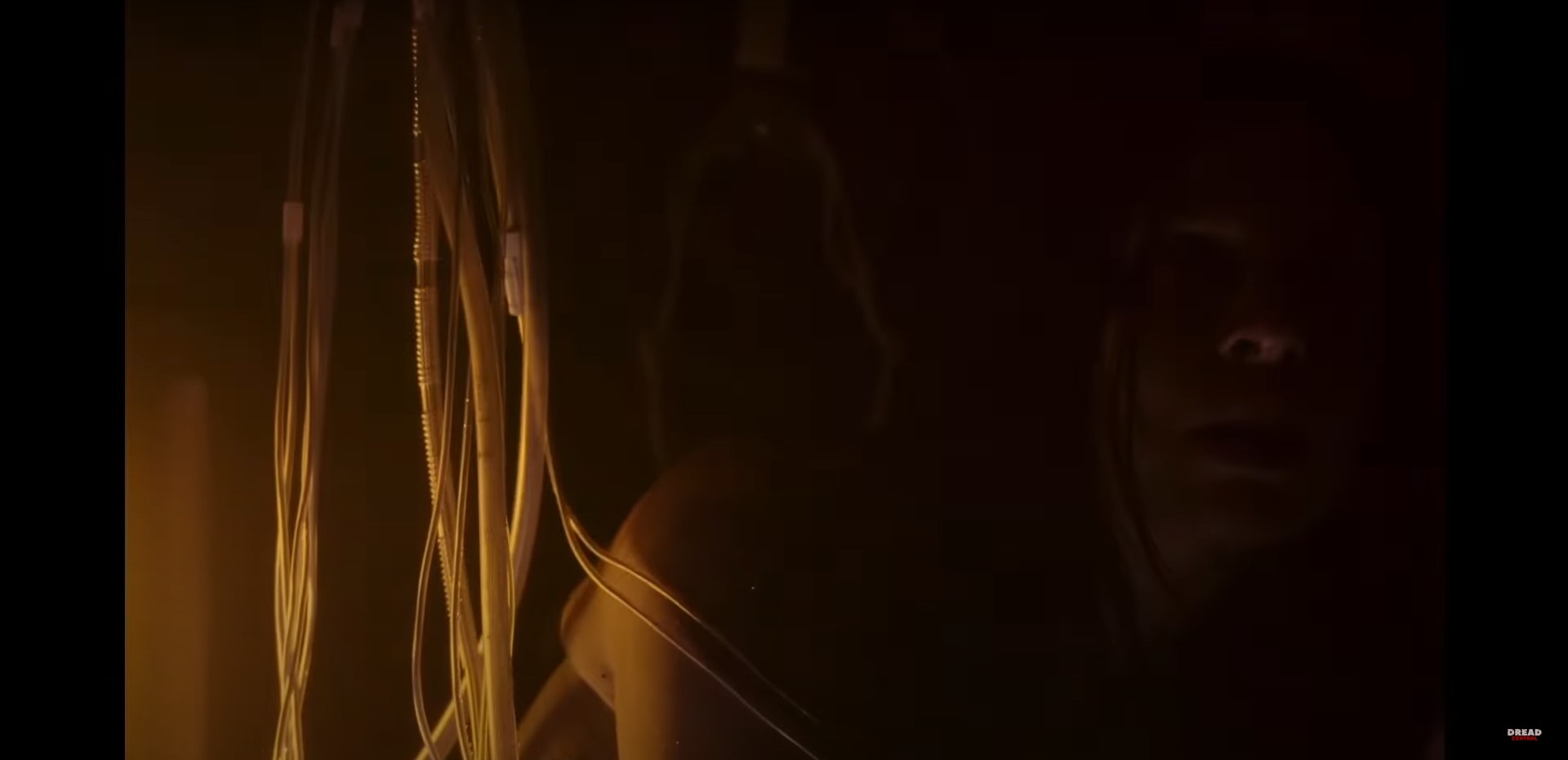
“Tin Can” might evoke a sense that one main character will be the focus point for the entire storyline, such as with “Buried” that stays put on the singular person trapped in this very tight, very claustrophobic-inducing soda can. Yet, that is not such the case with “Tin Can” that does circle around a centerpiece character in Fret (Anna Hopkins, “V/H/S/94”) but the cure-all scientist waking up in a life-extending canister while on the edge of saving mankind isn’t alone. Surrounding Fret are strangers, colleagues, and even her husband, some of whom, such as her husband, are suffering the protruding fungal fairy fingers of the virus. Anna Hopkins fields a hefty, difficult role after an initially a humble beginning as a scientist that more so-or-less feels the pangs of a low rent indie, but as Hopkins’ Fret transcends time by waking up weeks (or maybe months…years?) later, her environment becomes frantically imprisoning. The tight confines of the titular object with medical tubes dangling from the ceiling, a Tracheostomy tube down the throat, a malfunction video screen, and mysterious bars that light up one-by-one set a stronger stage for the actress to be put up against and Hopkins nails the mindset of a woman vehement and determined with escape to not only save her own life but the life of billions across the planet. In the cans beside Fret, providing Hopkins with more serve-and-volley fuel, is her husband John (Simon Mutabazi) inflicted by disease but becomes more than just a victim, Wayne (Michael Ironside, “Starship Troopers”) who I couldn’t really grasp as a component in the story as he’s like a project financier in the tin can project to save his own skin from being reskinned by fungus, Darcy (Amy Trefry) as a colleague-friend of John and Fret, Whistler (Tim Dunn, “The ABCs of Death”) who is the most interesting and weird doomsayer of the bunch, and a fist banging mute (Sara Campbell) also inflicted. For much the back-and-forth in the cannister talk, the dynamic is more of a talking head roundtable of initial discussions of popping open a small air vent so they sce outside their enclosed cell and eventually lead to more depth and deception that narrows the story with the what, when, why, and how.

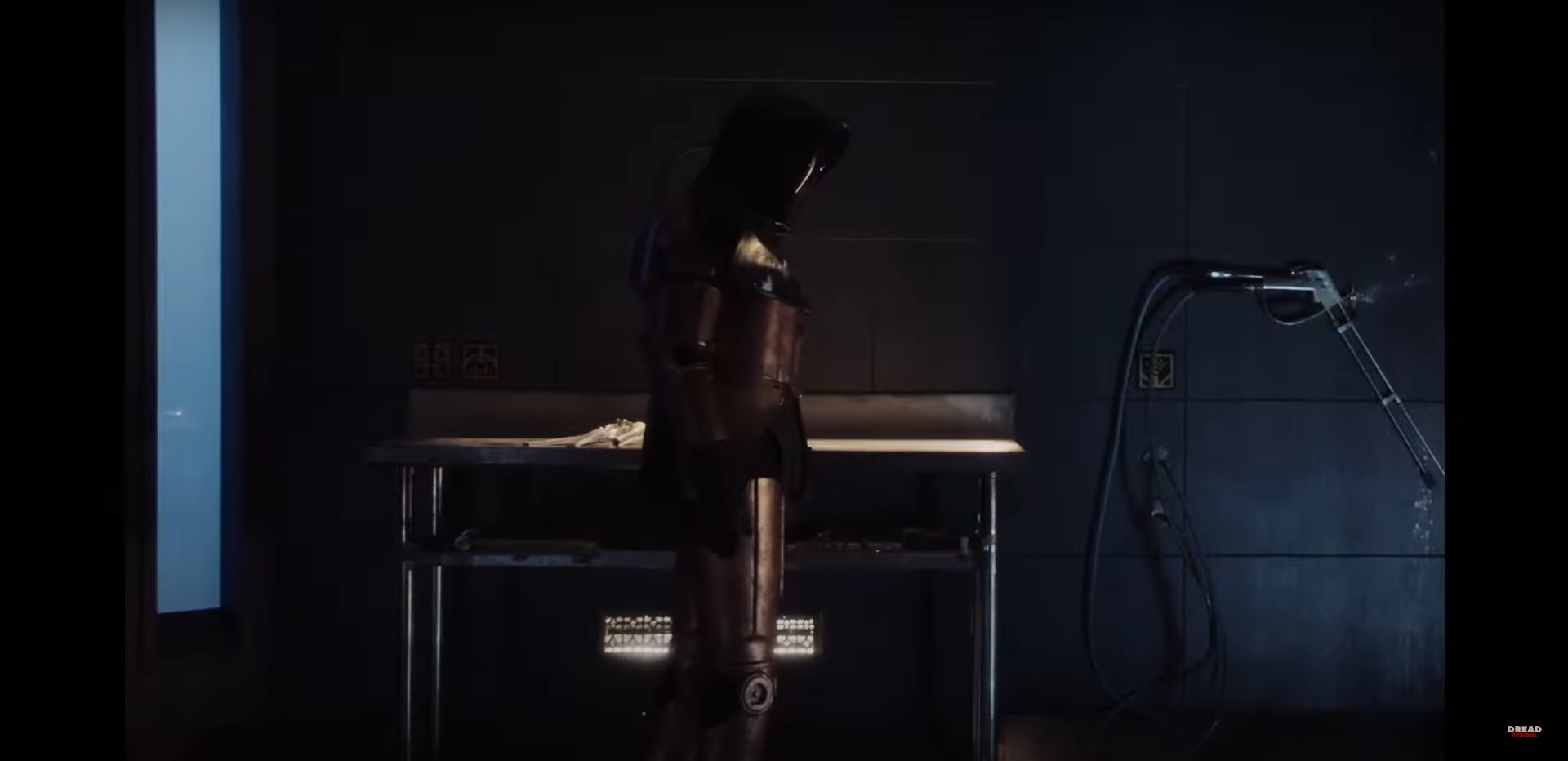
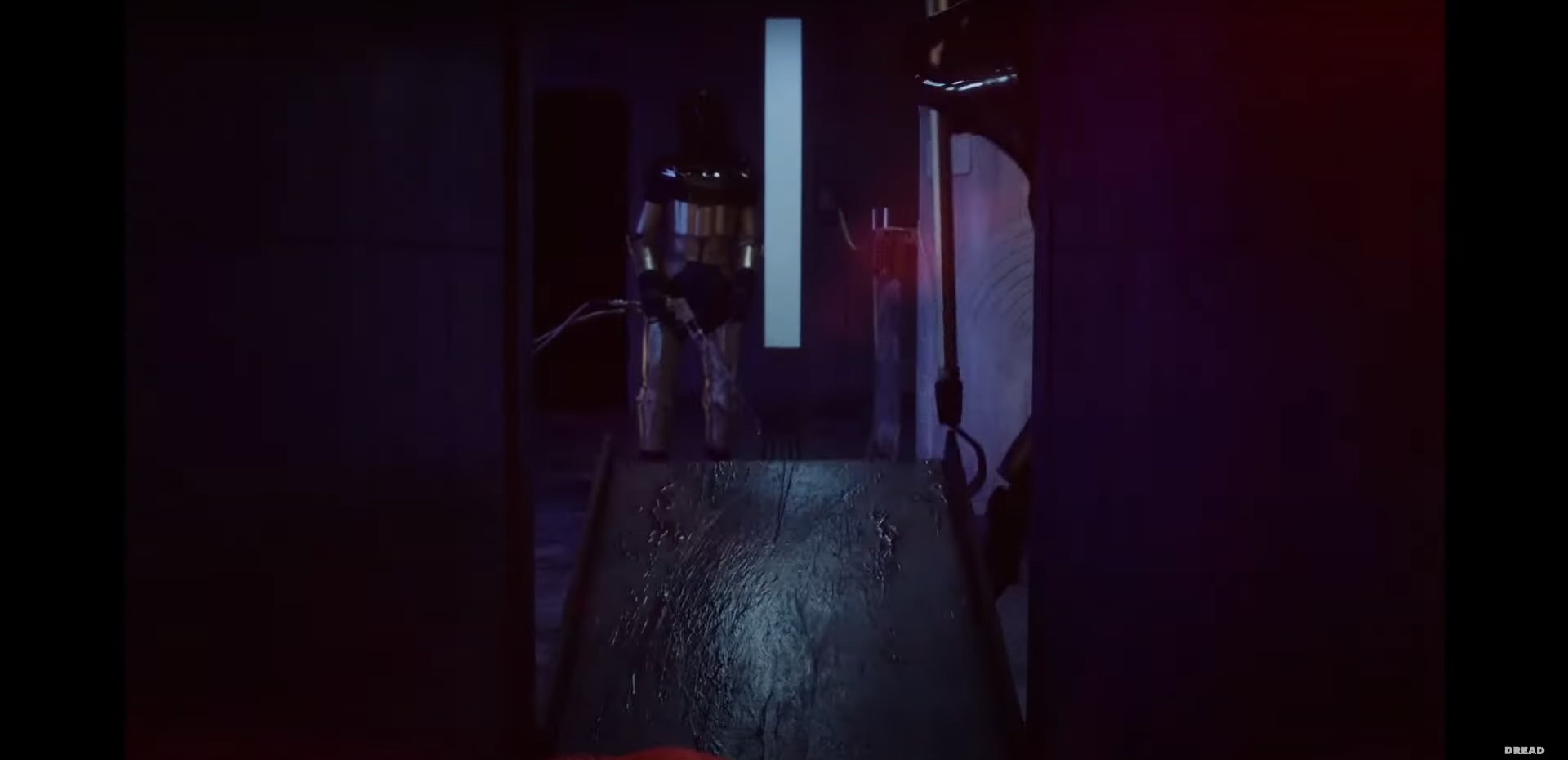
“Tin Can” aspires to be a chaptered three-act conundrum. I don’t mean that in a negative perspective. What Smith brings into existence is a polished independent film of Cronenberg-esque and has ensuing weirdness act-after-act only paralleled by the double-crossing exoneration or a retaliating impugn of keeping one alive after being severely scorned. The first act plays out like the world of today, a devastating pandemic that has ravaged the human population. The second act unsheathes the mystery of waking up inside the tin can device with people she knows and is eager to discharge herself from a capsule that’s supposed to sustain her life. Then, the third act rolls in, the third and final chapter, and time has officially been corrupted as we know it with a futuristic beings suited in various colored alloys. Alloys are definitely a theme beginning with title “Tin Can.” Fret discovers a cure for the diseases by commingling it with an alloy and each containment artificer is suited in a different metal and are credited as Copper, Gold, Silver, etc. What Smith could be suggesting is the element that could cure us could also incapacitate or, even worse, transfigure our existence with a lifesaving, yet life altering, solution to the extreme. Cinematographer Kevin Fraser industrializes the look of “Tin Can’s” existential view and is a glorious rusty bucket of a cheerless life. If Smith wanted to convey a life of nihility and automaton, Fraser nailed down the oxidation state. “Tin Can’s” a cold hard look at the cost of saving the world that, in the end, might not be worth saving.

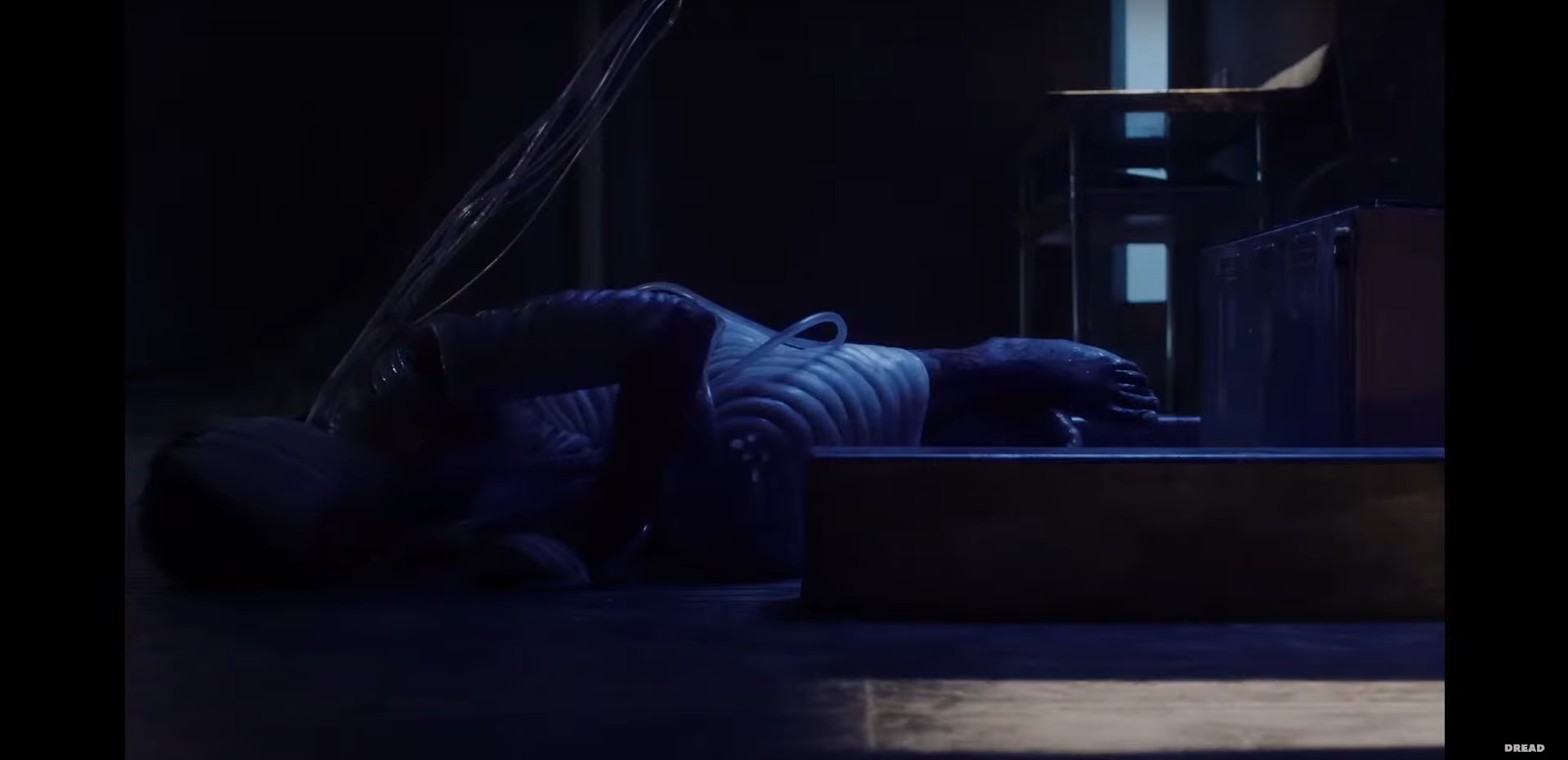
A part of the Dread Central at home release line, “Tin Can” arrives onto a high-definition Blu-ray distributed by Epic Pictures and MVD Visual. The region free Blu-ray is presented in a throwback 3:2 with letterboxing and has a color reduction implemented to give it that demoded depiction. Image looks amazing without an inkling of any kind of compression issues especially with many of the scenes shot in darker and bleaker circumstances. Fraser delivers some awe-inspiring, creative angles that produce a how-did-they-do-that response to get a 360-degree single take of Anna Hopkins in the cannister or the rotation of a limp body on a large wheel door. The Dolby Digital 5.1 English audio mix has solid sound design as more than half of the picture is off the principals talking through their metallic cylinder containers that created a muffled depth and low range flickering in the backorder, the mechanized hum mixed with scraping metal, does wonders to sell the dystopian effect that borders steampunk. No inherent or noticeable flaws in the final product. English subtitles are available. Special features include a commentary with Seith A. Smith, The Last Bell Doe Toll – the making of “Tin Can'” exhibits the construction and creation of the displaced subsequent future, how to achieve a few of those crazy Kevin Fraser shots, and provide cast and crew interview insights, and the bonus content rounds out with two music videos – The Last Bell Does Toll and ZAUM – The Enlightenment (Part I). “Tin Can” runs at 104 minutes and is not rated. “Tin Can” is ingenious on a level many will not fully understand and, frankly, I barely can tether my impression and have it make sense, but there’s a unique ore core to this science fictional, ill-fated fantasy that can be so odd at times you can’t help but not look away.

“Tin Can” on Sale Now at Amazon.com!