Tony Todd’s Last EVIL Released Film! “Cutter’s Club” reviewed! (Full Moon Feature / Blu-ray)

“Cutter’s Club” is Ready for Your Corpse! Buy it Here!

Two promising surgeons Jack and Jill seeking to reach new heights beyond their Hippocratic oath find themselves in presence of Dr. George Roberts, a once renowned surgeon turned obsessed head of a secretly society of surgeons known as the Cutter’s Club who use their skill to be monster makers, craved from slivers of fresh human flesh and harvested internal organs.  Suffering from a severe dissociative order, Dr. Roberts is eager to recruit his former lover and colleague Jill who has the necessary surgical skillset and medical knowledge to bring his two-headed, pint-sized monstrosity to life.  There’s only one problem, Jill’s boyfriend Jack is not in Dr. Roberts’s good graces and is kept out of secret operations to piece together a monster.  As Dr. Roberts’s split personality divides even further and the police become aware of the missing corpses used in their experiments, all of the Cutter’s Clubs efforts, two-headed monster, and even their lives are in jeopardy.

Filmed in 2005, shelved due to lack of funding, and thought lost by the lab storing the negative, the Charles Band directed “Cutter’s Club” went through hell and back to be finally released 20 years later.  The science fiction-horror teeters the same basic premise and principals of David Cronenberg’s “Crimes of the Future” where surgery is the new sex and expressive art, a concept Cronenberg had for decades prior, yet the “Videodrome” director couldn’t fully flesh out the idea into cinematic fruition until recently, starring Viggio Mortensen and Léa Seydoux in 2022.  The script that’s less body horror and more mad science than Cronenberg’s vision is penned by “Thir13en Ghosts” and “AMIEE:  The Visitor” writer, and long time Full Moon narrative collaborator, Neal Marshall Stevens under his pseudonym of Benjamin Carr.  Re-discovered, ironically, the same month Tony Todd died, the “Cutter’s Club” was restored to be the unreleased swan song production from the late and great “Candyman” actor.  Band produces the venture under his founded company Full Moon.

This November is the one-year anniversary of Tony Todd’s death, yet the actor still has new movie releases with “Cutter’s Club” being one of them.  As Dr. George Roberts, Todd plays to his stereotyped tune of being large and in-charge, commanding the screen with his low-frequency voice and intense stares, but Dr. Roberts also has a softer side in his disassociation, a side that’s kinder and gentler against the mad doctor version of himself but that more gentile version barely surfaces and Todd’s ultimately stuck playing an aggressor role he’s all too familiar with and known for.  Not to speak too ill of the dead, but Todd does a bit of overacting with the character by stretching into unnecessary exposition and melodrama, especially when kinder Dr. Roberts briefly sits behind the driver’s seat.  A more down-to-Earth performance comes from Melissa Searing (“Deadly Beloved”) as the anti-heroine Jill.  Grounding an overly articulated Todd to the story, Searing makes for a decent ambitious surgeon trapped inside the confines of the law and ethics and being romantically attached to colleague Jack who’s own self-indulgent inclusion is motivated by the affection he has for Jill.  Played by Davee Youngblood (“Bigfoot County”), Jack looks like the typical Full Moon principal white guy actor that’s more surfer dude with an early 2000’s spikey hair and puka pendant necklace and less defined as a serious surgeon other than wearing the blue scrubs.  Along with Todd’s Dr. Roberts, the Cutter’s Cub society is comprised of lesser disturbed promising medical professionals with David Sean Robinson, Jemal McNeil, and Raelyn Hennessee in various facets of medicine from anesthesiology to retrieving dead bodies from the morgue to being star students when it comes to surgery.  The latter Hennessee is also supposed to playing the jealous other woman to Jill with an at interval relationship with Dr. Roberts that suggests a level perversion or infatuation we’re never privy to.  Jon Simanton, from another Charles Band production “The Creeps,” fills out the cast as the man in a monster suit, stuffing himself into Two-Head, the pieced together monstrous creation.

Without a doubt, horror fans will flock to get their hands on the last and once lost Tony Todd title, but as with many notable genre actors, only a handful of first-class films out of many of the horror legends’ filmographies deserve to be stamped and sealed into their legacy.  “Cutter’s Club” will not be one of those remarkably renowned films.  And like usual, the interesting story of monster making and crafting art out of the flesh of the recently deceased is cut off at the knees by the production’s lack of funding, funding that has rarely been outside the inbreeding of crew talent that retains a certain staleness and the necessary funding to elevate “Cutter’s Cub” from out of the depths of dirt cheap filmmaking and into novel and crisply stylish territory.  Charles Band also nearly always finds a way to integrate his fascination with miniaturized dolls and creatures by having Two-Head be short and stout side villain, adding his directing trademark where he can.  You know it’s a dime-store production not by the rudimentary crafted man-in-a-shoddy-monster suit or the bunch of greenhorn actors that can’t express lines or actions without sullying themselves but rather by the obvious nude nipple pastie on Melissa Searing as she rides an over-sex acting Davee Youngblood nearly convulses out of the bed while lying on his back.  While nude nipples pasties themselves don’t indicate the production’s value, its the from behind-and-over-the-shoulder perspective camera shot that provides a little Searing side boob with the bubbling and loose pastie that really speaks to the fast-and-loose “Cutter’s Club” construction, screaming to the top of it’s lungs that not even a nipple pastie is worth the time and effort to fix for realism.  The story itself has the bone density to stand on it’s own two feet but has hardly any flesh clingy on the Jill love triangle with Jack and George, Jill’s intense motivation to be beyond the grave of a conventional surgeon’s oath to help people, and the secretly society’s wishy-washy goal that doesn’t quite materialize whether their objective is to sculpt art out of flesh or to be monster makers as their deranged core values.

Todd fans will surely want to pick up this lost but not forgotten movie that has been resurrected from the tomb of misplaced films. Full Moon Features handles their own production and distribution with a Blu-ray release on an AVC encoded, 1080p high-definition resolution, BD25, formatted in a widescreen 1.78:1 aspect ratio.  For an early-to-mid 2000s horror, that pleasant film layer of 35mm stock grain is a sight for sore eyes from modern day digital capturing with natural saturation and texturization that provide better practicality to the picture quality. Depth between medium to close up shorts offer plenty of outline and detail around the simultaneous focus points.  There’s not a ton of color range or texture with a most of the mise-en-scene blends a bland swirl of greens, browns, and blacks mostly only a few micro pops of brighter hues, though muted from the desaturated grading, coming through with Jack and Jill’s blue scrubs and we do get some nice sliminess from Two-Head’s stucco flesh.  Full Moon encodes two English audio options:  a Dolby Digital 2.0 and a Dolby Digital 5.1.  Both mixes keep put mostly in front with little atmosphere surround through the back and a front channels, resulting in the stereo mix to be just as adequate as the surround.  Dialogue retains prevalence throughout with the carnivalesque soundtrack of a usually tagged team of Charles Band-directed and Richard Band scored mix replaced with the Jonathan Walters trickling keyboard struck alto keys of menacing science.  English closed captioning is available.  Special features include an interview featurette with director Charles Band and actors Melissa Searing and Davee Youngblood.  The official trailer rounds out the special content laid out alongside a Full Moon promotional trailer for their streaming video magazine, VIdeoZone.  The standard Amaray Blu-ray contains collective character compositional artwork with no other physical trimmings.  The 82 minute, not rated film has region free playback capabilities. 

Last Rites: Jack and Jill might have went to fetch a pail of water, but “Cutter’s Club” is the one that fell and broke its crown. Nice to see Tony Todd in a relatively new project posthumously; yet, having no more financial standing to finish, “Cutter’s Club” feels just that, unfinished, as another slapdash, get-it-out-there-on-the-shelves, product to bank as the unseen film.

“Cutter’s Club” is Ready for Your Corpse! Buy it Here!

Surrounded by Aquatic EVIL, No One Can Escape “The Island of the Fishmen!” reviewed! (Full Moon / Blu-ray)

Check out the scantily-cladded woman encroached upon on “The Island of the Fishmen” Blu-ray!

A French prisoner ship sinks to the bottom of the Caribbean leaving only a handful of prisoners and the Left Lieutenant Claude de Ross, the ship’s doctor, stranded on a lifeboat for weeks until they a mysterious force drives them through the fog and crash them on the rocks of a seemingly deserted volcanic island. Only a few prisoners and the doctor manage to survive the wreckage, stumbling upon a ritualistic area of empty graves and abandoned artifacts of an island society. This is where the haggard and hungry men meet the beautiful Amanda Marvin on horseback and follow her through the island jungle to a clearing where the edifice of Edmond Rackham sits imposing on them. Having left his home country, Rackham settled upon this uncharted island, garnering local Caribbean inhabitants as servants, and being a greedy treasure hunter who might have just discovered the lost city of Atlantis. There’s only one problem, the city is surrounded by aggressive fishmen kept at bay by Amanda’s famed disgraced biologist father who has fallen severely ill, charting a course for the good doctor, Lt. Claude de Ross, to be unharmed in order to care for perhaps the only person who knows how to manage the wrath of the fishmen.

A swimmingly aquatic creature feature with an all-around gratifying men in costume pastiche, familiar to the style of “The Creature from the Black Lagoon,” in Sergio Martino action-adventure horror “The Island of the Fishman.” Also know under the revamped shots of “Screamers” aka “Something Waits in the Dark,” here we have the original film in all it’s natural glory from the director of “Your Vice Is a Locked Room and Only I Have the Key” and “Torso” director Martino from a script by Martino, Sergio Donati (“Orca”), “Slave of the Cannibal God’s” Cesare Frugoni who workshopped with Sergio Martino’s older brother, Luciano Martino, (“So Sweet… So Perverse”) on the original story. Some would also say that “The Island of the Fishmen” is also a crossbreed between H.G. Wells’ “The Island of Dr. Moreau,” H.P. Lovecraft’s “The Shadow Over Innsmouth,” and, aforementioned, “The Creature from the Black Lagoon.” The 1979 Italian production stars an international cast shooting along various locations in Italy and is produced by Luciano Martino under Dania Films and Medusa Distribution.

American, United Kingdom, and, of course, Italian come together to form “The Island of the Fishmen” cast that doesn’t stray too far away from their individual innate dialects. The most pompous is he Essex-born Richard Johnson’s sadistic and fortune hungry Edmond Rackham with a caricature of a voice that isn’t like anything in his performance in Lucio Fulci’s “Zombie.” As Rackham, the inflections reminisce of a British Humphrey Bogart mixed with a one Dick Dasterdly and so Johnson comes off a bit cartoony and overly dramatic compared to the film’s panache malnourished yet earnest hero in Italian actor Claudio Cassinelli (“Murder Rock,” “The Scorpion With Two Tails”) as Left Lieutenant Claude de Ross, a ship’s doctor who suddenly becomes the medical caretaker and leading guard over a lifeboat full of hardened prisoners, some who have blood on their hands. Franco Javarone and Roberto Posse play a pair of surviving convicts, especially two at odds on how they should treat their next in rank penal officer. Though being thrust into the oversight position, the Lieutenant doesn’t have to worry about his prisoners for too long as the island’s baleful environment with jungle death traps, poisonous water, voodoo priestess, a sadistic lord of estate, and mutant fish people swimming in circles around the island’s parameter and through the cut through waterways sees to their wellbeing. “Island of the Fishmen” does have a few predominant male figures of different caliber but there are also a pair of women inhabiting the island who, too, have counteracting roles. Bond girl Barabara Bach (“The Spy Who Loved Me”) became plagued by the ocean’s frightening fishmen only two years later as the captive dame of Edmond Rackham who holds her hostage as he pushes her father (Joseph Cotton, “The Survivor”) to continue with his mind control potion over the fishmen. Then, there’s Shakira. No, not the Brazilian singer-song writer with the hypnotizing booty shaker. This Shakira is a voodoo priestess, played by Jamaican actress Beryl Cunningham (“Dorian Gray”), who works for Rackham but ultimately envisions foreboding doom on the volcanic island. Giuseppe Castellano and Franco Mazzieri round out the cast.

A whole lot is going on in this film that from the surface seems, surfacing meaning the home video covers and posters, to focus chiefly on the hostile half-fish half-man creatures that bubble to surface, check out top side for any unwanted visitors, and quickly dispatch them before disappearing under the glassy waters of the Caribbean. I adore the design of the rather stiff but crudely convincing creature suits with buggy fisheyes, razor piranha like teeth, and cladded entirely green and scaley in a design by Massimo Antonello Geleng who by vocation was more a production designer with credits including this film along with “Cannibal Holocaust,” “City of the Living Dead,” “The Church,” and “Dellamorte Dellamore” to name a few. Yet, the fishmen were not a sole source of danger on an island that had a deadly schemer in Edmond Rackham, the motif of voodoo and jungle trap throughout, a volcano ready to erupt and engulf the island with lava, and the lost city of Atlantis as the grand epic finale that pivots this story on an acute elbow left that shows a mighty ambitious story on an Italian slim budget. To put it frank, Sergio Martino was able to put all the elements together into a cohesive, coherent plot with action, horror, exploitation, and mad science fiction albeit the story’s wild and diverging concepts.

Though many U.S. audiences know this film as Roger Corman’s highly altered, New World Pictures presented cut retitled as “Screamers,” Full Moon features releases the original oeuvre of Sergio Martino with a remastered Blu-ray release from the original 35mm negative. The 99-minute film is presented in a widescreen 2.35:1 aspect ratio that captures in perfect matte composition and frame the locational miniatures, such as the manor house or the underwater Atlantis temples, in a compression that doesn’t make the structures obvious fakes. Slightly tinged yellow, the overall color palette is renders out well enough to suit the release with a pristine transfer seeing no signs of real significant damage. The English language tracks come in two formats – a PCM 2.0 and a Dolby Digital 5.1 surround sound. The English-speaking actors have their original tracks intact while the Italian cast have their original dialogue re-dubbed in English for posterity on new releases such as this one. Dialogue, nor any of the corresponding audio tracks, show any signs of fidelity issues or damage, but do feel muffled, even on the 5.1 as if the sound was boost stifled and left with some of the channels lacking vigor. Aside from Full Moon trailers, the R-rated film rides solo on this hi-def release. “Island of the Fishmen” is a small film fighting hard to swim upstream and really does a number on many different levels regarding where the audiences should focus their attention on, but I can see why Roger Corman wanted to give Martino’s film a second run after a commercial flop with a new, gory scenes edited right into the heart of “Island of the Fishmen’s” flexible, cartilaginous bones. Despite Corman’s efforts, Sergio Martino’s unmolested, original reeling reel is the one and only catch of the day for this purist.

Check out the scantily-cladded woman encroached upon on “The Island of the Fishmen” Blu-ray!

EVIL in the Family Tree Makes for a Terrifying “Reunion” reviewed! (101 Films / Digital Screener)

Recently separated from her philandering fiancé, a pregnant Ellie moves in with her estranged mother, Ivy, whose staying at Ellie’s recently-deceased grandparents family home and packing up home furnishings to put the house on the market.  Strained with going through a pregnancy alone and tirelessly working on her theoretic book of modern medicine deriving from the roots of barbaric magic and medieval practices, Ivy pledges to take care of her while providing space to let Ellie continue research work, but the house lends to the painful memories long thought suppressed in Ellie’s mind, manifesting visions of her adopted sister, Cara, who died suddenly in house when they were children.  As the visions become more prominent, stronger, and real, Ellie questions her remorseful memories and her mother’s recollection of events that sheds light on her family’s horrendous secret of anatomical science.

From the start, the realization that Jake McHaffy’s “Reunion” isn’t going to be a happy one comes as soon as Ellie crosses the threshold into her late grandparents’ home and is immediately swathed with a blanket of unsettling ambiance.  The “Wellness” and “Free the Deed” McHaffy writes-and-directs his third film with a steadfast sense of dread in the New Zealand mystery-thriller that tackles human inbred themes of long suffering guilt, prenatal anxiety, and the role of an estranged family during a time of need.  McHaffy compounds layered fears by compositing them with the confines of an old dark and creaky house witness to all the past secrets.  “Reunion” is a production from a conglomerate of New Zealand and U.S. companies that embark on independent filmmaking endeavors by Greyshack Films, the strong female character supporting Miss Conception Films, Overactive Imagination, and Water’s End Films in association with New Zealand Film Commission, MPI Media Group, and Department of Post.

“Reunion” obviously isn’t going to be your typical relative gathering shindig with your bad joke-telling uncle wisecracking over his 10th Miller Lite or a nose picking brat of a cousin cheating at horseshoes near the pit; instead, “Reunion” a tightknit cast playing the roles of mother, father, daughter, and adopted daughter drawn together not by the sake of longing for bloodline companionship but by necessity and circumstance and imploding by the unfun games of revelations hidden inside the closest deepest and darkest of descendants. “Witches of East End” stars Julia Ormond in a nearly unrecognizable far cry of her more glamourous bewitching role in Joanna Beauchamp on the FOX produced Lifetime Television series. The English actress, who hails from Surrey, assumes the matriarchal presence of a helicopter mother overextending herself beyond the limits of her control in order to seize some kind of power she once had living in the archaic house. Ormond bounces off mother-daughter indignities with her sole child, Ellie, played by Emma Draper in her first feature lead performance. Thick tension between them causes reserved friction Ormond and Draper do well to nurture throughout while a stammering posture by “Lord of the Rings” actor John Bach as the wheelchair bound infirmed father adds a whole new layer of irregular rigidity to Ellie’s nerves and to Ivy’s patience. Aside from being blood related, father, mother, and daughter also have another thing in common – present in the moment of the death of Cara (Ava Keane). Peeling back each emotion output struggles, in a good way, to grasp the character mindset made murky by uncontrollable shaking and crying, sneaking and conniving, lies and deceits, and the disillusioned rambles that vortex around the house without pure clarity. “Reunion” rounds out the cast with Nancy Brunning, Cohen Holloway, and Gina Laverty as young Ellie.

Jake McHaffy’s “Reunion” has the hairs on the back of your neck standing from beginning to end with prolonged foreboding leading up to a shocking finale.  Between the manic and enigmatic performances from Julia Ormond and Emma Draper, a chance to rekindle the past feels like a distant thought and a lost cause being blockaded by the past’s poignant trauma they share.  McHaffy isn’t hesitant about revealing a stymieing history with flashes of image splices and flashbacks cut with an antiquated VHS-style playback producing a statically charged visual incumbrance.  The stress and strain burden’s Ellie’s pregnancy, dam breaking flood of memories, her research into the occult, and the surrounding chaotic state of the house contributes to teetering mental stability creating a visceral unintelligible and augmented reality that is too real for Ellie to keep an authentic perspective and the longer she stays and the more she’s immerse into Ivy’s poisonous maternal supremacy, only fabricating a new and scary world can Ellie dig herself out of her family’s troubling past.  There’s much going on in McHaffy’s story to be bog down fully understanding what you’re seeing and trying to piece together the puzzle is nearly impossible – I, frankly, still don’t understand much of it – but the beleaguered attention of beguiling imagery and that overwhelmingly wild ending entrusts “Reunion’s” place in psychological terror. 

Modern gothic has never looked this good as “Reunion” rises to be a stalwart of horror. 101 Films and MPI Media Group has released “Reunion” digitally this month of March, one year after the start of the pandemic that has kept families away from each other and when eases of restrictions set in that’ll shorten the gap between estranged loved ones that becomes a distressing reunion in itself. Quite a masterful brush stroke from director of photography Adam Luxton building the house into the frame and framework of the story, which goes hand-and-hand with a house that’s deemed a toxic surrounding symbolized by the black sludge that drips out of the sink and into Ellie, as well as crossing video outputs and weaving them in as well. Luxton’s imagery has formulation maturity that combines hard and soft lighting, blurring, a range of depth shots, delineated night scenes, and the capitalization of utilizing the clutter of boxes and knickknacks to tell an eclectic visual odyssey culminating toward an all-consuming finale. The 95 minute runtime film is presented in a widescreen 1.85:1 aspect ratio with no bonus scenes during or after the credits. “Reunion” creeps unsuspectingly into the skin, eyes, and soul as a metastasizing slow growth of appalling family drama.

Evil Is Only Skin Deep. “The Wax Mask” review!


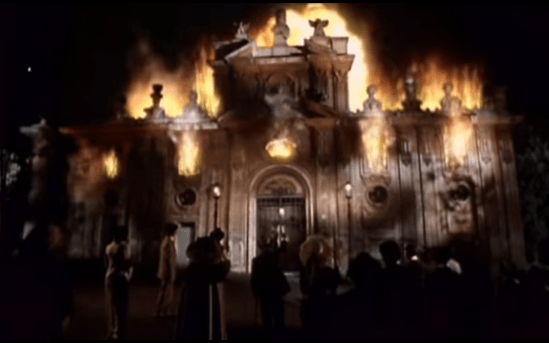
Set in Rome of 1912, a newly constructed wax museum, under a mysterious alchemy artist known as Boris Volkoff, stirs controversy with the showcasing of the world’s most grisly and notorious murder scenes. Two brothel customers’ debate result in the one challenging the other to spend the night at the curated museum of horror without having an ounce of fleeting fear. The next morning, the man has been found, apparently keeling over in fright, and the police are baffled, but something more sinister is afoot when Sonia, a young costume designer with a horrific past as the sole witness in the gruesome death of her mother and father in Paris 1900, becomes employed at the museum to costume the wax figures and faints when the scene of her parents’ brutal death is recreated as the museum’s new showpiece. Sonia and a reporter closely examine the museum when more people begin disappearing off the street, people who have ties with the beautiful costume designer, and learn the waxed creations are much more underneath their plastic-lifelike skin.

Before his untimely death, the Godfather of (Italian) Gore, Lucio Fulci, had been cooperating on a semi-quasi remake of Vincent Price’s 1953 thriller “House of Wax,” based on the Gaston Leroux’s novel, alongside fellow iconic Italian horror director Dario Argento (“Suspiria”) in a comeback collaboration for Fulci, but the entitled “The Wax Mask” film was evidently delayed partly in because of Fulci’s death. “The Wax Mask” was handed over by Argento, who was producing, to special effects guru Sergio Stivaletti (“Cemetery Man,” “The Church”) and months after Fulci’s death, a finished product shared very similar traits to the Godfather of Gore’s style craftily blended with more modern approaches to filmmaking was released to the public. Though tailored more toward the interests of gory special effects, Stivaletti’s 1997 film is dedicated to Fulci with the implementation of many of the director’s popular trademarks, including closeups on various eye expressions and zoom-ins on gore and the weapons before their fateful strikes, while also basking in strong bright colors in the midst of shadowy cinematography that’s typical of the giallo genre.

In such a crimson world, an elegant performance by Romina Mondello, who stars as the orphaned Sonia, has the Rome born actress bring beauty, innocence, and charm to the macabre that harbors contrasting arguments against undermining marred antagonists and she provides a breath of aesthetic liveliness amongst a narrative that surrounds itself in capturing beauty in inanimate wax figures. “Cemetery Without Crosses'” Robert Hossein embraces the enigmatic museum curator, Boris Volkoff, with struggling internal black aspirations that involve his recently acquired employee, Sonia, and Houssein is able to turn off and on that switch of longing and menacing, playing the hand of the character superbly to keep audiences guessing his true intent. Volkoff’s faithful assistant and exhibit creator, Alex, embodies creepy and morbid attributes wonderfully contributed by a relatively unknown Umberto Balli. The trifecta cast sells the ghastly science fiction that slowly builds toward the transformation of “The Wax Mask” from classic giallo to sensational mad science Gothicism with a boost of euro trashiness that’s more relative to the work of Jesús Franco or Joe D’Amato. Riccardo Serventi Longhi (“Symphony in Blood Red”), Valery Valmond, Gabriella Giorgelli (“The Grim Reaper”), and Gianni Franco (Dario Argento’s “The Phantom of the Opera”) round out the cast.

Stivaletti’s toolbox of special effects celebrate in the practicality that escalates when the cloaked killer’s metal claw literally rips terror through the hearts and souls of characters, but the glossy composite imagery thwarts realism and cheapens the already cheesy Euro horror with a laughable fire set ablaze and a slew of lampoon electricity while half naked women are strapped to a barbaric mechanized chair. The cut-rate composite won’t ruin a guilty pleasure viewing and won’t blast apart an arguably respectable adaptation of Gaston Leroux’s novel, but the script, co-written between Argento, Fulci, and “The House of Clocks'” penning collaborator Daniele Stroppa, does pull from other, interestingly enough, inspirations that one wouldn’t think would be genre compatible. The action-packed finale of James Cameron’s 1984 pre-apocalyptic, time-traveling cyborg blockbuster, “The Terminator,” makes an unexpected appearance with an endoskeleton villain donning some familiar and memorable moments from one of the greatest sci-fi films of all time.

“The Wax Mask” greatly resembles Italian horror cinema from the 1970s and 1980s spawned in the late 90s, a superb feat for a director more aligned in vocational special effects, but the jaded historical background accompanying the film places a stain on whether Lucio Fulci had much to do with the project at all. Much is speculated that Argento and Stroppa re-wrote Fulci’s original script after his death, removing much of Fulci’s atmospheric flair and adding more gore, but in the end, “The Wax Mask” instabilities are overshadowed by great practical effects, an engaging storyline, and a roster of flavorful characters. The One 7 Movies and CAV Distributing Blu-ray release is presented in 1080p. The widescreen 1.78:1 aspect ratio is the not the original 1.85:1 aspect ratio, but doesn’t constrain the image. The MPEG-4 AVC codec emits a bit of shakiness under the compression, suggesting a lower bitrate, but the One 7 Movies’ release is the best, sharpest looking transfer of the original source material with natural coloring on skin tones, vibrant shades of various colors, and shadows being exquisitely black. Four audio options are available from the English and Italian Surround 5.1 tracks to the English and Italian Stereo tracks with no accessible English or Italian subtitles in the static setup menu. Extras are slim with a handheld camera behind-the-scenes that’s solely in Italian. “The Wax MasK” is an ambitious Gothic hybrid horror that cements the memory of Lucio Fulci, pleases the gore of Dario Argento, and showcases the talents of debut director Sergio Stivaletti.

Purchasing One 7 Movies’ “The Wax Mask” at Amazon!