Good for Mankind is also EVIL for Greed! “Mandroid” reviewed! (Full Moon Features / Blu-ray)

“Mandroid” Blu-ray Now Available!

Scientists Dr. Karl Zimmer and his colleague Ivan Drago work in Russia to invent and perfect a humanoid android that uses the converted energy, labeled as SuperCon, from a unique fungus, that has endless potential and possibilities, to power it while controlling the android through a cerebral VR dashboard.  While Zimmer has plans to help humanity with the SuperCon project, Drago has other greedy plans to sell to the highest bidder, in this case the U.S. Government for military grade weaponization.  When Drago steals the mechanized android, he doesn’t have the SuperCon formula to fully complete the sale.  A CIA operative, Zimmer and his daughter, and a U.S scientist sent to validate the SuperCon and android for US. Government use work together to stop Drago who has gone mad with greed and disfigured by the highly radioactive converted energy as nothing will stop him from obtaining the full mandroid package he helped to create. 
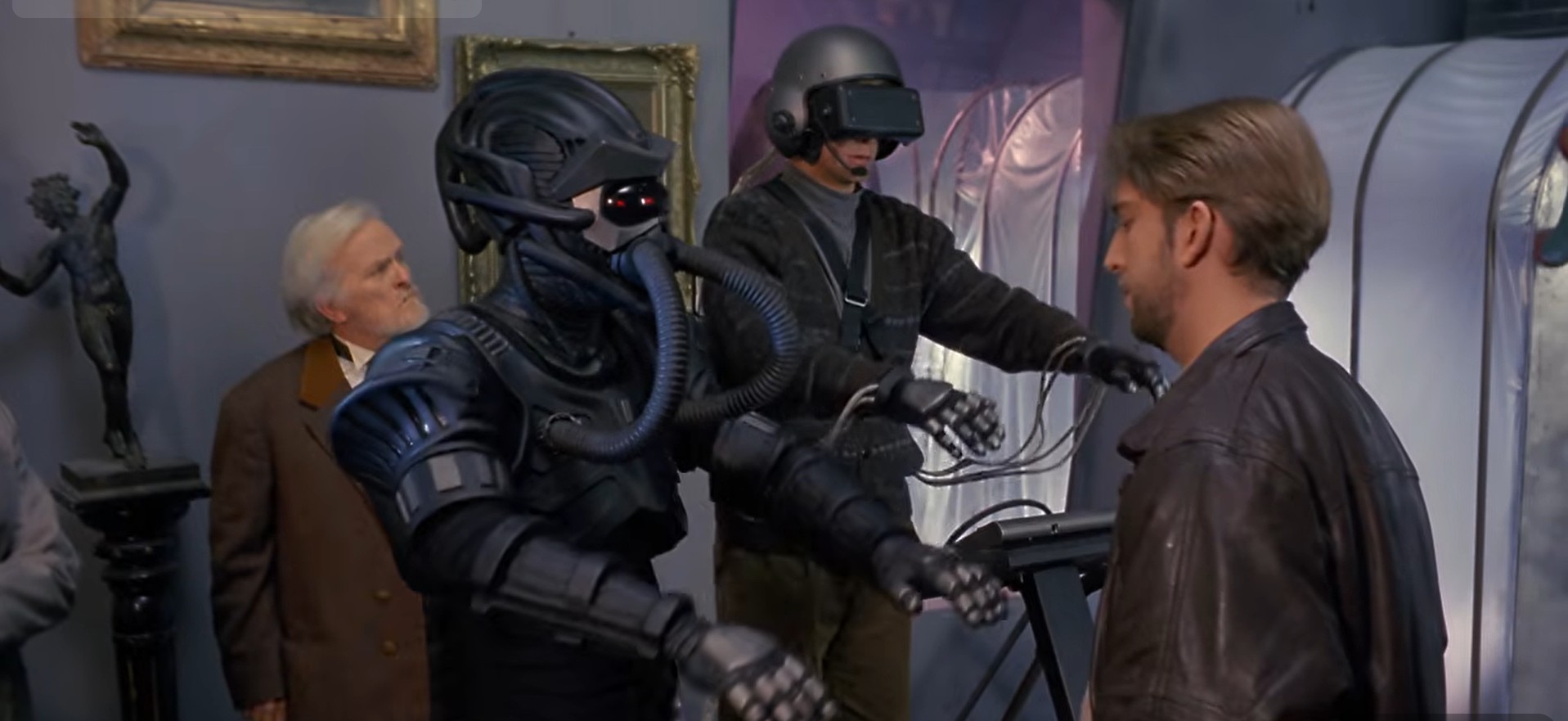
A Full Moon produced science fiction that really tones down the campiness to the point where the film doesn’t feel like a typical Charles Band production.  “Mandroid” is the 1993 mecha action-thriller from Swedish director Jack Ersgård (“The Visitors,) and penned by the Charles Band payrolled screenwriters Jack Cannon (“Robot Wars,” “Seedpeople”) and C. Courtney Joyner (“Trancers III,” “Puppet Master III:  Toulon’s Revenge”) under a pair of pennames, Jackson Barr and Earl Keaton.  “Madroid” would be the first of a two-film arc that uses secondary story elements of the “Mandroid” narrative to setup a parallel sequel or companion pieces entitled “Invisible:  The Chronicles of Benjamin Knight” that’s also directed by Ersgard and written by Joyner, creating a perfect double bill for Full Moon.  Charles Band has sole executive producer credit alongside the Romanian producers, a husband and wife team of Vlad and Oana Paunescu, at their studio and production umbrella of Castel Film, located in Romania and a frequent collaborator with the presenting Full Moon company credited with “Subspecies II and III” and “Trancers 4 and 5” to name a few titles.
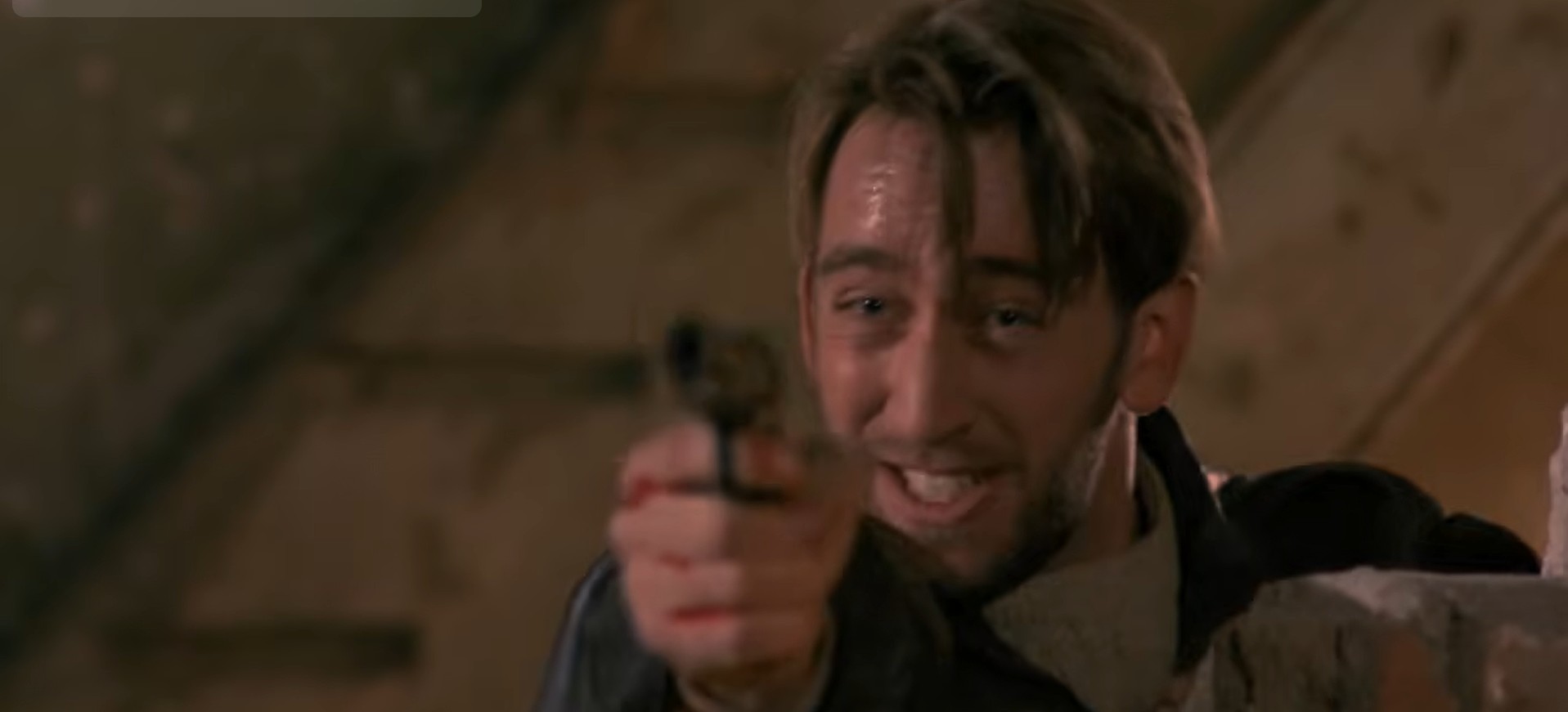
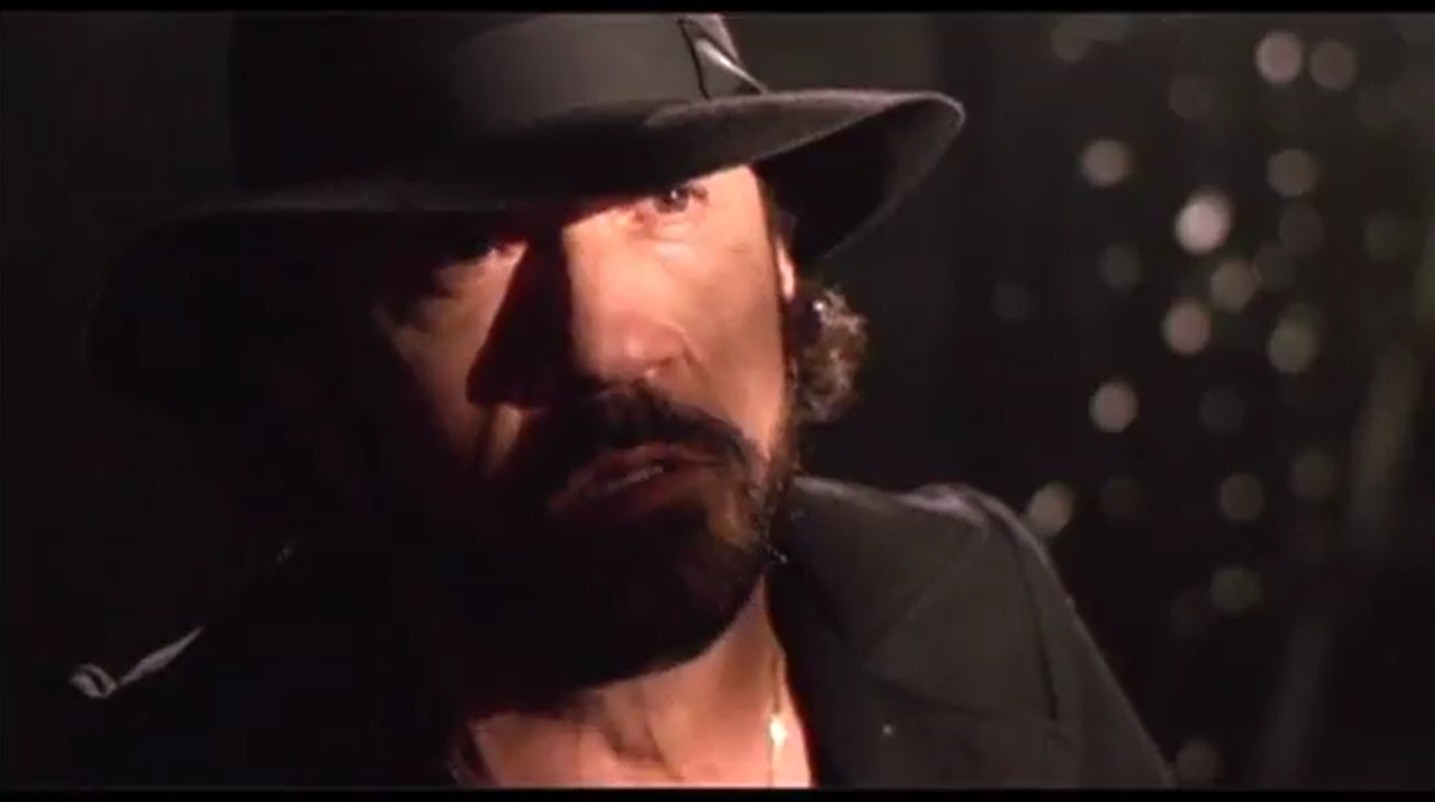
“Mandroid” acting favors more of the no-nonsense and serious tone for as science-fiction VR-controlled super android thriller set in Russia.  Brian Cousins is credited as the lead playing Wade, an American scientist hired by the U.S. Government to validate the SuperCon project under Dr. Zimmer and Drago but I find Cousins’ character lacks the charisma and the screen time to be unrivaled, sharing, or better thought as being oppugn, the feature prominence with the villain Drago who overshadows him considerably with the wonderfully USSR-trite performance by the late “Werewolf in a Girls’ Dormitory” and “The Entity” actor Curt Lowens.  Lowens brings to Drago the quintessential bad guy charm with the quintessential bad guy scarred looks as he exploits opportunities for personal gain and even using fear to evoke a homeless, Soviet-enthusiast mute (Ion Haiduc, “Bloodstone:  Subspecies II”) to be his henchman.  Their flaws inherently make them villains against a team of scientist, consisting of Wade and Dr. Zimmer (Robert Symonds, “The Exorcist”), his daughter Zanna (Jane Caldwell), and assistant Benjamin (Michael Della Femina, “Invisible:  The Chronicles of Benjamin Knight”) working together to achieve greatness for mankind, the benevolent and noble act.  The last principal piece of the puzzle is CIA agent Joe who’s not very tech savvy and may have more dubious reasons for his representation of the U.S. Government.  Cladded in a leather/faux leather jacket and tan slacks, as well as sporting a rugged 5 o’clock shadow, director Jack Ersgård’s brother, Patrik Ersgård (“The Visitor”), does not look like your conventional CIA agent to add a layer of unresolved mystery around him and to make him dangerous to either side of the good vs evil spectrum, but one thing is for certain about Ersgård character is his cunningness and courage.   Costel Constantin, Mircea Albusecu, and Adrian Pintea provide the Romania support cast to flesh out “Mandroid’s” merciless cold attire.
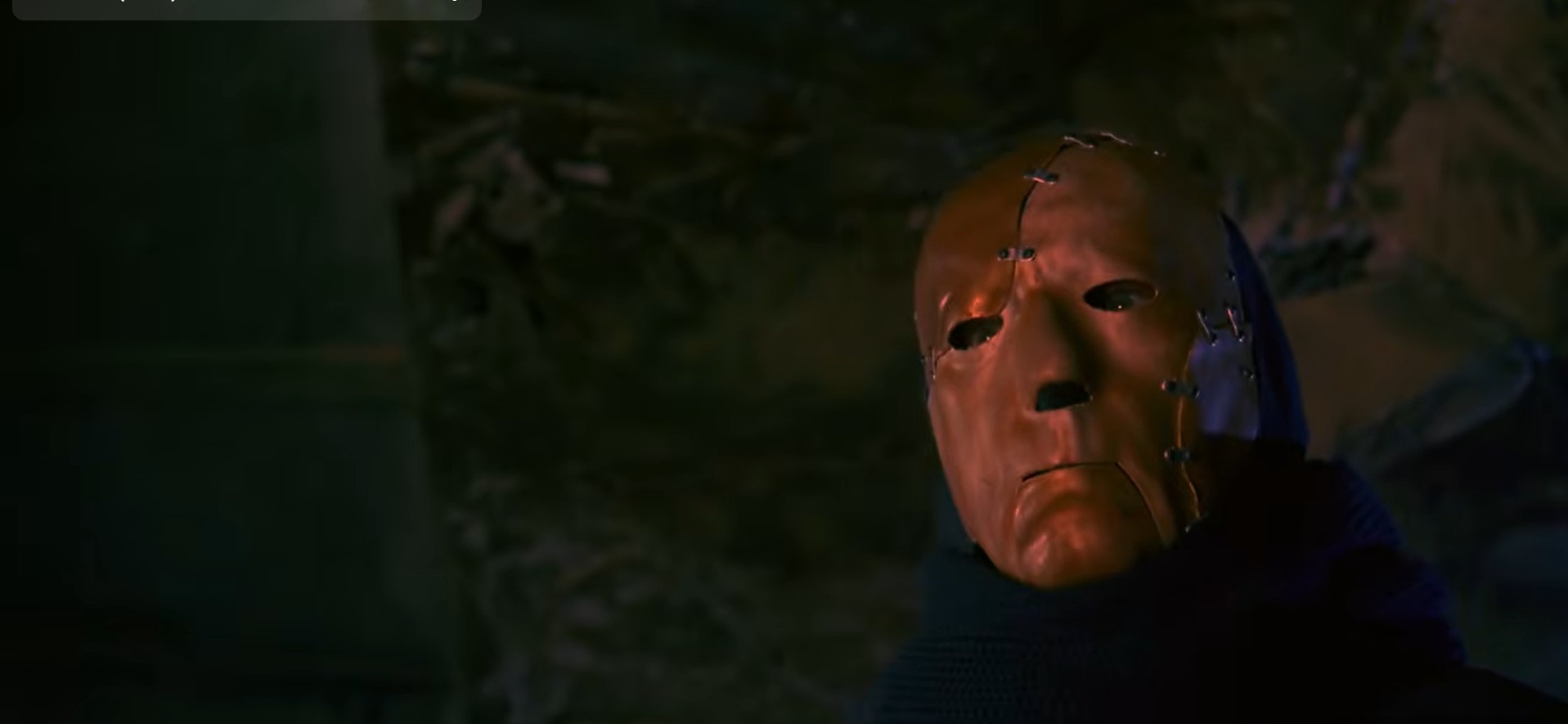
Less carnivalesque, less campy, and light on the pint-sized killers than most Full Moon productions, “Mandroid” has the seriousness of an early Stuard Gordon x Full Moon collaboration, aesthetically backed with darker tones, infused practical bloody imagery with some compositional VFX, and delivered signed and sealed by distinct and solid performances.  The SuperCon plot device is early days  man-in-a-suit backed by radioactive mushrooms that sound trippy when described out loud but Jack Ersgård subverts the idea’s potential faults and creates an atmosphere of intensity that sees large explosions, plenty of period costuming (Cold War era reminiscent) and is even able to secure SWAT armored vehicles and plenty of interesting, dilapidated locations that, from at least the U.S. perspective, feel like Mother Russia.  Whether a progressive highlight or an expectational fault, depending on the kind of person you ask, “Mandroid” does not contain nudity that can be savored from most of Full Moon’s catalogue; sorry readers but super blonde Jane Caldwell is not only the sole woman in the story but she’s very much clothed all the way through without a smidgen of sexy promiscuity.  The whole quasi-biological, man-and-machine affair represents the actual entertaining and creative storytelling side of Band’s company that has veteran actors mixing it up with up-and-comers to square dance around a radiative weapon of mass destruction tale. 
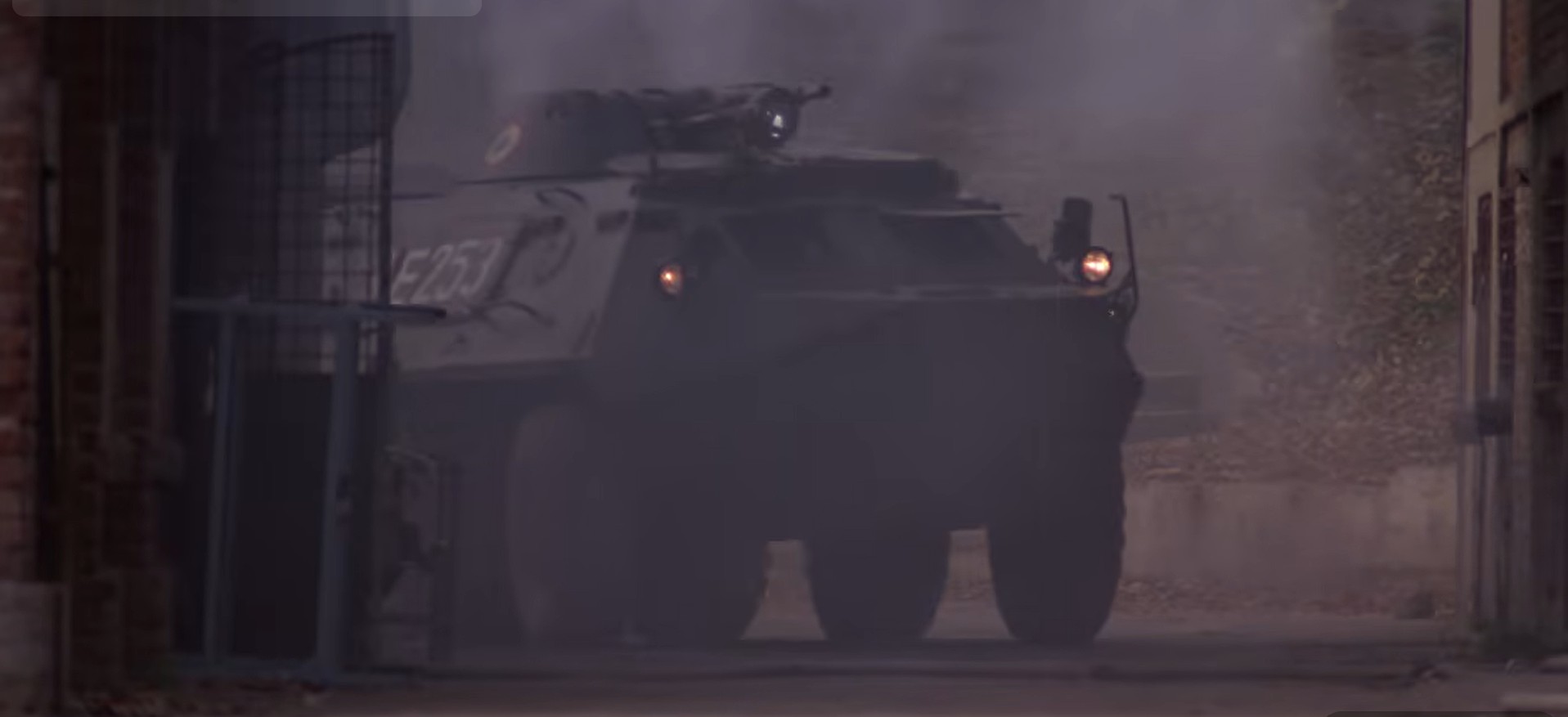
Full Moon Features remasters “Mandroid” from the original 35mm negative, scanned 2K with a high-definition, 1080p resolution, onto an AVC encoded BD25.  The end result is nothing far from an excellence reproduction that cleans up and clears out the inherent nuisances with standard definition DVD and VHS tape.  There’s a bit of a polished look upgrade that enhances great richness to shadows yet still picks up finer detail points that would have been missed through a lower resolution.  The overall detail is soft because of the nature of the lighting aesthetic that casts a soft glow of ethereal in a cold war era scenario while still maintaining an austere and raw sense of soviet times except with a red flare, “Mandroid” graded with blue.  “Mandroid” Blu-ray is presented in a widescreen 1.78:1 aspect ratio.  There are two English audio options available:  Dolby 2.0 Stereo and a Dolby Digital 5.1.  The lossy format is typical compression used by Full Moon and while it offers an adequate soundtrack, it does not boost up reproducing fidelity deserving for “Mandroid” explosive and highly active narrative with plenty of sound effects.  Dialogue is favored nicely and balanced with the action along with the atypical for Full Moon non-carnivalesque score by David Arkenstone (“Murdercycle”).  No compression or original audio track issues with little-to-no interference on the inlaid dialogue.  Special features include the original videozone advert, the original feature trailer, and other Full Moon original releases.  The standard Amaray Blu-ray case contains the original artwork and spined at number 88.  Full Moon’s “Mandroid” is rated R, has a runtime of 80 minutes, and is region free.

Last Rite: “Mandroid” is proof that Full Moon wasn’t always skirting by as they are today with cast, talent, and budget. For fans of Full Moon of yore, “Mandroid” is a serious title to be taken seriously, especially with a new Blu-ray release!
“Mandroid” Blu-ray Now Available!

A Homosexual Hooks Up with a Porn Star and Treats Her EVILLY Sleazy. “The Last Foxtrot in Burbank” reviewed! (Full Moon Features / Blu-ray)

“The Last Foxtrot in Burbank” Finally Recognized by Charles Band and Full Moon Features!

In the fictious setting of Burbank, France, a distraught and wandering Paul grieves over the loss of his gay, drag queen lover.  Wallowing in despair as well as barely entertaining his lover’s mother, Paul is on a half-hearted hunt for a new apartment and runs into Jeannine when the two meet looking at the same rental.  A mostly sexualized relationship ensues at the apartment with Paul treating the beautiful French woman and aspiring adult star like a piece of meat in a homosexual way, stemmed by his inadequacies in bed.  Jeanne, becoming fed up with Paul’s obsessive and polarizing behavior during their romantic tryst, lashes out in various ways, one as a gun-toting adult starlet that makes shooting scenes with her all that more dangerous to one’s health.  Paul’s health too becomes a target as Jeanne’s ultimate distaste for his floundering and obsessive ways, especially in condemning her pornographic lifestyle.

“The Last Foxtrot in Burback” is a film Charles Band (“Puppet Master”) desperately tried to erase and forget along with then newcomer editor, “Halloween’s” John Carpenter, as both filmmakers disassociated and disavowed its existed because of a couple reasons:  1) the romantic satirical spoof was not a horror/sci-fiction film both of them wanted to make at the time and 2) audiences were not appreciating it’s parodical and fleshy colored luster.  The film it removes inspirational humorous bones from is Marlon Brando’s “The Last Tango in Paris,” helmed by Bernardo Bertolucci who is dug a path of steamy sexual dramas, including “Stealing Beauty” and “The Dreamers.”  “The Last Foxtrot in Burbank” aimed to capitalize on its 1972 pushing-the-boundaries of sexualization success with writers Bill Haggard and Sam Vaughn behind the screenplay pages.  Band produced the film with filming held in Los Angeles and Marc Perilli serving as executive producer under the Federal Film Incorporation.

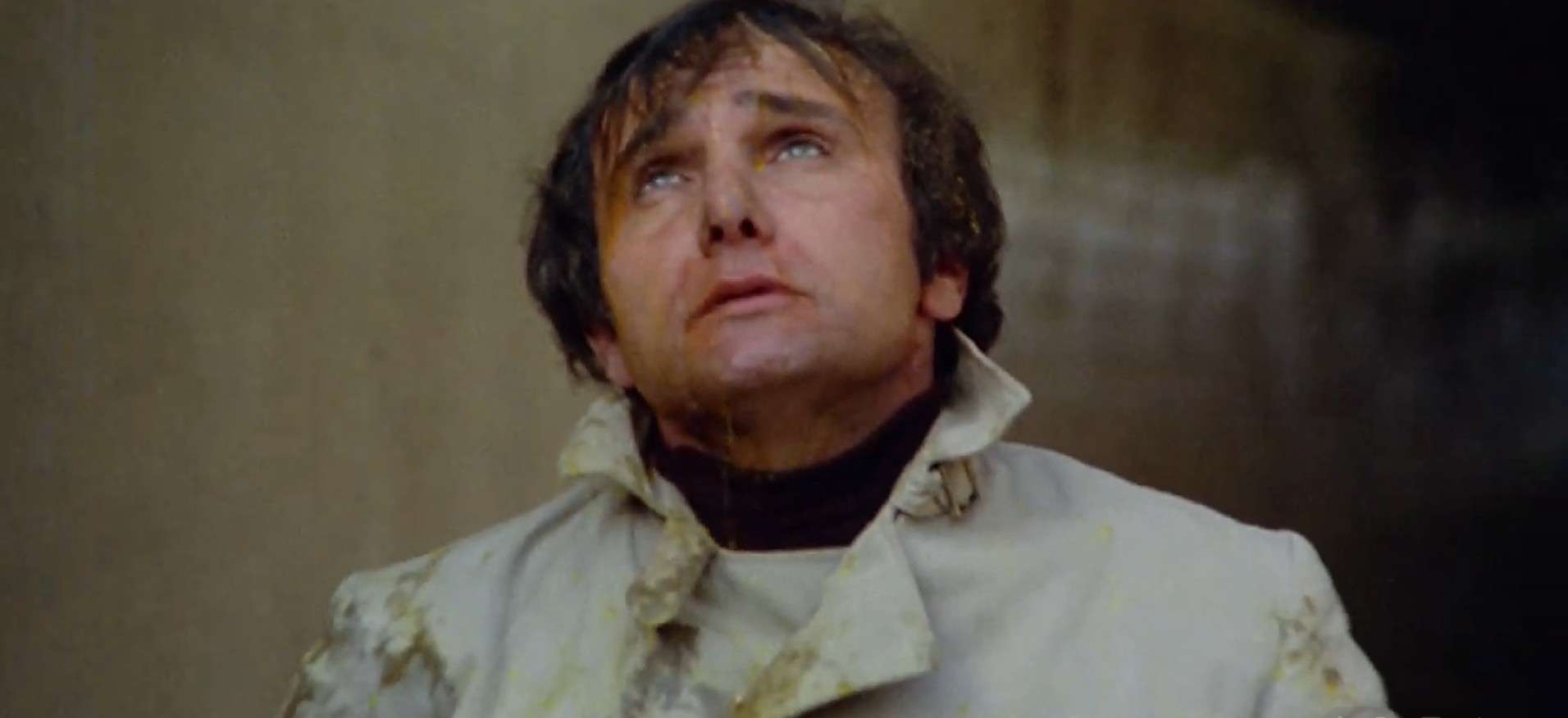
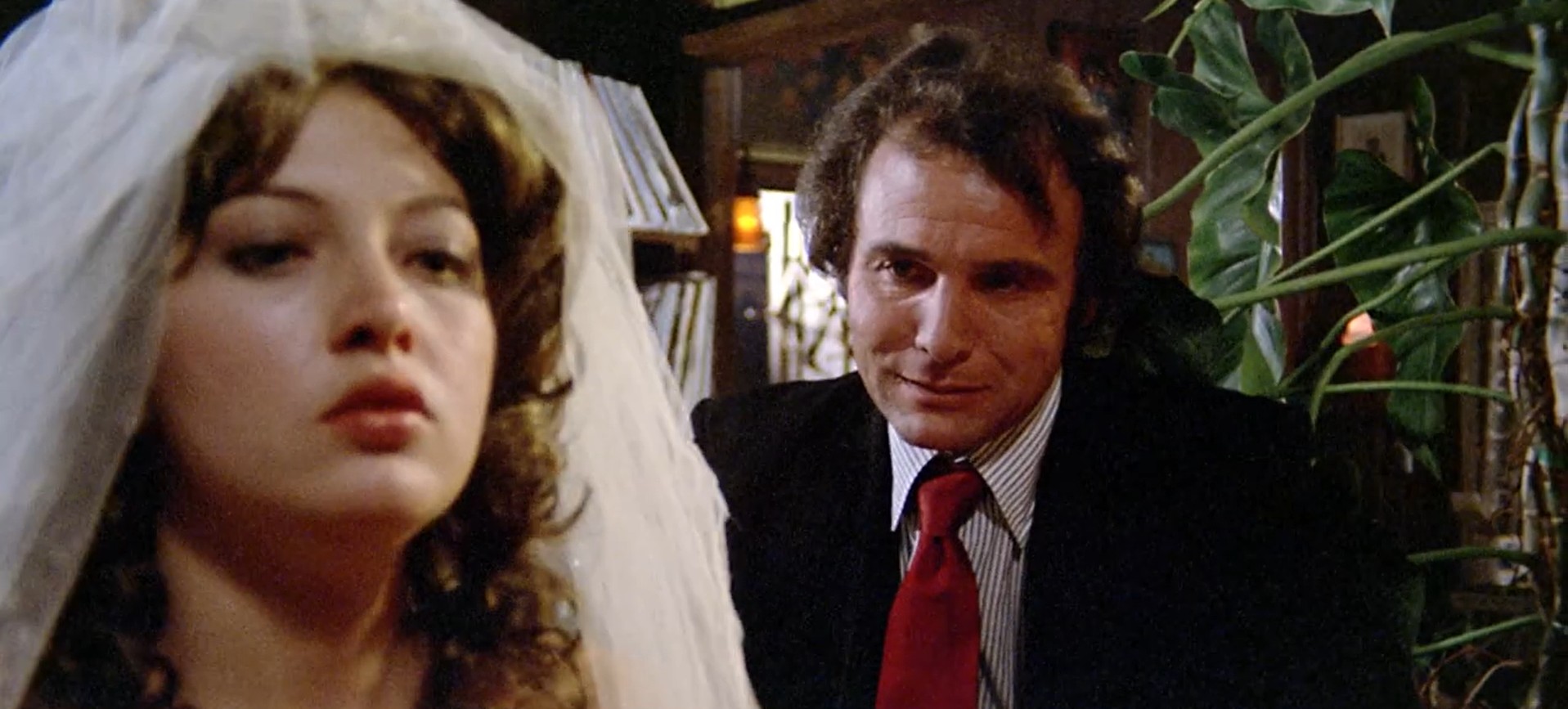
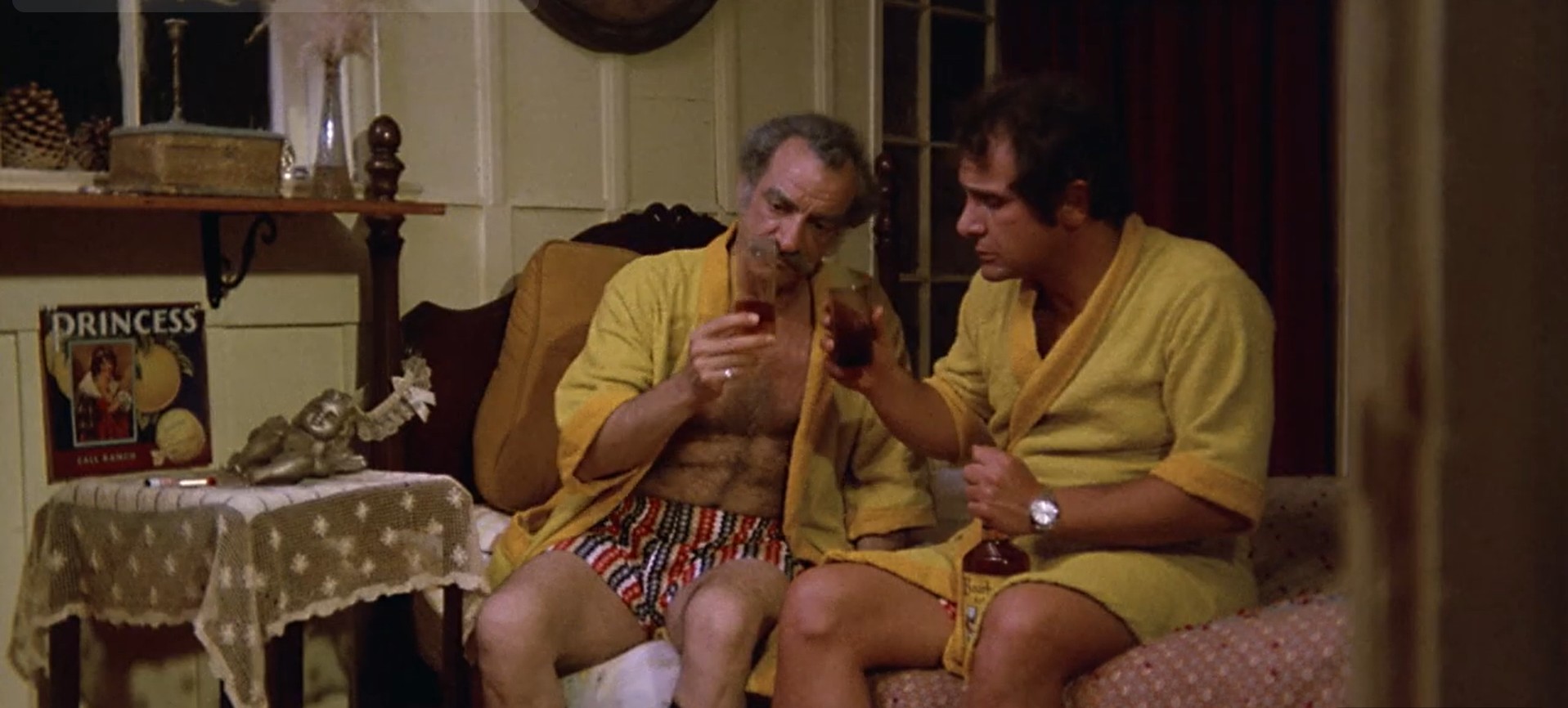
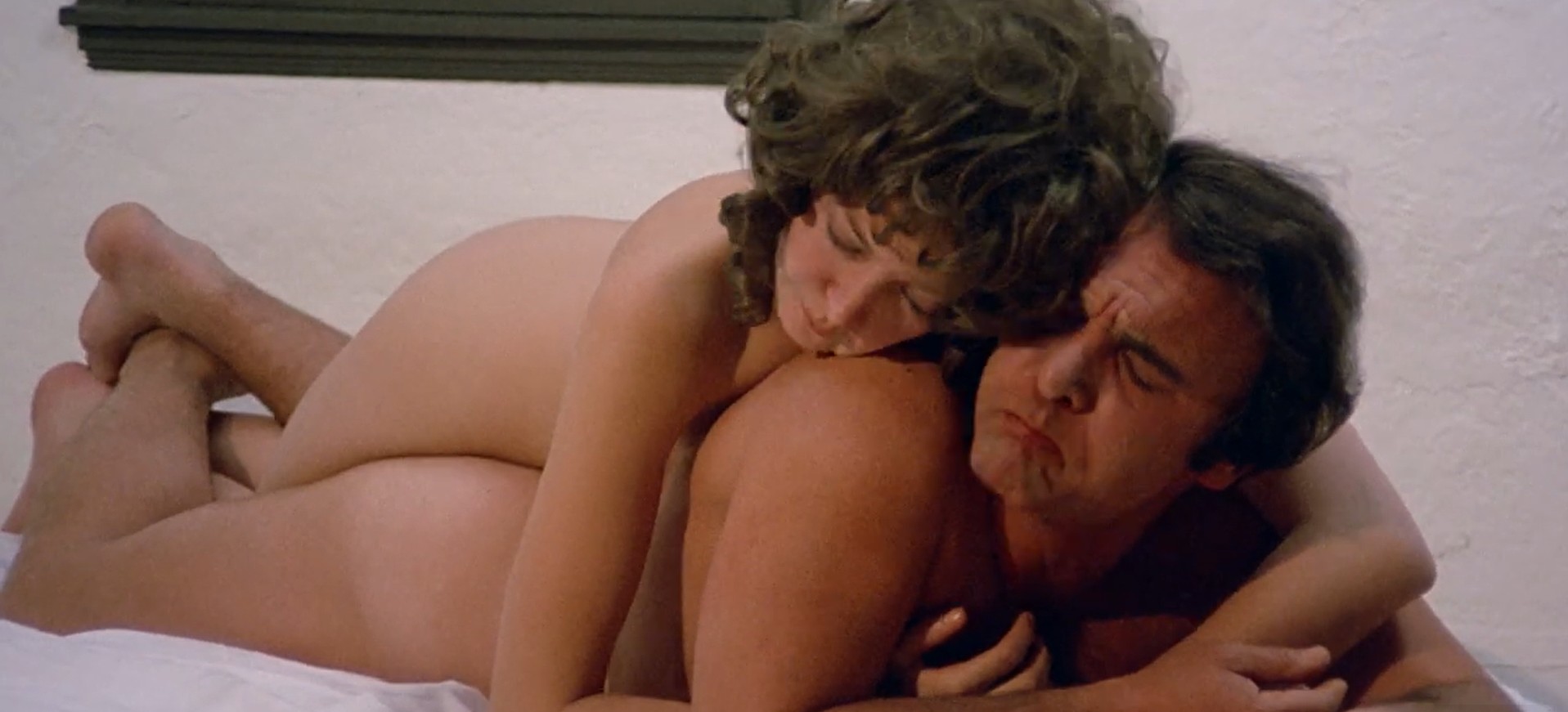
In his best Marlon Brando impersonation, Michael Pataki (“Halloween 4:  The Return of Michael Myers,” “The Baby”) opens his pastiche performance with hyperbole and flamboyance to emulate his version Paul to Brando’s version of Paul while still dishing the Brando-isms and deliveries.  Pataki also opens his trench coat to open-faced frontal nudity.  Yet, the one who is mostly nude is Sherry Denton in the role of Frenchwoman Jeanne.  Her role does harness the same essence of “The Last Tango in Pari’s” Maria Schneider, making Denton’s Jenne harder to define as she absorbs Paul’s verbal and emotional abuse, as she contemplates their arranged sexual rendezvous against her emotional withstand all, and how she manages a life in the adult industry as a sex object that runs parallel with being too a sex object outside the profession.  Pataki and Denton’s scenes together resemble that of a mother humoring a spoiled child.  Denton’s rather levelheaded compared to a full-blown exaggeration of Marton Brando in Michael Pataki with acute yelling spats and irrational sex requests that bleed into pleading and disappointment on a childish person of imprudence.  The gut punch of obsession, desire, and more refined melodrama is lost within Band’s spoof in a combination of bad writing and missed opportunities to sell the performances.  While this version of “The Last Foxtrot in Burbank” is not the pornographic scene splice in version, the actors still must be comfortable with each other in the story’s requirement of genitalia proximity and exposure as some scenes can be often graphic in its simulation of sex as well as be humiliating.  The cast rounds out with Merlouch Drabin, Sally Marr (“Young Lust”), Simmy Bow, and I. William Quinn (“Alligator”).

Supposedly, “The Last Foxtrot in Burbank” is a shot-for-shot spoof but Charles Band’s picture has jagged edges around a nonconformist narrative whereas “The Last Tango in Paris” abides by more linear storytelling.  The gags are not particular funny unless you’ve seen the Brando film and have a puerile sense of humor, but even then, the gags are terribly heavy fisted in a strive to really make light of sexual casualness and obsession in a conduit of Brando’s mumble and gravelly discord with the occasional outburst of hyperbolic flair.  For those who haven’t seen the Brando film, “The Last Foxtrot in Burbank” will be totally lost without a reference, especially the France set story shows it’s budget with the English-laden business and directional signs that play into the running gag of the fictious city that combines Burbank, California and Paris, France.   One could see why Charles Band and John Carpenter wanted to disassociate and distance themselves from this film but for both filmmakers, it’s a significant first film that kind of redirected their career paths when they knew comedy, such as this one, wasn’t their forte.  Charles Band even went as far as destroying all copies of the film and changing his name to a pseudonym, Carlo Bokino, to erase all involvement but he unsuccessful and a print was discovered unphased by his attempts to eradicate all known evidence.  Today, Band accepts his first film and even catalogue’s it with a No. 0 on the spine that makes it official Charlie canon. 

The first official and unofficial film of Charles Band’s career comes to Blu-ray home video from Band’s Full Moon Features in an unlikely genre release from the horror and science fiction regular.  The AVC encoded, 1080p high-definition, BD25 comes uncut and uncensored, transferred from an original negative donated from the UCLA archives under an anonymous donor.  Not much is stated here about what kind of a transfer we’re treated but the 2K scan appears adequate with a freshened image with moderate color saturation and details.  There are times the image appearance has a slightly faded realism, similar to that of William Friedkin’s “The French Connection” where details can be soft at times and ungraded.  Most scenes are better than not with palpable textures around more closeups and medium shots.  Skin tones are little more on the orange side, likely due to the chemical dye in the exposure that has an orange base which results in a natural, fringed tint.  The Blu-ray is presented in a widescreen aspect ratio 1.78:1.  Audio comes with an English LPCM 5.1 and a Stereo 2.0.  Both audio formats provide a crisp track of a dialogue, ambience, and what soundtrack is present, but the surround sound does little to enhance the film with its lack of off-camera or multi-directional scenes with mostly centered performances by the actors and not a ton of action.  The stereo 2.0 suffices.  No hissing or crackling present and the interference is kept to a suitable minimum to digest all its wacky dialogue.  The physical presence of Full Moon’s Blu-ray runs the same course as the others with a standard Amaray Blu-ray case and single-sided sleeve art with no other tangible attributes.  The nearly full-bodied orange colored sleeve mirrors “The Last Tango in Paris’” art to an extent and Full Moon uses stills with nudity on the back cover as an added perk.  The 56 minute Blu-ray, shorter because the cut of the hardcore inserts, is rated R and unlocked for multi-region playback. 

Last Rites: “The Last Foxtrot in Burbank” is a hard sell with its flat lampooning of “The Last Tango in Paris.” A handful of sleaze to be had but there’s nothing more cringy than watching histrionics for an extremely niche market.

“The Last Foxtrot in Burbank” Finally Recognized by Charles Band and Full Moon Features!

EVIL’s Vampiric Power Over the Homunculus is Short Lived! “Decadent Evil” reviewed! (Full Moon Features / Blu-ray)

The Remastered “Decadent Evil” is now on Blu-ray!

An evil vampiric bloodline has stretched from Europe to U.S., specially in the Los Angeles area, where Morella, a centuries year old master vampire, collects the blood of innocent victims and she requires just one more soul to fulfill a prophecy to be the most powerful and invincible vampire ever.  Morella is so cruel she even transformed her once lover into a homunculus, a scaly and green shrunken humanoid, to keep as a caged pet.  When two of Morella’s thralls are uncovered working at a strip club by a dwarf vampire hunter with a grudge, she finds obtaining the last soul to be challenging, especially when one of her subservient vampires, Sugar, is against the whole bloodsucking attribute and falls in love with the strip club DJ.  With Sugar, the DJ, the homunculus, and the vampire hunter standing in her way of total immortality of godlike proportions, Morella has little allies in her corner but has the majority of evil power behind her ancestral lineage. 

An early 2000’s Anne Rice facsimile, “Decadent Evil” is Charles Band and Full Moon’s other Gothically romantic infused vampire feature behind “Subspecies” and “The Vampire Journals,” which are technically all part of the same “Subspecies” universe in one way or another.   The “Puppet Master” and “Trancers” cult filmmaker helms the 2005 low-budget feature and cowrites it alongside a staple Full Moon screenwriter Domonic Weir (“Evil Bong”) in what would be one of Weir’s first feature length films for the longtime genre producing company after gifting the horror community with a “Critters” screenplay in 1986.  After a few minor re-writings of Hong Kong actioners for an English dub, Weir returns to horror with Full Moon and indulges Band on his diminutive obsession with tiny terrors.  And what may you ask is the small creature in a sexy-slathered vampire flick?  A homunculus is written into the story, of course!  Band produces “Decadent Evil” not under Full Moon but Wizard Entertainment in collaboration with Shoot Productions and Astonishing Features with Jeremy Gordon and Jethro Rothe-Kushel as association producers on the Los Angeles based shoot. 

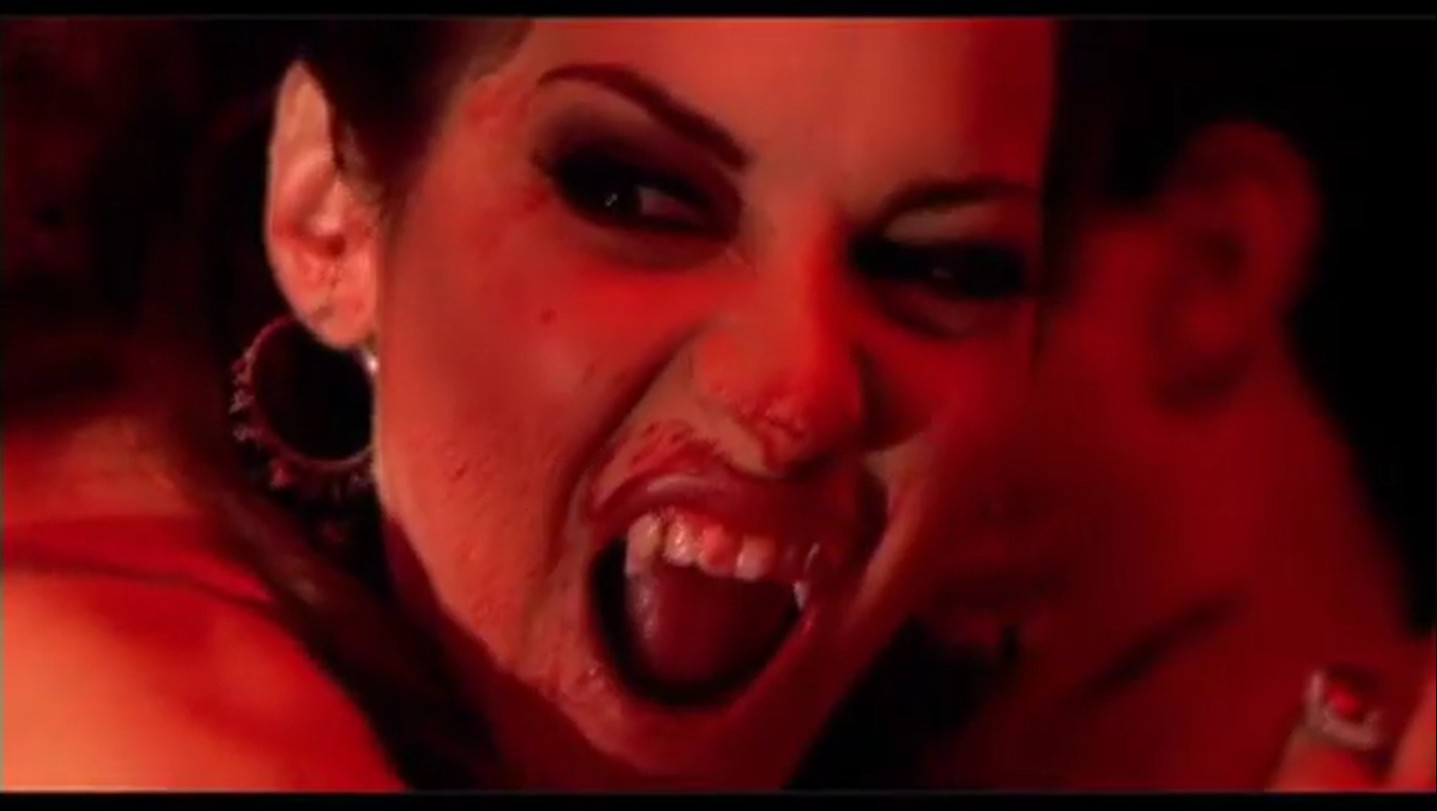
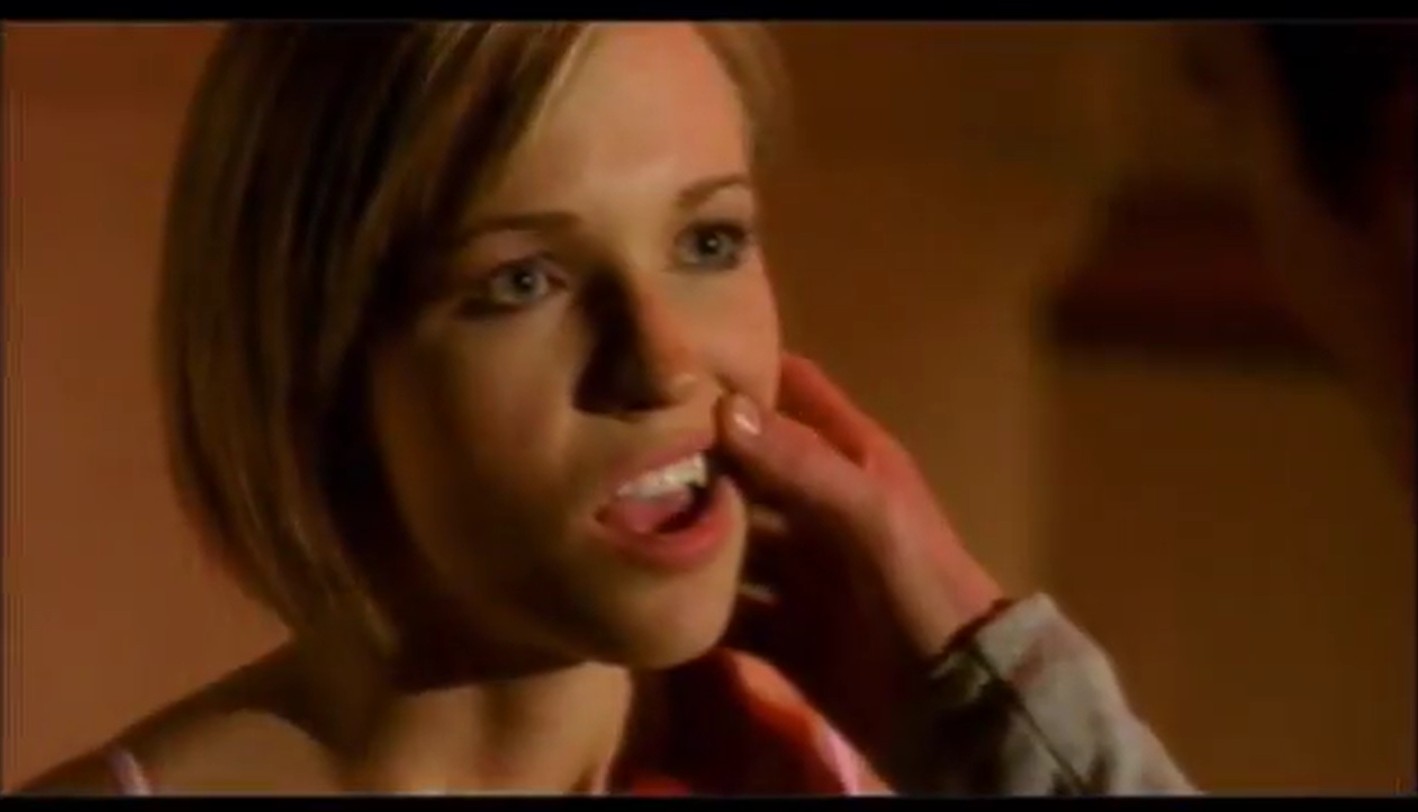
The prologue backstory of “Decadent Evil” can be misleading as to who the main characters will be with a restructured, recut introduction made from bits and pieces of scenes of “The Vampire Jounrals,” another Full Moon production, that uses a power Euro male vampire bloodline as the basis for Morella’s L.A. homebase of operations, which include the ying yang, naughty and nice, vampiric sisters, Sugar and Spyce.  “Blood Dolls” and “Prison of the Dead’s” Debra Mayer, a late 1990’s scream queen for about a decade and half until her eventual departure from acting, plays the head vampire in charge Morella with a firm grip on her subservient thrall, the angsty and gothic-inclined Spyce (Raelyn Hennessee, “Cutter’s Club”) and the sweet-and-innocence exuding Sugar (Jill Michelle, “Erotic Secrets”).  The sisters go through the motions of obedience but to an extent with Sugar basically disavowing her vampire blood in hopes for a romance relationship with her strip club’s DJ Dex (Daniel Lennox, “The Black Magic”) and Spyce pushes the limits of her own control, like a teenager testing their parents, by drinking the blood of those meant for Morella’s grand power count.  With a 67-minute runtime, “Decadent Evil” doesn’t have the minutes to really explore the characters that force the actors to be plain, act plain, and never be anything more than plain.  Even Phil Fondacaro, the headlining star and most recognizable face of the troupe, must purge backstory in a flash upon his acute introduction mid-way through.  The “Willow” and “Ghoulies II” actor is a vengeful vampire hunter after his father falls victim to Morella.  April Gilbert (“The Butcher”), Roger Toussaint (“Illicit Dreams”), John F. Schaeffer, and, of course, it wouldn’t be a Charles Band picture without a half-naked adult film star in Harmony Rose who goes topless for the cause. 

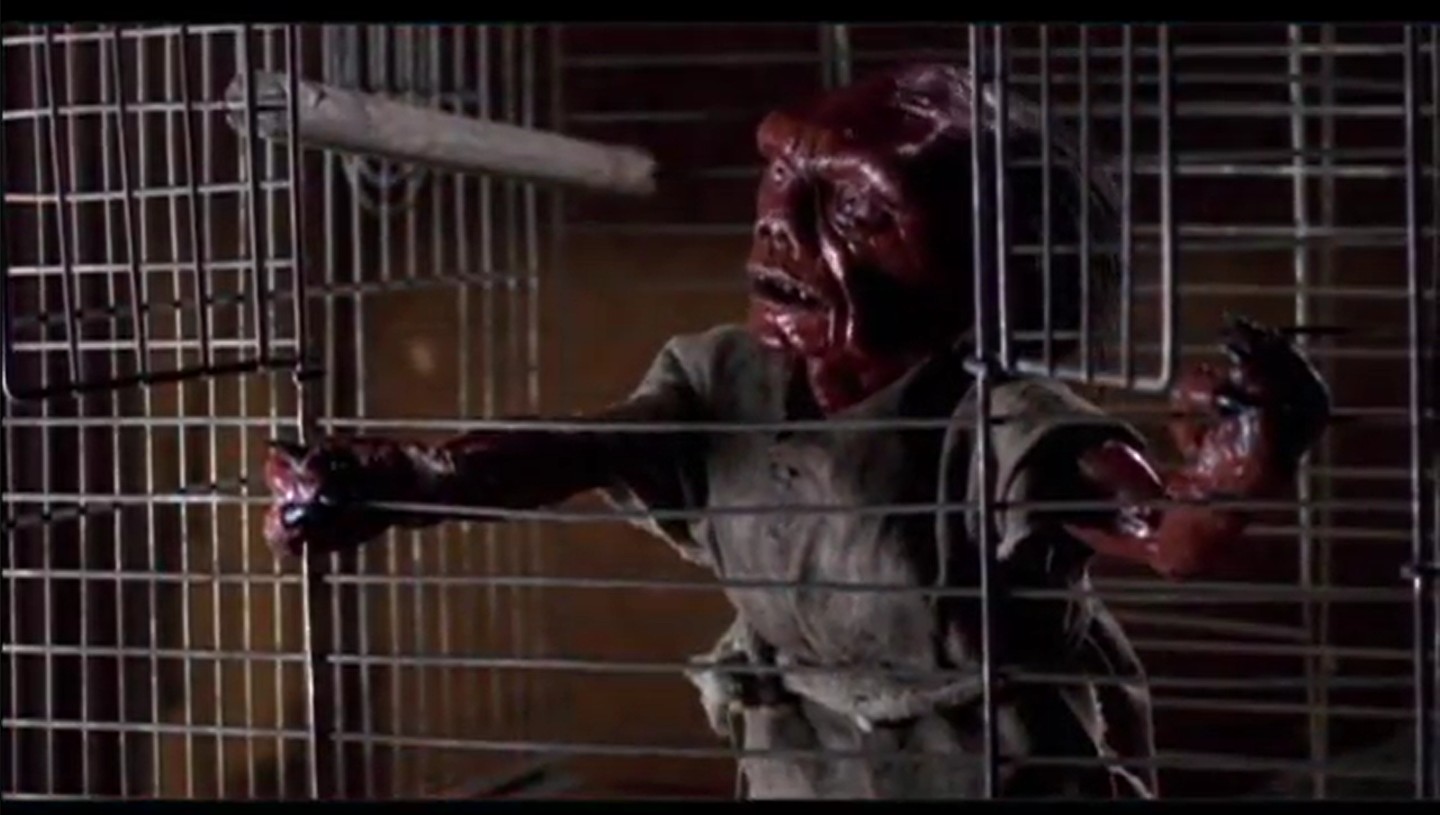
Locally shot near the company home base of Los Angeles, full of either Full Moon actors or greenhorn actors, little-to-no budget for practical or computer generated effects, a runtime of under an hour, and the tacking on of “The Vampire Journals” at the beginning to extend the length to just that under the hour mark is a true show of low-budget colors from Charles Band and Full Moon.  The premise of Morella becoming an omnipotent vampire through a scrapbook collection of pure blood is a solid enough premise that is unfortunately not explored enough to become invested, turning this Full Moon venture into what it has become over the last couple of decade, a feast of female-casted eye candy and fatigued nostalgia without implementing anything new to the vampire or horror genre.  There’s also the matter of the homunculus that becomes a centerpiece and eventually tops as the main motif that hangs around in a bird cage and perversely has eyes for blood while simultaneously carrying around a major libido with scenes of molesting and raping involving the pint size creature.  The whole idea is a bit off, added to sate Charles Band’s fascination of with small creatures, and only adds mild interest in its development through the story which ends in a perversion of slapstick that, again, doesn’t fit, this time in the narrative tone. 

Full Moon continues to upgrade their catalogue, and the “Decadent Evil” films are the latest to be AVC encoded onto a BD25 with a remastered, high-def, 1080p, resolution for the first time ever in HD with a transfer scan form the original 35mm negative.   The early 2000 film sustains a fair amount of its 35mm charm despite most companies flocking to the less expensive digital format and this helps retain a richer saturation and an organically bold image that accentuates the hardlines and elaborately dressed gothic interiors and the smoke-filled darkness of the strip club.  The rest of the settings are standard fair, but the focus is within Morella’s L.A. mansion that has a mistress vampire’s touch.  The digitized conversion and the upgrade in pixels have cleaned up the image some but hasn’t exactly wowed with impressive measure as the details often fluctuate outside stylized lighting and smoke.  There’s often superb, granule detail on the homunculus’s shiny wet gland-filled dermis and deep contoured bone structure in the obvious puppet’s face and head.  The English audio comes with a couple of uncompressed formats with an PCM 5.1 and a 2.0 Stereo.  The 5.1 is more than enough for dialogue, soundtrack, and the ambient environment, though the latter is more for immediate focal points rather than the natural course of surroundings.  For instance, the homunculus’s heavy breathing and slippery skin provide characteristics to the already unique character but since much of the narrative is held indoors in a still mansion, there’s not much to the audio atmospherics, and even the strip club is doused with a rock track that swallows any other diegetic and nondiegetic noise.  Dialogue prominently in front but can struggle with depth in the 5.1 mix that often doesn’t pick it up; there’s better discernibility within the dual channel that maintains a front forward audio rather than trying to diffuse the already distance stilted audio.  “Decadent Evil’s” soundtrack is less carnivalesque than other Full Moon productions because Richard Band is not at the orchestrator helm, providing “Deathbed” composer James T. Sale’s soap opera Gothicism and playful low-tones more opportunities to flourish with this campy vampy film.  Extra features include a behind-the-scenes with snip interviews with the cast, a blooper reel, the original trailer, and other preview trailers from Full Moon Features.  The physical release mirrors much from the same line of DVD to Blu-ray upgrades with standard Amaray case.  The one-sided sleeve art illustration is new, which is a fine collage of characters, yet is uncredited.  There’s no inserts or other tangible extras on this region free, 74-minute, unrated vampire indulger. 

Last Rites: Fans of Full Moon’s “Subspecies” and ‘The Vampire Journals” will find “Decadent Evil” to stagger in its more modern affiliation with a meek story having little-to-no bite, favoring more the shorter stints of an arbitrary homunculus inclusion and Phil Fondacaro’s flyby hunter.

The Remastered “Decadent Evil” is now on Blu-ray!

The Most Dangerous EVIL Isn’t the Hunter! “Slave Girls from Beyond Infinity” reviewed! (Full Moon Features / Blu-ray)

The future for beautiful women holds little promise as they are slaves across a patriarchal-oppressed galaxy.  Daria and Tisa are two of those women, scantily cladded and stowed away in shackles on a galactic starship.  Their harrowing escape crash lands them on the shores of a jungle planet where they’re recovered and hosted by game hunter Zed and his two robot servants in his lavish castle abode.  Dressing, feeding, and providing them comfortable room accommodations, Zed appears to be Daria and Tisa’s savior against those who have enslaved them and from the wreckage of their getaway ship, but along with another couple of salvaged survivors from another ship, Zed has nefarious plans for each one of them.  Plans that put the survivors back into the mutant-infested jungle where fervent game hunter Zed’s need for worthy sport aims to capture and kill his pampered and mount their heads on his trophy room wall.

In a male-controlled universe, the battle of the sexes rages on!  “Slave Girls from Beyond Infinity” takes gender warfare into the jungle thicket with assumed male insuperability going up against the strength and will of woman.  The amalgamating sex, violence, and horror director Ken Dixon, known for his credits in exploitation with “The Erotic Adventures of Robinson Crusoe,” “Filmgore,” and the documentary “The Best of Sex and Violence,” helmed his last entry in 1987 with this underclothed and campy science-fiction chase of human game.  Dixon, along with John Eng, Mark Wolf, and Don Daniel produce progressive gender boundaries with the film’s opposition to the laid ideology of Charles Darwin who once said man have a higher eminence, in whatever he takes up while woman intuition powers are characteristic of a lower race.  “Slaves Girl from Beyond Infinity” worked to balance the scale with women who won’t lie down and die because of man-favored gifts of sexual selection.  Beyond Infinity and Titan Productions served as the co-production companies and distributed theatrically by then Charles Band’s Full Moon Entertainment subsidiary, Urban Classics, until It’s sequential acquisition by Band and its assimilation into the Full Moon collective.

With the title like “Slave Girls from Beyond Infinity,” there better be a skimpy garbed cast of gorgeous women pew-pewing with futuristic laser guns and using their sexual promiscuity as a dangerous weapon.  Fortunately for us, Ken Dixon doesn’t drop the ball fulfilling the fantasy or, how I see it, is necessary for such a midnight showing title.  The film follows the imprisonment, escape, and into the hands of a human hunting madman story of Daria and Tisa, played by the super fit, super sexy blondes Elizabeth Kaitan (“Necromancer,” “Friday the 13th:  The New Blood”) and Cindy Beal (“My Chauffeur”).  Kaitan edges out Beal as the lead set early with Daria’s relentless confidence and better adept at taking advantage of a situation but both women play into the strong female heroine as they knock out well-armed and body-armored male guards, intoxicate the male, and even to the implied extent of a male identifying robot, gaze, and take on the murderous Zed in his own devious game albeit both barely having any clothes on for most of the duration in the cold of space and in the heat of the jungle.  Kaitan and Beal are not the only bodacious bods in the cast with the 80’s household scream queen Brinke Stevens (“The Slumber Party Massacre,” “Sole Survivor”) puts a foot out of the girl in a shower and other unnamed nude girl role and into a more principal character with Shala, a fellow planet stranded survivor from a previous crash told anecdotally, and in an opening, nonspeaking minor role, but definitely bursting with screams, and at the seams, of a barely covered flesh, is the unknown beauty Sheila White.  Stevens is sister to whom would become the “The Dark Half’s” special and visual effects supervisor, Carl Horner, as he plays Rik, a handsome, young man with a sneaking suspicion about their too-gracious of a host and a toying, on-the-brink love interest to a firm and more confident Daria in a steamy show sex scene to throw Zed off their conniving scent toward his do-no-good plans.  Zed’s a hard card to turn over and understand his true nature.  Played with impeccably classy and sporting glittery adorned, gun metal leather like a Niel Diamond on-stage outfit, Don Scibner has a traditional charm about him that he’s carried with him from his debut role in this Dixon film to other B-pictures laced with cult impression, such as “Moon of Scorpio,” “Night Shade,” and “Witchcraft XI: Sisters in Blood,” and really sells it as a game hunter giddy with the opportunity for new blood to track – male and female.  Between starship guards, robots, and planetoid mutants, Kirk Graves, Randolph Roehbling, Bud Graves, Jeffery Blanchard, Fred Tate, Jacques Schardo, Mike Cooper, and Gregory Lee Cooper fill in the supporting role gaps. 

“Slave Girls from Beyond Infinity” sounds like a busty-bust-up from the likes of Jim Wynorski but whereas Wynorski goes after a blend of buffoonery and boobs, and we’re talking about to the likes of really big, Russ Meyer-sized voluptuousness, Ken Dixon’s takes on a more earnest and natural approach, to an extent that “Slave Girls from Beyond Infinity” feels like a science fiction film of yore, circa 1950s with starship models, impractical attire, men in creature suits, and a timeless tone that is at odds with a futuristic setting.  A subtle whiff of campiness keeps the film from being monotonically stale.  The story itself is constructed from a historical literary framework, loosely based off the 1924 short story “The Most Dangerous Game” by Richard Connell with a big Russian aristocrat and game hunter, bored out of his gourd hunting animals, has turned to hunting shipwrecked people that find themselves stranded on his island.  Dixon replaces the Russian aristocrat with a lavishly leathered bachelor served by robots and skilled with a laser crossbow and the prey is technically shipwrecked but no longer worthy game man bur rather half-naked women comfortable in their loincloths and confident in their survival in an alien jungle amongst mutants, zombies, and a deranged hunter.  “Slave Girls from Beyond Infinity” certainly has that sublevel of sexual objectification and fantasy, or even perhaps is on par level with the murder of another human for sport premise as Kaitan, Beal, and Stevens not only bare most of their bodies, but their bodies are used as tools to subvert Zed’s snooping and are used by Zed in an exploitational sex act stemmed for this post-hunt thrill.

Full Moon delivers the most dangerous game in space down to insatiable fans of 80’s sex symbols and sci-fi oddities with a new Blu-ray release.  Unlike previous re-issue catalogue releases, either from standard definition to high-definition or high-definition to high-definition, “Slave Girls from Beyond Infinity” does not notify of any restoration or remastered efforts onto the AVC encoded, 1080p resolution, BD25.  However, not much needed to be improved on the already stellar picture from a virtually clean 35mm film.  I will say that the transfer did buffer out the natural grain of the film stock, but the details appear greatly featured amongst bronze and near blemish free skin tones from the model-esque actresses with big, teased hair down to the stubble and scarred faces of Rik and Zed, respectively.  Fabrics also come out on top with Zed’s outfit showing the stress marks of a leathery hide to the entirety of jungle epidermis, and even the forced perspective effects of composite mattes to enlarge the jungle setting, though an obvious matte effect, looks positively punctuated in detailed.  The soft lighting used to make the women stargazing eye candy does go against the detail grain but more accentuates the warm tones of a portrayed early science-fiction capture-and-kill.  The English LCPM audio comes in two formats:  a 2.0 stereo and a 5.1 surround sound mix.  The latter immerses you quite effectively but keeping the bass level and handled by the subwoofer reigns, dialogue comes over clean and clear in the front channels, and the sides offer atmospheric chitter of a strong world jungle.  Plus, all the laser fodder presents a satisfactory electric discharge familiar with the genre over the decades.  This suggests an optimization of the audio design for a full package of a sci-fi sonic palette.  This release does not contain a subtitle option.  The modest special features bundled with the feature include a skin-idolizing tribute to Elizabeth Kaitan that showcase her most memorable clothes-on and clothes-off moments from her film credits, the original theatrical trailer, and other Full Moon Features trailers.  The new HD suffers from the company’s consistent business structure of re-issue the film onto just a standard release with barely an encoded special features and little-to-no physical content, but the original film one sheet for the one-sided cover art offers an illustrated sexy and science-fiction splendor and the disc is pressed with select faces from the cover art floating amongst the stars in near translucency.  “Slave Girls from Beyond Infinity” Blu-ray is the R rated cut with a well-paced 75-minute runtime and is region free for global players, presented in a 1.78:1 aspect ratio.

Last Rites: Entertaining and easy on the eyes, “Slave Girls from Beyond Infinity” is an homage to the old science fiction psychotronic that’s vixenly sexy and savagely saucy under the guise of a cruel and deadly hunt on another world.

“Slave Girls from Beyond Infinity” Blu-ray Now Available! Order Here!

Tony Todd’s Last EVIL Released Film! “Cutter’s Club” reviewed! (Full Moon Feature / Blu-ray)

“Cutter’s Club” is Ready for Your Corpse! Buy it Here!

Two promising surgeons Jack and Jill seeking to reach new heights beyond their Hippocratic oath find themselves in presence of Dr. George Roberts, a once renowned surgeon turned obsessed head of a secretly society of surgeons known as the Cutter’s Club who use their skill to be monster makers, craved from slivers of fresh human flesh and harvested internal organs.  Suffering from a severe dissociative order, Dr. Roberts is eager to recruit his former lover and colleague Jill who has the necessary surgical skillset and medical knowledge to bring his two-headed, pint-sized monstrosity to life.  There’s only one problem, Jill’s boyfriend Jack is not in Dr. Roberts’s good graces and is kept out of secret operations to piece together a monster.  As Dr. Roberts’s split personality divides even further and the police become aware of the missing corpses used in their experiments, all of the Cutter’s Clubs efforts, two-headed monster, and even their lives are in jeopardy.

Filmed in 2005, shelved due to lack of funding, and thought lost by the lab storing the negative, the Charles Band directed “Cutter’s Club” went through hell and back to be finally released 20 years later.  The science fiction-horror teeters the same basic premise and principals of David Cronenberg’s “Crimes of the Future” where surgery is the new sex and expressive art, a concept Cronenberg had for decades prior, yet the “Videodrome” director couldn’t fully flesh out the idea into cinematic fruition until recently, starring Viggio Mortensen and Léa Seydoux in 2022.  The script that’s less body horror and more mad science than Cronenberg’s vision is penned by “Thir13en Ghosts” and “AMIEE:  The Visitor” writer, and long time Full Moon narrative collaborator, Neal Marshall Stevens under his pseudonym of Benjamin Carr.  Re-discovered, ironically, the same month Tony Todd died, the “Cutter’s Club” was restored to be the unreleased swan song production from the late and great “Candyman” actor.  Band produces the venture under his founded company Full Moon.

This November is the one-year anniversary of Tony Todd’s death, yet the actor still has new movie releases with “Cutter’s Club” being one of them.  As Dr. George Roberts, Todd plays to his stereotyped tune of being large and in-charge, commanding the screen with his low-frequency voice and intense stares, but Dr. Roberts also has a softer side in his disassociation, a side that’s kinder and gentler against the mad doctor version of himself but that more gentile version barely surfaces and Todd’s ultimately stuck playing an aggressor role he’s all too familiar with and known for.  Not to speak too ill of the dead, but Todd does a bit of overacting with the character by stretching into unnecessary exposition and melodrama, especially when kinder Dr. Roberts briefly sits behind the driver’s seat.  A more down-to-Earth performance comes from Melissa Searing (“Deadly Beloved”) as the anti-heroine Jill.  Grounding an overly articulated Todd to the story, Searing makes for a decent ambitious surgeon trapped inside the confines of the law and ethics and being romantically attached to colleague Jack who’s own self-indulgent inclusion is motivated by the affection he has for Jill.  Played by Davee Youngblood (“Bigfoot County”), Jack looks like the typical Full Moon principal white guy actor that’s more surfer dude with an early 2000’s spikey hair and puka pendant necklace and less defined as a serious surgeon other than wearing the blue scrubs.  Along with Todd’s Dr. Roberts, the Cutter’s Cub society is comprised of lesser disturbed promising medical professionals with David Sean Robinson, Jemal McNeil, and Raelyn Hennessee in various facets of medicine from anesthesiology to retrieving dead bodies from the morgue to being star students when it comes to surgery.  The latter Hennessee is also supposed to playing the jealous other woman to Jill with an at interval relationship with Dr. Roberts that suggests a level perversion or infatuation we’re never privy to.  Jon Simanton, from another Charles Band production “The Creeps,” fills out the cast as the man in a monster suit, stuffing himself into Two-Head, the pieced together monstrous creation.

Without a doubt, horror fans will flock to get their hands on the last and once lost Tony Todd title, but as with many notable genre actors, only a handful of first-class films out of many of the horror legends’ filmographies deserve to be stamped and sealed into their legacy.  “Cutter’s Club” will not be one of those remarkably renowned films.  And like usual, the interesting story of monster making and crafting art out of the flesh of the recently deceased is cut off at the knees by the production’s lack of funding, funding that has rarely been outside the inbreeding of crew talent that retains a certain staleness and the necessary funding to elevate “Cutter’s Cub” from out of the depths of dirt cheap filmmaking and into novel and crisply stylish territory.  Charles Band also nearly always finds a way to integrate his fascination with miniaturized dolls and creatures by having Two-Head be short and stout side villain, adding his directing trademark where he can.  You know it’s a dime-store production not by the rudimentary crafted man-in-a-shoddy-monster suit or the bunch of greenhorn actors that can’t express lines or actions without sullying themselves but rather by the obvious nude nipple pastie on Melissa Searing as she rides an over-sex acting Davee Youngblood nearly convulses out of the bed while lying on his back.  While nude nipples pasties themselves don’t indicate the production’s value, its the from behind-and-over-the-shoulder perspective camera shot that provides a little Searing side boob with the bubbling and loose pastie that really speaks to the fast-and-loose “Cutter’s Club” construction, screaming to the top of it’s lungs that not even a nipple pastie is worth the time and effort to fix for realism.  The story itself has the bone density to stand on it’s own two feet but has hardly any flesh clingy on the Jill love triangle with Jack and George, Jill’s intense motivation to be beyond the grave of a conventional surgeon’s oath to help people, and the secretly society’s wishy-washy goal that doesn’t quite materialize whether their objective is to sculpt art out of flesh or to be monster makers as their deranged core values.

Todd fans will surely want to pick up this lost but not forgotten movie that has been resurrected from the tomb of misplaced films. Full Moon Features handles their own production and distribution with a Blu-ray release on an AVC encoded, 1080p high-definition resolution, BD25, formatted in a widescreen 1.78:1 aspect ratio.  For an early-to-mid 2000s horror, that pleasant film layer of 35mm stock grain is a sight for sore eyes from modern day digital capturing with natural saturation and texturization that provide better practicality to the picture quality. Depth between medium to close up shorts offer plenty of outline and detail around the simultaneous focus points.  There’s not a ton of color range or texture with a most of the mise-en-scene blends a bland swirl of greens, browns, and blacks mostly only a few micro pops of brighter hues, though muted from the desaturated grading, coming through with Jack and Jill’s blue scrubs and we do get some nice sliminess from Two-Head’s stucco flesh.  Full Moon encodes two English audio options:  a Dolby Digital 2.0 and a Dolby Digital 5.1.  Both mixes keep put mostly in front with little atmosphere surround through the back and a front channels, resulting in the stereo mix to be just as adequate as the surround.  Dialogue retains prevalence throughout with the carnivalesque soundtrack of a usually tagged team of Charles Band-directed and Richard Band scored mix replaced with the Jonathan Walters trickling keyboard struck alto keys of menacing science.  English closed captioning is available.  Special features include an interview featurette with director Charles Band and actors Melissa Searing and Davee Youngblood.  The official trailer rounds out the special content laid out alongside a Full Moon promotional trailer for their streaming video magazine, VIdeoZone.  The standard Amaray Blu-ray contains collective character compositional artwork with no other physical trimmings.  The 82 minute, not rated film has region free playback capabilities. 

Last Rites: Jack and Jill might have went to fetch a pail of water, but “Cutter’s Club” is the one that fell and broke its crown. Nice to see Tony Todd in a relatively new project posthumously; yet, having no more financial standing to finish, “Cutter’s Club” feels just that, unfinished, as another slapdash, get-it-out-there-on-the-shelves, product to bank as the unseen film.

“Cutter’s Club” is Ready for Your Corpse! Buy it Here!