

Driving home from a wedding reception, Glenn’s car suffers a flat tire in the pouring rain. He finds refuge in the home of married couple, Art and Cyndi, with an extended offer to him to wait out the rain and spend the night, spending the night in bed with Cyndi at the pleading request of Art. The next morning, Glenn wakes up and Art and Cyndi are gone. Months later, Art shows up at Glenn’s apartment and shows him a videotape of a pregnant Cyndi. Unable to make sense how of his role within Art and Cyndi’s lives, Glenn agrees to meet with Cyndi to discuss future plans and wind up a romantic relationship, but when they suddenly wake up in a hospital and kept separated, they believe they lost the baby as well as the use of Glenn’s legs due to an assumed accident. What unfolds for the couple from then on is bizarre reality that doesn’t make much sense with only a few familiar chords being struck in their mind and every step of their life is being controlled by manipulators with various agendas.

A gyrating wool over the eyes suspense thriller is set to release this Friday, March 11th. That film is “Ultrasound,” the first feature film helmed by Rob Schroeder, the producer of “Sun Choke” and “Beyond the Gates,” both films starring Barbara Crampton. Unfortunately, “Ultrasound” doesn’t star the iconic scream queen but the Conor Stechschulte script, based off the Stechschute’s erotic psychological graphic novel series, “Generous Bosom,” produces the high intense frequencies from off the illustrated pages and into the subjected characters and audiences with disorienting loops of truths and falsities. The U.S. production is a product of the Los Angeles based Lodger Films, cofounded by Schroeder and Georg Kallert, and with co-producers Brock Bodell and Spencer Jazewski.

“Ultrasound’s” narrative is a latticework of character arcs divided into two stories that only merge when Glenn and Cyndi are involved in an unusual (some could say almost magical) scheme connived by hypnotist The Amazing Art, played with sure hand nervousness by Bob Stephenson (“Lady Bird”) whose very good at the soft touch of persuasion with his innocent demeanor. Stephenson works tirelessly his Jedi mind tricks on Glenn, “My Friend Dahmer’s” Vincent Kartheiser, and Cyndi, “Phoenix Forgotten’s” Chelsea Lopez. Kartheiser and Lopez relish in their own deceptions as two strangers being joined by unintended, radical means to fulfill not one but two devious plans. Between political scandal coverups and government sanctioned alternative military tactics, Chris Gartin (“Tremors II: Aftershocks”) and Tunde Adebimpe (“She Dies Tomorrow”) couldn’t be any more different in character engrained into their repelling tangential tales sourced from the same spoiled spring but both actors root deep into the same antithesis garden as a pair of well-informed and completely in control power hungry and idealistic men in idol roles, driving Schroeder’s message right into the heart of public figure facade versus public figure character and both Gartin and Adebimpe nurture that perspective all too well. Then, you throw in a monkey wrench named Breeda Wool (“Mr. Mercedes“) into the well-oiled machine of exploitation to be the controlled outlier only to have the veil lifted for truth. Wool, probably not intendedly punned toward “Ultrasound’s” theme of pulling the wool over one’s eyes or a wolf in sheep’s clothing, casts rightful doubt as Shannon, an innocent associate being kept in the dark, much like Cyndi and Glenn. While the cast is great in roles, none of them stand out in a singular performance and are all a cog in Schroeder’s contrivance. “Ultrasound’s” cast fills in with Megan Fox lookalike Rainey Qualley (“Shut In”), Porter Duong, and Mark Burnham who dons the fleshy mask of Leatherface in this year’s Netflix original and legacy sequel “Texas Chainsaw Massacre.”

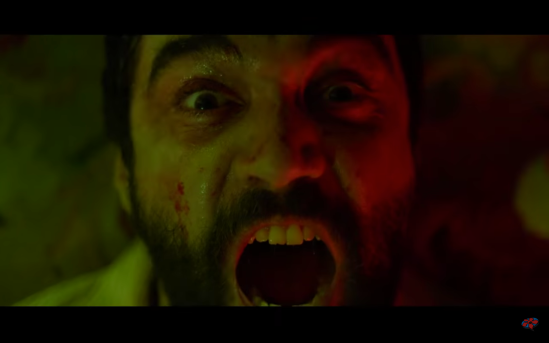
Tapping from the same virtual reality vein of Christopher Nolan and David Cronenberg, the idiosyncrasies of perception are no longer our own as audio, visual, and thoughts become the duped fool in “Ultrasound’s” underhanded exploitation. The concept, high in twist and turns working backwards to unfold what befuddles the hapless into a life believed depressingly real, parallelly touches upon the real-life issue of sleight of hand corruption and scandal. Because this person is an upstanding politician with a beautiful family or this other person has an advanced medical degree and is respected in the science community, we are supposed to take them at their word when in actuality, they’re pulling the metaphorical rug from under our sensorial feet to the extreme point where everything they have said and done that has crumbled down to a lie has a flummoxing and deafening aftershock effect that almost can’t be believed. The two-tale narrative connects with Art and his mismanaging of one plan that tosses his subjects into the hands of another group for what’s to become of Glenn and Cyndi and that transfer, much like the disintegrating hypnosis effect at times, is not tight enough and becomes lost in translation inside Schroeder’s illusive imagery and harsh editing to keep in story in line until a point. “Ultrasound” plagues with hot, intense colors under a low-key lighting, like a deep blue or an intense red, to often relay reality outside the confines of normality. Even though the word “Ultrasound” revolves around the manipulative use of ultrasonic frequencies, I do find the irony in Stechschulte’s story that at the center of much of the tumultuous misperception, there’s a baby often represented as there or not there depending on how we should perceive the characters and it’s like the filmmakers wanted to plug in, perhaps, the nuisances with scanning technology or dip their toes into body horror with body image.

“Ultrasound” is a great low-level, high-tech Sci-fi brainteaser ready to mess with your mind being released this Friday, March 11th, in theaters and on demand from Magnet Releasing, a subsidiary label of Magnolia Pictures that offers innovative tales of horror and science fiction from new, creative filmmaking talent. Since a digital screener was provided, we will not delve into any audio or video evaluations, but Mathew Rudenberg, whose worked in the past with Schroeder as DP on “Sun Choke,” has come a long way since his image work on the 2008 alien-driven-zombie film “Evilution” with keeping the frame tight during medium and closeup shots to never expose to much at one time, leaving a little to imagination when the time comes to open up the room, so to speak. Zak Engel’s analogue and digital synth-score with tangible instrumental highlights from Piano and violin and Bob Borito’s dial and knob sound design swishing static and low-frequency humming sends this soundtrack into a futuristic guise on contemporary grounds that insidiously works into the grand scheme low-tech yet terrifying Sci-Fi. The 103-minute film does not include any bonus scenes during or after the credits. I keep throwing around key descriptors like low-tech for “Ultrasound” and by no means do mean that as a criticism as I speak about the simplest of tech, the original mechanism, of our body and our sensory nodes that receives data input, processes it, and transmits signals to our outputting areas and “Ultrasound” looks at disrupting the supply of data and, just like in today’s pandemic and war climate, a break in the chain can cause unforeseen turmoil that upends lives when cranked up.




 It's Bloggin Evil!