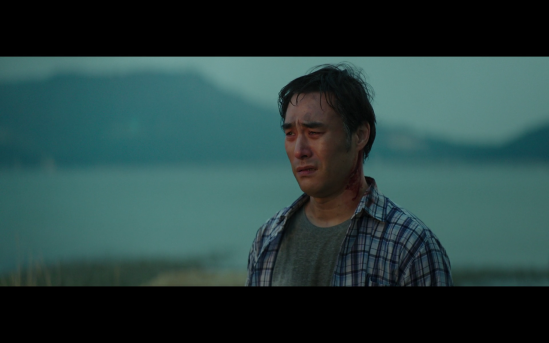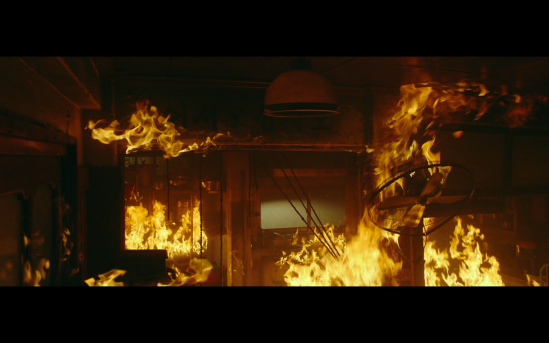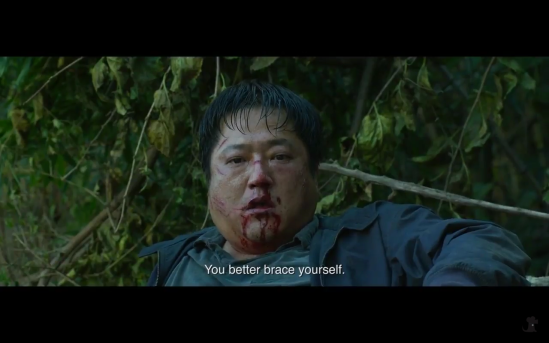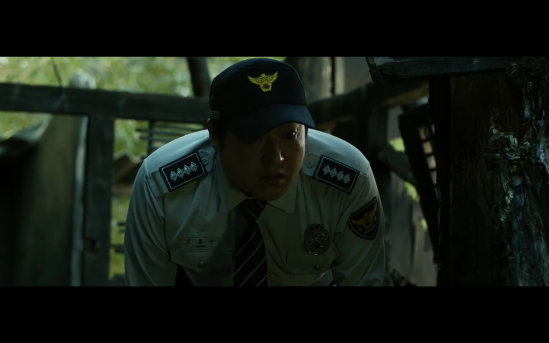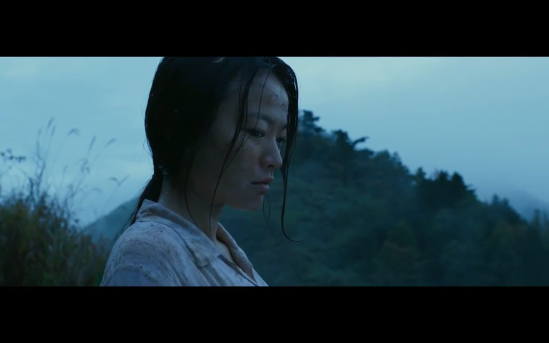
Digging Up the EVIL Disentombs the Past! “Exhuma” reviewed! (Well Go USA Entertainment / Blu-ray)

Open the Blu-ray Coffin on “Exhuma” Today!

A shaman and her assistant recruit a geomancer and a mortician to investigate the case of an American newborn boy’s distressing grave calling that has also haunted every patriarch member of the family for generations.  The large paying job sends them to remote forest where the unmarked grave of the boy’s great, great grandfather lies beneath the dirt.  For the geomancer, all signs point to not disturbing the grave but the father’s eagerness to cure his son’s troubles and the shaman’s persistence for a big payday goes against the wise geomancer’s better judgement.  All is seemingly well after exhuming and transferring the ancestral coffin to be cremated at a nearby hospital the next day until a greedy, hospital official pries open the sealed casket, releasing a long-awaited evil, and digging up out of the same burial ground another malevolent and mysterious ancient force that reaches far beyond the borders of Korea. 

Here as of late, ItsBlogginEvil.com’s last three reviews have taken readers on a genre-diverse tour of Asia, from Japan with Yu Nakamoto’s meta-slashers in “Ikenie Man” and “Harawata Man,” to Hong Kong with David Chung’s affrayed police actioner “Royal Warriors,” to conclude in South Korea with the supernatural horror in the realm of cultural superstitions of P’ungsu, or geomancy, in Jang Jae-hyun’s latest written-and-directed thriller “Exhuma.”  The 2024 film follows a string of religious related, supernatural themes Jae-hyun has put out in his prior two directed projects with “The Priests” and “Svaha:  The Sixth Finger,” and like “Ikenie Man,” “Harawata Man,” and “Royal Warriors,” a portion of Jae-hyun’s films are touched by Japanese culture.  “Exhuma” amounts to the same standard of crisscrossing the two cultures with dangerous results with “Exhuma” digging up a past better left alone.  Park Hyeong Jin and Kwon Ji Yong (“Ghost Mansion”) produce the spiritually turbulent story under Showbox Entertaiment and Pinetown Productions. 

“Exhuma” encircles four culturally inclined characters that entrench themselves into an unorthodox means of exhuming a disturbed essence for what is essentially an exorcism variant to alleviate living perturbation beyond the grave.  The superstition here revolves around the land temperament.  Geomancers find good sites to lay people to rest, ones that exert extrasensory, or grave call, troubles onto family members that place upon them a grief, anxious, and other mentally uneasy state, and it’s the “Exhuma’s” Geomancer who has story predominance, shared only with the young and beautiful shaman woman with tagalongs who resemble more of assistants than coequals.  In an age-old and cautionary tale of wisdom and inexperience, Choi Min-sik (“Oldboy”) and Kim Go-eun (“Monster”) play the respective roles of the reluctant and experienced Geomancer Kim Sang-deok and the naïve eager yet gifted shaman Lee Hwa-rim.  Receiving character voice over monologue introductions and becoming the ultimate deciding factors of this new job is worth the pay, they completely overshadow the Shaman apprentice (Lee Do-hyun,) and the mortician (Yoo Hae-jin) who works with the Geomancer.  Pivotal as these support characters are to the story, not only buffers for the evil that beleaguers them but also as latched on friends and family of the isolating weird and strange subculture to most but normalized in Korea, the shaman apprentice and mortician definitely take a back seat to the more prominent players to the point where they almost seem contributorily worthless to the task.  As a whole, the dynamic works because the shaman and geomancer alone would not be sufficient for diabolical misadventures of an exhumation gone wrong and supplement only when necessary to aid the fight against an ancient evil twice over.  The cast fills out with Hong Seo-jun, Jeon Jin-ki, Kim Jae-Cheol, and Lee Jong-goo.

The wafting back and forth between Korean and Japanese culture, the fraternization of beliefs and superstitions, tells “Exhuma” differently than most hilltop haunts and horrors.  Themes of a haunted past and inexplicable guilt riddle holes through family lineage, resulting rancorous ripples in the form of mental illness, and devised as a story vehicle device of supernatural subverting trauma from the sins of the father.  In America, Shamanism and Geomancy don’t exist, especially in the history, but for Korea and its people, the country is rich in transcendent ritual and mythology that shapes society, even in their cinematic culture as regularly do we see period films of feudal Korea.  History also dictates “Exhuma’s” need to be a representation of purging the long Japanese occupation of Korea for nearly three and half decades from 1910 to 1945.  The occupation was a disruption in Korean way of life with oppression and war machinations stitched into Korean’s fabric, hence the Korean plot of land being very spoiled with vileness in “Exhuma’s” tale of one historically troubled family’s course to remove that uneasiness that has plagued and followed them to America.  Yet, the past is rooted deep and Jang Jae-hyun’s understands the difficulty of eradicating a sullied ancestry by dichotomizing his darkly toned, folklore valued, and occult twisted story into two parts with sublayers as deep as the dirt surrounding the coffin, or rather, coffins with a formidable presence created and conjured by malicious Japanese Yōkai and represented in one of the most iconic Japanese figures as remnants of an Imperial Japan occupation.

Lying in wait underneath the high-definition terra firma is Well Go USA Entertainment’s “Exhuma” on an AVC encoded, 1080p resolution, BD25, presented in a widescreen 1.78:1 aspect ratio. Accompanied by no information on the video vehicle, IMDB.com lists Jang Jae-hyun and cinematographer Lee Mo-gae shoot with an Arri Alexa Mini which offers the ease of use of multiple lenses, and that shows here with a vast stretch to encompass the Korean mountains into the frame as well as keeping tight on characters while keeping in focus the immediate surroundings. Details are sharp under a flinty tone of saturated grays and blacks with spot pops and glows of in-scene lighting and under the capacity’s umbrella, finer textural elements suffuse through the darkness and into the fold. Audio options include the original Korean language DTS-HD 5.1 and an English dub DTS-HD 5.1. Crystal clear dialogue runs through parallel with the visual counterpart and is well timed and potent, touching the side and back channels with the eerie callings of the grave and its inhabited spirits running rampant free while harnessing focus on the character on scene to create a ranging discarnate of deep, ominous sounds that stalk and haunt the principals. English translation paces well and appears to be translated grammatically and is error free. Well Go USA Entertainment releases are feature focused and this one too containing only a making of featurette in the bonus content along with the trailer. The interior of the traditional Blu-ray Amaray comes with a disc pressing of the four principal characters peering into a dug grave. The exterior has a two-tone, subsoil profile forming a face out of a grave with the four principals on the topsoil and the same image also graces the cardboard O-slip that has a pseudo-lenticular sheen. Authored to have a region A playback, “Exhuma” runs just over two hours long at 135 minutes and is not rated.

Last Rites: The addition of learning authentic, practiced rituals benefits “Exhuma’s” folklore frights tenfold and with neat, grounded performances and a superb blend of visual and practical effects, this original, supernatural thriller raises the Korean movie industry up a notch on the global scale.

Open the Blu-ray Coffin on “Exhuma” Today!

Money is the Root of All EVIL! “Beasts Clawing at Straws” reviewed! (Blu-ray / Artsploitation Films)

A middle-aged man working a meager job at a gentleman’s bathhouse finds a Louis Vuitton bag full of money when routinely checking the storage lockers at closing.  Unsure about what to do with the money, he stows the bag away in the backroom and continues a moral, yet pauper’s, life while dealing with financial and family troubles at home.  Meanwhile, a border customs agent finds himself in severe debt with an unstable loan shark after his girlfriend skates and disappears with a large borrowed sum.  With a week to come up with the money, plus interest, he calls upon his distant cousin to assist in scamming a scammer who illegally came into some money, but things go awry when an overly friendly and clingy cop begins to snoop around.  Lastly, a prostitute grinds tirelessly to work off a large debt her abusive husband continues to blame her for with night after night beatings.  She jumps into bed with a young, handsome foreigner and her eager to support female boss to off her husband and collect the insurance money.  Yet, these troubled souls find that sticking to their convictions doesn’t always bode well as the unexpected happens in a blink of an eye.

The Asian film machine has mastered the art of the crime thriller from a proven track record that began with Akira Kurosawa films, if not even before that, and has chronically grown stronger, and sometimes more peculiar, with choice stylistic elements, suggestive themes, and extreme violence that has garnered, to much disdain, Westerner attention over the last 20 years with films like Park Chan-wook’s “Oldboy” and Andrew Lau and Alan Mak’s “Internal Affairs” being Americanized with a Hollywood remake.  With that being said in an upward trend of remakes spilling over the edge, there would be no eye-brow raising surprise if the introductory film, the tri-narrative crime drama idiomatically titled “Beasts Clawing at Straws,” from South Korean filmmaker, Kim Yong-hoon, will one day grace the English silver screens in a diluted variation of a Brad Pitt featured carbon copy.  Based of the Keisuke Sone neo-noir novel of the same name, Kim Yong-hoon’s pulpy impression of against-the-wall misdeeds is dog-eat-dog dark comedy gold.  “Beasts Clawing at Straws” is produced by Jang Won-seok (“The Gangster, The Cop, and The Devil”) and is a production of Megabox Plus M films (“Zombie for Sale”) and B.A. Entertainment.

The three prong, greed-catapulting narrative converge characters separately at first and then string them linearly together when the picture becomes clearly what exactly each one of them is chasing, but every story is magnetized to a single focal point, a person under immense pressure, stress, and the malice forces that thirst for their humility, kinetically embarking on the bad choice choo-choo steaming toward the station of vary bad things.  Bae Seong-woo stars as a downtrodden Joong-man, a middle-aged man stuck in the rut of poverty with a geriatric, browbeating mother, a fatigued wife, and busting his rump in a dead end job.  Seong-woo combats himself as a man tight rope walking the thin line of ethic principles when opportunity knocks at his door, but his ill-timed strike to grab life by the balls blows up in his face in a farce of instant karma leaves him less than what he had before.  Then there’s a Tae-young, a comfortably Governmental positioned customs agent facing a different kind of hardship when his ex-girlfriend, Yeon-hee, disappears with a borrowed lump sum of a gangster’s money and he’s left on the fence.  “Illang:  The Wolf Brigade’s” Jung Woo-sung plays into the desperate stench of the superstitious and ambitious customs agent.  Slightly cradling the severity of the situation, Jung amply positions Tae-young’s dilemma that resembles spearfishing in a barrel and he’s the fish.  The last story follows the abused wife Mi-ran, played reservedly by Shin Hyun-bin as a desperate woman looking to bank her soon-to-be dead’s insurance money.  When Mi-ran is abetted by motive-dueling pair of instigators, she finds that paying her debt can be more severe than ever imagined.  While sitting back and basking in the stir-craziness of the leads’ turmoiled chaos, the best characters of the film are the supporting roles of Kim Jun-han as an intestine devouring, fanny-pack wearing henchman, Park Ji-hwan as Tae-young’s bumbling, but begrudgingly loyal distant cousin, and Jung Man-sik as a breezy mobster with a cherry, yet malevolent disposition.  Youn Yuh-jung, Jin Kyung, Jung Ga-ram, Bae Jin-wong, and Heo Dong-won round out the cast.

Non-linear yet interconnected in story, “Beasts Clawing at Straws” hawks a Tarantino layered thriller with colorful deplorables from all walks of life and luxuries.  Kim Yong-hoon nourishes the unbridled, free-for-all nature of diving into the murky, shark-infested waters uncaged and tethered with cuts of raw steaks dangling from the pelvis area in this two wrongs don’t equal a right account of mistrusting desperation and misguided optimism.  Kim’s style echoes the likes of the popular “Pulp Fiction” filmmaker along the lines of shooting techniques and a frank view of violence to tell the frantic clutching of hanging onto what is left of tattered lives and borrowed time while disavowing pure, unadulterated nihilism by at least giving characters a grain of hope.  With any non-linear, multiple moving part films, individual aspects tend to become lost in order for pacing and “Beasts Clawing at Straws” doesn’t fall into the excluded category as factors that play into the main quandary are left hanging, such as in Yeon-hee’s circumstantial results of jetting off with a mobster’s money as the assumption is there, but nothing is fully concrete in her storyline.  The same indiscernible spousal battery stemmed from Mi-ran and her husband’s severe debt that leads to transgressions beyond marital misuse isn’t privy to the audience of how circumstances come about surrounding their predicament and we’re forced to speculate and shoulder an explanation that doesn’t quite feel justified.  However, neither of the slapdash developments hinder “Beast Clawing for Straws’” steamrolling posture to get that desirable bag full of problem-solving, filthy lucre. 

Artsploitation Films delivers a stylish and avaricious South Korea crime drama with “Beasts Clawing for Straws” into the U.S. Blu-ray home video market. The not rated BD25, high-definition 1080p release is presented in a widescreen, 2.39:1 aspect ratio, and nears the epitome of flawless. Aside from the picture slightly flickering, more noticeably on solid colored backdrops, the hue palette is absolutely gorgeous with the neon lights of South Korean cities, the breathtaking silhouettes of the natural mountains adjacent to a lifelessly still lake, and the variety of settings from an airy fish house to a modern, symmetrically designed bordello denote a keen eye by Kim Tao-sung. The South Korean language 5.1 DTS-HD Master Audio surround sound couldn’t be any better with a crystal clear aptitude for strong dialogue balanced in front of a robust soundtrack accompanied by deep range of ambience from fire crackling to the faint hint of rain drops audible from inside a restaurant, solidifying the depth package as well. English subtitles are available along with an English dub track in a dual channel Dolby stereo. What’s lacking with this release is bonus material as there is virtually nothing besides four Artsploitation trailers and the film’s own theatrical trailer. Parlous and deadpan funny, “Beasts Clawing at Straws” amazes as Kim Yong-hoon’s first time effort with the technical grace and the story construction that has been a paradigm for only a handful of notable directors able to execute an impeccable result.

Own “Beasts Clawing at Straws” on Blu-ray! Click the poster to go to Amazon.com

Mysterious Evil Destroys Small Village Families. “The Wailing” review!

screen-shot-2017-02-04-at-8-16-32-pmIn a small South Korean village, tight-knit families practically know one another in the quaint middle-class community. When mysteriously deadly destructions from inside local families and strange stories of animal carcass devouring creatures in the woods surface, local police sergeant Jong-Goo begins an investigation to connect a pattern of violence and superstition and at the center of it all is a suspicious and reclusive Japanese traveller. Bound by the law and an overall lack of courage, Jong-Goo proceeds to investigate with extreme caution, but when his young daughter, Hyo-jin, becomes subjected to the same symptoms that overtook destroyed families from within, the desperate father sets aside rules and regulations and uses threats and force when visiting the Japanese Stranger, whose rumored to be an evil spirit that’s plaguing the small village with terror and death.
screen-shot-2017-02-04-at-8-16-30-pm
By far, “The Wailing” sets the precedent on folklore horror. Acclaimed writer-director Hong-jin Na lands a harrowingly ambitious, well-constructed film right into the lap of horror fans with “The Wailing,” known also as “Goksung” in the film’s country of South Korea. South Korean filmmakers have once reestablished proof that foreign films can be as masterful, as bold, and as elegant when compared to any other film from major studio productions. Hollywood has started to come around by remaking one of South Korea’s most notorious films, the vengeful thriller “Oldboy,” and seeks to remake recent international hits in “Train to Buscan” and “I Saw the Devil.” Lets also touch upon that top Hollywood actors are beginning to branch out to South Korean films. “Captain America” star Chris Evans had obtained a starring role in Joon-ho Bong’s “Snowpiercer” alongside co-stars Ed Harris and the late British actor Sir John Hurt. “The Wailing” will reach similar popularity being one of 2016’s most original horror movies and one of the more unique visions of terror to clutch the heart of my all time favorite’s list.
screen-shot-2017-02-04-at-8-17-18-pm
Do-won Kwak stars as Sergeant Jong-Goo, a officer who avoids trouble at all costs and has no motivation to be on time for anything. Kwak, basically, plays the fool character, comically going through the routine of investigating brutal murders complete with stabbings, burnings, and hangings despite his Captain’s constant chastising and seizes every opportunity to act dumb and look stupid, but once the story starts to focus “The Wailing” as nothing more than an offbeat black-comedy, Hong-ja Na devilishly about-faces with a severe turn of events that’s a mixed bag of genres. Kwak no longer plays the lead role of comic relief; instead, a more self-confident Sergeant Jong-Goo takes control of the investigation as the deeper he finds himself involved in the dark plague that’s ravaging his village. He hunts down the Japanese Stranger, the debut South Korean film for long time Japanese actor Jun Kunimura (“Kill Bill,” Takashi Miike’s “Audition”) with a zen like aurora that’s enormously haunting to behold and captivating when his presence is lurking amongst the scene. Though Kunimura’s demeanor contrasts with other actors, he’s very much in tune with the dynamic, but it’s the maniacally, foul-mouth ravings of Hyo-jin, played by Hwan-hee Kim, that stand out and are the most distraught during her possession state that could give “The Exorcist” a run for it’s money and is a visceral vice grip to the soul that has to be experienced. Woo-hee Chun and Jung-min Hwang round out the cast in their respective and memorable co-starring roles as a peculiar no named woman and a flashy shaman.
screen-shot-2017-02-04-at-8-23-19-pm
“The Wailing” incorporates various folklore stemming from cultures all over the world including the Koreas, China, Japan, and even from China’s bordering neighbor Nepal and meshes them with religious practices of Buddhism to even the far corners that the Catholic faith possesses. The luxuriant green South Korean mountain backdrop sets an isolated, ominous cloud over a beautiful and serene archaic village, an awe-inspiring juxtaposition created by cinematographer Kyung-pyo Hong that coincides with the complete dread piercing through the heart of the story; a perspective vastly opposite to Hong’s works in the previously mentioned “Snowpiercer” that’s set in the tight confines of a class dividing bullet train. “The Wailing” bundles together mythos with visionary concepts and landscapes in an epic mystery-thriller that’s unforgettable; it will cling to you, like a evil-dwelling spirit, well after the film is over.
screen-shot-2017-02-04-at-8-18-18-pm
20th Century Fox, in association with Ivanhoe Pictures and Side Mirror, produce Hong-jin Na’s top horror contender “The Wailing” with Well Go USA and Kaleidoscope Home Entertainment distributing on DVD and Blu-ray. Unfortunately, I was provided with a DVD-R screener and can’t specifically comment on specifications and image or audio quality. Accompanying the screener were two bonus features: a behind-the-scenes featurette and the beginning tale of “The Wailing” featurette. Both were fairly informative that gives insight on Hong-jin Na’s mindset and how the director’s ambitious story in a malignant tale of comedy, horror, and mysterious involving demons, shamans, and, quite possibly, the devil himself. “The Wailing” significantly captivates, sucking you into the darkness with an uncanny amount of pull with a story too terrifyingly original to avert and too thick with vigorous characters in a plot twist too harrowing to forget.

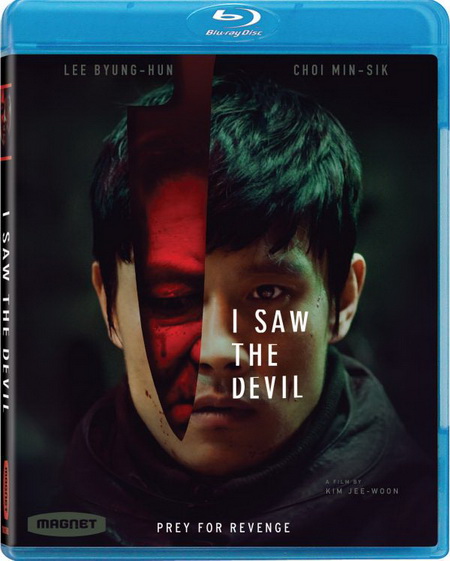
Evil all around! I Saw the Devil review!

Every so often, a hole must be filled.  This hole is the deepest, darkness, most horrifying and brutally stricken hole  a single person would imagine if they had the fortitude to ever do so.  The reason this hole needs to be filled lies majorly with curiosity and morbidness.  Human nature is quirky and our senses need to be overloaded with fear and shock when the time calls for it.  Jee-woon Kim’s I Saw the Devil fills that hole and exceeds to overflow it with unmerciful loathing which will haunt you long after the credits roll.

A solitary man rapes and dismembers young women in order to appease his appetite for human suffering, but when when one of his victims turns out to be the pregnant fiance of a secret service agent and a former police chief’s daughter, he may have made a big mistake.  The agent devises a plan to find his fiance’s killer and play a capture and release torture game in order to inflict as much as pain as the killer has caused the agent’s fiance.  What the agent doesn’t realize is that this killer is relentless when it comes to getting even and nothing will stop his destructive path.

Continue reading