The Golden Ninja Warrior Turns Good Ninja Masters to EVIL! “Ninja Terminator” reviewed! (Neon Eagle Video / Blu-ray)

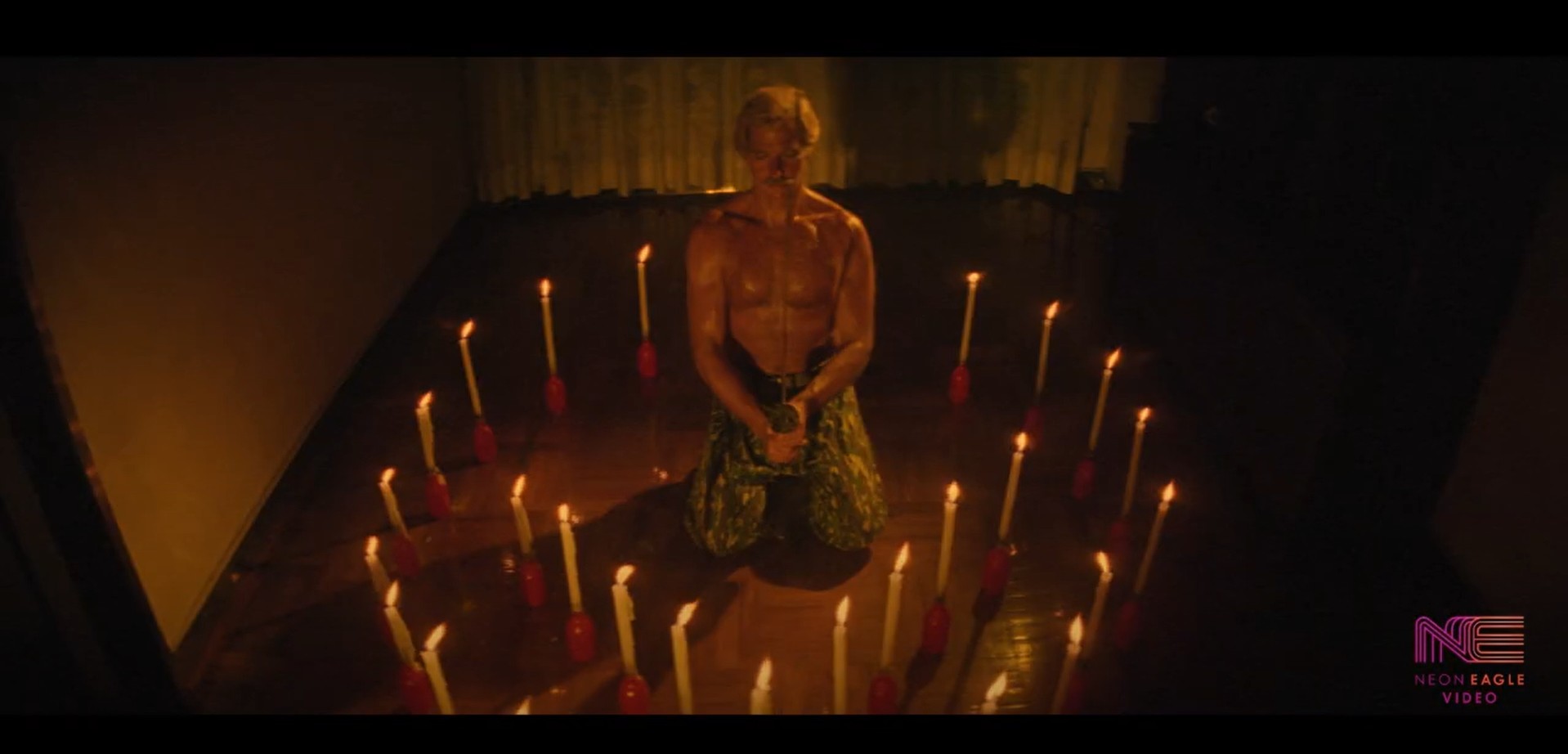
The Golden Ninja Warrior is the corrupt Ninja Empire’s most valued and powerful artifact with mystical powers to whomever posses it’s three pieces, granting them near invincibility against enemy attacks.  The Supreme Ninja leader displays the power of the golden bust, resembling a beastly torse and head wielding a katana, to three of the Empire’s Ninja Masters – Tamashi, Baron, and Harry.  The three Ninja Masters betray their supreme leader, each stealing a piece of the statue for their own intent and purposes.  With one piece back in the hands of the Supreme Ninja leader after Tamashi’s demise, the now crime boss Baron seeks Tamashi’s piece and will do anything, and kill anyone, to get it with the aid of his cruel right hand man Tiger Chan.  Meanwhile, Harry resigned from the Ninja Empire to reform the organization’s criminality but has been unearthed by the Empire’s Supreme leader with an ultimatum to return the pieces of the Golden Ninja Warrior.  With the help of his cocky and confident partner, Jaguar Wong, Harry and Jaguar investigate into Tamashi and his brother’s death, try and protect their surviving sister from those looking for Tamashi’s piece of the Golden Ninja warrior, and defeat any Baron or Empire warriors that stand in their way.
One of the numerous released Godfrey Ho productions in which the director shot new scenes with Caucasian, abroad actors and edited them into an pre-existing film his company owned the international rights.  “Ninja Terminator,” a bestowed title at the height of James Cameron’s highly popular cybernetic, time-travelling thriller “The Terminator,” is the 1986 Hong Kong feature that breathes new life into the South Korean,1984 released, martial arts gangster film “Uninvited Guest” as Ho splices new additional footage to create his own, half-cocked storyline for a cost-effective ninja themed film starring a recognizable white actor.  Ho writes and directs the IFD Films production that’s produced by Ho’s makeshift Ninja feature team of Betty Chan (“Ninja Strike Force”), Joseph Lai (“Full Metal Ninja”), and Steve Kam who regularly took popular U.S. tiltes and integrated them into their own for advantageous marketing.

Where to start with actors and actresses?  Two films shot in two completely different times with renamed characters and additional characters in a jumbled-up mesh of a ninja film.  Lets start with Richard Harrison, an American actor with muscles and good looks who couldn’t quite land the parts he wanted in his home country but found lead man success in other parts of the world, especially in the filmic industries of Italy (“Orgasmo Nero,” “One Hundred Thousand Dollars for Ringo”) earlier in his career and, in this case, Hong Kong (“Inferno Thunderbolt,” Diamond Ninja Force”) later in his career collaborating a handful of times with filmmaker Godfrey Ho.  For “Ninja Terminator,” Harrison isn’t a stealthy cybernetic ninja master but rather an idealistic, benevolent ninja master sporting a unique camo ninja-yoroi to, I guess, blend in around his home and urban environment…?  Still, the camouflaged attire has to be more clandestine than the hot red ninja-yorois of the Ninja Empire.  At least fellow western actor, Jonathan Wattis, as one of the three ninjas who stole a piece of the Golden Ninja Warrior statue and became a crime lord himself, donned a near traditional, black-dyed ninja garb.  Harrison and Wattis do the best they can being spliced into Jack Lam’s film “Uninvited Guest.”  Reconstructed or replayed to be named Jaguar Wong, for his character’s Jaguar fighting style, Jack Lam bests Wattis and levels with Harrison for screen time as a fellow principal lead despite the 2-3 year difference between principal photography but Jaguar fits in aptly enough into an inept chaos of a near nonsensical ninja narrative that jumps to inconclusive subplots with little connective tissue to the core plot.  Maria Francesca, Jeong-lee Hwang, James Chan, Simon Kim, Phillip Ko, Keith Mak, Tae-Joon Lee, Nancy Chan, Gerald Kim, Andrew Lee, and Eric Leung costar.

Cheaply made knockoffs and spirited, gung-ho capitalizing on popular film titles saw fists-of-fury in Hong Kong circa 1970s through the 1980s, much the same way the Italians also didn’t believe the copyright laws when they too took advantage with unofficial sequels, especially in the horror genre.  “Ninja Terminator” is obvious one of those projects and the sly Godfrey Ho manipulated the international market to garner new public interest in what is basically an old film with additional scene, a scheme done pretty much on the regular in various countries, even in the United States.  However, “Ninja Terminator” is not a good movie but rather a hilariously bad one weighed down by irrelevant offshoots to flesh out a scantily structured half-script.  With the additional scenes of Richard Harrison and the others spliced in, plus Jack Lam’s one-man army showdowns against henchmen and sub-bosses, the combat saves “Ninja Terminator” from full frontal embarrassment with competent choreographed fights, plenty of sword, ninja star, and ninja trickery play, and a fair amount of acrobatics, even if some of the scenes are just gratuitous cartwheels and flips in an ostentatious display of skill and of trying to raise the value of a low-budget production.  Granted, there are no cartwheels or flips in Jack Lam’s storyline, nor is there a single ninja, but Lam’s take-on-the-world scenes are confidently hip for the period and that is the jelly to the bold Ninja peanut butter that makes “Ninja Terminator” work on an amusingly bad level. 

Neon Eagle Video, a subsidiary label of Cauldron Films that focuses on the best of the worse of Asian cinema, scour the globe and deliver the best and authorized reproduction of “Ninja Terminator” on Blu-ray in North America, restored from a 4K scan of the original negative and presented in its proper anamorphic widescreen aspect ratio of CinemaScope 2.39:1. I must agree with Neon Video Eagle that this transfer renders the cleanest and clearest reproduction to date, likely ever, in this compilation of source materials to render a corrective, singular 4K scan. The AVC encoded, 1080p high-def resolution, BD50 offers ample storage to limit or squash any compression indelicacies on an already delicate Godfrey Ho production that’s been bootlegged to bastardization for decades. Corrected color timing sizes up the landscape, the mise-en-scene elements, and the characters too with a diffused scheme that holds firm vibrancy across an early 1980’s hip and preppy Japanese fashion. The audio is a forced English dub with an encoded LPCM 2.0 mono. The ADR definitely is seen and sounded as expected with total unsynchronized lips and dialogue, especially when the story is forged from splitting two films into one. What’s also evident amongst the three-prong, rough-and-ready sound design is the unrealistic fighting sounds, overzealous and overexerted to be more like the Hong Kong Kung-Fu movies of the decade before. The last element is the soundtrack that’s got some funk and groove in its ninja-yorois that likely borrowed and repurposed from another Godfrey Ho production to fit this particular need. Optional English subtitles are avaialble.. Special features include brand new material, including an audio commentary by Kenneth Brorsson and Phil Gillon of the Podcast on Fire Network, a second audio commentary by Asian film expert Arne Venema and Mike Leeder, an interview with director Godfrey Ho Ninja Master discussing the popularity of ninja films in the United States and the appropriation of the “Terminator” title as well as touching upon Richard Harrison and his onboarding onto the film, a second Godfrey Ho interview alongside separately dubber Simon Broad Golden Ninja Dubs discussing the quick and loose ADR of Hong Kong cinema, an interview with “These Fits Break Bricks” co-author Chris Poggiali Ninjamania, and the trailer. Neon Eagle Video’s standard release, showcased inside a clear Blu-ray Amaray, presents new artwork by graphic artist Justin Coffee. The reverse side of the cover holds the still capture composition of the original one-sheet. No insert material included, and the disc is pressed with the same Coffee illustration. The region free disc has a runtime of 90 minutes and though not listed as unrated, the film is surely such.

The First Authorized Blu-ray of “Ninja Terminator” Now Available!

Three Million and Staying One Step Head of the Cops is EVIL’s Masterplan! “The Cat” reviewed! (Radiance Films / Limited Edition Blu-ray)

“The Cat” Limited-Edition Blu-ray From Radiance Films Now Available!

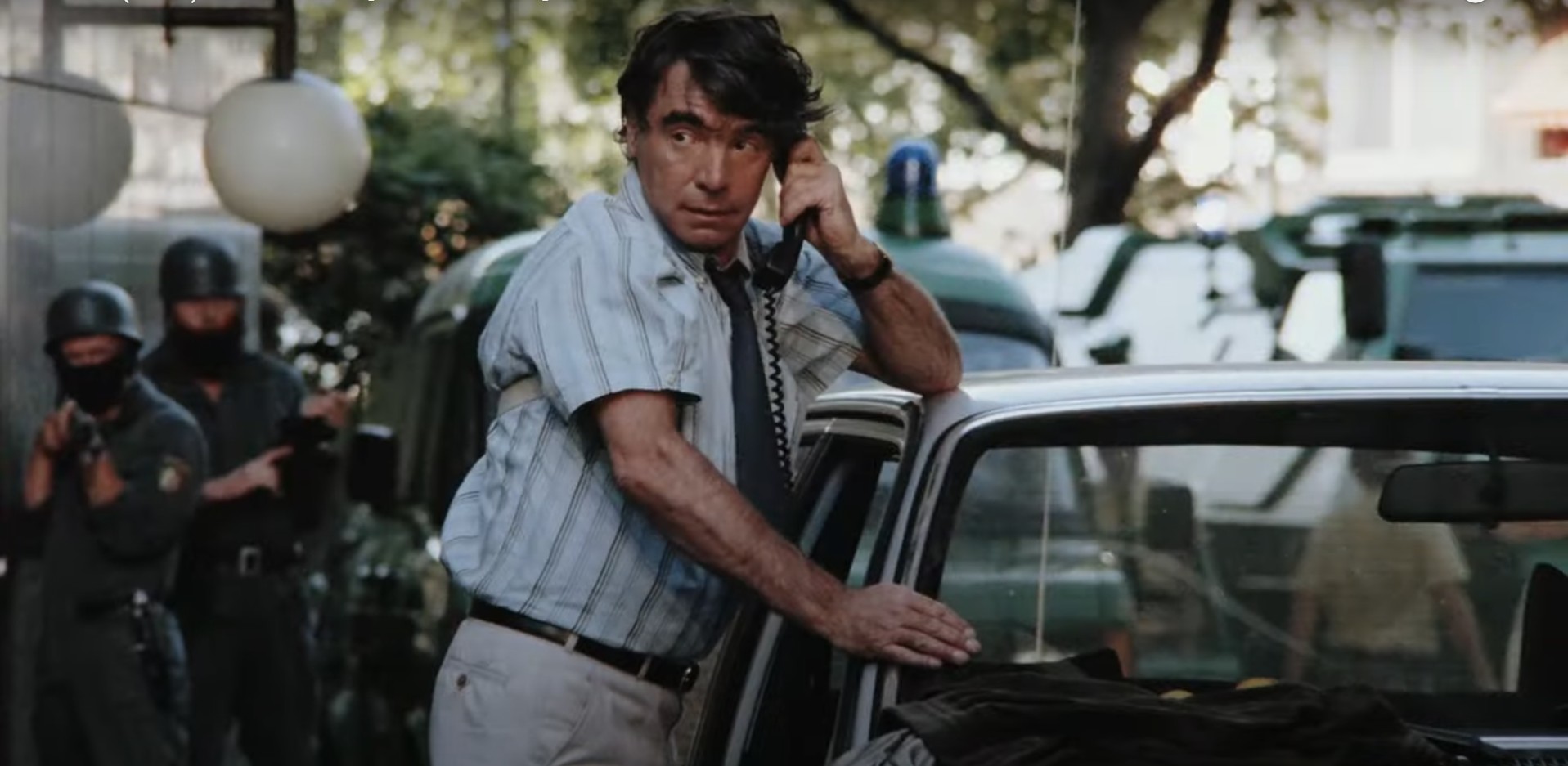
Two ex-cons hold up a Düsseldorf bank for 3 million German marks.  Armed with handguns and brazen with their daytime theft, the two men hold hostage a handful of alarmed employees, rounded up before the bank opens for business, including the bank manager.  Going into the heist with a money figure in mind, the vault is discovered with only 200,000 inside, but that was to be expected as the arrival of the police surround the building adjacent to the towering Nikko Hotel where a third man, the mastermind, spies down from one of the upper floors, instructing the two armed men inside of his plan as well as spying on the police activity aimed to thwart the robbery.  Always one step ahead, police, bank employees, and even the bank manager’s wife are all a part of the organized crime for the riches, and maybe even exact a little retaliation in the process too. 

The 1988 released, German crime-thriller “Die Katze,” or “The Cat,” is an intense ruse engrained with deception, affairs, and a saturated with emotional weight.  Helmed by directed Dominik Graf (“The Invincibles”) put the Munich-born, drama-comedy filmmaker to the test with the Christoph Fromm script, adapted from the 1984 novel Uwe Erichsen, entitled Das Leben Einer Katze, aka The Life of a Cat.  “The Cat” would be Graf and Fromm’s second feature together who, four years previously, collaborated on the slice of life for carefree, bike friends suddenly finding themselves in the unemployment lane of “Treffer” and who would then go to after “The Cat” with the gambling comedy “Spieler” two years later.  “The Cat” is a production of Bavaria Film and Zweites Deutsches Fernshehen and is produced by George Feil and Günter Rohrbach (“Das Boot”), shot on location at the Hotel Nikko in Düsseldorf as well as in studios in Munich.

“The Cat” contains a hierarchy amongst the thieves with Britz (Ralf Richter, “Das Boot,” “Sky Sharks”) being at the bottom as a hot-headed hired gun, Jungheim (Heinz Hoenig, “Das Boot,” “Antibodies”) is next step up as the managerial ex-con looking to score big with reprisal, untamed purpose, and, lastly, the only man who can keep Jungheim from spiraling out of control and the spying eye from the tower radioing orders is the mastermind behind the heist plan with a calm as a cucumber demeanor and a cool cat, or katze, finesse and his name is Probek (Götz George, “The Blood of Fu Manchu,” “Scene of the Crime: A Tooth for a Tooth “).  But, as we all know and as the old proverb goes, there is no honor amongst thieves, yet Graf’s filmic adaptation does instill some counterbalance against that adage by keeping a sliver of diligence within their circle but there is an underlining truth well-hidden under-the-table, only informing those down the ladder what they need to know, when they need to know.  As tension ebb and flow from each personality type, throw into the mix an equivocal loyal woman (Gudrun Landgrebe, “Rosinni”), an intelligent officer in charge of hostage operation (Joachim Kemmer, “The Vampire Happening”), and a stubborn and quick to catch-on bank manager (Ulrich Gebauer) and the ensembles ensues an edge of your seat volatility elevated by the steadfast performances with the actors unhinged and let loose to exact their roles.  With lots of moving pieces to the characters’ actions, supporting parts are key to the success, adding flavor to their persona types and unravelling more about who they are and how audiences are supposed to perceive them as either friend or foe.  Sbine Kaack, Heinrich Schafmeister, Claus-Dieter Reents, Iris Disse, Water Gontermann, Bernd Hoffman, Uli Krohm, and Klaus Maas co-star. 

Hardboiled in a game of pursuit and evasion, Dominik Graf finds without difficulty the essence of Uwe Erichsen’s thrilling crime novel staying mostly in one location, evolving the story as the police try every trick in the book to thwart who they believe to be ordinary bank robbers and as the confidence, and perhaps a little brazen cockiness, slowly builds self-assured success. This constant stream of checks and balances between the hard focused, unobservant antitheft division of Germany’s finest and the cooperative crooks consisting of brawns following instructions of the brain keeping ahead of a fate less fortunate never lets down, never idles, and never diverts attention. “The Cat,” in a way, feels very much like 1988’s “Die Hard” from director John McTiernan, a steady source of one-upping the good guys peppered with moments of unvarnished, graphic violence and dark, unforeseen levity, minus a lone wolf John McClane hero behind enemy lines. The very opening scenes of Götz George and Gudrun Landgrebe engaged sexually are raw, sensuous, and sweaty but are under top a jaunty soundtrack that mismatch the heat of the moment in its cheerful, breezy Eric Burden and the Animal’s tune “Good Times,” a track with lyrics that speak of regrets of negating better moments with unsavory choices finds more of a potent meaning at the gun blazing finale where facing death is an inevitable outcome for one’s poor decisions.

UK label Radiance Films releases “The Cat” in the North American market for the first time with English subtitles in a limited-edition Blu-ray with a Dominic Graf approved high-definition transfer, newly graded by Radiance Film, onto an AVC encoded, 1080p, BD50. While the heist concept may be familiar conceptually to “Die Hard,” the look of the film also has that natural grading of “Die Hard” as well with Radiance infused punctuations on skin tones with a natural hardness. The print used was a digitized file, likely already spruced from an extracted print used by Euro Video in 2017, but Radiance retains the organic grittiness as well as the grain in their own sprucing up that sees a muted hues appear more intense. Presented in a widescreen 1.85:1 aspect ratio, I’m curious to know if “Die Katze” was cropped in post to avoid nudity in the love scenes between George and Landgrebe that appear stretched with more pixelation and are oddly framed, as if portions were sliced off and positioning did not change. The German audio mixes include lossless DTS-HD 5.1 Master Audio and a stereo 2.0. The surround mix lets loose and gives way to all to all of “The Cat’s” range in securing side and rear channels with ambient police activity, fireball explosion crackling, and the echoing of cavernous settings juxtaposed against more intimate and cozy locations. Dialogue renders clear, robust, and prominent with a seemingly errorfree, newly translated English subtitle synchronicity albeit the pacing being a little rapid. No signs of compression issues nor any print damage or unpleasant hissing or crackling. Special features include new German-languaged, English subtitled interviews with Dominik Graf, screenwriter Christoph Fromm, and producer George Feil, a scene-select commentary with Graf, and the film’s trailer. Like the rest of Radiance’s catalogue, “The Cat” comes with a clear Amaray with an OBI strip overtop the reversible cover art. The reverse side displays the original home video and poster art. A 19-page color picture booklet features an essay by freelance culture writer and film critic Brandon Streussnig All the Good Times That’s Been Wasted, plus cast and crew credits and transfer information and acknowledgements. The region A/B encoded playback release has a runtime 118 minutes, is not rated, and is limited to only 3000 copies.

Last Rite: A masterful crime thriller, “The Cat” claws away the fuss to unsheathe realism and Radiance Films delivers the Germanic, harrowing heister in all its glory with a Hi-Def release.

“The Cat” Limited-Edition Blu-ray From Radiance Films Now Available!

All Evil Wants is to Make Art! “Bag Boy Lover Boy” review!


Albert’s just another lowly speck among the multifaceted masses of New York City. The lonely street hotdog vendor barely scrapes by in what could be considered a life, earning next to nothing to keep him on life support in the city that never sleeps. To impress a beautiful girl, a girl of his dreams, Albert accepts a position offered to him by an eccentric photographer and hopes to learn about creating art with a single click of a photographic camera, but Albert becomes the obsessive fixation of the photographer’s next breakthrough exhibit. Albert’s simpleton nature and the photographer’s edgy intensity pushes the aspiring artist to lure women into offbeat modeling sessions in the away photographer’s NYC flat. When he can’t retrieve the inspirational art out of his models, a frustrated Albert goes to extreme lengths to ensure his art is performed to his particular, elementary taste.

“Bag Boy Lover Boy” is the 2014 inaugural feature film debut of director Andres Torres who is one of the few directors out of countless others able to resuscitate the compellingly frightful grit of New York City long ago. I’m talking about the era of pre-Rudy Guiliani New York City in the 1980’s where graffiti splayed walls and the blue fluorescent of dilapidated charm was present on every grid blocked street. Torres, along with co-writer Toni Comas, supplements one of a kind character personalities very appropriate to inhabit the sinister ladened Big Apple. Characters who aren’t dolled up or even genuinely beautiful. Those characters who are easy on the eyes don’t have the inner soul to match, residing in them an defect of some sorts that makes “Bag Boy Lover Boy” feel all too real.

Jon Wächter, a director-actor with behaviors not too alien to that of his character, centers himself as that very bag boy, lover boy of Albert, the awkward citizen with a one track mind and living to fulfill no dreams, hopes, or goals. Wachter owns his role by giving no hints of aspiration to fortune or achievement until Albert meets the cynical Ivan, appropriately casted with New York City-based actor Theodore Bouloukos, is able to hone in on the streets’ muckiest ground level and incorporate a Ron Jeremy charm that’s shrouded sleazy, but devilishly smart. Ivan draws out of Albert a simple interest, a hope to create art through photography, but Ivan has other, more prosperous, plans for the gullible nitwit as model in his own artwork. Albert’s mind focuses solely on photography and not modeling, placing Ivan in a rather haste position to con his centerpiece with poor words of self-worth advice and filling Albert’s head with misogynistic directions when Ivan goes through his rather rough motivational spiel during shooting gigs. Albert then can’t separate reality with his newfound dream that puts “models,” played by Teena Byrd (“Ninja Versus Vampires”), Sarah O’Sullivan, and Adrienne Gori, in harms path. Kathy Biehl, Karah Serine, Tina Tanzer, Marseille Morillo, and Saoko Okano make up the rest of the cast.

What I found most interesting in Torres film is Albert’s perception of himself. After a couple of, what he thinks are successful, shoots with the women he lures and drags up to the Ivan’s flat, Albert perceives himself as this eminent rockstar, exhibited very boisterously in a fantasy scene within Albert’s dingy one room apartment. What’s really ironic about the whole story is that Ivan honestly could deliver every bit of the wealth, women, and respect he promises to Albert and with these promises, he could obtain Lexy, the girl he hopes to win over, but with such a narrow mind, unable to go beyond to foresee a positive future, Albert self-destructs into infamy with only some non-permissive nudity polaroids to show for it. Torres and Comas Shakespearean-like comedic tragedy concept is a consistent conundrum for each and every one of us, not just the slow and low like Albert, but for us who think in the short term, despite whether what we accomplish now might not be a desire or may not be our sole purpose in life. Even peering into Albert’s erratic, overly-exaggerated, if not visually stimulating, mind stories are not to different from what perhaps the rest of us experience.

Severin Films presents the EXU Media production of “Bag Boy Lover Boy” for the first time on DVD and Blu-ray home video. The region free, not rated, gorgeously illustrated Blu-ray is presented in full HD 1080p. The image quality boasts vibrant colors and really exemplifies the naturally gross visual aspects of New York City streets. Various skin tones come out nicely unfiltered and untouched, especially the pasty Wächter and the olive skin of Tina Tanzer, with only brief moments of filters to accentuate subversive content. The dual channel English stereo isn’t half bad. Even though English is not Jon Wächter’s first language, the Sweden-born actor’s dialogue is clear and coherent. The rather mixed bag soundtrack and the Barbara de Biasi score have boastful fidelity and remarkable clarity. Extras include a meaty audio commentary from director Andres Torres, Theodore Bouloukos, and editor Charlie Williams, The Student Films of Actor Jon Wächter: “Got Light” and “The Never-Starting Story,” and the film’s trailer. “Bag Boy Lover Boy” is surrealistically realistic while being slightly exploitive and courageously risky. A satirical film with the proper fortitude to challenge our judgements about life and the paths chosen while leaving an uncomfortable aftertaste of profligate opportunities. Torres also leaves with us a film that we’ll never forget.

Buy “Bag Boy Lover Boy” at Amazon!