EVIL Has an Unbreakable Glass Ceiling. “The Five Rules of Success” reviewed (Ambassador Film Group / Digital Screener)

Upon his release from a long prison stint, a man incarcerated into the system since a young boy tries his hand succeeding in the outside world.  Alone with no family or friends for support and looking to keep his nose clean, he designs his own set of rules for success, including responsibly checking in periodically with his hardnose parole officer and saving up enough money and knowledge working at a restaurant to open his own.  When the path seems clear and everything seems to be falling into place for his chances as success, societal temptations gnaw at him as negative influencers tempt to steer him astray and his own goals try to illicitly fast track his efforts.  Will he fall into crooked society’s trap or will he persevere to reach his aspirations? 

Hard knocks.  That’s the simple, raw core theme of Orson Oblowitz’s “The Five Rules of Success.”  The 2021 crime-thriller is the third directorial from the “Corbin Nash” co-producer, but the second penned script following his debut, a seedy L.A. underbelly thriller “The Queen of Hollywood Blvd” from 2017.  The story is the first for co-writer Christian de Gallego who steps out of his international sales executive role to put his ideas onto paper.  As compelling as any story could be mirroring the struggles of a downtrodden ex-con in a society that browbeats and takes advantage of those on good intentions to rebuild, “The Five Rules of Success” is also a visual quest of imagery and color, produced and distributed by the Ambassador Film Group with de Gallego producing and Apurva Patel as executive producer. 

Stepping into his lead man shoes debut is Santiago Segura (“47 Meters Down,” “Scream: The TV Series”) playing the mastermind behind the five rules of success as X, as in X could be anybody.  However, X couldn’t have been more invested into than what Segura put into the story’s character as a man left to his own devices, without support, without a comforting presence, and without much guidance.  Segura’s range is limited to a monotone stare and tough guy attitude that never wavers or breaks and you have to wonder what X is fighting for to make his ambitious dream a reality?  Where does his determination root?  The fact that there is an absence in a grounding, sobering symbol all the more makes X more susceptible to the deeper end of society’s morality pool.  Along his rise up from the ashes, X meets colorfully sordid individuals feeding off his vulnerability due to either being on probation or stereotyped as being inclined to be favorable toward criminal activity…you know, being released from prison and all.  He’s befriended by Danny (Jonathan Howard, “Godzilla:  King of the Monsters”), a drug using goon who works alongside X at his father’s restaurant.  “Crocodile 2:  Death Swamp’s” Jon Sklaroff plays the stark contrasted Greek immigrant father, restaurant owner, and disappointed father to Danny.  Sklaroff and Howard couldn’t be more adversarial as a hardworking immigrant father who struggled to get to where he is today and a silver spoon fed son throwing his life away with riffraff, drugs, and as the restaurant’s cook.  The relationship formed between X and Sklaroff’s character is the wishful dreaming that X couldn’t be the son he never had and all X has to do is be patient and listen to a little friendly advice.  A more brazen and mysterious obstacle in X’s path is his parole officer, Emma, whose uppity authority holds X’s freedom in the palm of her hand played by Isidora Goreshter.  The line is blurry whether Emma has either the hots for X or is secretly a sadist and Goreshter offers to uphold that inscrutable presence with unscrupulous tactics. 
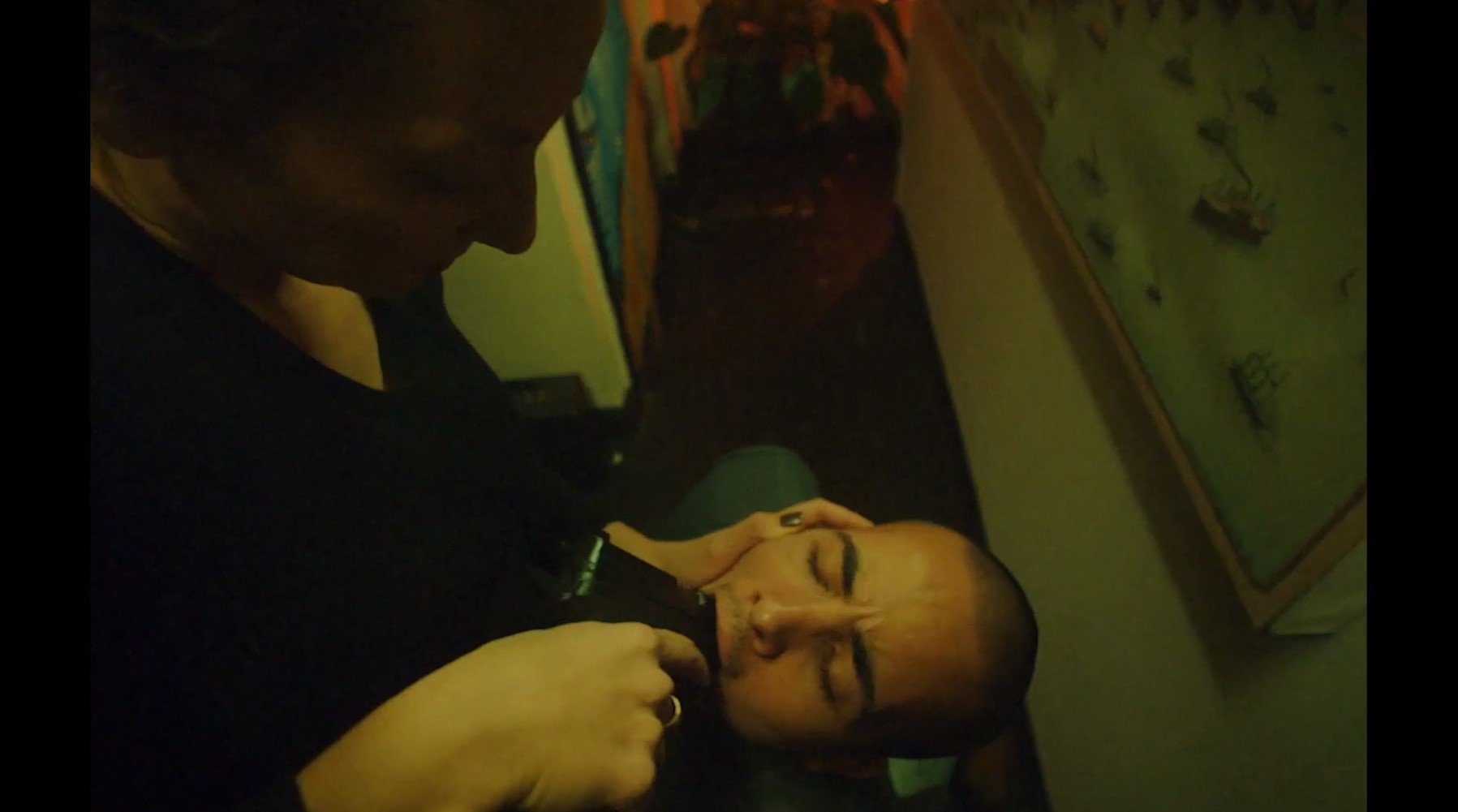
One way to crave out the meaning behind Oblowitz’s film is to not be standing high-and-mighty on greener pastures.  “The Five Rules of Success” sensationalizes real time problems with our prison system and the after effects of walking out a free man after years, if not decades, from a life that’s all you know to a life you know nothing about.  X’s past burdens him immensely as flashbacks, denoted in literal quick flashed cuts, of the downward spiral turning point in his childhood find their way into his determined route to success.  Ultimately, the past and present are one in the same where society sees not a boy, not a man, not a person, but a criminal and how we as a society be contemptuous of former convicts released back into our soicalled perfect public community.  There’s parallelism between each chaptered rule and the downward progression he sustains in his associations with the wrong people that start to twist his mindset, his rules, into the very unlawful reprehensible activities he tries very hard to avoid. Oblowitz does a nice job detailing X’s habits as a loner, working out his pent up frustrations by exercising, shadow boxing, and refining his rules, but the root of all evil is hard to ignore as cold hard cash, easy money for one of Danny’s illicit jobs, begins to lay out the possible steps to skip in order to fulfill his own ambition.  Despite the momentary monotone mishandlings from Segura, the story is well-written and mostly well played out with some scenes more intense than others with the subject material as you begin finding yourself rooting for the ex-con and booing the very society you yourself live in scot-free. 
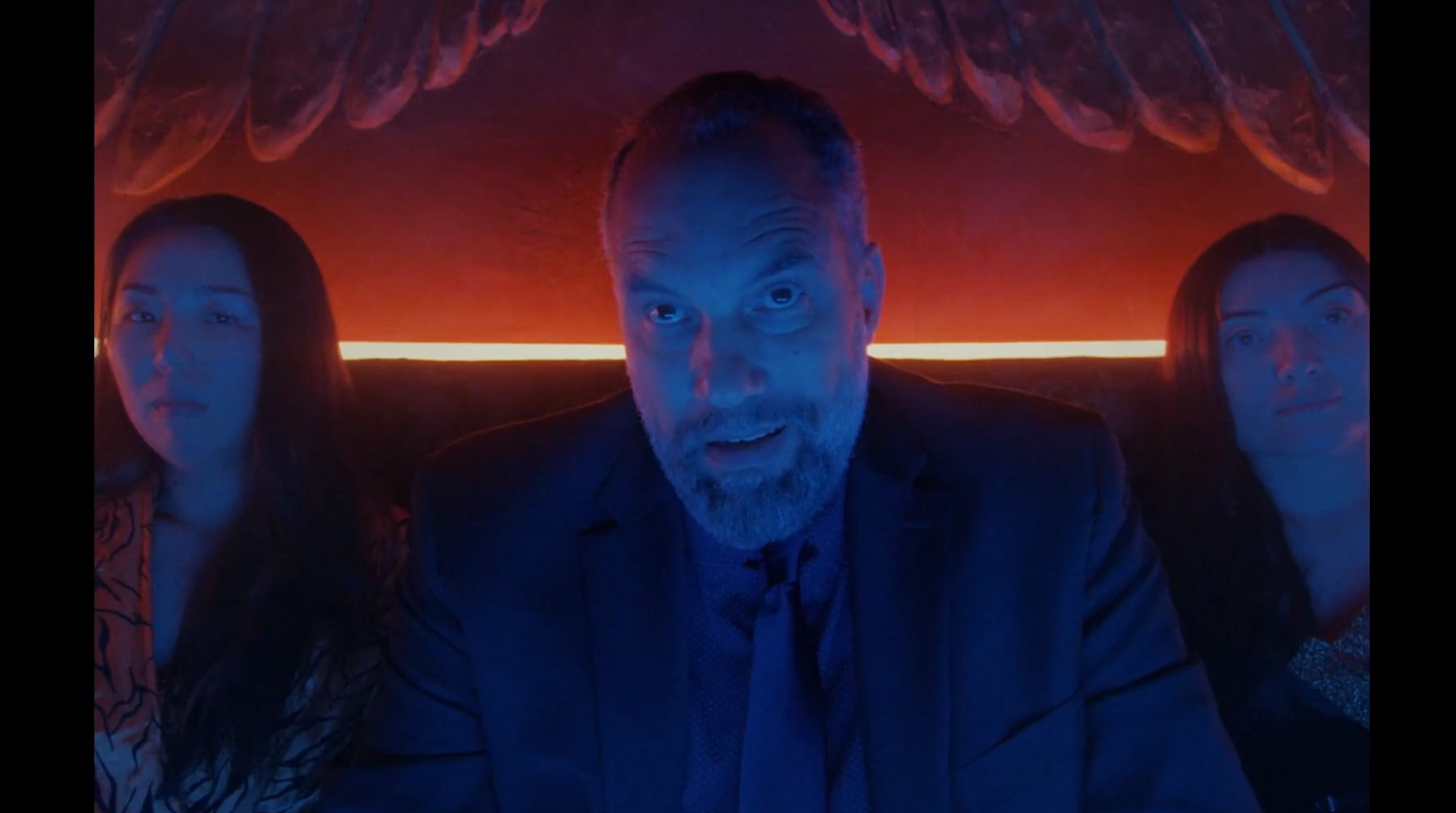
Clocking in with a runtime at 83 minutes, “The Five Rules of Success” symbolizes the ups and mostly downs in the here and now game of chutes and ladders.  Having been released last month, July 30, be sure to check out the unrated feature available for purchase on your preferred platform of either iTunes or Amazon released by the Ambassador Film Group.  Oblowitz doesn’t just write-and-direct the film, but he also serves as cinematographer dabbling in a Kafkaesque arranged world with hints of tint, hints of different lenses, hints at overexposures, hints at strobe, and more.  Nearly every scene is comprised of a different shooting technique or editing visual that may or may not possibly induce a seizure as forewarned during the preface.  Stylistically, I can only compare and describe “The Five Rules of Success” as this:  Stanley Kubrick’s “2001:  A Space Odyssey” meets Darren Aronofsky’s “Requiem for a Dream.”  As far as extras go, there’s a quaint, no major dialogue memorandum scene after the end credits that speaks to vicious circles and permanency.  For a L.A. shot film that has more technique than bite, “The Five Rule of Success” is a success of an auteur’s written storytelling as well as the visual understanding of just how to tell that story in a surrealistic context. 

Rent or Buy “The Five Rules of Success” on Prime Video!

The Unspeakable Evil That Drugs Do to Your Body! “Red Krokodil” review!


“Krokodil is a homemade drug. It combines codeine, lighter fluids, gasoline, paint thinner, alcohol, and other ingredients.” This fast growing Russian street drug gnaws along the inner layers of one man’s insides and clawing its way out. Also, the drug deteriorates his mental stability, invigorating extreme hallucinations from his damaged cerebral equilibrium and manifesting faux body images of himself as well as inviting humanoid demons into his tattered reality. The powerful opioid, if fabricated haphazardly, induces prolonged and deathly ill effects, both physical and mental, and as his body has survived in a post-nuclear world, his mind is as much of a ramshackle as the rest of the world is in ruin. As he spirals down, out of control, through the opioid rabbit hole, he becomes only a shell of himself, transforming into the purest toxicity of the drug that creates alligator scale-like sores over portions of his body.

The need to put the definition of Krokodil” first and foremost, in front of the plot summary above, felt necessary. Director Domiziano Christopharo made it essential to do the same prior to the credits of his 2012 film “Red Krokodil.” To the average joe, the very mention of “krokodil” means nothing other than a seemingly skewed, alternate version of the English word crocodile, but the gore and shock director, best known for his debut work “House of Flesh Mannequins,” wanted the background behind the street drug to sink in, to be injected, to be snorted, and to be smoked before audiences continue with their trip through the breakup of the body. Based off a script written by Francesco Scardone, the Italian director had set the stage with his grippingly ghastly tale telling talents toward the dominion of body horror combined with ample psychological manipulation from substance abuse and while Christopharo is no David Cronenberg, the eclectic filmmaker cycles the story through a poetic flow with mostly an off-screen monologue approach that gives glimpses of a degenerative mindset.

Co-producer of the film, Brock Madson, also stars as the withering drug addict. There are hints Madson plays the character named Arthur, but the film only credits the character as simply him, and theoretically, that’s proportionate to the storyline staged as a post-apocalyptic world where it’s just him, ensnared and isolated. The role’s non-verbal role leaves Madson to go full-throttle in physicality with a semi-to-fully nude performance and he maintains an animated disconcerting fear and aloof glee whenever the moods start to swing. For most of the duration, Madson is solo, but a couple of minor characters, fabricated by his addiction, freakishly gloom over him. Viktor Karam, as the Bunny Man, and Valerio Cassa, as the Monster, positions themselves as enduring internal calamities that plague the Madson’s character.

“Red Krokodil” is laced with themes and symbolism, especially in a religious sense with the resurrection of Jesus Christ that parallels the trials and tribulations of the addict, mainly with going through the withdrawals. In order to save himself to be reborn, he must first sacrifice himself and Madson literally dons the crown of thorns and self-inflicts a stake through his feet. However, this self-crucification is all in his head, but when he awakes he’s able to ignore the heavily influential calls of the krokodil. Christapharo had kept the addicts apartment a dull, colorless prison, growing with filth and decay, but once the addict has saved himself, the room brightens, the outside sky has illuminated, and the near-death abuser has a little life left to be jovial, but to keep the grim themed tone against this man’s struggle to live through strife, Christapharo invokes false hope that ultimately becomes the addict’s concreted freedom from it all. The addict’s inner monologue goes through the steps how recovery, rekindling good memories from the past and wanting to not feel himself as it’s painful to feel your own skin be on fire from the corrosive drug, but rather be a personification of the wind, sun, water, or the grass, an element of the film that touches upon how humans mistreat the Earth much like they mistreat their bodies.

Unearthed Films and MVDVisual present “Red Krokodil” on a director’s cut, high definition, 1080p Blu-ray. Sporting a macabre, yet gorgeously illustrated cover, the release also has the same attributes in the image quality presented in a widescreen 1.85:1 aspect ratio. Like most film distributed by Unearthed Films, the grime and the disgusting reign as supreme and “Red Krokodil” has ample muck with bleeding orifices and an unappetizing uncleanliness about it, but the picture quality is clean and detailed with very little electrical interference. Color palettes, when the addict dreams to escape to nature, is a potent reminder that “Red Krokodil” isn’t just transmitting two-toned, gray and black, scale and displays exquisite landscapes. Even the computer generated Chernobyl like waste land of a city going up in an atomic fashion is well done with only a slightly glossy feel. The Dolby Digital 2.0 track broods with the ideal amount of LFE from composer Alexander Cimini that’s not acutely jarring, but still manages to showcase the detriment. Bonus material includes an alternate musical ending, deleted scenes, photo gallery, the CGI test of the nuclear explosion, teaser trailer, two theatrical trailers, and Unearthed Films tailer reels. “Red Krokodil” is a total out of body experience. Overwhelmingly brutal with muscular and mental breakdown, director Domiziano Christapharo’s indie picture of ill-effects of drug abuse has done what “Requiem for a Dream” has done for the mainstream with the matter-of-fact implication that manufactured street drugs are the purest evil that we could voluntarily do to sabotage ourselves.

Buy “Red Krokodil” from Amazon today!

Subliminal Evils Slithered Inside Your Head! “The Holly Kane Experiment” review!


The questionable techniques of radical psychologist Holly Kane have been effective in redirecting and controlling unconscious thoughts through sensory deprivation. Facing potential legal trouble even after a successful Hospital procedure, Holly Kane turns to the offer from Marvin Greensdale, a wealthy and well-known psychologist seeking to employ Holly for clinical trials that would lead toward legitimizing her practice. In conjunction, Holly begins a romantic relationship with an admiring Dennis MacIntyre as her life and her life’s work have seemingly taken a turn for best, but as soon as she starts the clinical trials, Holly begins experience hallucinations and hearing whispering voices and she fears that her despondent and bleak family history of mental illness might be catching up with her or is it something else that’s covertly sinister?

Between Brighton and London is steered a conspiracy-riddled thriller entitled “The Holly Kane Experiment from a father-son filmmaking duo, writer Mick Sands and director Tom Sands. The filmmakers behind “Backtrack,” aka “Nazi Vengeance,” go deeper into the mysteriousness of subconscious cauterized by a fleshy cloak and dagger aspect layered thick, chillingly dense, and richly dark. Tom Sands invades the personal space of the senses by introducing sensory disrupting attributes in the same vein as Darren Aronofsky’s “Requiem for a Dream,” but Sands then diverts away from a snowballing psychedelic thriller to an undermining exploitation on a clandestine level.

Kirsty Averton stars as the titular character, the obsessed and isolated psychologist looking for answers inside the depths of her own mind. Averton performs well as the highly stern and fiercely focused Holly Kane and the English actress has a body to match. That’s remark is important to the story because with her beauty, the story would take an entirely different angle with her Holly’s employer, and lust admirer, Marvin Greensdale, played faultlessly by long time actor Nicky Henson (“Psychomania”) who flourishes an distinguished socialite whose more charming than aging youth. Also in the mix of the love triangle, James Rose makes his feature film debut as Dennis MacIntyre, a man trying to forget his past when he meets the beautiful Holly Kane. If there was an ever an odd wheel or a black sheep in the cast, Rose fit the bill with his scruffy appearance, homeless attire, and the insecurity in his voice and in his acting. The Scottish native has a personal interest in this film as he is, according to IMDB, a graduate of cognitive hypnotherapy and psychology, which begs the question, did Rose provide professional consultation? Holly Kane’s exclusive drug dealer, a chemist graduate named Jeannie, falls on the shoulders of Lindsey Campbell who mirrors as Kane’s opposite. Jeannie’s free spirit attitude and candid drug use sets up the fitting actress to nearly be free of constraint and to act under a hallucinogenic state until she encounters trouble with Greensdale’s operative goon Carl Grower in a riveting information extraction scene. With a chiseled jowl and a gaunt look, Matthew Neal certainly has a memorable role that he intensifies with a heart piercing look through a thousand yard stare and snare so devilish that Carl Grower instantly becomes a character favorite, but the character lacks significant screen time and is limited to basically the third act.

“The Holly Kane Experiment” subliminally pushes out the true intention of the plot and turns massively psychosexual. Once true intentions are made light, a thick film of filth just washes over and that’s subtle, yet poignantly subversive. However, Mick Sands’ scribing of the dynamic between Kane and Greensdale’s licentious activity through the power of suggestion form complexities turned improbabilities. Basically, the story was unchallenged by the writing with characters falling for obvious scrupulous activity. Also, the undercooked character developed plays a bit part in denoting the true power of individuals and the wane in others. Like aforementioned, Holly Kane is obsessive, fierce, and maybe even a little paranoid, but the character is easily blindsided by the very first instance of opportunity for her technique, even if blotted by questionable motives.

Today, “The Holly Kane Experiment” premieres in the UK on digital platforms. The Substantial Films production is a drug-fueled, psychosexual thriller poised to spotlight brainwashing and be an anti-establishment picture, but doesn’t quite pass the finishing mark with a jerky storyline that disrupts and undermines the time and spatial impurities, leaving a discombobulated aftertaste. The finale is also disconcerting with an abrupt and dissatisfying ending to forthright explain where characters land and I’m talking about all the characters fates. Overall, “The Holly Kane Experiment” is worth the time despite the issues with jarring the mind and violating the body, bending both to do bidding against one’s will, and that alone is impressively fearful. You can learn more about “The Holly Kane Experiment” at the film’s official website – www.thehollykaneexperiment.com.