

Clay Riddell just landed in Boston after scoring a huge deal in New York involving concepts for his graphic novel. With all the cellphone charging stations occupied, Clay calls his estranged wife from a pay phone to speak with his son, but when the landline severs communications, that’s when it started. People on their cellphones turn into Phoners, murderous maniacs who tear through anyone in a destructive path mindless insanity. Clay, in the midst of panic, bumps into subway train conductor Tom McCourt and fight their way out of the city, barely escaping with their lives. Fleeing a burning Boston overran by Phoners, Clay is determined to track down his family in New Hampshire with the help of Tom and two teens, Alice and Jordan, but the Phoners are not just absentminded anymore as individuals start to flock together exhibiting the beginning signs of their telepathic network lending to something far more sinister than just temporary mayhem.

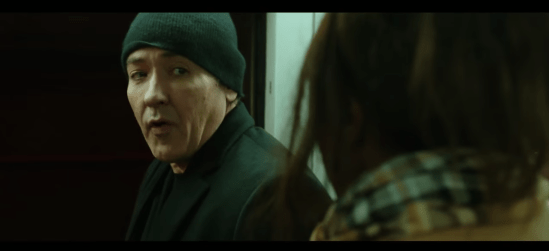
“Cell” is the feature film adaptation to Stephen King’s novel of the same title and reunites John Cusack with Samuel L. Jackson once again since their last costarring venture of King’s book-to-silver screen production of “1408.” King shares screenplay credits with Adam Alleca, who co-penned “The Last House on the Left” remake in 2009, and with “Paranormal Activity 2” director Tod Williams at the helm. From the first inkling of a “Cell” movie, back with Eli Roth was attached, the excitement couldn’t be contained as I read the Stephen King novel and was captivated by the unique story of mixed and varied human emotions and the uncontrollable yearnings to be a part of the collective through being electronically connected that ultimately becomes mankind’s undoing.
However, “Cell” was heading in the direction of certain doom from the moment Roth unattached himself from the project, sending “Cell” into the annoyance of limbo until a production company conglomerate formed to pull “Cell” from it’s stagnant state and attached Williams to direct. Yet once again, King’s beloved story goes into the throes of uncertainty with distribution after filming wraps in 2013. 2016 comes and Saban Films, along with Lionsgate , distributes “Cell” theatrically and within the home entertainment market respectively.

After all the monumental problems, I personally wanted to “Cell” to be one of the most entertaining and frightening horror films of the modern age, but as fate would have it, the Williams’ film disappoints. An film adaptation of a King novel needs more minutes to cover the story’s girth and “Cell” lacked pages of warranted minutes to be a full tell all for Clay, Tom, and the Raggedy Man. Portions of the novel were translated to the screen, but for the majority of the film, a rushed version of the story debuts to silver screen audiences that loses the book’s essence and dilutes character development, such as with Raggedy Man who has a sizable role in the book, but the character in Williams’ movie barely scratches the surface with being just a figurehead for the Phoners and not the collective’s soap box looming leader. The film started out great with intense chaos at Boston airport, pictorializing to life the Phoners from the King’s book with pinpoint precision, but from there on, the story’s time span goes vague whereas the book stretches out the length of time. Only a matter of two or three days does it seem the survivors jump from Boston, to the school, to the bar, to the story’s final location of Kashwak, but in reality terms and in the amount of devastation and character portrayal, weeks have passed.

The ending has been rewritten from a surprisingly mixed reaction to the book’s and yet, the unravelling of the finale does more than convolute matters when Clay finds his son. There lies almost a dual ending where one’s interpretation can be the film’s own storybook ending. Stephen King’s “The Mist” had an ending that, when compared to Frank Darabont’s totally new ending for the film, was totally inferior to Darabont’s and I feel like that’s the stage that was trying to bet revisited here with “Cell” and it just missed the mark completely. Not all changes are for the worst. Character Tom McCourt, whose white in book, went to Samuel L. Jackson who absolutely fits the role without question, nailing PTSD stricken McCourt with little emotion but with untapped hurt. If I ever had to choose an middle aged white actor for the role of Clay, John Cusack would be my first and only choice even before casting began for the film. I do feel like having a white Raggedy Man was purposefully steered away from social sensitivities with an antagonistic young black male in a hoodie. The cast rounds out with Isabelle Fuhrman, Owen Teague, and Stacy Keach (“Slave of the Cannibal God”).
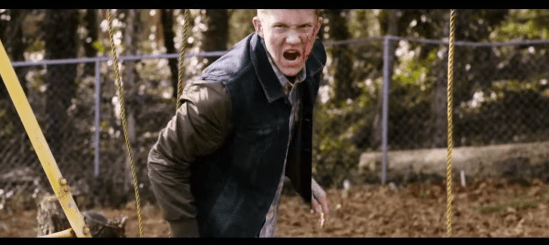
The digital visual effects were so poorly constructed and composited that I’m not surprised “Cell” didn’t have a longer theatrical run. The book had a number of jaw-dropping visuals the imagination could run with and now with seeing the depictions of those visuals on screen, they seemed seriously slapped together in such haste to where the devastating sensationalism turns inane and bland. King’s apocalyptic story warrants Hollywood scale effects, but received a few levels below that bar, failing to deliver major catastrophe on a world ending scale to the likes of “War World Z” or to cleverly style the film through a smaller medium such as George Romero accomplished with this first three “Living Dead” films.
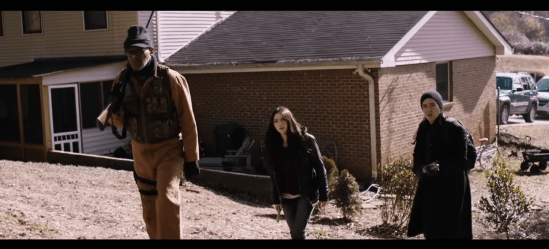
Lionsgate’s Blu-ray release is presented in widescreen 2.40:1 aspect ratio and the 1080p Hi-Def resolution becomes a disadvantage that clearly outlines the quality of the effects. The English 5.1 DTS-HD master audio is par for the course, but slightly in-and-out with dialogue that’s difficult to balance. The 98 minute feature’s bonus features includes an director’s commentary and “To Cell and Back: The Making of the Film” which is redundant if you’ve read the novel. Bottom line is if you’re fan of Stephen King’s novel, you’ll be sorely disappointed with Tod Williams’ “Cell” that’s nothing more than a long awaited entertaining rated-R apocalyptic horror with obsolete effects and with star-studded names attached to this Stephen King story adaptation.

Buy “Cell” on Amazon! Cusack and Jackson reunite!



 It's Bloggin Evil!