
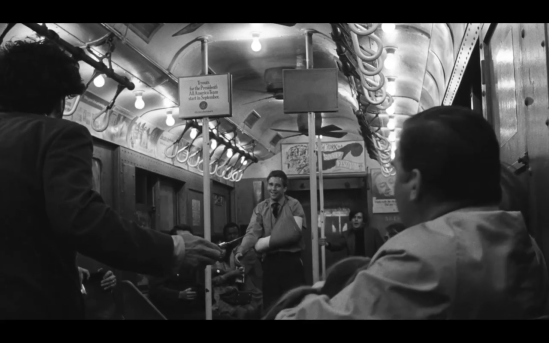
On the early morning streets of New York City, a drunken Artie and Joe delinquently roam the stillness of the Bronx after hours. After joyfully mugging an old man for a measly eight dollars and his wristwatch, their night leads them heading to the subway platform for more so called fun. A riotous Artie and Joe hop inside a railcar full of passengers that consists of two army privates on leave, a young couple on a date, an elderly Jewish couple, a young family with their 4-year-old daughter, an in recovery alcoholic, a passed out homeless man, a bigoted African-American and his wife, and a nervous gay. The passengers’ delineated diversity doesn’t thwart the two thugs’ harassment that holds the riders, in fear and in obstruction, from leaving the railcar and as personal limits are pushed to the edge, moral courage is effectively choked down by the helpless riders until one of them can’t take the bombardment of the perpetual daunting intimidation.
“The Incident’s” in your face, tell it as it is, hostage style dramatic thriller from 1967 barrels down an endless track of relevance and suspense inside the idealistic perception of New York City’s culture in the mid-20th century. Director Larry Peerce (“One Potato, Two Potato”) helms a masterpiece of a film that not only defied cinematic character standards but also defied the NYC transit authority who denied Peerce, along with cinematographer Gerald Hirschfeld (“Young Frankenstein”) to shoot in and on the NYC subway system. Taking a relatively guerrilla filmmaking approach to achieve railcar and platform exteriors, Peerce also managed to construct a true to size, if not larger, railcar to get the drama unfolding between the harmless transit riders and their two terrorizers. “The Incident” was the first feature film penned by teleplay screenwriter Nicholas E. Baehr whom also wrote the television movie version of the story entitled “Ride with Terror” a few years prior, but Larry Peerce clawed, scraped, and held together a cast and a crew that nearly dismantled due to funding and production issues until ultimately being saved by 20th Century Fox.
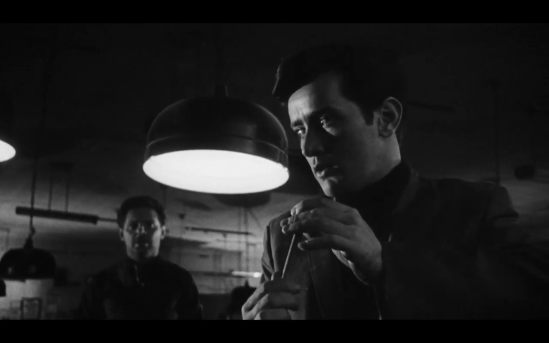
“The Incident” has such an ensemble cast that it’s difficult to even know where to begin. Two introductory feature film performances from Martin Sheen (“Apocalypse Now”) and Tony Musante (“The Bird with the Crystal Plumage”) as the errant ruffians is unequivocally good at being bad. Musante, especially, leaves a lasting impression as Joe Ferrone who oozes with slimy browbeating tactics by plucking that one sensitive nerve in each of the riders. As equally as good in comparison is in the injured Army private from Oklahoma, played humbly and genuinely by the baby-faced Beau Bridges (“Max Payne”), with a gosh-golly grin and a peacemaker wit about him that makes the private a prime target. Sheen, Musante, and Bridges are only the caboose when considering the train of highly trained styled actors that also include Thelma Ritter (“Rear Window”), Donna Mills (“Play Misty for Me”), Brock Peters (“Soylent Green”), Jack Gilford (“Cocoon”), Ruby Dee (“Jungle Fever”), Diana Van der Vlis (“X: The Man with the X-Ray Eyes”), Mike Kellin (“Sleepaway Camp”), Jan Sterling (“Women’s Prison”), Gary Merrill (“The Woman Who Wouldn’t Die”), and Victor Arnold (“Wolfen”). Ed McMahon makes his feature film debut as well! As an ensemble unit, the interactions evoke immense tensions and passion inside that railcar and from our very own couches.
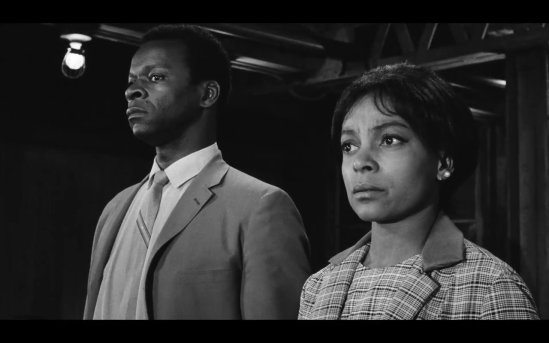
Everything about Larry Peerce’s “The Incident” capitalizes on being nearly flawless. From the construction of the last act railcar set to the flash of urban realism, “The Incident” is high level on the suspense thriller hierarchy, but the characters and their personal baggage egregiously forced to the surface is utterly captivating and refreshingly cathartic to simultaneously showcase adult bullying engage enragement while also bubbling and bursting through thin layered passive aggressive convictions and attitudes. Joe Ferrone is symbolically a catalyst for the majority of riders, exposing internal loathsome, sham friendships, and tough guy personas, that naturally shreds down their ghastly facades and revealing their true, if not unpleasant, selves. Equally as compelling is the one scene with racial profiling and prosecution by the law enforcement that is heavily journaled in the today’s media and Peerce clearly believes in this injustice and adds the brief, yet powerful, moment at the tail end of the film that involves Brock Peters’ character.
Eureka Entertainment proudly presents the 20th Century Fox raw and intense New York based thriller, “The Incident,” onto a dual formatted, Blu-ray and DVD, home video as part as Eureka Classic sub-label, marking the first time on Blu-ray in the United Kingdom. Unfortunately, a DVD-R screener was provided for coverage so a review of the video and audio will not be covered, but from the spec information provided, the transfer is a 1080p high definition digital transfer with uncompressed monaural soundtrack on the Blu-ray. There are optional English subtitles available. What can be said about Gerald Hirschfeld cinematography is this, it’s a complete mastery of the trade with a penchant for black and white and seamless edited camera cuts. Bonus features listed are a brand new and exclusive audio commentary by film critic and writer Alexandra Heller-Nicholas, author of Rape-Revenge Films: A Critical Study, a post-screen Q&A session with director Larry Peerce from the 2017 Wisconsin Film Festival, the original trailer, and a collector’s booklet feature new writing by film writer Sam Deighan and critic Barry Forshaw. “The Incident” is searingly powerful and a societal wake up call of we’re all in this together or we’re all a part of the problem.\
Tag Archives: UK


The Only Way EVIL Would Go Out With a Virgin! “Double Date” review!

Recently dumped and severely panicked around women, the prospect of ever dating again seems like a long shot to Jim. Self-assured Alex sees the opposite for his best mate as a golden opportunity for him to get Jim laid before his 30th birthday. When Alex finally coerces and assists Jim on scoring a double date with two sisters, Jim can’t believe his stuttering awkwardness actually proved fruitful, but little do Jim and Alex know that the sisters, Kitty and Lulu, are out for blood. The sisters seek a virgin to sacrifice to bring their long deceased father back from the dead and to complete their trio-family once again at the expense of Jim’s involuntary celibate lifestyle. Night clubs, fast cars, and visits to the parents take the four through a series of dark and drug fueled misadventures and the unexpected moment of falling love that makes this double date one to die for!
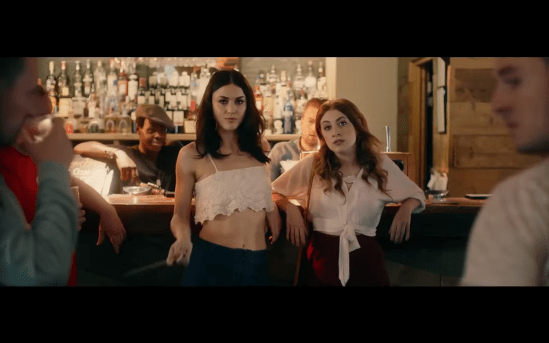
First dates are always inherently frightening. The idea of being alone with a stranger, who you’re kind of attractive to and trying to impress, yet don’t really know a single thing about them, can be daunting, if not paralyzing. First date in a double date is supposed to ease that overwhelming fear and take the strain off from the lack of possible interest in the other person, but for director Benjamin Barfoot’s amusing horror-comedy, “Double Date,” all bets are off and all tensions are on edge when dating goal sights are deadly different. Danny Morgan pens a comedic gem in which he stars as the bumbling virgin, Jim, joining his long time collaborating partner, Barfoot, to complete their first feature film together. The British made and produced film gives glimpses of London’s fung shui through the pubs, clubs, and overall eclectic nightlife to the aristocratic mansion homes to the likes of “Downton Abbey” resulting in a slight blend of the past and present into a well-oiled story embodied with terror and fun.

Funny man Danny Morgan stars as the awkward and blundering Jim whose plagued with fumbling qualities around women that usually leaves him somewhere in the inner circle of the friend zone. Morgan brilliant showcases Jim’s stunting inadequacies that eventually come to flower while maintaining a solid naturally slapstick presence of self-deprecation that turns into a full-blown bull in a china shop. The scene with his parents and himself singing his birthday song in front Lulu in audience, while tripping on drugs, is cathartically enjoyable and a riot of inner laughter. Morgan’s joined by “Being Human” actor, Michael Socha, as Jim’s very good friend, but all talk confident friend, Alex. Alex is certainly the yang to Jim’s yin on screen and off screen as Morgan and Socha have a certifiably fresh dynamic that makes them very entertaining to digest. Socha brings a different kind of comical energy that compliments Morgan’s dry humor that diversifies the content. In fact, all the characters bring a little something different to the table, such as with the sisters, Kitty and Lulu, played respectively by Kelly Wenham (“Dracula: The Dark Prince”) and Georgia Groome (“The Cottage”). Training like an elite athlete, Wenham takes the role to heart being a dark and beautiful villain that’s inarguably alluring as she’s cold and deadly. The Cheshire born actress, whom hands down can be the next Megan Fox, sinks her teeth into the performance and excels in the physical role that’s showcases her range of talent. Then, there’s Georgie Groome as Lulu, the timid opposite of Kitty. Also known as the girlfriend of Harry Potter’s Rupert Grint, she nails being the one in the shadows, relinquishing control mostly to Wenham for most of the film, and then slowly build character confidence and strength.

“Double Date” is a great blend of horror and comedy. The climax has this satirical and retro quality about that seems unfitting, but is stitched carefully to fit without bursting and popping a seam (or scene?) to the point of overly obtrusive. Benjamin Barfoot also has a keen eye to capture the pivotal and incandescent moments that make scenarios have more an impact, whether that being a facial expression, an awkward dance, or any kind of verbal or action exchange between characters. Doesn’t hurt that Barfoot’s rapport with Danny Morgan is a relationship riding the same director-actor level plane, similar to the dynamics between Adam McKay and Will Ferrell, with a synonymous cerebral synergy that clicks well for the silver screen.

From the independent film company who delivered “The Man Who Killed Hitler and then the Bigfoot,” Sparky Pictures releases the Screen International/FrighFest awarding winning horror-comedy, “Double Date”, onto digital, DVD, and Blu-ray come September 9th in the United Kingdom. Unfortunately, an in-depth review of the video and audio specifications will not be covered as a BD screener disc was provided, but what can be said about the soundtrack, performed by GOAT, is pure primitive gold and the appearance by Big Narstie is equally solid. Bonus material, on this check disc, included an extensive behind-the-scenes, from conception to wrap, of Danny Morgan and Benjamin Barfoot’s roller-coasting adventure on getting their film made. There’s also a commentary with cast and crew, deleted scenes, photo gallery, and trailers. “Double Date” is a true black comedy and a whole lot of fun that should skyrocket filmmakers Danny Morgan and Benjamin Barfoot toward future endeavors as a rising, powerhouse duo, contending to be the next hit in the satirical category.

Amazon has Double Date! Own it today!

EVIL Gets Schooled! “Slaughterhouse Rulez!” Review!

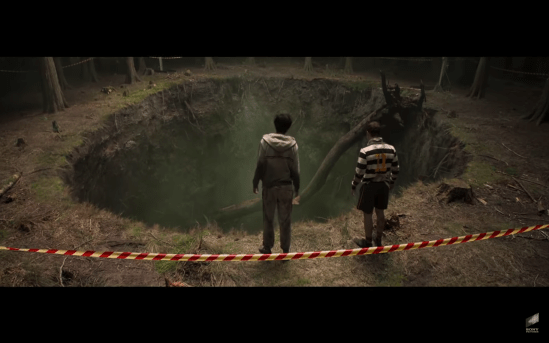
Slaughterhouse boarding school is an aristocratic playground housing some of the children of Britain’s most elite families. Alongside institutional studies, a long list of leisure activities are available, such as junior military, golf, and chess just to name a few. For new pupil Don Wallace, attending Slaughterhouse was just to please his mom’s persistence that soon sparked mixed feelings about his new surroundings between finding his place in the student vicious hierarchy and being in the company of the girl of his dreams: Clemsie Lawrence. The school also has a new headmaster, one who has made lucrative dealings with a fracking company for the extraction of natural gas at the outer rim of school grounds, but the seismic tremors caused by fracking result in large sinkhole, unleashing a horde of underground dwelling beasts that run rampant on campus grounds hungry for a meaty school lunch. It’s up to Don Wallace and his misfit school chums, plus one miserable school educator, to fight back in order to escape with their lives.
Boarding schools, especially the British ones, inherently have an intimidating nature about them and if the comfort decimating idea of being housed away from your parents isn’t frightening enough, the upper-crust cliques and sovereign clubs are an assumed terrorizing, foreboding thought – just look at all the paranormal and murderous boarding school incidents that happened to Jennifer Connolly’s character in “Phenomena” (aka “Creepers”). In Crispian Mills’ sophomore written and directed feature, also co-written with Henry Fitzherbert, “Slaughterhouse Rulez” is another boarding school that can be chalked up as being a killer institution adding big ugly beasts shredding through the student body as the antagonistic creature in this feature. The 2018 comedy-action-horror is produced in the UK as the first film from the Simon Pegg and Nick Frost production company, Stolen Picture. Pegg and Frost have a long and hilarious history together, breaking out internationally with the modern classic “Shaun of the Dead” and continuously worked together on various projects throughout the last 19 years since their George A Romero inspired success. The usually buddy comedy duo have reunited once again for Mills “Slaughterhouse Rulez” as supporting, yet memorable, characters that do steal the show.

“Slaughterhouse Rulez” mainly focuses around Don Wallace, the new teen on the scene who tries to live up to this standards his deceased father’s worked hard for, and Wallace, played by “Peaky Blinders” regular Finn Cole, goes through the motions of being the new kid in school that quickly discovers who his enemies are, as an outsider forced to be friend with the school black sheep, and falls heads over heels for the most popular girl on campus. Cole’s especially charming for most of the performance, but can flip his character to being weak in the knees and want to be reclusive when pushed too hard. Opposite love interest, Clemsie Lawrence (Hermione Corfield of “Pride and Prejudice and Zombies”), provides little insight into her perceptions of Wallace as the character does a 180 degree regarding her feelings for him, but Clemsie sure does have reason to withhold how she really feels by being a Goddess and being under surveillance by Clegg, a legacy God who takes his title literally as a divinity itself and has a sadistic iron fist for those who buy their way into Slaughterhouse. Clegg is a stone-faced psychopath performed very blunt by Tom Rhys Harries Wallace’s friend by roommate association, Willoughby Blake, is a social outcast who loves to live in isolation. Asa Butterfield, from “The Wolfman” remake and “Ender’s Game,” sizes up Willoughby crutched by depression and drugs as the most complex character with a dreadful secret. “Slaughterhouse Rulez” continues with an amazing lineup of talent that include Michael Sheen (“Underworld” franchise), Margot Robbie (“Suicide Squad”), Isabella Laughland (“Harry Potter” franchise), Kit Connor, Jamie Blackley (“Vampyr”), and, of course, Simon Pegg and Nick Frost.

Mills’ anti-fracking and subterranean monster flick isn’t all action and blood. For the first 2/3 of “Slaughterhouse Rules,” the filmmaker initially barely hints at a creature feature and harnesses to express his inner John Hughes with his attempt at a coming-to-age horror-comedy bursting with adolescent complexities, such as drug use, depression, suicide, bullying, love, adult and peer pressure, social differences, and so forth, that becomes heavily cloaked in humor and horror in the same vein as “Shaun of the Dead.” All the buildup of the teen dynamic comes to a screeching halt; literally, a bloodthirsty monster screeching when unearthed from the fracking folly killed, in a whole bunch of various degrees of the term, all the pre-apocalyptic adolescent shrapnel and turned it on its head as a means of overcoming the difficulties of the Slaughterhouse boarding school, relinquishing the difficulties into a honky-dory finale.

PER CAEDES AD ASTRA! “Through adversity to the stars” does the Stolen Picture produced “Slaughterhouse Rulez” find itself on DVD courtesy of Sony Pictures Home Entertainment. Presented in an anamorphic widescreen, 2.39:1 aspect ratio, the digital picture maintains a rather seamless presentation though I though there could have been a little more pop in the coloring. Director of photography, John De Borman, did a phenomenal job with the lighting through the woods, the school grounds, and the labyrinth maze under the school; a reminiscing aspect from his earlier work in Stephen Norrington’s “Death Machine.” The English 5.1 Dolby Digital audio track caters to every whim. Range and depth were good, especially with the beasts’ roars/howls. Dialogue is prominent, yet I still have a hard time with the English accent. Also available is an English Audio Description Track, French (PAR), Spanish 5.1 Dolby Digital, and English, English SDH, French and Spanish subtitles for a film that runs 104 minutes. Unfortunately, there is no bonus material. “Slaughterhouse Rulez” has the Pegg/Frost humor that we’re all now familiar with and still retains the funny, even if some of it is British-ly dry! With that said, Crispian Mills’ film observes adolescent behavior while also being blood splattering entertainment through the razor sharps jaws of the hounds from fracking hell!

Now available on DVD!

Evil’s Crimes Against Nature Will Not Go Unpunished! “Long Weekend” review!

Peter coerces his begrudging wife, Marcia, to forgo the luxurious hotels and chauffeured holidays for a long weekend of camping on a remote beach in Australia. An enthusiastic Peter packs the jeep with thousands of dollars worth of outdoor gear, including a surf board, a spear gun, and a hunting rifle. Marcia loathes the outdoors, can’t stomach the very thought, and she lets Peter know her distaste of his plan every other second while on holiday. Yet, this trip for them isn’t just a routine getaway, but, instead, a trip to get away from the swinging friction of close and very intimate friends, to rekindle their relationship, and save what little is left at a frayed string. The already awkward and complaint-riddle holiday turns from bad to worse when nature looms a foreboding shadow over the estranged couple, unleashing one ill-fated omen to the next that checks their nonchalant attitude toward nature with eco-radical discipline.

“Long Weekend” is an eco-horror film by “Innocent Prey” director Colin Eggleston. Alfred Hitchcock, perhaps, birthed the horror subgenre with his 1963 film “The Birds” that led to such films as “Day of the Animals” and “Grizzly.” Nearly 15-years later, Eggleston hones in on his inner Hitchcock by expanding the background on why nature turns cold and unsettlingly supernatural like. Working off a powerfully detailed and haunting script by “Razorback’s” Everett De Roche that circles around two characters like a hungry vultures, Eggleston vitalizes De Roche’s script with a paper to screen bleak, unsettling imagery on a monumentally minimalistic scale. “Long Weekend” could be considered a Hitchcockian film, and most likely is, but can stand firmly by itself as an extension on how mother nature can be a bitch when push comes to shove.

Two characters and the wilderness. That’s all “Long Weekend” boils down to on brass tacks, leaving two actors on the line to act off each other and off of the ominous presence that has fully engulfed them on an isolated stretch of beach and shoreside forestry. “The One Angry Shot’s” John Hargreaves tackles the conceited Peter with a full-bodied combination of heedless gusto and desperation that Hargreaves can seamlessly become lost in Peter’s self-worth. The Sydney born actor is paired with an English actress by way of Briony Behets from the 1980 film “Stage Fright,” a film also co-written by Colin Eggleston. Behets’ Marcia epitomizes the stereotypical enigma that men all think is the inner workings of a woman’s brain; Marcia is hot and cold with fleeting moments of passion for Peter, yet ready to kill him in the next scene. Behets converts the baffling intertwinement of Marica’s energy and channels it well into the dynamic that is their failing marriage.

What’s really special about Eggleston and De Roche’s film is the overloading symbolism. From subtle to simple, “Long Weekend” has the money betted on working on an underlying moment-to-moment, scene-to-scene in each act; a method tirelessly schlepped through with many modern features of today. Using non-threatening animals, such as a small possum and a sea cow or dugong, to be part of a menacing force driving the ominous presence across the narrative just sets the feng shui mindset of an unadulterated evil genius. Instead relying heavily on a physical entity, Eggleston heavily coincides creature imagery with the use of audible creature cues, whether a baby-like wail in the distance or the overpowering cacophony of animal growls and sneers, to invoke panic, fear, and paranoia to divide the already fragile pair into an atomic disaster of their undoing. “Long Weekend” will overshoot some viewers as piecing the puzzle together can be a slow and long process, but one aspect is certain, the off-camera animalistic stare has a powerful affect.

Second Sight delivers the ozploitation classic, “Long Weekend,” onto Blu-ray home video for the first time in the UK this November. Unfortunately, a review DVD-R disc was provided for this critique and audio and visuals components will not be covered. Bonus material was included on the review disc with audio commentary with executive product Richard Brennan and Cinematographer Vincent Monton, an Umbrella Entertainment produced panel discussion with film historians Lee Gambin, Alexandra Heller-Nicholas, Emma Westwood, and Sally Christie, Uncut “Not Quite Hollywood” interviews with Briony Behets, Vincent Monton, and Everett De Rocha, an extensive still gallery with an John Hargreaves audio interview, and original theatrical trailer. “Long weekend” is man versus nature at it’s best with sheer, unrivaled terror in a quaint eco-horror thriller package with a powerful message that nature will seek extreme judgement against Mother Earth criminals.
The Evils of a Transgendered Occultist! “Miss Leslie’s Dolls” review

On a dark and stormy night after a school football game, a teacher and three students take shelter at a cottage adjacent to a cemetery. If the cottage wasn’t creepy enough, the sole occupant owner surpassed the bar. She calls herself Miss Leslie, a middle aged woman with an ill-fated story of her friend and mother’s fiery demise from long past and a quirky penchant for making life-size female dolls that set inside an illuminating shrine. Though they feel uneasy about the creepy surroundings, the visitors stay and get cozy, especially with each other, but Miss Leslie has ulterior, deranged motives. Her dolls are not just lifelike, they once were vibrant lives of women Miss Leslie sorely wanted to inhabit their feminine confines of youth and beauty from over the years, but now they are an undecomposable shells, encase in Miss Leslie’s special doll making brew to timelessly capture their lovely physiques. They are also beautiful, yet painful reminders of her failed attempts to transfer her essence into their adolescent bodies.

Every so often you come across a film with a gigantically absurd hard shell cover with the gooey insides of eye-rolling cheesiness and you just have to ask yourself, how in the world did something like this ever come to fruition!? Yet, somehow, someway, these productions of an oddball variety always have an intense allure about them and end up being just one of the coolest rarities to grace the glazed-over irises. Joseph Prieto’s “Miss Leslie’s Dolls” is the epitome of this very phenomena. “Miss Leslie’s Dolls” is an exploitation, nearly softcore porn, horror with a deranged killers with severe mental issues that range from communication with dead to, what can be now construed as antiquated, complications of gender identity. One of the last directed films from Prieto, who also helmed “Shanty Tramp” and “Savages from Hell,” also penned the screenplay alongside longtime collaborator and producer Ralph Remy Jr. The script reads like an insatiable bedside thriller novel, an object of complete obsession through the entirety and well long after being completed; “Miss Leslie’s Dolls’” has a rich gothic lining, a strong sexual appetite, and a timely LGTB subject that involves debate on mental illness or inherited gender orientation.

Not many actors performed in drag. Sure, there was Jack Lemmon and Tony Curtis in “Some Like It Hot” and there was even Anthony Perkins from “Psycho,” who some might go as far as saying that “Miss Leslie’s Dolls” might draw inspiration from with the whole mother fixation, but only a small faction of fans, especially in the genre, might know Salvador Ugarte. The Cuban born Ugarte has great poise as a woman imprisoned in a man’s body. Miss Leslie just isn’t a deranged killer in drag; the character has deep rooted issues stemming out of not only being a woman embodied incorrectly, but also seeded by an engulfing obsession with capturing beauty to obtain it for herself, an addition from a result of a permanent scarring left behind by Miss Leslie’s homicidal rampage in the character’s history. Ugarte has the mannerisms and the gait down so unerringly that’s the performance is downright creepy, but there was one aspect of womanhood that Ugarte’s masculinity couldn’t mask: his voice. The actor is horrendously dubbed, adding charm to the bizarre concept. Ugarte’s joined by “Little Laura and Big John’s” Terri Juston, Marchelle Bichette (“The Gruesome Twosome”), Kitty Lewis, and Charles Pitts of “Supervixens.”

Contrary to the above, “Miss Leslie’s Dolls” has some drawback. Though the characters might be entertaining and interesting, especially with the Bourbon obsessed and hot for teacher Roy and his terrible gangster accent or the fact that Ms. Alma Frost is a smoking hot, twenty-something year old prude teacher to her pupils who are practically the same age as her, they’re washed over with an aloof mentality, consequently looking past or just blatantly oblivious to Miss Leslie’s obvious male features, her inauspicious ramblings, and the fact she has a shrine of creepy and realistic dolls of women that fill the room with the smell like rot and death. Perhaps too busy running through the cemetery at night in skimpy bedroom garments. Yes, this does happen. On top of that, Miss Leslie harness of occult powers goes relatively unexplored, yet very much utilized as an important portion of the film near the last act. Despite being passively mentioned and rather undercut from more than most of the film, Miss Leslie’s occult mischief is plucked right from left field to further the enigmatic aurora of Prieto’s mystical exploitation.

Network proudly presents “Miss Leslie’s Dolls” on an UK 1080p Hi-Definition, region free Blu-ray home video, remastered from the original film elements once thought to be have been forever lost. The newly scanned transfer came from a surviving print and presented in the film’s original theatrical aspect ratio of 1.85:1. The restoration included detailed grain management, the automated and manual removal of dirt and damage, and the correction of major color instability, warp, and density fluctuations. (In full disclosure, Network sent me a DVD-R screener and that is what the following critique is based off of) Though in some frames there flares up some instability, from my perspective, the first act and half really came out well with the vivid, yet natural, coloring. However, once inside Miss Leslie’s basement, woozy blotchy moments of Leslie fiddling around makes the particular scene a bit off putting. The stereo mono track is fair for the 1973 film that has it’s share of distortions and editing pop faux pas, but the dialogue is fiercely prominent, despite the inherent awfully laid dub track, and equally well balanced with ambient tracks. There were no bonus material on the release. Transvestitism horror is quite a rare experience that always has a lasting impression, cerebrally popping visuals of grim visions commingling with the blood, the viscera, and the other supplementary violence. “Miss Leslie’s Dolls” deserved this Blu-ray release and Network did right by Prieto’s obscure grindhouse feature that will sear into your skull.
 It's Bloggin Evil!