Become Lost with the EVIL in Your Head. “Faye” reviewed! (Reel 2 Reel Films / Digital Screener)


Author Faye L. Ryan has found success as a career writer penning personal growth and self-assurance books, but the renowned author has hit a mental wall in growing out of the process of mourning for her deceased husband, killed in a car accident in which Faye was at the wheel.  Scarred physically and mentally with painful reminders of that fateful night, Faye struggles to focus on her next new book, threatened to be dropped by her publisher if she doesn’t meet their deadline, and interacts with her husband as if he was still with her in person.  In a last ditch effort to get Faye back to writing before cutting her loose, the publisher offers up a lakeside vacation house to help focus on her work, but as Faye settles into her new, quiet writing space, she finds herself unable to escape a haunting presence tormenting her. 
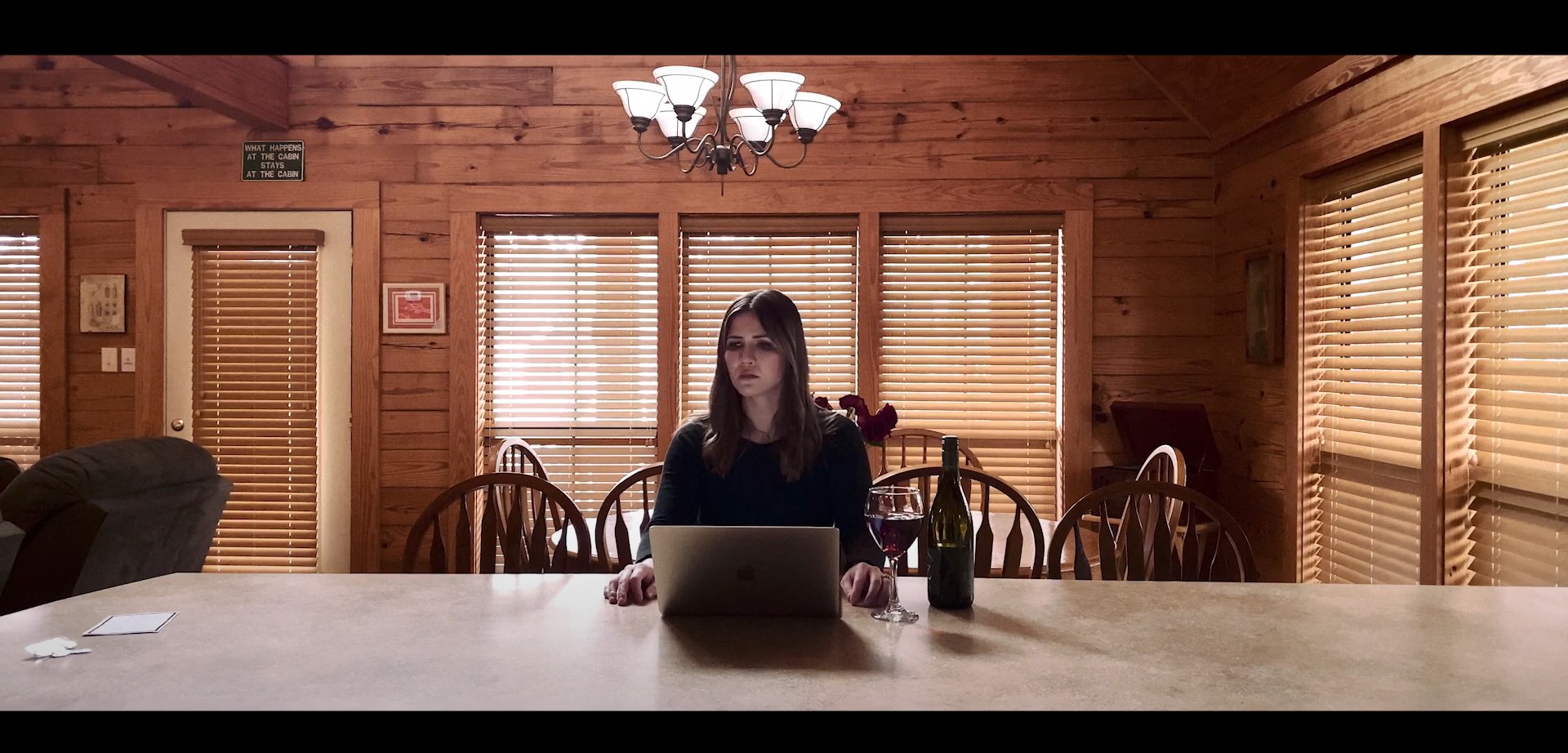
Working solo is tough.  Having no one to bounce off dialogue or react to their disposition can be daunting and unnatural for most actors and actresses.  Yet, the titular character in “Faye” must do very that to ensure Kd Amond’s 83-minute feature directorial about loss, grief, and the supernatural representation that braids into a broken reality will exist without suffering stagnation.  “Faye” is a 2021 female-driven horror-drama written by Amond and the film’s lone wolf star Sarah Zanotti as the two filmmakers reteam from the previous year’s dysfunctional family thriller, “Rattled.”  Shot between Nashville, Tennessee and the cabin resort of Lacombe, Louisiana, “Faye” is cut from an all-female producing team of by Amond, Zanotti, Sara DelHaya, and Nicole Marie Lim under Amond and Zanotti’s independent film production company AZ if Productions.
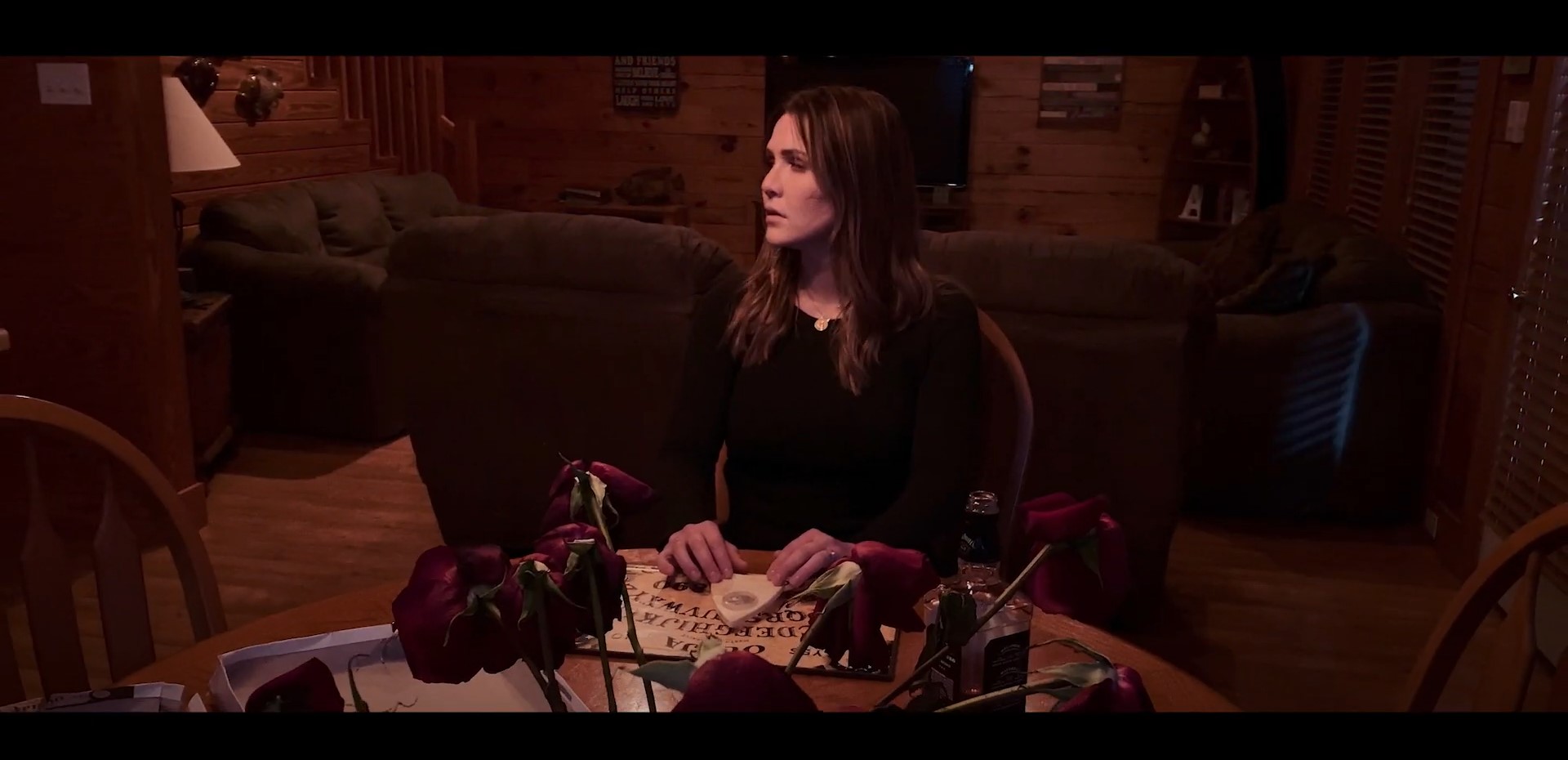
So, how did Sarah Zanotti perform going at the role alone with not another single body in sight?  Aside from the performance scale, initial first thoughts about an emotionally processing Faye rings clear that she is definitely alone with her thoughts without ever confronting her past head-on.  Faye, more or less, brushes the incident to the side, drowning herself in wine and loathing, until vague, intermittent memories pull her back down to reality every so often.  The role gratifies a sense of a struggling individual’s unintended and deeply personal isolation stemmed by unable to grasp with the hard to deal with issues to where’s she’s invented an imaginary friend in the form of her late husband in this pretend world of being normal, routine, and safe.  Looking from the outside in, Faye invokes pity on the saddest level as she converses with thin air as well as drinking large quantities of wine alone. There’s even the suggestion in either flashback scenes or maybe representational moments of despair that she, at one point in time, committed to, or thought of, suicide. As for the “Archaon: The Halloween Summoning” actress Zanotti? The actress, singer-songwriter, and proud cat mother (as stated on her personal website) breathlessly engrosses herself in Faye’s darkest moments with a ramble of insecurities that skate around the main issue until that issue manifests as a specter of duality, haunting “Faye” with her own scarred image that won’t allow her to leave until she combats the guilt eating her away. However, Zanotti’s a bit one tone through the entire storyline, never zig-zagging in a full range on emotive spectrum when face-to-face with the emulated specter. There are guest voices in the film whenever Faye takes or makes a phone call, including vocals from Corri English as Emory the publisher, Dean Shortland as Bobby, Brian Vance as Jacob, Kd Amond as Faye’s mom, and Zanotti as Elle.
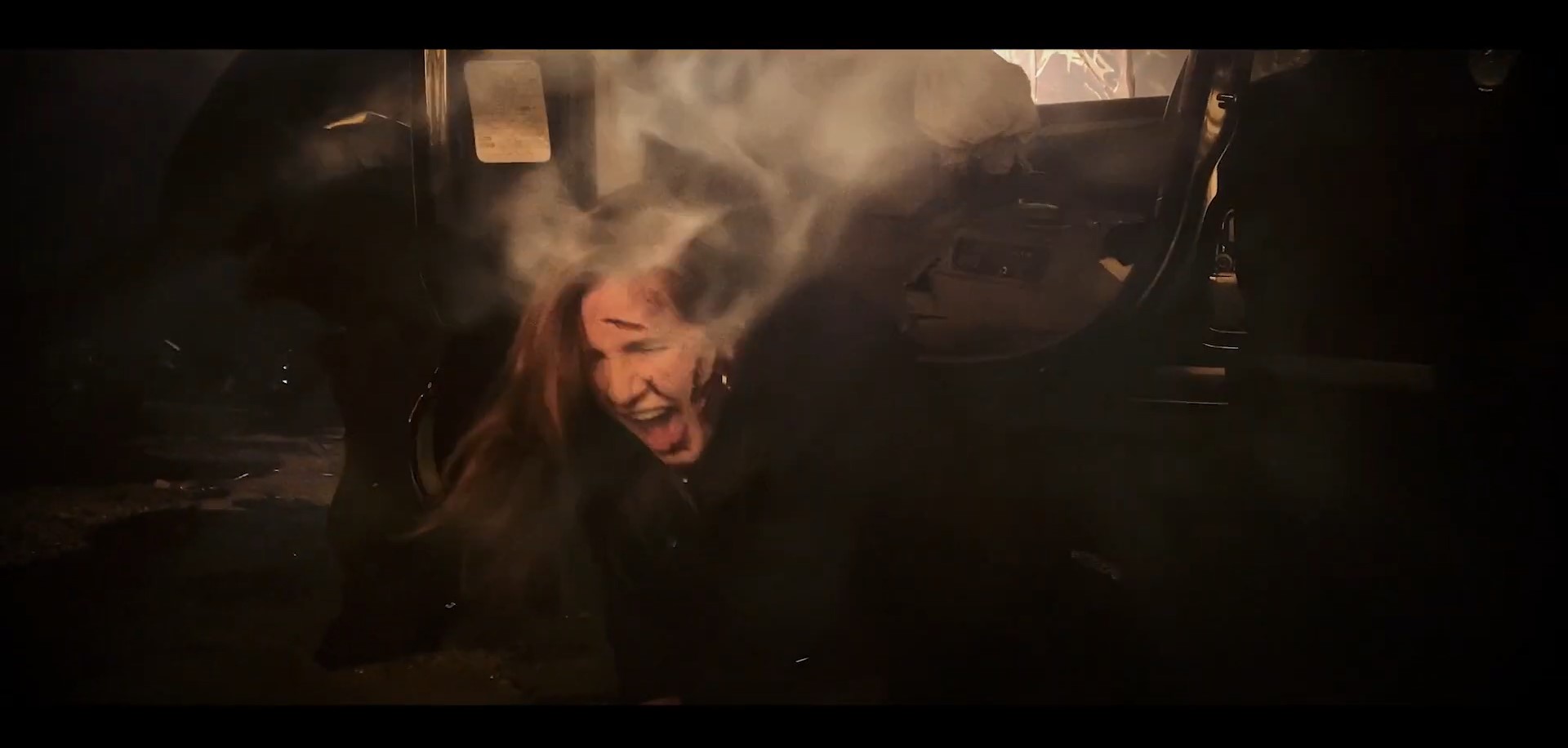
To carry an entire feature film on your shoulders is empathetically tough for the one and only principle lead Sarah Zanotti and also the director Kd Amond as well and I wouldn’t declare “Faye” to be an overstimulating visual film albeit snazzy editing and makeup effects when sucked into supernatural self-reproach and suffering. “Faye” leans heavy into self-centered conversation in an acerbic chaptered and non-linear context that can be difficult to follow it’s pathway structure at times when the titular character is not framed in the cabin but rather sitting, speaking on a well-lit platform that fits her personal growth expatiate, like a Tony Robbins-type, connecting back to Faye’s mindset or actions in the cabin. Though much of the conversion is directed toward herself or the mental image and two-way communication of dead husband, a good chunk of the dialogue is the unwavering tough love business-speak between agent and client. Faye publisher rakes in money based off book sales and if Faye isn’t writing up drafts than a publisher does not care about your personal tragedy. That dynamic during the calls feels utterly cold with no pity or sympathy for Faye in the voice of the agent who cares solely about client image for publicity and is determined to nag a draft out of a woman who has lost her best friend in life – grief and guilt be damned. As a spook show, “Faye” whips up a few moments of fearful highlights but does little to the film’s self-proclaimed horror label when more of the acidity of internalizing the death and destruction of her life becomes more manic without the monster that’s introduced too late or comes too little often to be integrated into the story properly and stands out as negative concentrated symbolism.
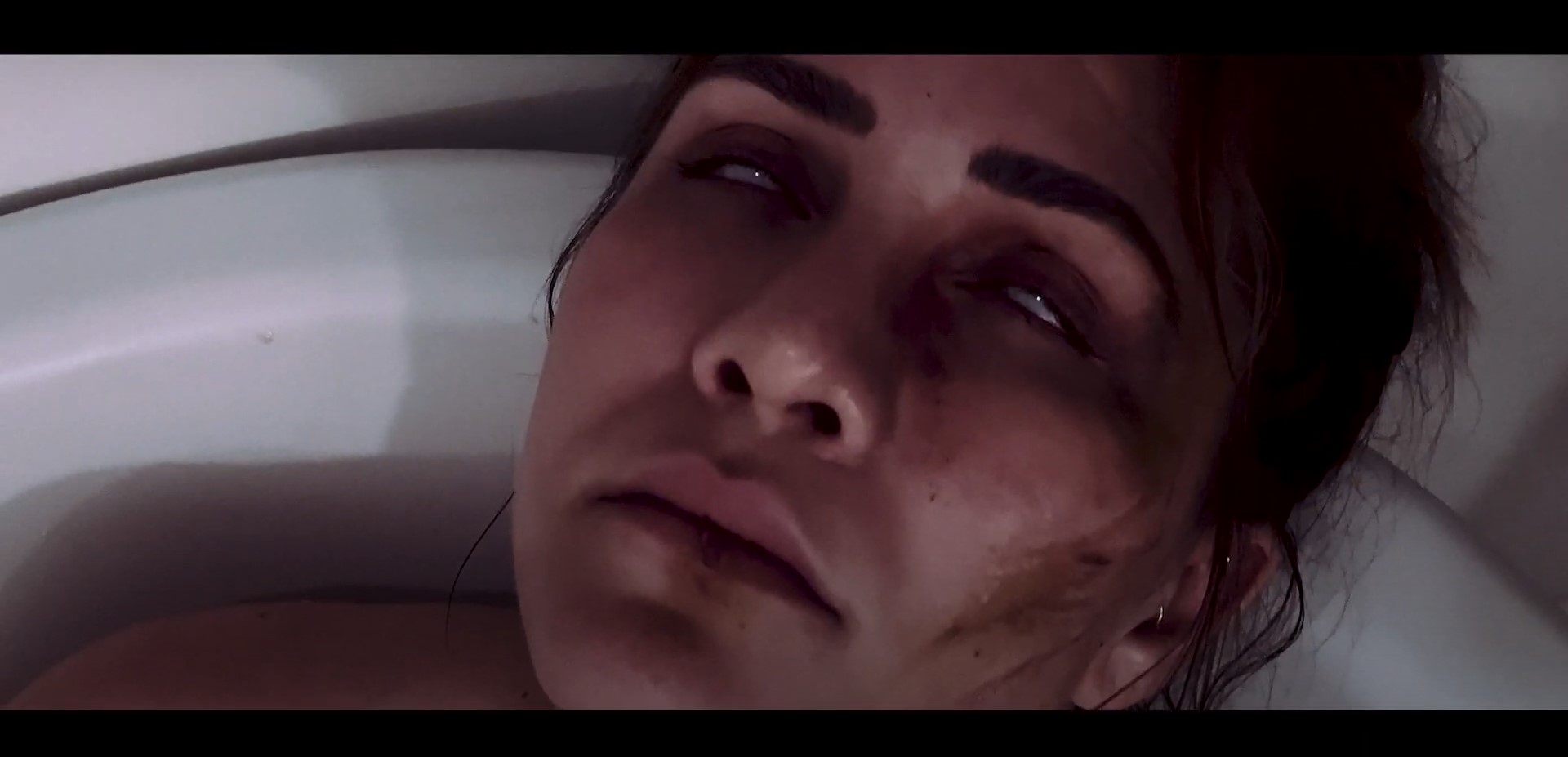
Oozing with heartbreak and melancholy, the fracturing viability in “Faye” calls forth the detrimental impact and for reinstation back in the society, one needs to fall before getting back up. Reel 2 Reel Films brings the American-made, woman-driven, atmospheric and apparitional “Faye” to the United Kingdom on digital home video come May 9th. Since a digital screener was previewed, there will be no critique of the audio or video qualities. Kd Amond was really a one woman show behind the camera by taking on not only the directing duties but also many others, including cinematography and visual/practical effects and for “Faye,” the film was mostly captured with natural lighting outside the cabin, practical lighting for cabin interiors, and key lighting of Faye on stage. There’s use of a filters during the more supernatural plights and to tell night scenes that don’t look natural, leaning toward a more style-choice purple. For any extras, there were no bonus scenes during or after the credits. “Faye” has strong bones for a good grief and guilt ghost film in the indie realm and while it doesn’t have the star-laden power of other similar themes of its kind in “The Babadook” or “Hereditary,” “Faye” still invokes the power of hurt and the summoning of self-condemnation.

You Must Put EVIL to Fire! “You Are Not My Mother” reviewed! (Magnet Releasing / Digital Screener)

Quiet and meek Charlotte lives with her granny and mother in Northern Dublin, Ireland. When Charlotte’s mother spirals into one of her depression fits after dropping off Charlotte at school, her mother disappears without a trace only to return a day later, wandering into their home in the middle of the night. Happy to see her mother acting jovial, the teen aims to reconnect the mother-daughter bridge that has long been under disrepair due to severe mental depression, but she then notices a string of fits, fits not concerning depression but of violent, erratic behavior too frightening for Charlotte to believe that this person who came back home in the middle of the night is the same person, her same mother. When her Granny suspects that mom has been replaced with a changeling, Charlotte and her new best friend Suzanne seek to uncover her mother’s true self on Halloween night when the barrier between our world and the spiritual world is at its thinnest.

There are many customs and cultures surrounding Halloween for various countries. Sometimes, the day that most of us horror fans look forward to every 31st day of October every year isn’t always about dressing up in costume, obtaining bags upon bags full of candy, doing mischievous pranks, or even sitting down to marathon the Michael Myers’ “Halloween” franchise. For UK, specifically in Northern Ireland, bonfires light up the land on Halloween,” or what is called Samhaim, for an array of reasons, one more traditionally being to keep evil spirits from crossing over from their dimension and into ours when the “All Hallow’s Eve” barrier between the two realms near kiss in proximity. Today’s Irelanders set ablaze bonfires more for an extravagant, beer-drinking party than to defensively thwart the uninvited spirits from gliding into our world and this becomes the Halloween backdrop for Kate Dolan’s written-and-directed, debut feature length folklore horror film, “You Are Not My Mother,” as a battle against the supernatural hidden in plain sight as one of us, a doppelganger. Dublin-based Fantastic Films (“Vivarium”) and the sweeping Screen Ireland compose as the film’s production companies with “Vivarium” and “Sea Fever’s” Deirdre Levins as producer.

The touch and go fragile battlegrounds of where children tiptoe on already severely fractured eggshells around their parents debilitating and volatile depression can be tough to capture on screen.  The voyeuristic hesitancy of sunken melancholy keeps the child around the fringes and ever guessing their parent’s rotating state of mind and “The Green Sea’s” Hazel Douple, as the teenage daughter Charlotte, nicknamed Char, and Carolyn Bracken (“The Dublin Murders”), as the unstable mother, connect strongly with that unnatural relationship imbalance.  Douple is perfectly reserved with Char’s mother’s erraticism, witnessing, and conveying a different response with just her eyes, every emotional stage washes over her mother from listlessness to jovial dancing to complete abusive rage, a range Bracken unnervingly does so frighteningly well.  Eventually, Char would need to realize the truth that her mother’s manic behavior is not solely due to a mental health issue but a malevolent fairy issue and need to break the chains of restraint to save the only parent she has left.  There’s no mention of a father figure throughout the narrative and could only speculate that the father either past or hightailed the relationship due an infinite amount of reasons with one being more prominent against mom’s harmful instability.  Amongst the multi-generational, female-driven, character story is the top matriarch in Granny, played by “Citadel’s” Ingrid Craigie, who is positioned awkwardly as a bypassed presence and not really substantial weight bearing down on the contentious tension in the house they all share together.  Granny’s off-putting and mysterious ever since the opening scene with a layer of understanding and occultism hardly tapped into or even with a slight of exposition as she builds talismans and goes off to visit a friend to discuss Char’s mother.  Paul Reid (“The Ritual”), Jordanne Jones, Katie White, Jade Jordan, and Florence Adebambo co-star.

“You Are Not My Mother” continues to be a tsunami of new wave UK horror washing onto the shores of theatrical, digital, and home video platforms and any film that starts with burning a baby just might be okay in my book.  No, I’m not a psychopath, I just like to be overcome by dreadful content; yet, though the Kate Dolan cinematic accession as a feature film writer-director doesn’t start with perfection with the story burdening more wrinkles than the direction  I’ve already touched upon the mishandling of Granny and her connection to a supernatural belief goes without say that her role as mediator falls severely short of development key to Char’s total comprehension of her mother not really being her mother due to XYZ reason.  The backstory also tries to reinstate itself into the present story but can’t shape up from its gelatinous yarn, giving little for Char and the audiences to work off of and take all that is happening with good faith on face value. There are continuous instances of this weak bridge connection between characters and events as we also see between Char and a school bully Suzanne who instantly become best friends after a single shared connection that’s not poignantly stabbing, but for the narrative, it’s enough for Suzanne, who wants chewed gum and stuck it on Char’s school notes or help set a photograph of her mother on fire, to open up a soft spot instantaneously without a hurtle to overcome.  Where “You Are Not My Mother” succeeds is in the character and story driven parameters without relying heavily on gratuitous special effects with enough practical to scare the wits out of you and firmly no CGI to supplement the creation of Carolyn Bracken’s facial dysmorphia, like a disturbing happy face emoji, as a replaced mother.

“You Are Not My Mother” is a Halloween movie, an Irish folklore Halloween movie, prickled with Samhain traditions at the very core of Kate Dolan’s story.  The film is slated for a March 25th release in theaters and on demand from Magnet Releasing. The 93-minute folklore horror is equally matched by its rifting, soul-stirring composition from the Belfast-based and worldly-sound of Die Hexen who also double-dips as sound designer, blending sometimes delicate but often jarring synthesized ensemble of sound. Narayan Van Maele’s cinematography has an overcast austere, almost icy, in the rendering of what is usually a lush in greenery and rich in historical, old-world place, but the Maele’s wide and long shots are engrossing accompanied by a tighter edge that often feels cramped when inside the house, good for close quartered domestic contention in the family drama parameter. There were no bonus scenes during or after the credits for this film. If not for Carolyn Bracken and Hazel Douple’s fiery and lucid performances to keep glued to, “You Are Not My Mother” would simply fall apart at the seams, squandering much of the Irish folklore that already hangs by a thread.

EVIL Rap-A-Tap-Taps on its Little Drum. “Caveat” reviewed! (Acorn International Media / Blu-ray)

You’ve Been Warned to Watch “Caveat” on Blu-ray from Acorn Media!

Recently discharged from the hospital after an experience with a nasty fall, Isaac suffers from severe memory loss.  In need of money, he reluctantly accepts a caretaker job from his landlord Barrett who hires him to oversee a traumatized and catatonic spell-ridden niece Olga living in a ramshackle island house.  When Isaac arrives for his five day, $200 per night stay, he’s convinced by Barret to wear a chained harness that limits his access to certain rooms of the house.  Before long, on the very first night, memories of his past begin to flood back when Olga tells him he’s been at this house before, cascading an overwhelming sense of danger over him when the thought of Olga and Barret scheming together at his expense.  As past contracts boil to the surface and the fight for survival extends into the next day, a long thought vanished player lies and waits for the perfect opportunity to resurrect. 

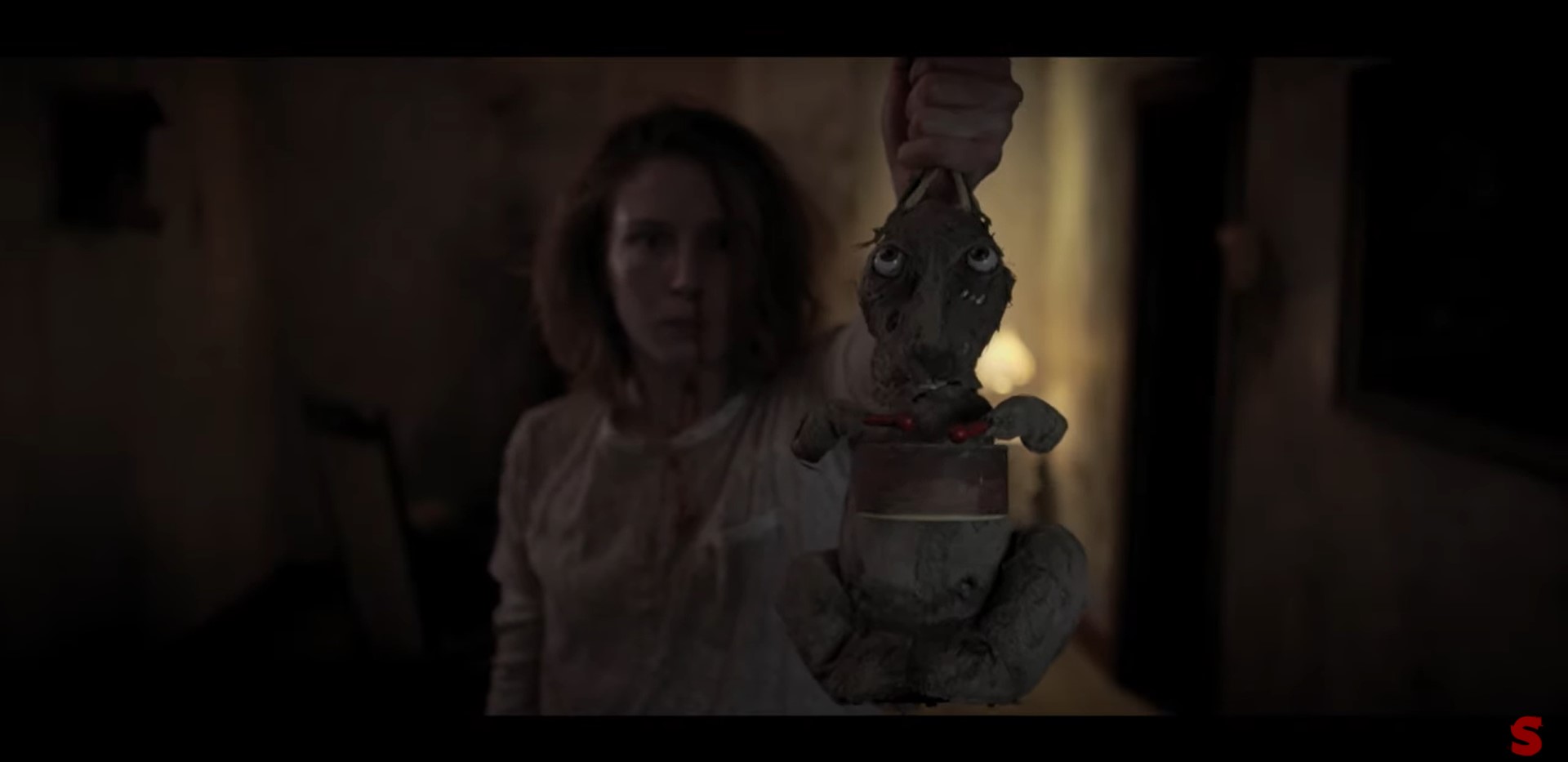
If offered to be the sole caretaker of an unstable teenager four five days the suicidal death of her father and the disappearance of her crazy mother, located on isolated island surrounded by a deep lake only traversable by rowboat, strapped inside a chest harness with a long chain stretching into the basement where its tethered, having brought no food or clothing, and the house is a complete rundown disaster filled with austere essentials and a filthy, menacing rabbit toy that rap-a-tats on a drum when the air is thick of a supernatural presence, would you take the job?  If the answer is yes, then Damian McCarthy’s “Caveat” is the right film for you and you also might want to see a psychotherapist, immediately.  McCarthy debut feature film directorial, as well as the writer is, a supernatural-psychological thriller of existential context about who we really are as a person.  The UK film is released as the first production by the independent filmmaking studio HyneSight Fims, produced by Justin Hyne, and credits executive producers in Tom Black and Mirella Reznic.

A person would have to be out of their right mind to agree to every single warning flag about this situational premise.  In fact, Isaac, a character recovering from head trauma that resulted in short term memory loss, would seem to be the ideal candidate.  Irish actor Jonathan French plays the scruffy-looking Isaac and with little backstory to go upon first meet, we’re stuck with French’s face splayed stuck lost and confused for most of the duration that’s a simultaneous ride for the audience who jump right into first talks of caretaking agreement without living, experience, and visualizing much of anything else before then but in the first instance meeting the man with a radical beard, Isaac is obviously not a long-shore fisherman and is also seems to be mindfully altogether and rational, if not very acute, about with what’s happening around him.   French doesn’t play a brain damaged invalid; instead, Isaac goes reluctantly with the flow as a rather poorly written gawk who thinks giving into another man’s intention of being strapped into a S&M vest is okay and left to rightfully care for a more true-to-form mental case on any level. The further the introduction is into Isaac’s odd assignment, the more we wonder why the hell isn’t he about facing and running across that barrier lake like Christ himself. That other man is Moe Barrett (Ben Caplan, “Band of Brothers“) who also strolls onto the scene in the beginnings of conversing with Isaac as if old pals and though Caplan is very good at Barrett’s normal and persuasive spiels without a hint of abhorrent creepiness behavior, Isaac’s so gullible to a fault that it kills that need for deliverance from protagonists to try their best to avoid an unfavorable situation when they see one. Leila Sykes fills out the main trio as Olga, the on-and-off catatonic teenage niece of Barrett. Again, something’s missing from the character development much in the same way as Isaac. Olga’s just living, if you can call it that, out of her absent parents’ house. Each one of these characters feels abstract, much like the narrative’s story and structure, to offer only incremental oddities one grain at a time to be not too invested in whatever else that might distract from “Caveat’s” mystery.

“Caveat,” by the way, is a warning and is the catch that makes Barrett’s deal of $200 per day for five days to watch over his nice seem too good to be true and, honestly, the rabbit hole Isaac doesn’t heed and scuttles down into as being the loose end saw tied up by a transgressor’s flimsy, kooky plan would have been enough to suffice. McCarthy adds another element to the already rough patch of this malicious thriller with an unnecessary, but highly effective, supernatural elements involving a menacing in appearance, drum-rapping, toy rabbit (or is it a hare?) that acts like a bizarro-Toys’R’Us PKE meter and a smiling dead body that has its grand jump moment near the end of the film. These devices are uncomfortably odd, undoubtedly scary, and sorely used too little despite the drumming rabbit’s home release front cover spread. There’s also this perfect circle motif present throughout the story – a front door port hole, a hole cut in dry wall that becomes an important barrier see-through, and Olga’s crazy mother draws white circles on black paper, plus other examples – which, to me, indicates the proverb what comes around, goes around with who commits evil, receives it in the end and visa-versa. McCarthy’s suspense building moments within the gloomy rundown house can leave one peak through the slithered opening between a pair of hands over the eyes. However, McCarthy leans more into the Isaac’s dire dilemma and keystone past which I think comes back to easily. The entire time he wanders the premises, nothing strikes him with familiarity, nothing invokes a recollection, and yet, as soon as it’s mentioned he’s been the house before – circa 1 year ago – a rush of linear memory comes crashing back into flashback frames and everything up to this point is explained during a Mexican standoff with Olga. “Caveat’s” second act dredges slowly along, disinterring up backstory to quickly wrap up Isaac into a neat little package.

Briming with darkness and wrenching with fear, “Caveat” is this strange and unusual angle of reading the signs more carefully, but also stirs in anamnesis to help reign in who we really are and to distance ourselves from the person we were previously. Acorn Media International and Shudder deliver “Caveat” onto a PAL encoded, region B Blu-ray home video in full high definition,1080p resolution, presented in a cinemascope anamorphic widescreen 2.35:1 aspect ratio. McCarthy and cinematographer Kieran Fitzgerald reel in the wider resolution for tighter shots, keeping the quality contained and detailed within the house’s decrepit interiors and the characters’ textural contrasting between skin and clothing. McCarthy opts out of gel use for night sequences, casting a real stark darkness over everything with only thin outline to express action. Audio is lively enough for the ow level action on “Caveat’s” English language DTS-HD Master Audio 5.1 sound mix.  “Caveat” relies heavily on the combination of dead silence and the building instrumentation that resonates reverberations in a soundtrack composed Richard G. Mitchell who knows a thing or two about elevating intensity through his diverse career.  Sound design plays into perfectly the silence as timed precise ambient noise, such as creaking wood under footsteps or the mechanical movements of the bunny, add to “Caveat’s” chilling charm.  The film is UK certified 15 for strong horror, violence injury detail, and domestic abuse with a runtime of 88 minutes.  The Blu-ray is accompanied with two audio commentaries in the special features – a director’s commentary and a producer’s commentary – as well as a split screen between the crude storyboards and the scenes they represent.  There are no bonus scenes during or after the credits.  Frankly, and I hate to say this, but the direction “Caveat” went was a bit of a letdown as the hope to extend upon Olga’s mother, a possible practitioner of black magic, but that’s not to say Damian McCarthy’s first feature crashed and burned in the utmost of failures.  “Caveat” is still very much a well-made, you’ve-been-warned, harrowing scare tale that raises every single small hair on the back of your neck.

You’ve Been Warned to Watch “Caveat” on Blu-ray from Acorn Media!

Herding EVIL Emotions to Your Doom! “Shepherd” reviewed! (Darkland Distribution / Digital Screener)

“Shepherd” on Blu-ray from Darkland Distribution!

The death of his young, adulterous, and pregnant wife pushes Eric Black into wanting nothing else but space from the rest of the world.  He ships off with his dog Baxter to an isolated lighthouse island, answering a classified job ad to be a shepherd of a flock over 600 sheep.  His arrival to the island’s dilapidated living house is beyond below expectations but serves the purpose of avoiding everything that reminds him of his lost wife and previous life.  When loneliness creeps around the entire stretch of the fog-covered island and intense nightmares sweep over him nightly, being trapped at his new home away home stirs madness into his everyday cup of life that also could be possibly the malevolent dealings of a supernatural presence residing on the island with him. 

Mourning is already a powerful post-shock emotion that can swallow a person whole without warning.  Couple the intense bereavement with a bristly line of behind-the-scenes loathing creates a perfect maelstrom that bears a force more soul crushing and more untouchably violent on the mind.  This is the psychological assaulting premise for Russell Owen’s new film entitled “Shepherd.”  The Welsh-born writer-director conjoins daunting atmospherics with slow burn deterioration and a Hell of one’s own making that questions conscious and subconscious morals.  Owens stretch through grim realities continue well after his first two films, a 2013 post-apocalyptic thriller in “Welcome to the Majority” and a 2020 survival of zombified inmates with “Inmate Zero,” the latter initiating the island motif for Owen’s latest film.  “Shepherd” is 103 minutes of bone-chilling folk horror from Golden Crab Film Production (GC Films) and Kindred Film under fellow producers Aslam Parvez and Karim Prince Tshibangu reconnecting with Owen from “Inmate Zero.”

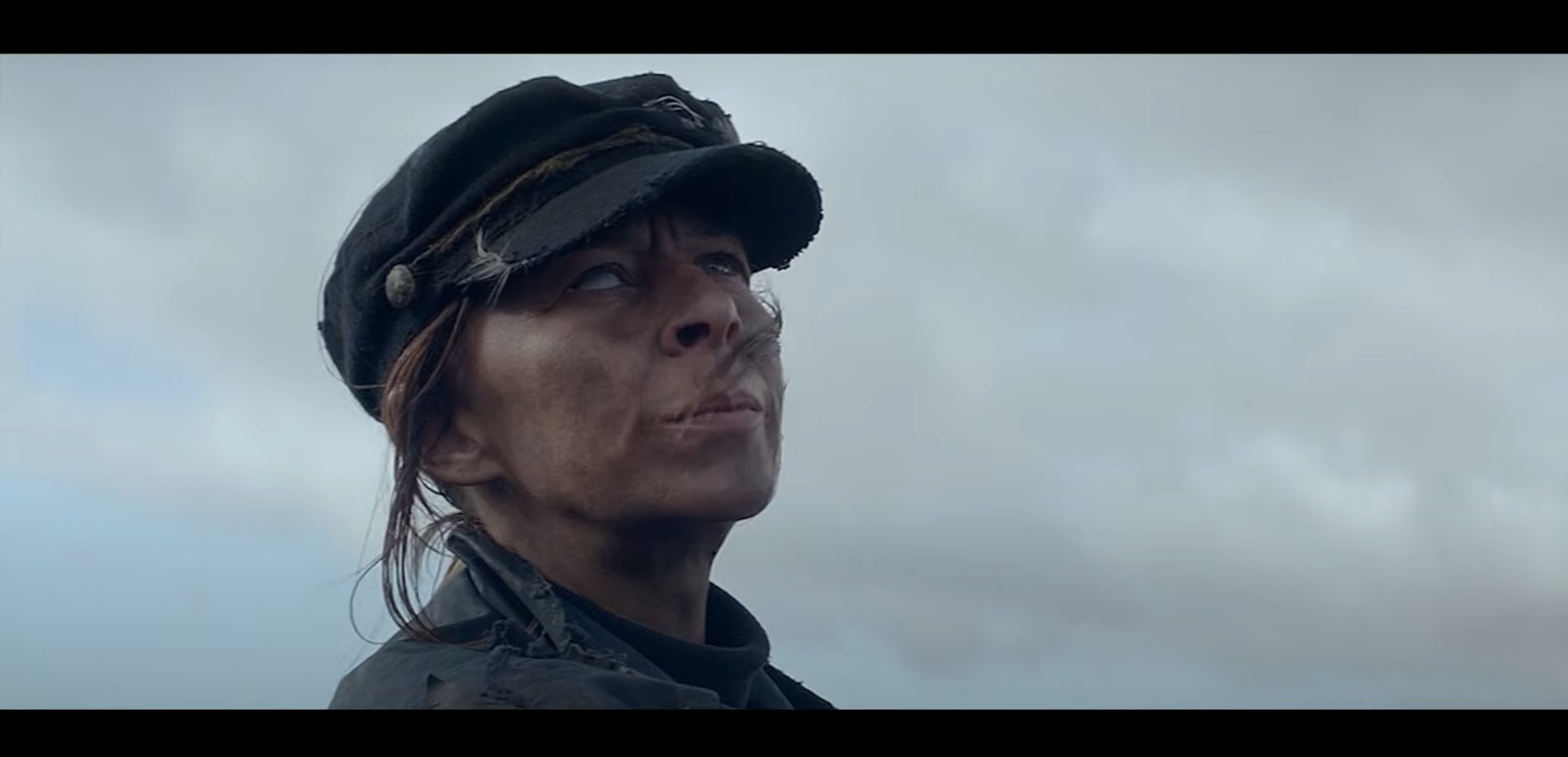
“A Discovery of Witches’” Tom Hughes embarks nearly solo on this frigid and fog-encrusted journey through self-segregating terror as Eric Black in order to break off Black from a world that won’t leave him be nor let him forget.   Hughes amasses a broody-flavored anguish, quietly stewing, fretting, and absorbing with great sedated composure the bombardment of strange occurrences during his stay on sheep island.  From his time with witches and vampires, the Cheshire-born, mid-30’s actor might be the lead of “Shepherd,” but it’s actually Kim Dickie (“Prometheus,” “The Green Knight”) who steals the show with her forebodingly salty fisher.  Haggard in appearance with a white, ghostly eye, Dickie’s frightsome performance and unsettling calm tone of voice could instill shivering fear into anyone who charter’s her boat heading toward a forsaken island.  The interactions between Hughes and Dickie are scarce with Dickie overshadowed by Hughes often wandering the island screen time like an avatar lost on in the fog of a Silent Hill horror game, waiting for something to pop out of the shadows and collecting clues to progress his story along.  Rounding out the cast is Greta Scacchi as Eric’s widow-bitter and devout mother and Gaia Weiss in a flashback and dream role of Eric’s deceased wife.

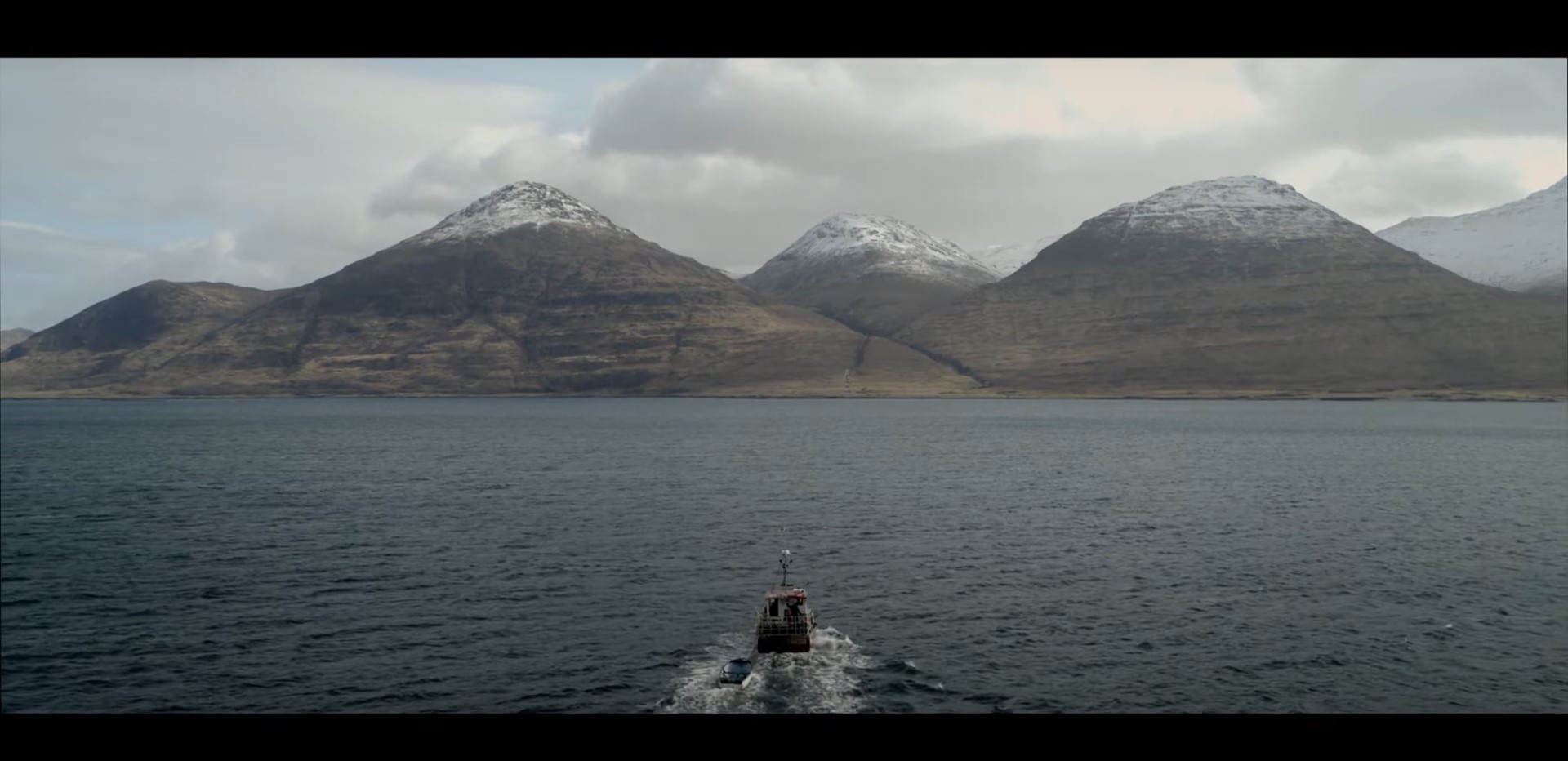
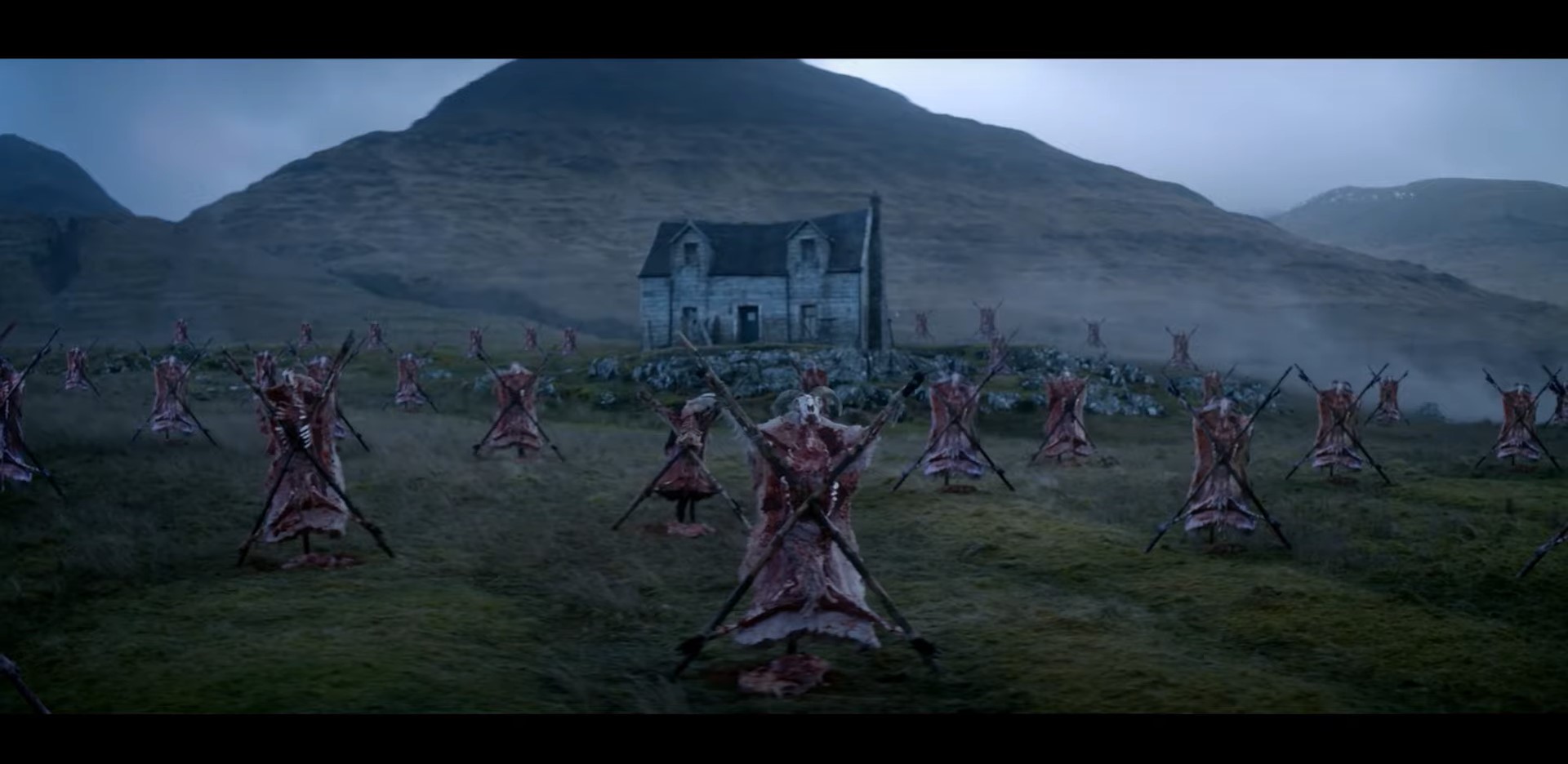
“Shepherd” immerses itself fully into the ideal concept of personal Hell with a wraparound mystery that batters and bruises the psyche of the protagonist, shielding away the hard-to-face truth, until a realization moment unfolds all the paranormal pastiche we’ve seen before in films such as Andrew Wiest’s “The Forlorned” and even Robert Egger’s “The Lighthouse,” both which involve lighthouses, lighthouse keepers, and a mixed-nuts’ tin of supernatural-madness. Trying to separate’s “Shepherd’s” niche from a very specific type of supernatural mystery subgenre surrounding a beacon of warning, or hope in some cases, is difficult to accomplish because each film, though stylistic diverse and eerily alluring in their own rite, regurgitate the same core context hinged on being unhinged. Now, what I’m not saying is that a remote, weather-beaten, and creepy lighthouse doesn’t make for a good setting – it sure as hell does – and cinematographer Richard Stoddard’s visual redecoration of the popular holiday tourist refuge, Isle of Mull, into a seemingly desolate, yet still a behemoth, island of nothing but monolithic rock faces and green grass as far as the eye can see. Stoddard’s use of in-flight drone cameras enables the visionary to capture breath-taking wide shots that dwarf Eric Black on his walkabouts in search for various odds and ends, providing an additional sense of overwhelming loneliness that pressurize the character to a breaking point. Space becomes an emblem of cursed irony for Eric between his need for separation from his disconnected place in the world to the vast space of Earth that inundates him into a bone-shivering panic. Space is also utilized by Russel Owen who’s able to manipulate through decent computer imagery the illusion of a large ship liner eerily resting a valley of fog or even taking a note out of Hitchcock’s shooting technique handbook of POV distortion, faltering Eric’s mind by disorienting him with swaying depths that play into the character’s fear of heights in another nod to the Hitchcockian coffer.

About every few years, a tense lighthouse lip-biter washes ashore. Released this past February of 2022, filmmaker Russel Owen’s psychological pilgrimage of coming to terms with consequential terror is his shot at the equivocal contretemps of one unlucky soul stuck on an eroded plinth of stone and shore. Darkland Distribution releases “Shepherd,” the second indie horror from Parkland Distribution’s dark subsidiary motion picture line, onto a UK Blu-ray with certified 15 rating and digital download, available off such platforms as Itunes, Amazon Prime, GooglePlay, Sky Store, Vubiquity (Virgin), BT, BFI Player, Rakuten TV and more. Since this review is based on a digital screener, I am unable to comment on the specifics of the Blu-ray A/V quality. The inhospitable-saturated soundtrack by Callum Donaldson is an unnerving mixture of low industrial rumblings and high anxiety string dissonance sure to keep the blood curdling with every resounding note and slice deep when the shocking time is right. I mentioned Stoddard’s eye for profound looming landscapes, capturing the natural beauty of the island, that are kept in continuity with the weathered fiber of the house and lighthouse interiors to match despite being shot inside a constructed studio set; however, a deep blue tint is added in post at random intervals of interior shots that pop out of place like a dislocated thumb, taking away from the realism and stepping more into the cerebral caged surrealism from which Owen ebbs and flows. “Shepherd” herds all the right tropes into a pen of madness. With a ferocity of natural imprisonment and the threat of evil dense within every molecule of the island, this awake nightmare fuels the ominous fire, but can’t quite reach its gut punch ending that curtails off toward ambivalence without cherishing a satisfying single resolution.

“Shepherd” on Blu-ray from Darkland Distribution!

Crawling Through the Bavarian Forest is an Eight-Legged, Seething EVIL Spider. “Venom” reviewed! (Twilight Time / Blu-ray)

Own the Limited Edition of “Venom” aka “The Legend of Spider Forest” on Blu-ray!

On holiday in a small sawmill town located in Bavarian countryside, artist and photographer Paul Greville seeks to capture the serenity of nature’s bountiful beauty. When he comes across a strange, wild woman with a spider scar on her shoulder, known as the “Spider Goddess” to the townsfolk as a curse individual, his curiosity sends him poking around the quaint, sleepy village that leads him into discovering also a rare and priceless painting thought lost after World War II. The deeper Greville digs into the mysteriously beautiful, unfettered girl and the valuable lost artifact, the more the town begins to resent his nosiness into their hidden agenda of a former Nazi scientist extracting deadly venom from the lethal forest spiders for noxious nerve gas weaponization.

Screenshot from IMDB.com

Better known as “The Legend of Spider Forest,” or “The Spider’s Venom” in the States, director Peter Sykes pulls from the madcap story cache a sticky, wacky web of lies and deceits with the unwinding-arachnid thriller “Venom” that involved mad scientists, creepy-crawly spiders, a half-naked wildling girl, and a plot planned from a World War sore loser shot in the United Kingdom as the backdrop for a Bavarian woodland. Five years before directing Christopher Lee and Denholm Elliott in “To the Devil….a Daughter,” the Australian-born Sykes was outfitting his sophomore UK feature with real, untrained, bird-eating tarantulas to be the basis of his visual terror in a mind baffling labyrinthine screenplay from the filmic exploitation brothers Derek and Donald Ford who, when not selling sex with their erotica celluloid (“Suburban Wives,” “The Swappers”), they were dappling in low-rung independent horror as such with the psychotronic “Venom” which is a co-business affair between Cupid Productions and Action Plus Productions with Michael Pearsons and Kenneth Rowles producing.

Screenshot from IMDB.com

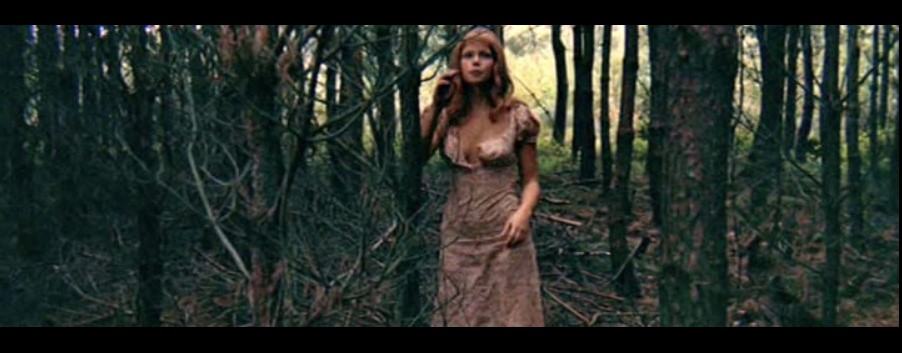
The unlucky sap caught in the village scheming drama is liberal arts enthusiast Paul Greville understood in his thirst for solving the case of the missing medieval art by English actor Simon Brent. The “Love is a Splendid Illusion” Brent, who left acting a few years after “Venom,” finally lands a significant lead man role albeit in a rather stretch of post-war German antics horror that has more twists in the narrative than there are actual spiders. Brent exudes an uncomfortable amount of a curious confidence as he charges through the forest to track down, or rather just happen to run into by chance within the vast area of a mountainous forest, “Erotomania’s” Neda Arneric, a Serbian rugged beauty playing wildling Anna with red-hot hair atop her short frame. We are first introduced to pixie cut Anna during a flashback of a full-frontal skinning dipping frolic in the river with a young, also naked, man and while the unknown man and Anna gaze with an effervescent stars of love in their eyes, the chemistry between Brent and Arneric is about as sparkless as a dud sparkler in a warehouse full of dud fireworks as their characters are too far apart and unalluring to fall for each other at first sight; instead, Brent casts such a demanding go-getter presence with his amateur investigation into the village’s little secret, his murky intentions toward the locally feared Spider Goddess is nothing more than nearly a figment of formulaic structure. We, as the audience, literally attempt to use our own mental will power against them in order to fall in line, or in love. More infatuation buzz surrounds the sawmill boss’s cloak-and-dagger daughter Ellen with “Children of the Damned’s” Sheila Allen as a willing and brazen femme fatale that seduces the hapless artist more than once, especially during one intimate session that restores him back to full health. Although an English production shot in an English forest despite being backdropped in Germany, there is one German actor that gave “Venom” that je ne sais quo toward locale authenticity, beginning with the sawmill boss and self-proclaimed first village resident Huber, played by Gerard Heinz (“Devils in Darkness”) in his last feature length film before his death one year later in 1972. The rest of the cast predominately is English with Derek Newark (“Fragment of Fear”), Terence Soall (“Theatre of Death”), Bette Vivian and one sole Czech actor Gertain Klauber (“Octopussy) giving it all with his very convincing German accent as the village Alps only pub and inn owner Kurt.

Screenshot from IMDB.com

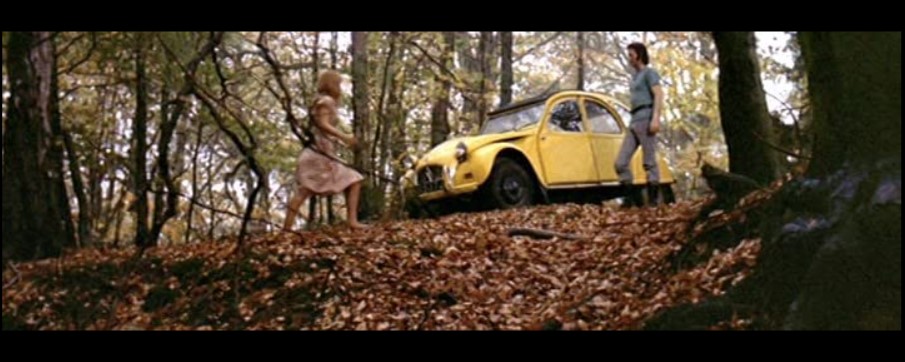
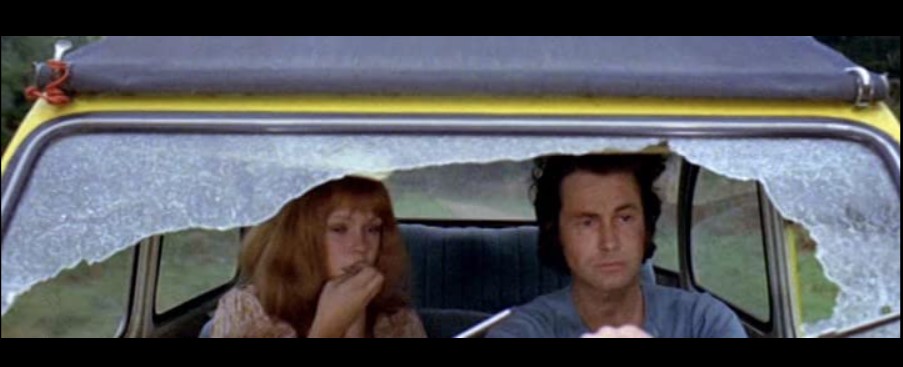
The sting of “Venom’s” unavailing characters is dangerously potent to a near effect of paralyzing the narrative. From Huber’s ireful small talk foreman with his own entourage of blue collar lackies to the mad scientist who doesn’t actually arrive onto the screen until the very last 10 minutes of story, in who is also perhaps the most interesting character garnering deadly spider venom and doing a little crossdressing on the side, “Venom” bears the brunt of unnecessary and disproportionate figures to be an implemented stopgap in managing Simon Brent’s screentime. Sykes teeters away from the majority of Greville’s point of view with little windows outside his perception that drop more diversional obscurity in who Huber and his operatives think Greville really is, why Greville is really there, and how can they handle Greville once he’s become too close to Huber and company’s operations. “Venom” slips unintentionally into the being a low-rent, haphazard Bond film or, better yet, a Scooby-Doo mystery without the Scooby Snacks, but there is ascot fashion. The story implies some exploitation of the mentally instable, using the “Spider Goddess'” strange behavior and her ominous ill-repute to be a warning to outsiders but Sykes conveys the latter allegorically with the destruction of pure, free love by an oppressive governing head, spreading lies about being cursed and deadly, only to find it again in a similar person, a person like Graville seeking to subvert the old wives’ tales and explore his unwaning curiosity no matter the consequences of bodily harm. I just like that Paul Greville drives off-road with a conspicuous bright yellow fiat through the forest shrubby and muck without getting stuck and without blending in.

Screenshot from IMDB.com

The skirmishing climatic finale quickly wraps up loose ends and, at the same time, is an intoxicating delirium of madness and suspense. Twilight Time delivers another Screen restored eldritch mystery onto Blu-ray home video as part of the limited-edition series licensed for a U.S. release from the UK’s Screenbound Pictures and distributed by MVD Visual. Presented in a 1080p, high-definition widescreen 2.35:1 aspect ratio, this is a good-looking transfer with soft, dream-like overtones stemming from a well-preserve original negative with the only drawback being the edge of the 35mm stock occasionally being visible in perhaps a mishandling or misaligning of the film reel that may have also been exposed to light slightly. Other than that, only a few hardly noticeable blemishes are on the image. The English language 2.0 LPCM Dual Mono that separates the dialogue and the ambient/score tracks. You’ll find a robust vocal channel, discerning very nicely from the action, but there’s still quite a bit of hissing and popping on the tail end that denotes more attention needed for better clarity. The film is rated PG but that doesn’t mean much of anything in early 1970’s with Anne Arneric going full-frontal, along with young beau Ray Barron, in emerald green tint as well as other brief flesh scenes from Arneric, arthropod terror, some blood, and the quickest flash edit I’ve ever seen of the lower half of a post-sawed torso. Much like the “Seven Deaths in the Cat’s Eye” release, “Venom” also has zero special features and, as a more tangible replacement, is a 11-page booklet with color and black-and-white stills, various poster art, and an essay by author Mike Finnegan. The Blu-ray cover art is also reversible with a color still on the backside. Don’t expect to contract arachnophobia after watching “Venom” in this high concept, poor execution of cheap boscage thrills.


Own the Limited Edition of “Venom” aka “The Legend of Spider Forest” on Blu-ray!