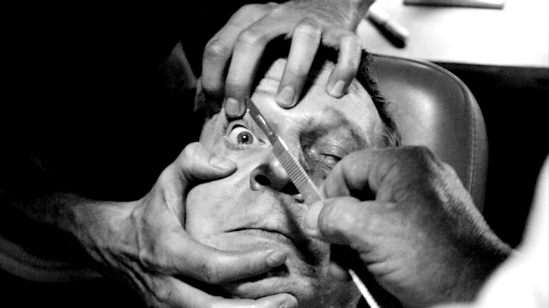
One man becomes the unfortunate subject of ghastly experimentations performed by a sadistic and blood thirsty doctor. Wheeled by abiding orderlies back and forth from his sterile white and padded cell to the mad doctor’s dark and dingy operating room office, the man’s will to live quickly begins to fade, yearning for death before suffering anymore in an alternative Hell. That is, until the handwritten notes start appearing on his padded room floor. The notes seep through between the pads from another tortured soul, a female, in the adjacent room. Withstanding new atrocities done to her before the man receives them, she pleads with the man to not leave her and to make a pact to outlive the inhumanities together.

Welcome to the new American Guinea Pig series! “Bloodshock” is the 2015 follow up film, on the coattails of 2014’s “American Guinea Pig: Bouquet of Guts and Gore,” from writer-producer and Unearthed Films president Stephen Biro and directed by special effects guru Marcus Koch. Koch, whose effects credentials include the Barbara Crampton starring thriller “We Are Still Here” and Koch’s prior directorial work “Rot” and “100 Tears,” strays away from the straight forward concept with an ultra gore art house expressionistic horror film that aims to break your mind as well as your body. Open for interpretation, “Bloodshock” fits perfectly into the ever provocative Unearthed Films’ wide open cache of underground cinema and will alleviate Koch to the next level of filmmaking. My interpretation of what this poor man and woman are experiencing is simply a penancing purgatory that’s intended to cleanse their souls in the warmth of their own wretched blood; the two victims understand their pain, as if not feeling the invasive effects of being dissected while still yielding breath, and are willing to subdue themselves to a maniacal physician until they’re able to briefly thwart his tireless work to share pain and open wounds in blood-soaked passion of hopeless ecstasy.

Dan Ellis puts in a powerful performance as the mistreated male patient with Lillian McKinnay, as the female patient, co-starring in an equally bold performance, especially being McKinnay’s first major role. Andy Winton’s diabolical medical maltreatment compares to the similar magnitude of “The Human Centipede’s” Dieter Laser by conducting exploratory, invasive, and unnecessary surgeries for sport while being candor about his blood lusting necessity. Amongst the three main actors, Biro’s script contains little dialogue, banking laboriously on physical renditions since both tortured patients’ tongues have been severed and jarred. Every movement is precisely executed and surged with attention, tuned to tell the story without much verbiage. Ultra gore isn’t everybody’s cup of cinematic tea and with an extremely thin film of dialogue as an outer coating, Ultra gore becomes that much difficult to be entertained by, but, recently, I’ve been lucky enough to come across another gore and shock film, coincidentally enough another Unearthed Films’ release entitled “Flowers” by director Phil Stevens, that had proved to me, as well as Koch has just done, that unspoken gore can be ingeniously crafted and thought provoking.

“Bloodshock’s” gore holds nothing back and leaves nothing to the imagination. The meticulous bone-sawing, head-splitting effects from a talented special effects team, consisting of Marcus Koch’s Oddtopsy FX crew, paint a sordid picture with a blood brush. Koch’s decision to go with Donald Donnerson’s cinematography under the two-tone of black and white doesn’t stiffen the poignant sight of blood, inner layers of flesh, or the splintering bone fragments. The Japanese would be pleased with their American counterparts realistically depicting gore and death captured amongst an underlying meaning. Unearthed Films has already taken the steps to continue the series with their next installment, “American Guinea Pig: The Song of Solomon,” which will pertain to a graphic exorcism and, currently, there are preview images and video scenes available.

The 3-Disc Collector’s Set from Unearthed Films and MVD Visual has priceless collector’s value. Not only does the set have a Blu-ray transfer of the 1.85:1 widescreen presentation, but also contains a DVD presentation and a third disc containing a CD of the Kristian Day industrial-jarring soundtrack. The black and white image quality is sharp and solid for a majority of 91 minute runtime. Some scenes go soft, losing shape to blotchy interference, but the qualities only supplement to “Bloodshock’s” charming grit. Only during the course of the patients unifying do colorful hues gradually seep in, almost unnoticeably, during an ostentatious sex scene involving blood and intestine that’s effectively edited to slowly build the passionate boiling point. Despite two of the main characters have their tongues removed, the Dolby Digital 2.0 audio has the dialogue so sorely crushed under the weight of the Kristian Day soundtrack that at some scenes I can’t even understand what the good mad doctor is saying. Also, on the DVD, I noticed that all audio tracks delay a second behind the action and dialogue. The bonus features are immense with interviews with director Marcus Koch, writer-producer, Stephen Biro, actor Dan Ellis, actress Lillian Mckinney, and two commentary tracks with Marucs Koch and Stephen Biro on one and actor Andy Winton, Gene Palubicki, and Alberto Giovannelli on the other. There’s also a behind the scenes featurette, production videos, and a booklet with a review from Ultra Violent Magazine! Unearthed Films certainly has a definitive release in their collection with “American Guinea Pig: Bloodshock” that’s packed with bonus material and full of venomous content abiding by the guidelines set forth by the Japanese. I don’t foresee the underground cinema juggernaut or the explicitly snuff-like Guinea Pig series ever slowing the flow of blood. “Bloodshock” fulfills the qualifications of the series by having the guts to show the guts and being just as demented and sick for fans who can stomach and endure grisly content.
Tag Archives: unearthed films
Evil Git Er Done in “Bubba the Redneck Werewolf” review!

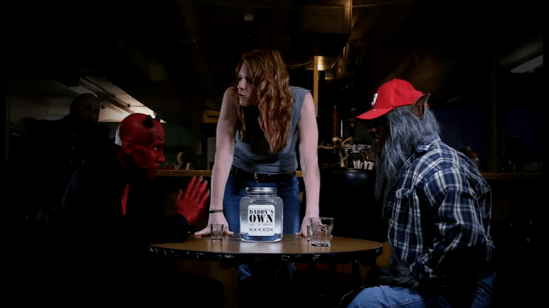
In the sleepy town of Broken Taint, dimwitted dog catcher Bubba Blanche is the town joke amongst the rest of the moronic residents even in the eyes of former girlfriend Bobbie Jo, wrapping her needs around the naked muscle-shirt arms of a triple wide trailer owning redneck. Bubba swears that he’ll do absolutely anything to win Bobbie Jo back and his pathetic cries stretch deep to the depths of hell, reaching the ears of the The Devil himself who suddenly appears in Broken Taint. The Devil strikes a dubious agreement with Bubba to make him stronger in order to win over Bobbie Jo, but when Bubba wakes up the next morning, the dog catcher has been transformed into a big, bad, and hairy werewolf. His curse becomes a gift straight from hell as he knocks the front teeth out of triple wide, wins the heart of Bobbie Jo back, and earns the respect of the local townsfolk. That is, until Bubba’s curse starts a chain reaction of unfortunate diabolical agreements between the conniving Devil and the town simpletons. As The Devil turns Broken Taint into his own tarnation playground, Bubba must use his newfound canine powers and some of his old hidden strengths to overpower and to outwit the clever Lord of the underworld.

Comic book movies. We either love them or hate them. We judge their fantastic value on the precision of who was casted as the hero or heroine and on the accurateness toward staying true to character origins. This may be common knowledge or it might not, but “Bubba The Redneck Werewolf,” a cigar-smoking, shot-gun carrying, jean-overall wearing werewolf, has been a successful comic franchise since 1995. Created by former CRACKED magazine writer Mitch Hyman, the true success of the provincial lycanthrope stems from the classic tale of a downtrodden individual being granted a huge amount of strength to overcome fear, to unleash ambitions, and to reestablish a brick wall of confidence all the while drinking a six-pack and drive a big truck. I’m sure Mitch Hyman would also note that the hilarity of a rootin tootin redneck werewolf with a patchwork heart of good intentions appeals to the masses as well.

When Two Rubbing Nickels, LLC partners with central Florida based and spoof-specializing video production company And You Films, that’s when Bubba truly comes to life from off the vivid comic book pages to ever critical independent big screen in 2014 where director Brendan Jackson Rogers’ colorful illustration of the hairiest super hero of all time and his barroom dingbats challenge a mischievous and dastardly Devil. What’s even more interesting about this under-the-radar adapted horror-comedy being released by MVDVisual onto DVD is the writer who penned the script. None other than writer, director, producer, and president of Unearthed Films, Mr. Stephen Biro. Yes, the man who delivers spectacular acquired gory avant garde and underground horror films to see a slither of public light puts forth his mighty pen to paper and etches out a perfect blend of comedy and horror that creates a sea monkey world where “Bubba The Redneck Werewolf” radiates with rib-tickling slapstick humor aimed to be darkly unapologetic and fused with embellished illustrations of spew and blood splattering mayhem.

The ensemble cast doesn’t have one single recognizable name credited and that makes this outrageous comedy that much alluring for nothing is taken overly serious. The very title of the film should be a clear expectation without explanation. Without that thespian pressure mounting on the casts’ shoulders, Rogers was able to build an alleviated atmosphere and let the actors be kids performing on the biggest stage of their careers. Even lead actor Fred Lass, who dons the Werewolf suit, had his very detailed and comprehensive werewolf facial mold conformed to show the expressions and the contours of his face. Bubba creator Mitch Hyman even has a starring roles as the Devil, his thin physique and defined face definably pops under a lush shade of hell branding red under a crown of dual horns; his satanic performance cultivates the very worst of humanity, using their greed against them, and reveling in their agony soaked suffering. Mitch Hyman wins the best ungodly trope since Al Pacino rendition of the Devil in 1997’s “The Devil’s Advocate.” Another unique element to harp upon are the strong female characters. Though the comic routinely objectifies female characters on the front covers with being petite and scantily cladded women of the countryside positioned around the massive werewolf with a baseball cap, only Malone Thomas’ role of Bobbie Jo resembles such a booty-jort, low-cut shirt clothed character, but, at the same time, Bobbie Jo remains a fierce constant show of strength for Bubba. She knows what she wants, how she wants it, and when to take it without shame and selfishness. Sara Humbert and Gail Fleming do the same for their respective roles of the blunt bartender Jamie Sue and the clairvoyant gypsy.

MVDVisual shotguns a beer and will deliver “Bubba The Redneck Werewolf” onto a region free DVD come 2017! The comic book image quality does well with the slight rotoscope composite with interlaced moments of raw and naturally colored scenes. The darker scenes in the widescreen 1.78:1 presentation comes off unsharp and blotchy, leaving details solely toward more well lit portions. The Dolby Digital audio track clearly puts forth dialogue amongst a balance ambient track. No issues are detected and sufficiently goes beyond being just good quality. A vast batch of bonus material outshines other indie releases, beginning with a 16 minute documentary “From Page to Screen. The Making of Bubba The Redneck Werewolf. Other extras include deleted scenes, blooper reel, Werewolf and Devil Make process videos, “The Ballad of Bubba” behind-the-scenes music video by The Blast-Offs, and the official trailer. Amongst the top contenders of modern horror-comedies and werewolf films, Brendan Jackson Rogers, Mitch Hyman, Stephen Biro, and Fred Lass have, literally, created a winning combination with their monstrous furry feature.

Evil Surpasses Decades and Has Never Looked So Good! “Francesca” review!

Fifteen years after the kidnapping and disappearance of Francesca, the young daughter of renowned poet and stage performer Vittorio Visconti and his wife Nina, a string of brutal murders by a relentless psychopath links itself to the case of missing Francesca and sparks community outrage with the deaths that are connected with Dante Alighieri’s The Divine Comedy. Detectives Moretti and Succo eagerly take on the case, that’s heavy with burden, to quickly apprehend the murderer but to also solve a more than decade old missing child case. As the bodies pile up and Moretti and Succo attempt to get closer to a resolution in the midst of grave public panic, a web of past dark secrets depict a convoluted picture surrounding the private Visconti family that may or may not be directly involved in what really came of poor young Francesca.

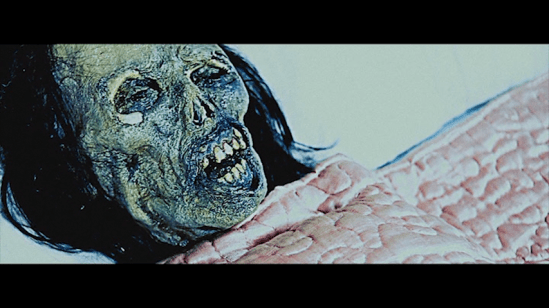
The sweet, bloody sweet giallo genre is not dead! The crime mystery thriller with shockingly grisly murders is alive and well and embodied in the soul of Luciano Onetti’s 2015 sophomore directorial that’s co-written with his brother, Nicolas Onetti. The Onetti brothers’ “Francesca” release gets a treatment deserving of kings with a gloriously and beautifully illustrated cover and inner lining that contains powerfully-packed 3-disc Blu-ray and DVD combo set distributed by the artistic gorehounds Unearthed Films and the multifaceted MVDVisual. Complete with an inscrutable and deranged killer that’s greatly diabolical in their own insane world built upon the Buenos Aires born director’s passion for Italian horror, every giallo loving attribute has been meticulously applied to “Francesca” from the shrouded killer to the use of characterizing the antagonist with simply their leather bound, throat-gripping hands high above the clicking of offbeat high heals not casted far from a creepy doll used to motif the killer’s ominous presence. Blood red violence streaks of eye disfigurements, or any facial disfigurement, throughout a script that’s much attuned to the structure and content, reigniting a flame of hope in a declining genre to which the 33-year-old Onetti appears to hold very dear to his heart.

In addition to the inner mechanisms and the ivory gears that constitutes a giallo film, Luciano Onetti takes his feature that one step further by reducing hues and adding an Italian post-production dub track, overlaying the assumptive Argentinean dialogue, to zip back to the past for a time hop location that’s purposefully set in 1970’s Rome. With props true to the time period, “Francesca” has undoubtedly a budget that delivers the malevolent charm of a Dario Argento slasher with a slightly modern taste for the Michele Soavi ghastliness, working seamlessly together to compile an apt tribute of surging giallo birthed right out of South America. “Francesca” is a stunning visual, a clear marker of filmmaking inspiration inspired by classic filmmaking that’s specific in it’s venture from familiar Italian editing techniques to capturing or creating the menace in even the most mundane of filler scenes.

“Francesca” is certainly a film that glorifies the anti-hero with a killer wreaking havoc amongst the public’s most disparaging people who got off the hook easily. When considering the depth chart, this vigilante psychopath exploits Dante’s work as a means of justification where one’s person journey to the gates of heaven must first travel through the gates of hell, providing a similar Charon’s obol of sorts where a metaphorical coin is viewed as a bribe for the gatekeeper or ferryman of souls. Even if considered an anti-hero, the murderer still manages to appeal as the villain because so much of the story’s focus is on Moretti (Luis Emilio Rodriguez) and Succo (Gustavo Dalessanro) and both Rodriguez and Dalessanro make their first on-screen film debut, suitably connecting with “Francesca’s” elderly ambiance.

The Not Rated Unearthed Films and MVDVisual 3-Disc Blu-ray and DVD combo is 77 minutes of pure fanboy gold, presented in a widescreen 2.35:1 in a vary of purposefully pruned coloring and intended faux film stock imperfections to recreate a 1970’s Italian giallo. The Italian dialogue track doesn’t quite synch and, again, that’s deliberate to fabricate a past ideal. My only gripe with this release is with the English subtitles as there were a few issues, including some key mistakes in spelling and with the pace of the subtitle that were way too quick. That shouldn’t sway anyone from this awe-striking and gorgeous limited edition release that comes complimentary with a booklet of an in-depth review from Ultra Violent Magazine’s Art Ettinger. The third disc rounds out the release as the film’s soundtrack, scored by Luciano Onetti and his progressive rock that’s a slight modernization of the synch-prog rock of this particular genre’s decade. “Francesca” comes straight out of a forgotten 40-year time capsule, looking to violate the eyes, minds, and ears of a younger generation and stimulating the nearly flatlined Italian giallo genre.
Mexico’s Stomach-Turning Evil is Here! “Atroz” review!

In a wake of fatally striking down a young woman with their vehicle, two errant and drunk men, Goyo and Gordo, are arrested for the gruesome crime at the scene of the accident While handcuffed in the back of a squad car, an unorthodox police chief named Juarez discovers a video tape recorder in the front of their mangled car with a tape revealing the violent torture and killing of a young transvestite hooker. One tape leads to another, and then another, individually exhibiting a trail of cascading blood and merciless torture in the deaths caused by Goyo and his unstable and dysfunctional life. Juarez digs further into Goyo’s ghastly cases going through each horrific tape setting up Goyo for a shocking conclusion from his past he long thought was dead.

“Atroz” will make you never want to tour Mexico! I can fully understand why “Cannibal Holocaust” director Ruggero Deadato fully backs Lex Ortega’s graphic horror film an associate producer and presenter as the two films, separated by decades, are much alike with the majority of their likeness in found footage techniques, frighteningly realistic imitations of murder, and their artistic and austere grandeur of filmmaking narration. Ortega also sustains an effective horror feature through the confines of a problematic ultra micro-budget. Along with aid from a talented roster of actors and crew, no way was Ortega’s film was not being made. “Atroz,” translated to “Atrocious,” opens with the unsavory side of Mexico’s impoverishment that contributes to much of the Central American nation’s disturbing amount of unsolved murders. The montage opening is so powerful and moving that what precedes shocks as a gritty insight of what everyday Mexican residents might experience one way or another in their lifetime and though Ortega goes that extra mile to be obscene and disgusting in every way possible, the director supports his work with seeding a traditionally patriarchal society with gender identity afflictions that evolves organically and is purposefully displayed in reverse order to add more, if it wasn’t possible already, to the shock value of “Atroz.”

The outer story involving Goyo’s interrogation about his stash of tapes is only the tip of the iceberg, sheltering three background influencing stories about Goyo that set up more familiarly in an anthology manner. Inked with intricate arm sleeve tattoos and perforated with metal facial piercings, Goyo and his larger friend Gordo, which means large man in Spanish fittingly enough, seem nothing more than your typical lowlife gangbangers. However, Goyo and Gordo are more disturbed than any Mexican cholos from the first torture tape of a transvestite prostitute, a punished, bit-part role awarded to actress/singer Dana Karvelas. The next two tapes are just as hard to swallow and stomach from the assorted fluid being consumed, to the explicit varying degrees of rape, to the vivd genitalia multination, and to just the sheer ultra violence depicted makes “Atroz” the gorehound’s holy grail of horror. Never have I’ve witness a film so graphic to come out of Mexico and, by golly, I thought the world needed this Lex Ortega film. In most cases, extreme gore and shock features run a course shortly after hitting the play button on your home entertainment device, but with “Atroz,” a drive to learn more about what motivates Goyo’s unholy acts unravel little-by-little and that quality is usually omitted and uncharacteristic of explicit gore horror.

Performances are firmly established all around with Carlos Valencia and Lex Ortega himself leading the charge as Juarez and Goyo. While Ortega doesn’t necessary have much of dialogue role with Juarez during interrogations, the undiluted carnage he lays down on the tape recordings are a rare and twisted characterization hardly visited by the indie circuit and certainly not given the light of day from Hollywood, being mostly sidelined to an underground context. Rare is it to have one actor who can impersonate malice upon others that when a doppleganger appears in Goyo’s younger years video tape, “Atroz” becomes that much of brighter highlight as a dark film birthed from Mexico. Carlos Padilla truly frightens as the younger version of Goyo staged in an abusive household with an unsympathetic father, an naive mother, and lots of physical and verbal mistreatment. Goyo’s a psychoanalytical unicorn, an epitome of the mind’s deranged wealth, and a testament that his surroundings molded the very fibers of his intentions do commit evil. The sight of blood is all it takes arouse Goyo and “Atroz” provides the character an ocean of sangre ready for lapping.

Practical effects wizards Jamie Lopez and Alfredo Olguín produced unrivaled effects on a budget that didn’t provide a second chance if the effect didn’t spin right the first round. Absolutely flawless did the duo’s work gleam in the blood it was soaked in and firmly how I held on for dear life my testicles when seeing a set being cleaved graphically severed. Lopez and Olguín have a combined 23-years of experience in the special effects game and that surfaced buoyantly at the top of “Atroz’s” shocking content. In the nature versus nurture debate, “Atroz” sides with nurture putting Goyo in the impoverished and traditional meat grinder that is Mexico and spat him out where wades in a chrysalis until bursting out into a state of lust for an endless stream of revenge and blood. Ortega accomplishes nurture’s wickedness by tenfold and Lopez and Olguín exemplifies it even more.

Unearthed Films and MVDVisual’s limited edition 3-disc Blu-ray and DVD set includes a JH5 & Eggun soundtrack. Presented in a widescreen 1.85:1 aspect ratio, the 79 minute runtime feature sports no blemishes and falters on any flaws, baring and setting a fitting desolate tone through a number of camera options. There’s also and English and Spanish language Dolby Digital 5.1 with optional English subtitles intent on properly channeling every port of your surround sound system. A pair of issue lie with the subtitles involving quite a few typos in English and some synchronization problems delaying captioning a full second or two after dialogue has proceeded. Bonus material includes the short film of “Atroz,” a crowd funding video, behind the scenes: music and sound design, behind the scenes: practical effects, behind the scenes: production, Unearthed trailers, a behind the scenes image gallery, and, of course, the aforementioned soundtrack. Whatever you do, don’t consume any food before and during experiencing the gore charged “Atroz,” Mexico’s most deranged cinematic delicacy to date!
In A World of Evil, An Embryo Becomes the Hero. “Mécanix” review!

In a dystopian of metallic wires, continuously spinning gears, and nightmarish creatures, human beings are being driven extinction, enslaved by these same terror creatures that rule the human’s once empowered world. Rounded up like mindless cattle for vivisection, humans dwindle in numbers and in spirit. When one human stumbles upon the embryo, the only object to which the creatures fear and the reason for the humans being vivisected, a new hope of freedom emerges out from the last of the human beings as the last freeborn man implants the embryo inside him. As the horrid creatures learn of the embryo’s whereabouts, a means to an end of their existence drives a frantic frenzy of nonstop destruction before their race becomes obliterated by the embryo’s uniting power.

“Mécanix” is a stop-motion, German Expressionistic film that’s a hard sell for most audiences. Director Rémy M. Larochelle and producer Philippe Chabot have extracted hell and beauty out of an idea of post technology cataclysm inspired by the DIY filmmaking. Spanning over a four year production and then another ten 13 years until U.S. DVD distribution, the 2003 released “Mécanix” creeps to make a cult film impact, but Larochelle’s film is making an impact nonetheless. The experimental nature, the stop-motion effects, and the entrenched expressionism of symbolism makes “Mécanix” unique and memorable thats a labor of love stemmed from Larochelle’s painting, drawings, and sculptures.

Back more than a decade ago, Larochelle sought to display technology and human interaction organically. The film doesn’t necessarily setup the series of cataclysmic events and lays down layers of assumption that humans have created technology and technology eventually goes Terminator coup, but, as if believing in the existence of the circle of life, technology can’t maintain without the human element and so they’re alignment ultimately comes together. “Mécanix” is a representation of that alignment that’s deeply subjective and disturbing, yet oddly fascinating, hooking automated teeth into an unsuspecting viewer.

Aforementioned, “Mécanix” took four years to completely conjure into a 70-minute motion picture feature. Within that time span, Larochelle painstakingly and thoroughly guides every aspect of the special effects, creating reality and fantasy together from through a 16mm camera to the spectacular finished product on screen, making the composited material flush and fitting for visual consumption. Also, ambient audio flawlessly helps bringing the sculpted terrifying creatures come alive who wield bulbous arms of clanky rebar and fleshy pulp, bares unidentifiable skulls protruding through cyborg tissue, and slither across the floor through dark crevices and nooks.

“Mécanix” isn’t an overly gory film, but it’s a hellishly wretched one coming out of Canada. Brief scenes of self-mutilation and depicted re-arrangements of the human anatomy are as about as graphic as “Mécanix” gets, subtly hinting more at explicit content. Stéphane Bilodeau’s freeborn man character, the male lead, and Julie-Anne Côté’s character, the female lead, born from the embryo have light weight speaking roles. The creatures communicate much more of their need for the embryo, giving inanimate characters a good slice of the dialogue, yet Bilodeau and Côté singularly convey their scenes appropriately despite never being in the same scene together. The two main characters present the only non-mechanical beings. Even the humans who are enslaved have a rigidness about them, android-like, while serving their master creatures, who some even don the use a wheelchair to move around – technology needs technology to maintain life sustainability.

Unearthed Films and MVDVisual brings the IPS Films, Creatio Ex Hihl & Avant-Gore Films “Mécanix” to the U.S. home entertainment market 13 years after the world premiere. Being Rémy M. Larochelle’s only feature film to credit, the director can’t be compared to his other work obviously, but “Mécanix” is a fine debut, especially with the amount of sacrifice put into his inspired “Begotten” similar artistic style. The DVD is presented in a in 1.33:1 full screen aspect ratio with a Dolby Digital 2.0 mix that’s suitable for the drowning tone soundtrack from Southern Lord’s doom metal group Teeth of Lions Rule the Divine. The video quality is an attribute to 16mm standards, containing speckles of imperfections that simple add to the charm. The only extra included is an unorganized, yet entertaining interview with director Rémy M. Larochelle and Philippe Chabot, geeking out over answering prepped questions about the film’s formation and inspiration. “Mécanix” rarity will be the prayerful hope and the ultimate declination towards the film’s success as the market for experimental is never catchy with audiences, but the uncontrollable gawking over the “Mécanix” mechanical creatures and practical effects becomes unavoidable.