

In the year 2022, Special Forces solider, Captain Robbins, is court martialed for putting a bullet in the head of his commanding officer. After escaping two maximum security prisons and a record of rebellious activity, a corrupt and power hungry warden of the Lactivus prison ships Robbins off to an off shore island called Absolom, where prisoners can roam free with no chance of escape due to 24/7 surveillance by Satellite and rocket launcher armed helicopter gunships surrounding the island perimeter. Island prisoners separate into two factions: the Outsiders and the Insiders. Each with the respective camps, the lawless Outsiders overwhelm the Insider’s numbers by 6 to 1, leaving the small manned community in constant fear of attack and pillage by the Outsider’s merciless leader, Walter Marek. When the insiders learn than Robbins has faced Marek and lived, they take the former solider into their community, but Robbins sole desire is to escape off the condemning rock and with the help of a few good men from the Insiders’ camp, the chances of escape and survival are greater together as long as Marek and his band of starving cutthroats don’t seize the endangered community first.

“Escape from Absolom,” also known as simply “No Escape” in the U.S., is a Martin Campbell directed action film from 1994 that’s futuristic and violent, fun and thrilling, and kitschy without being too cheesy. Campbell, who went on to direct not one, but two, James Bond films, begins a base of epic action that’s toweringly ambitious and pulled off nicely with the stunts and the editing. Based off the Richard Herley novel “The Penal Coloney,” the script is penned by Michael Gaylin who puts pen to paper to scribe a playful, passively aggressive dialogue, but fun and energetic on a the same coy lines of other high visibility action films. Gaylin was able to conform to a story that has no dynamic with the opposite sex in one of the few films that exhibits a rare all male cast.

“Goodfella’s” star Ray Liotta finally got his time to shine as the butch and badass action hero that is Captain Robbins, a highly skilled special forces solider and killing machine whose pragmatic intentions, at first, are hard to read. The cockiness overtop a well-cloaked deadly skill set works to the advantage of the blue-eyed actor for New Jersey. Opposite Liotta is Stuart Wilson (“Hot Fuzz”) as Walter Marek, a 7-year island lifer with dreadlocks and nose bridge piercings to match his psychotic leadership. Wilson does psychotic just fine, but the look resembles John Travolta’s atrocious attire from Battlefield Earth. Lance Henriksen, One of the most recognizable legendary genre actors, has a more serene approach in being a mentor and the leadership figurehead of the Insiders camp when compared to conventionally eccentric, sometimes maniacal performances, but Henriksen has a mellow side to him that conveys are very affectionate kumbaya approach, but any personality compared to Stuart Wilson’s internal rampage would be a stark contrast. “Ghostbusters'” Ernie Hudson has his role as security office in the Insiders camp and the sole black man of the film, for obvious reasons, stands out, but Hudson just adapts to anything you put him in though the Michigan born tended to sway toward the thrilling fantasy/sci-fi genre in the height of his career. Rounding out the cast is Kevin Dillon (“The Blob” remake), Kevin J. O’Conner (“Lord of Illusions”), Don Henderson (“The Ghoul”), Ian McNeice (“Dune”), and Michael Lerner (“Maniac Cop 2”).

All things considered, “Escape from Absolom” is a torrent men-in-prison extravaganza that’s one part Sylvester Stallone “Judge Dredd,” one part Chuck Norris “Missing in Action,” and, as a whole, an endangered brand of droll entertainment. Speaking of Stallone, Ray Liotta did it first as a character who is an expert at escaping the inescapable maximum security penitentiaries and instead of Arnold Schwarzenegger and Dave Bautista as contentious, yet supportive allies, the friendly, yet solidly statured Ernie Hudson and Lance Henriksen share Liotta’s Captain Robbin’s unquenchable lust for freedom, even if it to provide unsheathe exposition of the unethical corporate penal system practices. Far from being a perfect film and extremely blantant on a no underlying message, Martin Campbell undoubtedly has a fine tuned niche of capturing the casual eye with large scale action sequences and an affable character allure.

Umbrella Entertainment releases “Escape from Absolom” on a region-all Blu-ray, presented in 1080p, widescreen 16:9 aspect ratio. The coloring is phenomenally remastered and stable compared to previous transfers. There are times when depth becomes two-dimensional or flat, skewing the picture noticeably, but the overall picture quality is spectacular in the vast amount of Australian landscapes and even in the night scenes that show hardly any enhancing, such as sharpening or contrast. The English DTS-HD Master Audio 2.0 track is laid out nicely with audible poise and precision balance. Dialogue is prominent while explosions have just the right amount of oomph under an exact LFE recipe. The release sports other language Dolby Digital audio tracks such as a German 2.0, Spanish 2.0, Italian 2.0, and a French 2.0. Optional English SDH subtitles are available. Bonus material includes a two part making of featurette from around the production of the film with interviews with cast and crew, four TV spots, trailer, and a reversible cover. Runtime is 118 minutes. Martin Campbell’s “Escape from Absolom” is dystopian dynamite, explosive and aggressive with a flare for enjoyable banter amongst defined and diversified characters inhabiting an utopian island of mostly societal scum.
Monthly Archives: August 2018
In the Shadows, Evil Awaits to Rule. “Shadowbuilder” review!

In the fight against pure evil, the Catholic church trains champions to battle against the forces of hell and all that is unholy. Father Jacob Vassey is one of those very champions. The man of the cloth who wields dual 9mm handguns and has a penchant for penancing through the act of self-righteous wrongdoing in the name of Church and of God. When an treacherously evil Archbishop summons a shadow builder to undo all of God’s creation on Earth, Father Vassey pursues the demon to the small town of Grand River in search for a hunted pure soul; the demon tracks down young Chris Hatcher whose been through a sign of God’s passion, the stigmata, and is the key to demon’s ultimate goal. Once the shadow builder has collected enough souls and has laid sacrifice to the boy, the demon will reverse the creation of God, humanity will cease to exist, and the world would be ripe for restructuring at the whim of one of hell’s most demented minions. Humanity’s last hope lies with Father Vassey, a local sheriff, Chris’s veterinarian aunt, and the town loon to bring forth light toward the prospect of a dark and gloomy apocalypse.

“Shadowbuilder” is the 1998 apocalyptic horror film from director Jamie Dixon, steering his sole major production from a high octane and progressive anecdotal script by “Iron Eagle IV” screenwriter Michael Stokes and produced by Imperial Entertainment, who delivered some great films like “The Bikini Carwash Company” and The Bikini Carwash Company II.” Based off the short story in the “Under the Sunset” collection by Bram Stoker (author of “Dracula”), “Shadowbuilder” expands, develops, and morbidly seduces around Stoker’s tale that doesn’t necessary implement a Universal Studio’s “The Mummy” like tale progression and design, telling of a weak, yet venomous creature feeding on souls or people in order to regain world destruction strength. Stokes script goes right into the action with Vassey’s hunt for the beguiled Archbishop and the way Vassey is introduced is absolute 1990’s gold: a priest armed with two handguns with laser sights. Studios don’t make films like this anymore! Rivals as one of those films that has a doppleganger, like “Deep Impact” and “Armaggeddon” that coincidentally came out the same year as “Shadowbuilder. “End of Days” is that doppleganger film as the two share unholy similarities of a citizen of hell on a mission to sacrifice a human for above ground dominance.

No actor could pull off properly the gun-toting and shrewd role of a haunted and troubled priest that is Father Jacob Vassey. No actor except Michael Rooker (“Henry: The Portrait of a Serial Killer” and “The Walking Dead”). Rooker’s gravel pit voice is inarguably his best trademark trait that nails extra tension into the substantially bleak and world-ending situation; a tone that carries enormous weight and Rooker’s natural vocal gift, along with his lip snarling, square chin and piss-offstare, earns the actor to be the well armed and dangerous man of the cloth. “Bruiser’s” Leslie Hope joins Rooker as the Veterinarian aunt and the film’s love interest, but not of Father Vassey. Instead, the love interest belongs to the local town sheriff, Sam Logan, played by Shawn Thompson. Hope and Thompson’s on-screen chemistry can’t seem to puncture through as it’s defined as back burner material, overshadow by Vassey’s unwavering pursuit of the demon and the frantic search for the boy, Kevin Zegers (“Dawn of the Dead” remake), through the muck of the shadow builder’s poisoning of the town upstanding morality and ethics. Rounding out the cast is Andrew Jackson as the shadow builder, Hardee T. Lindeham (“Survival of the Dead”), Catherine Bruhier, and genre vet Tony Todd (“Candyman”).
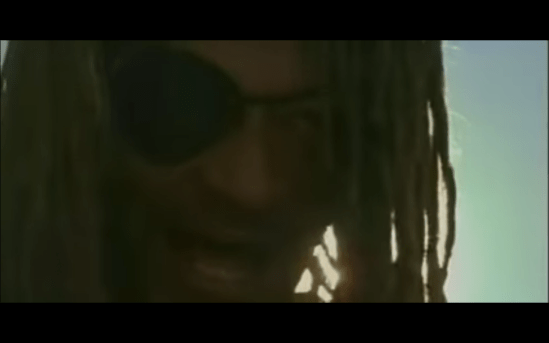
“Shadowbuilder” is by far a perfect horror film. Dixon, new to directing, dives into the infancy stages of CGI and, for the most part, the turnout pans out with the effects despite being slight crude around the edges. Stokes script puts story development right into the fast lane and doesn’t let off the gas so if you walk out of the room for a coke and return, you’ll miss something pivotal. The design works well to keep up the pace for a story that has a lot to tell and to not give the viewers a chance to piecemeal pick apart a teetering concept. One aspect that really tilts toward the negative is actually Tony Todd’s performance as the town crazy, a one-eyed Rastafarian named Evert Covey who is completely aware of the demon’s presence, but goes unexplained. Todd sells crazy, and sells it really well, but the lack of exposition into purpose plunders the character into outside the lines oblivion that begs the question, why is this character here? A guess would place Covey as a means to keep the lights running as he’s some sort of convivial, jerry-rigging mechanic.
MVD Visuals Rewind Collection label sports a special edition Blu-ray of Bram Stoker’s “Shadowbuilder.” The 1080p resolution is presented in a widescreen 1.85:1 aspect ratio. Despite the the 1080p resolution that aims to bring a little more detail to the fold, the coloring on the transfer is quite faded with considerable noise that’s hard to ignore, but while the noise is underfoot it doesn’t necessarily cripple “Shadowbuilder’s” ominous and foreboding vehicle. The CGI looks better than expected being an early model from the millennial transition into more prominiment animation in the turn of the century. The English uncompressed 2.0 PCM sound track passes muster, leaving dialogue rightfully forefront and substantial ambience as support. Bonus features include a nifty poster insert, a visual effects tour, and a making of featurette with interviews that include with the director Jamie Dixon, screenwriter Michael Stokes, the demon himself, Andrew Jackson, and Tony Todd. Kevin Zegers has his own featurette, a commentary director Jamie Dixon, and the theatrical trailer alongside MVD trailers for other Rewind Collection films. Michael Rooker, Tony Todd, and a demon. A winning combination reamed with apocalyptic mayhem, destruction, and undiluted carnage and up on a pedestal with on the eclectic MVD Rewind Collection.

Buy it today at Amazon!

Evil Messes With the Wrong Family! “Pickings” review!
Ruthless mobsters crack down hard on barkeeps, strong arming their way into seizing every bar in town. When they mess with Jo Lee-Haywood, the too cocky gangsters messed with the wrong Southern gal as Jo turns out to be Jo Pickings, one of three dames of the notorious Pickings gang. Jo tries to abide by a straighten arrow inspired by her deceased husband and four kids, but crime tugs at her violent past, scraping the good from her clean off. With the help of her brother, Boone, and her sisters, Doris and May, Jo and her family of heavily armed outlaws aim to fight back against thugs and thieves in this modern day western.
“Pickings” is the freshman film of first time feature film producer, writer, and director Usher Morgan. The contemporary gritty western is a maelstrom of goliath turf wars that’s stylized with rotoscoping and other comic book fatigues to dress Morgan’s film as an aesthetically popping story with illustrative visuals, anomalies, and raw tooth violence. The clear cut message, a fairly popular thematic motif among westerns, is don’t mess with family, even if family has been through an estranged time, and though Morgan’s theme runs a fairly conventional line, the “Sin City”-esque overlay gives “Pickings” a strong double take. What’s an especially fun and unique concept is having one of the characters, Sam “Hollywood” Barone, be exhibited in black and white while everyone else is in color as if the character was pulled straight from a Humphrey Bogart classic.

Elyse Price headlines as Jo-Lee Haywood, a wife-mother scorned by notorious gangsters, but the tough as nails mother of four runs a tight-ship when it comes to her bar and to her family. Price doesn’t hold back, taking the gut-checking hits and delivering a twice as big response with a performance of contempt and revenge. Price is joined by Joel Bernard, the sole brother of the Pickens gang whose as tough as they come, especially when you’re the only boy with three sisters. Bernard does the job matching Price’s hard nose character with his own more subtle version. The two other sisters, Doris and May played by Michelle Holland and Lynne Jordan, barely scratch the surface in an appearance that makes their characters difficult to absorb. Aside from Jo Lee-Haywood, the only other character with a significant character arc is her daughter Scarlet Lee-Haywood filled in by Katie Vincent. Vincent’s softens up against her mother’s violence despite being a passive witness to her cornered brutality, but can adhere to the akin familiarities of her family’s long and violent history. The cast rounds out with Yaron Urbas, who in my opinion is a decent mobster, Michael Gentile, and Emil Ferzola.
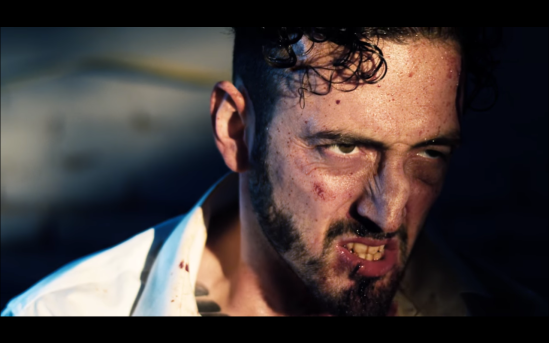
“Pickings” doesn’t come without problems and one of the problems is is the story concludes on a really too clean note. The inner monologuing exposition of Jo Lee-Haywood conveying her start-to-finish tale of her involvement with the three dames, Doris, May, and Jo, is a good visual like the rest of the Morgan’s film, but is just that, a good visual, and doesn’t carry the weight of suspense and becomes even more diluted when Doris and May have little interaction with Jo and barely any screen time at all to put the oomph into conveying their badassness. Aside from being obvious and telling, the gun blazing finale is also a bit underwhelming and disappointing, chocking everything to a one sided victory without any, or the hope of any, dire loss to compensate just feels empty and, again, too clean for comfort.
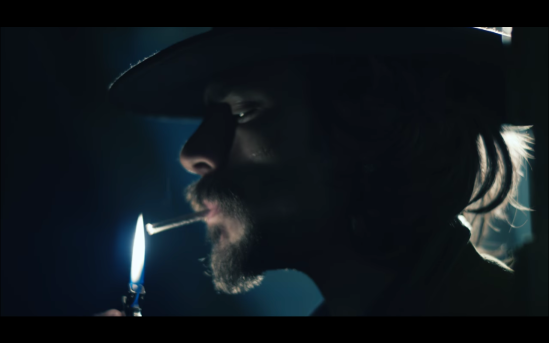
Courtesy of Dark Passage Films comes “Pickings” onto DVD and Blu-ray home video. The DVD is presented in a widescreen 1.85:1 aspect ratio that capture the neo-noir facets of shadowing figures and haunting mysteries. Morgan’s film doesn’t necessary pop with color, but that’s particularly the nature of the genre. Aside from that, no real issue with the DVD transfer. The audio is a stereo option that has an ample dialogue track and a stocky ambient accompaniment. Katie Vincent’s bootlickin’ acoustical score never wavers, cracks, or looses range. Extras include deleted scenes, filmmakers’ commentary, “The Mop” a Pickings short, a behind the scenes featurette, and a spoof reel during the end credits. Loaded with female empowerment, “Pickings” is a violent crime drama with neo-noir battle garments of two warring clans ready to get along like the Hatfields and McCoys, but the undercutting finale puts a sharp spur in one’s couch melding backside, leaving much to be desired from a women scorned vendetta.
 It's Bloggin Evil!