Umbrella Entertainment’s Volume three of Drive-In Delirium is coming! Here’s the press release and newly release trailer:
“DRIVE-IN DELIRIUM IS BACK & NOW DELIVERING
1080p TIMES THE INSANITY! VOLUME 3 OF THE BLU-RAY SERIES HAS ARRIVED AND IT’S THE BIGGEST AND BEST ONE YET!
Just when you thought that you’d seen every pulse-pounding, blood-drenched, flesh-filled scrap of trailer trash comes this third stupefying serving of mind-numbing, skull-splitting retro movie madness!
Bulging with over 6 hours of non-stop sex, violence, vehicle destruction, cockamamie cosmic carnage (not to mention an overload of Bronson badassness) – DRIVE-IN DELIRIUM: THE NEW BATCH is a rip-roaring, off-road, high-def ruckus that proudly programs your Blu-ray player to DETONATE!”
PROGRAM DESCRIPTION
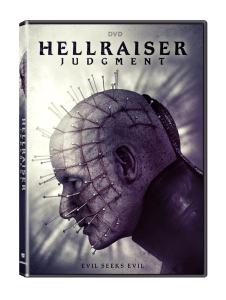
Experience a terrifying new chapter in the legendary Hellraiser series when Hellraiser: Judgment arrives on Blu-ray™ (plus Digital), DVD, Digital, and On Demand February 13 from Lionsgate. The tenth film in the classic horror series tells the story of three detectives as they struggle to solve a horrifying murder, but instead find themselves thrust into the depths of Pinhead’s hellacious landscape. Including horror icon Heather Langenkamp (A Nightmare on Elm Street, Wes Craven’s New Nightmare), and written and directed by Gary J. Tunnicliffe (Hansel & Gretel), the Hellraiser: Judgment Blu-ray and DVD will be available for the suggested retail price of $21.99 and $19.98, respectively.
OFFICIAL SYNOPSIS
The dreaded Pinhead returns in the next terrifying chapter of the classic Hellraiser series. Three detectives trying to stop a diabolical serial killer are sucked into a maze of otherworldly horror, where hellish denizens including the Auditor, the Assessor, and the Jury await to pass judgment.
BLU-RAY/DVD/DIGITAL HD SPECIAL FEATURES
· Deleted & Extended Scenes
· Gag Reel
CAST
Randy Wayne – “Escape Room” and “Death Pool”
Heather Langenkamp – “Star Trek: Into Darkness” and TV’s “Truth or Dare”
Paul T. Taylor – TV’s “Sheltered” and “Alternative Math”
Rheagan Wallace – TV’s “Malcolm in the Middle”
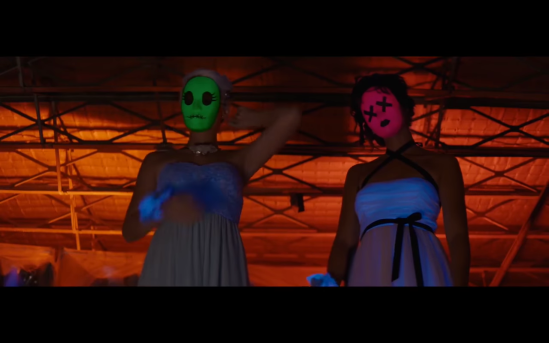
A small mid-western town has been terrorized by a string of gruesome murders and two local high school girls, Sadie and McKayla, seek to lure the killer out to not stop his onslaught, but to be put under his machete wielding wing. The best friends use their twitter page, @TragedyGirls, to platform their grisly kills as devastating tragedies and to be supportive outreaches in order to be beloved by all and to obtain social media stardom as a facade over being iconically elusive serial killers, but when their plan to capture a mentor fails, a wedge drives between them when Sadie begins to fall for longtime friend, and video editor for their twitter page, Jordan Welch. That’s all the fuel needed to spark McKayla into a deadly paroxysm in order to get her best sociopathic friend back by her side.
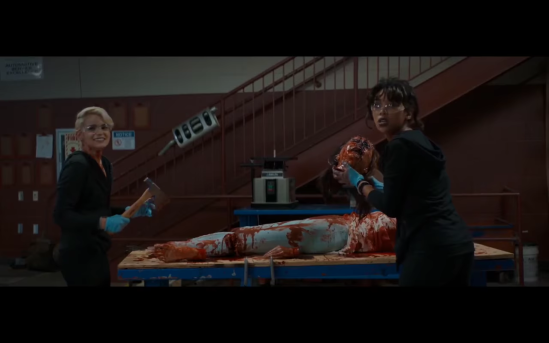
“Tragedy Girls” is the uptempo horror-comedy by writer-director Tyler MacIntyre along with fellow co-writer Chris Lee Hill, both whom previously helmed another horror-comedy entitled “Patchwork” in 2015. “Tragedy Girls” aims to put the slasher genre on it’s head by turning what should be two sweet high school girls into the sadistic hunters instead of the usual genre trope of hapless prey and incorporate the dark side of social media, using platforms, such as Twitter, to gain notoriety through exploitation of others’ very lives, but the use of social media doesn’t sticker MacIntyre’s film as tech horror. Instead, typical ditzy-dynamic adolescent drama is integrated into the gory melee Sadie and MacKayla fabricate for fandom. There’s plenty of blood and death to go around through a mix bag of slaughter with some being inspired by other horror films, channelling such classic as “Friday the 13th” and “Carrie.”
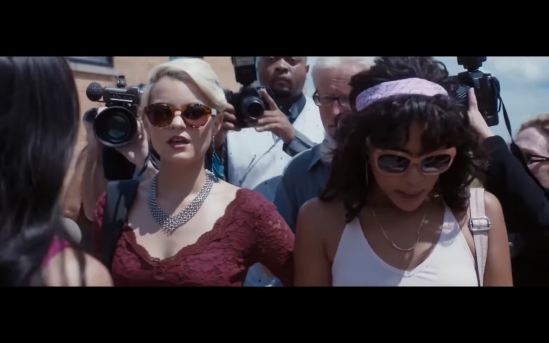
“Deadpool’s” Negasonic Teenage Warhead, Brianna Hildebrand, and Alexandra Shipp, who’s also a Marvel superhero in X-Men franchise as Storm in “X-Men: Apocalypse,” star as besties Sadie and MacKayla. Hildebrand and Shipp are doubly frightening as two sociopathic killers and equally as scary as silver screen teenage girls glued to their phones while keeping up with their good fashion sense, but their pixie cut and cheerleader personas are as embellished as their underlining dark craft to make “Tragedy Girls” over-the-top and shocking on a “Save by the Bell” level. Though the two are stone cold, homicidal maniacs, a love interest is added for Sadie. The “The Hunger Games'” Jack Quaid, son of Meg Ryan and Dennis Quaid, fills the shoes of the lovesick Jordan Welch and Quaid does a fine job being the smartest guy in the room, but still being blindly dumb to the situation unfolding around him and Sadie. Surprisingly, a number of various genre vets rear their heads in this film, starting with “The Strain’s” Kevin Durand. The 6’6” tower of pure muscle Durand embodies a Jason Voorhees like villain when masked; unmasked, he’s about as stupid as they come and Durand can do stupid very well. Part of the comedy, of this horror-comedy film, stems from an uncharacteristic role played by Craig Robinson as a very unfit, local firefighter hero, fittingly named Big Al. The “This is the End” and “Ghosted” star bores through his minor role of Big Al with very little dialogue as Robinson is well known for wit, but the comedian has one of the better scenes with a 2-on-1 fight scene with the two demented school girls. The last recognizable face being mentioned flames out as quickly as it’s flamed in from the Sci-Fi genre. Josh Hutcherson, another “The Hunger Games” star, goes James Dean as MacKayla’s emo ex-beau, Toby Mitchell. Hutcherson’s character doesn’t quite fit the “Tragedy Girl” mold that pushes the limits later on in the film and his portrayal of Toby Mitchell is awkwardly misplaced as overzealous and forgettable. Rounding out the remaining cast is Timothy V. Murphy (“The Frankenstein Theory”), Nicky Whelan (“Flight 7500”), Keith Hudson, Savannah Jayde, and Katie Stottlemire.
“Tragedy Girls” will do well as it’s a solid horror-comedy with a la carte gore. None of the characters seize the progression of the trope reversal story and with the exception of Hutcherson’s Toby Mitchell, the actors conform precisely to the animation of their character’s scribed personas. Hildebrand and Shipp are the epitome of that last statement. The pair of actresses have a real life proprietary appearance about them and to crossover those looks and meld them into Sadie and MacKayla will forever establish them as the true tragedy girls. “Tragedy Girls” isn’t just about flip-flopping the genre rear ended up; writers MacIntyre and Hill pen a film that’s also about female empowerment with two strong actresses filling the shoes of two self-sufficient badasses committed to doing what’s conventionally labeled male subversive behavior and accomplishing it on whole other level. Even if on the wrong side of the law, the tragedy girls stick together through the good and the bad to overcome various high school and beyond high school hurdles that attempt to thwart not just their friendship, but their cyberspace popularity.
Gunpowder & Sky proudly distributes “Tragedy Girls,” a film by fresh faced production companies like Its The Comeback Kid and New Artist Pictures, onto VOD now and DVD home video February 6th. Since provided with an streaming link for review, a well-rounded critique on the DVD’s technical specs, picture quality, audio tracks, and bonus features will unfortunately not be commented on, but the very film itself should entice the most casual horror film goer who usually doesn’t stray off the mainstream path. With familiar faces and plenty of bloodshed, “Tragedy Girls” holds water against competitors in a flooded genre. Don’t forget to follow them, #tragedy_girls or @tragedygirls, or else you’ll be next tragedy exhibited in their wall feed!
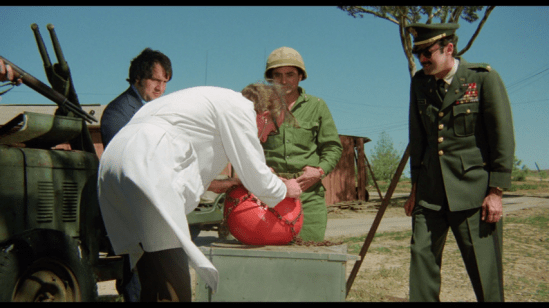
The United States comes under a relentless siege from a formidable foe unlike any other. An enemy that’s risen from the ground up to overthrow the very soil Americans’ inhabit. Flashing proudly their red colors, this adversary will fight and destroy anyone in their path. The attack of the killer tomatoes will seek to end mankind and take over the world! As desperation sets in, top U.S. generals, under the aloof guidance of the President of the United States, assemble a motley crew of special ops that become America’s best hope against a vicious barrage from the killer fruit….or are they vegetables? Under the leadership of Mason Dixon, his team will infiltrate, investigate, and, if lucky, exterminate the rotten to the core tomatoes. From the glossy red cherries to the plump big boys, the round ripe killers are hungry from human pulp and only Dixon and his team can stop them!
Courtesy of the MVD’s Rewind Collection, a newly released line of retro cult cinema, comes the impeccably unsystematic comedic spoof “Attack of the Killer Tomatoes!” for the first time on high definition Blu-ray! Writer-director John DeBello, along with his co-writers and fellow many hat wearing cohorts Costa Dillon and J. Stephen Peace, takes satire to the composter, lets it fester for a month, and releases a heaping pile of slapstick gold to the masses. The zany indie production, backed by various family members and local mom and pop retail operations, has been a horror comedy staple for past 40 years with not-so-cutting edge timeless humor that pokes a satirical finger at other more serious ventures such as Alfred Hitchcock’s “The Birds” with the film opening with a message about viewers brushing-off jovially the Hitchcock subtle creature until the event actually happened with aggressive, unflinching fowls terrorizing a small town and in that context, a film about killer tomatoes was born. DeBello’s film aimed to poke fun at many other things as well and successfully pulled the wool over the eyes of critics who remarked how awful his film was to behold, but that was the director’s sought-to, goal line intention.
Out of a cast of untrained talents and actors and actresses who never saw the bright lights and prepped sets ever again, only one actor stands out as a recognizable face and household name and that face and name was of Jack Riley as a Government slug. I might be a sucker for classic re-runs, but I remember Riley from his stint on “The Bob Newhart Show” and his very presence in “Attack of the Killer Tomatoes” legitimizes not on the film’s creditability but set the humor tone that was to be expected and despite almost being killed during filming as the rented helicopter accidentally crashes with him in it, the comedian rose from the ashes like a reborn phoenix and suggested to use crash footage to seemingly boost the pint-sized production value. However, it’s David Miller, who has zero interactions with Riley, in the lead role as a Mason Dixon. Though with an uncanny resemblance to the late funny man John Belushi with the wavy dark hair upon his short round figure, Miller goes fairly dark, as in quiet, for his leadership role as perhaps the only sane, and logical, character in the entire sequence of misfits. Dixon’s right hand Lt. Wilbur Finletter is played by co-writer, co-producer J. Stephen Pearce who courageously commits himself to doing all his own stunt work in a film that proudly wishes to just have a good time. Pearce’s approach to the lieutenant is with a sullied gung-ho persona that’s effective, but barely in the eyes of Mason Dixon. Dixon’s love interest Lois Fairchild, the only credited role of actress Sharon Taylor, inarguably is involved in an awkward game of being coy with Finletter as Fairchild, being a rookie reporter, aims to get the story at any cost while Finletter’s dimwit has him skate around her advances and oblivious to her information seeking intentions. Rounding out the cast is George Wilson, Eric Christmas (“Porky’s), Ernie Meyers, and Ron Shapiro.
Before “Scary Movie,” before “Naked Gun”, and even before “Airplane!,” “Attack of the Killer Tomatoes” had tailored, if not probably pioneered, this particular gag humor and in today’s day-and-age of political correctness, films like John DeBello’s are much like the Dodo bird – extinct. In the mix of light hearted witticisms, a number of racial, sexist, and overall bad taste cracks lie sporadically about the 87 minute runtime that wouldn’t make past the MPAA standards of today, that would invoke public ridicule and outcry for the filmmakers’s heads, and would unjustly place on a blacklist mark all involved, but just like a many number of these cinematic relics, they’re grandfathered into the fold. Though I doubt many millennials have even heard of the killer tomato franchise which would be baffling since health conscious wackos would enjoy seeing genetically modified tomatoes run a rampage, proving their points.
“Attack of the Killer Tomatoes” arrives on a special collectors edition Blu-ray/DVD combo set from MVD’s Rewind Collection. For the 1978 film, this release, presented in an AVC encoded 1080p 4k digital transfer of a 1.85:1 aspect ratio, is by far the best yet with a rich coloring range that pop and bring new life to the cult favorite. Hair line blemishes and some blotchy moments rear ugliness every so often, but the outcome of this release is astonishing when compared to previous DVD versions. The mono uncompressed PCM track reinforces a well rounded release when technically speaking. The dialogue is crystal clear and the musical numbers go off without a hitch. Perhaps, not as resonating as one would hope, but in the end, the mono track really sounds good here. Bonus features aplenty with audio commentaries from director John DeBello, J. Stephen Pearce, and Costa Dillon, three delete scenes, a collection of old interviews from cast and crew entitled Legacy of a Legend, a discussion on the helicopter crash, and “Attack of the Killer Tomatoes” original 8mm short film plus much, much more. Roughly about two hours of bonus content on this release makes it certainly a definitive collection. It took only 40 years for “Attack of the Killer Tomaotoes” to receive the treatment the John DeBello directed creature feature rightfully deserves and though might stink like rotten organic matter, there’s certainly nothing like the splat-fest riot of rolling, death-dealing fruit fleshed with trail blazing comedy unlikely to be repeated in today’s uptight community.
Own this version of “Attack of the Killer Tomatoes!”
Recently released from prison, ex-con Boris reaches out to his former lover, Wendy, to discuss the status of their relationship after her cold feet episode on a robbery job where she drives away the getaway car, leaving him red handed when the cops arrive. Wendy wants more than anything to live a normal, honest life and Boris aims to please her wishes, but needs to pull of one big job to set their future. Fortunately for him, Wendy happens to be the plaything of a wealthy paraplegic who owns a lustrous castle. Boris convinces Wendy to recon the inside, to find where the treasure might lay within the belly of the castle walls, and when the pair of thieves manage to break into the castle’s fortified basement, escaping is inevitable when a deadly game unravels. Trapped inside a chamber of terror, Boris and Wendy must go through a series of enigmatic riddles and deadly traps to move forward toward what they’ve broken into to steal, but when offered a chance to leave the game with their lives intact, will an acceptance to live be decided upon or will Boris and Wendy gamble for greed?
InterVision Picture Corp., has done it again with another stellar resurrection from the VHS video graveyard with the release and distribution of the Canadian gem “Beyond the Seventh Door.” The debut of B.D. Benedikt’s written and directed horror doesn’t display much of the elements associated with the horror genre with the exception of an acute dispersion of thrills and mystery; instead, Benedikt’s film breeds a mutt that commingles fear invoking atmospherics with the intensity of an unflinching, yet undetectable, moral essence that amusingly reestablishes the very Canadian stereotype of being too nice for the North American nation’s own good. The clearly expressed message of greed goes without saying in a plot that involves incurable thieves making life and death choices over materialistic riches despite the consequences that follow if to pursuing the latter. Another theme exposed is that working together will increase your chances to overcomes obstacles as Boris and Wendy mesh their strength and their smarts to solve puzzles and to escape traps before them and on the other end of the spectrum, going at the situation alone doesn’t work out for either one of them. The prominent themes intertwine effortlessly into a modest story that doesn’t become undercut by today’s inherent plot twists or fail to meet captivating interests as the themes are timeless and current as greed never goes out of style proven by the recent Oscar nominations for Ridley Scott’s drama “All the Money in the World.”
The cast quartet requires not one more soul to showpiece this Canadian cult classic. Leading the quaint pack is the Yugoslavian stud Lazar Rockwood and the rumors are true, Rockwood does look like the long time on screen villain Billy Drago, but Rockwood, as Boris, is no hard nose bad guy but along the lines of an anti-hero with his crooked conscious overtop a softer, tender heart for his past life lover Wendy. Bonnie Beck tackles Wendy as a woman pulled by two desires: her feelings for Boris and a normal life without lawlessness. Her more memorable scene consists of her stripping her red, thigh high skirt, exposing the lacy, black garter underneath, and comically trying to plug water spewing holes in order to not drown. Rockwood and Beck’s on screen chemistry doesn’t jive and, to be overly honest, their bond is substantially weak, but to embody and embrace a characterized scorn and torn twosome, the pair share a set ablaze with passion for accomplishment that oddly resembles Richard Chamberlain’s Allan Quartermain’s adventures sans the quirky comedic charm. Rockwood and Beck completely make up about 90 percent of the screen time as Gary Freedman, in his sole credit, dons the mysterious Castle owner and a local Canadian celebrity, a street performer, named Ben Kerr who only had to sit with his eyes open and act a corpse.
Modest as it was, “Beyond the Seventh Door’s” independent production couldn’t rival the end resulting magnitude of which the construction of the trap rooms and the characterization of the score would suggest a bigger wallet project, transforming that aforementioned simple story into a big ticket item. Behind the financial curtain is the responsible parties, the Herceg brothers Frank, Steve, and Tony and along with a fourth producer, Lubomir J. Novotny, Bozidar D. Benedikt gained the trust to pull off a no-budget thriller into a wild brain, catacomb horror that pre-dates the escape room element of “Cube” and Jigsaw’s lethally virtuous games. Now, I wouldn’t say “Beyond the Seventh Door” pioneered the genre, but merely had a minor influenced and sometimes that’s all it takes for inspiration.
Canada’s ambitious exploitation film “Beyond the Seventh Door” is now out for the first time every on DVD courtesy of InterVision Picture Corp., the sui generis distributor of rare independent genre films. Presented in a full screen 1.33:1 aspect ratio, the shot-on-video image quality retains an above VHS level quality with a clearer picture and refined details. BBlotchy moments are still prevalent, especially in long shots of Boris leaving the prison and walks along a cold path to the waterfront, but doesn’t kill the reflective moment. The audio 2.0 mono track has great clarity, range, and depth that showcases some of Lazar’s greatest lines of his hilariously read dialogue, such as “Screw you! You hear me, screw you!” The synthesized soundtrack emanates balanced LFE and range. There’s minor, but inconsequential, hissing during dialogued lines. Bonus features include audio commentary with director B.D. Benedikt, star Lazar Rockwood, and moderated by Paul Corupe of Canuxploitation.com. Also included are interviews with B.D. Benedikt, Lazar Rockwood, and Paul Corupe in a “Beyond Beyond the Seventh Door” segment and a look at Ben Kerr, a Toronto eccentric, in “The King of Cayenne” that delves into Kerr’s street performing life, his run for political office, and his overall love for a cayenne pepper cocktail. “Beyond the Seventh Door” is an anomalous, door-after-door misadventure with eccentric performances and an exceptional plot twist that only B.D. Benedikt could kook up and only Lazar Rockwood could pull off.