Feminism Fights EVIL The Only Way Possible in “Broken Mirrors” reviewed! (Cult Epics / Blu-ray)

The Best Depiction of the Unpleasant Side of Brothels.  “Broken Mirrors” on Blu-ray.

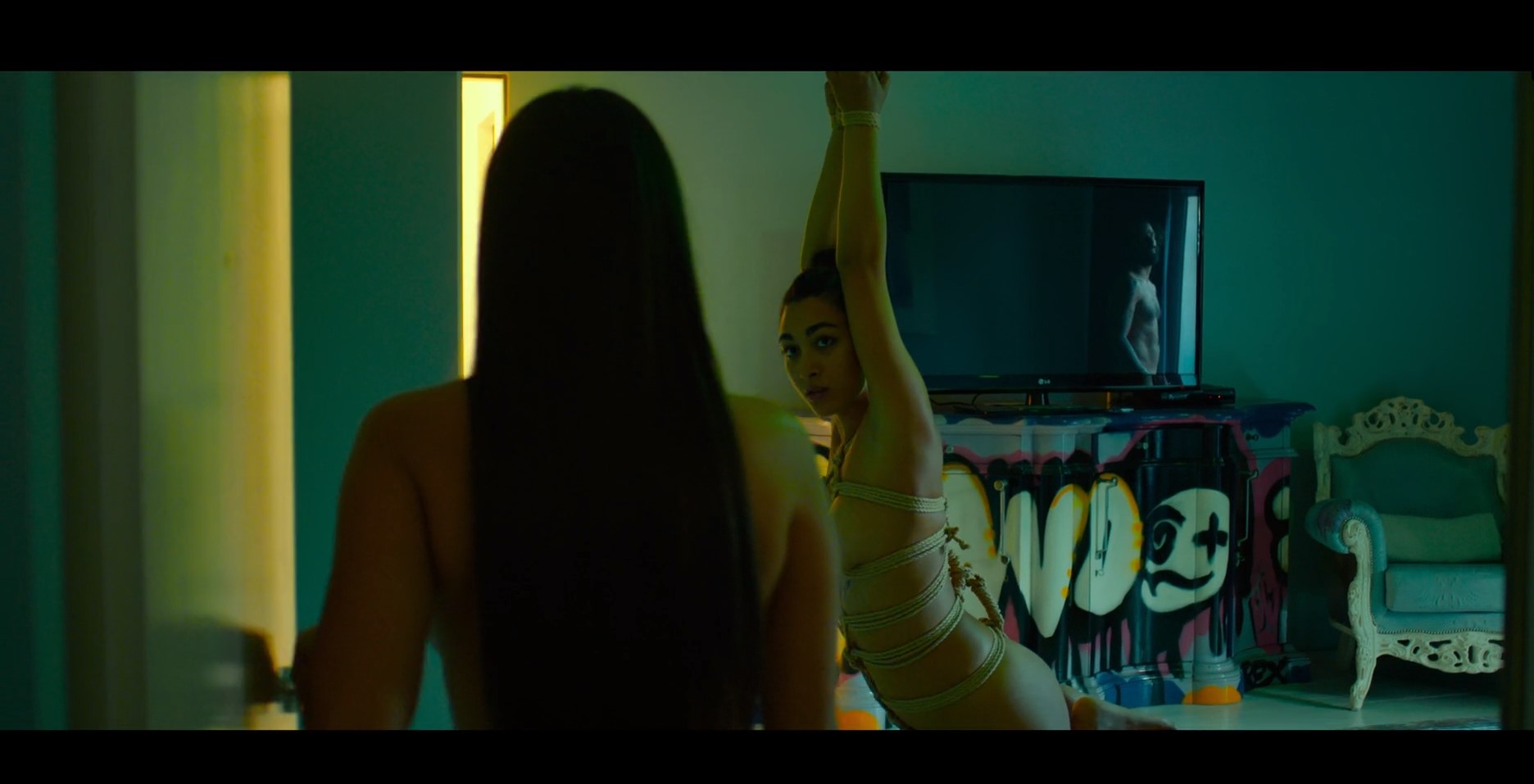
An Amsterdam brothel Happy House Club clings to the good girls that remain employed to pleasure the reprobate and insensitive johns that visit.  Dora, a virtual working girl lifer, brings in new blood, Diane, a young mother desperate in need of financial support because of her drug addicted husband.  Night after night, customers select through the ever-growing service list the club’s owner deems profitable while the women and the matron manager naively cope with a profession that’s quick, easy cash.  They create a process, a standard of procedure so to speak, that tries to make the work that much less degrading but with each client, a little piece of their humanity is chipped away.  Simultaneously, a methodical serial killer abducts the women he previously surveillances from off the street, chains them to a bed in a remote room, takes snapshots of them in confinement, and slowly starves them to death, which could last months.  The two stories are intertwined and connected by a gender dominance disease in which a slow resistance begins to build to an explosive head.

The unofficial sobriquet of the Queen of Feminism Marleen Gorris had made a name for herself as a staunch supporter of feminism and lesbianism with her controversial and provocative films.  Her acclaimed 1982 debut written-and-directed “A Question of Silence” show oppressed gender solidarity and mutiny against a systematically enslaved masculine society.  Continuing her crusade against the patriarchal grain, Gorris followed up “A Question of Silence” with another powerfully messaged, social commentary film that, again, places women emotions and safety under the unyielding thumb of men two years later with “Broken Mirrors.”  Natively known in the Netherlands as “Gebroken Spiegels,” the film marks the return of select cast from her inaugural feature, marshalling in a new narrative in the neo-feminism cinema under the returning production company Sigma Film Productions with producer Matthijs van Heijningen (“A Woman Like Eve,” “The Cool Lakes of Death.”).

As mentioned, a pair of actresses have carried over from “A Question of Silence” to maintain a principal performance in “Broken Mirrors,” beginning with Henriëtte Tol who played the outwitting secretary in Gorri’s debut returns as a woman working in Amsterdam’s red-light district as a seasoned employee of the Happy House Club.  Tol ups the ferocity levels of her previous performance while still maintaining a gradually steady sex appeal.  Another returning actress who nearly didn’t have any dialogue in her previous role as a mother without a voice is Edda Barends now in a character that can’t stop screaming for her life as the latest abductee chained to a cruddy bed in a cruddy room with a coming-and-going, polaroid-enthused sociopath. In Barends starkly different rage against the man machine archetype, the actress finds herself discomposed in the face man she can’t understand but eventually recognizes his nasty need and withdraws it.  Both women excel beyond the unsavory current conditions and transfer the power that’s been dangling over their heads into themselves.  Newcomer Diane, played by Lineke Rijxman, becomes the key to initiate the unraveling of power of a man-owned brothel that subjugates women not as mere employees of a man-owned business but as nothing more than moneymaking ass-shakers and back-layers.  Rijxman puts in the work of having her character be resilient at work and at home as she juggles a wide variety of disgusting clients to please their whims while coming home to deal with a junkie husband’s mess.  As the story progresses and the women fall deeper under life’s heel, Dora and Diane spark what begins as a mutual friendship that slips gradually into sexual tension, giving them more assurances when they need it the most as the brothel parties become bigger and more intense.  The parallel story runs along the same oppressive path but in unconventional, unlawful, and inhuman way with the kidnap and starvation torture of a young mother.  Eddie Brugman is also a returning “A Question of Silence” actor who now finds himself in the shoes of Jean-Pierre, a mild-manner husband and by all rights societally normal seemingly man who visits the brothel for a quickie, easy money as Francine (Marijke Veugelers) would proclaim, but his dark hobby is to snatch unsuspecting women for his own perverse pleasure of watching and hearing them plea for their lives.  By the end of both stories, connected by Jean-Pierre and who finds himself at the end of the disappointing stick for his kicks, crafts more than one way to not give in and to stand up against male malarkey and nastiness.  The cast rounds out with Carla Hardy, Coby Stunnenberg, Anke van ‘t Hof, Elja Pelgrom, Hedda Oledzky, Arline Renfurm, Johan Leysen, Wim Wama, and Elsje de Wiljn.

Not only is “Broken Mirrors” another contentious and provocative incendiary story that wedges apart men and women, with the latter being victimized and justified in their actions, but Marleen Gorris also directs one hell of a boiling point intertwining between parallelisms that almost have no link to each other until the reveal.  Gorris doesn’t necessarily employ red herrings to keep audiences guessing but rather keep the killer obscure, as all that we are exposed to see is from behind the man, who doesn’t speak much either and if he does speak, his responses are to the point with as little descriptors and adjectives as possible.  Not only is the editing between simultaneous stories organic but also the other editing techniques that materialize the characters’ emotional decaying befit the mostly linear structure, such as with the student party montage at the brothel that does a roundtable of individualized scenarios between the women and their slimeball clients in an emotionally painful grin-and-bear it series that culminates to which one character best describes the ordeal as feeling like a human lavatory.  The feeling is very much mutual with viewers as well, like a used wet nap to scrub off a soul staining filth covering head to toe, as Gorris represents a thematic exactitude of fiercely dividing feminism that would define her career. A clear understanding of how brothels operate is greatly depicted with that flimsy layer of excitement and efficiency to mask the ugliness underneath.

“Broken Mirrors” arrives on a Blu-ray home video from Cult Epics and, once again, resurrects and restores a pièce de résistance of Netherland celluloid. The new 4K high-definition transfer from the original 35mm negative is presented in European widescreen 1.66:1 aspect ratio on an AVC encoded, 1080p, BD50. 35mm print looks none worse the wear over the course of father time with a mint print. Restored color graded has freshened up the natural print palette of the brothel story while the kidnapper’s tale sustains a grayscale to bisect the narrative and the delineation for both presents a palatable depth. The aplenty natural grain doesn’t swarm and takeover the higher pixelations to award us with a satisfying vintage image that now enriched without any smoothing enhancements nor any compression issues to note. The Danish language release comes with two audio tracks: A DTS-HD MA 2.0 Mono and a LPCM 2.0 Mono. “Broken Mirrors” fair well from both dual channel formats with the DTS-HD aggrandizing the Lodewijk de Boer razor synth score with intent that in itself is a character. Comparatively elsewhere, the two outputs offer little differences and sate with forefront dialogue, balanced in front an equally balanced ambient track. Optional error-free English subtitles are available with haste text to keep up with the fast-paced Dutch. Special features include an audio commentary by Leiden University film scholar Peter Verstraten, an archived 1984 interview with U.S. sex worker and activist Margo St. James with Cinema 3 host Adriaan van Dis, a promotional still gallery, and trailers. The Cult Epics Blu-ray comes in a clear, traditional snapper sporting the film’s most iconic and titular moment, displayed also on the disc art, while the reverse side of the cover depicts a still image of Carla Hardy. The region free Blu runs at a not rated 110 minutes. A good double bill against “A Question of Silence,” “Broken Mirrors” makes for a morosely on the trot sister feature in more ways than one to further a Marleen Gorris artfully aired agenda.

The Best Depiction of the Unpleasant Side of Brothels.  “Broken Mirrors” on Blu-ray.

A Teacher’s Raunchy Romance is Not the Only EVIL Being Committed! “Amor Bandido” reviewed! (Cinephobia Releasing / DVD)

Forbidden Love and Severe Malefactions in “Amor Bandido” on DVD July 18th!

A remiss 16-year-old Joan is the son of a wealthy magistrate who doesn’t see eye-to-eye with his father’s wishes.  What was supposed to be the last day of school before Easter break turns into Joan’s most anxious day when he learns that his mistress, his teacher Luciana, is exiting her position at the school that very day.  Pleading to Luciana to take him with her, she reluctantly accepts his tagalong despite him being underage and her being more than double his age.  Their unlawful affair leads them to an isolated manor where they can romantically explore themselves in a paramour tour of passion.  A couple of days have past and Joan is completely smitten until Luciana’s brother arrives and the whole getaway has been a trick at Joan’s expense.  Now, the adolescent is being held captive and has to fight for his very life before he’s executed for being nothing more than a wealthy judge’s son and a naïve, jilted lover. 

More by more, news stories are printed of older women, specifically women in education, having intimate relations with a young, student boy – sometimes, another girl as well.  Men have always been the archetype of the infamously ugly term pedophilia, but women can be just as predatory despite the lack of widespread printed and televised attention.  Mostly, these new bites are mostly obscured in the newsfeed of an online aggregated newsreel, hyper-regionalized to the area where the crime was committed, but the story is nearly always the same – young (often good-looking) 20-30 year old teacher abuses young, under 18-year-old boy in the car, at her home, via text with lewd pictures, etc.  Honestly, boys have long been hot for teachers, but there is an inherent sliminess to the idea that has been rooted in steamy fantasy pubescent minds.  Iconic films like 1967 Mike Nichols’s “The Graduate” starring Dustin Hoffman aroused the notion of forbidden lust while others like George Bower’s 1983 “My Tutor” and even the more recent “No Hard Feelings” with Jennifer Lawrence, to an extent, makes light of the subject matter; however, no other filmmaker really captures the act’s grooming nature like director Daniel Werner.  Werner’s “Amor Bandido,” or “Bandit Love” depicts minor exploitation like never before with fellow screenwriter Diego Avalos in their feature film together after the production of their 2019 short, another contentious teacher-student relationship, entitled “Nadador.”  The Argentinian film is a co-production of The National Institute of Cinema and Audiovisual Arts (INCAA) and Werner Cine, produced by Werner and Nicolás Batlle.

The film opens up to Joan, a 16-year-old student with a bit of a chip on his shoulder as he glues together a volcano-like model in slapdash fashion.  Spoiled further into his innate teenage angst by his own abundance of wealth, Joan is able to get away with essentially disrespecting his empty-threatening father and boozy mother.  The extent of his entitlement spills into the classroom when learns his teacher, Ms. Luciana, is leaving the school at the end of the day and this is where we learn that Luciana and Joan have been in a forbidden affair as they meet in a storage room where she caresses his crotch as they kiss.  Though looking very much like a 16-year-old brat, Renato Quattordio is actually in his early 20s when the Buenos Aires born actor becomes passionately intertwined on screen with early 40’s actress, Romina Ricci.  The noticeable age difference places a stamp of scuzzy approval as the principals really put on a show of sensuality that defies the numerical age gap while also defining the maturity and the experience of individuals.  Quattordio hits the mark as the naïve teen eager to jump at the behest of his older, curvaceous companion.  And, boy, is Romina Ricci curvaceous, luring Joan in as the wanton teacher cautious of their alluring affair.  The erotic thriller quickly turns into a survival thriller when Joan’s eagerness to grow up comes face-to-face with Luciana’s past, embodied by Rafael Ferro (“Terror 5,” “White Coffin”) and Sergio Prina as two money greedy thugs eager to milk Joan for all that he is worth.  “Amor Bandido” rounds out with a few more bandidos in Mónica Gonzaga, Carlos Mena, Jurge Prado, and Santigao Stieben.

“Amor Bandido” is a coming-of-age tale with a pair of dichotomizing facades strung together by opposing forces in choosing between love or money.  Essentially, those two driving forces boil down to the relationship’s core and that is what director Daniel Werner simmers on, a test of idolatry strength between two people.  Werner pretenses the narrative with a forbidden love escaping to the rurality to make passionate, unjudged lust in a love context, well, at least for one of them.  The absconding is only a diversion for another unlawful act and is palpable in the undertone that something isn’t quite right with Joan and Luciana’s relationship, something that you can’t quite put your finger on and it’s not the surface fact that she’s a mid-30 something-year-old teacher screwing her 16-year-old student.  Werner leaves a breadcrumb trail of concerning clues that make sense when all is exposed but keeps those hints closed to the chest, protected to not giveaway too much until the summiting turning point of the exiting passion and entering perpetration.  Yet, despite our intuitive inklings of the funky air, the pivot still hits hard like a blindsided punch to the jaw that dislodges the mandible and rattles the teeth when the two lovebirds are struck with one payday load.  The only aspect that could be narratively tweaked is the introduction of the wounded stranger whose motives are understood but not quite absolutely clear his connections and how he became wounded in the first place with a gnarly gash on the calf that looks like a Great White shark attack had a snack on.  Digressing to figure out where he fits into it all becomes a distraction and a divergence from the main story that has now snowballed into additional but unwanted molestation, possible incest, and a ransom deal that won’t be faithfully upheld. 

“Amor Bandido” is the first feature to be covered by us courteously supplied by our friends as Cinephobia Releasing, a new distribution label from original world-searching and independent cult worshipping cinephiles of Artsploitation Films.  Coming soon to home video on July 18th, the single-layer DVD is presented in a widescreen 1.85:1 aspect ratio from a digitally recorded print and renders an expected damage and dust/dirt free picture with nature, yet smoothed out detail, skin tones and natural coloring.  There’s not a ton of visual risk here from cinematographer Manuel Rebella (“A Taste of Blood”) with the stimulation coming strictly from performances and the erotic, forbidden spirit.  The DVD5 format falls below par for darker portions within the frame that are seen with splotchy banding as well as the aforementioned smoothness around facial features.  The Spanish Dolby Digital 5.1 surround sound and a Spanish Dolby Digital 2.0 are equally comparable with the focus primarily on the dialogue and less on the sound design to warrant extra channels so both tracks output relatively the same.  There are scenes or sequences all other tracks are muted or receded to make way for a vivacious musical soundtrack to accentuate the moment.  Dialogue comes across clean and clear without any interference in the balance of the little ambience of rustling leaves, water splashing, and gun shots.  Option English subtitles are available, but I did spot a pair of typographical errors.  Bonus features include a 3-minute sale and promotional make-of with director Daniel Werner, the original trailer – separated from the bonus features on the static menu – and trailers for future Cinephobia Releasing films, such as “Sublime,” “Emmanuelle’s Revenge,” “Brightwood,” “The Latent Image,” and “The Goldsmith.”   Pressed with the cropped but same image as the front cover, the DVD comes in a standard tall snapper with the front cover sporting that crotch-fondling moment of intimacy.  The Cinephobia Releasing title comes unrated, runs at 80 minutes, and is has region 1 playback.  The coming-of-age arc prevalently scores into the naïve, angsty adolescent tale but “Amor Bandido” also suggests that maybe maturing too quickly should be left off the table, keeping fantastical temptation at bay and keeping innocence intact for kids to be kids just a few years more.

Forbidden Love and Severe Malefactions in “Amor Bandido” on DVD July 18th!

To Do EVIL, You Must Pay EVIL a Ton of Euro. “La Petit Mort 2: Nasty Tapes” reviewed! (Unearthed Films / Blu-ray)

Step Back into La Maison de “La Petit Mort” for a Sequel that’s Hard to Stomach!  

La Maison de la Petit Mort’s doors remain open under new management, continuing to serve the dark web public interest with a wide variety of snuff services.  For the right price, a fantasy-driven in-person torture show can be arranged for your liking, and one can be an commanding observer or one can get their hands dirty in participatory play where anything goes and pleasures are on-demand.  The German snuff house expands their reach to a global level with live webcam shows that can be directed by the high price paying patron and the leather-cladded vixen staff carry out their illicit instructions exactly.  A robust menu of dark pleasures, displayed on a new showreel of select gruesome services, are available at the simple transfer of a money wire or cash in hand for the depraved to make their fantasies a reality.

In 2009, German born director Marcel Walz helmed a linear, three-act narrative of tourists laid over in the big city winding up at patronizing a dark and dingy dive bar, La Maison de la Petit Mort, only to be abducted as inventoried stock for the rich to exploit in a slew of murder perversions.  Five years later in 2014, Walz returns for a sequel, “La Petit Mort 2:  Nasty Tapes,” with reprising principal actress Annika Strauss co-writing the film alongside Walz as well as stepping back into the sadistic black platform shoes of Dominique, one of the two lovely ladies with a lecherous and violent vocation.  The direct sequel that follows a day-in-a-life of the snuff house’s employees making an advert showreel does not follow suit in the way the first film was structured.  Instead of a linear, chronological narrative, “Nasty Tapes” evolves into an anthology of different kill archetypes for the marketing video. Walz’s Matador Films serves the production oversight with Harald Schmalz (“Collar”) coproducing the anthological torture porn feature.

“La Petit Mort 2: Nasty Tapes” doesn’t seen a whole lot of return on the original cast.  The tourists were all mangled, mutilated, and murdered, the original Monique bit the dust in an escape attempt, and the first Maman rode off into the sunset rich with blood money.  Instead, and among other things, “Nasty Tapes” folds a new treatment of terror with the same old eggs and flour by reinventing itself into an anthology type, introducing a new, blonde Monique (Yvonne Wölke, “Bad End”) into the batter, and disclosing the new owner of the freaky, fetish club, a feminine man by the name Monsieur Matheo Maxime (Mika Metz, “The Curse of Doctor Wolffenstein”).  Annika Strauss is the only original cast member to reprise her original role of Dominique, the brunette to Monique’s blonde and who showed slight inkling of hesitation before being summoned to torture and murder.  Strauss doesn’t buck the character trend as Dominque still displays disgust on her face when slicing a man’s facial features in a Picasso style portrait.  Yet, Dominique remains loyal to the Monsieur and to the La Maison de la Petit Mort by committing the atrocities without question, unlike the regular administrative bookkeeping and housecleaning she regularly remains vocal in opposition in what’s a slither of dark humor contrast between her gruesome work compared to mundane work.  Unlike Cyanide Savior singer Manoush, who was a very convincing merciless club owner Maman, Mike Metz plays a very different, more layered proprietor portrayed as someone who sees the work as a paycheck to fund his deepest desire – to be a beautiful woman just like his wife Jade Maxime (Micaela Schäfer, “Sky Sharks”).  That’s about the gist of complexity the sequel has to offer with much of the thinly laid foundation is bricked up by a compilation of back-to-back kill scenarios that involve some extreme genre directors as special guests, such as Uwe Boll (“House of the Dead”), Dustin Mills (“Bath Salt Zombies”), Mike Mendez (“Big Ass Spider!”), and the late Ryan Nicholson (“Gutterballs”), taking part in the clandestine, underground activities in-person or on the web.  The film fills out the cast with victims and victimizers in Armin Barwich (“The Terror Stalkers”), Bea La Bea, Babriela Wirbel (“Plastic”), Nichol Neukirch, Marc Rohnstock (“Necronos”), Thomas Pill (“Moor-Monster!”), Kai Plaumann, Markus Hettich (“No Reason”) and the twins, Barbara and Patrizia Zuchowski.

When going into a German gore film, such as “La Petit Mort 2:  Nasty Tapes,” you have to go into It having an affinity for, or at least an understanding of, complete shameless representation of torture and killing of another human being for the simple and pure joy of the act.  In other words, you have to be somewhat sick in the head.  For me, personally, the sickness is rooted out of admiration for special effects and how the F/X artist(s) can create a realistic depiction of an unofficial autopsied anatomy. Filmmaker Ryan Nicholson, who passed away in 2019 of brain cancer, not only had a role in the Marcel Walz sequel, but was also the special effects artist, following in the footsteps of one of the notable German underground special effects artists, Olaf Ittenbach (“Premutos:  The Fallen Angel”) who had done the graphic gags on the first film with head turning results.  Nicholson, with a credit list that has a foot in independent productions and more mainstream, Hollywood productions, such as “Final Destination” and the remake of “Blair Witch” from 2016, doesn’t disappoint and keeps the blood, guts, and stringy sinew seamless in a gruesome pageantry of death that rivals and continues Olaf’s original stamp.  Beyond the glossy surface of a blood glaze, “Nasty Tapes” is nothing more than a kill-after-kill anthology with no concrete premise for either of the individual slaughter vignettes.  Title cards setup the kill moments with basic victim descriptors, such as married status, age, and how much their life has been paid for, but doesn’t humanize them in the least, creating zero compassion for the unsuspecting abductee fated for something far worse than death.  Instead, Walz flips the script with more background on the clients with ipre-and-post interviews of their most intimate time at La Petit Mort.  This structure can be monotonous as there’s nothing else to look forward to or to absorb empathetically as a viewer in an anthology that simply glorifies the leisure time of an undisturbed murder.  

As a nail-pulling, nose-cutting, drill-holing, lip-stitching, dick-scissoring, gut-stabbing anthology, “La Petit Mort 2: Nasty Tapes” is a gory, good time and is even better now in high-definition with a 1080p Blu-ray release from Unearthed Films The AVC encoded BD25 looks as good as can expected for a shaky cam, hectically edited, and filthy dark German gore film presented in a 2.35:1 widescreen aspect ratio.  Details are oleaginous wet with blood and tissue that incongruently with the Roland Freitag’s gloomy yet suppressed cinematography and Kai E. Bogatzki discordance and chaotic editing technique that is supposed to elicit extreme shock but consequently results in a loss of the intended grisliness.  Unearthed Films‘ release exhibits no issues with compression, but the hues and tones appear to fuse in the near eliminate of some contours where there should be some.  The German-English DTS-HD 5.1 mix can be score heavy, especially a hard and energized Tekkno title credits from composer Klaus Pfreundner that’s distinctive German, but “Nasty Tapes” has profound focus on its core selling point – torture.  The very few scenes of intercut dialogue shots spliced into the client’s sociopathic session are well understood and do have prominence over the score, as well as the ambient milieu of screams and the integrated flesh destroying Foley, despite the cam-esque quality of the pseudo-testimonials.  The burned-in English subtitles under the German Language only are synced well without error and with consistently good pacing.  Disc extras include a behind-the-scenes making of cut out from the main camera, an alternate torture scene, a behind-the-scenes still gallery, a short advert of a naked woman strung up by her arms and being stapled with signs, and Unearthed Films trailers.  The Blu-ray physical features don’t stray to far from normal Unearthed Films releases with a standard Blu-ray snapper case with grisly cover art of a marred victim’s plucked out eye and a Jade Maxime holding a bone saw and wearing ripped fishnet stockings and black lingerie.  The pressed disc art has the rehashes the back cover image of Monsieur Maxime wearing a venetian mask.  The Blu-ray comes unrated, region A locked, and has a manageably sufficing runtime of 83 minutes to not overkill the overkilling.  Transparent in its surreptitious atrocities, “La Petit Mort II: Nasty Tapes” subsists as Marcel Walz charnel house of horrors with a new revamped anthology approach to razzmatazz special effects wetwork without any due remorse. 

Step Back into La Maison de “La Petit Mort” for a Sequel that’s Hard to Stomach!  

EVIL Will Suck on Your Menstrual Soaked Tampon. “The Hood Has Eyez” reviewed! (SRS Cinema / DVD)

An Early 2000s Exploitation With Lots of Infamy!  “The Hood Has Eyez” on DVD!

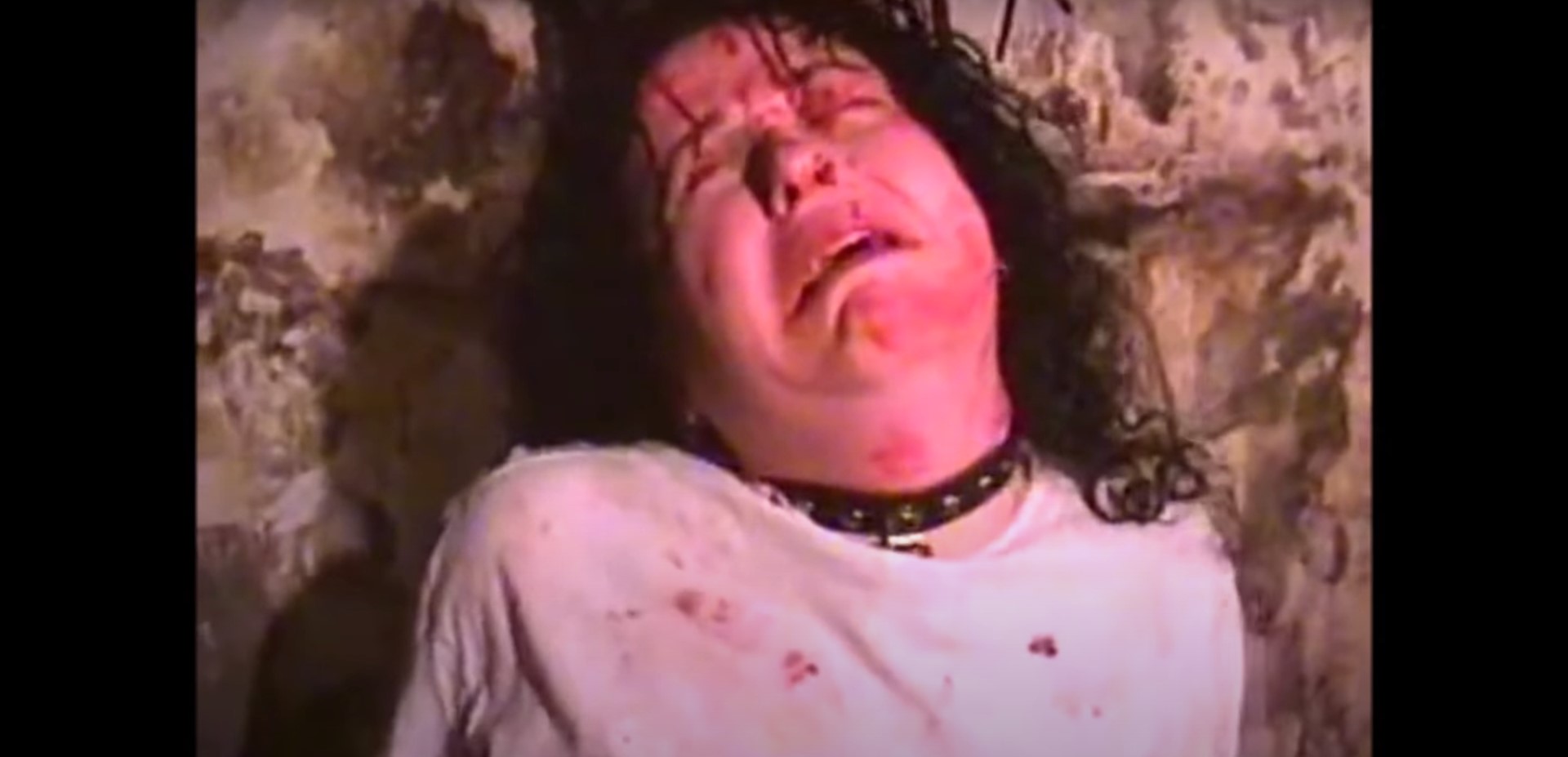
Attending a school ditch party was the last thing the obedient Kimmy wanted to do but the peer pressure from her fellow Catholic schoolgirl friends convinced her to the other side of the tracks of town.  On the way, a half-naked woman runs out in front of their car and in attempt to flee the scene on foot, to protect their innocent repute status, they run into two gangsters holding them at gunpoint in an alley.  The now frightened teens are forced into an isolated park area, joined by the now fully-clothed and not injured woman they hit earlier in what has been revealed to be a ruse to rob them, but the gang leader, Psycho, has more distasteful and violent plans to squeeze more out of his prize than cash.  Psycho brutally rapes Kimmy and is left for dead by not only the gangsters but also the one other surviving girl she had considered to be her friend.  Battered and broken, Kimmy’s morality and reality snaps, sending her down an unmerciful vengeful path against those who condemned her to die.

If filmmaker Terrence Williams set out to make an exploitation film of genital mutilation, forced sodomy, and a man sucking on a bloody tampon, then mission accomplished!  The straight-to-video, SOV rape-and-revenger of monstrosities, “The Hood Has Eyez,” pulls no punches, knows no limits, and cares to give no concern for the atrocities it depicts.  A bastardized yet familiar rephrasing of an early Wes Craven classic, “The Hills Have Eyes,” Williams uses Craven’s basic setup plot to write-and-direct his own version of uncivilized lowlifes exploiting and murdering out-of-their-element travelers in the most graphic and appalling ways.  Williams takes the fear out of the hills and drops it into a remote park plopped in-between the suburbs and urban grounds, swapping out inbred hillbillies for Latino gangsters and a nuclear family for schoolgirls in short skirts and one unlucky white dude.  Collaborating producer and wife of Terrence Williams, Nicole Williams, has previously and subsequently worked together other films, such as “Curse of La Llorona” and “Horno,” under their now defunct joint company, Cinema Threat Productions in Los Angeles. 

The 2007 released “The Hood Has Eyez” reunites a good chunk of the cast from Williams’ “The River:  Legend of La Llorona,” “Revenge of La Llorona, “Llorona Gone Wild” and “Curse of La Llorona” films completed and released within a couple years previously which created a certain level of comfortability and trust amongst the cast as well as the cast and director.  With some of the intimately graphic content of “The Hood Has Eyez,” those warm and cozy congenialities play key to selling a broken bottle scene being rammed up a vaginal cavity or a nail hammered down into penis urethra.  Without that delicate easiness in the air, scenes like the aforementioned won’t work, resulting in the entire project collapsing upon itself even before wrapping up principal photography.  At the tip of the spear are Cyd Chulte and Antonia Royuela as the principled Kimmy and her antithesis, the deranged Psycho.   Chulte, who cut her teeth with roles in “Curse of La Llorona,” takes one-half the lead of a young woman broken by the barbarity and succumbs to justified vehemence for torture, dismemberment, coat hanger abortions, and eventual death but before being pushed to the edge of her life and into a state of insanity, Kimmy’s presence melds into the group of a lemming unit and takes a backseat to the other lead half behind Royuela’s unhinged ultra-violence of a gangster gone rouge from the plan.  Psycho’s posse – Joker (Carlos Javier Castillo, “Axeman”) and She Girl (Anne Stinnett, “Revenge of La Llorona”) – truly reflect their handles as Psycho’s devil and angel on his shoulder, trying to either egg him on or have him withdrawal while withdrawing is still in his favor but, of course, we wouldn’t have a debauchery and savage movie if the angel over the shoulder had prevailed and so Psycho has his perverse way with Kimmy and friends – Susan (Jesselynn Desmond, “Horno”), Rachel (Jamielyn Lippman, “The Absent”), and Jerry (Tom Curitore, “Llorona Gone Wild”). 

The way I see it, Terrence William’s trashy exploitation nod “The Hood Has Eyez” has three distinct parts, much like the three-act structure of any narrative archetype.  Terrence Williams defines these acts tremendously clear in an almost too simple of a way that it feels rudimentary, maybe even old fashioned.  The setup is simple:  overweening teens doing what they’re not supposed to be doing become caught up in an unfavorable part of town with a maladjusted gang.  The confrontation squares the two factions to a literal position of facing each other while the teens coward in fright and disadvantage as they forcibly bend to the will of the gun-toting gang calling all the shots.  The resolution pivots the story 180 degrees, like any good rape-revenge thriller should, after misdeeds thin out whose left for dead and who’s intractable impulses are fully left satisfied and goes right into execution mode without passing go, without collecting $200, and without pause of a trauma processing moment as Terrence Williams wastes no time digging deep into the sludge of psychiatric stability with a hasty move right to rectifying an eye-for-an-eye balance.  Up until a point, “The Hood Has Eyez” carries a lot of dire weight within the confrontational girth that can be hard to stomach.  There’s a few casually lighthearted and fun witty moments peppered beforehand, such as a jokes at the expense of airhead Susan and her player boyfriend, but then after the grave assault that leaves Kimmy left to suffer all the post-traumatic syndrome results, things really go dark, and I’m’ talking black comedy dark.  Kimmy goes into full Rocky Balboa training mode, doing pushups and enthusiastically practicing staff spinning in the light of the falling sun.  Terrence Williams actually gives Kimmy a rousing montage before ripping the dick off a two-bit thug.  Where am I getting to with all this?  Well, I’m not sure how Terrence Williams wanted audiences to digest his brutal film that goes through touchpoints of opposing genres.  Usually, if comedy and gore are present in one narrative, slapstick typically is the go-to conduit – think “Evil Dead II” or “Dead Alive.”  For “The Hood Has Eyez,” the gore effects are hearty, the characters are vicious and victimizable, and Williams maintains an intact beginning-to-end narrative, but confounds with a few choice character actions that sully the overall presentation.

The Cinema Threat Production has now been integrated into SRS Cinema’s Extreme and Unrated Label – Nightmare Fuel – and unquestionably is underground extreme horror at its foulest.  Released with a widescreen aspect ratio of 1.85:1 of the 420p standard definition, camcorder tape footage and in a new director’s alternative cut, “The Hood Has Eyez” has relatively decent image clarity with a very subdued amount of lossy compression results, especially for progressive scan 480 pixels.  Details are soft as expected with the commercial equipment and lower resolution but though a slightly faded color scale, the coloring range renders intense enough for higher marks and can play a trick on the eyes by falsely delineating the objects to create a space based off the hue edging alone.  The English Dolby Digital 2.0 track props up the quality even more with Terrence Williams using a boom mic attachment instead of the built-in mic to gather meticulously the intended dialogue and skirmish kerfuffle.  As a result, dialogue is really sharp here, especially during Psycho’s off-the-rail verbal abuse, rants, and one-liners.  The post-production Foley stands apart from the inhouse sound with prefabricated sound bytes but that’s the way of micro-independent filmmaking.  The alternate cut includes a newly shot opening scene that was originally intended for the original script that was added back in to actualize the Williams’ vision after a cast sudden dropout departure.  Bonus features include a commentary with Terrence and Nicole, a raw, secondary cam behind the scenes footage in making certain scenes, a blooper reel, image slide show, two original cut trailers, a new trailer, and a Women in Horror vignette featuring Nicole Williams discussing the importance of women in horror and her contribution to the genre.  The release is presented in a traditional DVD snapper with a beautifully illustrated cover art based off the shoddy composited “The Hood Has Eyez’s” one sheet.  In the past few years, SRS has upped their game with cover arts and continue to impress with their new branding campaign that makes these films feel no longer cheap at first glance.  Inside, the DVD press art is the same as the cover with much of the RGB removed to a single layer red. There is no insert inside the case.  Terrence Williams set out to capture the inelegant essences of nitty-gritty exploitation and hits the nail on the head, literally, with this passion project of perversity. 

An Early 2000s Exploitation With Lots of Infamy!  “The Hood Has Eyez” on DVD!

Norwegian EVIL Has Women Issues! “The Thrill of a Kill” reviewed! (Wild Eye Releasing / DVD)

Enjoy the “Kill” on DVD now Available on Amazon.com

Out of work Kimsy and her irritated mother butt heads over Kimsy’s lack of effort in trying to find a job and help out with responsibilities around the house.  After a particularly nasty argument, Kimsy storms out to walk off her frustration in the quiet surrounding woods.  Instead of lowering her blood pressure, Kimsy’s blood runs scarred and runs down her head as she’s knocked out and picked up by a playful serial killer with an irreparable hate for women and takes gratification in degrading them by any means possible.  Sadistically bred by unconditional motherly abuse, the killer treats each of his prized possessions like dogs to submit to his every beckon and call.  Kimsy’s mother and sister, Camilla, grow concern for Kimsy who hasn’t returned home and set off to find her.  When they realize she’s been abducted, they’re able to track her to a remote, vacant cabin used as a kill house and as they set foot inside the cabin to save Kimsy, a killer lies and waits to strike. 

Lars-Erik Lie’s Norwegian torture porn, “The Thrill of a Kill,” resonates with the old and true proverb, what comes around, goes around.  Filmed in and around Norway’s largest ski destination and resort, the Scandinavian mountain town of Trysil becomes the backwoods abattoir for the director to set his exploitation workshop for the bleak Norse horror.  “The Thrill of a Kill” is the first feature length fictional film from the Norway-Born Lie who has digs into the indie underground and gory storytelling, self-funded by his own banner, Violence Productions, and is coproduced by Morten K. Vebjørnsen and Arve Herman Tangen, Morten Storjordet, and Linda Ramona Nattali Eliassen serve as executive producers.

Dichotomizing “The Thrill of a Kill” into two stories set during two different time periods, Lars-Erik Lie’s focal point is not the hapless victims caught in a deadly spider’s web of perversities.  Instead, Lie’s story formulates the theory on how the sociopathic killer was ill-nurtured into a monster with an interweaving plot set in 1968 of a young boy (Carl Arild Heffermehl) neglected and abused, verbally and physically, by an alcoholic and sexually promiscuous about town mother (Sonja Bredesen) who would bring home another town drunk to bed. Missing his (deceased?) father and tired of being bullied by his own mother, the boy mental state snaps like a twig under immense emotional, family-oriented pressure and descends into a murderous madness. Years later and all grown up, the maniac mountain man abducts young women as a direct result of the hate toward his mother and her mistreatments. Arve Herman Tangen becomes the goateed face of the grown man gone haywire. Tangen develops his character with purposeful intent and with a nonaggressive tone to persuade his bound quarry to remain subdued. The role is nothing short of typical that we’ve seen in other films of its genus where a screwed-up child-turned-adult runs a deviancy amok sweatshop of imprisoned flesh and torture devices and Tangen really adds nothing meaningful to derangement. In her debut and only credited role, Kirsten Jakobsen, former Model Mayhem model from Oslo, succumbs to being the unlucky alternative girl, Kimsy, that runs into the big, overwhelming man while strolling through the forest. One would think Kimsy would have suffered brain damage after being struck and knocked unconscious not once, not twice, but three times by the killer who undresses her after each time with the third and final blow putting the final touches on his toying with the girl and bringing her back for a visit to his hen house of brutalized women. After the first blow or two, Jakobsen doesn’t show that much concern for Kimsy’s attentive wellness or concern as Kimsy continues to just wander as if nothing major has happened. Camilla Vestbø Losvik is a much more reliable and realistic rendition of the situation as Kimsy Sister, Camilla. As another alternative and attractive woman, Camilla shares a strong kinship with Kimsy despite their mother’s disciplinary differences toward them, to which eventually their mother (Toril Skansen) comes around as the patron saint of motherly worriment that’s likely a contrasting parallel to the killer’s unaffectionate mother. With an ugly-contented subgenre, “The Thrill of a Kill” has various compromising positions for its cast with rape and genital mutilation that there’s some shade of respect give to those who can mock play the unsettling moments we all are morbidly curious to see. The film rounds out with a lot of half-naked women strung up in bondage or chained to the wall with Linda Ramona Nattali Eliassen, Veronica Karlsmoen, Veronica Karlsmoen, Madicken Kulsrud, and Ann Kristin Lind with Raymond Bless, Niclas Falkman, and Jarl Kjetil Tøraasen as drunk, male suitors.

“The Thrill of a Kill” recreates the simulacrum of SOV horror as Lars-Erik Lie pulls out his handheld video to follow Kimsy’s journey through the jollies of a madman and the mother and sister’s rout out for their lost Kimsy. The beginning starts off with a zombie-laden dream sequences that places Kimsy in a field with a killer and his mutilated corpses that reanimate in a bit of foreshadowing of what’s in store for the spikey haired damsel. By dismissing her vividly horrifying dream of diminutive meaning, just like she does with everything else, Kimsy falls easily into the killer’s hands signifying one of the films’ themes to never take things for granted, especially those things that are important to you as exampled later on in the story. That’s about as much purpose I could pull from out of Lie’s film that floats like a feather on surface level waters. There is one other tangential offshoot Lie attempts to explored but never fleshes out fully is the unbeknownst to Kimsy and Camilla’s perverted hermit of a father who lives on the outskirts of town. Their mother thought he would have insight on Kimsy’s whereabouts but instead he tries to forcibly coerce Kimsy into his shack for involuntary lovemaking and then the exposition ensues after Camilla barely escapes his axe-chopping in (sexual?) frustration clutches. That exposition literally goes into a tunnel leading to nowhere and doesn’t alter the actions of Camilla or her mother to do anything different, expunging any kind of knowledge to utilize for a complete character arc and just comes to show Lie’s written bit parts don’t define the narrative of learned opportunities or gained instinct but rather are just additional sleazy show. The same sleazy show can be said about the rape scenes as they won’t ascertain the intended reaction of squeamish uncomfortableness. Now, while rape is no laughing matter or accustomed at any degree, there’s a level of numbness to these scenes that carry a severe flat affect to doesn’t display the anguish, the terror, or the hurt these women are going through as the killer decides upon himself to violate them. There’s literally no fight in these undrugged, still vigorous, young women who have just been snatched and made into his plaything and while some seasoned BDSM partisans may get aroused, the emotional receptor in me wants to empathize what their strife agony, but maybe that’s why the film is titled “The Thrill of a Kill,” to be an emblem of fun, cheap thrills.

Coming in at number 70 on the spine, the Norway schlocker-shocker, “The Thrill of a Kill” lands appropriately onto the Wild Eye Releasing’s Raw & Extreme banner. The 2011 released film finds a vessel for its North American debut over a decade later after its initial release and presented in a 1.33:1 aspect ratio, with vertical letterboxing on 16×9 televisions, despite the back cover listing a widescreen format and being released in 4:3 is a bit surprising as other countries display in anamorphic widescreen and the lens used in the film is definitely anamorphic as you can tell with flank falloff that distorts the image and makes the picture appear rounded. Color grading is slightly washed and lives in a low contrast. Again, I have to wonder how aesthetically different the transfer is on the outer region product. Soft, SOV-equivalent details don’t necessarily kill the image quality, but you can obviously notice some pixelation in the frame inside the shack and in wider shots of the landscape amongst the low pixelated bitrate. The Norwegian Golby Digital Stereo 2.0 comes out clean, clear, and about as full-bodied as can be with a two-channel system. Some of the Foley is overemphasized production which comes off sillier than the deserving impact of a thrown punch or a meat hook going through the lower mandible. English subtitles are burned/forced into the picture but are synched well without errors though the grasp maybe lost a little in translation. Bonus content is only a trailer selection warehousing select Raw & Extreme titles, such as “Hotel Inferno,” “Acid Bath,” “Morbid,” “Bread and Circus,” “Absolute Zombies,” “Whore,” and “Sadistic Eroticism.” Continuing to achieve maximum controversial covers, Wild Eye Releasing doesn’t hold back for “The Thrill of a Kill” DVD with a crude, yet fitting DEVON illustrated cover art that is a platterful of unclasped splatter while in the inside is a still frame of one of the more tongue biting scenes. No cuts with this unrated release and the film clocks in at 85 minutes with a region free playback. A grating gore gorger with mother issues, “A Thrill for a Kill” redundantly recalls our attention back to the subservience of what makes horror horrifying and while what terrifies us is pushed aside, the free-for-all fiend-at-play treats the death-obsessed to a buffet of blood and defilement.

Enjoy the “Kill” on DVD now Available on Amazon.com