Shooting Up EVIL May Cause Hellish-Hallucinations! “Ozone” reviewed! (Temp Digital / Blu-ay and DVD)


On a stakeout to meet an informant, Detectives Eddie Boone and Mike Weitz are ambushed by a drug dealer named Richter and become separated in the fierce firefight. While detective Weitz tracks down their traitorous informant into a decrepit druggie den, Boone wrangles with Richter who injects him with a new street drug called Ozone. Unable to locate his missing partner for days, Eddie breaks standard police protocols to find his longtime friend and partner by digging into Ozone’s grimy underworld filled with powerful hallucinogenic manifestations from the drug that turns users into mindless mutated addicts and killing machines. Eddie will have to go through Hell to stop the distribution of Ozone and to rescue his partner from an elevated and fully transformed drug lord with unconventional powers that believes Eddie is key to his world dominance.

First, “The Dead Next Door.” Then, “Robot Ninja.” Now, TempVideo and MakeFlix present the next super-duper, 2-disc collector’s release from the visionary B-movie director, J.R. Bookwalter, with his 1995 horror film, “Ozone.” Co-written with the visual effects artist from “The Talisman” and “Subspecies 4: Bloodstorm, David A. Wagner pens his one and only option in which Bookwalter immediately took a shining to following a string of very taxing and bargain titles for a flyby label. Able to by clairvoyant with how “Ozone” should be constructed, deep inside the creative process of his auteur mind, Bookwalter felt desire to oversee the production, taking the helm on just how he would make an ambitious project come to a life on a microbudget. “Ozone” parallels the subculture of powerful narcotics, like heroin or cocaine, and amplifies the conditions of the euphoria side effects to monstrous, unpredictable heights through a labyrinth of what the hell is going to happen next? Mostly shot in Akron, Ohio, “Ozone” is a production of Bookwatler’s own company, Suburban Tempe Company aka TempeVideo, on an astonishingly low-budget of $3500 and a handpicked cast and crew.

Comprised mainly of Ohio based actors, “Ozone” finds it’s star in James Black who has previously worked with Bookwalter on “Zombie Cop” and “Chickboxer.” Black went on to stardom, making a living off of the Hollywood limelight by having roles in such films as “Soldier” alongside Kurt Russell and “Out of Sight” with George Clooney among many other television and movie roles, but Black’s humble beginnings shouldn’t be overlooked. His performance as the lead character, Eddie Boone, highlights his attributes as a leading man. The physicality of the former professional football player with good looks catches the corners of eyes that the man from Lima, Ohio can act as well as do action scenes professionally and effectively despite budget limitations. However, “Ozone’s” talent doesn’t end there with Black’s co-stars who wear multiple hats in other roles or behind the camera. Case in point is Bill Morrison and James L. Edwards as the two makeup a total of five characters in the film as well as serving to be critical components as crew. Morrison dons two roles plus crafting the special makeup effects and miniatures. Edwards supports three roles, including the main antagonist in what looks like a hefty body suit. Morrison and Edwards going through the rigors of makeup to pull off various characters with polar personalities provide “Ozone’s” well-rounded, always interesting, idiosyncratic individuals Eddie encounters through his misadventures of drug-fueled nightscapes. Tom Hoover, Michael Cagnoli, Michael Beatty, Jerry Camp, Mark S. Bosko, Wayne Alan Harold, Neil Graf, Leo Anastasio, Parris Washington, and Lori Scarlett in an unforgettable birth of a mutant baby scene rounds out this cast of colorful characters.

“Ozone” is a gooey, gory, gumshoe of a horror film baked on narcotics laced with nightmares and for the budget price of a dime bag, J.R. Bookwalter injects a full-fledged, black tar, down the rabbit hole thriller that’s akin to a Clive Barker Faustian concept. “Ozone” draws similarities from “Hellraiser” as well as could find strong congruence with “Lords of Illusions,” a film which was released the same year as “Ozone” in 1995. Instead of magicians of the occult, the use of a more salt of the Earth drug is a powerful, tangible substance that reflects relevance more so than of fantasy. Audiences can relate more to the idea of the twisted wrenching of habitual use of not only illegal drugs, but with perhaps medications, alcohol, or any number of other addictions that seemingly take over one’s life and replaces it with the worst part of themselves. The mysterious encounters Eddie Boone is subjected to during his tour of the drug enlightens the hardnose detective to an out of body horror experience wretched with disfigured humanoid shells and countless mutants determined on cornering the market on living not sober not on their own volition. The use of the new morph special effects merged with the respectable practice effects by Bill Morrison and his team gorge on body modification and overpowering death as synonymous to being high.

Just like “The Dead Next Door” and “Robot Ninja,” “Ozone” receives the king’s treatment into a duel format, 2-disc Blu-ray and DVD Signature edition release. Shot on Super-VHS C videotape in 1995 and then transferred to DVCAM in 2002 for the DVD remastering, the 2020 upgrade used the DVDCAM masters were captured as ProRes 442 HQ QuickTime video files for a new and comprehensive color upgrade, additional deinterlacing, and amend any other Super-VHS C tape imperfections. What resulted for the Blu-ray release is a super clean and enhanced look presented in the original 4:3 (1.33:1) aspect ratio of perfectly color corrected hues, brilliantly effusing various colors to coincide with the artistic storytelling of Eddie Boone’s trippy trek through “Ozone’s” chthonic evil. Seldom do minor blemishes pop up; in fact, you won’t even really notice when godsmacked on “Ozone’s” uncanny use of budgetary limitations. The English language DTS-HD Master Audio 5.1 surround sound mix is equally as impressive. Pulled from the DA-8 tape achieve of the original audio masters on an eight-track cassettes, all of the dialogue and some original sound effects were used as the basis for the new restoration in which Maui Holcomb and director, J.R. Bookwalter enhanced over the course of 18 years. Dialogue cuts to the front of the line, mixed and balanced well with the explosions, gunfire, and other skirmishes, delivering a flawless and discernable product. Depth and range render nicely throughout. The DVD specs are the original 1994 VHS version also in the original aspect ratio with an English language Dolby Digital 2.0 stereo mix. Jens C. Moller grand score elevates “Ozone” to the “next stage,” as the street mutates would coin it, offering up a bountiful, robust score that simultaneous blends action and horror seamlessly. If you’re looking for every nook and cranny bonus material on “Ozone,” you got it with an extensive bonus package on the Blu-ray disc that include a 2020 audio commentaries from J.R. Bookwalter, a 2003 commentary with the director and star, James Black, 2003 commentary, entitled “Street Zombies” from Bookwalter, bloopers and outtakes, production art and stills, news’ topic reels from 1993, promotional gallery, “Ozone’s origins explained through “Paying for Your Past Sins” with J.R. Bookwalter, “Into the Black” with star James Black and how he became involved, a 2003 location tour with actor James L. Edwards, behind the scenes footage with the only audio available is a commentary by J.R. Bookwalter, early test footage, and Tempe trailers. The DVD has additional material, such as awesomely isolating the musical score, 2020 audio commentary with Doug Tilley and Moe Porne of the No-Budget Nightmares Podcast, scenes from the Spanish dubbed version, the 1992 B’s Nest Video Magazine Intro, the original trailer, the Japanese trailer, the “Street Zombies” trailer, and more Tempe DVD trailers. The not rated, 81 minute, region free release also has optional English and Spanish subtitles. Inside the casing, which has a reversible wrap cover with the original VHS cover, housed inside a cardboard slipcover of revamped artwork by graphic designer Timothy Rooker includes an eight-page color booklet with liner notes by Tempe historian Ross Synder; it’s a good read up on “Ozone’s” conceiving and a little history on SOV of the 1990’s. Exquisitely enhanced and lush with material, the Signature Edition of “Ozone” just might be the definitive one of the wildly insane and bloodied occult cop fiction of independent horror ingenuity.

Available for pre-order. Hit shelves August 11th!

Spies, Lies, Thighs, and EVIL Guys! “The Dallas Connection” reviewed! (Mill Creek Entertainment / Blu-ray)


Chris Cannon and Mark Austin are back to save the world from a devious organization once again as the two bureau agents are assigned to protect the last world-renowned scientist that developed an International World Arms Removal (I/War) satellite project that could detect terrorists’ weaponry no matter how concealed, but when the other three scientists from around the globe are brutally assassinated, the odds are stacked up against them and the bad guys are always one step ahead of them. Given four computer chips to guard at all times, I/War assigns their best agents to the task of securing hope for the project, called The Dallas Connection, for three days until a specifically timed launch to coordinator with a passing asteroid field that’ll power the satellite for years decades to come, but the well-armed and well-organized crime uses all assets and their power of seduction to gain control over the satellite at all cost.

The L.E.T.H.A.L. ladies series continues with the second buddy-cop picture, “The Dallas Connection,” helmed by Christian Drew Sidaris, son of the erotically charged-action producer and filmmaker, Andy Sidaris that follows up on the first Drew Sidaris prospecting fracas, Enemy Gold. “The Dallas Connection” is the tenth installment of the series, known also as the Triple B series (that’s Boobs, Bombs, and Bullets) that has little-to-nothing linking the entire series cache together aside from being exclusively explosive wrapped with a sensual rouleau of Playmate and Penthouse centerfolds, tightly coiled around the tight and firm half-naked bodies of it’s leading stars. The Sidaris team, under the Malibu Bay Films and Skyhawks Films banners, one again economically ignite a successful B movie that promises 90’s attired, flamboyant action on set at a few familiarly recycled locations in Shreveport, Louisiana and Los Angeles, California, redressed for a not-so different genre or distant premise.

As aforementioned, centerfolds are a staple in any Sidaris, father or son, girls and guns feature and “The Dallas Connection” is no exception, starting off with their main squeeze, good friend, and cult movie icon, Julie Strain, as one of the chief co-antagonist under the nom de guerre, “Black Widow.” Strain is tall, sexy, and a wild villain capable of restraining the violent kick of an AK-47 in thigh high boots and a low-cut open jacket that embodies gun nuts most delectable dreams. The once Penthouse Pet of the Year stays quite reserved compared to her tantamount villainous role in “Enemy Gold” by going topless only in a couple of instances in a death grip roll that involves a lap dance before her prey’s demise, a specified attribute to the beautiful and deadly small spider she spins her call sign from. Black Widow is joined the just as deadly Cobra, fellow Penthouse Pet of the Month February 1993, Julie K. Smith, and Scorpion, the equally as Julie Strain tall, Playboy Playmate of the Month December 1991, Wendy Hamilton. Smith and Hamilton offer up polar features that doesn’t make “The Dallas Connection” a one-type of woman show, but both are voluptuous in their own rite, adding sizzling hot tub sex scenes and long-legged strip shows to accentuate “The Dallas Connection” amongst the B movie fray. “Phantasm II’s” Samantha Phillips becomes the whip cream on top, rounding out Sidaris’ centerfold assembly, as another the third Penthouse Pet of the Month, June 1993. There’s also Bruce Penhall and Mark Barriere, but who cares about these shirtless studs who drag race old Plymouths and jet ski when you four gorgeous women to ogle over? Penhall and Barriere mark their return as Chris Cannon and Mark Austin from Enemy Gold in a buddy-cop adventure loaded with a Dirty Harry Magnum .357 and a M1 Grenade launcher assault rifle. Kaboom! Rounding out the cast is Gerald Okamura (“Big Trouble in Little China”), Roland Marcus, Cassidy Phillips, Ron Browning, Tom Abbott, and Rodrigo Obregon as a satellite scientist.

After finishing “The Dallas Connection,” I wanted to say that I’ve seen this movie before and not because of some misplaced form of déjà vu, but, rather, that I, in fact, HAVE seen this movie before in the precursor film of the L.E.T.H.A.L. ladies series, “Enemy Gold.” The story’s been tweaked slightly to a story with the same framework. Hell, like also mentioned, when you throw in some of the same locations as in “Enemy Gold,” Sidaris’s home with the hot tub and the cabin the woods, and redress the same actors, Julie Strain, Bruce Penhall, Mark Barrier, Rodrigo Obregon, Tom Abbott, and Ron Browning all in the essentially the same roles, “The Dallas Connection” just feels like an extension or a mirror image of that former film, making the story a weary one with nothing really new to spectacle except for three pairs of new, large-and-in charge, breasts in Smith, Hamilton, and Phillips. One difference noticed is that the bureau agents this time around are a lot dafter with skulls thick as a brick and unable to use common logic in the most practical situations. There have been many a time when producer Andy Sidaris commented his films to James Bond, but at least Bond had the smarts to always be on guard; Chris Cannon and Mark Austin do indeed think with their other head that do, in benefit, leave the door open for some saucy hot tub sex that’s perhaps the best simulation from Sidaris reel I’ve seen to date.

Available for the first time on Blu-ray, “The Dallas Connection” will get your rocket launchers off with ton of gunplay and is loaded with beautiful women. The region A, 1080p high definition presentation from a 4K scan restoration has an aspect ratio of 1.78:1 widescreen. The image’s simply gorgeous from the 35mm negative baring a few minor faint scratches that linger only for seconds at a time. There’s quite a bit of noise during the night scenes that almost make the scene look daylit, but skin tones, especially gleaming with water, are remarkably velvety and the textures on clothes and skin looks great for a low budget action. The English language DTS-HD Master Audio dual channel mix medleys appropriately, dialogue is clear and upfront and ambience has proper depth and range. Explosions are powerful coming through the dual channels with a hefty LFE and gunfire can rip just as good as Dutch blasting away at a trophy hunting alien in Predator. Even the sexy lounge soundtrack from Ron Di Iulio is on point despite being a rehash of “Enemy Gold” once again. Hardly any blemishes or distortions coming from the audio track. English SDH subtitles are optional. The bonus features mirror that of “Enemy Gold” as well with Andy Sidaris and Julie Strain doing this awkwardly coy and sugar daddy bit showing off “The Dallas Connection” merchandise and international posters that lead into Andy’s film school where him and his wife, Arlene, go onto commentary on how to shoot scenes and edit them together, using an action and a sexy scene from “Return to Savage Beach” as reference. In the same behind the scenes, there’s an equally bizarre Joe Bob Briggs interview where the legendary MonsterVision and The Last Drive-in Host seems uncomfortable with Andy and star Julie K. Smith about how he persuades to get these beautiful centerfolds to be in his films. Other bonus material includes a commentary on the film itself and theatrical trailer. “The Dallas Connection” is a Texas-size IED with a busty ornate façade, but acts more like a duplication of something we’ve already experienced, making the sophomore feature from Christian Drew Sidaris just a more of the same.

Only $12.99 at Amazon.com! Plus, you purchase a VHS tape! WHAAA!?!

Hard Bodies, Hot Vixens, Civil War Gold, and an Evil Bolivian Druglord in “Enemy Gold” reviewed! (Mill Creek Entertainment / Blu-ray)


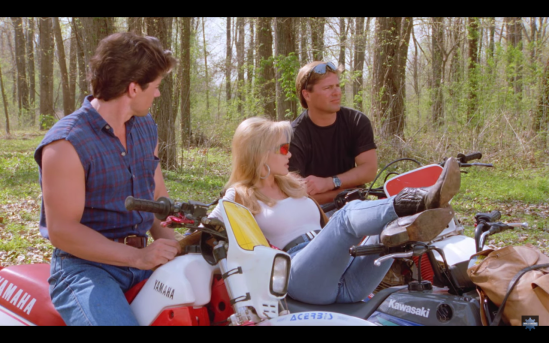
Agents Chris Cannon, Mark Austin, and Becky Midnite go in guns blazing on a drug smuggling operation operated by the goons of a Bolivian drug lord and club owner named Santiago. Furious with their meddling that cost him a hefty dividend, Santiago employs the crooked agency director, Dickson, to do something about his rogue operatives, but with his bureaucratic hands tied, Dickson can only get the agents suspended until further investigation clears them of any wrongdoing. During their leave, the three go on a gold finding expedition based off the tale of a legendary suicide mission conducted by a Confederate Lieutenant during the American Civil War that involved infiltrating behind enemies lines and stealing Union gold to fund the rebellion cause. The gold is believed to be hidden deep within the woods, a secluded area Santiago just happens to learn about while eavesdropping on the agents movements. Deciding take matters into his own hands, Santiago hires an exotic hitwoman, Jewel Panther, to hunt them down for elimination.

Perhaps the Tinto Brass of action films, Andy Sidaris wrote, directed, and produced an extensive filmography of weaponry-packed James Bond-esque films crammed with robust eroticism from the late 1980’s to the heart of the 1990s under his, and his wife’s, own independent banner and though “Enemy Gold” has all the markings of a Sidaris’ productions, including many, many female assets and rock hard abs, his son, Christian Drew Sidaris is handed the sovereignties of the 1993 bodacious hot-body, action-comedy in which he co-writes with Wess Rahn. The cult film showcases the best parts of the most beautiful people who have less-than-stellar thespian chops, hiring outside the conventional casting agencies to lure the attractive attributes of what Playboy and Penthouse have to offer, and sticking them into the tightest and skimpiest clothes that would put Miami’s South beach flamboyantly wild atmosphere to shame. Let me not bring in East Coast flavor to a production that stretches from California to Louisiana under Sidaris’ economically savvy Skyhawks Films company, in association with MBP and Starlight Films.

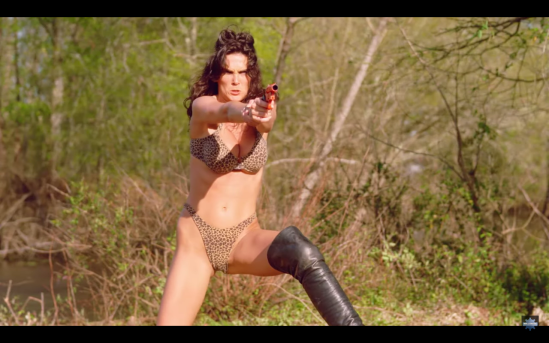
I wasn’t joking when I said Sidaris scouted out Playboy and Penthouse centerfolds that sizzle with sex appeal when strapped with an automatic weapon. The concept is every gun-toting redneck’s wet dream when the producing Sidaris’ employ the well-endowed to be the center of the action. Penthouse Pet and cult horror icon, Julie Strain, certainly fits the description. The voluptuous 6ft 1in actress has the best role in the house as Jewel Panther, the scantily-cladded assassin with a pugnacious attitude that can turn a quarrelsome skirmish into an oddly erotic babes and bombs moment as she whacks a couple of clueless park rangers in nothing more than her thong bikini. Not only does Strain play the best monikered character in the flick, but is a tantalizing, Amazonian lioness of a personality on screen. Suzi Simpson is another centerfold working for truth, justice, and the lethal way as Becky Midnite. The blonde bombshell Playmate does a little dirty work in her cut-off, daisy duke jeans, wriggling in and out of tight situations, and tight clothes, when being eyed up and down by Santiago’s thugs. Midnite’s not as interesting as Jewel Panther and Simpson acting mirror’s than par level posture with rigid aesthetics, even during her sex scenes with Bruce Penhall (“Body Count”). The last Playboy centerfold is Tai Collins, aka Taquil Lisa Collins, and before she was a renowned philanthropist, founding multiple foundations, and spearheading charities for children, Collins was a D.C. suit, an agency head that oversees operative missions, who saw fit to be in a romantic relationship with a subordinate (“Fit to Kill’s” Mark Barriere”) and underneath that suit, you guessed it, was dressed-to-kill lingerie. Then, of course, you have the Bolivian drug lord, Santiago. The role was awarded to one of Andy Sidaris’ casted actors, the late Rodrigo Obregon. The square jaw and poofy-haired Obregon quarterbacked all of Santiago’s antagonism toward the extermination of all the beautiful people aka the agents, but was in reality, or at least in character, was a big softy compared to Jewel Panther who ended up being more despicable in her foxy iniquity. “Enemy Gold” rounds out with Alan Alabew (“Bulletface”), and “Day of the Warrior’s” Ron Browning and Tom Abbott.

Though saturated with plenty of T&A, the Sidaris team keeps scenes classy, sexy, and elegant without stepping a foot into pornographic territory that would ultimate undermine and reclassify “Enemy Gold” as another Axel Braun flesh-flick. Granted, the acting is as cheesy as a cheeseball growing on a cheesy-cheeseball tree and every fit bod sports a cut off T-shirt and vest while pretending their early 1990’s Lenny Dykstra by wearing his baseball shades and fitting a mini-mullet, but for the value, “Enemy Gold” is a goldmine of cut-price epic action providing a variety of numerous explosions and marginal Michael Mann style gun fights. Throw in lengthy scenes of nudity, such as thorough shower scenes and a primal topless with a sword around a firepit, and you have “Bullets, Bombs, and Babes!” so says the tagline. It ain’t lying! Rahn and Drew Sidaris’ script fairs as the weaker link to the entire package that setups a really good criminal retaliation premise that recoils back to one half of the titular element, gold. The film opens up during CIvil War time with a narrative prologue of a Confederate suicide mission in attempting to steal union gold and burying it deep within the forest. The preface only becomes relevant when Christ and Mark decide to use their sudden suspension leave to go on their annual treasure hunt for the buried gold. Santiago’s reprisal of his drug bust forces the Civil War backstory and the gold to be subservient, debasing the story to an unbalanced point that it can’t seem to recover from the absurdity of events.

“Enemy Gold” is worth it’s weight in buxom gratification with a well-endowed Blu-ray plus digital release from Mill Creek Entertainment. The transfer hits Blu-ray for the first via a 4k restoration presented in 1080p, high definition widescreen with an aspect ratio of 1.78:1. The immense details is exquisite when regarding the show of excessive skin in nearly every segment. Exterior scenes look and feel lush within the trees, bushes, and lakeside landscape. Some of the grain is inconsistent, leaving exposed some fluctuations of blockiness to hurtle over. The transfer did suffer some irreparable minor damage, such as some deep scratches that are noticeable in editing and a moment of reel flare that pops up briefly. The English language 2.0 DTS-HD Master Audio offers a respectable mix helmed by the clearly prominent dialogue though, at times, renders a bit soft. Explosions are nicely discernable even in the dual channel. “Repligator’s” Ron Di Iulio’s “Night Court” meets “Red Shoe Diaries” score dips into a monotonous swanky-funk, but is an appeasing instrumental. English SDH are optional/ Bonus features include an introduction by director Andy Sidaris and, if you didn’t get enough boob action, a flirtatious Julie Strain that build up what to expect in a dated DVD launch intro. If you want even more Julie Strain topless, the behind the scenes featurette offers a little more of that DVD launch promo plus a gag of Sidaris guide to filmmaker, plus some interviews with wife Arlene and Drew Sidaris, an interview with Joe Bob Briggs, and some a brief history into the Sidaris legacy. There’s also an audio commentary and trailers. “Enemy Gold” is a prime example of the best erotica action before the turn of the century, fearlessly proud and independent to be perfectly content in the content that’s centerfold perfect. Recommended.

When The Earth Goes Silent, EVIL Begins to Conquer. “The Blackout: Invasion Earth” reviewed! (Shout Factory! / Digital Screener)


In a distant future, the entire Earth goes dark without warning. Communications are completely severed with no sign of life exists except for those scared and confused inside what is to be called The Circle of Life that has encompassed Moscow and other parts of neighboring countries. Reconnaissance teams venture out into the quarantine zones, discovering dead bodies as well as noticing people have gone missing. A month later, an outpost goes under siege by an army of bloodthirsty bears. These bizarre events go unexplained, leaving military jarred, and to find answers, seven teams are dispatched to various areas surrounding the outpost to locate signs of life. While the teams are scouting, an powerful alien reaches out to the outpost, warning them that Earth is in the middle of a four wave attack by his race looking for a new home. Before their 200,000 year trip ends with destination Earth, the last wave, 160 million mind-enslaved missing humans, will attack the Circle of Life at the command of the alien informant’s counterpart and it’s up to the ravaged scout team to band together to extinguish the extermination of mankind.

Nothing is more frightening than wiping out 95% of the world’s human population in the blink of an eye without so much of a sign of explanation. Welcome to “The Blackout: Invasion Earth,” which depicts just that very unfathomable scary episode of terra-loneliness and free-for-all, fear induced panic amongst the civilian population, tapping into the same vain of “The Day the Earth Stood Still” or “Arrival.” The big budget, Russian sci-fi action-horror, originally titled “Avanpost” or just “The Blackout,” is penned by television scriber Ilya Kulikov and directed by Egor Baranov. Released this past November in Russia, “The Blackout: Invasion Earth” touchdowns inside the North American market from genre distributor Shout! Studios come June 2nd, becoming a planet-sized contender for the biggest science fiction film of the year with relentless suspense, alien-on-alien hand-to-hand combat, and an encroaching bear blitz that can’t go unseen! The Moscow based TV-3 and Premier Studios serves as the production companies with studio heads, Valeriy Fedorovich and Evgeniy Nikishov, producing an estimated $4.3 million dollar film.

Unless you’re a no-life film buff whose up to speed with all the latest Russian thespians, many of us in the States will not recognize these Slavic actors; actors such as Aleksey Chadov, Pyotr Fyodorov, Artyom Tkachenko, or Svetlana Ivanova with no standing in the usual cache of domestic and international circle of ascertain identity that any joe can just look at a cast list and go, “aha!,” and put your index finger right on their name in recognition. However, if you look closer, you’ll unearth titles you might have heard of, such as “The Darkest Hour” (Pyotr Fyodorov) and Night Watch (Aleksey Chadov). Fyodorov and Chadov play Yura and Oleg, military comrades by circumstance who are pitted against an inexplicable and unknown occurrence. Though fighting the same war, the two friends contrast different backgrounds. Yura comes from a long lineage of military blood, but becomes somber in his soldier role as he suffers an immense loss at the moment of blackout and when he discovers love for a field medic, Olya (Svetlana Ivanova), his will to fight survives by a thread. Juxtaposed against Yura is the cab driver turned enlisted man Oleg whose only living relative, his dementia-malady mother, had survived the blackout and the event has given this man in a rut purpose and a fire lit inside him. Artyom Tkachenko plays the stoic alien savior with a nearly human form, all except the three slit vertical mouth, makes him deceptively trustworthy and Tkachenko eats into that cautionary persona of whether this being is actually assisting in saving the human race or angling his prey to work against an adversarial counterpart, Ra (lya Volkov) to gain dominance totality. Performances all around exact a fair amount of rigidness to them, but I blame the forced English dub that can seemingly thwart natural deliveries. The physical and range of action is choreographed with assiduity from the actors, making me believe root cause of the rigidness is certainly the dubbing. “The Blackout: Invasion Earth” closes out the cast list with Konstantin Lavronenko, Andrey Mezhulis, Artyom Markaryan, and Lukerya Ilyashenko.

“The Blackout: Invasion Earth” is a special effects juggernaut; some of the best, awe-inspiring visual effects I’ve ever witness has come from Russia, with love, that’s a projectile explosion of a thriller and, in true Russian fashion, a slew military grade heavy duty vehicles are heavily showcased through as if they’re on parade as modified tanks, BTR-70’s, and triple rotor attack helicopters for answers and rescue recovery. Being that the film is set in the future Moscow, Baranov didn’t oversell the evolution of technology and, in fact, made a stark contrast that hindered humanity still in the throes of a primitivism culture when up against otherworldly powers. Yet, there were still boots on the ground soldiers tossed into the meat-grinder that is the quarantine zone. Sure, there were some sentinel machine guns that shredded the enemy at the first sign of sensor, but despite all the flying gizmos, armed to the teeth choppers, and nifty gear, mankind had not strayed far into development. The stagnancy of man’s evolution became the highlighted theme as their deconstructed to being simply a virus that loves, hates, mates, etc. and without all that man has technically progressed throughout the years, man, itself, stays the same. The 160 million people caught in the blackout, turned into mindless slaves, and even before the war against an unknown force, rebellious and fearful groups pit brother against brother. The message suffers slightly from the cut-and-dry rigidness as aforementioned, but more so with the main characters with try to digest the alien’s, perhaps, too complicated plan of usurpation that has been 200,000 years in the works. While the story might be clunky and kind of claggy in the middle, the intensity clings to you from the moment of the alarming sound, troop mobilizing opening credits to to those BRT-70 trucks mowing down a horde of slaved individuals and never ceases with jaw-dropping, effects-driven cinematography to let you re-catch your breath for 128 minutes.

Witness mankind’s last stand against it’s first form in “The Black: Invasion Earth” being distributed on June 2nd by Shout! Studios onto DVD, Blu-ray, On-Demand, and digital streaming from these streaming services: AppleTV, Amazon, VUDU, GooglePlay, PlayStation®, XBOX, hoopla, Fandango Now, DirecTV, Comcast Xfinity, Spectrum, Cox, Charter, and AT&T U-verse. Since a digital screener was reviewed, the video and audio technical aspects will not be reviewed, but for the record, while the English dubbing is less desired and still hinders the story slightly, the dubbing isn’t all that terrible with crafty timing to stay in sync and maintaining some natural exposition deliveries. There were no bonus materials accompanying the release and there were no extra scenes during or after the credits. No bonus features were listed on the press release either. “The Blackout: Invasion Earth” bedevils with a population consuming reset laced with existential philosophies and the ups and downs of human nature set up behind the curtain of an impressive visual menagerie of brilliantly detailed special effects on the most grandest of scales.

Available on Blu-ray!

And Prime Video!!!

May the EVIL Be With You! “Star Wars: Episode IX – The Rise of Skywalker” reviewed! (Disney / Blu-ray)


The rebellion suffers lost after lost against the oppressive First Order and news that the evil Emperor Palpatine lives casts an even larger shadow of fear and hopelessness across the galaxy. As Fin and Poe Dameron continue running small strikes against imperial targets, Rey finalizes her training as a Jedi with the help of Princess Leia, but as Kyle Ren discovers the Sith coven and the existence of Palpatine, his desire to search and track down Rey grows stronger before releasing a new First Order fleet of Star Destroyers with the capabilities to destroy entire planets. The Force pulls at Rey, guiding her to face her most difficult challenge: the truth about her parents and lineage. Rey faces crossroads that will determine whether she will continue to fight for good or cave into her anger and fear that’ll inevitably lead to the dark side.

Star Wars? What is Star Wars doing being reviewed on a blog that mainly covers the schlocky low-budget horror scene and the occasional obscure and weird Sci-Fi arthouse film? And the fact that “The Rise of Skywalker” is a Disney film makes this writeup the first ever Disney review for ItsBlogginEvil. No, don’t fret. I’m not selling out my love for the gore, scream queens, and pint-sized productions for the mondo-glitzy, big budget Hollywood epics nor am I making a soft right turn into bloodless PG-13 commercial commodities, but, and this is a big atypical but, “Episode IX” needs to be heard from those outside on the fringes. “Episode IX” is perhaps the darkest film of the cross-generational saga alongside “Revenge of the Sith,” or at least a close second, and, so it be, Disney was gracious enough to provide us a Blu-ray review copy of the J.J. Abrams grand finale to an adventure that has trekked through 40 plus years of galaxy-conflict, saw countless different alien species, gave us more pew-pews than we could ever hope to hear, three different versions of Anakin Skywalker, and the phantasmic super powers of what is known as the Force, all of which is encompassed by a fascist, utilitarian power. Co-written with Abrams is “Argo” and “Justice League” writer Chris Terrio from a story co-written also by “Jurassic World’s” Derek Connolly and Colin Trevorrow.

“Episode IX” begins with Kylo Ren (“The Dead Don’t Die” and “BlacKkKlansman’s” Adam Driver) discovering a pyramid shaped device that’ll Mapquest his way to find the secret Sith location where a familiar evil figure from the past returns and has built a gigantic fleet over the last three decades. This time around, Kylo Ren’s less of a toddler in the throes of brain development as he’s embattled with guilt and choice. Adam Driver does nail the performance with solemnity in his last performance as the son of Leia and Han Solo. The story’s heroine, Rey (Daisy Ridley), is also facing internal conflict with self-discovery as the prospect of knowing who she is sets her on a quest to discover her ancestry and what she might find might blur the sides of good and evil. The young actress who had a number short films and one horror title under her belt (“Scrawl”) before skyrocketing into “Star Wars” mythology returns to Rey as a Jedi hot off the Leia training course and thrusted immediately into the Force’s subconscious dark star, shielding her from the truth for fear of what may come of it. While Ridley shines, the Rey character sprints from, at this point in the Saga, point M to point Z, jettisoning much of the internal grappling to a mere blip on the ship’s internal sensors. Rey also feels entirely infallible, thrusting her character beyond the limits of mortality by completely overshadowing not only Kylo Ren, but also Emperor Palpatine. The other two new to the “Star Wars” crew, Poe (“Ex Machina’s” Oscar Isaac) and Finn (“Pacific Rim: Uprising’s” John Boyega), received similar shaft treatment of reworked characters from the original trilogy, possessing nothing new to offer. Poe a watered down version of Han Solo, a hot shot pilot who doesn’t understand the concept that together him and his fellow rebellious friends can defeat anything that stands in front of them; Lando Calrissian had to educate him with a bit of heart-to-heart exposition. However, Finn is perhaps the biggest undercooked character who has an inkling of Force within him that always simmers to the surface, but nothing is definite, nothing’s explained, and nothing is provided to perhaps the best known minority character in all of “Star Wars” behind Lando. Lastly, and I know the character write is up long and might be a little drawn out, Abrams really botched Carrie Fisher’s Leia that worked in awkwardly unused footage of the Princes/General from previous films. The simple and bland rhetoric used when Leia’s having a “conversation” with Rey is nearly painful to stand as Rey pours from an emotional spigot and all Leia can be, responsively, is cold, blank, and superficial. Mark Hamill, Anthony Daniels, Naomi Ackie, Domhnall Gleeson, Richard E. Grant, Lupita Nyong’o, Joonas Suotamo, Kelly Marie Tran, Billy Dee Williams, Ian McDiarmid, Harrison Ford, and Greg Grunberg co-star.

I adore “Star Wars” as much as the next nerd who grew up between the first and second trilogy. The blending between science fiction, westerns, and samurai tropes speaks volumes on how engrained George Lucas made space come alive with larger-than-life gusto that appeased not only fans of space adventure and wonders, but also fans saturated inside the spaghetti westerns and those with an affinity for Akira Kurosawa films. Those genre bending tactics really brought the film community together to appreciate the novelly detailed miniatures that came to life and the eccentric, sometimes outlandish, characters like Han Solo, Jabba The Hunt, Boba Fett, and Leia in that scantily-clad slave girl bikini. Yet, “Episode IX” irks me, irks me hard, as the once innovate “Star Wars” has been placed into a bingo ball spinner to have it’s originality called out once again in one ginormous homage to see, again, the Emperor, who seems very high and mighty upon his throne of Sith muscle, pitted against a ragtag team of good doers and their champion quasi-Jedi who has to make a between benevolent freedom or a junta power. That’s not to say that “Episode IX” is a total sham of a finale. Fans will receive the totality of a “Star Wars” film complete with light saber clashes, space battles, and the beautiful, yet sometimes violent, different worlds that ships can hyper speed to in seconds. The visual and practical effects are bar-reached and awe-inspiring by means of thousands of ships clustered together, the dim-lit bars crowded with varied character creatures, and the speeders racing through canyons and sandpits become heart-pounding thrill rides of excitement. The introduction of new characters, like the amiable and smile-evoking bot technician Babu Frik, the former Poe co-spice trader and survivalist Zorii Bliss, and another ex-Storm Trooper, Jannah, forms that similarity bond with Finn, are new blood that delight when on screen. Yet, these new characters are shamefully underused as minuscule support that garners only a speck of adoring fandom but little else to the story’s plotline.

“Star Wars: The Rise of Skywalker” comes home with a 2-disc Blu-ray and Digital Code release, sheathed inside a rigid slipcover, presented in 1080p, full high definition, widescreen, 2.39:1 aspect ratio. Video is top shelf quality of everything a “Star Wars” film should be with colors and details galore that are arranged purposefully and perfectly to aesthetically please a contrast against the bleakness of space. The extensive line textures are seriously sharp and along with the vast special effects professions who model, shape, and digitally imprint the liveliness into the work, but there are instances, such as on the Sith home world, where the visual effect of an arena filled with distantly scoped blurry Siths dampens the moment of Rey’s endmost consignment. It looked and felt cheap and didn’t properly convey’s Rey’s loneliness against all odds. The lossless English language 7.1 DTS-HD Master Audio caters to every pew-pew blaster sound, every ship zipping through space with an engine-like exhaust, and every electrical discharge of a light saber humming in the throes of dual. The dialogue, and Chewbacca’s guttural growls, are effervescently prominent with a natural tone and not commingled by the other tracks, making “Episode IX” some of the best sound work to date in any “Star Wars” film. Capping off the Saga soundtrack with the familiar John Williams robust overtone and coursed throughout an engaging orchestra that moves in synth with story’s dynamics. The bonus feature disc includes an over two-hour documentary entitled “The Skywalker Legacy,” a full length feature of orgasm supplementary regarding “The Rise of Skywalker” and diving deep into the mythos of “Star Wars'” history. Other bonus material includes the mechanics of creating a speeder chase on the Pasaana world, shooting in Jordan to utilize it’s dessert location to create an alien planet, exploring the D-O ship that’s new to the franchise, an interview with Warwick Davis who returns to “Star Wars” to once again don an Ewok character along with his son Harrison, and a cavalier look at the otherworldly creatures and highlighting those who play the part of these beings. For many, the book of George Lucas’ “Star Wars” has been closed as the final episode completely arcs the Skywalker story. Yet, for a few who wish to explore more, “Star Wars” is sought to be an open to a means for other characters to be explored, such as with The Mandalorian,” and, just maybe, that cute Babu Frik. “The Rise of Skywalker” exited in a cliche fashion, a warp drive to an already established and tiresome rehash of circumstances, while only supplying a healthy demand of star power and intense action inside a rapturous package overflowing to the brim with too much content and too little substance.

Complete the Saga! Amazon has “The Rise of Skywalker” on Blu-ray+Digital!