
Euronymous, an Oslo teenager hellbent on launching true Norwegian Black Metal, shapes his band Mayhem with edgy publicity stunts that invokes the calling of Satan and being an anarchist against the moral norm to make his brand renowned around the underground music world in the late 1980s. As his fame flourishes with creating ungodly music, owning and running a music store, and helming his own record label, Euronymous continues his crusade agasint the establishment, but the lines blur when his messages of hellfire become unforeseen reality. Suicide, arson, violence, and coldblooded murder push Euronymous to the limits of his own soapbox inactions, leaving him open for the possibility of being overthrown by his own acolyte metalheads.
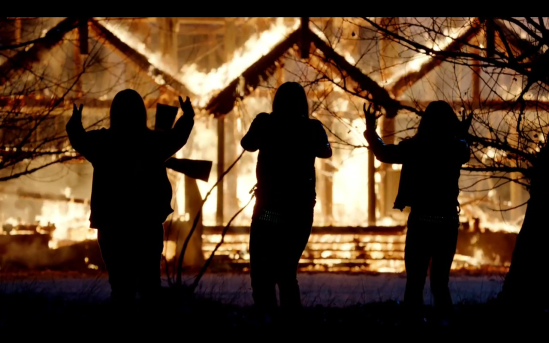
To prepare myself for Jonas Åkerlund’s biographical thriller, “Lords of Chaos,” I immersed myself into Jason Lei Howden’s 2015 black metal horror film “Deathgasm” as precursor preparation into the intense and unforgiving metal macabre genre. Whereas “Deathgasm” is a balls to the weed whacker splatter film of the pissed off demonia kind, “Lords of Chaos” is a polar horror feature with factual roots. Åkerlund’s, who directed Mads Mikkelson in Netflix’s “Polar” and has an extensive history in directing music videos for various artists, draws inspiration for the 2018 film from his own experience in a Swedish Black Metal band, Bathroy, from the late 80’s. The Grammy award winning music video director creates beauty out of the horrific true life event, unidealized nearly entirely without much speculation that faithfully puts to picture a misanthropic tragedy in a bone-chilling manner.

From “Signs” to “Scream 4,” Rory Culkin has remained on the actors-to-watch radar and is most certainly, our favorite Culkin to watch on the screen. In “Lords of Chaos,” Rory plays and narrates the story as Øystein “Euronymous” Aarseth, the guitarist and creator of Norwegian Black Metal band, Mayhem. As if written stars, Euronymous surrendered to Rory Culkin’s performance and Rory Culkin became Euronymous. The eerie synonymous blurred identities that catapults Culkin to be admired amongst his peers and his worked beloved. Opposite Culkin is Emory Cohen as Kristian ‘Varg’ Vikernes, former Mayhem bandmate and convicted murdered of Euronymous. Cohen is bitterly intense with a historical figure whose committed arson and homicide and the New York City born actor uncomplicated approach to a complicated character had a natural phenomena about that would spook your soul from your body. Culkin and Cohen fed off each other’s energy to an explosive dynamic too good to be stagecraft. Another highlight from “Lords of Chaos,” though rather story line brief, is Val Kilmer’s son, Jack Kilmer, as Per Yngve Ohlin aka Dead. Kilmer tackles a depressed introvert and, in one opinion, nails the mental deficiency metalhead who was ordained to take his own life with great savagary showmanship. The film also costars Sky Ferreira (“Green Inferno”), Valter Skarsgård, Anthony De La Torre (“Johnny Gruesome”), Jonathan Barnwell, Sam Coleman (“Leatherface”), and Lucian Charles Collier.
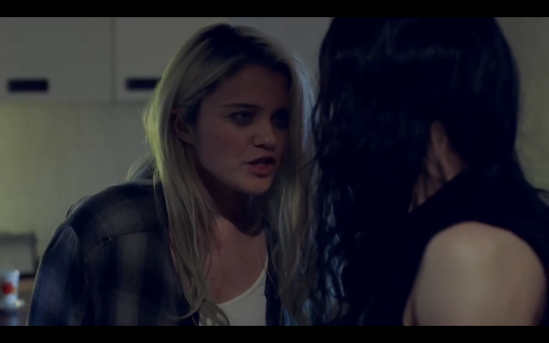
If not paying attention, “Lords of Chaos” will slip under the radar since most audiences are conditioned to subsidize shiny cinema productions that make you feel all warm and cozy inside and spark wander and induce marvel and amazement. Åkerlund’s film will not send those sorts of puppy dog tingles down your spine. Many biopic films about ill-fated tragedy don’t do well with the general population; “Auto Focus” comes to mind with Greg Kinnear and Willem Dafoe. Critics eat up the inherent black dramas like Cookie Crunch and “Lords of Chaos” exudes madness and misery through deep seeded vigor for fame and principle. Åkerlund deserves nothing but our admirable applause for delivering an unadulterated visualization of literal mayhem from soup to nuts.

Umbrella Entertainment releases onto DVD home video “Lords of Chaos,” a co-production from Gunpowder & Sky, 20th Century Fox, Vice Films, and Insurgent Media. Presented in a widescreen, 1.85:1 aspect ratio, Umbrella Entertainment’s picture quality is exemplary in it’s natural, yet supernatural-like surrealistic manner in a clean digital presentation. Pär M. Ekberg’s depiction is hard-edge elegant and haunting with recreations of and the intertwinement of actual photos of Euronymous, Varg, and Dead. If you’ve seen “Polar,” you know Åkerlund and Ekberg brush stroke a fine line between reality and graphic novel much the same as “Lords of Chaos'” allegory. The English language Dolby Digital 5.1 surround sound mix has high level attributes with clean and perceptible dialogue, a vast range of ambient noise, and a killer black metal soundtrack worth banging your head to. No bonus features accompany this title. “Lords of Chaos” is a heavy story that needed to be told and feels very much like a part of Åkerlund, an extension of himself through his past brought forward to illuminate the blackness in us all derived from the power of metal with a psycho-psychology that’s industrial-built.
Category Archives: Chilly Thrilly


Two Undisciplined Girls Do EVIL in the Netherlands! “My Nights With Susan, Sandra, Olga, & Julie” review!

After years with struggling with fame, Susan finds solace in an idyllic and solitude Netherlands’ farmhouse near the waterfront. Her peaceful lodging transforms in a youth hostel as she welcomes three refuge women – Sandra, Olga, and Julie – and one man – Albert – into her life and in exchange for a place to stay, Susan embraces the company after her entanglement with loneliness. Despite Sandra and Olga’s sex-crazed psychopathy and an unhinged Albert’s voyeuristic habits, Susan has been able to maintain an even keel quality of life. That’s until the handsome Anton shows up. His arrival stirs the nest of sexual desires and has Susan questioning her reclusive lifestyle. Anton’s presence also riles up Piet, a crazed women living in a shed on the outskirts of the farmhouse. To make matters more complex, Anton becomes mixed into a murder mystery involving a dead American. Was it the mischievous sexual delinquents Sandra and Olga? Or did the wild Piet finally snap her moral conscious?
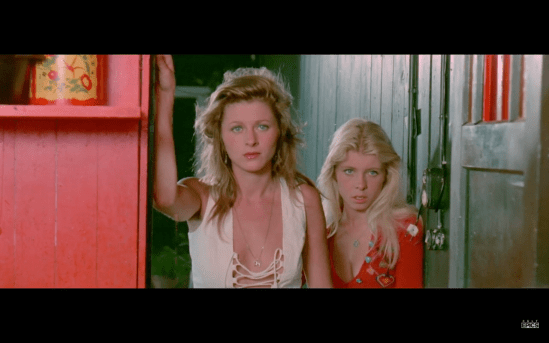
During the height of the 70’s sexual revolution, the Dutch seize the opportunity to piggyback their own free love films. Pim de la Parra’s 1978 “My Nights with Susan, Sandra, Olga, & Julie is an epitome example of the Dutch sex wave genre that shares the tantalizing groping, succulent squeezing, fornicating spooning, and …well, you get the idea. Originally titled as the longwinded My Nights with Susan, Olga, Albert, Julie, Piet, & Sandra (whew), this film is the last production of Pim de la Parra’s Scorpio Films from a script co-authored between Parra, Harry Kumel from Belgium, David Kaufman from America, Charles Gormley from Scotland, and Carel Donck from the Netherlands in a melting pot of cultural creativity. “My Nights with Susan, Sandra, Olga, & Julie” sizzles the screen with nudity in characters just walking around or riding on a child’s rocking horse stark naked that’s ostensibly organic for a story beginning with cold blooded, arbitrary murder.

Before partying the circumstantial matron of a youth hostel, Netherlands’ Willeke van Ammelrooy was Eva in “Frank & Eva,” another film by Pim de la Parra. She was also Alicia in “Blue Movie” director Wim Verstappen’s “Alicia” and also played Mira in Fons Rademakers’ “Mira.” As the evidence provides, Ammelrooy is very experienced as the leading lady role, portraying three titular characters from 1971-1974 by post-humorously acclaimed Netherland directors. Yet again, Ammelrooy plays a titular character in Susan, a country cloistered luminary seeking to be a forgotten face, but Ammelrooy steely performance of a woman pretending not to be hiding secrets is a fascinating insight into a character’s personal shielding; however, when Anton, “Wet Dreams’” Hans van der Gragt, their hot and cold dynamic creates a formidable hard love rigidity influenced by forces internal to Susan and external forces from those her immediate life at the farmhouse. Olga and Sandra have more intoxicating behaviors that run the story amok and what’s more interesting about the actresses, Franulka Heyermans and Marja de Heer, is that they’re amateur actresses according to Pim de la Parra. Cold and, yet, lively, Heyermans and Heer have mountainous ration and serve Parra genuinely. Marieke van Leeuwen, Serge-Henri Valcke, Jerry Brouer, and Nelly Frijda round out the small cast.

Pim de la Parra’s influences stem heavily from Alfred Hitchcock. The filmmaker implements voyeurism and the wrongfully accused that are essential to the Hitchcockian style. I also find it hard to believe that on the first day of shooting on Hitchcock’s birthday, August 13, that Pim de la Parra’s first scenes are that of birds on a beach. Coincidence or a little salute to the master of suspense, either way, the now retired filmmaker unifies a harrowing score with birds and a beach to not only by respects to Hitchcock, but also sets the tone of the film of an erotic thriller with blotches of dark comedy strewn in.

Cult Epics proudly releases “My Nights with Susan, Sandra, Olga, & Julie” onto a new high definition two-disc Blu-ray/DVD combo set. Presented in a widescreen, 2.35:1 aspect ratio, in a 1080p transfer from the original 35mm print, preserved by the Eye Film Institute in Amsterdam. The original print is nearly pristine with a palatable amount of stock grain and with only a minor amount of film wear. No observations of border enhancing or sharpening that would dilute the bona fide quality. The Dutch DTS-HD 2.0 Master Audio track nicely accompaniments the film with depth and range and the Dutch dialogue upfront and present and the very Hitchcock-esque soundtrack by Elisabeth Lutyens (“The Skull”) provided a perfect suspense drive score in her last composer post. Supplements includes an introduction by Pim de la Parra, poster and photo video gallery, Scorpio Films’ shorts that includes “Heart Beat Fresco,” “Joop,” and “Joop Strikes Again,” and Scorpio Films’ theatrical trailers. Cult Epic’s region 1 DVD and the all region Blu-ray release favors another Dutch sex wave cinema flavor with just modernization of an intertwinement of erotically charged lust and lives with repulsive and deadly temperaments and with Pim de la Parra at the helm, you’re going to get primo framing and angles sure to captivate.

Purchase by Clicking the Blu-ray Cover!

One Night in an EVIL Sanatorium. What Could Go Wrong? “Haunted Hospital: Heilstätten” review!

Among the outskirts of Berlin lies a vacant and dilapidated Heilstätten hospital once used by the World War II Nazis to conducted “mercy deaths” for tuberculosis patients. Over the years, the hospital has remained dormant in its subsequent closure after the war and infamous labeled cursed and haunted during daytime tours, becoming the sole connection between instances of madness and murder through the decades. When a pair of YouTube pranksters and social media influencer gamble against each other on spending 24 hours inside the hospital for viral stardom to gain more followers, they’ll put the hospital’s paranormal notoriety to the test with the help of Heilstätten tour guide Theo as their access onto the grounds. With all the cameras set up and the stage set for an all-nighter spook show, their viral glory campaign becomes a malevolent presence’s bloodbath welcoming.
“Heilstätten,” also known as “Haunted Hospital: Heilstätten” under the North American market, is the gruesomely supernatural found footage horror film from “Potato Salad” director Michael David Pate. Pate, who also co-wrote the script with Ecki Ziedrich, helms his own perspective on the sanatorium (English term for Heilstätten) horror that offers more than just a phantom in hospital wings. Deranged and soulless Nazis performed immoral experiments on not just the Jewish people, but also sought to eradicate the sick for their feverish impurities, such as those afflicted with tuberculosis. “Heilstätten” pits history against the present in a egregious tone of respecting the past and diminishing the importance young social media influencers without a peck of smarts or appreciation.
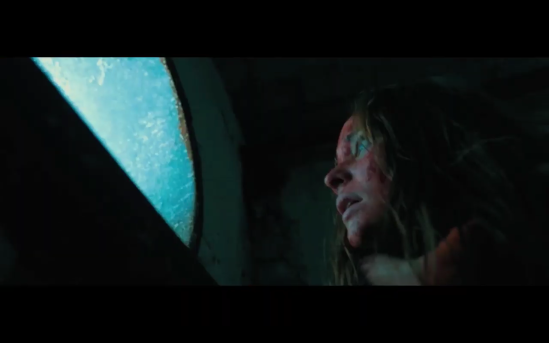
The 2018 film stars “Tape_13’s” Sonja Gerhardt as Marnie, a social media star who records and implores people to face their worst faces, catching up with the group of YouTubers before they dig themselves deeper into their own graves. Gerhardt’s hard sell of her character doesn’t quite shape the sincerity in stopping the carnage before it happens as Marnie is the proverbial monkey wrench in the overnight blood bath. Marnie is drawn to Theo, an ex-lover that hasn’t quite severed her interests in him, played by Tim Oliver Schultz. As the tour guide breaking all the rules, Theo’s compulsion to help wavers on the idea of being just as renowned on the internet as those he’s helping, but there is more to meet the eye with Theo than the surface level material. The more complex characters revolve around the pranksters, Charly and Finn, played by Emilio Sakraya and Timmi Trinks, who become wedged by social media influencer Betty, Nilam Farooq. Charly’s strive for world wide web fandom drives him blind to the circumstances around him, especially when Finn and Betty become romantically involved, and despite Finn’s willingness to be part of the prank, his conscious breaks beyond Charly’s gimmicky barrier where lives actually do matter over stardom when people end up missing or dead at the hands of an ominous force. “Heilstätten” cast rounds out with Farina Flebbe, Maxine Kazis, Lisa Marie-Koroll, and Davis Schulz.
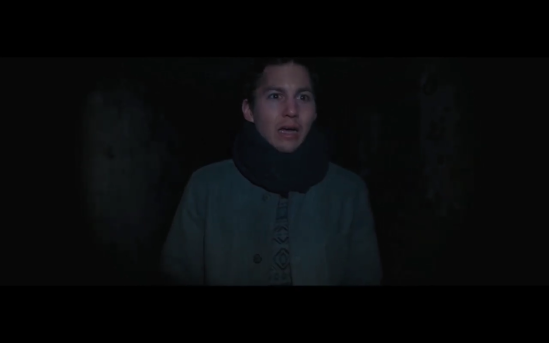
The trick about “Heilstätten’s” allure is the moments that the ghost film isn’t afraid of the blood and flesh bits founded upon a nicely laid foundation with the Nazis’ extermination activities and all the notorious lore surrounding a hospital. The hospital itself, Heilstätten, wasn’t created out of thin air just for the story sake. Pate and Ziedrick used the withering Beelitz Heilstätten as their base, utilizing actual historical facts, such as Adolf Hilter was treated at the hospital during World War I, to even further demonize the setting, but in reality, Beelitz Heilstätten rehabilitated the war wounded rather than mercy death the Tuberculosis-stricken. Yes, the hospital was Nazi occupied, but so did the Russians after the war. “Heilstätten” has rich backstory that basically breeds itself into a horror film. However, one aspect about what discourages “Heilstättens” effectiveness is the use of soundtrack for a found footage horror film. No found footage horror film should ever have a soundtrack that doesn’t add to the realism and renders the film more closely to William Malone’s “House on Haunted Hill” in more than one similarity.

Well Go USA Entertainment admits proudly Michael David Pate’s 20th Century Fox International produced “Heilstätten” onto a dual format, DVD and 1080p Blu-ray, release. The Region 1 and A, not rated film is presented in a widescreen, 16:9 aspect ratio, that’s relatively free of problems. The second act shadows find definition hard to make out under the quick, stark edits, but the “Predator” heat vision is nice touch to liven things up when the darkness is as black as night. The German language DTS-HD Master Audio lives up to the supernatural maelstrom that cause the covers to be pulled up to your eyeballs with range and depth to personify the gloomy corridors and multi-level death snares. The hard-lined English subtitles are well synced and accurate and the release also offers up an English dub track. The DVD comes with an English language Dolby Digital track too. Bonus features a slim with a just a trailer to it’s name. “Heilstätten” is one effectively spooky, atmospherically creepy, and dreadfully engrossing good time with a full-bodied backstory topped with Blut und Eingeweide.

Buy today at Amazon.com!

EVIL Checks Into the “Motel Mist” review!

The Motel Mistress stands tall beside a highway on the outskirts of Bangkok. The adult-oriented love accommodate caters to the freakiest of the freaks under the soft glow of the hotel’s purple-pink neon marquee that’s shimmers on the rooftop during the tantalizingly active nightlife, flickering to a more conspicuous Motel Mist, but during the day, the near vacant hotel sits dormant and has scarce use. That’s all about to change when four visitors and one Hotel Mist front desk man become five strangers entwined into an uncanny affair that begins with illicit sexual desires between an extremely perverted and dangerous middle-aged man and a young school girl with ulterior motives and ends with a former child star’s refuge into, what he believes, is communications from beings not of this Earth. Salacious deviances, revenge, and strange occurrences check into the Hotel Mist, but will the five strangers check out?

From the erotically charged DVD cover from Philadelphia based home video distribution company, Breaking Glass Pictures, the Truevisions Original Pictures in coproduction with the 185 Films and Song Sound Productions produced “Motel Mist, written and directed Prabda Yoon, has the irrefutable markings of an unforeseen science fiction thriller from Thailand. Yoon’s introductory 2016 picture initially dodders on various genre borders that venture into the human complexities of interaction from an alienation or a subversive standpoint and wholeheartedly whips 180 degrees merging into exacting revenge and experiencing unearthly dimensions to an inevitable mesh correcting what’s characteristically abnormal. Though sexual romps in one-night-stand lodges have been marketed as quite the norm in Bangkok, Yoon pushes the creepy factor limits to the max, turning the dial on predatory intentions to an unreal reality.

The focus surrounds five characters with dialogued roles. The characters, with the exception of two of them, are essentially from all walks of life: a young hotel concierge with ambitions to be a fire stick performer, a middle-aged man with duel façade, a child star with unknown psyche complications, and then there are the school-aged girls with relatively the same motivation, but of a diverse personality type. We’re gently introduced to the middle-aged father figure Sopol, played by Surapol Poonpiriya, gazing at a newscast about a missing child celebrity on a car onboard touchscreen. Poonpiriya reels in slowly a conservative, perhaps even old-fashioned, fatherly figure where children shouldn’t swear and nose deep in cell phones isn’t a proper and good thing, but then the actor yanks hard back on the spoke, settling his character into a blurry role between niceties and deviances. Sopol’s an abhorrent wolf in sheep’s clothing, lavished and proud of his alternate life of an older man whose been with many younger women in his prefabbed BDSM motel room. His latest fair object is Laila, a young school girl in a short skirt with fresh innocence splayed from head to toe, performed by Prapamonton Eiamchan. Laila goes with the Tot’s flow by guiding her every move and letting him manipulate her like a doll of his pleasure. Eiamchan’s curious portrayal befalls her character’s with a relationship with masochism because of a more deep rooted motivational factor and the dynamic between Eiamchan and Poonpiriya pulls at the unsettling strings while also teasing visceral fantasies. Yet, oddly enough, Vasuphon Kriangprapakit cerebral performance being an antenna for alien correspondence is more intriguing. Kriangprapakit’s Tul is the crucial focal point that connects each character, playing against their vices that shepherds into a more savior role; in fact, Kriangpapakit could be considered appearing like the Thai version of the Messiah. While Tul requires a force invading into one’s mind bubble, Tot bubble seems to have popped with vague ambitions and being an overall motel lackey. Tot, a role suited for the talented Wissanu Likitsathaporn, sports green hair atop his punk rock outfit, and, like today’s typical millennial, enjoys conversing on the phone, especially with women. His sympathetic qualities aim to grant him amnesty for his cooperative nature, especially assisting covertly alongside Sopol, and being an agent of greed when figuring out his other daytime tenant, Tul, has a reward for his whereabouts. Katareeya Theapchatri rounds out the cast as Laila’s accomplice, Vicky.

As the subtitle insists, “Motel Mist” is a setting where there are no limits. Whereas that’s true for unlimited sexual pleasures and displeasures as well as thematics akin to the “Outer Limits,” “Motel Mist” has some limitations to challenge the experimental engine on which the film is powered. For one, the takeaway message has vague variables and not enough outright exposition to grasp viewers by the balls for that deep-in-thought, chin scratching moment that ekes forward the turning giant wheels in our heads, spinning conclusions and possible theories into plausible themes. For me, the takeaway message borders somewhere along the lines of the mysterious mechanics of the cosmic universe righting the wrongs between inherently misguided human faults and interactions. Whether that notion weighs in with any truth or not is most certainly up for grabs and could possibly way off the marker, but the enigmatic complexities are what make films, like “Motel Mist,” interesting to dig into and explore.

Breaking Glass Pictures calls for room service and has delivered “Motel Mist” onto DVD home video presented on a DVD9 with a widescreen, 2.39:1 aspect ratio and the region 1 Sci-Fi/Thriller runs just under two hours at 117 minutes. Often with a warm resemblance to Bangkok atmosphere, Yoon also seizes every opportunity with a vast color palate to shape the character developments in Room 7 with sultry red and Room 5 with a sterile black and grey. No problematic issues from a nice sharp picture in natural lighting juxtaposed a vivdly colorful. The frame work, by cinematographer Chananun Chotrungroi, captures micro stories with such aggression that it becomes a thing of beauty and with Yoon’s long takes, the sensation, no matter how unpleasant, lasts what seems to be an eternity. The Thai language stereo 2.0 dual channel audio mix has clean range and depth with parameters around mid-to-high levels of output through the variations of dialogue, ambient, soundtrack, and miscellaneous distortion tracks. There are English subtitles available and while seemingly translated okay, the yellow font coloring blend way too much into the background, making reading them difficult. Special features include a pair of behind the scenes with cast & crew and a trailer. Common perceptions of Bangkok could be extracted out entirely from director Prabda Yoon’s “Motel Mist” with a taste of illicit sexual affairs and the super bizarre in this unique science fiction thriller.


Make a Deal with EVIL, EVIL Will Come Calling! “The 27 Club” review!

Kurt Cobain. Robert Johnson. Amy Winehouse. Jim Morrison. Jimi Hendrix. All these recording superstars have one tragic thing in common: their fame engrossed lives ending horribly, sometimes violently, at the young age of 27 at the height of their careers. Their deaths are a part of an elite group called the 27 Club that incorporates effervescent celebrities from all walks of fame. When another popular rock star ends up mysterious deceased a night after his concert, the same concert that student journalist Jason attended, the eager academic finds himself at the right place, at the right time while researching and documenting the notoriety of the 27 Club. While hallowing out the club’s infamy, Lily, a wild and struggling musician, enters his life on a connective collision course toward his research that evidently surrounds itself around an ancient Latin-based text. The book is binding to those seeking rock star status in exchange for their souls and with a steep decline in her musical career, Lily provokes satanic rituals with exploiting help from the love struck Jason, but the only thing Lily didn’t count on was her unexpected love for him back.

The actual 27 Club lore continues to be an interesting notion. A curiously notorious concept that flew under the radar for this reviewer up until happening upon and diving into the Patrick Fogarty’s written and directed soul-bargaining tale regarding the idea’s parameters as the film’s foundation. Fogarty, the staple music video director for bands such as Black Veil Brides and The Burning of Rome, tests his hand at satanic, soul-swallowing horror, simply titled “The 27 Club,” for Cleopatra Records cinematic sub-division, Cleopatra Entertainment, and is co-written a mythos script alongside “Clownsploitation’s” Joe Flanders and Michael Lynn. Even if nothing more than a freak coincidence, Fogarty processes an innovative take on the 27 Club that has spanned over century and, perhaps, provides a little education and knowledge to those outside the music industry.

Many iconic rock stars rise from the grave to spit philosophical truths and knowledge, constructed as miniature prologues of a chaptered story, intertwined with a relatively unknown cast beginning with headlining leading lady Maddisyn Carter as the toiled Lilly seeking refuge in any drug or sexual partner her beautiful disaster can ensnare in a world of deaf tone destruction. Her character is intended to be refracted by the introduction of the 27 Club research journalist, Jason (“Mutants'” Derrick Denicola), who just happens to be around when another musician kicks the proverbial bucket, but Carter maunders through the relationship with Jason and unable to materialize compassion, losing any slither of internal conflict Lilly may possess. Todd Rundgren, Cleopatra recording artist and a member of the progressive rock band, Utopia, headlines polar opposite of Carter on the cover of the home media release only and not as a chief player in this possession plot. The role downsizes his long legacy in the music biz and though a small role and acting isn’t Rundgren’s first love, the rocker tops as being one of the film’s better moments as a record store wise-guy patron doing the right thing and a creepy video-chatty music professor. “The 27 Club” tortures the cast of remaining souls with Adam Celantano, Kali Cook (“Victor Crowley”), Zack Kozlow (“Devil’s Domain”), Mr. Chromeskull himself Nick Principe (“Laid to Rest” and “Chromeskull: Laid to Rest 2”), Jason Lasater (“Death Tunnel”), Zach Paul Brown, Emily Dalquist, Eugene Henderson, wrestling superstar John Hinnigan, Gogo Lomo-David, Tasha Tacosa (“Halloween Pussy Trap Kill Kill”), and, my personal favorite, Killjoy’s Victoria de Mare!

Novel backstory might be one thing, but a comprehensively sound one is another and while “The 21 Club” begins like a John Carpenter cask of embolism-depth imagination and beguiling, if not apocalyptic hinting, descent into oblivion, Fogarty’s film collapses when Lilly and Jason seek out a couple of drug dealers to understand the book’s portentous contents. Conveniency and rushed theatrics push a scene-to-scene overhaul that forgets to breathe and come up for air, losing that dramatic, dire consequence associated with a thriller. No consequences steep the pot to forge a luxury of sympathy or any type of relation toward the characters. Jason and Lilly’s dynamic was hot and cold at best and why Lilly kept Jason around after learning of his possession of the book is a complete mystery. The exposition isn’t conveyed properly in this instance and their coupling wipes on a thin wave toward the finale. There’s also the common motif of a sex tape – Jason records his and Lilly’s sexual encounter after a night of clubbing and Lilly’s record producer explicitly states if there’s a sex tape out there that might risk damaging her career – and then that information goes dark, nothing but crickets to line an explanation to why her sex tape would be important to the story. If a stipulation of her fame agreement with the reaper was to not lie or become involved scandalously entangled, the sex tape would be the perfect real world-relating catalyst that fully encompasses the fame-to-fallen storyline.

Cleopatra Entertainment and MVDVisual release a sweet, multi-format package perfect for home entertainment of Patrick Fogarty’s “The 27 Club.” The all region DVD/Blu-ray combo set also includes the compact disc soundtrack to the movie that features music from Todd Rundgren featuring NIN’s Trent Reznor and Atticus Ross, plus Die Klute, Bestial Mouths, The Anix, Jurgen Engler and more. The full HD, 1080p Blu-ray, which was viewed, is presented in a 1.78:1, widescreen, aspect ratio. The 97 minute digitally shot film has a wonderful color palate that often shutters from natural tones to one or two-toned primary color filters with also a desaturated approach to the 27 Club’s most recognizable members conducting a foggy room soliloquy. Banding issues have noticeable effects in various stages of darker scenes, especially surrounding a humanoid figure. The English language Dolby Digital 5.1 surround sound has insignificant bite through the multi channel conduit that denotes continuous issues with Cleopatra Entertainment’s home video releases. With a recording penchant for talent in the music industry, the expectation is high in delivering bombastic results flowing from one through five and presenting a singular comprehensive result, but the range and depth lack beside the powerhouse release and instead, find more solace in the third format of a traditional CD soundtrack content with great musical contents. Bonus features include two interviews with the film’s stars, Maddisyn Carter and Darrick Denicola, slideshow, trailers, and of course, a CD soundtrack all underneath a slipcovered jewel casing. “The 27 Club” spins a concoction of malediction around historical tragedy that’s more heinous hoopla and than harrowing horror and while the release bursts with razor sharp teeth and high pixelating resolution, channelling all the material rudimentary didn’t stay glued together in the end, hurting the character progressional arch and thinning out the hair-raising filament.

Pre-order “The 27 Club” available June 11, 2019!


