Prudish EVIL Takes on the Arcade in “Joysticks!” reviewed! (MVD Visual Rewind Collection / Blu-ray)

Get Your Herky-Jerkey Hands on “Joysticks’ on MVD Blu-ray!

Arcade manager Jefferson Bailey runs his grandfather’s business like a nonstop party lined with token-operated video game machines, stocked with a complete concession counter, and welcoming beautiful women to enjoy not only the endless entertainment of the arcade machines at all hours but also to gush over his handsome, easygoing demeanor. With an expert gamer and a newly hired dweeb helping to run the arcade, Bailey has a lot of free time to enjoy the perks of popularity until a wealthy businessman, Joseph Rutter, continues to have a hard time keeping his entitled daughter away from the arcade and Bailey which he considers both to be corrupting the town’s youth. Rutter, his two bumbling nephews, and a peevish gamer try everything in their power to shut down the arcade but Bailey, the employees, and the lucrative patronages won’t subside without a fight, even if that means settling everything on a single video game battle.

An obscure and forgotten teen sex comedy from the early 1980s, “Joysticks” is a celebration of the coin-operated video game at the height of the arcade’s heyday. Director Greydon Clark (“Satan’s Cheerleaders,” “Without Warning”) helms the Al Gomez, Mickey Epps, and Curtis Burch screenplay with ton of sex appeal, a display of 8-bit gaming graphics, and a cheesy, chunky storyline of big, bad entitlement versus the small, teen-run business of fun, sex, and videogames. The 1983 film was shot in Los Angeles and had introduced to the big screen not only a few of the more popular game titles – Pac-Man, Millipede, Pole Position, Naughty Boy, and Defender 2 – of the period but also introduced a new game with Midway’s Satan’s Hollow. “Joysticks” is a Greydon Park Production with associate producers in Curtis Burch, Daryl Kass (“Darkman”), and George Perkins (“Teen Wolf”) with also Clair Farley and Raylan D. Jensen serving as executive producers.

Headlining “Joysticks” is legendary, recognizable actor of “Walking Tall” and “The Shadow of Chikara,” Joe Don Baker, as the gruffly, arrogant suit Joseph Rutter going up against the then arcading-entrenched youth, represented primarily by actor-turned-director Scott McGinnis (“Last Gasp”) as the fun-loving arcade manager Jefferson Bailey. Baker fits into that stereotypical group of the out of touch older generation who doesn’t understand new and fascinating entertainment technology that attracts young people and, as he would understand it, these arcades are nothing more than the exterminating flame that attracts the unsuspecting moth. Bailey makes for a good fun while upholding certain convictions that doesn’t entail him being the villain of the story; those attributes fall not only into Baker’s lap but also Jonathan Gries as the eccentric gothic gang-leader King Vidiot. The “Fright Night 2” and “TerrorVision” actor, who outside the horror realm is well known for being Uncle Rico to the titular “Napolean Dynamite,” sports blue-red hair, cladded in leather, and has a hold over four equally garbed and dyed-colored women as his subjects to his peculiar behavior around the arcade. Initially Gries felt like an integrated part of the clientry until miffed by the arcade’s resident joystick and buttons master of gameplay, Dorfus (Jim Greenleaf, “Evil Speak”) in a one-on-one challenge. If “Joysticks” is a film about the joys of an arcade hall that’s precious to protect from overly concerned parents, the Dorfus character is pretty much the antithesis of that theme having once been the high school thin valedictorian now a sloppy, flatulating, and overweight gamer. Another character that doesn’t quite fit into the equation is the nerdy Eugene (Leif Green) whose character predates “Revenge of the Nerds” that released a year later but didn’t quite absorb into the fold of the only other companioning misfit in Dorfus. Where Eugene succeeds, with the help of Green’s performance, is the bumbling dumb-smart guy whose innocence instills more trouble for himself than anything else, especially with the braless women around him with Kym Malin (“Weird Science”), Kim G. Michel, Becky LeBleau (“School Spirit”), Lynda Wiesmeier (“Avenging Angel”), Morgan Lofting, and Corinne Bohrer (“Zapped!”). The supporting cast fills out with John Diehl (“Stargate”), John Voldstad (“Leprechaun”), and Logan Ramsey (“Doctor Hackenstein”).

As far as in the canon of 80’s teen sex comedies, “Joysticks” fits the bill as a nonpolitically correct cinematic lark with all the goofy and raunchy bells and whistles that come standard with these types of movies but there’s something missing from the ’83 feature that doesn’t quite put the categorical entry at the same quintessential high level as “Revenge of the Nerds,” “Private School,” or “Porky’s.” The narrative trajectory often stays in stagnant territory, or in more detailed terms a lopsidedness, instead of a back-and-forth, tit-for-tat jostling contest that hardly challenges the opposition to face dire straits. Also, too often does “Joysticks’s” jokes fall flat, perhaps the lost in flavor is due in part to the film’s 40-year-old comedic gags, that mostly reoccurs with Dorfus passing horrible gas or Eugene stumbling into an unlikely sexpot to his disadvantage. There is substance in a deeply rooted character arc with the once pro-level Jefferson Bailey unable to play his beloved coin-operated machines because of a traumatic event involving a past love of his life that results in him trembling, sweating, and getting into his own headspace but that, too, is obstructed by the warmed-over objective that generally has a loveless love-interest in a mostly male dominated principal cast, a short-fused motivation reasoning for most characters, and a rough patch polish, such as with that ear-throbbing main theme song, that tries to compensate with wacky situational and sexual archetypes which are not unpalatable to say the least but can’t keep “Joysticks” from respawning after all its lives have been used up.

Catalogued as number 58th on the MVD Rewind Collection banner, in conjunction with the Multicom Entertainment Group, “Joysticks” receives special package design that will surely please fans of older video game consoles and cartridges, but the packaging keeps with the Rewind Collection overall theme that is a testament to its label.  The AVC encoded, single-layer BD25 presents the fill in full 1080p HD and in an anamorphic widescreen aspect ratio of 1.78:1, based off a 2015 2K scan and restoration of the 25mm film elements.  This 2015 transfer is likely from the Scorpion Releasing limited number release from nearly a decade ago, licensed to MVD for broader and more easily accessible distribution.  Though an older transfer, the color saturation still pops albeit some heftier grainy frames that stumbles the overall consistency from time-to-time.  This ultimately also affects the details to an extent, especially on medium shots where the action is pulled away from the camera to get a wider view.  Closeups and extreme closeups look better with tighter detail and better contrast.  The English LPCM 2.0 mono is the only available audio track.  The lossless format provides ample volume and is a real pedigree of the original audio recording.  Dialogue has most a firm grasp on the layer design with no inaudible inadequacies but can often be anemic in more noisy settings, such as the arcade where bleeps, bloops, and other video game noises invade the audio field and dilute distinction and depth.  Legion’s “Joysticks” theme track also renders palely in his cheesy metaphorical lyrics that mix sex with video game playing, even if as appropriate as it may be to the context.  English subtitles are available for selection.  Special features include an archival feature length commentary and interview with director Greydon Clark but also has a brand-new roundtable commentary with MVD’s director of acquisition Eric D. Wilkinson, Cereal at Midnight host Heath Holland, and Diabolik DVD’s Jesse Nelson.  There’s a short film “Coin Slots” which is a faux “Joysticks” trailer that costars Eric D. Wilkinson and directed by Youtuber and producer Newt Wallen.  MVD’s physical presence of “Joysticks” is where the fun is at with an Atari themed orange slipcover with boxed in picture of sex-comedy appeal poster art, a more slimdown version design that’s more attuned to the MVD Rewind Collection look for the cover art in the clear Blu-ray Amaray case, and a Blu-ray disc pressed with the coloring and markings of an Atari game cartridge.  A more complete version of the cartridge look is on the reverse side of the reverse cover art, preferably for this reviewer to mix up the designs between slipcover and cover art.  A folded, back-and-front illustrated mini-poster of both cover arts is housed in the inside the case insert.  The region free release has a runtime of 88 minutes and is rated R. 

Last Rites: The packaging alone is worth the cost of this inexplicably obscure and quaintly waxen teen sex-comedy that now breathes new life on a more accessible high-definition Blu-ray release from MVD Visual!

Get Your Herky-Jerkey Hands on “Joysticks’ on MVD Blu-ray!

Spiraling Vloggers Seal Their Fate When Face-to-Face with the “Woods Witch” reviewed! (SRS Cinema / DVD)

“Woods Witch” Available on DVD from SRS Cinema!

Vloggers Jonah and Jocelyn struggle to sustain a healthy dose of followers for their internet channel.  To spice things up and increase follow traffic, the two embark on a 48-hour challenge to stay in the nearby haunted woods of Allensville where a number of people have gone missing, even a fellow, more popular, vlogger named Garrett Gasper after he was self- recording and suddenly vanished when stumbling upon the blood tree, a tree that oozes a blood-like substance from the trunk.  Tagging along are vlogging, ambivalent friends Dacia and Eugene to help capture the spooky essence of what should be an easy, follower-increasing stunt for the impulsive influencers.  They’re also joined, reluctantly I might add, by a local cowboy, two bar patrons, and a father looking for his daughter who don’t know what they’re instore for as what ensues the unorganized, slapdash survey of the woods is far from being simple and safe when they stumble into the area of a seemingly hippie commune that’s actually a sex cult devoted to the woods witch Melora.

If you’re a diehard horror fan, or even just a physical media movie aficionado, you might have heard of the name Shawn C. Phillips.  The eccentric, high-energy, social media personality buys, watches, and reviews the latest and greatest on home video weekly on this Youtube channel under the handle Coolduder.  Aside from being also a movie actor with a range of roles in mostly low-budget, independent, B-to-Z grade horror films, such as “Girls Gone Dead,” “Blood Orgy at Beaver Lake,” and “WTF!,” Phillips’s social media presence further extends to an inspirational weight loss journey, shedding over 235 lbs.  Having been a longtime actor and producer, one of the Baltimore, Maryland native’s newest ventures is directing having shot mostly self-recorded videos to be inserted into other filmmakers’ movies.  Phillips’s latest is “Woods Witch,” a found footage comedy-horror that’s one-part “Blair Witch Project,” two-parts ADHD (Attention Deficit, Hyperactivity Disorder).  He codirects the film with costar and “Amityville Karen” actress Lauren Francesca in her debut directorial and cowrites with Julie Anne Prescott, writer of many more recent “Amityville” inspired budget horrors like “Amityville Karen,” “Amityville Shark House,” and “Amityville Bigfoot.”  DRAX Films (“Bae Wolf,” “Acorn”) is the production company behind feature that provided most of the funding in conjunction with crowdfunded portion.

Obviously infatuated about being in front of the camera, taking a backseat to his own co-directed film wouldn’t be enough for the nearly 40-year-old personality who costars alongside Lauren Francesca as social media influencing boyfriend and girlfriend Jonah and Jocelyn.  Loud and opinionated, the couple struggle with maintaining viewership but, before that, they also they also struggle with the foulmouthed, death-threatening volley between Jonah and Jocelyn’s robbing-the-cradle by robbing-Jonah’s-cameraman mother, played by Sally Kirkland (“Fatal Games,” “Two Evil Eyes”).  And that sort of leads into a couple of themes “Woods Witch” harps on.  One theme is the constant bickering, shouting, and squabbling between anyone and everyone in a free-for-all of one-upping each other or to not take humility very well in front of others.  None of the characters side with one another, steadying a position of satellite attitudes and courses that lead the story into all different types of unhinged and unfocused directions.  The second theme connects with Sally Kirkland and the other in-and-outs of overripe star power for what crowdfunded money could afford and while there are some likeable and decent names in the cast, such as the late Tom Sizemore (“Relic,” “Saving Private Ryan”) in his last role before his death, James Duvall (“May,” “Donnie Darko”), Robert LaSardo (“Strangeland,” “Death Race”), and Lisa Wilcox (“A Nightmare on Elm Street 4:  The Dream Master”), they used to headline the attraction with only minutes to shine in their respective scenes.  The cast fills in with Kelly Lynn Reiter, David Perry, Carl Soloman, Bill Dawes, Lorelei Linklater, Nicole Butler, Ken Davitian, Bryant Smith, Eva Hamilton, G. Larry Butler, Mary Jones, Tom Harold Batchelder, Jake Pearlman, Brian Metcalf and Sadie Katz. 

“Woods Witch” uses multi-media found footage to tell the story where a bunch of egregiously entitled vloggers trek into infamously mysterious woods for hits, likes, subscribers, and e-revenue.  Not an original bone in its narrative body by any means, Antoine Le’s “Followed” comes to mind, but “Woods Witch” doesn’t hit where it should as a heavily improv comedy-horror that lampoons found footage horror in the woods and, instead, has undeniably become massively cacophonous of in all areas.  Going into the feature familiar with some of the cast and the distributing banner, expectations of a Shawn C. Phillips directed film were all fastened at the lower screwball level with horror elements tacked in here and there, aptly fitting the mold the social media influencer has established for himself with the eccentric personality of a physical media farceur who adores horror, but nothing can prepare audiences for how much confused noise is strewn about with the constant yelling, backbiting, and randomizing introduction of characters that turns what should have been an entertainingly crass and witchy film into just being a completely crass and witchy yawner.  Being completely flat and unfunny wouldn’t be a totally fair statement as “Woods Witch” does have its moments, such as the tree blood being rubbed all over Phillips’s naked torso and him, as Jonah, proclaiming naively Dascia’s kinkiness can be found humorous, but these funny bit moments are far and few in between and there’s just not enough new, fresh, or actor-driven comically-inclined wit and materially to feast on to support the lack of horror despite a few morsels of gore that are left in the dust, overshadowed by an immense pre-trip setup of interviews and infighting that ruins the rest of the reel. 

Enter the world wide web and wacky world of Shawn C. Phillips with his co-directed film with Lauren Francesca in “Woods Witch” on an SRS Cinema DVD. The MPEG2 encoded, 480i upscaled to 720p, DVD9 pulls the differing, clashing video qualities together, mostly earlier on and near the finale, for a coherent beginning, middle, and end narrative telling. If only I could say the same about the story, themes, and character roles. Anyway, not a lot of banding as there’s not a lot of dark scenes in what mostly is fill lighting that brightens up what’s in the scene. Details are okay enough when not implementing shaky cam’s in-and-out focusing found footage and lighting doesn’t completely washout the miniscule bits of texture. The coloring also has a naturally graded look as well as the objects’ organic color palette as budget doesn’t allow for too much fancy cinematography to also evoke a sense of realism. The English language PCM 2.0 stereo mix is consistent as it is coherent with the clarity and the dialogue. Even with pandemonium breaks out, which is often with the screaming and snappy conversations between each other, dialogue remains unscathed without audible squashing feedback or other interferences. English closed captioning is optionally available in the extras. Special features include a behind-the-scenes raw footage from fellow Youtuber Kenneth Ramone who has a small part in the film, a handful of cut scenes, theatrical trailer, funny trailer, an audio commentary by director/star Shawn C. Phillips going deep into the casting, locations, backstories, script and improv moments, etc., and there’s a Lisa Wilcox stinger in the post-credits as the mayor for an additional or extended scene with some improv. The SRS Cinema package comes in a standard DVD Amaray case with eye-catching illustrated artwork, disc pressed with the same artwork, and is an unrated, region free release with a 96-minute runtime.

Last Rites: Humor and horror underperform in the film “Woods Witch” that’s sole purpose is to be a comedy-horror. What the film does do is parody other found footage features and their filmmakers under a misguided sense that in-the-woods horror, from a camera lens point of view, is past its prime when in reality, the long-in-the-tooth subgenre is better than this parody by far.

“Woods Witch” Available on DVD from SRS Cinema!

Gaudy, Superfluous EVIL Sits in Your Living Room and Destroys Your Family. “The Coffee Table” reviewed! (Cinephobia Releasing / DVD)

“The Coffee Table” Would Look Good in Your Living Room! Purchase It Here Today!

Jesús and Maria are new parents with a beautiful baby boy.  Maria has been eager for a baby and sent through several medical treatment for the bundle of joy while Jesús continuous rides the fence about being a father.  When the baby arrives, the boy becomes a source of usually one-sided bickering and jabbing contention as Maria feels Jesús could be a better father to their newborn son.  When they move into a new apartment, they find themselves in a furniture store looking at a gaudy glass coffee table Maria can’t stand the sight of, but Jesús very much can’t live without.  While Maria steps out to shop for an upcoming luncheon with Jesús’s brother and young girlfriend, Jesús briefly stops assembling the table to take care of the baby until a tragic accident happens that reshapes everything and everyone Jesús cares about, and impels him to bottle in the tragedy, hiding it in extreme guilt from his wife and guests, as he struggles to find the right moment to relieve his soul. 

Marriage is hard.  Parenting is even harder.  Choosing a coffee table should be a delicious piece of decision-making cake but for director Caye Casas choosing living room décor can be deadly.  The “Killing God” director follow up his debut feature with the 2022 released domestic disturbing comedy-horror “La Mesita Del Comedor,” aka “The Coffee Table.”   Casas cowrites the film with Cristina Borobla, her first screenwriting credit but not her first collaborative effort working with the director as the vocational Art Director has been involved in Cases’s other works, such as “Killing God,” his 2017 short “RIP,” and amongst others.  Maria José Serra (“Amigo Invisible”) and Norbert Llaràs (“Killing God,” “The Perfect Witness”) put their producer café mugs onto “The Coffee Table” with the hailing from Spain production companies La Charito Films, Alhena Production, and Apocalipsis Producciones. 

Much of “The Coffee Table” is set inside the tiny, newly moved into apartment of Jesús and Maria who even though rag on each other’s opinions and one of them don’t necessarily favor being a parent, deep down the unlikely pair do have a strong love attraction that swims upstream against the repelling.  In the roles of Jesús and Maria are David Pareja, whose worked with Casas inner circle before with “Killing God,” and Estefanía de los Santos with an unforgettable, characteristic raspy voice that magnifies the role tenfold.  Both Pareja and de los Santos are comedically bred with a long list of hilarious Spanish features to prep them to see the gut-punching, black humor of what’s to come in “The Coffee Table.”  Frankly, there’s nothing negatively to report in Pareja and de los Santo’s flawless, funny, and unfortunate family dysfunctional performances surrounding their love-hate relationship and the knot of culpability and the bliss ignorance contrast that’s delineated between them.  Floating into the mix of repressiveness are side stories that become assimilated by the untold tragedy, such as the neighbor’s daughter (Gala Flores) with an intense belief Jesús loves her, the smarmy coffee table salesman (Eduardo Antuña, “Killing God”) who also have an interest in Jesús, and Jesús’s brother Carlos (Josep Maria Riera, “RIP”) and his barely 18-year-old girlfriend (Claudia Riera, “The Communion Girl”) being ribbed for their own odd couple relationship and giving a surprise announcement of their own. 

Though a comedy and a horror, I didn’t find “The Coffee Table” all that funny but more so quirky, outrageously bold, and shockingly hard-hitting instead.  Horror, definitely without a doubt, comes through but not in a typical to be scared or to exact fear way with any of the conventional themes to support its harrowing weight.  The horror that uncoils is every parent’s worst scenario, the underlying nightmare that grabs the soul and squeezes until every drop of anxiety is wrung out of our wet bag of bones and meat.  The incident itself is gnarly and unspeakable but the post-trauma slithers in a nasty case of guilty conscious, shame, and fear that can freeze someone to the spot to where they clam up, sweat profusely, stomach twisted, and have self-harming thoughts from the conjoined cause and effect of having to tell your partner the most terrible of news and see their composure, their affection flush away in a blink of an eye.  Casas able to string along the aftermath to extract a feature length film without it ever approaching critically forced or farfetched, adding on and expanding upon the luncheon or Jesús’s wiggling through painfully with excuses on why Maria should leave the baby sleeping peacefully in their room.  The passively aggressive sparring atmosphere quickly turns into colossal tension and hopelessness through the mechanism of dark black comedy.  As a parent myself, “The Coffee Table” evokes great sadness and mental strife of the situational possibility, the greatest horror of all time.    

The cruel film by Caye Casas arrives onto a Cinephobia Releasing DVD. The MPEG2 encoded, upscaled 720p, DVD5 comes in at being the eleventh release for the Philadelphia based, eclectic independent film distributor. And, boy, is it a doozy. For “The Coffee Table’s” image, not the two, artificially gilded naked women holding an oval shape, unbreakable pane of glass, the feature’s picture quality renders about as good as any single layer capacity unit can decode in a digital age with modest details, muted hues, hard lit, and a good amount of spectrum banding in the darker areas. Not to fret, however, as there’s plenty to discern with a film that isn’t reliant on details but more reliant on hitting you wear it hurts, heavyheartedly. The Spanish language Dolby Digital 5.1 uses a lossy compression that, again, suitable to the movie’s means of conveying a contortioned, ruthless story defining the very meaning of a no way-out, no-win situation. Dialogue really is key for this type of narrative to work and progress and does come through fine without an ounce of earshot hinderance. Also, not that type of film that provides a breadth of range or depth as much of the layers express in a very near arrangement, as expected in a concentrated setting of Jesús and Maria’s apartment home. English subtitles are optionally available, and they synch up and pace well with only one noticeable grammatical error. Not much in the way of special features as only Cinephobia Releasing trailers fill that spot and there is not mid or end credits scene. The 90-minute film’s DVD release comes not rated and has region 1 playback. Other regions are untested, and the back cover does not state the official region playback capacity.

Last Rites: Caye Casas and Cinephobia Releasing has the cajónes to not table this wonderfully bleak black comedy-horror from reaching audiences far and wide. “The Coffee Table” is a painful reminder of just how fragile life can be, much like a cheapy made piece of tawdry decor from China.

“The Coffee Table” Would Look Good in Your Living Room! Purchase It Here Today!

A Fiasco of EVIL When Jobs Collide! “Punto Rojo” reviewed! (MVD Visual / Blu-ray)

“Punto Rojo” on MVD Visual Blu-ray!

Diego, an imperial member of a hooligan gang dedicated to a fútbol club, sits and waits in a car in the middle of nowhere and listening in on a radio quiz show about his club’s sport where contestants can win $200,000 if they answer the questions correctly.  Having more knowledge than any run-of-the-mill caller, Diego rings up the radio station and passes easily to the next round, providing him a chance to win the jackpot once he passes the two more rounds he’ll be called upon to answer later in the day.  After hanging up, a man falls from the sky and lands dead on the hood of his car, a plane crashes in the distance, and a combat ready agent parachutes down and points a gun directly at him.  When brought around to his trunk, a tied-up man lies inside seemingly knowing the armed agent.  Two illegitimate jobs collide and go sideways when one faction underestimates the other in a fiery dance of fists, bullets, and explosions between hooligans, gangers, and law enforcement. 

A pulpy crime comedy-thriller tapped from the same snappy, vicious vein as such film as Guy Ritchie’s “Lock Stock and Two Smoking Barrels, David Fincher’s “Fight Club,” and Joe Canrnahan’s “Smokin’ Aces,” this Argentinian-produced, writhing black comedy titled “Punto Rojo,” translated to English to “Red Point,” is written-and-directed by “Necrophobia 3D” writer Nicanor Loreti, credited as Nic Loreti.  The 2023 film delivers eclectic, colorful characters, a contortioned, nonlinear narrative, and has knockaround and kick it in the teeth clout told partly in a violence-laden flashback fashion.  Loreti self produces the crassly club leitmotif and high level-level compositional film alongside Damian Loreti, Lucas Accardo, and Orlana Castro under the product flags of Boitkot Films, Otto Films, and the government nationalized INCAA, the National Institute of Film and Audiovisual Arts. 

“Punto Rojo” begins quietly enough with Diego, played by the ruggedly intense features of Demián Salomón (“Terrified,” “Satanic Hispanics”), car sitting alone in, you guessed it, Red Point, a pediplain-esque area with not a soul surrounding him.  That is until a sleek, aero-suited skydiver crashes onto the hood ruins his euphoric fun of scoring first run success on-air of a radio quiz show.  Salomón dually presents the brutish outward appearing Diego as one-dimensional until he’s face-to-face with Paula, an Interpol officer also dressed in a sleek, skydiver area-suit and sporting a pixie cut from Mariana Anghileri (“On the 3rd Day”), then Diego’s simplicity turns complex in a more than meets the eye rough and tumble character pitted to hold his own in a brief cat-and-mouse game against an Interpol agent whose worked months, if not years, undercover to take down a high-powered criminal organization transporting a characterized atomic bomb.  Diego turns into one of those takes a hit and keeps on ticking tough guys as Paula has to work out and resolving the crumbling operation at hand.  Anghileri can act tough, be tough, and look tough during an operation gone awry and while both Diego and Paula square off in an advantage taking tit-for-tat, they’re unknowingly intertwined and sequestered by two different reasons that makes their fighting comically, and brutally, erroneous unfounded.   “Punto Rojo” fills out the cast with Juan Paolomino, Matías Lértora, Paula Manzone, and Pablo Sala.

While not based on the Argentinian comic book series of the same name, penned by Fernando Calvi, and published by Totem Comics, one can’t help believe Calvi’s metaphysical superhero somehow slipped in and brushed a bit of influence upon Nic Loreti’s pulpy design that sees screen filling, voulou text, brief live scene-to-comic transformative illustration filters, and, of course, the absurd ultraviolence that allows for a great deal of forgiving punishment in the name of entertainment value.  The nonlinear narrative told through a couple of extended flashbacks fills in the first acts’ gaps mechanized by an all-in-one, up-to-speed process to fully explain how and when the two lead principals came to meet but then suddenly becomes muddled when the patiently and systematically cared for first two acts hastily unfolds by the rapid fire ending that doesn’t have an ounce, or even a chance for, coherency.  The ending almost resembles the unfortunate process of an unfinished film that is quickly cut for wrapping and presentation as a last-ditch effort to accrue a pocket change profit from the investment and the crude finale is cheaply glued together, pieced slapdashedly, and arranged with crisscross confusion.  The ending also drops that comic book style used early on, bringing the integrated audio score combined to flex with the enlarged, ostentatious text and vivid panache to a grinding halt against what could have been a stellar ending from the short-lived laid out and shocking material we do get to experience.  By no means is “Punto Rojo” a bad story, just mixed up technically and arranged, and that hurts the viewership the most when an intriguing, weaving concept falls short of expectations. 

MVD Visual brings this South American quagmire of a story Stateside with a new Blu-ray release. The AVC encoded, 1080p high-definition, BD25, presented in an anamorphic 2.39:1 aspect ratio, captures in full frame Loreti’s long shots held in landscape view without a touch of grading to betone the natural exterior features. Mariano Suárez (“When Evil Lurks”) works the camera angles, dollies, cranes, and, I suspect, drones to blueprint and definition an extremely near sea of brown and tan around the more thrilling elements, such as the characters, that bring the drab set to life with a pop of color. No real issues with compression as the quality in color and, aside from the superimposed, gimcrack plane explosion, details remain unwavering, to which to also note that black levels, and there are many in flashbacks, render a solid inky darkness. The Spanish language audio options come in two lossless formats: a DTS-HD master audio 5.1 and a LPCM 2.0 stereo. The infusion of Pablo Sala’s (“Witch”) guttural guitar notes into the opening and closing credits, as well as isolated and detached to denote significant plot points, has potency inside the channels, as well as having a pleasantly diversifying grating of our ears, but never insidious replaces or missteps into the dialogue’s solid top track amongst the variable fray of explosions, skirmishes, and thematic atmospherics of the setting that do slither into the right auditory fields. Option subtitles are available and are timely moderately well with only a single mistake noted. Special features include Nic Loreti’s short film “Pinball” and the original theatrical trailer, both in high-definition. In the audio options, director Nic Loreti and producer Lucas Accardo’s English commentary can be sourced for more feature-length insight. Coming in a standard Blu-ray Amary case, the mesh screen-topped, blood red graded cover lacks that format fixation for marketability but gets the point across of the principal players involved in the fracas. The disc is pressed with a cropped version of the front cover and there is no insert included. The region free MVD Visual release comes not rated and has a runtime of 80 minutes.

Last Rites: Good start, bad finish. “Punto Rojo” lurid charisma out the gate lures audiences into a world of deceit, action, and violence that promises a backfill to fulfill a middle-of-the-story beginning; however, the climatic bomb dropped on us, or rather U.S., had no time to dissolve into our nervous system and what “Punto Rojo” greatly constructs with its economic desperation and black humor is quickly demolished in a blink of an eye in the sky.

“Punto Rojo” on MVD Visual Blu-ray!

To Be EVIL, It Takes a Little Backbone. “The Fifth Thoracic Vertebra” reviewed! (IndiePix Unlimited / DVD)

Own “The Fifth Thoracic Vertebra” on DVD. Purchase Here!

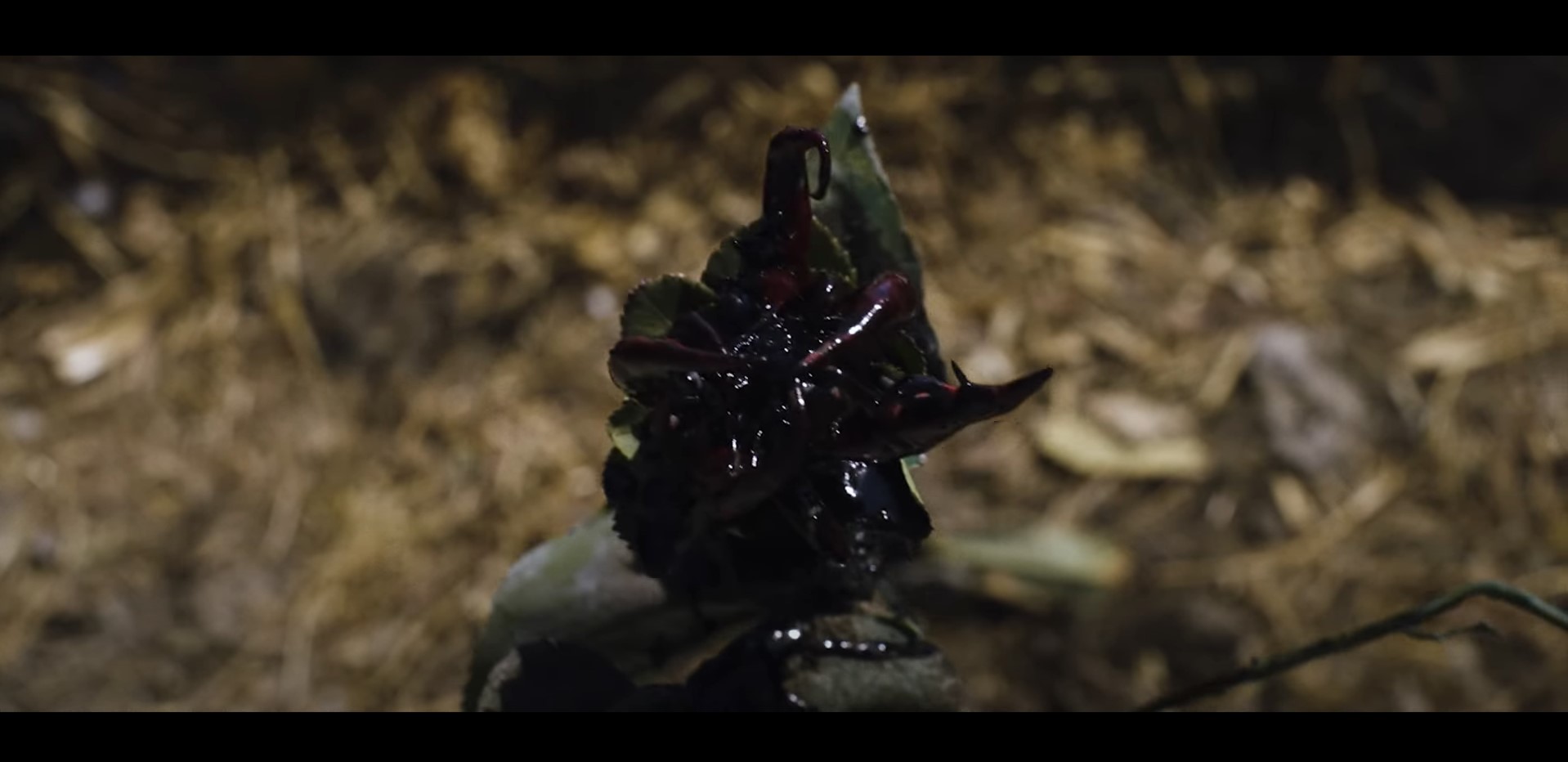
In the Gyeongbuk region of South Korea, a brand-new mattress is being delivered to a young couple’s new apartment but upon arrival, the fed-up delivery men take off when no one answers the door and leave it for the job endeavoring girlfriend who must lug up the mattress herself as she finds her boyfriend asleep on the floor. After more than year together, the threadbare relationship inevitably ends and the girlfriend vacates the apartment, but during all that time together, a mysterious mold formulates from within the mattress and surfaces on the pillow top. The mold turns sentient and uses an outgrowth protuberance to latch onto and extract the boyfriend’s vertebra for nourishment. From then on, the mattress is discarded into the world, being picked up and used by unsuspecting nourishments for the interior mold. Travelling across Korea land to difference providences, feasting on the vertebrae that becomes the building blocks of a new being, the growing mold digests to integrate itself into a human world. Absorbing the miscellanea range of emotions from its victims, what was once small fry fungi has become self-aware, compassionate, and even more hungry to live.

How do you write-up the depth of a film that’s undeniably indescribable? Syeyoung Park’s “The Fifth Thoracic Vertebra” trembles on the edge of being the epitome of that very sentiment with an abstract creature feature concept bred out of people’s raw emotions. The 2022 South Korean phantasmagoric horror, fattening itself off the dysphoric and euphoric morsels, is written-and-directed by Park as the filmmaker’s debut feature film credit that tackles life birthed out of death, such as the symbolic end of relationships and literal death, and becomes a metaphor stemmed by the natural growth phenomena of fungi, a new lifeform that grows out of rot. The Moonstone Productions indie picture is a festival favorite amongst the Fantasia Film Festival and others and is distributed onto physical media by the s streaming platform IndiePix Unlimited.

“The Fifth Thoracic Vertebra” doesn’t hone into and latch onto one core group of principals characters; instead, the travelling, moldy mattress has episodic events with interactions to various emotionally-turbulent or charged people that the being inside the dingy mattress not only cuts out and extracts a physical piece of who these characters are but also absorbs their emotional weight, in what could be considered as an incident in molding the mold into what it itself can come to be.  One-sided care and love, a tempestuous connection, contempt, amorous spontaneity, loneliness, and death feed the fungus and shape its mildewy putrescence on the mattress like the coating of an incubation chamber to ensure growth, maturity, and nutrition.  The episodic events hit and miss the gravitational pull needed land firmly on what’s being conveyed.  The woman on death’s bed was perhaps the most impactful written with regret left unsaid, unaccounted for, and is shouldered by the thing in the mattress to fulfill with a letter to the woman’s daughter to let her know about the mother’s definitive adoration.  Other instances are fleeting, perhaps lost in translation, of the evocative impression intended as the mattresses does a reach around for a clean vertebrae excision.  In either case, the now-vertebrae-less don’t even notice when a large part of their backbone is literally ripped from them in the moment; only in post-snatch do they double over in pain and unable to stand and straighten from their crippling past.  The film’s cast includes Mun Hye-in, Ham Sukyoung, On Jeong Yeon, Jung Soo-min, Kim Ye-na, and Park Jihyeon as the humanoid creature.

The fifth thoracic vertebrae, the T-5 spine part and not the film’s title, is located near the top-center of the spine in the thoracic grouping and it supports the abdominal muscles and feeds into the chest wall coinciding with the muscles around the rib cage, lungs, and diaphragm, to assist with breathing.  In Sye-young’s abstract, “The Fifth Thoracic Vertebra” does not brace audiences for metaphorical monsters surrounded by dreamlike imagery and esoteric purposes.  With no explanation, visual or verbally articulated, piecing together the strange circumstances is heavily relied upon our own personal experiences in life, our past mistakes, our relationship fails, our giddy fondness, and so forth to interpret Sye-young’s theoretical philosophy on the unfinished leftovers of a kaput relationship.  I believe Sye-young also felt the need to explain his film in a director’s statement on the back of a DVD that questions the whereabout “bits and scraps” of a failed relationship by anthropomorphism means and relating it all to the cycle of fungus.  While a difficult conceptual pill to swallow, “the Fifth Thoracic Vertebrae” can display beauty and disgust in a composite of odd juxtaposition in a peculiar world where a dirty, moldy mattress is an acceptable roadside pickup and debilitating excised bones of the body go without being questioned.   There’s an aloof presence that speaks symbolic volumes to the relationships depicted and with an open mind and broad, thoughtful strokes, one may see through the director’s expressionism.

Indiepix Unlimited, an online streaming service dedicated to independent films, also caters to the physical media market with a DVD release of “The Fifth Thoracic Vertebra.”  Encoded onto a single layered 5GB DVD-R, it’s been a while since I’ve seen an official release on the recordable DVD format and for the visual picture quality that’s already on a standard definition 720p resolution, we receive a middle-of-the-road 1.78:1 widescreen aspect ratio presentation. Posterization, in voids and on the skin, is the main artefact culprit in a stylish context of warm gel yellows and greens and the seldomly naturally lit hues which are not as richly saturated but can hold its own for a DVD-R.  There’s not a ton of detail in the mattress mold and any clear view frames are obscured by distance, the cover of darkness, and the cover of blankets as, much like all else, the contours are nicely delineated but the overall color scheme of the film blend together. The South Korean uncompressed LPC 2.0 mix has a pleasing enough unassuming range and depth field that hits all the notes and presents ambience with basically what is needed to envelope the immediate surroundings around the principal objects, all balanced through the dual channels.  The burned in English subtitles are not flawless but are synched well and seemingly translated okay.  The release comes feature only and the standard DVD Amary casing comes with an eye-catching, or rather eye-starring, front cover with no outer coverings or inserts.  The disc art deliberately yells DVD-R with a plain white, barely unique logoed, ring splay.   The release comes not rated with a runtime of 65 minutes and is confirmed to play on region 1 playback.  Untested for other regions. 

Last Rites: “The Fifth Thoracic Vertebra” impresses with forlorn residue in what is an offbeat creature feature where the creature is inside the mattress rather than under it.  Yet, the story stretches the imagination too far and near a snapping point that allows for no breathing room in what is a tale of lamentable remnants that creepingly germinates spores into a melancholic mycelium overtime. 

Own “The Fifth Thoracic Vertebra” on DVD. Purchase Here!