Miles, a thirtysomething video game developer, remains stuck in an unfulfilling and lonely existence where being an internet troll gives him his only taste of dominance over those who normally succeed above him in all other life aspects. When he pokes and prods a popular and sadistic underground death match known as Schism, the virally trending sensation sweeping the internet nation comes knocking at his apartment door to officially install him into the next melee bout. With guns crudely surgically bolted to both hands, Miles, whose used to running from just about everything, now has to nut up against Schism’s most prolific killer, Nix, and save his kidnapped ex-girlfriend from the deviants behind the game.

Social commentary runs amok in this grisly balls to the wall, gunplay stimulating action-comedy, “Guns Akimbo,” from the New Zealander, “Deathgasm” writer-director Jason Lei Howden. Trading in doom metal horror for a crass bullet ruckus, Howden barrels down with an on fleek supercharged story like a runaway freight train or a 6,000 round per minute minigun, shredding through a high body count like in a high occupancy round of a first person shooter. Under the production wing of Occupant Entertainment and distributed by Saban Films, who released films such as “The Girl with All the Gifts” and Rob Zombie’s “31” and “3 From Hell”, “Guns Akimbo’s” edgy dystopian air gangling along nerdy humor scraps “Robocop” utilitarian veneer for a fresh coat of millennial trivialities, fleshing out, in a ream of firepower, relevant societal topics and facing their adversarial shades head on in a barrage of blood soaked bullets.

Spearheading “Guns Akimbo” is Daniel Radcliffe, who seemingly continues to distance himself from the world of wizardry of “Harry Potter” and focusing his current career on off-Hollywood and chic films that has gained Radcliffe a cult following alongside his cache of wizards and witches fandom. Feeling content stagnant, Miles lounges comfortably in the power of being a keyboard warrior and Radcliffe leads the non-exuberant charge until pushes comes to guns bolted to my and someone is trying to kill me-shove. Opposite Radcliffe is Samara Weaving as a brashly confident and hard-hitting character of familiar skin that’s similar to her Melanie Cross role in Joe Lynch’s “Mayhem.” Instead of being a mild-mannered woman infected to be a savage, floor-clearing combat artist, Weaving bares no dissuasion embodying another uncaged killer becoming the nitty-gritty, tattooed, and uncouth Nix, hard-nosed with violent tendencies stemmed by the fiery murder of her family. Together, Weaving and Radcliffe make engaging adversaries and friendlies who both end up on working on themselves while working with each other in a do-or-die game. Ned Dennehy plays the creator of Schism and overall bad guy Riktor. The Irish actor, who recently had a role in Nicholas Cage’s “Mandy,” finds himself just as tatted up as Nix, waving a nihilistic-revolutionist banner like its something to be proud of, but despite Dennehy’s best efforts in alleviating his cynical nature with a few sarcastic quips, Riktor comes off as bland and unfulfilled as a story’s aortic villain; instead, I found myself more curious about his fascinating short-lived henchmen played by Mark Rowley as a Zangief Street Fighter doppelganger, Racheal Ofori shelling out with double barrels, and Set Sjöstrand as a gimp mask wearing Fuckface. The international cast rounds out with Natasha Liu Bordizzo (“Hotel Mumbai”), a once in a lifetime hilarious homeless man act by funny man Rhys Darby, Grant Bowler, and Edwin Wright (“Turbo Kid”).
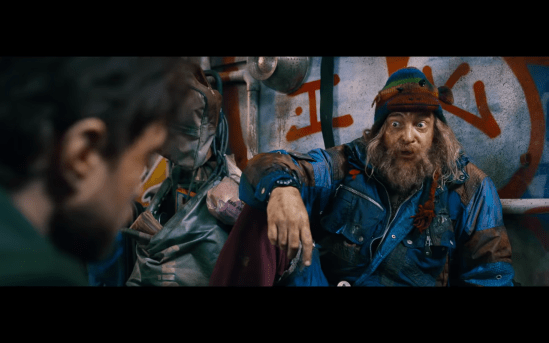
“Guns Akimbo” could have been pulled straight from the crimson flashy illustrated pages of a popular graphic novel and, most definitely, would have worked as one too, soon to come for sure, but as a feature film is concerned, as fun as Howden drapers it with explosions, expletives, and executions, “Guns Akimbo” ultimately shakes at the knees with acute breakneck, 24-hour speed that clocks in at a 95 minute runtime. While that’s the standard runtime of choice for movies, average around 90 to 100 minutes, consequences from flying through backstories (Miles, Schism, Riktor, Nix) in a blink of an eye at the story’s expense to hastily push for gun blazing glory puts all the pressure on the viewer to keep up. The story’s non-linear moments also factor into being an onerous barrier for audiences which are shiplapped together egregiously just for the sake of going against the atypical plot structure design and interspersed with flash backs and wishful thinking near death pipe dreams all jam and crammed packed into the sardine can that is the very eye-candy combat of “Guns Akimbo.” Yet, enough time was mustered for symbolism where Miles finds himself ensnared in the sticky negativity that is the social media sludge, fueled by the sadistic voyeurs enjoying the show in a violence-porn tapestry. From troll to titan, Miles rises as the unlikely gladiator presence in Schism, pushing him toward being a viral sensation from which he can’t escape despite the lack of enthusiasm to anything related to Schism and his skyrocketing social media status. The whole showdown thrusts him into controlling his own life whether he likes it or not, a kick in the ass for a lack of a better phrase, to get him motivated.

Come February 28th, Saban Films’ “Gun Akimbo,” produced by Occupant Films’ Joe Neurauter, Felipe Marino, and New Zealand film producer Tom Hern, will go full blown trigger happy into select theaters, on demand, and on digital. Since this movie is yet to be officially released, is a screener, and doesn’t have a home video release just quite yet, there will be no audio and video critique portion of this review nor were there bonus material. There have been many great dual wielding action heros in our lifetime, including John Weston from “Equilibrium,” Selene from “Underworld,” and even that Counter-Strike terrorist avatar with the option to wield Dual Berettas. Now, we have Miles from “Guns Akimbo,” an immense ball of New Zealand vitality, un-tapered exploitation, and twofold in gun fun.
Category Archives: comedy
Death Fears No EVIL in Takashi Miike’s “First Love” reviewed! (Well Go USA / Blu-ray)

Orphaned boxer Leo grows up to be an up-and-coming star in the sport. After losing a match by TKO from a soft punch, Leo is diagnosed with an inoperable brain tumor that sends himself into despair. In another part of town, the established yakuza and the imported Chinese mafia boil toward an inevitable war over turf and drugs. When Kase, a junior enforcer, betrays his yakuza family, scheming with a crooked cop to steal drugs for profitable gain, the tide turns blood red as the yakuza naively blames the Chinese. Caught in the middle is a drug addicted prostitute named Monica, a slave to the yakuza for her father’s past mishaps, who is kept locked away in a small apartment overseen by a yakuza lackeys, romantic couple Yasu and Julie, that also use the apartment to control drug flow. When Kase plan to raid the apartment and steal the drugs goes array, Yasu winds up dead and Monica escapes, running into Leo who has nothing left to live for except to protect Monica. A distraught-induced psychotic Julie, the deadly yakuza, the Chinese Mafia, a double-crosser and his crooked cop partner, a delusional girl of the night, and one apathetic boxer clash in a single night’s ultraviolet web.

Extreme Japanese auteur Takashi Miike fastens a lively tongue-and-cheek and supremely savage crime thriller in his latest mad yakuza film, amiably entitled, “First Love,” also known “Hatsukoi.” “First Love” is anything but friendly and pleasant as the street of Tokyo run red with blood or else the 2019 released film wouldn’t be a Takashi Miike trademark special. Penned by Miike’s long time collaborator, Masa Nakamura, the filmmaker’s affection for horror eludes this title that hones more toward the unpleasantries of clan betrayals, snarky criminal shenanigans, and, of course, a flavor for mega violence that become a maelstrom angrily surrounding a demoralized boxer and the victimized forced-into-prostitution young woman he aims to selfishly protect while in his mental clout regarding his mortality. Produced by OLM, Inc production company headquartered in Tokyo takes a step away from manga with “First Love,” a step that has been evolved over the last few years, but may have contributed to some of the illustrated content that seemingly has infiltrated into the third act with an initial explosiveness in the beginning portions of a car chase scene.

Cast as Leo Katsuragi, the boxer, is Masataka Kubota, a familiar face from another Miike film, “13 Assassins,” and most recently from the heavily Japanese cultured specter feature, ‘Tokyo Ghoul.” Leo’s lighter weight physique and fresh face has Masataka look the part of a promising fighter whose positioned for fame early into the story, but that framework comes to a screeching halt when he’s destined for a tumorous death. When Leo is coupled with Monica, a drug addicted forced in prostitution plagued with crippling hallucinations side effects, the repressed Leo finds himself sheltering someone with more burden on her shoulders than upon his own. Monica’s portrayed by Sakurako Konishi in what’s essentially her first major role and being paired as a scared, lonely, and crazy character coupled with a stoic vet in Masataka makes for an easy dynamic. Shôta Sometani’s chin deep in trouble Kase goes without saying that Sometani’s unfathomable range and charisma adds an aloof comic relief along with Kase’s dishonest detective slipped covertly into by “Ichi the Killer” himself, Nao Ohmori and pursued by a retribution spirited girlfriend, Julie, of her slain yakuza boyfriend; a role spearheaded with such energy and gusto from Rebecca Eri Rabone, credited solely as Becky, who has a slight Cynthia Rothrock vibe. “First Love” is no slave to boorish performances from Takahiro Miura (“Shin Godzilla”), Cheng-Kuo Yen, Sansei Shiomi, and Mami Fujioka.

“First Love” emerges as a smart and fun battle royal of decimation in the anarchist criterion. One would think a prolific director such as Takashi Miike would wear out his welcome with tired and stale filmic bread, crumbling with every soggy rinse and repeat. That’s not the case with “First Love.” Why is it entitled “First Love” anyway, you ask? The question’s open for viewer interpretation, much like most of Miike’s suggestive elegant style, and presents an illuminating unexplored journey in itself. A ventured guess would be that Leo and Monica have never experienced the feeling previously in either content or a labored life with Leo being an impassive athlete and Monica an escort since high school. The corollary of bumping into each other by chance results in the unorthodox dismantling of two rival criminal organizations, baring then an age-old theme of love conquers all and renders the mystics of destiny fueled from from within all the way easter egging sexual taboos inside his brazen, sometimes insane, transgression storyline. Either way, Takashi Miike helms a tremendous brutal-comedy that brands him as being the Martin Scorsese of Japanese filmmaking.

Blades, guns, and a fresh score on Rotten Tomatoes, “First Love” has mainstream aptitude with a carnage driven crime syndicate finesse and is now available on a two-disc, dual format Blu-ray and DVD release from Well Go USA Entertainment. Encased in a slipcover, the not rated feature is presented in full HD, 1080p, and in a widescreen, 16:9 aspect ratio. This review will focus it’s review on the Blu-ray quality. Much of Miike’s style is neo-noir basking in very grounded color palette that’s occasionally adorned by the neon brights of Tokyo. Often does Miike composite in his work and “First Love” is no exception with a brief manga nearly a rallying ending; the illustration is super sharp, a visual pop of blue and white, and, obviously, clean. Ultra-fine details add to a prizing fatalism and even the tasteful gore, on a granular level, passes the screen test. Some scenes appear sleeker than others inside a dark scope coded with darker shades of green and yellow, but the overall result smothers any kind of inconsistency. The Japanese and Chinese 5.1 DTS-HD Master Audio tracks savor every last audiophile morsel. The clear dialogue renders nicely, big effects and action sequences offer a wide range, and the depth covers more than enough ground surrounded by hustle and bustle of the urban element. Kôji Endô’s enchantingly lethal score will immerse you right into the mix and provide a slick culture twist upon classical composition. The English subtitles are well paced and mostly accurate as I did catch one grammatical mistake. Incased inside a slight embossed titled cardboard slipcover, the release also offers a teaser and a theatrical run trailer. Cynical on the surface and romantically submersible to the core, “First Love” is a Takashi Miike instant favorite of amusing antagonism and shorn almost completely of genial garments.
EVIL No Longer Swims Only in the Water! “Bad CGI Sharks” reviewed! (Sub Rosa Studios / DVD)

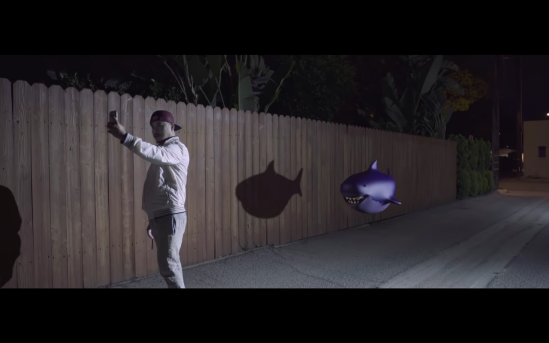
Living hesitant, unconfidently, and unfulfilled in Hollywood, California, Matthew finds himself fired by his employer after experiencing a promotion interview from hell, but that’s not the worst of his problems. Earlier the same day, Matthew learns his estranged older brother, a free-spirited and enthusiastic Jason, has been kicked out of his parents’ home, provided a plane ticket, and sent to live with him possibly forever. The estranged brothers finally reunite after years apart and Jason infiltrates back into Matthew’s uptight life their childhood obsession with sharks to try and finish a rough, shark-thriller script from their past, entitled “Sharks Outta Water.” When a magical movie muse decides to grant them their boyhood cinematic aspiration, the sudden appearance of a poorly render man-eating shark floats about their neighborhood streets, hunting down the brothers during a night of computer imagery terror limned with shoddy shark frenzies.

Out in the surf of the internet, a list lurks just beneath the dark waters of the web. A list containing a flooded genre of some of the worst shark movies detrimental to mankind’s inherent fear of a primordial aquatic creature that was once known to be the ocean’s apex predator. To save us from the cold, bleak shark banality, “Bad CGI Sharks” absorbs all toxic mundane trash skimming the vast global networks and big picture boxes to recourse from the singular trained thought that sharks are much more than a punching bag of relapsed rendered dogfish with jaws. Written, produced, and directed by MaJaMa, an alias for Matthew Ellsworth (Ma), Jason Ellsworth (Ja), and Matteo Molinari (Ma), “Bad CGI Sharks” flaunts a straight-to-video, no-budget comedy-horror in the face of whoever is willing to once again put themselves in front of a speeding bad shark movie train; yet, the filmmaking trio embark on a creative, meta journey risky with little blood shed and a swarm of animated things that mark somewhat of a resemblance to sharks. What crests is insightful satirical wit over the ostentatious flare of gratuitous explosion, nudity, and monstrous sharks.

In keeping to the budget, MaJaMa already wear many hats behind the camera. To extend even further their invested working capital, the filmmakers also star in the lead roles, virtually as themselves, to surely hammer down a film entitled “Bad CGI Sharks” in their own brand of humor. We begin with Matteo Molinari, the Genova, Italy born actor who had a small role in 1994’s “Silence of the Hams,” a spoof starring Dom DeLuise and Billy Zane derived from the Jonathan Demme’s Hannibal Lector thriller, “Silence of the Lambs,” if the title itself wasn’t self-evident enough. Molinari is the only main lead not using his namesake and, instead, becomes the magical movie wizard Bernardo with his muse movie clapper. Bernardo was built for Molinari as the two are synonymous to each other’s manners, speech, and quirky simpatico charm, resulting in an innocent, mischievous movie imp to be the bridge connecting the gulf between Jason and Matthew’s polarizing characters. Jason’s a severe caricature of hyperactivity and of someone whose stuck in the past and while Jason Ellsworth has his moments, without his brother Matthew’s stern, grown-up, and spruced up onscreen self, the dynamic just wouldn’t be as potent as Matthew is essentially the activator spray to Jason’s gluey personality. The cast concludes with Jenn Liu (“Stranger in the House”), Josh Sterling, and Shaun Landry.

Tiptoeing around the fringes of being a stoner film, “Bad CGI Sharks” pushes a hyper-meta reframe of how shark movies, or perhaps the film descends deeper into the water molecule level of just the shark representation itself, should be brought back to the shores of reality from the watery depths of Davy Jones’ poorly rendered locker. Coinciding with crystallizing the shark-sploitation category is a more tender note of embrace with relatable themes of rediscovering brotherhood and mending broken bonds. Matthew’s parental manufactured disgust with his older, yet childlike, brother casts a large, dark cloud that seizes up any kind of affection and the floating shark, the symbolic dream of their childhood, tests their relationship, motivating the the character arches in the face of “Bad CGI Sharks.” Amongst the witty banter and flying carnivorous fish, “Bad CGI Sharks” shows innate signs of no-budget difficulty such as story pacing where the middle sags with Jason and Matthew running around Hollywood for awhile in a progression stagnation and there lies some early editing miscues with audio mixing and mic work. Like a shark, “Bad CGI Sharks” needs to keep swimming or else it’ll upend and die; luckily, MaJaMa saves the cinematic beast with the shark devours the internet and all bets are off!

If you like your sharks floating and roaring, then “Bad CGI Sharks” DVD home video is for you, sailor, courtesy of SRS Cinema and MVDVisual. The not rated, region free DVD is presented in a widescreen, 16:9 aspect ratio, with, an IMDB listed, Sony a75 II Mirrorless camera complete with a “vintage” lens. Most of the image transpires cleanly and sharp, even the inorganic, floating sharks look fair in their farce facade, and with the specialized lens seemingly cornered to just around the Bernardo’s outer shell host duties and intermission skit and also in the initial attack sequence in which is the only scene with any kind blood shed. The English language audio tracks include a 5.1 surround sound mix and a stereo mix. The audiophiles will find solace in knowing “Bad CGI Sharks” doesn’t mean bad audio tracks. Dialogue has clarity throughout, depth and range remains steady, and there’s negligible hum electric feedback. Bonus features include a commentary track with MaJaMa, a retrograde toy commercial for all the characters, the teaser trailer, trailer, and SRS promoted trailers. Though lacking bloody chum, “Bad CGI Sharks” has bite albeit with more comedy than creature feature horror, fleshing out real world problems with hilarity in a cheapjack rendition of a killer shark.