A Saltwater Croc is Pure EVIL in “Black Water” reviewed! (Umbrella Entertainment / Blu-ray)


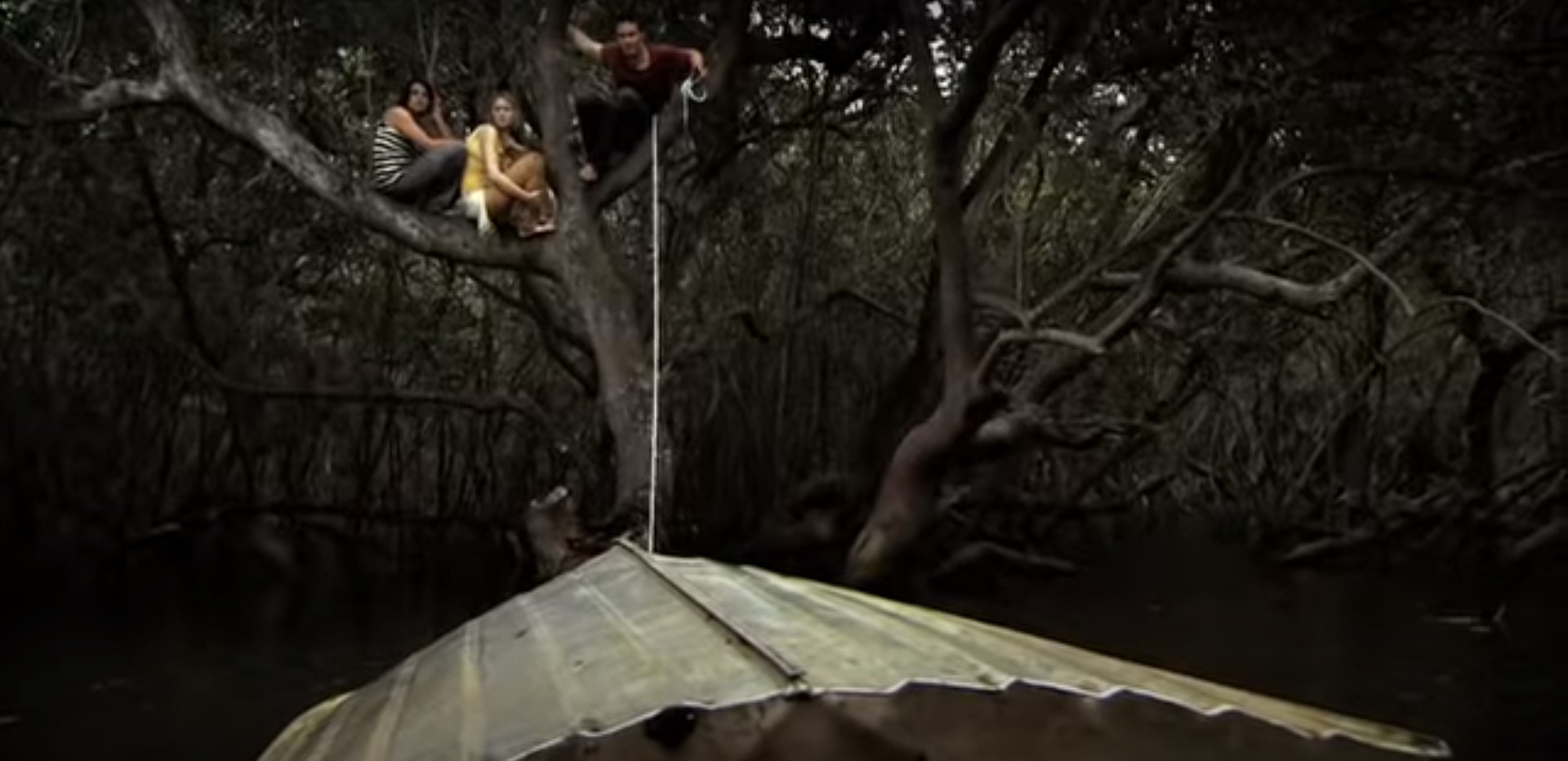
On a two week holiday, Grace, her husband Adam, and her younger sister Lee, embark on a road trip through Northern Australia, stopping at the local bars and roadside attractions all along the way.  Their next ad hoc destination is to fish at the rurally located and rinkadink river tour and fishing guide, Backwater Barry’s.  With Barry himself already out with another tour group, his assistant happily agrees to take them fishing out on a small, metal Jon boat along the mangrove tree dense distributaries.  When their boat is flipped by a large, aggressive crocodile and their guide dead, the water-protruding trees become a lifeline for temporary safety, but being fully encircled by murky water leaves them with no escape route and hidden from the river mainstem where help would like cross.  With a hungry croc lurking below, the only means of survivor is to reach the flipped Jon boat that’s stuck stranded in the middle of water. 
Aside from my personal favorite subgenre, Sharksploitation, the next best would the reptiliansploitation!  If there is even such a scaly subgenre about cold-blooded killers, especially involving the waterproofed skin of alligators and crocodiles lurking and wriggling in murky waters.  I’m a child of the 80’s and grew up on such classics as “Eaten Alive” (technically the late 70’s), “Alligator” and “Alligator 2, and the Australian ozploitation thriller, “Dark Age.”  Even the more modern reptilian ravagers, “Lake Placid” series and Alexandra Aja’s “Crawl,” are hugely exciting, entertaining, and come with a lot of bite!  Another ozploitation crocodile themed film came across my viewing pleasure just recently is the Andrew Traucki and David Nerlich co-written, co-directed “Black Water.”  The 2007 independent production is filmed across multiple locations in the Northern Territories and New South Wales of Australia where much of the butt-clenching terror is filmed in the crocodile-less mangroves of the Georges River.  “Black Water” is presented by The Australian Film Commission and Territorial Film Developments and developed by Michael Robertson’s ProdigyMovies who cater to low-budget ozploitation genre pictures that usually pit man versus nature to the death!

The concise cast provides “Black Water” with an intimacy you wouldn’t get with a bigger, cast-saturated production.  Three principles and two supporters imbues the characters’ fears, tensions, and their rush of adrenaline into the viewers without having to dilute into offshoots with an extensive list of throwaway and expendable roles.  Diana Glenn, Maeve Dermody, and Andy Rodoreda turn from touting tourist to terrorized tenderloins for one of nature’s most ruthless hunters. The dynamic between the three is one that is high on the relationship status; a family consisting of a wife and husband and sisters, leaving zero room for apathy between the characters themselves and between the viewers and the characters as their importance of loss is greater to each other and that extends beyond the screen.  Traucki and Nerlich give little-to-no wiggle room for escape, forcing the survivors to wade the ominous waters.  The fear is prevalent more so in the eyes of Grace (Glenn) who is not only worried about her husband and sister, but also her motherly instinct to protect her newly learned pregnancy.  Lee (Dermody) and Adam (Andy) lack that hesitation, that trembling moment of dipping their toes back into water, in a seemingly inability to feign being affected by the force of flesh-ripping nature lurking just below the surface.  Even with subsequent failed survival attempts, I found difficulty relating to Lee’s fear who, in the latter half of the story, calmly breaststrokes approx. ten yards to reach the boat in a moderate attempt at heart-racing desperation.  Fiona Press (“Out of the Shadows”) and Ben Oxenbould (“Caught Inside”) round out the cast.
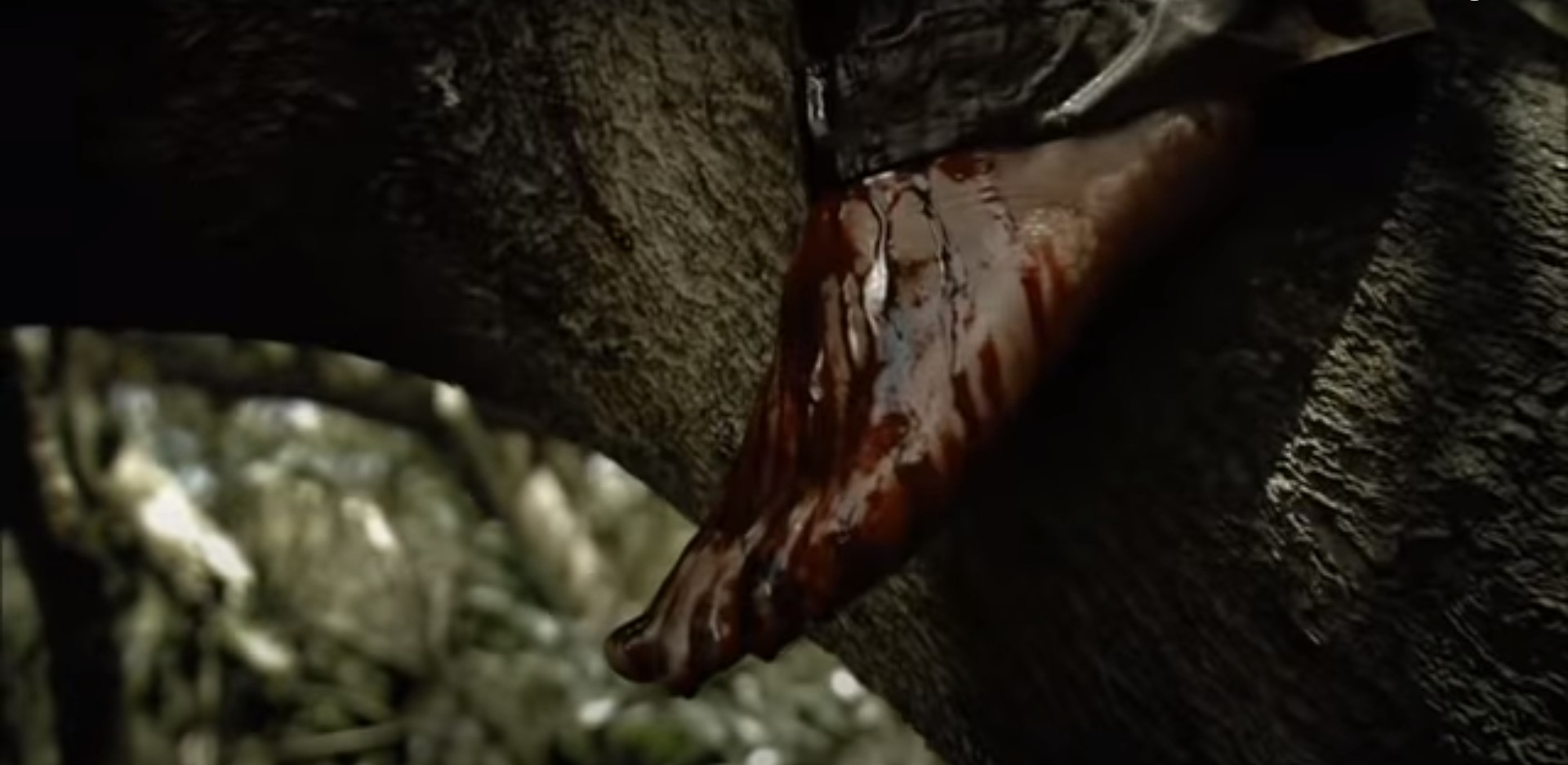
“Black Water” is the epitome of ingenuity when placing actors and crocodiles in the same space together.  Real people, real crocodiles.  Yes, the visual effects produced by Nerlich, Traucki, and their team, including of compositor Peter Jeffs, create a frightening cohabitation, stretching the limits of the VFX with the instinctual movements of in captivity crocodiles and laying them over the mangrove scenes that have the actors.  Whenever the croc pops up from the water with just his snout, eyes, and the few ridges of his back breaking the surface, the motionless stare from the beady Devil-eyes can make you hold your breath.  “Black Water” has killer anticipation with a death roll component that no one is safe from a maneater’s hunger. At some instances, the composites are not entirely seamless with the depth or the angles as which the croc moves through the water, but the overall effect is successful and potent. With limited escapes routes come limited plot devices. “Black Water’s” length felt almost painfully reliant on time spent in the mangrove trees with the characters mulling and weighing the options, the option to go for the boat became it’s own motif, and a short lull quickly stiffens the initial boat-flipping tumult. One second, the four fishers have lines in the water and the next second they’re in the water, “crocodile in the water” is being screamed at the very top of Adam’s lungs, and tour guide Jim has instantly disappeared from story in a blink of a crocodile’s snapping smile. No amount of backwater expertise assisted in Jim’s, or any of the patrons’, survival. After the commotion has subdued and the realization that a crocodile has come to feed, survivors stick the trees like monkeys a mere 7 to 10 feet from the surface water, stagnant still in shock and unable to muster a thought about what to do. After the lull, man versus nature gets right back outwitting one another with the croc having a big screening advantage.

Holidaying never looked so terrifying where a day in the office seems like an escape in “Black Water.” The story is a cautionary one of the increasing populations of both humans and crocodiles in Northern Australia and was based off true events as noted by director Andrew Traucki off the account of two teenagers stuck in a tree after the death of their friends by a croc in an interview with MovieWeb.com. A reemergence of the 2007 film, stemmed by the recent sequel, finds itself on a full HD, 1080p Blu-ray from Umbrella Entertainment. The Australian label’s region B release presents the 89 minute feature in a widescreen 1.85:1. More than most of the picture is shot in natural light without being too heavily under the guise of lens manipulation with the steady cam under “Primal’s” John Biggins cinematography. The composited recordings crocs and locations blend almost seamlessly, only rendering a smidge of smear glossiness around the croc’s edges in the tinted blue nighttime scenes. Whenever the croc pops up in the water with a human character sharing the scene, the frame unveils evident cropping but only to sell the effect of the two being in the same moment, removing the outer edges to avoid potential gaffes. The English language and ambiance audio tracks offer two options, a 5.1 and a 2.0, both congenially in a DTS-HD master audio mix. For this particular review, the 5.1 was explored and the dialogue, ambience, depth, range, and run of the mill soundtrack do sound clear, without a hinderance of muddles dialogue, and pertinent to the circumstances happing on screen. Special features include an audio commentary with the directors, a mixture of polished and rough deleted scenes, a making of segment that includes interviews with the directors, actors, and producer Michael Robertson about locations, special effects challenges, and the characters who sell the story, and the theatrical trailer. There’s no pretense with “Black Water” in it doesn’t hawk mutant crocodiles or a behemoth beast thought lost over time; instead, “Black Water” feasts on realism, capturing plausibility and instinctual fear that makes us never want to go into knee high water ever again.

“Black Water” is now available from Umbrella Entertainment on Blu-ray!

EVIL Will Have You Die Laughing! “Too Late” reviewed (Gravitas Ventures / Digital Screener)


Non-stop and around the clock, Violet is the worked obsessed assistant to legendary showman and standup comic Bob Devore at the Too Late comedy club.  Violet books new talent and schedules the lineup day in, day out, but that isn’t all she does for her overly demanding boss.  Bob Devore has been around for a long time and during a very specific moon cycle, Bob needs to eat and we’re not talking pizza or Subway sandwiches.   Bob is a literal monster who feeds on devouring entire people, especially no comedy talent hacks provided by his assistant, Violet.  The longevity of Bob’s Life spans decades, if not centuries, as he sees people come and go right off existence.  When Violet meets a nice guy comic who Bob takes a shining to, the long time lonely assistant decides enough is enough and the time to stand up to the eternal stand up comedian and monster boss is now before what little she has is taken from her. 

I hear the Los Angeles stand-up comedy scene is tough.  Sometimes, even cutthroat.  In D.W. Thomas’ comedy-horror “Too Late,” a blend of mic night funnies with a hunger for full body snacks, dying on stage turns into a whole new meaning!  Thomas’ debut feature film kills it as a low-budget horror that incorporates figurative levels of monstrosities behind the curtain of a stand-up’s spotlight.  The 2021 film is the first screenplay credit for Tom Becker that tackles underappreciated long hours and work ethic of female workers in a typical male dominated profession., touching upon the toxicity of the business.  “Too Late’s” underground comedy-horror sees the light of day under the indie production studio, Firemark Media, and is produced by Thomas and Becker as well as executive producer and long time industry vet, Lonnie Ramati, a production business affairs manager dabbling in producer with the selected credits including “The Expendable” sequels, “Leatherface,” and 2019’s “Hellboy” under his belt. 

“Too Late” marquees mostly tongue-and-cheek talent in a cast list chocked full of comedians, starting with actress, writer, and jack of all trades stand-up comedian Alyssa Limperis in the headline role of Violet.  What’s ironic with Limperis’s “Too Late” role is that Violet is perhaps by design the least funniest amongst the characters as a lonely, borderline depressed, and overworked slave of an assistant to Bob Devore, a renowned variety show presenter and entertainer played by one of my favorite spoof performances by Ron Lynch from last year in Travis Irvine’s “Killer Raccoons! 2! Dark Christmas in the Dark!” as General Negligence.  As Violet begins to blossom after meeting humble comic, Jimmy Rhodes (Will Weldon), after bumping into him renting out one of her friend’s closet since, you know, L.A. is a tough, expensive town, this give Limperis ammunition to turn Violet sour on her abrasive, glass ceiling mentor.  Limpers excellently conceals intentions in each relationship step taken with her new unassuming and amiable beau and this really brings out Devore’ darkness crafted so well by the New York born actor and comedian with a gloomier roaring-twenties vaudeville vibe.  One thing I will say about the chemistry between Limperis and Weldon is I didn’t think there was much spark as their flirting banter catered to good friendzone material.  Perhaps used for their more syndicated appeal, Mary Lynn Rajskub and Fred Armisen add very little to the mix.  “24’s” Rajskub is a no-nonsense hotshot comic who has Devore wrapped around her finger whereas Armisen plays a nearly simpleminded stage hand who adds a bit of levity to the darker tone with his pudding cups and indecisiveness on blue filter gels for the spotlight.  The rest of cast pans out with Jack De Sena (“The Veil), Brooks Wheelan, Jenny Zigrino, Billy Breed, and Paul Danke. 

“Too Late’s” opening drive buildups a focuses around Violet’s passively aggressive position in being an undervalued assistant to her bark-and-you-jump Boss.  Constantly scribble but unenabled to perform her own material be her own self-starting, stand-up comedian, Violent falls into a lonely state that she is unaware of and it takes her best friend/roommate’s lighthearted berating to get Violent to come to a Jesus moment with her total profession and lack of relationship unhappiness. What’s not in the prevalent in the first act is Bob Devore’s permanence, his beastly transmogrification, and his appetite for anthropoids. If you didn’t read the synopsis beforehand, the acute dark turn “Too Late” takes comes at a shock because of how little-to-no prep there is setting up the true Bob Devore. A backfill of creeps a long, like opening the little chocolate stuffed doors on an advent calendar, in a wait and you’ll get more character treats up to a grand finale. About two-thirds of the way through, “Too Late” starts to flounder with what to do about Devore as a character, never expressing a full delineation of character to how Devore ended up at a nightclub, or who, or actually what, the actual hell is he and how Violet, who isn’t as innocent as one might believe, became so fatefully involved. The underlining theme here, noted explicitly in the title, is don’t hold yourself back no matter the circumstances, whether be an actual monster or a monstrous personality, because life is short, time is of the essence, and carpe diem! Violet, a hard working female in a male dominated industry and is undercut by not only her dominating boss but also her advantage taking male peers, need a monkey wrench in the gears of a monotonous, browbeaten life and that happened to be Jimmy Rhodes, a nice, non-threatening, and unimposing comedian who seemed to be just be handed the keys to Violet’s rightful castle just because he’s a man, and though she falls for Jimmy, that’s the career careening straw that breaks Violet’s abuse absorbing spirit.

With a dry wit, “Too Late” black humor is more figurative than funny but first time director D.W. Thomas makes good on her debut horror-comedy that has released this month in select theaters and on digital platforms, such as iTunes, Google Play, Fandango Now and all major cable/satellite platforms from Gravitas Ventures. A digital screener doesn’t allow me to fully dive into the A/V quality but the Scott Toler Collins cinematography grasps the underground comedy scene experience, selling the location of an boutique variety show club, hard mood lit in various colored staged lighting with a smoky irradiance, of tight medium and closeup shots that kind of hover amongst the characters. “Too Late” is not effects heavy though maybe should have been to make Bob Devore a real menacing presence as much of his late night snacking is done off screen, through shadows, or blurred during a shallow focus. We always get the aftermath Bob Devore, bloated and bulging at the seams from a big meal, like a secondhand Eddie Murphy fat suit from “The Nutty Professor.” Still, kudos to Mo Meinhart (“The Walking Dead”) in making Ron Lynch appear farcically 40lbs heavier in what you might typically seen in a Looney Toons episode. Bucking the more modern trend, this indie picture has no bonus scenes during or after the credits. The in-film stand-up is spotty at best but “Too Late” has a lot else to focus on with a deeply disturbing look at machismo arrogance and sexism inequality that are the relevant horrors of today.

“Too Late” on Amazon Prime!

Pandemic EVIL Is Just Not For Dry Land Only! “Virus Shark” reviewed! (SRS Cinema / DVD)


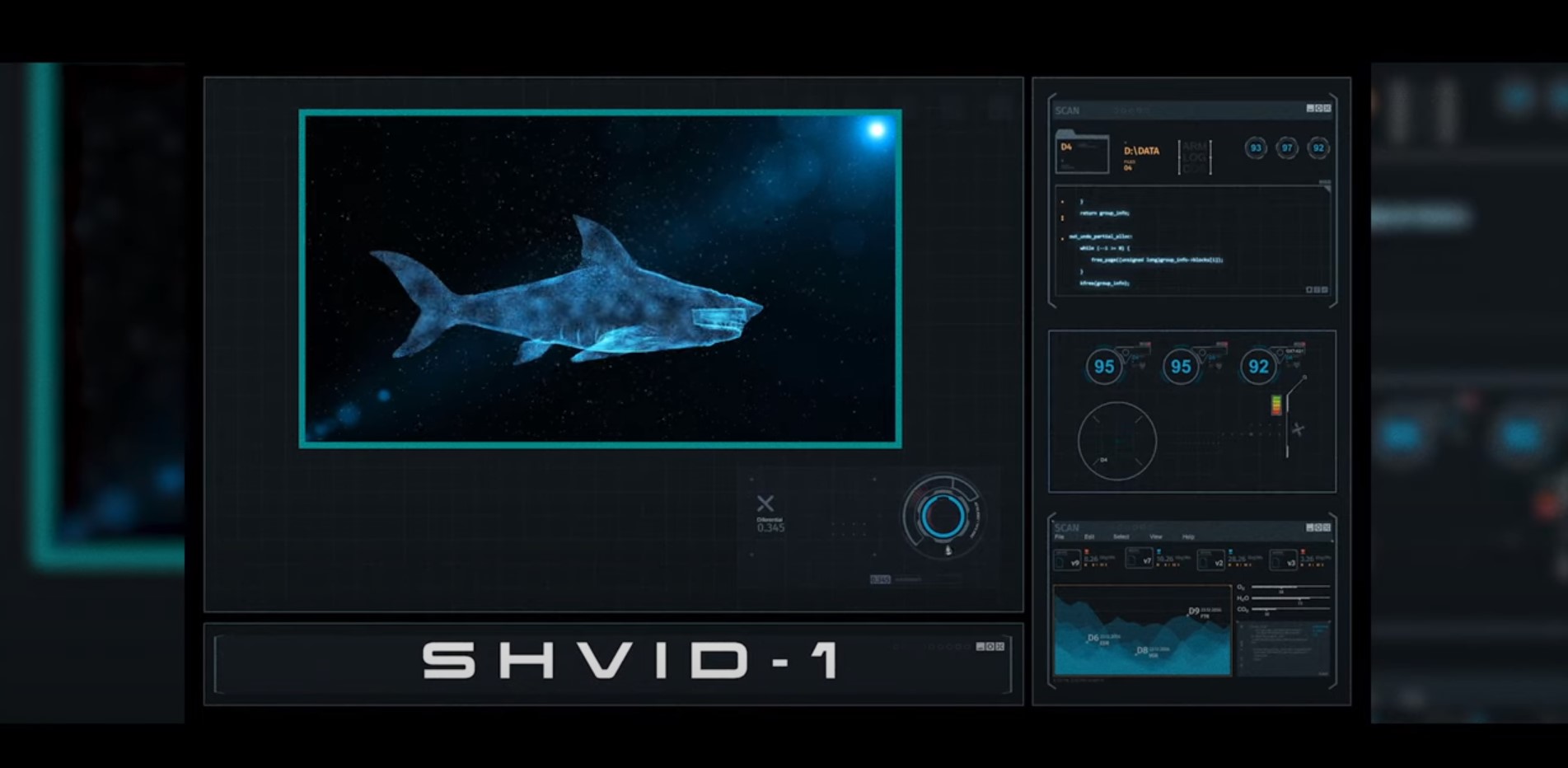
Deep at the bottom floor of the ocean is CYGNIS, a research laboratory retrofitted to be a race against the clock in finding a cure for a world devasting virus called SHVID-1.  Spread by infected oceanic sharks, a handful of shark attacks on unheeding beachgoers turns the world’s populace into mutated marauders and blood thirsty, zombified killers.  Running quickly out of time, the handful of scientists, a maintenance chief, and a security guard find themselves under pressure, literally, as the 30-year-old antiquated CYGNIS station is beginning to show signs of buckling under the ocean’s immense weight.  Factor in virus-mad sharks chomping at the station’s life sustaining systems and a betrayal by the project leader looking for cure glory in greed, a perfect storm brews 1000 leagues down overshadowing the severe global pandemic that has swallowed the world whole.  Survivors must surface topside with the cure before all hope comes crumbling down on top of them.

Okay!  I’m pretty sure director Mark Polonia parallels or exceeds my own unhealthy obsession of the sharksploitation genre with his own series of outrageous D-flicks dedicated to the gross profit of the monstrous shark rampage stigma seen in the Pennsylvania born filmmaker’s previous works in “Sharkenstein,” “Land Shark,” “Amityville Island,” “Shark Encounters of the Third Kind,” and the soon-to-be-released, the vampire and shark alliance, “Sharkula.”    Polonia’s latest, “Virus Shark,” is written by Aaron Drake and echoes the pro-Trump public ideology of willful ignorance in snubbing governmental official warnings about staying away from large crowds unmasked during the COVID-19 pandemic.  Polonia throws Megalodon-sized shade at partygoers and right wing conspiracists with SHVID-1, an obvious play on the real virus, and the sun and sand worshippers who venture into the shark infected and infested waters despite the recommended counsels to stay on shore.  Aside from the social commentary lampooning, the rest of “Virus Shark” is in shambles as a super low-end indie production from Polonia Bros. Entertainment and produced by SRS Cinema’s Ron Bonk. 

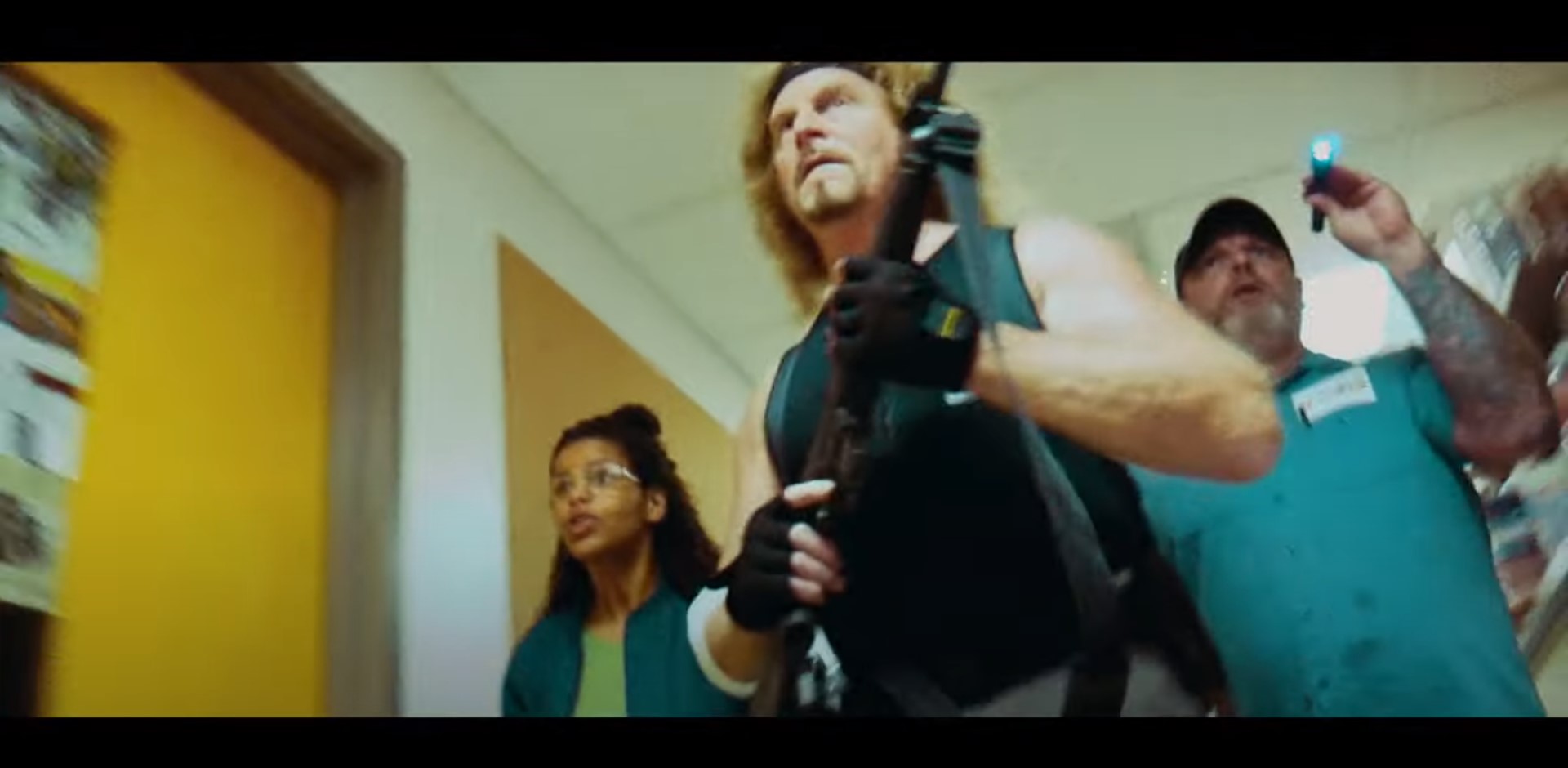
Served up as chum for contagious sharks are a troupe of regular independent staples beginning with lead actress Jamie Morgan entering her second bout with a killer shark after surviving another SRS Cinema gem, “House Shark.”  In the role of marine biologist Kristi Parks, Morgan is not free diving into the vivarium pens and wrangling or bareback riding the maneaters like “Deep Blue Sea’s” Thomas Jane; instead, the actress has a more meek stance as her limiting character transforms into a protective shield over mankind’s last known hope – a cure for the virus.  Fellow scientists Anne Satcher (Natalie Himmelberger, “Shark Encounters of the Third Kind”) and Gregory McLandon (Natalie’s real life husband, Titus Himmelberger, “Sharkenstein”) don the lab coats and spectacles to look the researcher part without actually seemingly doing anything of importance, or anything that makes sense anyway.  The team is rounded out with “Queen Crab” actors Steve Diasparra as the maintenance man Rickter D’Amato, an homage to Joe D’Amato who has helmed a trashy sharksploitaiton film himself with “Deep Blood” (read our recent coverage review here!), and the awesomely 80’s hairdo’d Ken Van Sant the dated commanded-cladded security guard and horn ball, Duke Larson.  Deliveries and any sense of conveyed emotions are a smidge above forced as if reading straight from a cue card.  The off camera stare has to be my favorite gaze into space moments, especially when an aggressive Great White beelines right toward them and the reactions are nothing more than a gaping mouth.  Van Sant wins top prize for at least giving a half-hearted attempt at empathy for a character completing a character arc.  “Virus Shark” fleshes out with Yolie Canales, Noyes J. Lawton, and Sarah Duterte who are also a part of the tight knit celluloid circle of deep-six cinema. 

Speaking of deep six, as in “DeepStar Six,” a semblance toward notable underwater horror films of the deep really do crest through “Virus Shark’s” stagnant flat surface.  Little bits of adulation toward “”DeepStar Six” with the jettisoned escape pod, “Deep Blue Sea” with the shark pool, and “Leviathan” with the topside communication sans Meg Foster sprinkle a blanket of welcoming derivativity amongst a cheaply endeavor.  When I say cheaply, I mean “Virus Shark” scrapes the bottom of the barrel with embarrassingly bad shark hand puppets, interior locations of the underwater sea lab are about as realistic as the innards of your run of the mill High School building, and every single gunshot is the same soundbite stuck on repeat, no matter the gun or the caliber.  I do admire the innovation at times.  An example I would pull would be the two miniaturized pincers matted on top of a live-action still frame used as hydraulic clamps to pickup the rather rigid shark figurine from the “pool.”  You can call it sloppy, but on a pea-sized budget, I call it thinking outside the box.  Much of the story felt underdressed, missing parts pivotal to the impelling actions that either progress cataclysmically or just drop off the face of “Virus Shark’s” malfunctioning sonar.  Under the table deals and sexual innuendos made between project head Dr. McLandon and topside liaison Shannon Muldoon are skimpy at best as well as Kristi Parks’ all for naught endgame to saving the world.  Everything seemed and felt pointless, senseless, and without merit that the “Feeders” and “Splatter Farm” director shouldn’t be totally judged by as we’ve seen much better on much lower budgets from Polonia who he and his late twin brother, John, have been around for decades making movies up until 2008 when John passed away.  Mark Polonia continues to carry the torch but the lack effort has seemingly been replaced with chugging out one scab film after the next to the tune of tone deaf gratification.

Wash your hands, wear your mask, and maintain a social distance of 6-feet from the television when swimming with the “Virus Shark,” that has beached itself onto DVD home video courtesy of SRS Cinema.  The unrated DVD is an AVC encoded single layer DVD-5 and presented in a widescreen, 1.85:1 aspect ratio.  The image quality appears relatively sharp without a hefty loss from compression, especially around the spectrum of low-cost effects that range from rigidly clean to absolutely warped and absurd, but what do you expect from a release that has the cameraman’s reflection visible in the shot and spells region with an extra I – reigion 0 – on the back cover?  Underwater sea lab shots filtered through an oceanic blue hue make due the illusion of a domed research station on the sea floor bed whereas the insides lack a production manager’s personal touch as much of the interior scenes look to be a school with an obvious swimming pool setting and many insipidly sterile hallways and rooms.  Extras on the 74 minute film include a commentary track and SRS trailers with no bonus scenes during or after the rehashed intro credits for the end credits.  The English language 2.0 mono track isn’t the peak of fidelity with the lossy audio compression and inadequate mic placement made apparent by the limited depth and range in  dialogue tracks.  The overlaid narrow foley remains on one level from start to finish finished by stock soundboard snippets.   As far as Sharksploitation goes, “Virus Shark” ranks near the bottom of the food chain.  Of course, there have been far worse killer shark films threshing in the genre pool, but the COVID parodied subaqueous actioner wades underneath the skills of Mark Polonia.

Get Infected by the “Virus Shark” on DVD Home Video!

First There Was a Good Guy Doll. Then, There Was a Turkey. Now, EVIL Comes In the Form of a “Killer Piñata” reviewed! (Darkside Releasing / Blu-ray)

A father purchases 3 piñatas for his young child’s birthday party the day before going on a weekend getaway.  His college age eldest child, Lindsay, stays behind to have a night of drinking with her best friends, one of them being her ex-boyfriend who hasn’t figured out that her romantic interests no longer lay with the entire male sex.   With the pink piñata done in at the party and the other Captain American-resembling one bashed to smithereens by Linday’s friend, the surviving donkey piñata, possessed with the bullied and vindictive soul of a piñata factory worker, is fueled by bloodthirsty vengeance and on a campaign of death as one-by-one Lori’s friends fall casualty at the paper macheted hooves of the candy-filled sinister piñata and it’s up to Lindsay and a hook for a hand, old Latina piñata shopkeeper to stop the carnage.

I, personally, never whacked a sweet-treated stuff piñata on a joyous, celebratory occasion in my 37 years of growing up (in retrospect, my childhood didn’t seem very fun) and after watching Stephen Tramontana’s farcical horror-comedy, “Killer Piñata,” the 2015 release, receiving an enhance 2021 Blu-ray director’s cut, has now instilled a crippling fear of the inanimate that secures the fact that I, and probably my kids and my kids’ kids, will never take a baseball to those cute little piñatas ever!  With a penchant for the worst-of-the-worst horror movies and being an acolyte of the Jordan Downey’s brazen killer holiday turkey masterpiece, “ThanksKilling,” Tramontana, along with his entrepreneurial cohorts who started out in the healthcare field and have turned into amateur B-horror filmmakers, helms his crowdfunded sophomore feature, but first donkey piñata bloodbath, and co-wrote alongside fellow screenwriters Nick Weeks and Megan Macmanus who spun a wild fantasy into cinematic reality.  The 8 day shoot around Chicago’s Logan Square employs Tramontana’s investment partners Jennifer Kunkel as producer and Paul Summers as cinematographer, editor, and score artist under their pun of a production banner, Angry Mule.

“Killer Piñata” casts Chicago regional actors who thought starring in a film about a murderous piñata would be a once in a lifetime opportunity as well as a challenge to broaden their craft by working with puppets and, boy, were they right!  Stage actress Eliza-Jane Morris stars as Lindsay, battling not only a party donkey figure but also her sexual preference ignorant ex-boyfriend, Scott (Billy Chengary).  Much as Lindsay in herself is a trope of what is known as the final girl in horror, the script is riddled with trope characters just to make it abundantly clear “Killer Piñata” means funny business. Scott is the clingy, insecure ex who can’t see between his legs why Lindsay is no longer interested. His pal, Chad (Nate Bryan), resides on the opposite side of the spectrum as the confidently shameless, hypersexualized, and vain best friend who is equally matched in being confidently shameless, hypersexualized, and not terribly vain with Lindsay’s bestie, Rosetta (Lindsay Ashcroft). Martin (Daniel Hawkes) rounds out the group of the ill-fated soirée as Rosetta’s much hated bothersome cousin who is perhaps the only character out of the five to feel any morsel of pity for as he’s incessantly bludgeoned by insults, especially by his own Rosetta, and doesn’t have a single clue what’s in store for him. The most seasoned talent on set played a fiesta Latina shopkeeper with a “I Know What You Did Last Summer” hook for a hand; “High on the Hog” and “Asylum of Fear’s” Joette Waters gives an over-the-top Dr. Loomis performance. Cast rounds out with a fair amount of bit roles from Elvis Garcia, Sheila Guerrero-Edmiston, Steven James Price, and Elias Acevedo who all indulge in the nonsense of a superficial inanimate villain horror.

A piñata running rampant in a suburb home with poisonous candy being expelled from it’s paper and cardboard rectum and able to mechanize corpses like in Gundam with a simple transfer of hoof-to-spine energy awards Tramontana and his thinking outside the box team a 9×9 baking dish full of creative brownie points. “Killer Piñata” can also be funny indicative to all by the nonsensical title and if you’re not stiff as a board in the humor department, you’ll find one scene to be unsettling shocking with a lingering piñata blowjob death that’s literally jaw-dropper and a teary eyeful. While the film is by no means an in earnest attempt at a serious plot, continuity mistakes, in scene goofs, minor equipment quality issues, and narrative pacing drag down Tramontana’s quaint pintsize slasher and even drags a little more apathetically with tired jokes, farting gags, and formulaic routines albeit some okay puns and a smirk inducing making weapons montage. Not until around the plot point of the third act is when the death scenes start to hit the fan, briefly hovering up to the “ThanksKilling” gore-and-gags level, splattering the blood splatter here and there while the first two acts barely register on the oh, damn Geiger counter in what’s an interior imbalance of how to set the tone of a killer piñata video diagram.

Only five years after the initial release of “Killer Piñata,” Darkside Releasing proudly releases an enhanced Blu-ray director’s cut of the film that saw an overhaul and rejuvenation on the color grading, a brand new sound mix, and a quicker pacing, which I still think could have been tweaked better.  Presented not rated in a widescreen, 1.85:1 aspect ratio, with a runtime of 84 minutes (originally 87 minutes but trimmed in the new director’s cut for pacing), there is some early on banding in the opening shot’s blue sky over Chicago, but for an indie production on a budget less than 5k, or now maybe more with a facelift in the new release, the coloring has a brighter glow and is not as flat some of the original footage appeared. The anecdotal animation nicely becomes an intermission to the story and a change of pace in the par quality with simple, but well illustrated, sketch animated backstory.  I never knew the original score, but the Paul Summers pulsating electro-club rescore homages the works “Killer Piñata” is inspired by with an upbeat soundtrack mingled with a traditional minor key soundboard.  Special features includes a new audio commentary, a recollection of pre-, post-, and during production in “A Look Back at Killer Piñata,” a reason why we never saw a sequel follow up title “Whatever Happened to Killer Piñata 2?,” the making of featurette with a few key scenes, and bloopers & deleted scenes.  Stay put after the credits for a bonus scene that aims to piece together things for the potential sequel director Stephen Tramontana promises.  The future for “Killer Piñata” is not yet certain and I firmly believe, in what I consider to be the promising next steps for the murderous inorganic party-pooper, is that the genre needs and should receive a crossover of Turkie vs Piñata in a showdown of the possessed puppets or in an egregious alliance to take a good chunk of mankind’s population down a peg!

Take a Whack at the Killer Piñata Director’s Cut on Blu-ray!


I Think We’re Going To Need Bigger EVIL! “Deep Blood” reviewed! (Severin / Blu-ray)

As kids, four boys were warned with an anecdotal tale of an ancient Native American spirit that took the shape of a killer shark malevolently stalking and killing the native villagers for their overfishing ways.  Now adults, the four friends pursue very different lives as all four return home for the summer with interests in rebuilding family relations, girls, colleges, and avoiding the local punk, Jason, hellbent on making their lives miserable, but when a shark turns up and kills one of them during a solo dive, they recall the ancient tale and sound off to the authorities who take little heed to the incident.  Their small beach community thinks they’ve killed the man-eating shark causing the ruckus, but when more chewed up bodies color the ocean red, the friends must take the task upon themselves to see the shark never devours anyone else again. 

Italian shark-on-a-loose romper helmed by the legendary serial Italia horror and erotica trash filmmaker, Joe D’Amato (“Emanuelle in America,” “Anthropophagus: The Grim Reaper”), cashes in on the monster, man-eating shark celluloid frenzy with an uncredited directorial of the 1990 sharksploitation, “Deep Blood.”  Originally to be Raffaele (Raf) Donato’s directorial debut, the George Nelson Ott script was salvaged by the then producer and cinematographer D’Amato after Donato’s change of heart and professions in the film industry.  “Deep Blood,” that went under working titles “Wakan,” the designation for the Native American evil spirit, and just simply “Sharks,” was shot mostly with an English cast in the sunshine state of Florida with various underwater scenes filmed in Italy.    D’Amato’s production company, Filmirage, supported the film in collaboration with Variety Film Production that has dipped it’s toes into another killer shark flick, Enzo G. Castellan’s “The Last Shark,” which some footage was utilized for D’Amato’s film nearly a decade later.

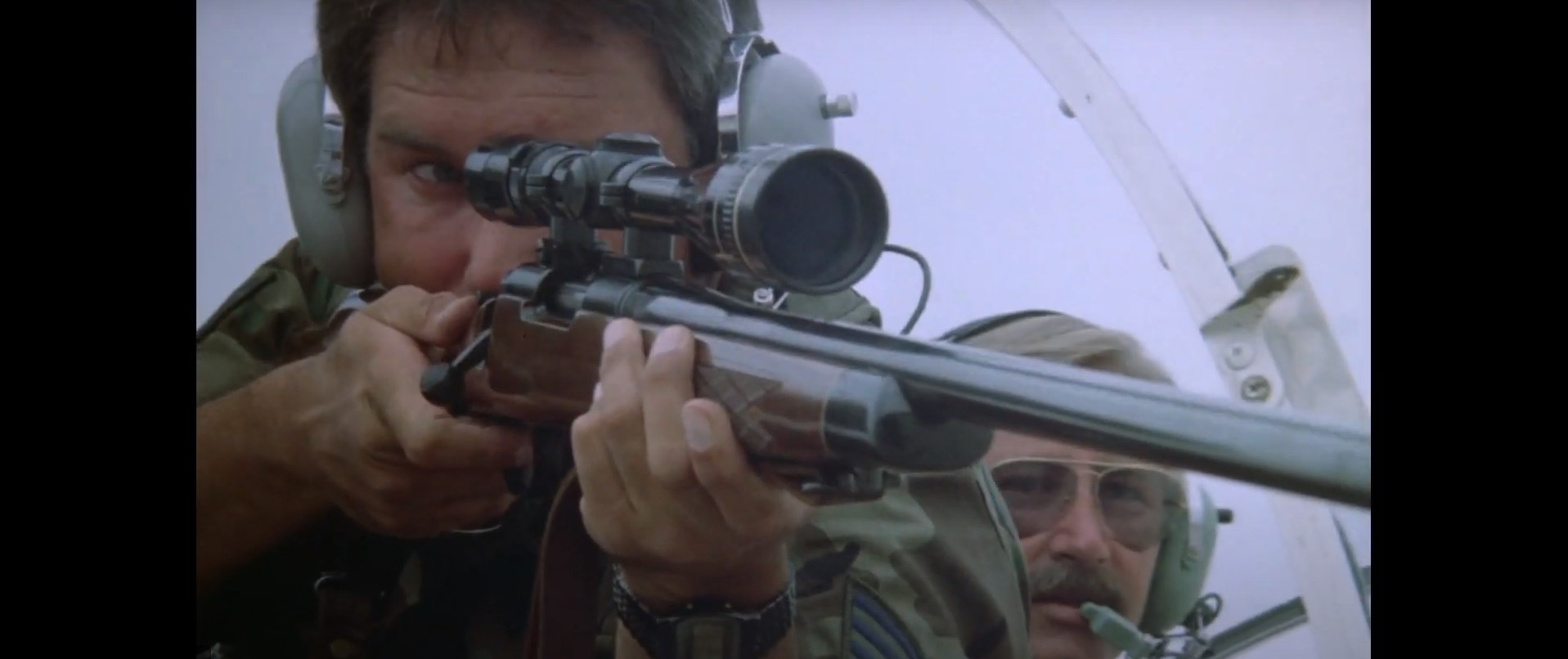
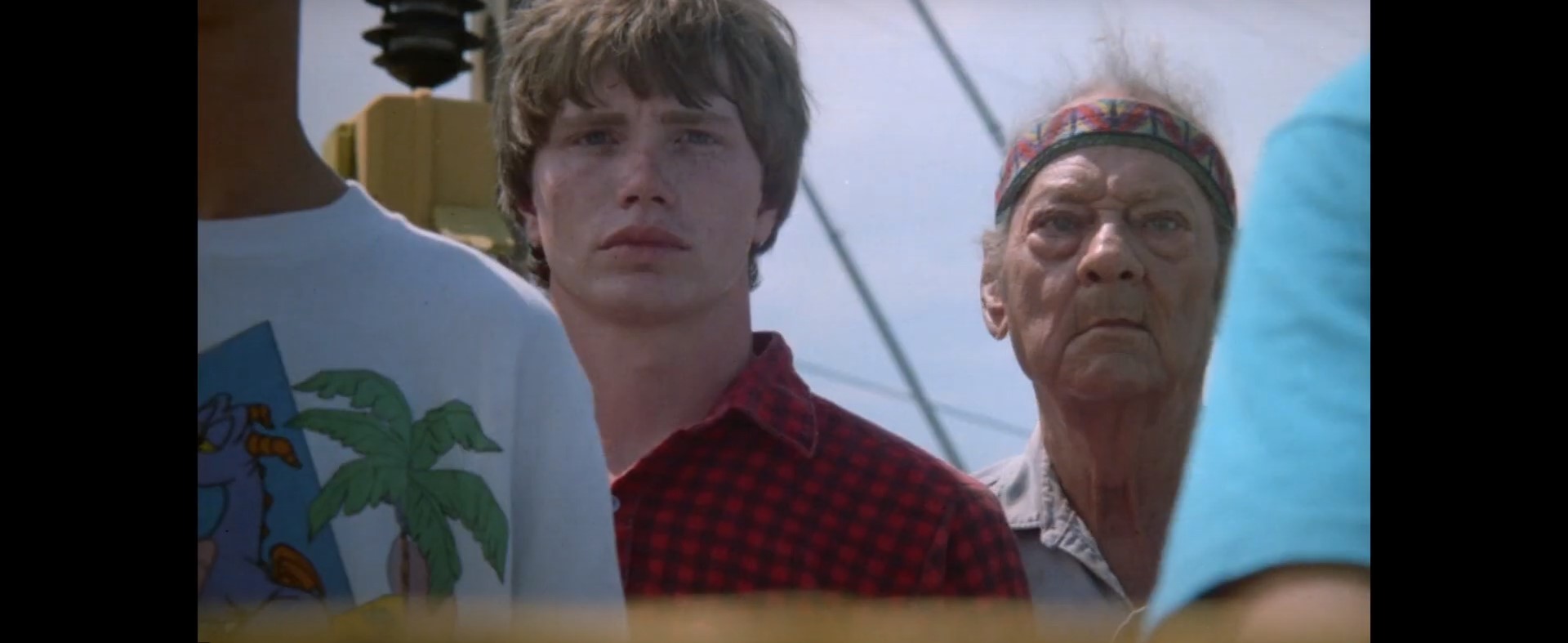
“Deep Blood” circles around the opening of four friends innocently having the time of their lives with a normal ocean side firepit, roasting wieners, being told horrifying campfire stories of the black finned Wakan by a mysterious Native American (Vans Jensens) who hands them a relic piece of oblong driftwood with noteworthy carvings about Wakan and slicing their wrists to make an impromptu blood pact to fight against Wakan whenever the time comes.  You know, the usual stuff you do with your friends.  As grown men, Miki (Frank Baroni), Allan (Cort McCown), Ben (Keith Kelsch), and John (John K. Brune) find themselves back home, reunited to only have their friendship ripped to shreds when John becomes Wakan’s tasty snack on a solo dive.  Ott’s script really, really, and I mean really, tries to add depth to the characters, such as Allan’s spoon-feeding Mayor of a father handing out life advantages to his son every possible moment or with Ben who struggles between fulfilling his parents’ wishes of going to college or starting his professional golf career.  There’s also some backstory about the death of Ben’s sibling at sea that has had some psychological torment on his father, Shelby (Charlie Brill, “Dead Men Don’t Die”).  D’Amato crumples up character development like a piece of scrap paper and shoots a fade away jumper into the waste basket.  My personal favorite in the shallow end moment is the local lout and head of a gang, Jason, who senselessly disparages the four friends, for whatever reason we don’t know, acutely 180’s from I’m-going-to-kill-you to becoming a good friend (out of respect?) and takes an active participation in hunting down the shark.  All the relationship dynamics seem to just culminate right into the big, explosive deep-dive and pursuit for shark blood in the guys’ booty shorts and cut off sleeve shirts.  Talking roles are aplenty but nothing worth the empathy or sympathetic emotional baggage surrounding the remaining cast of characters played by actors James Camp, Margareth Hanks, voice actress Mitzi McCall, and Tom Bernard as Sheriff Brody…I mean, Cody.   

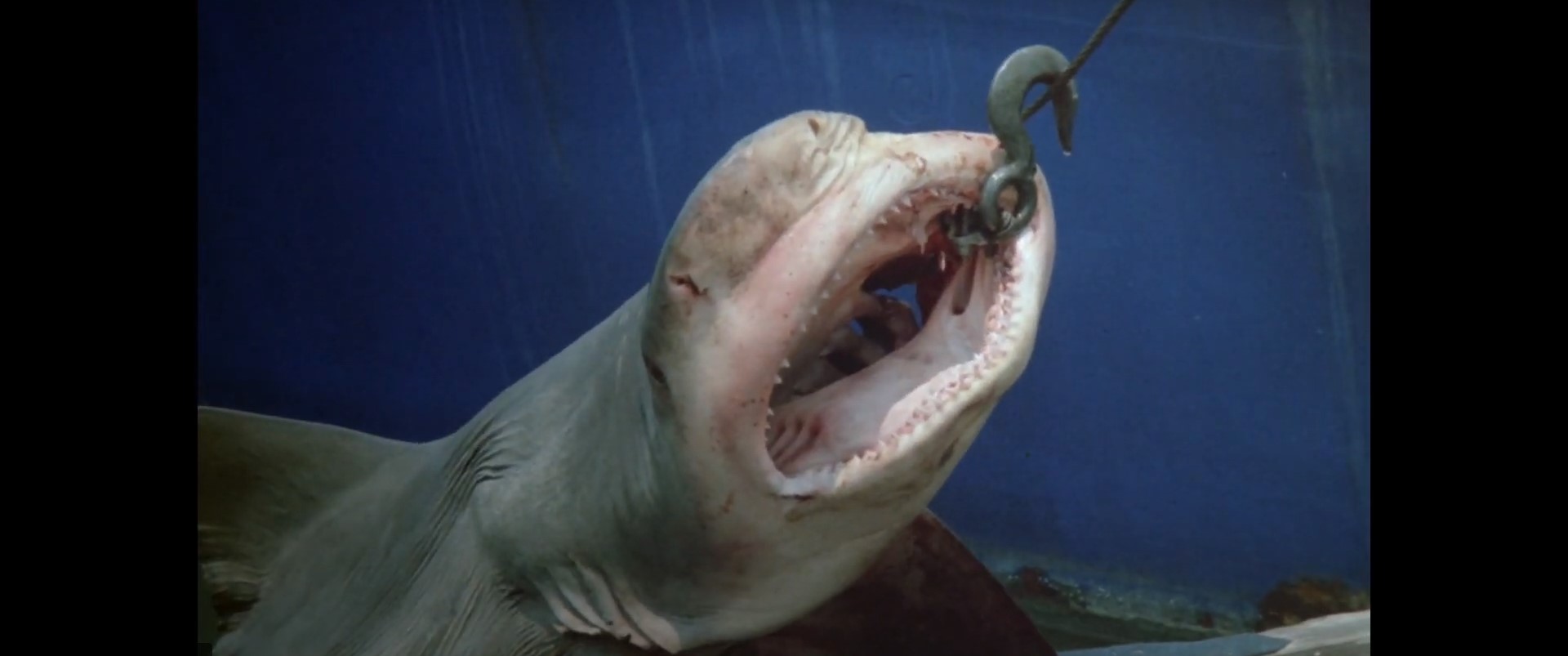
Only slightly echoing acts of Steven Spielberg’s flawless “Jaws,” “Deep Blood” also begs, borrows, and steals scenes to piecemeal together a semi-coherent story.  In the wild Great White shark snippets from National Geographic video clips and shark scenes plucked and reused straight from another Italian schlocker, there lies a nonexistent sliver of thought in creating an original piece of footage that puts the resemblance of a monstrous shark and an actor in the same scene together with D’Amato relying burdensomely on editor Kathleen Stratton to handle the fragmentary bits of different look and feel shots and turn it into single profit linear narrative gold. But honestly, what do you expect? D’Amato was to be the director of photography but ended up in his lap directorial duties, taking on the extra work like any good producer. Many of the shark attack scenes are spliced together with the actors bobbing and turning up and down in the water with the iconic bubble and splash sequences that solidly create the allusion and the illusion of a frenzied blood bath, but some locations are blatantly amiss shots, especially those of the actors snorkeling and scuba diving inside an obvious aquarium vivarium in clearly an exterior beach scene, that are more of a blow toward our intelligence than anything else. When the movie magic shark finally does make an appearance, a rigid, clean cut, my 9-year-old nephew could draw better shark effects sells little amazement, wonder, or pelagic terror of the open water. “Deep Blood” is a see-it-to-believe sharksploitation disaster-piece with the Joe D’Amato Midas touch.

Luckily, seeing every story blighted nook and cranny and experiencing all the dysfunctionalities between characters have never looked better with Severin Films’ worldwide inaugural Blu-ray release of “Deep Blood.” Newly scanned in 2k from the original 35 mm negative and presented in a pillarbox 1.33:1 aspect ratio with a high definition 1080p transfer, the image clarity is about the only thing flawless in the film with natural looking color grading for a richer hue presentation. Aside from the wonkiness of equipment quality differences with Nat Geo’s stock footage, there wasn’t much in the way of image imperfections aside from faint speckle damage and a slight scratch briefly visible in one of the later scenes. Details are phenomenally crisp in the face, as you see every sagging wrinkle on Van Jensens’ mug, and even the slight white capping of the waves renders clearly across. The English language 2.0 mono track features a clean, discernable dialogue albeit some slight hissing. Carlo Maria Cordio’s synthesized score doesn’t invoke fear of the water, but does contribute to the Italiano-charm of D’Amato’s underwater thriller with a seducing melody of lo-fi chords to accompany the shark attack scenes. Optionally, a parallel Italian track provides a dub that isn’t typically as elegant in syncing with American actors. Special features for the 91 minute film include a trailer and a listed multi-region playback; however, I could get the disc to play on the region B setting. If you’re a shark film aficionado like myself, no matter how undeniable cheesy (and I’m looking at you “Bad CGI Sharks”), then “Deep Blood’ is an enjoyable serrated chomp into a chum soaked sandwich good to the last morsel.

Own Deep Blood on Blu-ray from Severin Films!