

In September of 1997, the Anderson family vanished from their remote home on Briar road, leaving behind scores of scattered blood, a lynched dead body, and a house keeper in mental shambles. Seventeen years later, Jeanie and her son Adrian move into the Briar home with the legendary and infamous reputation for being ghastly haunted. Living on hard times with her father being laid off from the region business, Angela reluctantly accepts a good paying caretaker position for Adrian at the notorious Briar home. When a local drug runner gets wind that his stash’s repository is no longer vacant, a dangerous game of retrieval pits the desperate small time dabblers against a supernatural force living inside the home that puts Angela, consequently, in the middle of a terrifying standoff.

Sheldon Wilson. A name that’s under the horror radar for most horror fans, but for this particular reviewer, this particular fan, Sheldon Wilson has had a major influential role in bringing a wealth of horror to my life. The director’s 2004 film “Shallow Ground” was the first domino piece to fall that a started landslide of independent horror cinema to come flooding into my presence and opening up my world, my eyes, to the many facets of the genre. I fell hard for “Shallow Ground” that led to the foundation of a grand and glorious horror collection that would be acknowledged Rob Zombie, who’ve I’ve heard, has an extensive film collection. Wilson’s latest venture “The Unspoken” has reminded me that horror can live in the restraints of the past and can be bold with an unforeseen twist.

Now, “The Unspoken” epitomizes the very definition of generic titles, but the premise goes far beyond being geriatric with similarities, but not on the same elaborate scale, to the 2012’s “The Cabin in the Woods” by exploiting the genre’s familiar tropes but shifting, at the very last moment, to an ending that’s well received and a breath of fresh air. From the Wilson films that I’ve experienced, his story structure is orchestrated in a detailed manner making the subtleties pop with saturated intensity. With “The Unspoken,” Wilson’s indirect jump-scare style is very much engrained and effect goes without diluting the entire film as some, examples such as some of the recent Halloween films, have done in the past to the point of tiresome and ungratifying.

A satisfying cast genetically makes up the captivating story with young and upcoming scream queen Jodelle Ferland in as the lead role of Adrian’s desperate caretaker Angela. Ferland has quite the stint in horror starring in such memorable films as the recently referenced “The Cabin in the Woods,” “The Messengers,” and as the young child in 2006’s strong video game adaptation of “Silent Hill.” Ferland possesses that scared and innocent persona and she leaves nothing on the table when forcing to battle against a supernatural danger that can animate a decaying, jaw-severing dog corpse. Pascale Hutton, Anthony Konechny, Chanelle Peloso, Lochlyn Munro (Freddy Vs. Jason) and a passing-through role for “The Hitcher” remake’s Neal McDonough as a local sheriff rounds out the rest of the “The Unspoken” cast. Sunny Suljic, who portrays the unspoken Adrian, solidly performs as the creepy and mute, Damian resembling child even with his bad young Elijah Wood haircut. Together, the ensemble plays their respective roles with as much as earnest as the next film with more of the focus on Angela and Adrian throughout with supporting characters driving much of the storyline, funneling toward a surprising catalytic event.

For the majority of the film, “The Unspoken” meets the harsh criteria fans need and desire from their horror films with some solid practical effects, no CGI effects, a story-driven plot, and a haunted house full of good scares with tidbits of blood and gore in between them all. There’s even a little nod of respect for the “Amityville” series. Only insignificant character underdevelopments raise a few unanswered questions about situations perhaps more pertinent to the motivation of the story such as the forbidden relationship between Angela and best friend Pandy which floundered a bit out of place within the confines of the plot and went stagnant when more about the Briar home became revealed or when Pandy’s more-or-less boyfriend Lutheran and his drug scheme goes through the sharp blades of a blender.

The Lighthouse Pictures produced and Arrow Films UK distributed paranormal disturbance feature “The Unspoken” hit retail shelves and online markets September 5th. I’m unable to review video and audio quality with a region 2 DVD-R and there were no bonus material available from the static menu. However, Wilson’s film fairs with a sharp and clean appearance without the bedazzling of a Hollywood budget; the director’s use of the slow panning method and focusing on unsettling camera angles to transform an ordinary mountain home into a menacing dark presence doesn’t require much touchup in order to terrify audiences. If you’re a fan of quiver inducing, nail biting horror with a good M. Night Shyamalan twist at the end, “The Unspoken” will leave you completely terrified and utterly speechless.
Category Archives: Death
The Counselors Face an Evil Murderous Rage. “Summer Camp” review!

Four camp counselors prepare a woodsy, dilapidated living quarters a couple of days before their anxious campers arrival. As the preparations seem to be going as scheduled, a sudden violent rage takes over the head counselor with the eyes turning severely bloodshot and a bloody-black ooze seeping from the tightly grit mouth. The isolated camp structure that should bring joy and excitement to young children becomes an unescapable labyrinth for the counselors when the local transient residents fall also to the murderous madness. Trust between the terrorized counselors thins as none of them have an idea how the infection transmits. Without an operational phone or vehicle, the surviving counselors can only count on themselves to flee and fend from a fury seeking to massacre them all.

When first hearing of Alberto Marini’s inaugural co-written and directed film entitled “Summer Camp,” a vivid portrait of radiant sunshine, lake canoes, bow and arrow games, and lots and lots of children campers naturally come to the forefront of mind – basically, “Salute Your Shorts” pops right into the old “cabeza,” even in front of slasher genre fave “Friday the 13th” that culturally Hollywood-ized camp counselors, transforming them into unlimitedly horny teens, subjecting campers into hapless victims, and demonizing campgrounds as death camps. And while “Summer Camp” resonates good times in the season’s solstice heat, Marini’s version of camp weaves a craft basket of intense fear.

“Summer Camp” opens to a newscasters voice over reporting that three American counselors have vanished in the wilderness of Spain and are unlikely to be alive at this point of search. The setup already denotes no resolution to the counselors’ fate who make their on screen appearance in the following scene engaged in a trust game the Italian filmmaker had constructed to appear as every horror trope imaginable – a woman running through the woods with a blindfold and hands tied behind her back, a lurking ruffian peeping the counselors from the dense tree lot, and etc. The possibility of horror themed scenarios trickle at the top of a hill, snowballing until Marini decides to sudden plop down a massive, unbreakable brick wall in front of soccer ball size snowball before reaching critical speed, size, and strength for massive destruction. Marini’s a magician by convincing viewers to believe the trick in one hand, yet subtly revealing the real trick in the other and by doing this, a flare of confusion immerses the counselors and the audience in order to keep them guessing at every step of the way.

Continuing with Marini’s script co-written with Danielle Schleif, a contrived portion of many possible triggers that causes the violent behavior almost as if Marini and Schleif used satire to highlight the absurdity of previous zombie or infected films and their numerous infected origins. “Summer Camp” leads you to believe that one of the following three, or perhaps a combination of all three, possible culprits are responsible for spawning deranged and violent behavior. Characters are purposefully shown to be unprotected to the transmission of external blood or saliva, seen drinking the mysteriously broken and recently fixed well water pipes, and being exposed to an unusual after spring pollen buildup that seems to be everywhere. Which element prompts an outbreak? Or is it all three?

When the characters are aggressively possessed, a crossbreed between an “Evil Dead” Kandarian demon possession and a hybrid-rabies strain infected from “28 Days Later” sum up a “Summer Camp’s” possessed state of being. The actors themselves wholeheartedly accepted the role, doubling and switching themselves between normalcy and lunacy with ease. While the story prides itself on being quick to action and fast paced like Danny Boyle’s 2002 film, the characters’ depth burdens no viewer and their ultimate fate will raise no brows. The bare bones character backgrounds only affix their red shirt destiny; yet, Marini has already doomed his own characters for on script stupidity and whether intentionally or not, written to be cursed never qualifies a character to be a likable hero or heroine. When Will knocks out a possessed Michelle, he quickly unlatches his belt that holds up his pants to tie her legs with it and while that seems like a smart idea in the beginning, Will stills needs a way to keep his pants up from falling to his ankles in order to run through a dark dense forest from the numerous possessed individuals lurking about, screaming their lungs out. Will also attempts to unlace one of his shoes to bound Michelle’s hands. Why?! You’re going to need a tight fitting shoe to run through the forest and…oh forget it.

Diego Boneta portrays the unluckiest of the luckiest counselors. As Will, he’s accused of murder and along with being bitten, battered, incised, and even drilled; yet, he manages to still lead the surviving charge even if the odds are against him. The physicality of the role contrasts with Boneta’s character whose short and has a vision disadvantage, but Boneta underneath the skin of his character sports an athletic build as shown from one gratuitous shirtless scene. The dynamic between Boneta, Jocelin Donahue as Christy, and Maiara Walsh as Michelle couldn’t have been any better with decoding the group’s trust issues even until the very end, especially between the tomboy with a mysterious past Michelle and the prissy and uptight Christy. Dynamics stands out as the bright point of Marini’s skeleton script that doesn’t involve many complexities as it does debunking horror tropes.

The Lionsgate distributed the rated-R DVD release of the Spanish horror film has a 16:9 widescreen presentation with a Spanish and English 5.1 Dolby Digital audio complete with Spanish and English subtitles. With an average film runtime of 84, “Summer Camp” maintains just enough endless terror to suffice an entertaining haphazard horror-comedy and that’s about all the entertainment delivered from a DVD with thin extras including only trailers and a digital ultraviolet. The lightweight nature of this release should definitely not deter a viewership, but rather “Summer Camp” should be embraced as an intense and scary gauntlet of escape and survival. A well-fought first time feature from director Alberto Marini and a good showing of faith for a talented young group of actors seeking to imprint their names into horror.

Buy “Summer Camp” at Amazon.com!

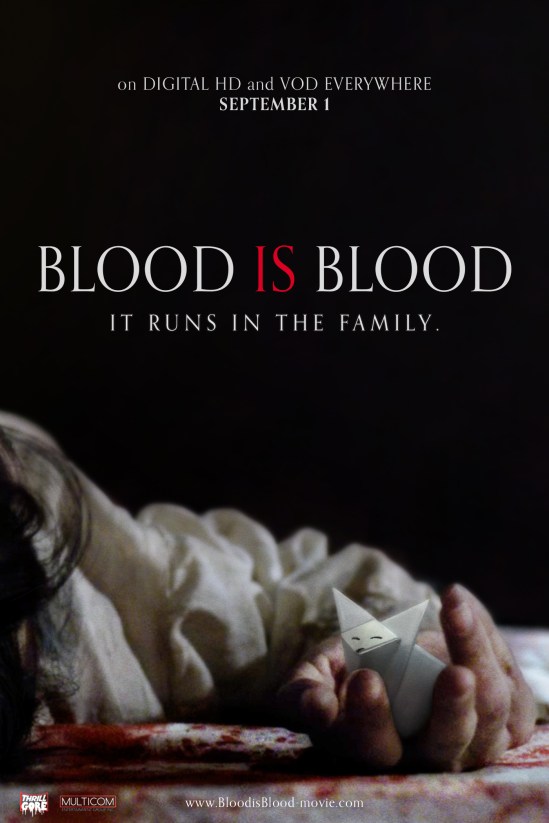
“Blood is Blood” Going into the Family Scrapbook this September!
Multicom Entertainment Group is releasing psychological family horror “Blood is Blood,” the first digital acquisition from under the horror banner channel “ThrillGoreTV.” “Blood is Blood” release will be on digital HD and VOD September 1st! Sooner than you think!
“For privileged siblings Brie, Daniel, Crew and Jess family has always come first. But when Crew (Danile DiTomasso) invites his girlfriend Sara (Kate French) into the family, distrust begins to bubble between the siblings. Seeing Sara as a threat, Brie grows spiteful and suspicious that she is being replaced… That is until the night Crew attempts to murder her in their family house. Traumatized, Brie is sent to a mental facility where she is tormented by hallucinations of Crew from the night of the attack. But when the visions begin to bleed into reality, Brie starts to fear that it’s not just her sanity that’s in danger, and she flees the facility. In a frantic attempt to return to her remaining siblings and warn them, Brie begins to uncover a trail of gory, sinister secrets that leads her to question whether she knows her family as well as she thought.”
Freshman film of writer-director Stuart Sauvarin and stars Fiona Dourif (daughter of iconic Brad Dourif), Kate French, Daniel DiTomassee, Andrew James Allen, Tessa Harnetiaux, and Caitlin Harris. Website: http://www.bloodisblood-movie.com/
Evil’s One Kaboom Step Away! “Landmine Goes Click” review!
Three backpacking American tourists and good friends Daniel, Alicia, and Chris tour through the Georgian countryside, looking for that one last hurrah before Daniel and Alicia tie the knot. When the trip seems to be going well, Chris steps on an old landmine, leaving him grounded and motionless to the spot. The next series of events will determine their fate as an psychopathic local and his Rottweiler happen upon the frightened and helpless Americans. Caught in a maniac’s twisted game, their only chance for survival is to play by the local’s Machiavellian rules or otherwise take their own life-risking chances by stepping off the a shrapnel-exploding, flesh-piercing, life-ending mine.
“Landmine Goes Click” bares no one identity. The Georgian thriller from director Levan Bakhia cleverly abridges four genres together, resulting in one intensely merciless story of unfortunate and deadly circumstance intently set to destroy one’s emotions. Bakhia teams up again with writer Lloyd Wagner, both who’ve previously worked on heated horror chiller “247°F,” and are joined by Adrian Colussi to substantiate a story that’s dices through a range of plot subdivisions from thrilling and exploitive to revengeful and tragic.
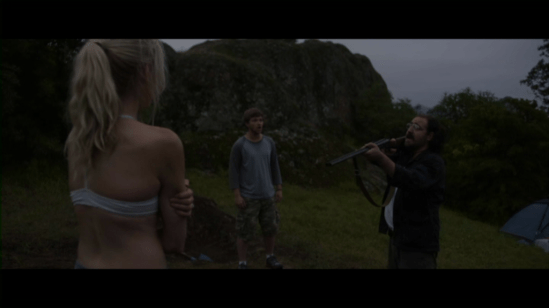
Kote Tolordava, the late Georgian actor who tragically died of a heart attack shortly after filming, defines the look and the manner of a sleazeball psychopath. A straggly comb over laid upon unkempt shoulder length hair with a stubbly five o’clock shadow that rests beneath a bushy Georgian bred mustache combined with an over extended gut stretching a bulbous silhouette in a white under shirt that’s covered with a breast opened, military-like navy colored coat sizes up Tolordava’s Iiya character as a harmless human joke, but pair that look with a loaded Remington, a muscle-laden Rottweiler, and a taste for taking advantage of the situation and you have a maniacal genius ready to reap the benefits of your misfortune. Tolordava’s wears Ilya’s clammy skin as if it’s his own, playing the local kook with a sadistic hard-on.
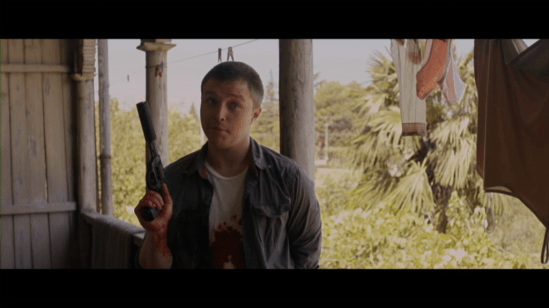
But Sterling Knight, as Chris, carried the film to a jarring conclusion, especially in the last acts. My initial reception of Chris was a big question, why does Chris, whose unable to move from the landmine, severely antagonize a creature like Ilya? Once the characters progress to a level of no return, to a level of depravity and maliciousness, understanding Chris was no longer an enigma and how Chris follows up with Ilya begs, absolutely begs, for retribution. Knight’s day and night performance tells tales of his acting talent. Don’t let the youthful face, the deep blue-eyes, or the Justin Beiber vocals fool you, Sterling Knight demonizes handsomeness.
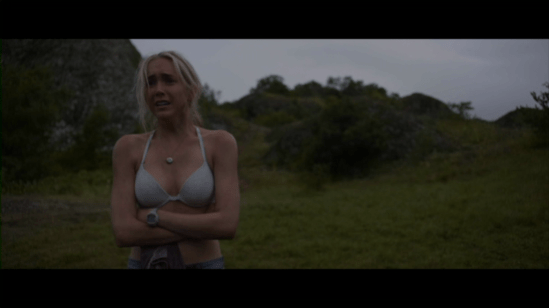
With Tolordava and Knight, Spencer Locke, K-Mart from “Resident Evil: Extinction” and “Resident Evil: Afterlife,” had the toughest role to be burdened with as Alicia being an object of affection for not one, not two, but three characters and, in two of characters’ cases, in a malevolent way. Locke’s scenes were the most difficult to gape at, but her character ends up being the driving force behind almost everything that happens, even to divulged information prior to the beginning of this film to which we are not privy. Alicia is essentially the epicenter that crumbles the foundations of lives around Daniel, Chris, and even Ilya and like an epicenter, Alicia becomes the butterfly effect that ripples devastation from a single event. Like I said, a role that bares a heavy burden.
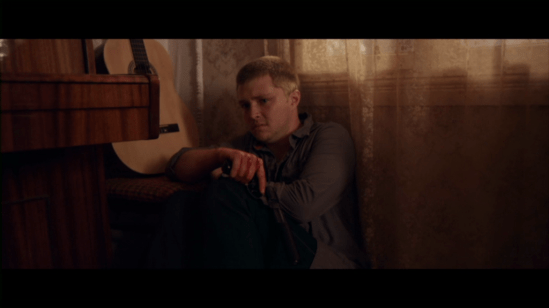
Bakhia utilizes effects that can be easily overlooked. His use of miniatures of the Georgian countryside, compositing them with the live action motor vehicles, is a stunning visual, alluring to our minuscule selves in the world. Also, the director, I noticed, does many long takes by swerving the camera from side-to-side that may consist of a stationary position or even tailing to characters, obtaining individual reactions and letting the scene play out without as much as a single edit for a lengthy period of filming. My first experience with Bakhia at the helm isn’t spoiled with gaudy gore or an outlandish unrealistic script; “Landmine Goes Click” thoughtfully provokes our inner animal and is constructed and edited similar to the style of Oscar winner Martin Scorsese. No film goes without flaws as I thought some of the fade to black editing was oddly placed and the overlapping during genre transition didn’t settle with the mood at the time. However, I’m not a big fan of exposition, but I thought there was enough exposition to get us through on how Chris managed to step on a landmine and also to what really happened to Alicia. Any more footage would have been overkill, making the 110 minute runtime that much smoother.
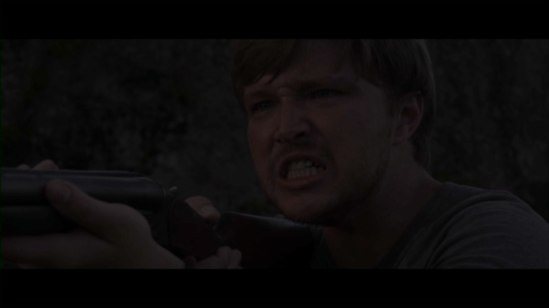
“Landmine Goes Click” rightfully found a home as an Icon Home Entertainment Frightfest Presents. Spurred with volatile tension and a dynamically charged cast, “Landmine Goes Click” is the tip of the Levan Bakhia ice berg and watch out for more films from Sterling Knight, an actor that can steal a scene, or in this case, a movie right from under another talented actor Kote Tolordava. Since the disc sent to me was a screener, I am unable to review the audio and video qualities, but I can say that there wasn’t much bonus material aside from an introduction of the film by Frightfest’s Alan Jones and Paul McEvoy and the other Frightfest film trailers. Like a good concealed explosive device, “Landmine Goes Click” exploitatively shreds through your soul, cleaving barbed shrapnel to linger and rot in the confined spaces of psyche.
The Evil Doctor is in! “Doctor Butcher M.D. (Medical Deviant)” review!

New York City hospitals are being terrorized by a crazed maniac or maniacs stealing the body parts of the deceased and local authorities are discovering the half eaten remains of torn apart bodies in the streets. When a medical orderly is caught in the act of cannibalism by nearly devouring a corpse’s heart and then commits suicide by diving out high rise window, the Doctor’s assistant and leading anthropologist Lori Ridgeway recognizes the tattooed symbol of Kito on the orderly chest, a symbol from a long forgotten tribe in the Moluccas Islands. Worshipping a cannibal God, the primitive tribe still practices the form of anthropophagy. Lori’s colleague, Dr. Peter Chandler, has been placed on a research team to root out New York City’s recent cannibal problem and when the Kito symbol clues him and his team of a possible lead, an expedition team forms to travel to the Moluccas Islands in search of the existence of inhabitants. Dr. Chandler rendezvous with a long time acquaintance, Dr. Obrero, whom has lived on the islands for years. When Dr. Obrero arranges a boat and his right hand man to accompany the expedition, Dr. Peter Chandler and team step foot into a hellish nightmare, bloodied with unspeakable and aggressive cannibal acts. Just when nothing could be worse than flesh hungry cannibals, hideously disfigured zombies frighten even the primitive locals. The island holds a dark secret and Dr. Chandler aims to unveil it no matter the cost!

Finally! The definitive 2-disc edition of Aquarius Releasing’s “Doctor Butcher, M.D.” aka the Italian cut “Zombie Holocaust,” from the Flora and Fulva Film production companies, has been released and, oh, how glorious the Severin Films release is with a super sleek Blu-ray reversible cover art – “Doctor Butcher, M.D.” title as the main cover and “Zombie Holocaust” title on the reverse side – and the high definition gore that hasn’t been gooier and oozier than ever and all in thanks to the upscaled 1080p full HD resolution transfer. Uncut with eye-gouging effects, eviscerated and mangled bodies, and packed with a slew of medical terrors and oddities, the Marino Girolami’s directed video nasty from 1980 just might get itself banned once again by the international censorship boards.

The schlock runs thick through a plot that’s eerie similar to Lucio Fulci’s Zombie (aka Zombie 2) with many of the locations and sets repurposed for the Girolami picture involving exotic land cannibalism, a mad scientist, and, you guessed it, zombies. Yet, “Doctor Butcher M.D.” rightfully receives being a detached entity, an “Annabelle” to “The Conjuring” of sorts, even when both films star Scotland-born leading man Ian McCulloch. With uncanny and grisly disemboweling special effects that turn a stomach inside out and give you a reason to make use of that barf bag provided by Severin Films as a bonus insert, some death effects didn’t go quite as planned such as, in example, when the cannibal orderly dives out a multistory window and the stunt-dummy loses an arm when crashing onto the floor. The next scene has the actor, with arm intact, lying in a pool of blood. Another scene involving Doctor Butcher and his cranium saw nearly doesn’t sell the effect when the saw itself isn’t spinning at all during close ups of a cranium cap removal. However, none of these miscues matter as the rest of the special effects trumps any other gore film of this decade.

The American bought rights to “Zombie Holocaust” were destined to be re-edited as the film had to bulk up on Americanized tastes, slightly targeting specific, well versatile audiences of New York City’s infamously sleazy and exploitive 42nd Street, which is now defunct. The additional and pointless scenes that were intercut from a scrapped Roy Frumkes’ horror anthology, “Tales That Will Tear Your Heart Out, at the beginning of the film didn’t transition seamlessly enough to cause an unfavorable reaction, but only added on to the powerful zombie train that spawned from George A. Romero and the Living Dead films. The antics of Terry Levene, an American producer and 42nd Street icon, led to guerilla marketing, an overlapping score from the late “Blood Sisters'” composer Walter Sear, and the superbly cut trailers had guaranteed butts in the seats at Levene’s, amongst others’, circuit theaters. Plus, the T&A from cult Italian actress Alexandra Delli Colli might have had something to do with putting butts in seats as well.

The story hadn’t changed much between the alternate film versions of the Romano Scandariato screenplay and the story itself is wound looser than a turn of a century Gary Busey. Thin motivations drive characters to do the stupidest things possible such as go on an expedition to a cannibal island, go to a cannibal island without state of the art weaponry and more bodies than a modern day NFL football roster, or go straying away from the safety of your group to stroll through the island’s bush alone. The obviousness is aggravating to say at the least, but omit the blatant stupidity of the characters and no one would die a horrible and gruesome death that fastens our morbid tastes to the screen. The story’s spontaneous and adventurous nature appeases thrills of a long-lost culture on an island of hell that’s ready to be explored and re-discovered and ready to taste fresh blood and organs once again.

Severin Films have outdone any previous release of the reconfigured “Doctor Butcher, M.D.” and the original “Zombie Holocaust” when discussing the video presentation. The 1080p performs at a high bitrate with a vibrant display of natural colors that diminish much of the natural grain and negative damage and exhibits finely tuned and leveled darker tones from the original 35 mm negative; a HD presentation that, and this goes without saying, naturally outperforms the the transfer from Shriek Show’s “Zombie Holocaust” DVD release in the early 2000s. The English DTS-HD Master 2.0 audio mix on “Doctor Butcher, M.D.” performs greatly without many given distortions or loss of audio while the “Zombie Holocaust” on disc two has the same DTS-HD Master option, but also gives an alternative with a linear PCM Italian only audio mix without subtitles. Walter Sear’s Stateside score and Nico Fidenco Italiano score tribute their respective nations clearly through the mastered audio mixes with Fidenco’s score surfacing here and there on the Aquarius Releasing edit. Severin Films provides an impressive list of new bonus material on each disc, with the first disc having insightful interviews with Aquarius Releasing’s Terry Levene, editor Jim Markovic, filmmaker and documentarian Roy Frumkes, “Temple of Schlok’s” Chris Poggiali, Gore Gazette editor and Butcher Mobile rider Rick Sullivan, and Gary Hertz all discussing their involvement “Doctor Butcher M.D.” and their ties to 42nd Street. The second disc focuses more on “Zombie Holocaust,” interviewing male lead Ian McCulloch and McCulloch sings “Down by the River” in another segment, FX masters Rosario Prestopino and Maurizio Trani, actress Susan Buchanan, and a look at New York City then and now piece where “Zombie Holocaust” shot certain scenes.

Buy the 2-disc Definitive edition of “Doctor Butcher M.D.” from Severin Films today!

 It's Bloggin Evil!