EVIL Wears a Mask, Has Sex Parties, and Likes to Watch. “X” reviewed! (Cinedigm / Digital Screener)

Christian King was handed the philanthropic The Foundation once was directed by her mother Lynda, a legendary singer with powerful vocals who is now on the decline with onset dementia.  Christian, along with her business partner and friend, an equestrian stable hand named Danny, uses The Foundation as a façade for monthly masquerades of elaborate dinners and afterhours sex parties that rake in substantial donations from her clients, but Christian, who clads no mask, doesn’t partake in the normal debauchery of the orgiastic stage.  Her perversions are more privately invasive as she gets off on voyeurism with a hidden camera recording every thought-to-be discreet act her clients are doing in the bathroom.  When a Stella, a familiar face from Christian’s High School past, crashes one of the parties, forgotten secrets bubble to surface that lead to nail-biting paranoia.  Compounded with the seemingly recorded rape of Stella in her bathroom, Christian King’s money and monarchy threaten to expose her peeping Tom habits to the world. 

Sex, lies, and video tape.  “X” is the Generation X’s response to Stanley Kubrick’s “Eyes Wide Shut” doused in cynicism and a disaffection spray.  “X’s” carnality of deceits is the edited and directed work of LGBT+ advocating filmmaker and music artist, Scott J. Ramsey, who co-wrote the 2021 released film with Hannah Katherine Jost.  Ramsey and Jost previously collaborated on Ramsey and producer, Kevin De Nicolo’s short music videos, “Knave” and “Queen,” for the duo’s queer electro goth-pop band, The Major Arcana; the shorts inspired the feature films voyeuristic qualities, majestically medieval terminologies, and, of course, a queer theme.  A garnered support sees “X” as a family produced suspense thriller from not only Kevin De Nicolo, but also Alex serving as producer with Susan and Tazio De Nicolo as executive producers for the self-funded production under Ramsey’s indie banner, The Foundation, completing the filmmaker’s trifecta of multi-media storytelling.

Following polar oppositely a minor role in her first feature film, “Sleep Away, a family comedy, Hope Raymond quickly jumps the rated for everyone shark and right into the complex titular character a melodrama sexcapade and illicit perversion. Raymond plays a King, a character named Christian King, who employs the definition of her name by applying the real world as her kingdom, or at least her lavish home, to used for the monthly orgy shindigs. Christian King was probably name more suited for a male lead, and was at one point most likely written for such, but tweaking the role for a female actress gave Christian King new meaning, a new perspective, and a whole new depravity intrinsically worked into a system that’s thrives off of identity anonymity, ambiguity, and gender reversal. While Raymond plays the royal King, her business partner, Danny, plays the royal Queen under the sexuality masking by Brian Smick, also making his sophomore feature film appearance. Raymond and Smick comfortably indulge themselves into roles of pansexuality without having the lifestyle be the crux of “X’s” core. Zachary Cowan and, introducing, Eliza Bolvin play the, whether intentional or not, monkey wrenches thrown into the King and Queen’s perfect, cash-cow machine. “X” endows Bolvin’s Stella as a threat to the King’s illicit Kingdom, but Stella provides strategic publicity as a renowned cam girl in certain circuits to which the Queen aims to market for new members. When Stella invites her boyfriend, Cowan’s Jackson, that’s when things get complicated with misperception and mistaken identities. Rounding out “X’s” cast is Valerie Façhman, Hans Probst, Ashley Raggs, Vickey Lopez, Mira Gutoff, Miyoko Sakatani, and Wendy Taylor.

The five act chaptered narrative, described a Shakespearean tragedy and a Hitchcockian thriller, continues the regal motif all along the way, exploiting the means to sound ritzy, refined, and provocative and to show the power of sovereignty with Christian King’s thumb over every single orgy participant’s dirty little bathroom secrets or as she puts it, “I know them better than anyone else,” as she shamefully masturbates to what should be the privy of relinquishing the bladder. The idea of getting off on watching people in the bathroom isn’t just a twisted, one-off fetish, but also symbolizes a power aspect against the unaware, leading to self-serving and self-induced loneliness because of the one-up she holds over them. “X” tries to justify King’s rationale for exploiting her sexually engorging guests with flashbacks of sexuality shaming by the snarky high school boys, which in my opinion, dilutes the LGTB+ perception of you are who you are because something terrible happened to you. However, on the other side of the spectrum, you have Danny who is also taken advantage of in more than one way and in a different and separate context, but doesn’t react in the same regards as his King. Their dichotomy exposes true personalities and gives audiences a defined line of ego and humble attributes to experience different perceptions and events that speak to who they are as an individual. “X” circulates around the titular King of self-proclaim monstrous perversions in a dicey cinematic case study in vanity, arrogance, and the sexy manipulation power.

From being entirely shot in Northern California to the five year, labor-intensive production, “X” marks a spot with a digital and DVD release from Cinedigm with digital platforms including VUDU, Google Play, Amazon, and iTunes. “X” runs a lengthy, but well entertaining pace of 127 minutes and is presented in a widescreen 2.35:1 aspect ratio. In a little buyers beware tidbit, the dialogue track might feel dubbed and that’s because it is. Director Ramsey has noted that due to the constant crashing waves in the background, much of the the three year post production included re-recording all the dialogue as well as creating a 11-track score album accompaniment entitled “At the Devils Ball” from his band The Major Arcana. Chantel Beam’s first feature credit is a good solid effort with a slew of medium closeups and framing of multiple actors in a single scene while tip-toeing outside the box and into another world with a playful black and white sequence and the hidden bathroom camera reel that’s spun like a kinky comedy, but renders into the realm of diabolical depravity. As a pillar of anonymity, X has always served as the wild card for anything goes and the same rings true for Scott J. Ramsey’s autarkic ball room blitz between sex and perversion film.

Buy “X” on DVD or Stream from Amazon Prime Video!

Classy Brothel Girls Bring Dirty EVIL Secrets to “Madame Claude” reviewed! (Cult Epics / Blu-ray)

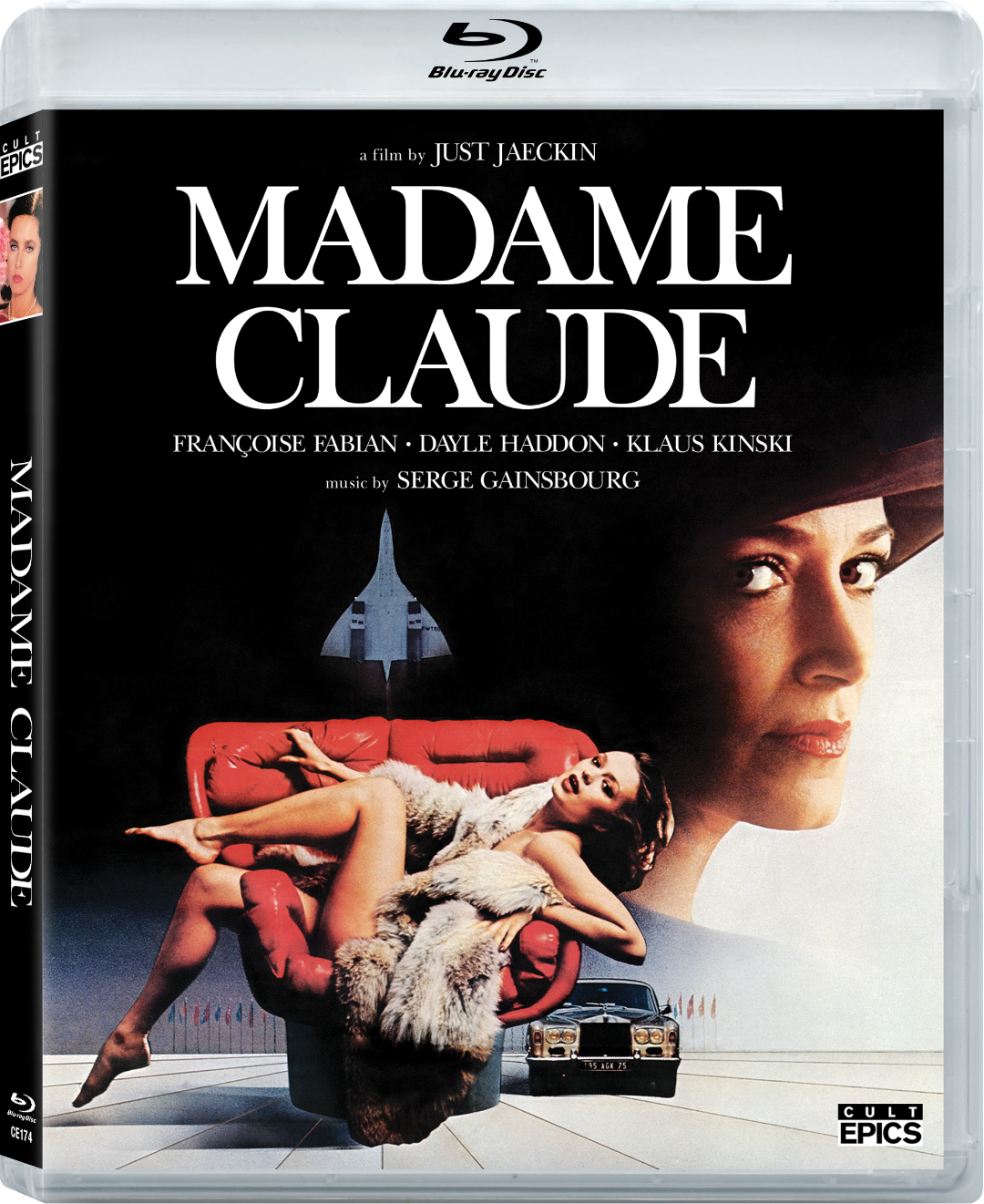
A high end Paris brothel ran by the influential Madame Claude sends the most beautiful and sophistical women to wealthy and powerful dignitaries all over the world to satisfy their most sexual desires.  Her lucrative business becomes a governmental target seeking to collect back taxes on the illicit business.  However, the French government is the least of her worries when a playboy-aspiring rake and amateur photographer snaps photos of Madame Claude’s clients in compromising situations that can be ruinous to their status.  The CIA becomes involved when unscrupulous business dealings involving an American and Japanese companies connect to Madame Claude and her potentially persuasive young women after rumored photographs put the Madame Claude in the middle.  Two governments, big businesses, a jet setting brothel, wealthy socialites and a nosy photographer become involved in lies, secrets, and the potential for murder.

Part biography, part fiction, “Madame Claude,” also known as “The French Girl,” is the 1977 released erotic and political thriller based off the real Madame Claude, Fernande Grudet, as her life of prostitution management and scrutiny unfolded before the public eyes in the mid 1970’s.  Erotically and elegantly sexy with gorgeous women groomed into lust and ensnared into the lion’s den of exchanging powers, “Madame Claude” became the third film from the immensely successful erotic French director, Just Jaeckin, following 1974’s “Emmanuelle” and 1975’s “The Story of O.”  Jaeckin, pressured by his financiers to continue his success in the highly sought eroticism, returns to the randy genre, but this time with a story to his liking, one that is embroiled in the background of a bribery scandal involving aerospace company, Lockheed, at the heart of it. From a script by crime-action writer André G. Brunelin, based off the book of memories of Madame Claude by Jacques Quiorez, Jaeckin splices visual elements of each story together to form not only an arousing sexual lamination but also a cloak-and-dagger tenser of a film. Shot primarily in Paris, with minor shoots in the Bahamas and Washington, D.C., especially the scenes on the faux White House, “Madame Claude” is a production of Orphée Arts of Paris with Claire Duval on as executive producer.

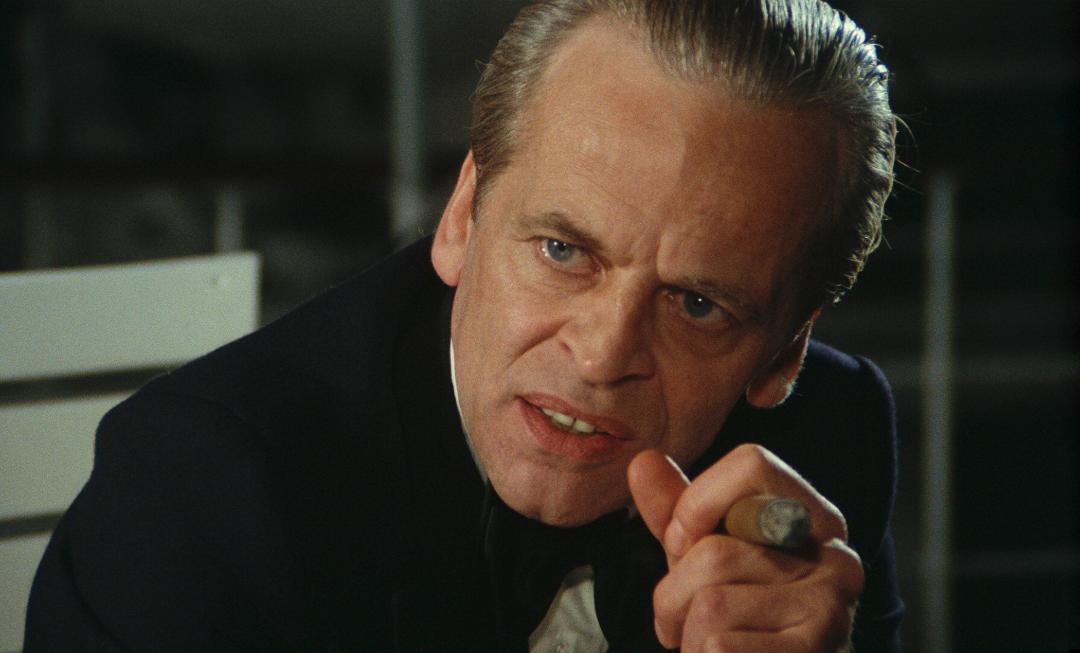
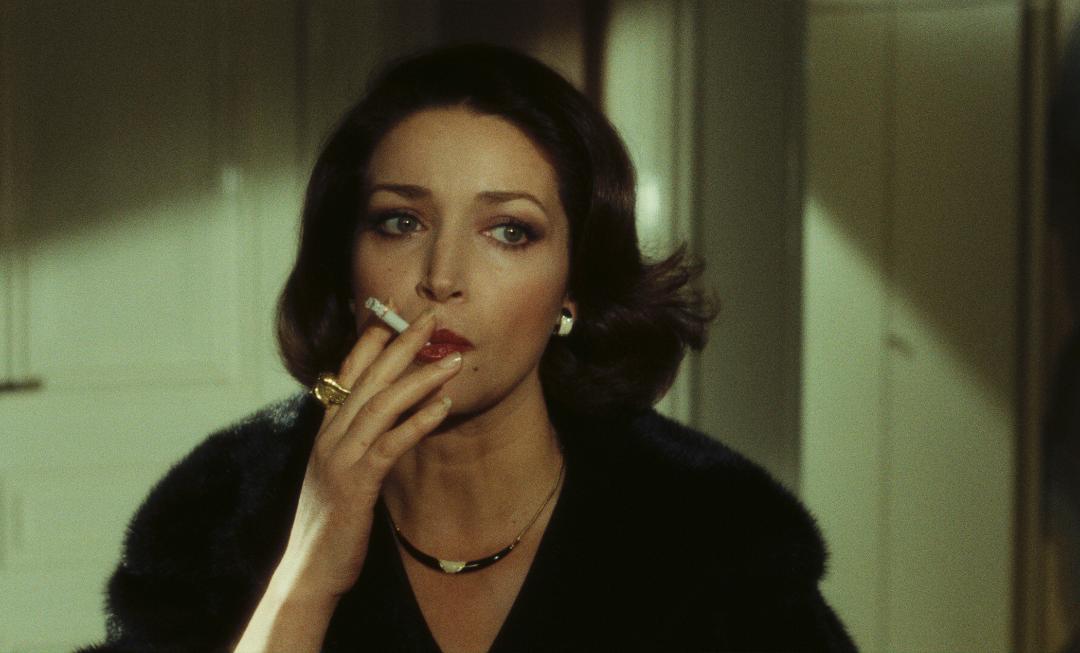
While the titular character is the obvious centerpiece, Jaeckin mingles the characters around each other in a game of espionage chess toward the endgame of checkmate. Keystone to everyone’s problems is Madame Claude, played by renowned French actress and early onscreen sex object, Françoise Fabian, who previously had roles in the paranormal pubescent horror, “Expulsion of the Devil,” a more comedy-friendly brothel film, “Holiday Hookers,” and among many other films predating 1977, but not until later in Fabian’s career did show rocket to success, playing older, more aligned, women that strongly championed feminism, such as portraying “Madame Claude” who used sex as a means to gain control and power of men, and pushed it to the brink of the era’s cinematic limits. “Horsehead’s’ Murray Head plays the photographer schmo, David Evans, making Madame Claude’s life complicated. An about town ladies man, Evans goes to each of Claude’s girls one-by-one and, for some reason or another, they invite the handsomely charming, but brutish, amateur porn photographer into their bedrooms, sleeping his way into blackmail scheme that will bring down the most powerful brothel head in all of Paris while also lining his pocket with not only money but power among the socialites who treat him like the village idiot. Head’s nails down the fast-and-loose aspect of Evan’s personality that treats his stratagem like a game he’s already won, but when the government agencies come knocking on doors, Head about faces Evan’s waggish incompetence to a frightened man looking around every corner for danger. It’s wonderful to see Head interact with Klaus Kinski (“Nosferatu the Vampire”) and Marc Michel as a ridiculed subordinate in an examination of social status as Kinski and Michel flaunt expensive taste and lavish orgies in lieu of decency, but it’s Murray Head, playing the fool with cemented proof that would put all them of into shame, as the aspirer to their life of luxuries. The beautiful Dayle Haddon (“Cyborg”), Vibeke Knudsen-Bergeron (“Spermula”), and Ylva Setterborg stun in just a handful of the very elegant, and very naked, women acting as Madame Claude’s international bound employees. Other cast of characters in “Madame Claude’s” game of lies and spies include Robert Webber (“Death Steps in the Dark”), Jean Gaven (“The Story of O”), François Perrot, André Falcon, and Maurice Renot.

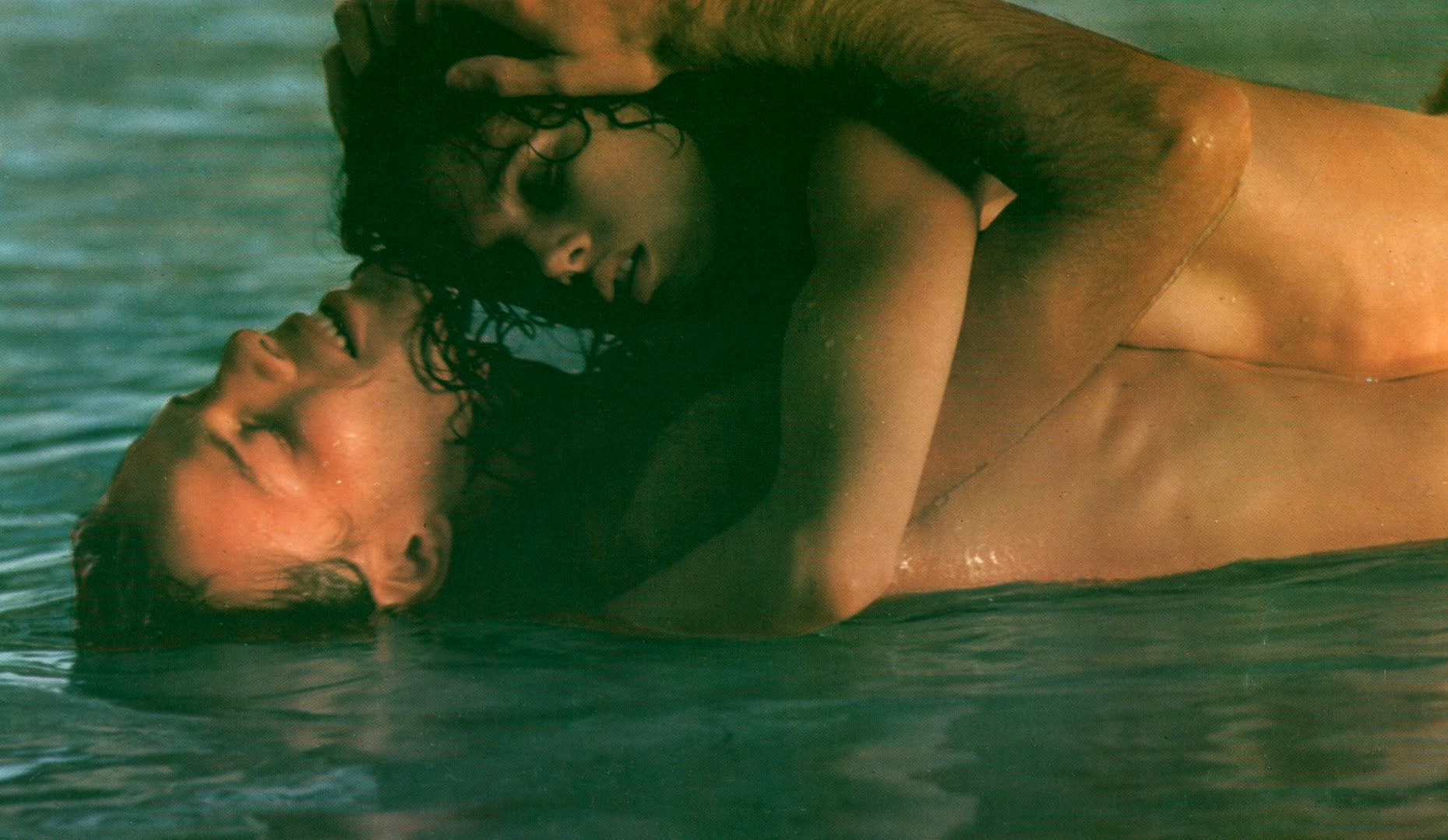
Following his films “Emmanuelle” and “The Story of O,” Jaeckin’s “Madame Claude” strays into an atypical kind of formulaic eroticism downplaying the sexual excursions and discoveries for a more typical crime drama affair. Jaeckin’s directorial abilities can take you on an exotic tour around the world and onto the fleshy planes of some of the most gorgeous and provocative women to ever grace the screen. Yet, “Madame Claude” trims substantially the skin with a more precise execution to be more of an oil lubricating the machine rather than the gear that actually operates the mechanism to entail sex as a misused tool for motivation and bribery. These scenes of fleeting eroticism outright shine Just Jaeckin’s proclivities with mirrored reflections and becoming lost in the entanglement of sexually enflamed bodies and these scenes outright shine Jaeckin’s intent on delivering a corkscrew crime drama with double-dealings, wiretapping, and counterintelligence gathering as what unfolds isn’t clearly delineated between Madame Claude, David Evans, the French and U.S. Governments and the Lockheed scandal that actually becomes sidetracked at times by the infiltrated sex-training of Madame Claude business as the brothel head has to train an alternative misfit new girl and send her to the Bahamas work trip shortly after a quick one-night-stand initiation with one of the Madame’s trusted former beaus. We wholeheartedly become more intrigued and fascinated with Madame Claude’s feminist principles, recruiting subjugated women to use their sexuality to dominate and become wealthy in the process. In more than one scene, Madame Claude flaunts self-admiration in transforming star-crossed girls into young women fortune bound with their promiscuous ways. Madame Claude’s murky backstory caresses her complexities of anti-man without detail delving into the turning point catalyst that made her become who she became to be, an affluent Madame, other than a seemingly emotionally and controllably invalidating romantic experience with a long time friend and business companion, Pierre (Maurice Renot).

Cult Epics sustains another forgotten classic into a celebrated Blu-ray release with a new 4K HD transfer of “Madame Claude” from the original 35mm negative, supervised by the original cinematographer, Robert Fraisse. Housed on a BD50, the region free release maintains the impeccable coloring under Fraisse’s soft glow with no cropping or undue enhances that tries to put out fire with gasoline and, aside from a discolored yellow-greenish, translucent stripe, perhaps a loose film roll, during the opening scene, the image quality is clean and pleasing in it’s natural 35mm grain. The English and French language audio tracks come with three options: LPCM 2.0 mono, DTS-HD Master Audio 2.0 mono, and a Dolby Digital 2.0 Stereo. The DTS-HD Master Audio had the highest marks, slightly topping Dolby Digital stereo with a little more gusto in the pipes. Audible dialogue is clean and forefront, but the engineered dubbing laid over Murray Head and, even, the self-dubbing of Dayle Haddon can be off-putting at times when actors’ voices seem to not be sharing the same vocal space with others on screen. French composer Serge Gainsbourg’s lounge, yé-yé score tuned into that erotic soufflé of light and airy pop music that can be often dreamy with singsongy female vocals, complimenting the softer, sexier side of Jaeckin’s film while also playing into period melodies of the 1970’s. Cult Epics always has down right with resurrecting obscure erotica for not only quality sake but also to arm the hell out of the releases with bonus material. Included with “Madame Claude” is an audio commentary by Jeremy Richey (author of the upcoming book entitled Sylvia Kristel: from Emmanuelle to Chabrol), a high definition, Nico B. produced interview with director Just Jaeckin from 2020, the vintage French theatrical trailer, a promotional photo gallery, and Cult Epics previews. Not the most sensual film shot by the renowned maestro of venereal visuals, Just Jaeckin explores his versatility by acclimatizing familiarity with new horizons surrounding brothel delights with shadow games and the new 4K Blu-ray from Cult Epics is the one, and only, way to experience it all in “Madame Claude.”

Cult Epic’s “Madame Claude” on Blu-ray. Available at Amazon – click the poster!


Chronicling the Cannibalistic, Necrophilism EVILs of a Serial Killer is for Adult Eyes Only! “LoveDump” reviewed! (A Baroque House / Digital Screener)

July, 2003 – a hollow-hearted serial killer, Denise Holmes, moves into a motel room of a populated metropolis of the West Coast.  Journaling every perverse and murder-lust desire in a diary, the unspeakable acts of sex and death blend together as one as the urge to kill grows bolder, leaving a trail of gore in the wake.  Paranoia begins to sink in after the last execution of an innocent victim and desecrating their bloodied, decapitated head in an inerasable moment from the mind. What you’re about to hear are the audio recordings of Denise Holmes’ diary inserts, read by Detective Jamie Reams whose giving a tactile voice to a wraith-like monster.

Over the years, the term Horror has been exploitatively glamourized for capital, trendsetting and bedazzled with glitzy gems of tamed teenager torment that sold the strung up, struck down, and sliced-and-diced adolescent carnage-fodder into each and every way the human brain can conceive with only a tweak of difference adorned with each ornate kill. Horror has also become garish with gorgeous women for the gratuitous donation of bare skin for the camera and the audiences to entice and gawk at the beauty in death. I’m not going to lie, I eat every millisecond of film of the good, the bad, and the ugly when it comes to horror, and, truthfully, horror has been making a strong stance in the last couple of years and I’ve been embracing the subtle tingling of mind game thrillers to the overtly ostentatious gore-soaked slaughterhouses of a genre with the broadest spectrum known to the cinematic universe. The filmmaker under the alias of SamHel pushes our tolerance for extreme content to the breaking point with the written-and-directed 2020 adult-fetish exploitation, “LoveDump,” an independent film from the USA under the production company, A Baroque House, that set out to pay homage to the graphic adult and fetish horror films of 1990s Japan.

The 33-minute short film only stars two performers in non-speaking, purely physical roles. First up, Wolvie Ironbear, an intersex non-binary adult content pansexual specializing in gothic and kink fetishisms, depicts the notorious necrophiliac serial killer, Denise Holmes, and Apricot Pitts, an unshaven fetishist whose also in the adult content creator realm, as a hapless prostitute who becomes a slayed statistic of sadism lured in by Holmes to greedily satisfy the nagging ghastly degeneracies. Most of the runtime runs with Ironbear licking at the chops, contemplating the next libidinous victim. Thick in the air is the sordidness moisture of solo self-gratification with unorthodox sex toys: a pig’s head, human blood, and other interesting, socially ignoble objects not fit to describe without dismantling in spoiler territory. Ironbear has to be a killer and a pretender, playing into a pretense that is a wolf in a sheep’s kinky-gimp clothing when Pitt’s prostitute steps into the motel room. Together, Pitts and Ironbear are electric, sexy, and give a damn good X-rated show of lust and macabre that turns the fever of carnality into a gruesome display of monomania participation.

“LoveDump” is not an attractive title, but suitable for unattractive content of desecrating the dead to the likes of Jörg Buttgereit’s “Nekromantik” and Marian Dora’s “Cannibal” while striving to be akin to Japan’s extreme horror like “Splatter: Naked Blood” or the notoriously sought after Guinea Pig films. “LoveDump” has an outrush of a snuff film that emanates a deep, dark secret club with elite memberships under pseudonym-ship in the producer and production departments. The makeup and special effects prompt disconcert of an upholding quality for an indie picture and, so much so, the affect of the human soul skin-crawlingly good that we can’t find ourselves looking away when the urge to be squeamish is strong. SamHel’s film digs niche graves that not everyone will have the courage enough to step into by choice. For myself, “LoveDump” is purely curious voyeurism, ingesting and digesting the film as an informational vessel of visceral paraphilias and without a solid plot to chew on, “LoveDump” is a straightforward stitch in time gorging more on graphic imagery than story and that is where the A Baroque House flick loses me to an extent.

Don’t expect palsied love-stricken hearts to be oozing with jubilee affections; instead, expect a romantic bloodbath of narcissism in a solo courtship like none other in SamHel’s ultra-gory “LoveDump” on a limited edition DVD and Blu-ray from A Baroque House. The camera work by the monikered Excessive Menace renders a SOV resemblance from the 90’s with a lot of unsteady handheld shooting as well as adjusting the clarity of focus, but the frames do flicker noticeably which can be a minor nuisance. Almost all the sex and gore scenes are in an extreme closeup the gives you an extreme eye feel for the commingling faux blood and real semen. One of my only gripes is with the angles in the intercourse with Apricot Pitts that didn’t translate over well without the proper focus and lighting to be as a graphic as possible. Since provided with a digital screener and the screener provided is a rough cut of the short film, there were no bonus material included, if there were any. The limited edition physical packaged Blu-ray will include the full HD uncut version of the film, a still gallery, a behind the scene making of, and trailer. I assume the LE DVD contains the same features, but are not specified. Be warned! “LoveDump” is not teeny-bopping horror filmed for any Joe Schmo to casually sit down to Netflix and chill with their partner, unless they’re into switch BDSM with an ichor fetish and, in that case, “LoveDump’s” an avant-garde aphrodisiac bred out of extreme and unwavering compulsions.

The Maestro Delivers Us From EVIL! “P.O. Box Tinto Brass” and “IsTintoBrass” reviewed! (Blu-ray / Cult Epics)


Tinto Brass, whose very name is synonymous with erotica cinema, presents a tantalizing series of letters and videotapes, written and recorded for him by adoring women executing their most sensual fantasies, exploiting their carnal desires, and giving the director a peak into their wet dreams. Brass’s lovely young assistant retrieves numerous submissions from his P.O. Box and as Brass scours through the countless correspondences, attempting to penetrate through the mundane to find that special something from his female fans, the stories become animated from text to short film visuals that involve spread eagle voyeurism, reluctantly desiring wife swapping, and a little husband and wife role playing to spice up their drab marital sex life by incorporating home movies. Each woman is able to confide in the maestro who harbors a gift for delivering classy and joyous erotica to not only the cinema market, but also into his admirers’ private lives.

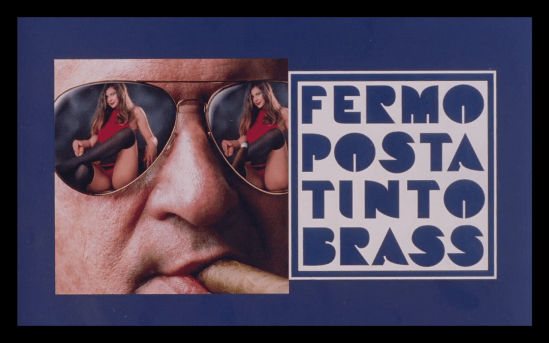
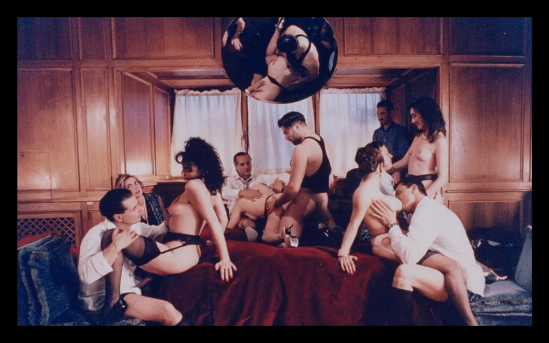
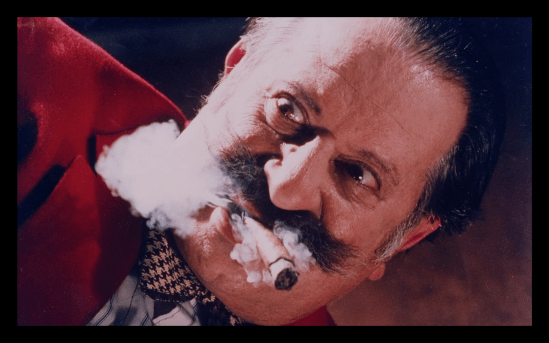
While America became gradually engrossed by the Showtime syndicated erotic drama series, “Red Shoe Diaries,” hosted by “X-Files” David Duchovny that showcased unconnected sensual stories from women who bared it all in heated encounters with male companions, the Italians’, who were experts in erotica cinema that this time, had their very own, slightly more explicit, version released in 1995 in full-length feature form, cleverly titled “P.O. Box Tinto Brass,” from director, and as titular presenter, the erotic master himself, Tinto Brass. Originally titled “Fermo posta Tinto Brass” in the native dialect,” “P.O. Box Tinto Brass” arrives on a new and restored 2-disc Blu-ray release from Cult Epics and acts as a celebration on not only the filmmakers’ immensely arousing body of work, but also a celebration on the director himself who has the uncanny ability to unearth the hidden away desires in all from his tongue-and-cheeky intimacy story arcs that relieve suppression for exploration of our natural sexual ambitions without the culpability instilled by taboo cultures. Granted, some of the material presented might feel dated and not as salacious as every John and Jane Smith can now utilize their God-given bodies to amass a modest fortune across the world wide web of sex, but to understand today’s culture, which still seems a fair share of sexually oppressive forces, we must look at Tinto Brass’s gift in normalizing what once was bedroom only material. Brass, who sport smoking a signature cigar throughout the film, uses his platform and becomes the vessel of expulsion to remove the privacy and shaming barriers that hinder healthy sexual appetites and, literally, creates a tactile representation of sexual jubilee with little-to-no seething judgement other than that of the character’s own restrictions. There are a ton of Brass trademarks shots that include, but not limited to, the hairy vulvas, a playfulness toward the vagina, exhibitionist flaunting, loads and loads of butt and breast angles in and out of clothes, elaborate location patterns on a grand, maybe art deco, scale, and, perhaps his most notable trademark, the expansive range of setting up elegant shots reflected off mirrors. As a whole, “P.O. Box Tinto Brass” brings a lighthearted and free atmosphere that’s uninhibited and sexy during and between each segment and while Brass is no doughy-eyed David Duchovny, I would be remiss in the lascivious eyes of Tinto Brass if I didn’t mention that after immersing ourselves in the “P.O. Box Tinto Brass” anecdotes, me and my wife had the most passionate, free verse sex we ever had since we’ve tied the knot 8 years ago, an experience that’s akin to an economically-friendly version of sex therapy. Thank you, Maestro!

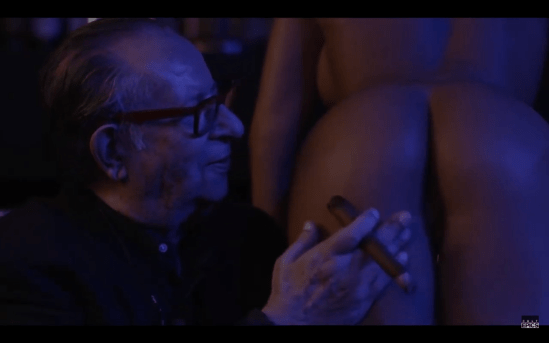
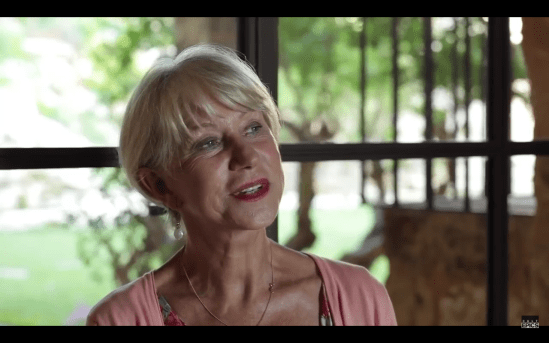
This leads us into the second disc of this Cult Epics epic release with a 2013 documentary, entitled “IsTintoBrass,” from a longtime Tinto Brass colleague and good friend, Massimiliano Zanin, who delves more into Brass’s political, experimental, and monumental work compositions that shaped the director into who is now the renowned eroticism auteur with a belief and a slogan that the ass is the window into the soul. Thought being born, bred, and flourish as an Italian filmmaker, “IsTintoBrass” speaks volumes about his French influences and his life guiding time at the Cinémathèque Française in Paris where he met Henri Langlois and Lotte H Eisner who exposed Brass to rare, unseen films His time Cinémathèque Française afforded him praise on his first films, such as “Who Works Is Lost” and “Attraction,” that were to the likes of French directors like Jean-Luc Godard and were labeled as a blend of part French New Wave movement and pop cinema. Zanin guides us through Brass’s continuous battles with censorship boards whose biggest problem with his filmic formations was not the nudity, but the supposed transgressions against conventional cinematic norms, especially with “Salon Kitty” that was an atypical example against the latter half of his career and used sex as a means of power of another person. His entrenched struggles didn’t end there as the documentary also shed lights on filmmaker’s most controversial work, “Caligula,” which became not his work due to a an underhanded producer who decidedly desired more sex than story and fought Brass, in more than one court of law, for the rights. Notable friends, colleagues, and film critics go through the eclectic Tinto Brass timeline, recalling and reexamining his decisions and aspirations into a multinational praise of his work. Some of these speakers included Franco Nero (“Dropout”), Helen Mirran (“Caligula”), and Sir Ken Adams (“Salon Kitty”). Plus, there is plenty of T and A to go around,

If Tinto Brass didn’t have a stroke in 2010, Zanin’s documentary wouldn’t have been made three years later as it’s a highlighted tribute of one remarkable Italian filmmaker’s life achievements stemmed from something as terrible as a life threatening ailment; yet, that’s how these things usually go, right? A retrospective acknowledgement, usually overwhelming positive in general, of a great artist whose work is greatly admired, frequently in a posthumous manner. In this case, Zanin saw fit to encase a historical record on Tinto Brass before meeting his maker, beginning with a really vigorous look into his inspirations at the Cinémathèque Française, chalking up much of his earlier work to his time spent looking through reels upon reels of avant garde films, but then Zanin quietly fades out of the path that elevated Brass as the cherished erotic connoisseur. Zanin’s story takes this awkward tangent to only skim the surface of Brass’s erotic films, which is strange since Zanin’s known and collaborated with Brass the last 20 years, about 13 years when this documentary was released, and penned a pair of his Brass’s saucy scripts, “Cheeky” and “Monamour.” Yet, the last 20, if not 30, years is surprisingly fleeting in Zanin’s capsulated effort to immortalize Tinto Brass. Still, the overall film is perhaps more endearing than Tinto Brass would have ever imagined, especially as brash and as perverse as his image portrays him outside the parameters of the filmic dome. Inside that dome, Brass has obtained throughout the decades a following of professional admirers and adoring fans who see him for what he truly is, himself. “IsTintoBrass” isn’t a gratuitous or perverted exhibition of an old man’s horniness; it’s an intoxication of what it means to actually be free from the repressive nature of censorship, the rapturous high of being an unchained artist, and being an obsequious master craftsman of cinema.

Cult Epics delivers a 2-disc limited edition Blu-ray of Tinto Brass’s “P.O. Box Tinto Brass” and Massimiliano Zanin’s “IsTintoBrass.” “P.O. Box Tinto Brass” has been newly restored and re-mastered in 4K high definition from the original 35mm negative and presented is a widescreen, 1.85:1 aspect ratio. The picture is absolutely stunning that revels in the burst of primary colors Brass was keen to implement. The details and the tones on the naked skin flesh out every beauty mark, fiber of hair, and every pore. Typically, Tinto Brass films run purposely a little soft to create a dreamlike, if not fantasy-like, setting to obtain a jovial mood setting for the uninhibited moments, but the details are still strong throughout. “IsTintoBrass” is presented in a widescreen, 1.85:1 aspect ratio, from a 2K transfer scan of digital video, aside from the snippets of Brass’s work. Video presentation is like crystal that obviously wouldn’t distinguish any kind of transfer anomalies because there wouldn’t be any. The Italian language 2.0 Mono LCPM/DTS-HD Master Audio 2.0 Mono (“P.O. Box Tinto Brass”) and the DTS-HD Master Audio 5.1 Surround (“IsTintoBrass”) are clearly discernible in all regards, especially in the Tinto Brass directed feature form ’95 with a clarity in the speech, a softer ambience that supports the dialogue rather than be level with it or overwhelm it, a range that mingles to support the dialogue as well. English subtitles are available on both discs. To smooth off any rough edges is a score by Riz Ortolani (“Cannibal Holocaust”) with a vibrant, cheeky score that fits perfectly into Brass’s wheelhouse of curvy, adventurous women. Bonus features on the first disc includes a 2003 interview with Tinto Brass who gives a brief background on his cinematic start, poster and photo gallery, and the trailer. Disc 2’s bonus material includes an interview with writer-director Massimiliano Zanin providing his reasoning for this documentary, a Tinto Brass achieve photo gallery, a couple of short interviews praising Brass’s passion, and trailers The package is also a work of art sheathed inside a cardboard, black and blood red slipcover and inside the casing is a 48-page booklet of Gianfranco Salis stills from the Tinto Brass achieve which are beautiful and almost Playboy-esque. To experience Tinto Brass is invaluable enough, but to experience his films in high definition is without a doubt worth it’s weight in gold with the powerhouse release of “P.O. Box Tinto Brass” and a retrospective documentary “IsTintoBrass” from Cult Epics!

Check out the LIMITED EDITION “P.O. Box Tinto Brass” release!

Spies, Lies, Thighs, and EVIL Guys! “The Dallas Connection” reviewed! (Mill Creek Entertainment / Blu-ray)


Chris Cannon and Mark Austin are back to save the world from a devious organization once again as the two bureau agents are assigned to protect the last world-renowned scientist that developed an International World Arms Removal (I/War) satellite project that could detect terrorists’ weaponry no matter how concealed, but when the other three scientists from around the globe are brutally assassinated, the odds are stacked up against them and the bad guys are always one step ahead of them. Given four computer chips to guard at all times, I/War assigns their best agents to the task of securing hope for the project, called The Dallas Connection, for three days until a specifically timed launch to coordinator with a passing asteroid field that’ll power the satellite for years decades to come, but the well-armed and well-organized crime uses all assets and their power of seduction to gain control over the satellite at all cost.

The L.E.T.H.A.L. ladies series continues with the second buddy-cop picture, “The Dallas Connection,” helmed by Christian Drew Sidaris, son of the erotically charged-action producer and filmmaker, Andy Sidaris that follows up on the first Drew Sidaris prospecting fracas, Enemy Gold. “The Dallas Connection” is the tenth installment of the series, known also as the Triple B series (that’s Boobs, Bombs, and Bullets) that has little-to-nothing linking the entire series cache together aside from being exclusively explosive wrapped with a sensual rouleau of Playmate and Penthouse centerfolds, tightly coiled around the tight and firm half-naked bodies of it’s leading stars. The Sidaris team, under the Malibu Bay Films and Skyhawks Films banners, one again economically ignite a successful B movie that promises 90’s attired, flamboyant action on set at a few familiarly recycled locations in Shreveport, Louisiana and Los Angeles, California, redressed for a not-so different genre or distant premise.

As aforementioned, centerfolds are a staple in any Sidaris, father or son, girls and guns feature and “The Dallas Connection” is no exception, starting off with their main squeeze, good friend, and cult movie icon, Julie Strain, as one of the chief co-antagonist under the nom de guerre, “Black Widow.” Strain is tall, sexy, and a wild villain capable of restraining the violent kick of an AK-47 in thigh high boots and a low-cut open jacket that embodies gun nuts most delectable dreams. The once Penthouse Pet of the Year stays quite reserved compared to her tantamount villainous role in “Enemy Gold” by going topless only in a couple of instances in a death grip roll that involves a lap dance before her prey’s demise, a specified attribute to the beautiful and deadly small spider she spins her call sign from. Black Widow is joined the just as deadly Cobra, fellow Penthouse Pet of the Month February 1993, Julie K. Smith, and Scorpion, the equally as Julie Strain tall, Playboy Playmate of the Month December 1991, Wendy Hamilton. Smith and Hamilton offer up polar features that doesn’t make “The Dallas Connection” a one-type of woman show, but both are voluptuous in their own rite, adding sizzling hot tub sex scenes and long-legged strip shows to accentuate “The Dallas Connection” amongst the B movie fray. “Phantasm II’s” Samantha Phillips becomes the whip cream on top, rounding out Sidaris’ centerfold assembly, as another the third Penthouse Pet of the Month, June 1993. There’s also Bruce Penhall and Mark Barriere, but who cares about these shirtless studs who drag race old Plymouths and jet ski when you four gorgeous women to ogle over? Penhall and Barriere mark their return as Chris Cannon and Mark Austin from Enemy Gold in a buddy-cop adventure loaded with a Dirty Harry Magnum .357 and a M1 Grenade launcher assault rifle. Kaboom! Rounding out the cast is Gerald Okamura (“Big Trouble in Little China”), Roland Marcus, Cassidy Phillips, Ron Browning, Tom Abbott, and Rodrigo Obregon as a satellite scientist.

After finishing “The Dallas Connection,” I wanted to say that I’ve seen this movie before and not because of some misplaced form of déjà vu, but, rather, that I, in fact, HAVE seen this movie before in the precursor film of the L.E.T.H.A.L. ladies series, “Enemy Gold.” The story’s been tweaked slightly to a story with the same framework. Hell, like also mentioned, when you throw in some of the same locations as in “Enemy Gold,” Sidaris’s home with the hot tub and the cabin the woods, and redress the same actors, Julie Strain, Bruce Penhall, Mark Barrier, Rodrigo Obregon, Tom Abbott, and Ron Browning all in the essentially the same roles, “The Dallas Connection” just feels like an extension or a mirror image of that former film, making the story a weary one with nothing really new to spectacle except for three pairs of new, large-and-in charge, breasts in Smith, Hamilton, and Phillips. One difference noticed is that the bureau agents this time around are a lot dafter with skulls thick as a brick and unable to use common logic in the most practical situations. There have been many a time when producer Andy Sidaris commented his films to James Bond, but at least Bond had the smarts to always be on guard; Chris Cannon and Mark Austin do indeed think with their other head that do, in benefit, leave the door open for some saucy hot tub sex that’s perhaps the best simulation from Sidaris reel I’ve seen to date.

Available for the first time on Blu-ray, “The Dallas Connection” will get your rocket launchers off with ton of gunplay and is loaded with beautiful women. The region A, 1080p high definition presentation from a 4K scan restoration has an aspect ratio of 1.78:1 widescreen. The image’s simply gorgeous from the 35mm negative baring a few minor faint scratches that linger only for seconds at a time. There’s quite a bit of noise during the night scenes that almost make the scene look daylit, but skin tones, especially gleaming with water, are remarkably velvety and the textures on clothes and skin looks great for a low budget action. The English language DTS-HD Master Audio dual channel mix medleys appropriately, dialogue is clear and upfront and ambience has proper depth and range. Explosions are powerful coming through the dual channels with a hefty LFE and gunfire can rip just as good as Dutch blasting away at a trophy hunting alien in Predator. Even the sexy lounge soundtrack from Ron Di Iulio is on point despite being a rehash of “Enemy Gold” once again. Hardly any blemishes or distortions coming from the audio track. English SDH subtitles are optional. The bonus features mirror that of “Enemy Gold” as well with Andy Sidaris and Julie Strain doing this awkwardly coy and sugar daddy bit showing off “The Dallas Connection” merchandise and international posters that lead into Andy’s film school where him and his wife, Arlene, go onto commentary on how to shoot scenes and edit them together, using an action and a sexy scene from “Return to Savage Beach” as reference. In the same behind the scenes, there’s an equally bizarre Joe Bob Briggs interview where the legendary MonsterVision and The Last Drive-in Host seems uncomfortable with Andy and star Julie K. Smith about how he persuades to get these beautiful centerfolds to be in his films. Other bonus material includes a commentary on the film itself and theatrical trailer. “The Dallas Connection” is a Texas-size IED with a busty ornate façade, but acts more like a duplication of something we’ve already experienced, making the sophomore feature from Christian Drew Sidaris just a more of the same.

Only $12.99 at Amazon.com! Plus, you purchase a VHS tape! WHAAA!?!