
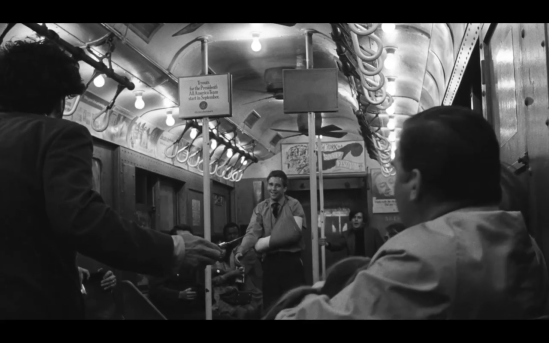
On the early morning streets of New York City, a drunken Artie and Joe delinquently roam the stillness of the Bronx after hours. After joyfully mugging an old man for a measly eight dollars and his wristwatch, their night leads them heading to the subway platform for more so called fun. A riotous Artie and Joe hop inside a railcar full of passengers that consists of two army privates on leave, a young couple on a date, an elderly Jewish couple, a young family with their 4-year-old daughter, an in recovery alcoholic, a passed out homeless man, a bigoted African-American and his wife, and a nervous gay. The passengers’ delineated diversity doesn’t thwart the two thugs’ harassment that holds the riders, in fear and in obstruction, from leaving the railcar and as personal limits are pushed to the edge, moral courage is effectively choked down by the helpless riders until one of them can’t take the bombardment of the perpetual daunting intimidation.
“The Incident’s” in your face, tell it as it is, hostage style dramatic thriller from 1967 barrels down an endless track of relevance and suspense inside the idealistic perception of New York City’s culture in the mid-20th century. Director Larry Peerce (“One Potato, Two Potato”) helms a masterpiece of a film that not only defied cinematic character standards but also defied the NYC transit authority who denied Peerce, along with cinematographer Gerald Hirschfeld (“Young Frankenstein”) to shoot in and on the NYC subway system. Taking a relatively guerrilla filmmaking approach to achieve railcar and platform exteriors, Peerce also managed to construct a true to size, if not larger, railcar to get the drama unfolding between the harmless transit riders and their two terrorizers. “The Incident” was the first feature film penned by teleplay screenwriter Nicholas E. Baehr whom also wrote the television movie version of the story entitled “Ride with Terror” a few years prior, but Larry Peerce clawed, scraped, and held together a cast and a crew that nearly dismantled due to funding and production issues until ultimately being saved by 20th Century Fox.
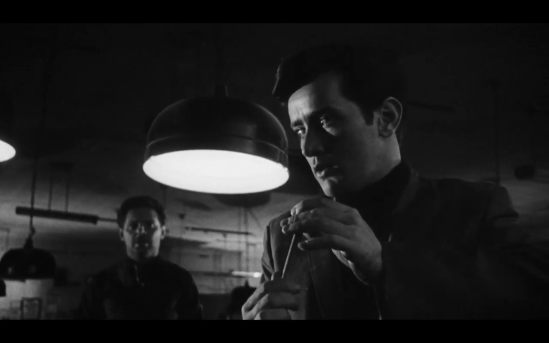
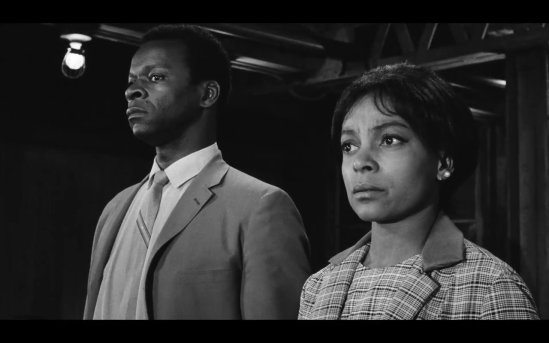
“The Incident” has such an ensemble cast that it’s difficult to even know where to begin. Two introductory feature film performances from Martin Sheen (“Apocalypse Now”) and Tony Musante (“The Bird with the Crystal Plumage”) as the errant ruffians is unequivocally good at being bad. Musante, especially, leaves a lasting impression as Joe Ferrone who oozes with slimy browbeating tactics by plucking that one sensitive nerve in each of the riders. As equally as good in comparison is in the injured Army private from Oklahoma, played humbly and genuinely by the baby-faced Beau Bridges (“Max Payne”), with a gosh-golly grin and a peacemaker wit about him that makes the private a prime target. Sheen, Musante, and Bridges are only the caboose when considering the train of highly trained styled actors that also include Thelma Ritter (“Rear Window”), Donna Mills (“Play Misty for Me”), Brock Peters (“Soylent Green”), Jack Gilford (“Cocoon”), Ruby Dee (“Jungle Fever”), Diana Van der Vlis (“X: The Man with the X-Ray Eyes”), Mike Kellin (“Sleepaway Camp”), Jan Sterling (“Women’s Prison”), Gary Merrill (“The Woman Who Wouldn’t Die”), and Victor Arnold (“Wolfen”). Ed McMahon makes his feature film debut as well! As an ensemble unit, the interactions evoke immense tensions and passion inside that railcar and from our very own couches.
Everything about Larry Peerce’s “The Incident” capitalizes on being nearly flawless. From the construction of the last act railcar set to the flash of urban realism, “The Incident” is high level on the suspense thriller hierarchy, but the characters and their personal baggage egregiously forced to the surface is utterly captivating and refreshingly cathartic to simultaneously showcase adult bullying engage enragement while also bubbling and bursting through thin layered passive aggressive convictions and attitudes. Joe Ferrone is symbolically a catalyst for the majority of riders, exposing internal loathsome, sham friendships, and tough guy personas, that naturally shreds down their ghastly facades and revealing their true, if not unpleasant, selves. Equally as compelling is the one scene with racial profiling and prosecution by the law enforcement that is heavily journaled in the today’s media and Peerce clearly believes in this injustice and adds the brief, yet powerful, moment at the tail end of the film that involves Brock Peters’ character.
Eureka Entertainment proudly presents the 20th Century Fox raw and intense New York based thriller, “The Incident,” onto a dual formatted, Blu-ray and DVD, home video as part as Eureka Classic sub-label, marking the first time on Blu-ray in the United Kingdom. Unfortunately, a DVD-R screener was provided for coverage so a review of the video and audio will not be covered, but from the spec information provided, the transfer is a 1080p high definition digital transfer with uncompressed monaural soundtrack on the Blu-ray. There are optional English subtitles available. What can be said about Gerald Hirschfeld cinematography is this, it’s a complete mastery of the trade with a penchant for black and white and seamless edited camera cuts. Bonus features listed are a brand new and exclusive audio commentary by film critic and writer Alexandra Heller-Nicholas, author of Rape-Revenge Films: A Critical Study, a post-screen Q&A session with director Larry Peerce from the 2017 Wisconsin Film Festival, the original trailer, and a collector’s booklet feature new writing by film writer Sam Deighan and critic Barry Forshaw. “The Incident” is searingly powerful and a societal wake up call of we’re all in this together or we’re all a part of the problem.\
Category Archives: Evil Reviews


Evil Turns Frat Boys into Bloody Greek Yogurt! “Dude Bro Party Massacre III” reviewed!

Brock Chirino, a survivor after tragedy strikes twice by a serial killer named Motherface who stalked and killed his campus fraternity brothers of DELTA BI THETA, is found gruesomely hung from a flagpole with his guts strewn tightly around his neck. Brock’s twin brother, Brent, wants answers and begins pledging with the troublemaking and cursed fraternity that is on the verge of having another Motherface encounter, beginning with the death of his popular twin. Sinister powers to be send the remaining DELTA BI THETA brothers to an isolated and notorious lake house where one-by-one, beer-by-beer, each brother is hunted down with their own personal fears invoked by the serial killer and lethally weaponized against them.

More enjoyable than a cheap case of beer pong beer is the trope-after-trope satirical genre upheaval in “Dude Bro Party Massacre III” from first time feature film directors Tomm Jacobson, Michael Rouusselet, and Jon Salmon with a screenplay penned by lead actor Alec Owen along with contributions from the directors and Ben Gigli, Brian Firenzi, Joey Scoma, Michael Peter, Mike James, and Timothy Ciancio. Usually with a conglomerate of writers and directors attached to a single project, the resulting work lacks coherency as a mesh of styles create a havoc bearing exhibition for the viewer whose head is about to explode and ready to give up on trying to make sense of disastrous, multi-motivational storyline, but these particular guys are a part of an internet comedy troupe the under 5-Second Films production company, established in their good ole college days circa 2005 to 2008, and have long list of meaningless, yet funny, credits in sketch comedy that include Uproxx Video and Funsploitation. The filmmakers’ “Dude Bro Party Massacre III” is the supposed third film in a trilogy of unspeakable comedic terror without really having a first film or its sequel as the gag, but rather recap, ingeniously and in a squeamishly gory fashion, a fast-paced and well thought out montage of series of events from the “first two” Dude Bro Party Massacres.

The 5-Second Film troupe can be synonymous with the guys of Broken Lizard, but in a slightly tweaked version that’s sure to be piss your pants funny and keep eyeballs glued to their 103 minutes of beer, hazing, and blood. Kicking it off in a dual role is Alec Owen as Brock and Brent Chirino; one super cool bro and the other just a regular cool bro, share a meaningful twin experience that keeps both characters in the mix. Owen dons daft well, but do so the slew of other in his close knit entourage of Paul Prado, Ben Gigli, Joey Scoma, Brian Firenzi, Michael Rousselet, Jon Salmon, and Kelsey Gunn. Their well-oiled machine of timing, exuberance, and expressions, from years of collaboration, make them a juggernaut in their field, leveling with, or even just beating out, the Broken Lizard team for best satire horror film. To top things off, the eclectic special guest stars add that little something, a little spiked cream in the dark, bold, Columbian coffee if you will, of unprofessionalism that just makes “Dude Bro Party Massacre III” a go to rental (or purchase) on a movie and chill night. Did you ever think you’d see Larry King in a horror movie? Yeah, that Larry King who made millions as a late night talk radio host said, “Star in a horror movie? Sure, why the hell not?” Though brief, King’s appearance is welcoming gory garnish and other guest stars whoopee in the same fate, including esteemed porn actress, the queen of sex, Nina Hartley, in an unusual non-sexual role, rock performer and producer Andrew W.K., Tommy Wiseau collaborator Greg Sestero, and my fellow Portsmouth, Virginian native, Mr. Patton Oswalt in another brilliant comedic performance. Yes, I’m dead serious, bro. Plus, Olivia Taylor Dudley as Motherface equals a repeat performance; perhaps for “Dude Bro Party Massacre IV???”

“Dude Bro Massacre III” is a 100% intentional caricature of the 1980s slasher genre, going against the well established and solid bedrock that’s bred horror fans for generations, and rocking the sacred structure to the core that not only will be admired by hardcore horror fans, but also not objectionable in its goofiness those said fans and will sufficiently gaudy for the causal popcorn moviegoer. Those in the former will recognize that tropes vitalize without tiring out the dude bro party, such as with a snarky, masked killer returning from the grave, twice, whose a bit of a mash up of Jason Voorhees and Freddy Krueger, the Final Girl notion is reversed to a Final Boy left to tell the ostentatious tale, and extravagant and elaborate deaths ultimately become a living, breathing entity to inspirit. Plus, backstories and character tangents diversify the story perpetuation enough to not over-saturated solely on DELTA BI THETA reckoning. In all honesty, the gore is the star and if gore was the object of wealth, “Dude Bro Massacre III” would be an affluent God with blood splatter on a divinity level.

5-Second Films and Snoot Entertainment release the Not Rated, 2015 satirical horror, “Dude Bro Party Massacre III” onto DVD home video distributed by MVDVisual. Presented as the only surviving VHS copy of a dismissed and banned film by some guy recording a television airing over his childhood memories, a 4:3 aspect ratio continues to sell the artificial, retrograded video nasty of obscurity. Even the mock cut in faux commercials are a nice touch that reminded me a little bit of John Ritter’s “Stay Tuned.” One thing that’s missing was the presence of digital noise as the image was really too vibrant and clean to be a super VHS or any other kind of SOV. The English language 2.0 audio track is clean with prominent dialogue and hefty amount of ambient blood gushing, splashing, exploding, etc. Bonus features aren’t impressive with only audio commentary available through the static menu, but Devon Whitehead, whose cover arts with Scream Factory releases are beyond ridiculous, lends his talents here with another intrinsic, manic storytelling work of art. A little late to the game with this review for a film from 2015, but “Dude Bro Party Massacre III” is getting a re-release and is worth the time pledging oneself to again and again with a high level rewind satisfaction rate.

Don’t Let A Bro See It Alone! Available at Amazon.com

Insemination EVILS in “Bigfoot: Blood Trap” reviewed!

The folkloric Bigfoot goes bananas on one man’s family, killing his wife and young daughter before leaving him crippled. Years later, the same beast rips the guts out of two tattooed women filming a girl-on-girl romp in the middle of the woods after mistakingly gunning down Littlefoot with their accompanying high powered rifles. Meanwhile, gun store owner, Shannon, receives news that’s she’s inherited land from her estranged, molesting grandfather that could be worth a small fortune. Before opting to sell the land, Shannon, her brother Billy, and her two uncles, Bob and Chester, aim to have a good old fashion hunt, but are viciously attacked by the monster. Barely surviving the ordeal, they managed to capture the creature with a tranquilizer gun and phone in an eccentric cryptozoologist, Dr. Corman, who presents a radical proposition: To prove his missing link genome theory, he wants to conclude that Bigfoot can, in fact, inseminate a human female to produce an offspring. Though crazed and inhumane, the wild idea could bring in loads of capital from all sorts of scientific angles, but the greedy captors soon learn that’ll it’ll take more than a pretty face to get the legendary and mysterious Bigfoot into the proper mood for lovemaking!

With the exception of a few films, the lesser known Sasquatchsploitation genre has been more schlocky exploitation than of Bigfoot doing some serious rampaging. Critics from around all outlets, small and big, have mercilessly dumped upon the hairy big fella, calling the flicks stinky as much as reeking Bigfoot in it’s natural habitat. Unfortunately, “Bigfoot: Blood Trap” sustains the same fodder and, perhaps, evens lowers the bar even further. Despite claims of the satirical motivations and plenty passion for the project, the John Orrichio directed film released in 2017 is a bit of giant mess. The New Jersey based Orrichio (“Paranormal Captivity”) collaborates with Edward X. Young, who was thrusted into scandalous controversy with this film as he was then an active candidate for a member on the New Township Board of Education. Safe to say, a storyline involving young women being kidnapped for rape and insemination didn’t go over well with parents, but Young and Orrichio sallied-forth to bring us a plot about an abomination from the abominable.

As aforementioned, Edward X. Young steps into the role of a creepy cryptologist named Dr. Corman whose obsessed with impregnating an abducted, innocent young women. With extensive credits in no-budget horror, including “Mold!” and themed holiday slasher “Easter Sunday,” Young is highly enthusiastic about his part, being one of the main fixtures of the overhauled production, evening tackling the special effects rich with blood soaked intestines. Another lasting cast member is “The Soulless” actor John McCormack as uncle Chester. Rustic as as he is rusty, McCormack bulldozers through his lines, never letting emotions and inflections carry his performance to fruition. Playing Chester’s nephew, Billy, is “Bloody Christmas’s” Dennis Carter Jr. With turbo energy and a high, if not zany, voice, Carter blossoms more of the satire from hiding, especially when contrasted against his sister, a gun-toting, possessive, money grubber named Shannon played by Chrissy Laboy (“Long Island Serial Killer”). Young, McCormack, Laboy, and Carter are the staple four that have the most scenes, but since the production spanned over the course of years, main characters came and went like yesterday’s bagel, introducing other characters into the fold from a supporting cast that included K.J. Hopkins (“Witches Blood”), Richard Szulborski (“Paranormal Captivity”), Gregory Stokes, and John D. Harris Jr.

As much as one can open their mind to all types of movies, across a vast spectrum of genres, sitting through “Bigfoot: Blood Trap” tested patience, will, and interests. The over-the-top gore, with strewn organs being, sometimes awfully blatantly, ripped from the bellies of Bigfoot victims did not turn heads away in disgust. The problem is more insidious with sloppy, shoddy technical gaffes with a brain seizing storyboard and choppy editing topping the lineup. Performances eek by without much scathing and one could even look past the joker in the “Trading Spaces” monkey suit passing as a vicious Bigfoot, but the lack post-production effort, especially with such a lengthy shoot, kinda says, “Hey! Let’s wrap this up! “Pronto!” and carry on with our lives without batting an eyelash in attempting at beautifying a hunk of ho-hum creature feature, but there is one positive thing about “Bigfoot: Blood Trap,” Orrichio manages to pull off 95 minutes in a sex with Bigfoot bonanza and I’m sure nobody else can claim that title.

“Bigfoot: Blood Trap” is released onto DVD home video courteous of Wild Eye Releasing on their Raw & Extreme label. The DVD is presented in a widescreen, 1.78:1 aspect ratio, that often looks stretched over a canvas with plenty of digital noise and low lighting woes. Colors look okay and same can be said for skin tones. There’s hardly any tinting so all, if not most, scenes are in natural lighting. Some lens cleaning wouldn’t hurt either on the drone for ariel shots. The English language stereo 2.0 lossy mix has hard stops when regarding quality. Swelling vocal tracks lack fidelity gusto and wander into the crackling territories often associated with poor mic placement or an unfinished track mix. Dialogue also comes and go from the forefront to the background. Bonus features include a production interviews, which are basically actors introducing themselves and being advocates for their characters. Also included is a segment entitled “Andy Girffith,” where little foot and Bigfoot reenact that rememberable son and father walk with a fishing rod with whistling that recognizable and catchy thematic tune. “Killing the Girls” is a true behind-the-scenes look into two of Bigfoot’s potential unwilling mates meeting their ends at the monstrous hands of the hairy beast; it’s a glimpse of Edward X. Young, wearing his special effects technician hat, gooey up the gore on the girls as the act out their best scream queen impersonations. Rounding out the extras is a music video and trailers. From the Wild Eye Raw & Extreme’s snarling, bloodied-teeth, Bigfoot faced DVD cover, high hopes created a false foundation leading into a John Orrichio’s Sasquatch breeding farm film! Yet, no matter how enthusiastic the cast, “Bigfoot: Blood Trap” unsavory independent charisma snared time that we’ll never get back into our precious lives ever again.

Own this Raw & Extreme film today!

The Only Way EVIL Would Go Out With a Virgin! “Double Date” review!

Recently dumped and severely panicked around women, the prospect of ever dating again seems like a long shot to Jim. Self-assured Alex sees the opposite for his best mate as a golden opportunity for him to get Jim laid before his 30th birthday. When Alex finally coerces and assists Jim on scoring a double date with two sisters, Jim can’t believe his stuttering awkwardness actually proved fruitful, but little do Jim and Alex know that the sisters, Kitty and Lulu, are out for blood. The sisters seek a virgin to sacrifice to bring their long deceased father back from the dead and to complete their trio-family once again at the expense of Jim’s involuntary celibate lifestyle. Night clubs, fast cars, and visits to the parents take the four through a series of dark and drug fueled misadventures and the unexpected moment of falling love that makes this double date one to die for!
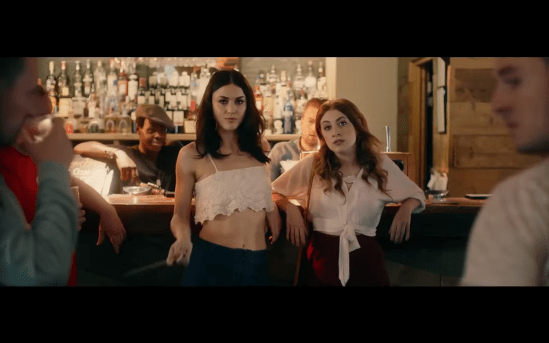
First dates are always inherently frightening. The idea of being alone with a stranger, who you’re kind of attractive to and trying to impress, yet don’t really know a single thing about them, can be daunting, if not paralyzing. First date in a double date is supposed to ease that overwhelming fear and take the strain off from the lack of possible interest in the other person, but for director Benjamin Barfoot’s amusing horror-comedy, “Double Date,” all bets are off and all tensions are on edge when dating goal sights are deadly different. Danny Morgan pens a comedic gem in which he stars as the bumbling virgin, Jim, joining his long time collaborating partner, Barfoot, to complete their first feature film together. The British made and produced film gives glimpses of London’s fung shui through the pubs, clubs, and overall eclectic nightlife to the aristocratic mansion homes to the likes of “Downton Abbey” resulting in a slight blend of the past and present into a well-oiled story embodied with terror and fun.

Funny man Danny Morgan stars as the awkward and blundering Jim whose plagued with fumbling qualities around women that usually leaves him somewhere in the inner circle of the friend zone. Morgan brilliant showcases Jim’s stunting inadequacies that eventually come to flower while maintaining a solid naturally slapstick presence of self-deprecation that turns into a full-blown bull in a china shop. The scene with his parents and himself singing his birthday song in front Lulu in audience, while tripping on drugs, is cathartically enjoyable and a riot of inner laughter. Morgan’s joined by “Being Human” actor, Michael Socha, as Jim’s very good friend, but all talk confident friend, Alex. Alex is certainly the yang to Jim’s yin on screen and off screen as Morgan and Socha have a certifiably fresh dynamic that makes them very entertaining to digest. Socha brings a different kind of comical energy that compliments Morgan’s dry humor that diversifies the content. In fact, all the characters bring a little something different to the table, such as with the sisters, Kitty and Lulu, played respectively by Kelly Wenham (“Dracula: The Dark Prince”) and Georgia Groome (“The Cottage”). Training like an elite athlete, Wenham takes the role to heart being a dark and beautiful villain that’s inarguably alluring as she’s cold and deadly. The Cheshire born actress, whom hands down can be the next Megan Fox, sinks her teeth into the performance and excels in the physical role that’s showcases her range of talent. Then, there’s Georgie Groome as Lulu, the timid opposite of Kitty. Also known as the girlfriend of Harry Potter’s Rupert Grint, she nails being the one in the shadows, relinquishing control mostly to Wenham for most of the film, and then slowly build character confidence and strength.

“Double Date” is a great blend of horror and comedy. The climax has this satirical and retro quality about that seems unfitting, but is stitched carefully to fit without bursting and popping a seam (or scene?) to the point of overly obtrusive. Benjamin Barfoot also has a keen eye to capture the pivotal and incandescent moments that make scenarios have more an impact, whether that being a facial expression, an awkward dance, or any kind of verbal or action exchange between characters. Doesn’t hurt that Barfoot’s rapport with Danny Morgan is a relationship riding the same director-actor level plane, similar to the dynamics between Adam McKay and Will Ferrell, with a synonymous cerebral synergy that clicks well for the silver screen.

From the independent film company who delivered “The Man Who Killed Hitler and then the Bigfoot,” Sparky Pictures releases the Screen International/FrighFest awarding winning horror-comedy, “Double Date”, onto digital, DVD, and Blu-ray come September 9th in the United Kingdom. Unfortunately, an in-depth review of the video and audio specifications will not be covered as a BD screener disc was provided, but what can be said about the soundtrack, performed by GOAT, is pure primitive gold and the appearance by Big Narstie is equally solid. Bonus material, on this check disc, included an extensive behind-the-scenes, from conception to wrap, of Danny Morgan and Benjamin Barfoot’s roller-coasting adventure on getting their film made. There’s also a commentary with cast and crew, deleted scenes, photo gallery, and trailers. “Double Date” is a true black comedy and a whole lot of fun that should skyrocket filmmakers Danny Morgan and Benjamin Barfoot toward future endeavors as a rising, powerhouse duo, contending to be the next hit in the satirical category.

Amazon has Double Date! Own it today!

Taking the Vindictive Fight Against EVIL! “Girl Number Three” reviewed!

Art major Max lives a disciplined life, especially in the love department which is constantly challenged by her roommate to play the field, but Max aims for true love and will consummate her feelings toward longtime boyfriend, Brian, whose patience will be rewarded with a sexy maid costume at a Halloween party that will eventually lead back to the bedroom. Before the party, Max is kidnapped by masked men at gunpoint and taken to an abandoned textile factory. Surrounded by All Hallows Eve zealots and eight other hooded and bound women, Max becomes the ritualized girl number three, a number bestowed upon her as a chosen sacrifice amongst the brotherhood for sex and, most likely, death. When part of the crumbling building collapses, Max seizes the opportunity to flee, but as escape from the building seems impossible and other women screams echo through the vacant hallways, girl number three has been pushed too far and picks up an old fire axe, concluding that she must kill them all.

The second Shami Media Group distributed production to come across our chop block in a matter of weeks. First, the Nathan Thomas Milliner directed “A Wish for the Dead” written by Herschel Zahnd was the fitting entry film to ease into and extract our thoughts, takes, and opinions. Overall, Milliner’s film sold a solid product. Now, here’s Herschel Zahnd directing “Girl Number Three” that’s written by Nathan Thomas Milliner and Zahnd guides us down a completely different pathway from Milliner’s wish granting of undead havic and into a conceivably relevant sadistic exploitation and vengeance thriller. Released a decade ago in 2009 and based off of a Milliner’s short graphic novella, which seems to be a reoccurring and fruitful source of material for their production company Renegade Arts Productions, Zahnd’s ice breaker into the feature film market with “Girl Number Three” precedes the Milliner’s “A Wish for the Dead,” kickstarting the duo’s long wrong together into independent filmmaking.

With the two filmmakers so intwined, of course there are others, in the cast, that have had starred or have had bit parts in both films. Leading lady, Julie Streble, is one of them. Streble’s tackles the titular character who shoulders more than just being a conventional final girl; in fact, far from it as she’s a girl who makes things final…forever. Streble has an absolute vision as a scorned and beguiled woman to well-round Max’s initial love is true nature and her ideology slowly unravels as Max’s day trek becomes nothing more than an objectifying daily journey as the film progresses. From being bumped into twice by men, without an apologetic gesture, and being googly-eyed and hit on with unwelcome advances, Zahnd forces Max’s everyday struggle with the opposite sex down the audience’s already #MeToo’d cultured throats – remember, this film was made 10 years ago before many of the current movements. Other characters are not thoroughly developed to be systematically a part of the story to unfold in such importance, but play significant parts in her physical and mental reshaping of being a killer elite and the actors and actresses in those role include Kent Carney, Shawn Dolphin, Jess White, Jason Crowe (“Don’t Fuck in the Woods 2”) and “A Wish for the Dead” troupe – Dennis Grinar, Lori Cooke, Melissa Hoff-Decker, Chuck Lee Miller, and Adam Pepper.

“Girl Number Three” has a story that drives down a one lane road, a road certainly headed for Max to give her abductors hell, but a proverbial fork in the road puts a monkey wrench into gears already in motion. There won’t be any spoilers to be had here, but the outcome of “Girl Number Three” discerns differently in a social context that maintains another variant of disturbing exploits. A welcoming trickster’s commodity might change perceptions or might insight and evoke counter attitudes of how Max unravels her newfound vindictiveness. I praise Zahnd and Milliner for their foresight of a cultural that’s abrasively pandemic and how the structure of their film decimates one demeanor to seamlessly flow into another without a speck of hesitation. However, the latter borders being undercooked, and perhaps favors an unchancy raw red center, in not dumping more into the backstory or even circumnavigate with a savage shocker of an ending. The end scene was good enough to call the film quits, but not without leaving much to be desired.

MVDVisual and Shami Media Group ups the kill counter with the Renegade Arts Production, “Girl Number Three,” releasing the 80 minute unto DVD home video. The singer layer DVD is presented in a widescreen, 16:9 aspect ratio. Filmed in black and white, the devoid of hues reinforces the subject tone while also appearing to shade obvious low-budget obtrusions. With a story that mainly takes place inside a ramshackle building, black and white was an obvious choice as colors receptacles would be sorely underused and everything would just appear vapid and monotonous, like looking at the same four walls in a prison cell or a high school classroom. However, there’s always a downside to shooting black and white, such as contrasts levels on an unstable picture and the evident presence of digital noise. Exteriorly, the blown up moon and glowing yellow building windows composite was superficial at best, but clever in a pinch. The English language 2.0 stereo mix had the worse of the two major technical aspects with a low-bit rate that caused some hissing flare ups, the lossy metal soundtrack lacks robust fidelity, and there’s was also a complete disregard for depth. For example, when Max is exiting a store on her cell phone, her vocals remain on the same audio level from the background to the foreground. The mix is what it is, but there are solid points for a decent range and an agreeable dialogue track. There are no bonus features available other than a static menu, with two options to proceed into the feature. Don’t know why. The DVD art from SMG is a gorgeous illustration of the titular character that’s sexy, raw, and retro. “Girl Number Three” has grindhouse bones and director Herschel Zahnd fractures conventional storytelling with a notable plot twist, but Max and her cobwebbed axe doesn’t just rack up a body count as the intertwinement of the person and the instrument of destruction only eviscerates temporary contentment waned much more cognition.

Available @ Amazon.com!


