A Major Book Deal Isn’t Worth This EVIL. “Writer’s Block” reviewed! (Gravitas Ventures / Digital Screener)

Skip Larson has become a one hit wonder in the literary field.  The aftermath of his initial work, a best seller success, has never again been duplicated as Larson’s wretched and dispassionate heart and mind hit an unscalable writer’s block that can’t afford to pay the ever mounting bills.  When a stranger approaches him at one of his dismal book signings, an opportunity presents itself to meet serial best-selling novelist, Chester Everett McGraw, at his private ranch where Larson has to decide whether to sign McGraw’s rigorously partisan and severe contract for wealth, prestige, and a chance to co-author McGraw’s next big novel after being cut off from the outside world for six months or walk away from everything without penalty and return to his mundane life struggle.  Larson agrees to McGraw’s extreme terms and begins working chapter after chapter on McGraw’s next literary masterpiece, but as the days turn to weeks and each draft is ridiculed and critically trashed, an irritated Larson itches to leave but the snake-tongued McGraw, his brutish bodyguard, and even the beautiful maid, who has suddenly taken a liken to him, keep tortuously motivating him back to novel drawing board whether he likes it or not. 

Putting pen to paperwork with a looming deadline on the horizon is already stressfully hair pulling, but when the cold steel of a gun muzzle is pressed against your sweaty temple, the pressure grows tenfold to get the creative juices flowing before the contract is up in Jeff Kerr and Ray Spivey’s co-written and directed 2019 exploitation thriller, “Writer’s Block.”  The independent feature is the second collaborated project between Kerr and Spivey following their 2016 documentary, “The Last of the Moonlight Towers,” about the obsolete street illumination system, the last of its kind, of electric light towers in Austin, Texas.  Continuing the trend of holding their filmmaking shop in their home state but not exploring non-fictional antiquated monolithic engineering marvels, the directing duo concentrate their Texas-based shot film toward being a cinematic turn-pager saturated with perfidious suspicion and crackpot characters that keep the road toward a clandestine endgame alluring and mysterious, unfolding in a similar regard to that of its general context of an exceedingly multifarious murder mystery novel.  Kerr and Spivey’s Sharp Town Productions serve as the attached production company.

Kerr and Spivey shop locally when choosing their downtrodden literary hero, Skip Larson, plagued with a wretched past and the desirable callings of the bottle.  The filmmakers settle on “Fear the Walking Dead’s” Craig Nigh who can sell smartass with the best of them and be as tough as nails when push comes to shove.  On paper, Larson’s a forlorn gambler risking his chance at life by accepting a seemingly glamorous, one-in-a-life, game-changing deal by a fellow writer he admires, but with a number of fishy, tall-tail signs of deception and corruption by McGraw and his goon, Digger, Larson can come off naïve, especially when he sticks around still after his free will fractures under physical violence and threatened to be shot.  The oppressive McGraw obviously has an ace up his sleeve in his proposed partnership with Larson and, never once, feels sincere in building Larson’s library with his dreams.  I found Mike Gassaway’s performance as McGraw to be one-note.  “The Next Kill” Gassaway tussles with sly intentions of a manipulative best-seller author, devolving into an unintentional weaker ranch obstacle that dwindles down McGraw to be more of a façade behind the true game being played against an unwary Larson.  Though McGraw as the brains, the cowboy hat wearing former oil rig worker, Digger, provided much of the muscle whose anxious temperament kept him from seeing the final stages of McGraw’s malevolent game.  Chris Warner finally lands a principle role that isn’t a short lived bit part that’s labeled Flatbed Driver or Prison Guard.  Instead, Digger Haskell seems like a teddy bear good old boy that Warner can inherently step into without having to get lost in a new persona and Warner fleshes out Digger’s hasty disdain in how the slow progression keeps him for enjoying what he loves to do best – being a hired goon – but the character rarely established a definitive connection of servitude toward McGraw other than the notable writer taking the oil rig injured man under his wing, causing some unresolved character development.  Cataline is perhaps the most underwhelming character as the immigrant house cleaner who falls in love with Skip Larson.  Played by Jeannie Carter-Cruz (“Sasquatch!  Curse of the Tree Guardian”), Catalina bashfully wills herself around the house, not really cleaning much in the audiences scope of her profession, and becomes discreetly entangled with the struggle writer for unknown reasons she herself couldn’t explain, leaving her, and Carter-Cruz, exposed in an under-seasoned character course. Katusha Robert, Avery Lewis, and Natasha Buffington rounds out of the cast.

“Writer’s Block” shoves an easily relatable theme of success never comes easy right into audiences’ laps as Skip Larson’s humiliation exhibits as much through literary famed Chester McGraw’s browbeating tactics ranging from verbal assaults to unwanted sexual persuasions. Not by McGraw. That would be gross. Yet, in essence, the actual frustration condition of writer’s block for an author in any facet is akin to the sensation of conquering in what seems the impossible. Once Skip Larson tips the odds into his favor, the woebegone writer’s line graph to success skyrockets off the chart after a bit of tough love motivation stemmed by McGraw and his boot camp, side-hustling ranch. However, “Writer’s Block” suffers from the titular misgiving in the form of pacing irregularities, a loitering third act, and a paper thin Skip Larson backstory that only dabbles into his post-family tragedy alcoholic stupors and his peradventure subversive dealings with his gangster cousin. The gangster cousin tangent is by far the most offshoot subplot underlined only in flashbacks and at the finale that introduces a character that has seemingly never been a functional part of the story but is pivotal in Skip Larson’s corner. The crux of the story’s issues is that it tries to incorporate too much whereas the basic building blocks, the pure premise, would have sufficed and have been modestly more successful if stuck to instead of throwing a curve ball of horror into the macabre construction of McGraw’s collective work of best sellers as trophies that becomes synonymous with his obsession for hunting, if not more so conquering, the wild game he annihilates.

When a wordsmith’s mental typewriter stalls and the hands hang still with fingers dangling above the alphanumeric keys, waiting for inspiration to flow through the very fingertips that provide financial stability and creative vigor, use the Gravitas Ventures released “Writer’s Block” as a tool to unstick the tacky words, pry open the oppressive blockade of the expression dam, and let the flood of literature be unbridled. Released earlier this month on November 3rd, “Writer’s Block” is now available on VOD and streaming platforms, such as Amazon Prime Video, Apple TV, Fandango Now, and Google Play as well as all major cable and satellite platforms. The 98 minute film is shot in the capable hands of Alex Walker who stays put mostly in natural lighting, swerving almost unnoticeably at times into various colored lighting (mostly blue or purple) and utilizes the story’s drone to capture effective aerial shots. There were no bonus features included with the screener nor were any bonus scenes during or after the credits. “Writer’s Block” is a tousle survival-thriller careening toward a grisly surprise that requires a little more spick and span shaping for a grittier exploitation.

Own “Writer’s Block” on Prime Video!


This Little EVIL Piggie Went to the Post-Apocalypse Human Meat Market! “Bullets of Justice” (The Horror Collective / Digital Screener)

The years following the third World War, America has been overrun by the Governments very own super soldier weapons project involving splicing the human genome with pig DNA.  The creatures, dubbed Muzzles, have occupied the country 25 years later and have turned the tables on the human species, capturing, breeding, slaughtering, and eating their packaged to serve meat.  When humanity created a toxin to combat the Muzzles, they inadvertently released a gas that sterilized the entire human population and the last of the human survivors have formed a resistance who aim to seek out and destroy The Mother, the continuous Muzzle breeder no man has ever seen, but is supplied large volumes of man meat in order to maintain Muzzle production.  The task to root out the mother’s trough of carnage falls upon Rob, a human bounty hunter working for the resistance, and his mustache sporting Raksha, who never loses a fight.  Together, Rob and Rahska butcher their way through a pigsty to locate and kill The Mother, but not every human shares their hope for mankind. 

“Bullets of Justice” is a hog wild, Bulgarian-made, bulldozing bloodbath of a post-apocalyptic exploitation may-ham from the warped (or genius?) minds of co-writers Timur Turisbekov and Valeri Milev with the latter sitting in the director’s chair.  Milev, who directed the 6th installment, “Last Resort,” of the “Wrong Turn” franchise, collaborates with first time filmmaker Turisbekov and pulled out all the stops in this outrageously funny, insanely gross, and eyebrow raising delicatessen of deprave cold cuts.  Initially considered as a pilot for a television series and later tossed around as a potential short film, “Bullets of Justice” found invigoration and traction as a feature length film from premise’ author Timur Turisbekov that led to a crowdfunding campaign on Indigogo to cover the remaining post-production costs of all the material shot by Turisbekov and his friends.  Zenit TT serves as the production company.

Blasting away sounders of swine, graced with the visual effects washboard abs, and is able to score tail of every single last human woman he comes across in this dog-eat-dog world, even his sister’s, is Timur Turisbekov as humanity’s last hope, Rob Justice – hence, “Bullets of Justice.”  Rob’s a stone-faced and skilled Muzzle gravedigger with a penchant for being one step ahead of everyone else and Turisbekov can act out the part of an untouchable 80’s action hero with relative ease complete with fancy fighting choreography  and a thousand yard stare and though the dubbing track is undesirable, it satirically plays into the black comedic satire of the man versus pig post-war consequence conflict narrative and there’s a score of characters with all sorts of dialect dubbing that doesn’t single out just Turibekov.  Rob’s sister, Raksha, stuns even with a stache on the upper lip of the darker attributes of Doroteya Toleva in what is perhaps her most memorable, if not most bizarre, performance that adds more of an aggressive balance to Rob’s stoic demeanor.  “Bullets of Justice” freely offers up plenty of nudity to go around from male full frontal to female full frontal though neither Turisbekov or Toleva bare them true selves as body doubles and movie making magic fill in the private parts, but there’s plenty of dirty, glistening in sweat, real skin from actresses, such as stuntwoman and actress Yana Marinova (“Lake Placid 2”) and the introduction of Ester Chardaklieva, to fill that authenticity void plus a few heftier and plump extras in the roles of slaughterhouse pig fodder.  What’s most frustrating about these quintessential apocalypse and ostentatious characters is that their development and arcs never, ever come to term of a poorly knitted post-production. I wanted to learn more about the antagonist with “the most beautiful ass,” Rafeal, played by male belly dancer Semir Akadi, I wanted to understand Askar Turisbekov’s General Askar betrayal, and even dive into what drove “Machete’s” Danny Trejo’s Godless dogma as a single parent to young Rob and Raksha in his small bit role. “Bullets of Justice” rounds out with Dumisani Karamanski, Alexander Ralfietta, Neli Andonova, Gregana Arolska, Svetlio Chernev, Dessy Slavova, and Doroteya’s twin sister, Emanuela Toleva, in a small dream role.

Being spurred as a potential television series or a short film, “Bullets of Justice” barely formulates a step-by-step story as the genesis of a surreally articulated full length embattlement with pre-scripted, pre-funded, and pre-shot scenes full of head turning high cost stunts, explosions, and with World War II replica weaponry (50 caliber, MP 40, STEN, etc) of already completed shots for a particular medium in mind, which was unfortunately not a feature. This is where post-production needed to step up to fill in the gaps, to muster visual segues, in order to piece the unsystematic scenes into a single unit of thought, but the second act inevitably goes off the rails as taut tangents snap like over tightened cable cords when Rob and Raksha team up to flush out The Mother and then one of the next scenes has Rob smack dab in the middle of being teleported, his future has developed the mode of travel through time and space, and while the viewer tries to interpret whether this is a dream or a style of the director’s auteur expression, Rob is actually teleporting to, well, we don’t really know where initially. Crucial backstory elements come whirling in to explain Rob trying to go back to the year just after the third world war to unearth where the mother might be hiding, but keeps missing the exact date. How Rob gets back to his own time is not known; Yet, these series of unexplained inconsistencies reap the benefits of such a gory good time that includes midgets firing submachine guns and dropping grenades out of the jetpack of a flying pig-man wielding a minigun on each arm – an entirely insane concept. Is “Bullets of Justice” a well-made, well-rounded film that would make your film professor proud? Probably not. Yet, here’s the kicker, a theory of mine that might explain everything. Rob Justice is actually daydreaming the entire degrading society where he is the lone savior of mankind, never missing a target, bedding all the women, idolizing a villain, and that end shot ties those concepts all together. Again, just a theory but it’s a damn good one.

A highly-recommended blood, sex, and pigs with machine guns exploitative romp and ruckus, “Bullets of Justice” overindulges with vice transfixing visual and imaginative dexterity that can now be experiences on multiple VOD platforms such Amazon Prime, Apple TV/iTunes, Google Play, Xbox, and Vimeo distributed courtesy of The Horror Collective (“Blood Vessel”). Orlin Ruevski’s cinematography is impressively expensive without actually costing an arm and leg with a well stocked cache of wide shots that capture the simulated war-torn world and girth of rural landscapes while simultaneously, through the use of low contrast and darker color tones, harness shots of grime and graveness of the Turisbekov’s pig-utter chaos that ensues. Combine Ruesvki’s expeditiously confident totalitarian style with the campy visual sfx from the Bulgarian based Cinemotion LTD, same visual effects company on “Tremors 5,” a rare and beautiful species of film emerges from the edge of rotoscoping to the go-big-or-go-home ludicrous-speed composites. Since this is a digital release, there were no accompanying bonus materials or scenes. With non-stop melees and a flavor for the tasteless, “Bullets of Justice” rattles along as a pure, uncut dystopian fantasy big on the pig and galore on the gore.


Must Watch “Bullets of Justice” on Amazon Prime!

Defy EVIL to Live! “Alone” reviewed! (Magnet Releasing / Digital Screener)

Six months after the suicide of her husband, Jessica struggles to cope living in the city that holds too many fond memories of her once happy life with her husband.  Jessica packs her things and quickly drives out to the wilderness, separating herself from the city as well as her unsupportive parents.   On the road, she encounters an incessant man following her every track before violently kidnapping her and hiding her away in a bare room of an isolated cabin deep within the woods.  Her escape opposes her not only against a calculating captor hot in pursuit, but also against nature’s unforgiving elements, showing little mercy to Jessica’s dire and desperate getaway. 

From eluding the flesh hungry, running zombies of Syfy’s “Z-Nation” and Netflix’s “Black Summer,” director John Hyams has us fleeing once again for our very lives against a more realistic monster in his upcoming abduction thriller, “Alone.” Screenwriter Mattias Olsson takes a backseat from directing “Alone,” which is a remake of his written and co-directed 2011 Swedish film, “Gone,” paralleling the premise about a woman fleeing a family tragedy only to be followed and kidnapped by a man driving a SUV.  Shot in Oregon’s silvan outskirts, “Alone” is a survival thriller with emerging themes of taking back one’s life in more ways than one and no more running from an unbearable past built into a conceivable terror situation that has unfortunately been a common episode all over the globe.  “Alone” will be the second feature film produced under Mill House Motion Pictures, under the supervision of founders Jordan Foley and Jonathan Rosenthal, the latter having a small role in the film, and is also a film from a second Jordan Foley company, Paperclip Limited, who has Lisa Simpson voice actress herself, Yeardley Smith, as one of the active partners, and, lastly, in association with XYZ Films.

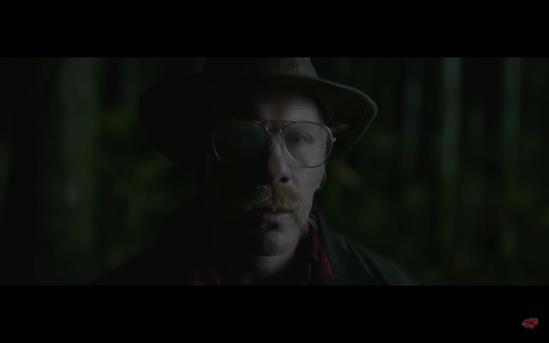
The up and coming young actress, Jules Willcox (“Dreamkatcher”) stars in the lead of Jessica who hasn’t have a friend in the world, alienating herself from her former life and her parents with a sudden escape to the Oregon wilderness.  The physically demanding role withstands the brunt of constant attack, whether from Marc Menchaca’s unnamed assailant character or the natural elements of the forest that include from the massive rapid rivers and torrential rains to the smallest of roots that spear her bare feet while on the run.  Willcox also brings to the role an indistinct mindset, jumbled with the lingering and complicated suicide of Jessica’s husband, paranoia, and an instinctual reaction to survive, especially through Willcox’s eyes that arch from fear to fortitude.  To really envelope Willcox in that unwarranted fear of harm and pushing her character into the unknown of the adversarial complex that is mother nature is Marc Menchaca as a conniving creep looking to do as much pleasurable damage on his bogus business trip as possible.  Menchaca also looks the part, resembling an out of place 70’s-80’s serial killer with round thin-framed glasses and a moderately bushy handlebar mustache overtop a sturdy frame.  Now while these attributes are not indicative to just serial killers, they sure as hell work well on screen to really sell the intensity that Menchaca delivers as a faux Ned Flanders type nice guy, a sheep in a wolf’s clothing so to speak, who acts a lure against his prey before venomously striking.  The small cast rounds out with Anthony Heald of the Anthony Hopkins “Hannibal” films in a small, yet uncharacteristic, good guy role as a hunter caught in the middle of Jessica’s situation.

While suicide might be the catalyst that compels Jessica to drive into the middle of nowhere, Matthias and Hymans only utilize the power theme as an instrument against Jessica’s psyche.  Jessica runs and hides from polite and comfortable society, but the recently widowed soon discovers that she can’t outrun her past as she hits a perverse wall constructed in the form of a man of sordid pleasures and sociopathic tendencies.  Her kidnapper becomes, in a way, her therapist who, at one point, pins her to the ground and scrolls through the personal photos on her tablet, forcing her to talk about her husband up to the point of his death, and consistently throughout the film that his actions were cowardly, removing the blame from her and onto him while emphasizing her tremendous guilt for not seeing the signs earlier.  “Alone” blossoms a wildly curative dynamic that encourages Jessica to then defend herself and her husband’s memory by standing up against not only the man’s relentless chase, but also her guilt.  The thick Oregon setting becomes a security blanket, sheathing her endless dismay, but the forest is actually does more harm than good for Jessica.  Only when does Jessica steps into a wide clearing of lumberjacked tree stumps does hiding from all the pain and torment become no longer an option as she makes her last stand against her attacker, unloading her fear, anger, and guilt upon the man by exposing him as an oppressive killer. While immersed in watching, “Alone” will deprive oxygen from your body that’s desperately gasping to fill your lungs with air in every harrowing chapter, but “Alone” is a breadth with a throng of digging out of despair overtones and a conduit for self-repair that’s unraveled symbolically through the afflictions of bona fide sadism.

“Alone” rises above the call of arms against predatory men in this thrilling remake from John Hyams, releasing into Theaters and VOD on September 18th from Magnet Releasing. The rated R, 98 minute feature will not have the A/V specs critique due to the digital screener, but Federico Verardi (“Z-Nation”) grasps the elegant threat of the woods by using drone shots to shoot the very tippy-top of the swaying trees that conceal the ground, as if obscuring the atrocity being committed below, and applying low-contrast to make insidious hard shadows against green lush that turn beauty dark and deceitful. *Director John Hyams has noted the rapid’s scene where Jessica temps fate to escape her pursuer was practical and performed by stuntwoman Michelle Damis and though looked a little off around the Jessica’s unsubmerged profile as she’s whisked away down the river, the effect is 100% legit. “The Pyramid” and “Becky’s” Nima Fakhrara scores a low-impact tremble for most of the feature with Jessica’s running through the woods is accompanied an equally low-impact drumming, letting the ebb and flow of resonating forest ambience engulf much of the soundtrack to solidify it as a correlative character; even the end credits is purely nature’s ambient noise. Since “Alone” is a brand new feature, there were no bonus material or bonus scenes during or after the credits. “Alone” knicks the core of vulturine power, but turns the tables toward more feminist revelation to fight and take back one’s life.

*Correction: Previously stated the rapids scene was CGI.


Let’s Ride the Ol’EVIL Succubus to Chastity High School in “Sadistic Eroticism” reviewed! “Wild Eye Releasing / DVD)


At California’s Chastity High School, a strict and sadistic far-right facility body abuse and favor a select assembly of pupils, isolating the semi resembling studious teenagers, who wear black trench coats, innocently worship indie horror flicks, and the idea of women, to the whims to not only a rapist principal and a Nazi fascist assistant principal, but also suffer prolonged torment from the school’s popular kids. When one of the regular teachers slips, falls, and dies on a pool of ejaculate, a voluptuous and alluring substitute teacher, Ms. Lizz, fills in, hoping to become a permeant teacher at Chastity High, but Ms. Lizz has a three hundred year old secret being a vampiric succubus who lures in and possesses the popular, sex-crazed, hormone driven high school jocks who will do her bidding in abducting the beautiful high school sluts and for Ms. Lizz to drink their blood to retain immaculate beauty. Its up to three Troma loving and heroine doping geeks and an odd janitor to stop Ms. Lizz before she laps up slut blood and moves on to the next school.

Like a barrel full of doured high school rape jokes bubbling in a stasis of formaldehyde, the farcical cringe-worthy comedy-horror, “Sadistic Eroticism,” is the brain damaged brainchild from writer-director, Alex Powers, as his debut feature film shot entirely on VHS cassette that pays homage to the SOV horror of the early 1980’s, such as “Boarding House” or “Sledgehammer.” Powers, who went on to helm “GrossHouse” and its sequel, congeals on a slapstick of analogue digressions to introduce himself as an auteur filmmaker who, unrestrained, can exceed beyond the distinct hardline of political suitably that’s not only a testament toward the very title of the film, but also, perhaps, securing Powers on a number of studio blacklists unwilling to touch him with a single junk-destined email originating from the other ends of the Earth. Starchild Video serves as production company, which if entering “Starchild” and “Sadistic Eroticism” in the same search engine field, you’ll get a nice little stern warning about your search results involving child sex abuse and any images depicting such should be notified. Yikes.

More promising than the infamous history of the Hungarian noble woman, Elizbeth Bathory, to which “Sadistic Eroticism” properly appropriates it’s title and abstract character from, is the colorful, if not disdainfully charged, personalities teeming with a variety of depraved intentions and the entire cast embraces the full blown degenerate toxicity. More than likely, most of the cast list is made up of not household names like JD Fairman, James Coker, Nicholas Adam Clark and T.J. Akins as a black Nazi fascist hard up on Christian values and stern punishment. On the flipside of that coin, genre fans can root through the blurry, sometimes overexposed, tape recordings and find familiar faces of the then scruffy looking filmmaker James Cullen Bressack, writer-director of the popular indie found footage thriller “To Jennifer” and producer to the subsequent franchise films, “2 Jennifer,” “From Jennifer,” and “For Jennifer,” suited up in a shirt-sized Confederate flag as one of four high school bullies to fall under Ms. Lizz’s spell. The prolifically half-naked all the time indie actor, Michael Q. Schmidt (“The Pricks from Pluto Vs. The Vaginas from Venus”), straps on BDSM gear for a little sodomy counseling as Principal Buggary, “2001 Maniacs” Field of Screams” Miles Dougal slaps on a wife beater for some sleazy slumber party slime ball in a high school girl’s father role, and, of course, the lovely pornographic actress who branch out and take a break from oral sex, group sex, three-way kissing, and – oh wait – they do and simulate that in this Powers’ as well. Tori Avano, Imani Rose, and Jayden Starr are the three high school sluts who shameless flaunt their assets for Sophie Dee to snatch up and soul suck her way for anomalous aesthetics as a satanic form of cosmetic surgery. The latter actress, Sophie Dee, is endowed, more ways than one, with the role of the vampire-succubus Bathory, keeping well….well abreast her monotonic acting talents with her adult industry persona. All four ladies show an abundance of above waist skin and engage in some solo girl, boy-girl, boy-boy-girl, girl-girl-girl, boy-boy-boy-girl… and now I must sit down a rest my brain. Dou Waugh, Sto Strouss, Paymon Seyedi, Candis Higgins, Mel Martinez, Aaron Granillo, Matt Johnson, Ian Fisher, Jody Barton, and Yajaira Bardales round out the cast.

Jokes and slapstick humor disassociated, “Sadistic Eroticism” still relates to the Elizabeth Bathory backstory told on VHS through a tube television presentation of Ms. Lizz’s abnormal history subjects. The succubus creature is nothing less than a buxom beaut that undresses with her feminine wiles zombifying men to do her bidding without her lifting a finger to break a nail against the hypersexualized school girls; yet, to show this century’s old cacodemon as provocatively dressed and to skim around bellying up the tension isn’t quite enough to sell the dominance an ancient evil should be wielding like she owns the whole damn school. There’s more of visceral presence of evil between Principal Buggary and Assistant Principal Defur and though they’re also vaguely under the influence of the succubus, their combined power is the epitome of “Sadistic Eroticism.” The script, characters, and subject material are indicative of Alex Powers attempting to reel in Lloyd Kaufman and his Troma slum-empire to purchase and distribute the filmmaker’s squawking lechery of a film and yet, perhaps, the Troma acquisition team also saw too much of a yawn-fest to bare the Troma brand as the nearly two hour runtime sluggishly relies too hard on being incoherently schlocky to be coalescing competent to make sense. “Sadistic Eroticism” is more masochistic in it’s ostentatiousness to desensitize power and rape and call it comedy, but rocks a mean cast of players from all walks of life to be a mean-spirited take of The Blood Countess.

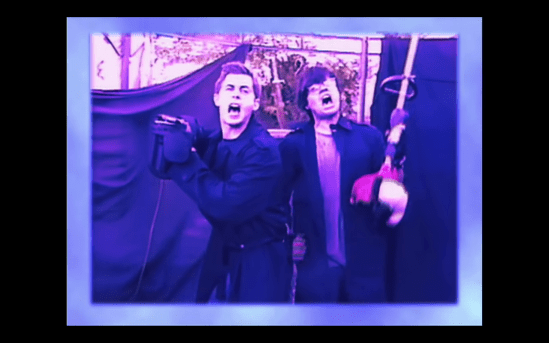
Open your lesson books and get ready to be schooled by the twisted and obscene in Wild Eye Releasing’s re-release of “Sadistic Eroticism” on the label’s Raw and Extreme banner, distributed by MVDVisual. The region free, unrated release is presented in a SOV full frame of 4:3 aspect ratio. Tracking is the least of the problems with this uncouth image presentation rendered from pillar to post quality of warm tinges, severe color corrections required, and gauche details emblematic of cassettes, but all that was Alex Powers intended design to relive in the era of SOV. However, there are some less than stellar, even for SOV, that negate the effort, such as high contrast and poor lighting nearly blanking out darker scenes and the entire climatic end has a neon purple border and the scenes are also recorded in an awful tint of purple, making the entire finale be seen through Grimace vision. To top it off, the jagged opening titles, credits, and crooked visual composites are nearly discernible. The English language mono track is touch and go, mostly go as dialogue wanders into a deaden muffle and is also drowned out by a stock score tracks. There’s not much range or depth as much of the audio is picked up by the poor quality of the VHS handheld mics as exhibited on the special features, which include a director’s commentary and a behind the scenes hosted by that James Coker, who does a pretty good engaging the actors for the in-the-face interviews to explain their characters, scenes, and just overall thoughts with porn starlets and actors milling about or in takes. Sophie Dee’s bosomy eye-catchers, Tori Avano’s star-shaped nipples, Imani Rose’s vivacious sexual appetite and a stockpile of lewd, crude, and nude wets the very foundational whistle of “Sadistic Eroticism” bungled in a sloppy heap of first time filmmaking.

Order “Sadistic Eroticism” on DVD at Amazon!

Nothing Will Stop EVIL From Being EVIL! “Chaos” reviewed! (Dark Force Entertainment & Code Red / Blu-ray)


Visiting home on break from UCLA, Angelica visits her close friend, Emily, at her parents’ secluded country home. With nothing else better to do in the small rural town just outside Los Angeles, the two teenage girls set off early to attend a local rave deep within the woods at the reluctance of Emily’s overprotective parents and to kickstart what could be a drink and dance fueled night, they aim to push the limits and find a drug pusher to score ecstasy as the first priority to make a dull party fun. They run into Swan who promises the best ecstasy as he leads them to his cabin away from the rave. What Angelica and Emily find is themselves caught in the middle of a ploy by a sadistic gang lead by the ruthless Chaos, whose wanted in 4 states for his barbaric and merciless methods and looking for something fun to play with and torture. The cat-and-mouse game with the girls makes an interesting turn when the gang arrives at Emily’s parents’ house when their van breaks down and the parents suspect them in Emily’s sudden disappearance, veering the night into unreserved chaos.

“Chaos” is the intended true love song remake to Wes Craven’s 1972 sadistically vile “The Last House on the Left” that’s co-produced by Marc Sheffler, who play Junior Stillo in Craven’s film, and, at one time, Krug himself, David Hess, was attached to the project. “Chaos’s” conception is the brain child of Steven Jay Bernheim and David DeFalco, with the DeFalco wielding the hammer of writer and director, and the pair have collaborated a few years earlier on another DeFalco directorial, a comedy horror entitled “The Backlot Murders.” In the eyes of the filmmakers, the amply charged exploitative “Chaos” shares more in common with the original “The Last House on the Left,” despite having no official connection other than the ties with Marc Sheffler, and that the more commercialized remake of the same original title, released four years after “Chaos” in 2009 by Universal Pictures Home Entertainment (UPHE), lost that raw camerawork and visceral storytelling that depicted the abhorrent human malevolency that’s capable from within us all. “Chaos” is essentially a self-funded project from Steven Jay Bernheim’s Bernheim Productions.

Though Sage Stallone, the late son of the iconic action movie star, Sylvester Stallone, receives front cover bill due to, in perhaps, his name alone, but the film is called “Chaos” which centers the story around the “Heat” and “Laid to Rest” actor, Kevin Gage. In some kind of cosmic circumstances in regards to recent events, before the Kelly Preston settled into married life with John Travolta, she was once wedded to Gage, marking “Chaos” as a timely film from 2005 and a just so happened upon my lap occurrence for this review. Yet, Gage, a seemingly giant of a man with a resemblance build toward WWE/WWF’s legendary Bill Goldberg, utilizes his intimidation appearance, transferring all the good and gentleness that’s described of him from fellow costars into a pure embodiment of evil whose misogynistic, bigoted, a killer, and just a downright bad guy giving way a testament to the character’s adverse moniker. Gage brings to the table a formidable tone, viperous wit, and a clean cut brutality in the most sordid and unforgettable ways that makes him stick out as portraying one of the most inhumane villains in the last 15 years of the cinematic universe. Chaos’s infamy is by ingenious design from the Marc Sheffler and David DeFalco collaborations who, along with the actors’ faux backstories, meticulously craft each of the gang’s personalities. Sage Stallone’s Swan seems like a similar parallel version of Sage in reality as a chain-smoking, reserved individual sans the perverse context. “The Love Witch’s” Stephen Wozniak is a complimenting character that offerings a different personality with Frankie and Frankie’s feels like a two-bit slime ball with long, greasy hair, an unkempt beard, and a scrawny figure but can produced an evil that’s step or two back from Chaos; Frankie is a character you’ll love and you’ll love to hate, making Wozniak’s performance singular and one of the best in the film. Then, there’s Daisy, the only female of the group though more butch than delicate, and Kelly K.C. Quann (“Baberellas”) adds a dose of Southern inhospitality to Daisy’s brutish beauty. “Chaos” rounds out with a bunch of victims; hell, everyone’s a victim, but the cast includes Deborah Lacey, Scott Richards, Maya Barovich, Chantal Degroat, Ken Medlock, and Jeb Barrows.

“Chaos” absolutely equates toward the unflinching callous themes from “The Last House on the Left” of violence amongst various degrees of people, youthful ingenuousness, and systematic racism with the latter being extremely relevant and on point, years earlier, of the current social climate in America. Yet, with any remake, “Chaos” yearns to stand on its own by instituting an unmeasurable sense of graphic violence that will churn stomachs, advert eyes, and belly-up the throes of disgust. For a good portion of “Chaos,” the exploitation narrative is fairly run-of-the-mill, damn near walks the same line as Craven’s story, with a sadistic gang kidnapping two young women for their own amusement only to then wander unknowingly into the arms of retributive parents, but two scenes sticky out and go beyond the course of customary exploitation fodder and into necrophilia, mutilation of body parts, and a perverse way to kill another human being with such tactless intentions that the act makes the other gang members splay questions, doubt, and fear amongst their faces. The film opens up with a written warning, not so much on the intense scenes themselves, but resembling more of a public service announcement for parents that what you’re about to see does and will happen to the youth of land, but these shocking scenes are just that, for shock value, and that a small percentage of people partake in such grisly matters. “Chaos” is violence upon violence, leaving no room for conscious absolving resolutions in the unofficial capacity of a remake that pungently separates itself with extreme violence and that’s saying something considering Craven’s visceral first course.

As the bestow flagship release of Dark Force Entertainment, “Chaos” arrives onto a deluxe special edition Blu-ray in association with Code Red and distributed by MVDVisual. Transferred through to a 1080p, high definition scan, from the original 35mm negative, complete with extensive color correction, and presented in a widescreen, 1.78:1 aspect ratio. “Chaos” doesn’t look very chaotic anymore in regards to the image quality; instead, the before stardom cinematography by Brandon Trost (“Lords of Salem” and “Halloween” remake) creates the voyeuristic position of the audience is now visually distinct with stable color markers that are more in tune with the premise’s raw approach. The English language dual channel stereo mix renders softer than desired, especially in the first act as Angelica and Emily converse through the woods. The teenagers dialogue are nearly mumbling on their rave trek with depth issues perplexing their relation to camera. Range seems to be well faceted: rustling leaves through the woods, the clank-clunks of a rustic van, the ground skirmishes. All seem to exude exact decimals of their intended value. Even the firing of firearms has a pleasantry about it. The special features include brand new interviews with co-producer Marc Sheffler, who goes in-depth pre-production and production while also touching upon his other interests before concluding with director David DeFalco and a man in a banana suit making an appearance and offering up dick jokes, and actor Stephen Wozniak with a fountain of information about his time on production, his fellow cast, and about the filmmakers as he is being interviewed in front of a locomotive museum. I love the absurd, obscurity of it all. The bonus material rounds out with commentary from the director and producer as well as the original theatrical trailer. The lewd and radical “Chaos” has engrossing roots of violence that burgeon into realm of rarity or, if not, into sadomishsim extended by the filmmaker’s deepest darkest desire, but what’s transpires on screen is difficult to look away from which begs the question, is it morbid curiosity or is there something far more sinister within us all?

Own “Chaos” on on the new “Blu-ray” release!