In Milan 1951, a prestigious magician, Dante the Great, is tragically killed when a deadly trick goes wrong. Fast forward 30 years later, the magician’s son, Lorenzo Manzini, has trouble finding his own success following his father’s footsteps as a struggling magician. The night before his grand debut, a woman has been gruesomely murdered on the very stage his father had died. As a compulsive gambler and an excessive drinker in over his head in debt, Manzini goes on with the show, but the events following his performance inspire a grisly, sadistic murderer to uses magic tricks to kill and point all evidence toward him. Hounded by a mysterious, chain-smoking detective, a frantic Manzini must split his efforts toward his own investigation into the murders, but as the bodies start to pile up and the evidence grows even more against him, there may not be anything left in Manzini’s bag of tricks to prove his innocence.

In the old traditions of an Italian murder-mystery, “Abrakadabra” is the 2018 released giallo inspired film from the Argentinian filmmaking brothers, Luciano and Nicolas Onetti, along with Carlos Goitia serving as the third wheel scriber on the script. The trio have worked previously on one other project from 2017, another horror of course, with the haunted ruins premised, “What the Waters Left Behind.” With the Onetti’s being brothers, their collaboration runs deeper, sharing an affinity for the genre that has inspired the duo to collaborate on another giallo thriller, “Francesca” in 2015 and “Deep Sleep,” where Nicolas served as producer to Luciano’s writing and directing duties. “Abrakadabra,” as well as “Francesca,” are not only far cries from the haunting and terrifying reminiscence of the ruins in “What the Waters Left Behind,” but also varies in direction, cinematography, and production design that more in lines with giallo hallmarks, such as extreme closeups, awkward camera angles, and posh interiors. “Abrakadabra” is a production of the Nicholas Onetti and Michael Kraetzer New Zealand founded company, Black Mandala, and another Nicholas production company on a more localized level with Guante Negro (Black Glove) Films co-founded with brother, Luciano.

Despite being dubbed in a fine-tuned homage of an Italian overlay track, the actors involved are hail from South America, as where the film is shot. The story centers around Lorenzo Manzini, played by German Baudino (“2/11: Day of the Dead”), and Baudino shepherds Manzini toward the brink of desperation, spinning out of control from the malevolent forces that seem to be binding his hands to gruesome murders. Baudino captures the marks of the giallo fervor in his animated performance, especially when running through a memorial park with arms flailing and a streak of fear across his face, but since it’s a murder mystery swarming around Manzini, the magician’s encounters with other rich characters comes key to unravelling Manzini’s dubious circumstances. His lovely assistant Antonella (Eugenia Rigon), the lurking chain-smoking detective (Gustavo Dalessanro), and a hospice-housed convicted murderer (Abel Giannoni) become cryptic pawns that turns “Abrakadabra’s” into a deadly game of chess soused deep into the thralls of a calculated whodunit. The remaining cast, including Clara Kovacic (“Jazmin”), Ivi Brickell, Raul Gederlini (“Francesca”), Pablo Vilela, Alejandro Troman, and Luz Champane, are perhaps the weakest link in the chain to hold “Abrakadabra” back from being a well-rounded giallo. There presence seemingly come into the fold without much creditability to their substance toward the story are, some of them, are easily dispatched with the same loosy-goosiness that firmly dilute their characters.

You have to give the Onetti brothers tremendous credit. Their attention to detail techniques, production design, and overall wardrobe schemes accomplished a toppling feat in taking the natural aesthetics, textures, and sounds of an Argentinian setting shot film and transformed all the blatant aspects to resemble an Italian giallo filmed in Italy from the 70’s or 80’s. Yet, does the veneer alone make “Abrakadabra” a good giallo film or just an immaculate carbon copy? The Onetti’s certainly know enough to exact a perfect replica as seen in “Francesca,” which was my first experience with the Onetti brothers, but “Abrakadabra” is a step backwards form “Francesca” from a story standpoint with some mishmash editing and character underdevelopment around the midsection of the second act that immobilizes the story from going forward properly, leaving the lead character Manzini in a circular rut rather than a tailspin to the climax. The prologue of Dante the Great’s accident and the twist ending that harks back to a opening Harry Houdini quote, “What the eyes see and the ears here…the mind believes,” solidifies as the best riveting acts of the Onettis’ film that becomes equalized negatively by a drab dynamic interior. In any case and though an Argentinian production “Abrakadabra” is an invigorating slice of Italian cinema with razor-sharp characteristics and a well shrouded and gloved killer.

Open sesame on the inaugural, limited edition Blu-ray, release of “Abrakadabra” from the new genre distributor on the block, Cauldron Films, who plans to release a full slate of cult films from 70s and 80s in the coming months. Limited to only 1000 copies, the Blu-ray release will include inserts of promotional artwork, a limited edition high quality slipcase with original poster art, and a CD soundtrack with music by Luciano Onetti. However, I won’t be able to review in full the finished package or the audio and video qualities as this review is based off a disc screener, but I can tell you reaffirm that DP Carlos Goitia’s scenes are amazing well established, lit, and a glimpse into the past. The Luciano Onetti score can be invasive at times, but a pure product of the electro-synth rock that goes hand-in-hand with the giallo cinematography. Audio options include an Italian 5.1 surround sound, and an Italian and English 2.0 stereo that come with optional English and Spanish subtitles. Accompanying the unrated 70 minute film is the theatrical trailer and raw behind-the-scenes footage without subtitles. As Cauldron Film’s maiden release, “Abrakadabra” is anything but hocus-pocus with a bloody homage to Italian giallo films complete with a vital synthesizing soundtrack and a shocking twist finale.
Category Archives: Just fucking awesome
To Be EVIL, You Must Capture EVIL! “Thir13en Ghosts” reviewed! (Blu-ray / Scream Factory)

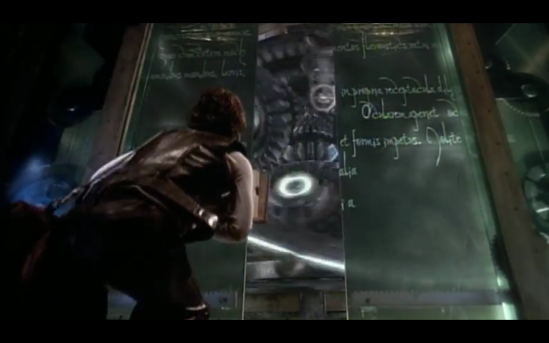
A maniacal and obsessed ghost hunter, Cyrus Kriticos, traps 12 tormented and violent spirits with the help of an avaricious, but anguished psychic, Dennis Rafkin, but when trapping the last ghost, the worst of the worst, a barbaric mass murder in life and in death named Juggernaut, Cyrus is killed in the process. His death leads to the inheritance of a one-of-a-kind house to his widowed nephew, Arthur, and his two children who are barely scraping by after the unexpected fiery death of their beloved wife and mother. When they enter what seemingly feels like a godsend house, immaculately structured entirely out of glass and metal, they find themselves trapped inside after tripping a series of mechanism that turn the isolated and elegant abode into a labyrinthic machine. Stuck inside with Arthur and his family are Dennis Rafkin and a ghost friendly liberator, Kalina Oretiza, who explain that the house is actually an evil machine with a goal of opening the eye to Hell and that the ghosts, imprisoned in the basement, are components that are being set free one-by-one in order to fulfill the ritual.

In the world of remakes, only a select few ever surpass the original. In fact, on rare occasions, do remakes actually replace the original due in part to being beyond respectful as well as masterful amongst critics and genre fans that have bestowed the reimagining an untouchable rendition to which no one can find anything wrong with it; this films include John Carpenter’s “The Thing,” David Cronenberg’s “The Fly,” and Chuck Russell’s “The Blob,” with Zack Synder’s “Dawn of the Dead” and Tom Savini’s “Night of the Living Dead” receiving well-deserved honorable mentions, because let’s face it, topping George Romero’s original work can be said to be blasphemous slander. What about those remakes in between? Those just above the pile of awfulness that generally makeup remakes? I consider Steve Beck’s “Thir13en Ghosts” to be one of this mid-level remake films that registers well with fans, but on the flips side of that coin, doesn’t ascend to total prominence over its predecessor. Written by longtime Full Moon Entertainment writer Neal Marshall Stevens (“Hideous!” and “The Killer Eye”) and Richard D’Ovidio (“The Call”), “Thir13en Ghosts” is a 2001 near-total rework of the 1960 William Castle directed and Robb White scripted “13 Ghosts” that used gimmicks like 3D specter glasses to draw audiences into the theater. “Thir13en Ghosts” was the second film after another William Castle remake, “House on Haunted Hill,” of the newly formed, William Castle nod-to, Dark Castle Entertainment, a division of Joel Silver’s Silver Productions formed by Silver, Robert Zemeckis (“Back to the Future”), and Gilbert Adler (“Bordello of Blood”) that honed initially on producing stylishly modern takes on classic gothic horror, such as “Ghost Ship,” the remake of “House of Wax,” and “Orphan.” What came out of this collaboration between Steve Beck and Dark Castle Entertainment is a complete dismantling of the wood paneling and lament flooring story for a modern marvel to emerge of unique terror that hasn’t been duplicated since.

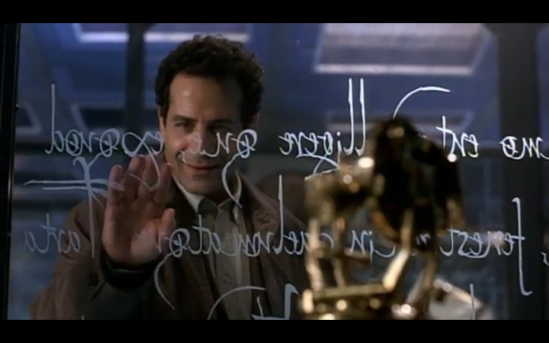
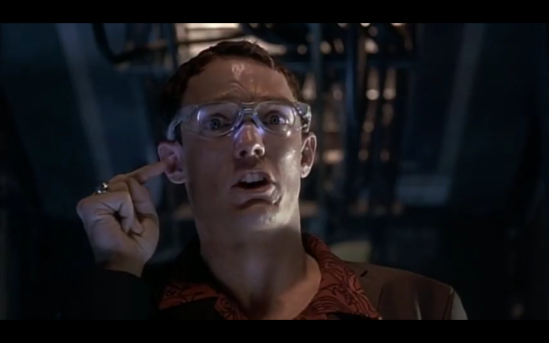
“Thir13en Ghosts” has an impressive, if not all-star, cast with diverse range of styles and experiences that it’s almost dumbfounding on how the filmmakers were able to contract some of these talents, including F. Murray Abraham, who has had an already eclectic credit list with “Amadeus,” “Surviving the Game,” and Mimic, and Tony Shalhoub who hand standout performances in “Addams Family Values,” “Men in Black,” and “Galaxy Quest.” Abraham and Shalhoub bring a sense of classical and methodological structure in a stark contrast between rationality and irrationality built upon an indifference of solitude and a sense of family. Then, there’s the comedic relief in the midst of danger, Matthew Lilliard (“Scream”) as the suffering psychic who uses his wit tongue to spur others and introducing hip-hop artist, Rah Digga, in one of her only motion picture performances to alleviate suspension with more tongue-and-cheek moments. Lilliard and Digga offer up two different comic styles while sustaining the underlying severity of being trapped inside an evil machine full of violent ghosts. Shannon Elizabeth, who we all know by now as the stunning “American Pie” girl, Nadia, or as I know her as the unfortunately raped and murder victim of a killer snowman in “Jack Frost,” plays Arthur Kriticos daughter, Kathy, who still a fresh faced newcomer to Hollywood despite being a hot commodity after her topless role in “American Pie.” The superb support roles don’t end there with notable roles from JR Bourne (“Ginger Snaps Back: The Beginning”), Matthew Harrison, Alec Roberts, John DeSantis, and EmBeth Davidtz, Sheila from “Army of Darkness,” as the ghost liberator.

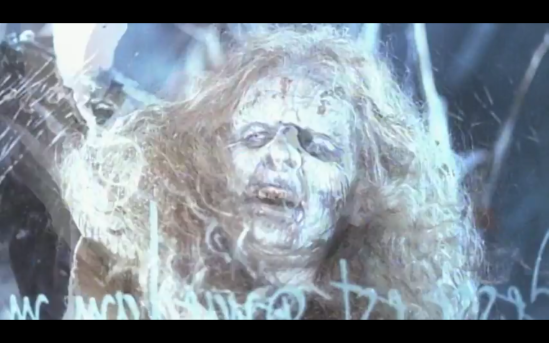
It’s hard to believe that “Thir13en Ghosts” is nearly 20-years old. I still recall my 17 year old self sitting in for a theatrical showing, remembering the opening gargoyle growling as the Dark Castle Entertainment logo reveals itself during the opening title credits, and coming out of the maze-like, gory-ghost film having experienced something special, even if then I didn’t understand why, only to years later realize that I’ve never seen something like “Thir13en Ghosts” before in my life. How does a remake reinvent itself so much that it can separate itself from the original film while also beguile with fresh ideas and no take a slew of browbeating chirps from those who holdfast that the original is the one and only? Most remakes cheaply throw gore to the wind, adding buckets of blood in hopes to satisfy horror buffs, but what winds up happening is that we ultimately get bored, having experienced blood and guts from singular storied films. “Thir13n Ghosts’” premise isn’t the only worthwhile experience that deserves praise, but also the spectacular production design by Sean Hargraves that thrusts the glass house concept into new heights with the house actually becoming an interestingly steampunk character itself and the prosthetic effects from a team spearheaded by a trio of the best special makeup effects artists in horror today, such as Howard Berger, Robert Kurtzman, and Gregory Nicotero., turning ghoulish encounters to ghastly visions that convey truly a tormented soul in the 12 ghosts. Though the story itself isn’t perfect, flawed at times with static character development and a few plot holes involving the ghosts and sequences of events, “Thir13en Ghosts” remains a cult favorite gaslit by frightening imagery, a solid cast, and unforgetting production design that started 21st century horror off brazenly strong.

Collect all “Thir13en Ghosts” on the Collector’s Edition Blu-ray courtesy of Scream Factory sheathed in a cardboard slip cover and has a reverse artwork liner that has the original poster artwork and new vivid illustration by Joel Robinson. Presented in a 1080p, high definition widescreen, 1.85:1 aspect ratio, from the original 35mm negative, “Thir13en Ghosts” shares a consistent image and vibrancy layer with the DVD version with an enhanced color stability. No edge enhancement or cropping adjustments rendered or any other blemishes to speak of, but the softer details could have been sharpened to gave a hard edge around the non-spiritual energy. The English language DTS-HD Master Audio 5.1 boosts the already hefty soundtrack that’s full of explosions and ghostly swooshes and moaning hums, finished off with grand, orchestra soundtrack by John Frizzell It’s been said that audience had to excuse themselves from the film due in part to the overbearing noise coupled with the strobe-like imagery, but the overall audio and visuals are a combined one-two punch of sensory power that works well. The Scream Factory release has new interviews in the bonus material, including sit downs with actors Shannon Elizabeth, Matthew Harrison, and John DeSantis and producer Gilbert Adler. There’s also a audio commentary with director’s Steve Beck, production designer Sean Hargraves, and special effects artist Howard Berger. There’s also an in-depth look at the creation of the thirteen ghosts in a small featurette, their backstory profiles, and the theatrical trailer. However you want to call it, whether it’s “Thir13en Ghosts,” “Thirteen Ghosts, or “13 Ghosts,” this new century remake still holds up to today’s horror lot with spellbinding phantom pandemonium in a glass box!
“Thir13en Ghosts” on Blu-ray on Amazon.com
EVIL Uses EVIL as a Conduit in “Amulet” reviewed! (Digital Screener / Magnet Releasing)

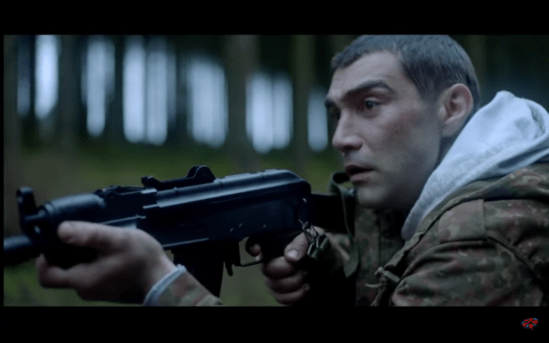
Tomaz, former Eastern European soldier of war is now living homeless in London, squatting overnight in rundown buildings with other displaced individuals and families. When the building he’s sleeping in goes up in fire, he’s injured upon escape and wakes in a hospital to learn that a nun found him and his belongings, leaving him a note to visit her upon his release. The nun, Sister Claire, offers him food and a bed in exchange for dire house maintenance for a sickly mother, Miriam, and her caretaker daughter, Magda. As time passes, Tomaz begins to fall for Magda, but her odd behavior and the dying Miriam’s severe skeleton living accommodations in the attic as well as her frail, pail body nag at Tomaz’s conscious that something is awfully amiss. However, his present enigma isn’t the only thing tugging at his tormented conscious when faced with the shocking truth of his residence.

Actress turned filmmaker, Romola Garai, makes her full-length feature debut with a fissionable creepy, punish-thy-sinners, slow burn horror film entitled, “Amulet.” The UK production is written and directed by Garai, who previous work includes main cast acting roles in Joe Wright’s World War II dramatic thriller, “Atonement,” the sci-fi horror “The Last Days on Mars” along with costar Liev Schreiber, and filling in some tremendous shoes in the prequel to the 1987 rom-edy, “Dirty Dancing,” “Dirty Dancing: Havana Nights.” Now, Garai peers through camera lens, orchestrating from the director’s chair, an eerie body horror tale that involves demons, past regrets, and a diabolical, antiheroic nun conniving for the sake of humanity. Speaking of which, humanity is one of the central themes that “Amulet” explores in hellish fashion as our actions determine the outcome of our various shade of humanity forged ourselves and how we will be judged accordingly. “Amulet” is a production of Head Gear Films and Kreo Films FZ, and Metrol Technology, who have all collaborated on “Cargo, as well as in association with “Shed of the Dead’s” Trigger Films.

Cast in “Amulet’s” only male role is the Romanian born Alec Secareanu as Tomaz. The graduate of Caragiale Academy of Theatrical Arts and Cinematography actor envelops himself into a trouble ex-soldier without a country, unwilling to return to a worn-torn land in hopes to relieve himself from reliving the past. Secareanu exudes tenderness for Tomaz in order for audiences to empathize for a homeless man who has agreed to assist Magda and her ill mother. Garai engrains Tomaz with such sentimentality, it’s proves difficult to see the man any other way until the filmmaker incorporates Magda into the mix, a capricious role imparted upon to “Blade Runner 2049’s” Carla Juri. Juri moderately reprises her eccentrically free performance from the 2013 comedy-drama, “Wetlands,” as a seething promiscuous and alluring woman but, in the darker vision of “Amulet,” Magda is a servant of her dying mother who has a lying in wait, sheathed vocation yet to be revealed until Tomaz’s curiosity becomes too much. Secareanu’s and Juri’s performances define the characters with no details left out, but the overall best performance goes to Imelda Staunton as Sister Claire. As professor Dolores Umbridge from “Harry Potter and The Order of the Phoenix,” Staunton was maniacal as she was sophisticated, channeling that same energy into Sister Claire as a double-dealing nun with a fraudulent ebullient attitude. Sister Claire was molded surely for the English actress whose high cheekbones, tight mouth, and round eyes give her a perfect blend of meek malice. “Amulet” rounds out the cat with Angeliki Papoulia and Jacqueline Roberts.

“Amulet” scores well as a feminist’s film, more so as the debut film from a woman filmmaker, that takes the horrifying actions of men and, literally, demonizes their red herring benevolence, but, in Garai’s style, that isn’t overly provocative and megaphoned from a soapbox. The doleful, sometimes frivolous, tone regales in a bleaker light of conniving and withholding intentions. While “Amulet” relishes inside an original thought, the story ebbs with disjointed connective dots. The story itself isn’t linear as we’re moved back and forth between Tomaz’s tenure at Madga’s residence and his wartime past being posted up far from the frontlines in isolation, a moment Tomaz continues to relive while dreaming during his time his hands are self-bound with tape, a curious event that becomes important to note as the story unfolds. While the story isn’t linear, that is not why the audiences’ problematic pursuit will be challenging, but more so with the discerning of the amulets role amongst the trifecta of outcomes for Tomaz, Magda, and Sister Claire. The amulet, which is unearthed by Tomaz in the middle of the woods during his draft, is a woman with a shell headdress. Shells are a common motif throughout, serving as a warning of what to come. In some Christianity folklore, shells are a sign of light and salvation and, in a way, serve as Tomaz’s path toward salvation from a lost soul to provided a purpose with unholy consequences. It’s all interpretation, but “Amulet” is a novel look at blending religious predestination with a grim mythological tenor as an excellent melting pot source of ghastly affliction.

From Magnet Releasing comes the twisted tale of transgressional talisman, “Amulet,” from first time filmmaker Romola Garai. Since this film will release potentially in theaters and definitely on demand on July 24th, the digital screener will not be reviewed on it’s audio and video technical aspects, but Laura Bellingham, the direct of photography working on her debut full-length feature as well, introduces an uncomfortable warmth that engulfs the characters. It’s a reoccurring fire like theme, from Tomaz’s hotel inferno to Madga and Miriam’s home, that could be synonymous to the accommodations of fire and brimstone. Dialogue clarity is good and the ambience is equally fine. The soundtrack by Sarah Angliss didn’t do much for story, striking a pretermit chord in order to focus more on the story. There were no bonus features included with the digital screener nor were there any bonus scenes during or after the credits. “Amulet” is the very definition of feminist horror that bludgeons the stereotype and is well executed to deliver not just a subvert message of importance, but a damn fine film of dreadful body horror and artful mythos.
EVIL Necking in Bavaria! “The Kiss of the Vampire” reviewed! (Scream Factory / Blu-ray)

English newlyweds, Gerald and Marianne Harcourt, travel by motorcar to their honeymoon destination when, all of the sudden, the car breaks down in a small Bavarian village. The remote village is barren of life except a few irregular villagers remaining reclusive in their residence. Unable to go any further, the Harcourts stay at the local hotel where one other guest resides. Soon, their presence is requested in invitation by Dr. Ravna, a prominent and respected gentlemen of affluence, to have dinner with him and his family, but little do the newlyweds know is that Dr. Ravna is the master of a vampiric cult that has been plaguing the small village, turning the inhabitants into acolyte vampires, and now Dr. Ravna has turned his fixation on the beautiful Marianne. Will Marianne succumb to the vampire’s alluring powers or with the help of Professor Zimmer, a drunkard vampire hunter bitter with revenge, stop Dr Ravna before it’s too late for his new wife.

Stepping once again into the mystifyingly, macabre tale of a Hammer Films’ production, “The Kiss of the Vampire” stimulates as one of the progenies of the early beginnings that is today’s Hammer Horror as we know it and adore with the 1963 gothic tale of seductive vampirism and the callous, if not equally heartful, reprisal of the brokenhearted vampire hunter from director Don Sharp, who would direct a decade later the deadly occult riders of 1973’s “Psychomania” aka “The Death Wheelers.” The picture is produced and penned by “The Curse of the Werewolf’s” Anthony Hinds with the latter being credited under Hinds’ pseudonym, John Elder. Perhaps one of the lesser known Hammer Horror films due to limited broadcasting, “The Kiss of the Vampire” becomes the next installment of a Hammer Horror classic upgraded through a 2K scan from Scream Factory for maximum restoration on a nearly five decade year old film that included a scene straight out of the book of Alfred Hitchcock, but instead of birds, a swarm of crazed bats scour a chateau tower for blood. One of the last films to be shot at the Bray Studios in Berkshire, England, “The Kiss of the Vampire” is a smooch baring fangs that pits good versus evil marred as a defect from the Devil himself.

At the center of the natural versus supernatural tug-a-war is Marianne, a young, blonde English on the heels of being quickly hitched to Gerald Harcourt seemingly on the downlow, is played by Welsh actress Jennifer Daniel, who, at the time, was a newcomer to full-length features as she developed a steady career in television from the 50’s to the 60’s. Daniel is no Tippi Hedren, but she’s close, as the English socialite having embarked toward unfamiliar surroundings, a brooding Bavarian land with a fatal affliction that’s ravaging through the residents. Marianne and Gerald, an elated husband in a role by Edward de Souza, make a fairly adorable couple complete with newfound marital bliss and ignorance of the harsh realities of the outside world; perhaps, that young and in love ignorance is the most profound theme in “The Kiss of the Vampire” that explores the naïve nature of outsiders and blinded youthful endeavors despite the clear and present dangers that loom around them. Playing Dr. Ravna, who is not Dracula mind you, is Noel Willman, who bares a stunning resemblance to plumper Peter Cushing, and Willman’s socialite role is interesting as Dr. Ravna’s a blunt around the edges and, yet, unbelievably charming, a find blend from the Irish born actor who would later collaborate again with Jennifer Daniel in another Hammer Films product, “The Reptile,” in 1966. Opposite to the abundance of Dr. Ravna’s seemingly endless wealth and power is Professor Zimmer, a brooding dipsomaniac hellbent on destroying Dr. Ravna for the death of his daughter, played by “The Curse of the Werewolf’s” Clifford Evans. Though we know immediately from the opening graveyard funeral scene Professor Zimmer’s outskirt profession, his dark top hat, cape, sunken eyes, and brash persona places him in a seemingly villainous category and that displays Clifford Evan’s range as an actor. “The Kiss of the Vampire’s” strong support cast includes Jacquie Wallis, Peter Madden, Isobel Black, Vera Cook, and “The Devil-Ship Pirates’” Barry Warren as an intense spellbinder disciple of Dr. Ravna.

Critically speaking, “The Kiss of the Vampire” tenders more of an extension of the vampire mythos that directs more of the classic creature to the enigmatic way of the cult through an elegant Don Sharp vision rich in Gothicism and sound in the era it’s portrayed, early 20th century. Focusing more on the Hinds’ story that more or less involves Dr. Ravna’s fascination with Marianne to join his co-ed harem, the way he initiates Marianne might also indicate that the good doctor his binary feelings toward both sexes, making “The Kiss of the Vampire” very much an appealing, but clandestine, homoerotic companion to it’s more straight seduction tale. Another more obvious taboo for a film from the early 1960’s, “The Kiss of the Vampire” has no shame in being bloody. Scenes involving Professor Zimmer impaling his undead daughter violently with a shovel through her coffin and the blood floods upon the coffin opening is morbidly beautiful. Even when Gerard Harcourt smears with blood the sign on the cross on his chest is an absolute eye opener of the use of blood, as a weapon, and a defender of holy sanctums that nearly frightened Universal Pictures to the point of changing the entire essence of Sharp’s original depiction. Yet, one thing is constant between Hammer’s version and Universal’s broadcasted edit, the batty ending is a quick, cut-corner finale that puts a bat screeching halt to everything the story built up to and leaves plot holes that go seriously unexplained no matter how newfangled the method was on how to dispatch a cultish vampire coven. Okay, that’s enough vampire puns for this review.

Pucker up! “The Kiss of the Vampire” is receiving a Blu-ray collector’s edition treatment from Scream Factory! The interpostive went through a 2K scan and presented in a high definition, 1080p, of two widescreen aspect ratios, 1.66:1 and 1.85:1. The picture is phenomenal with lush hues that earlier home video versions, even the Warner Blu-ray boxset, didn’t even skim the level of Scream Factory’s collector’s edition. Colors only fade during the superimposed editing between scenes that really rack the vision cortexes to try and make sense of the transitions. The original negative survived well over the years with little wear and tear that consists of some minor scratches that are barely noticeable. The English language DTE-HD Master Audio mono track is a suitable accompaniment for single channel audio. Dialogue is clear and relatively unobstructed aside from a low distortional hum throughout the entire 88 minute runtime, but it’s faint enough to be a natural tune of the film. One audio mishap happens around the opening scene with the priest’s depth during his graveside sermon. The priest’s dialogue starts out strong and prominent, but when cut to Professor Zimmer, standing far in the distance, the priest vocals are reduced by a few decimals, but the volume remains the same when cut back to the priest, never upping his dialogue when cut back to his graveside sermon. English SDH subtitles are optional. A slew of new bonus material includes a new audio commentary by film historian and author Steve Haberman and Constantine Nasr and Little Shoppe of Horror’s founder, Richard Klemensen, speaks in tribute to the life of the Men Who Made Hammer with composer James Bernard and production designer Bernard Robinson. Other bonus content includes audio commentary with actors Edward de Souza and Jennifer Daniel that’s moderated by Peter Irving, deleted scenes from Universal’s NBC Broadcast that are bloodless filler interjections reshot with a brand new sub-story involving new characters not from the Don Sharp production, and the theatrical trailer. “The Kiss of the Vampire” might be an offbeat Hammer film, but the Scream Factory collector’s edition aims to infiltrate into horror collections nationwide with glorious looking picture and a stockpile of new bonus features to chew on.
Subscribe to EVIL’s Vlog! “Followed” reviewed! (Global View Entertainment / Digital Screener)

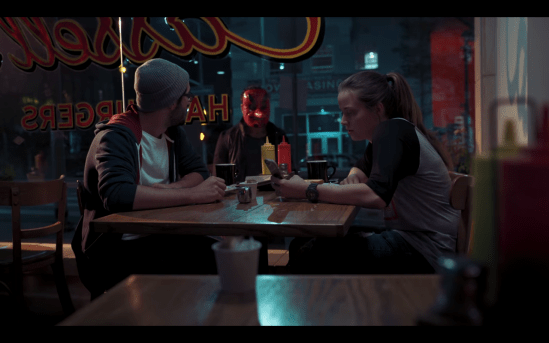
Unable to entertain that ghosts actually exist and to be one of the best social media influencers he can be on the world wide web, influencer “DropTheMike” vlogs locations’ ghastly back stories that are now presumably haunted by the very souls the locations consumed. When offered a once in a lifetime opportunity, worth a small fortune in the sum of a quarter of a million dollars and set start up his family with his recently pregnant fiancé, “DropTheMike” quickly challenges his followers to scout out the next paranormal investigation on the cusp of Halloween in 2016. With the results in, an overwhelming number of responses held one of the most notoriously haunted hotels in America, The Lennox, as his and his video crew’s next targeted exploration from the tops of the roof to the dank, dark basement. Ecstatic and eager in a pool of mixed emotions amongst his crew, “DropTheMike” pushes forward despite the forewarning counsel from a hotel historian and his friends, booking rooms for a three day stay that turns horribly frightening when the social media influencer’s greed for followers and fortune provokes the damned souls and the spirit of an infamous serial killer who once hacked up his victims in the very same room “DropTheMike” is staying in.

Us bloggers always try to use our social media platform powers to not only gain internet popularity amongst the ever growing, or continuously exploding, tsunami of 24/7 news, reviews, and inspirational muses for instant, impactful transmission to billions of users, but also to express the things we, the bloggers/vloggers, express what we’re passionate about. Sometimes, what we’re blindly passionate about undertaking can haunt and consume our very being, and also destroy our souls and that’s the epitomic baseline for Antoine Le’s 2020 supernatural cyber-horror “Followed” that’ll feed into select drive-in theaters Friday the 19th. “Followed” is Le’s debut full-length feature film penned by the self-help screenwriting guru, Todd Klick. Shot on location in Los Angeles, Le and his crew use a number of different hotels give the illusion of being inside the fictitious Hotel Lennox, including Hayward Manor Hotel for the lobby scenes and Hotel Normandie for the interior rooms, re-working the rest digitally to effectively pull off the faux location without issue. Branded Pictures Entertainment and Le’s own co-founded Viscape Arts, along with co-producers Greg Berlant and Matthew Ryan Brewbaker, server as the production studios that pushes cyber-horror virtually toward to the forefront of found footage and dark web terror.

In front of the camera, the main attraction, the host with the most is “DropTheMike,” played enthusiastically by Matthew Solomon in his sophomore feature film and handling the pressures of a demanding social influencer position with pizazz to generate subscriptions with the utmost vigor. Personally, I’m familiar with too many influencers that cast a pendulum energy to the akin of a zany children’s educator personality known as Blippie. Google Blippie and have you’ll be able to paint a picture of a less morbid version of “DropTheMike” but with the same kind of body and facial expressions. Solomon’s counterpart is Tim Drier as Mike’s director of photography, Chris. Reversed within the confines of his Christian faith, Chris has serious reservations about The Lennox stunt, opposing Mike at every plea for him to shoot what could be the influencer’s biggest achievement and turning point of his mediocre career. If it wasn’t for being sweet on Danni, a fellow DP, Chris would snuff out any venture into the what Mike thinks is the one big publicity stunt. Played by “The Incantation’s” Sam Valentine, Danni’s a bit of an instigator or, perhaps, shares Mike’s agnostic views on the spirt world, but communes with the film crew in order to reach out to her former fling in Chris and see what materializes from the questions that have been plaguing her. The story primarily focuses on the trio and their friendship dynamics, but there are interesting key support roles that provide a well timed and deserving boost to keep “Followed” grippingly tense and violently rough-hewn toward the path of the malevolent specter plane, including performances by Caitlin Grace, Kelsey Griswold, Christopher Ross Martin (“American Horror Story: 1984), and veteran actor of “Deer Hunter” and “Carnisaur 2,” John Savage.

What makes “Followed” different from other cyber-horror genre films, such as “Unfriended,” “iLived,” or “Like.Share.Follow?” Cyber-horror looks a lot different now than 20 years ago when the genre viewed the mechanics of machine was bedeviling autonomy and people were slave to the machine in one way or another. “Death Machine,” “Lawnmower Man,” and “Evil Speak” are the quintessential ghost in the machine with each plot platters different variations of to subordinate mankind. Now, these films might seem low-tech and more tangible instead of the trying to grasp the idea of cyberspace. Aside from the dark web snuff premises, cyber-horror nowadays, such as “Followed,” is bound by the original influencer, the devil, who has strewn his watermark through the many conduits of streaming services, infecting at will the dark powers to beguile and besiege the barrier of rationality, and deconstruct human morality to the most primitive and primary sin. “Followed” doesn’t break the mold of cyber-horror, but exploits the mold to the max to deliver a terrifying hotel with a ghastly black past. Based perhaps on a number of personal grim accounts and then chained together like an all-in-one anthology, “Followed” jazzes up with the second act with myths, visions, and theories between the rather ordinary bookend beginning and end, always stepping up evil’s game to the point where you never know what to expect and that’s what’s enjoyable about the found footage aspect because nothing is certain, especially when each floor has a history of violence.

Book your reservation to hell and subscribe to the nerve-racking black magic of Antoine Le’s “Followed” hitting the drive-in theaters on June 19th, insidiously expanding into more drive-in theaters on June 26, and eventually landing onto VOD later summer 2020 courtesy of the new kid on the film distributor block, Global View Entertainment. Since “Followed” was viewed as a digital screener, the video and audio aspects will not be critiqued, but the official specs include a presentation in a widescreen format, aspect ratio 1.85:1 with an English language 5.1 surround sound audio mix inside a 96 minute runtime. “Followed” is a visual feast that apply a number of different kind of filming techniques from handheld, spy cams, and security footage and brush the hue spectrum from the ominously vibrant reds to the forlorn splay of sterile metal and steel. With tactics that include a pluralistic phantom ecosystem all living together at the Lennox Hotel, the varied soundscapes and ambient bytes spookily outfit the multi-headed apparition commune existing just on the threshold of the reality plane and seeping in when poked, like a sleeping bear with a stick. There were no bonus material included or any additional scenes during or after the credits. “Followed” is a cherub of the cyber-horror junkets before it’s time that indulges itself into the destructive and careless path of a social influencer, ignoring the sinister forces amongst the other things, like personal property, public safety, or personal safety, real influences tend to disregard when climbing the social media latter to the 15 minutes of fame of internet stardom.
Find a Drive-In near you by clicking on “Followed” official website : https://followedhorrormovie.com/
[youutube=https://www.youtube.com/watch?v=VduFOTzm8DI]