An EVIL Re-Imaging of a Donald Farmer Classic! “Savage Vengeance” reviewed! (SRS Cinema / DVD)

“Savage Vengeance” now available on DVD home video!

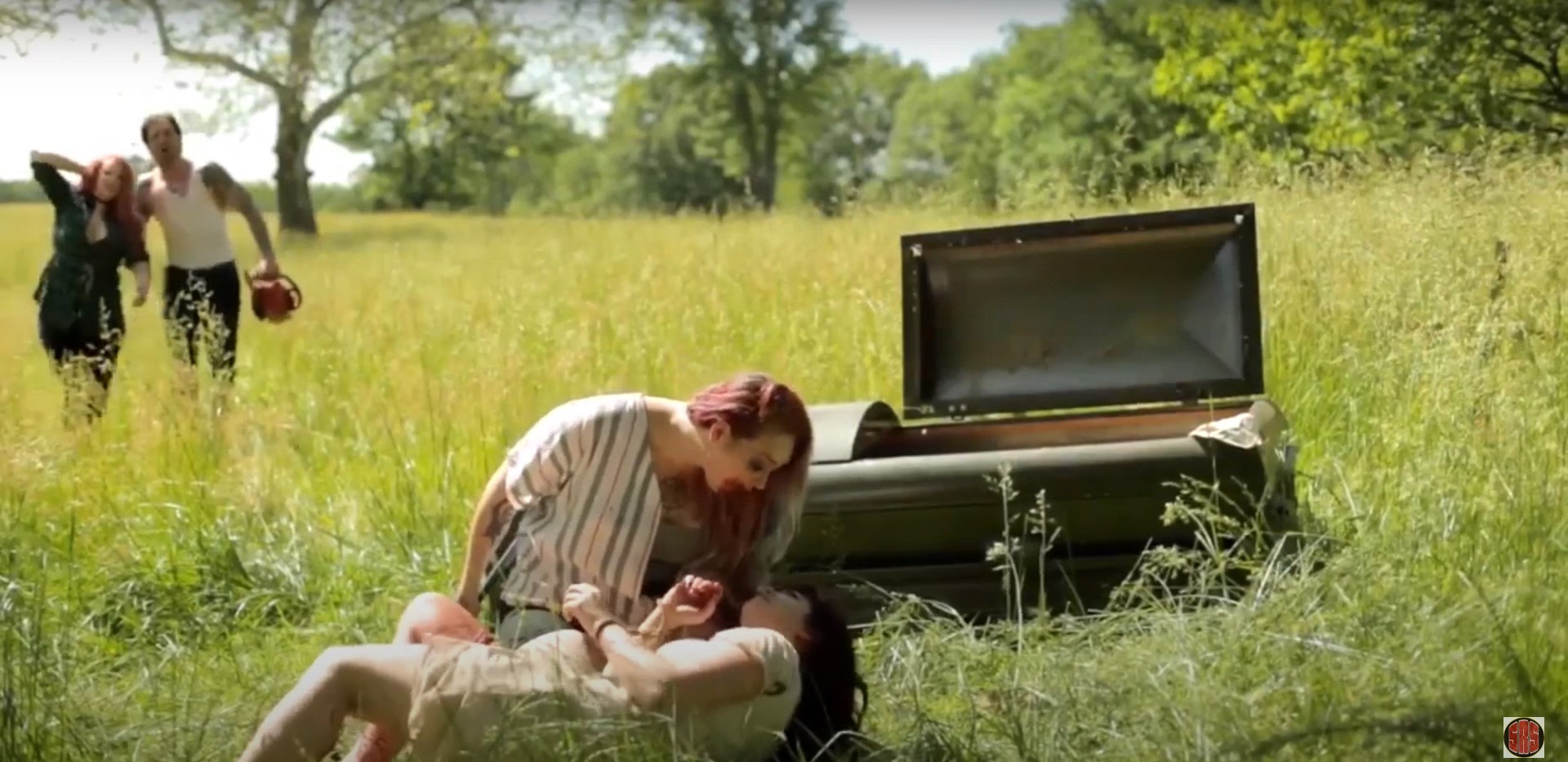
Best friends and law students Tara and Meghan take a much needed depressurizing road trip and run into a Ronnie and Thom, a pair of locals with car trouble looking for assistance at the nearby gas station.  Hesitate to offer a ride, Tara agrees to their proposal of a life for sleep accommodations at Ronnie and Thom’s lake house in the Ozarks.  A serene lake and a drink in hand relaxes Tara’s foremost suspicions about the sketchy couple who seemingly chill and all about a good time catering to Tara’s stressed out needs.  The next thing Tara remembers is waking up to Ronnie and Thom standing over her, tied up, and her and Meghan threatened to become dinner for a pair of bloodthirsty cannibals who’ve just about wrapped up their previous viscera meal, but Tara isn’t as innocent as she appears as she shares the same killer instinct as her captors.  A struggle ensues, the tables begin to turn, and what was once prey has now become the predator!

A re-imagining of Donald Farmer’s 1993 original of the same title starring “I Spit On Your Grave’s” Camille Keaton, director Jake Zelch takes a pun-intended stab at “Savage Vengeance” with a twist in the schlocky sordid and dark tale by replacing Farmer’s original motivation for revenge for cannibalistic carnage.  “The Haunting of Mia Moss” and “The Dark Web Tapes” director helms Farmer’s story as a base while attempting a revamp and build upon with new characters and new plot devices along with contributing screenwriting by “Another Evil Night’s” Jason Harlow and “Lycanimator’s” Sébastien Godin.  Shot in Tennessee, “Savage Vengeance” is a production of Zelch’s Missouri based company, Unreality, and is produced by the filmmaker and headlining star Tamara Glynn (“Halloween 5:  The Revenge of Michael Myers”) with Donald Farmer and Curtis Carnahan as executive producers, marking the third feature film collaboration between Carnahan and Zelch.  Stratosphere Films handled the theatrical distribution.

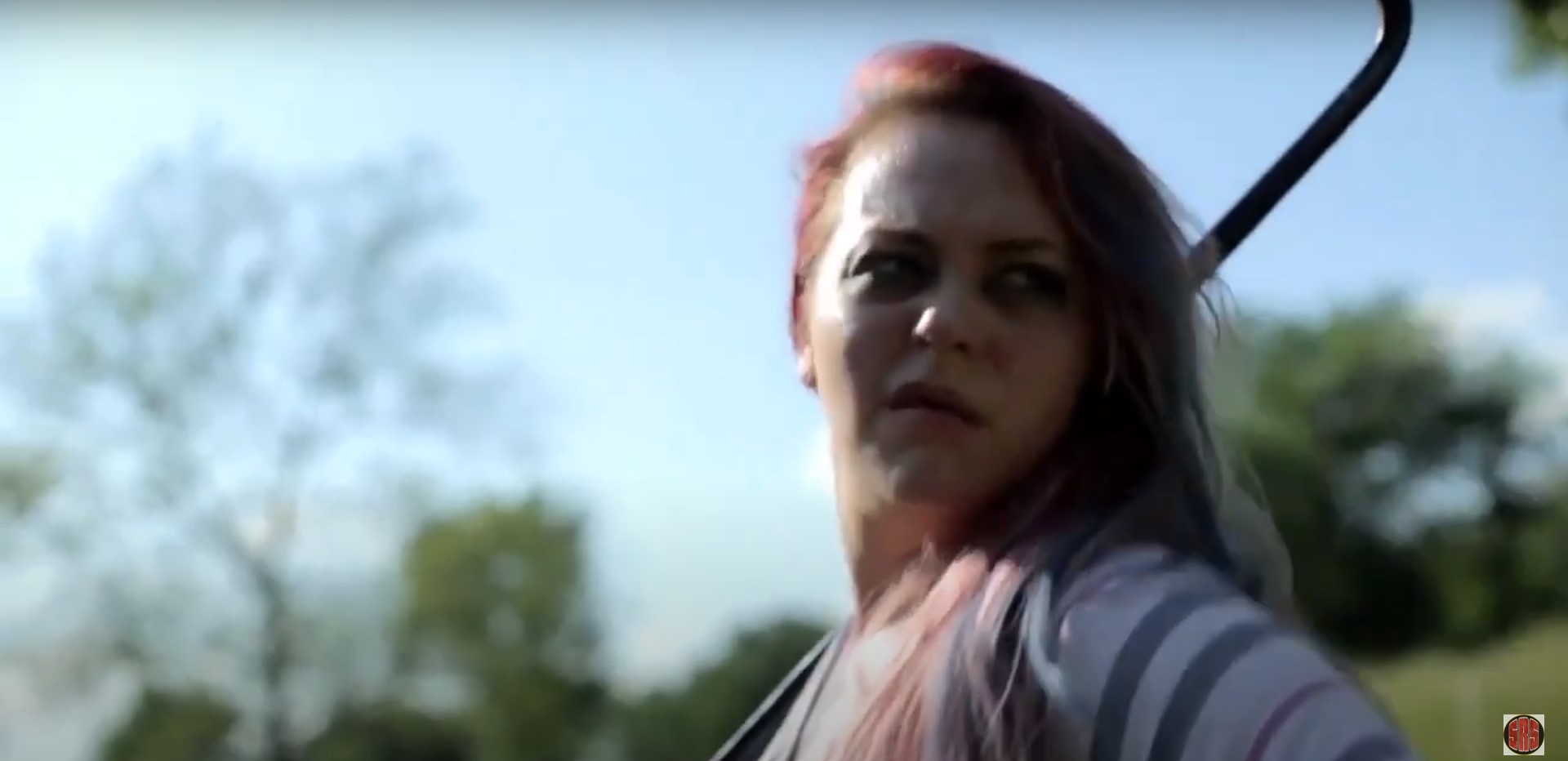
Zelch’s “Savage Vengeance” has an identity problem.  Having reformulated the original premise, which doesn’t offend me as I think reinventing the wheel can sometimes be fresh and creative under the same directive title, the script has trouble nailing down a proper principal by shooting, by my count, three different segments disconnected from each other and with three different protagonists leading the charge in each.  Tamara Glynn receives top bill despite only garnering about 10 minutes of screen time in the beginning due to much of the opening footage being lost due to backup hard drive failure, according to Zelch on the director’s commentary.  The “Terrifier 2” and “Halloween 5” actress is essentially captured, chained, and trying to find a way out after waking up in a scarce-looking attic but because of her aforesaid credits, the DVD front cover banner head makes for a great advert sell point.  Instead, modern scream queen Roni Jonah (“Kill, Granny, Kill!,” “The Bloody Man”) becomes the runtime face of “Savage Vengeance” as Jake Zelch intends for the girth of the story.  Jonah, as Tara, paired with Jasper Evans as best friend Meghan heading toward an in schtook situation not only the cannibals on the road ahead but internally with rape, pregnancy, and a dysfunctional love triangle that has more to do with illicit lust than love with Tara’s boyfriend David (Dave Ivan), a theme much closer to the original essence of Donald Farmer’s rape-revenge exploitation.  However, what’s assumed is taken for granted and not utilized to all its pathways the concept could have complexed the characters rather than freezing them in a face value understanding.  That understanding comes a tool against cannibals Ronnie (Kat Underwood) and Thom (Cody Alexander, “Eat the Rich”) who are your typical crazed anthropophagus antagonists, as well as sadistic sodomist as we see with Adam Freeman’s (“Debbie Does Demons”) character, of film.  When these characters meet and try to be merge an acquaintance or friendship, in Tara’s shoes, I might just be a little more judgmental of two heavily tattooed wanderers, the male sporting a knife sheathed in holster around his backside as he walks around his wifebeater tank-top, handing out to me mysterious drinks on their isolated, rural property.  The whole setup doesn’t do the story justice to Tara’s decision making but then again, she’s not as pulled together as Zelch’s useable footage relays.  The third segment pops up after initial closing credits with Jessa Flux (“Debbie Does Demons”) to possibly offer up an imminent sequel “Savage Vengeance 2:  Better Off Dead, starring Flux.

Almost seems unfair to cover and review Zelch’s “Savage Vengeance” because of so much of the footage being forcibly cut and the shot narrative going through essentially restructured surgery to make pieces segue and make sense on screen.  Honestly, the recut doesn’t work, leaving too much unanswered and too much to decipher to put a solidified stamp on the series of events.  Thus pushing forward the abridged cut may warrant an impartial review until a more definitive, complete cut sees the light of day.  The material “Savage Vengeance” shows currently splices together the MPEG files that survived the great blue screen of death and transfer fail, such as with the Tamara Glynn opening that’s only connected by the brief present of Ronnie eating cat guts and Thom surprising and looming over Glynn before her deafening scream.  The additional footage explained by Zelch added context to the cannibals and provided a memorable kill to setup the tone of Zelch’s homage to late 70’s rural horror.  Fortunately for Zelch, horror fanatic brains are wired differently, able to fill in most of the gaps of a formulaic building blocks; however, the success of this can also be attributed to Zelch’s scramble editing to make a semi-intelligible story with what’s left contextless of the low budget nitty-gritty.  Another highlight is the blood with pretty-penny special effects from the multi-hat wearing Kat Underwood and her colleague Erin Felts who drum the gore the best they can with prop dummies for splitting in two, a whistle dogged dildo-penis gag, and saucy blood and guts to give the film the edge it needs to tribute Farmer’s ferociously.

I’ve said it once and I’ll say it again, I do applaud SRS Cinema’s time, effort, and creativity in the physical media artwork as the gorgeously dripping blood, sex, and horror pulp is quintessential eye candy for fans in what is typically a microbudget and mediocrity poor effort in the graphic cover art department of terribly arranged and hack job compositions. None of that rubbish here with many of the SRS Cinema titles, including “Savage Vengeance” on DVD.  The 1.85:1 widescreen and 720p standard definition presented DVD5 might have a deliciously illustrated cover but the film itself is marred by the artificial VHS overlay of tracking lines and macroblocking, especially when Zelch aims for a 70’s exploitation veneer that was mostly 16 or 35mm.  Instead of a grainy-laced, dirt-spotted, cigarette-burned, and scratched up celluloid frames, or a resemblance of something akin to it, “Savage Vengeance’s” aesthetics only bask in the softer details of lower resolution clarity and in the ethereal of a delicate lighting that eliminates shadowy contours that offer depth.  Frame rate also seems to be slow down some sporadically throughout as well as the erratic focus as if you’re coming out of sleep and trying to regulate your eyes from dark to light.  The English Dolby Digital 2.0 audio mix stems from the onboard, built-in camera mic that captures the surroundings which has pros and cons, such as diluting the dialogue to a subdued audible.  Not a ton of balance from the surrounding environment when augmented sounds, like the zaps of the electric fence or the overpower roar of chainsaw decibels that don’t change in closeups or wide shots, make their way into the fold.  No subtitles are available.  Bonus features include a Jake Zelch commentary with scene-by-scene backstory and explanation as well as the full explanation of his lost footage, actor Adam Freeman commentary that revolves around his acting craft, male nudity on screen, and his opinions of rape and sexual assault in general, a gallery slideshow, and the feature’s trailer.  Aforementioned, the illustrated cover of Tamara Glynn looking slyly and sexy holding a blood chainsaw is primo quality on front of the standard DVD case.  Inside lies no insert and with the same image on the disc art. Until a completely restored version of director Jake Zelch’s vision, the filmmaker’s “Savage Vengeance” can barely stand as perspicuous testimony of an uncalled for 30-year-reimagining.

“Savage Vengeance” now available on DVD home video!

EVIL Inspires a New Concert. “Nightmare Symphony” reviewed! (Reel Gore Releasing / Blu-ray)

“Nightmare Symphony” is a Falsetto of Praise for Lucio Fulci.  Purchase the Blu-ray Below!

Unable to cope with another large box-office failure, the American indie horror director, Frank LaLoggia, is in the travails of a make-or-break psychological thriller overseas in Kosovo.  With an executive producer forcibly pulling LaLoggia’s creative marionette strings and the film’s screenwriter displeased and disapproving LaLoggia’s arm-twisted version of the story, the struggling director finds himself frantic and in the middle of a breakdown caught between a rock and a hard place with a postproduction from Hell.  Those around him, the conceited producer, the upset screenwriter, the pushy wannabe actor, and more, are being hunted down and brutally murdered by a masked killer and the imaginary line between Frank’s reality and paranoia grows in intensity coming down the wire of completing his career-saving, or rather lifesaving, film.

Long time since I’ve heard the name Frank LaLoggia enter the dark corners of my brain as it relates to the horror genre.  The director of 1981’s “Fear No Evil” and 1995’s “Mother” had seemingly vanished from the director’s chair spotlight and more-or-less, or rather more so than less so, vanished from the broader film industry altogether.  Then, Domiziano Cristopharo’s “Nightmare Symphony” suddenly drops on the doorstep and there’s Frank LaLoggia, starring in the lead role of an Italian horror production.  Domiziano, known from his entries of extreme horror, such as with “Red Krokodil,” “Doll Syndrome,” and “Xpiation,” engages LaLoggia to act in an unusual role, as himself, and turns away from the acuteness depths of uber-violence and acrid allegories to a toned down, more conventionally structured, narrative inspired by the Lucio Fulci psychological slasher “Nightmare Concert,” aka “A Cat in the Brain.” Co-directed with first time feature director Daniele Trani, who also edited and provided the cinematography, and penned by the original screenwriter of “A Cat in the Brain,” Antonio Tentori, “Nightmare Sympathy” plays into questioning reality, the external pressures that drive sanities, and weaves it with a meta thread and needle. The 2020 release is produced by Coulson Rutter (“Your Flesh, Your Curse”) and is an Italian film from Cristopharo’s The Enchanted Architect production company as well as companies Ulkûrzu (“Cold Ground”) and HH Kosova (“The Mad MacBeth”).

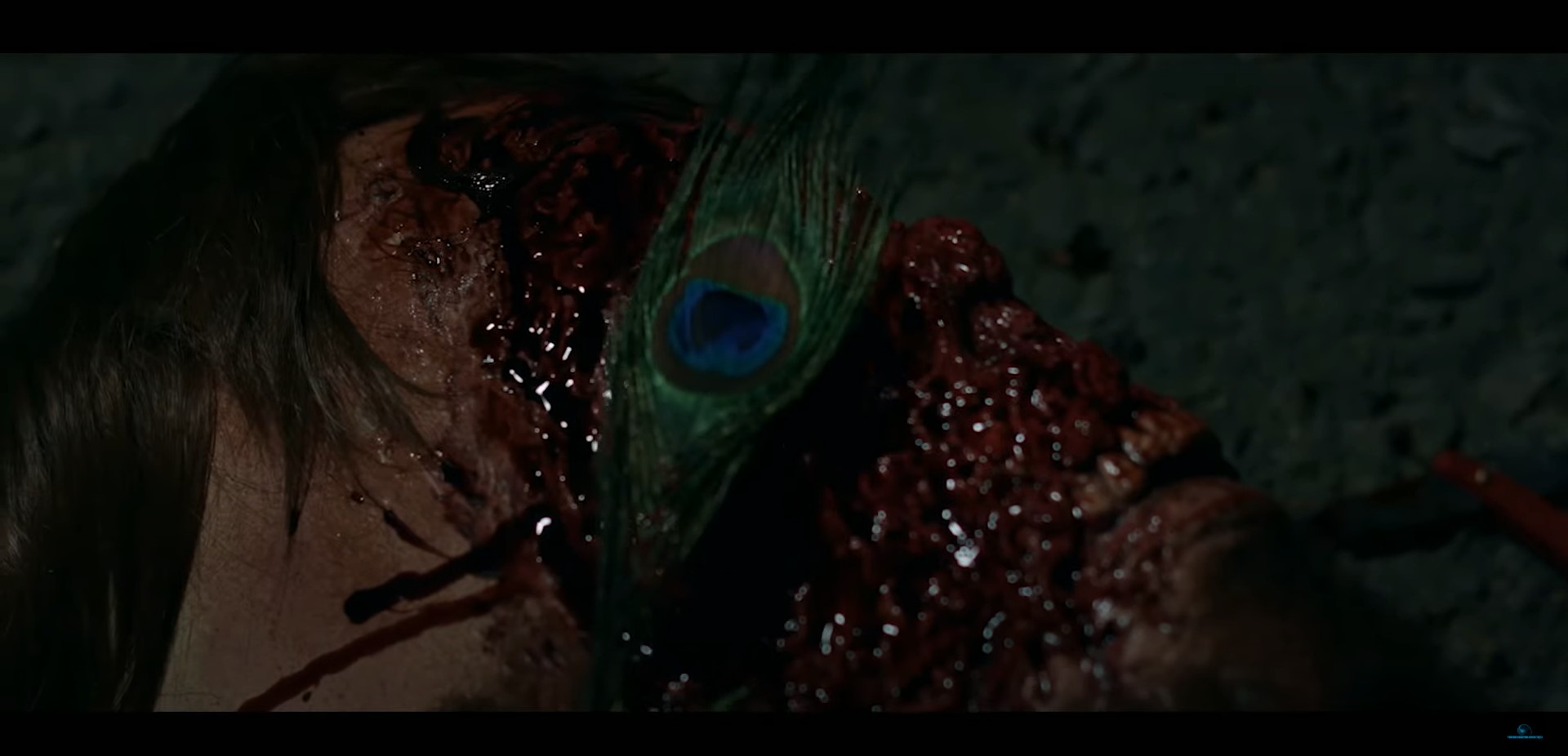
Much like “A Cat in the Brain,” Frank LaLoggia depicts his best Lucio Fulci representation as a horror filmmaker whose storyline production mirrors the individual slayings surrounding him. As a character, LaLoggia is not entirely aware of the murders as the peacock headed slasher’s string of sadism runs parallel to LaLoggia’s post-productional workload. Cristopharo pays a simultaneous tribute to not only Fulci but also LaLoggia with a built-in brief, off-plot moment of the editor, Isabella, a good friend and longtime partner of LaLoggia, running a reel of “Fear No Evil” to reminisce over his debut picture. Antonella Salvucci (“Dark Waves,” “The Torturer”) plays Isabella but also LaLoggia’s pseudo film lead actress Catherine in a dual role performance with the latter marking Salvucci’s topless kill scene that hits and sets up the giallo notes. Isabella denotes the director’s only real friend with everyone else, from the screenwriter to the executive producer, push their own self-gratifying wants onto the American filmmaker from all angles. A vulgar herd of personalities descend upon LaLoggia to exact their strong-willed ideas on how the film should appear and be marketed. From the screenwriter Antonio (Antonio Tentori, ‘Symphony in Blood Red”), the imposing desperate actor David (Halil Budakova, “Virus: Extreme Contamination”), to the uncultured and pushy executive producer Fernando Lola (Lumi Budakova) and his aspiring actress Debbie (Poison Rouge, “House of the Flesh Mannequins”), they all look to exploit LaLoggia’s modest career for their own benefit. Performances vary with a range of experience, and we receive more noticeably rigid recites and acts from the Kosovo cast in a clashing pattern with the Italy cast that has worked with Cristopharo previously. Ilmi Hajzeri (“Reaction Killers”), Pietro Cinieri, and Merita Budakova as a chain-smoking lady stalker that has glaring eyes for Frank LaLoggia.

While not necessarily thought of as a remake, “Nightmare Symphony” is certainly a re-envision of the Fulci’s “Cat in the Brain.” What Cristapharo and Trani don’t quite well connect on is connecting all the pieces of the psychotronic puzzle together into what is meant to be expressed. The giallo imagery is quite good, a praise of the golden era period in itself, with a mask and glove killer, the closeup of gratuitous violence, most of the score, and the stylistic visuals imparted with ominous shadow work, foggy and violent dream sequences, and with congruous cinematography and editing of earlier giallo. Plus, audiences are treated to not only the aforementioned Antonio Tentori, screenwriter of “Cat in the Brain,” but also have composer Fabio Frizzi score the opening title. Frizzi, who has orchestrated a score of Lucio Fulci films, such as “Zombie,” “The Beyond,” “Manhattan Baby,” and even “Cat in the Brain” just to select a few notable titles, adds that proverbial cherry on top to evoke Fulci directing “Nightmare Symphony” vicariously through Cristapharo and Trani. There are some questionable portions to reimagining’s take on the original work that are more the brand of the contemporary filmmakers. The presence of death metal prior to one of the kill moments puts the overall giallo at odds with itself in a fish out of water aspectual scene composition. Another out of place component are the external characters that are not directly involved with LaLoggia’s peacock-head themed slasher; the ironical venatic of an animal hunting down people is the reversal of a Darwinism theory that instead of sexual selection, the beautiful and elegant peacock forgoes using grace to attract and aims to survive by natural selection and thus the killer kills to remain alive. However, the story and the directors never reach that summit of summation and with the oddball characters adrift from the core story – such as the stalking woman and the eager actor – “Nightmare Symphony” flounders at the revealing end with its severe case of blinding mental delirium.

With a cover art of an upside skull overfilled with film reels and unfurling celluloid through the soft tissue cavities, “Cat in the Brain” continues to be reflected in “Nightmare Symphony” up to the release’s physical attributes on the Reel Gore Releasing’s Blu-ray. Presented in on a AVC encoded BD25, with a high definition 1080p resolution, and in a widescreen 2.35:1 aspect ratio, the Reel Gore Releasing espouses the Germany 8-Films’ Blu-ray transfer for a North American emanation, which might explain some of the complications with the bonus features that’ll I’ll cover in a bit. Situated in a low contrast and often set in a softer detail light, “Nightmare Symphony” doesn’t pop in any sense of term with a hazy air appearance and a muted color grading that goes against the giallo characteristics, especially when the clothing and set designs have the same desaturation or are colors inherent of low light intensity. Despite appearing like a slightly degraded transfer on a lower BD storage format, compression issues are slim-to-none with artefacts, banding, or blocking and this results in no tampering edge enhancements or digital noise reduction. The release comes with three audio options: A German DTS-HD 5.1, German DTS-HD 2.0 Master Audio and an English and Italian DTS-HD Stereo 2.0 all of which are Master Audio. The German audio tracks are a dub from the 8-Film Blu-ray and the 5.1 offers an amplified dynamics of the eclectic soundtrack and limited environment ambience. Dialogue remains outside the dynamics on a monotone course but is clean and clear with good mic placement and a neat, fidelity fine, digital recording. The German dub has a distinct detachment from the video because of its own layer environment, sounding a little sterile than the natural English or Italian, but works well enough as expected with the supplement multi-channel surround sound. English SDH and German subtitles are optional. Bonus contents feature a behind-the-scenes which is entirely just a blooper reel, an English language interview with co-director Domiziano Cristopharo whose secondary language is English, the original soundtrack playlist, and the teaser and theatrical trailer. I mentioned an 8-Films’ transfer complication with the bonus content because there’s is also an interview with Italian screenwriter Antonio Tentori that’s only in German dubbed and subtitled with no option for English subtitles or dub. When you insert “Nightmare Symphony” into your player, an introductory option displays to either pick German or English and I considered this to be the issue for the German only interview with Tentori; however, that is not the case as both country options are encoded in German for the interview, so at the beginning option display, I would recommend the German selection because the setup will have contain all audio options for the feature whereas the English selection will only contain the English 2.0. Reel Gore Releasing’s Blu-ray comes housed in a red snapper case, the same as the company’s release of “Maniac Driver,” and has a less tributing reversible cover art with more revealing and illustrated aspects of the narrative. The release is region free, unrated, and has a runtime of 78 minutes. Another little fun fact about the release is the incorrect spelling of the director’s name on the back cover that credits his surname as Christopharo instead of Cristopharo. Influenced by Lucio Fulci beyond a shadow of a doubt, “Nightmare Symphony” proffers the Horror Maestro’s less notable credit with a companion piece that punctuates both films love for the giallo genre, love for the violence, and love for the morbidly unhinged human condition.

“Nightmare Symphony” is a Falsetto of Praise for Lucio Fulci.  Purchase the Blu-ray Below!

Channeling the EVIL from the EVIL DEAD! “Slaughter Day” reviewed! (Visual Vengeance / Blu-ray)

SOV “Slaughter Day” on Bluray for the First Time Ever!

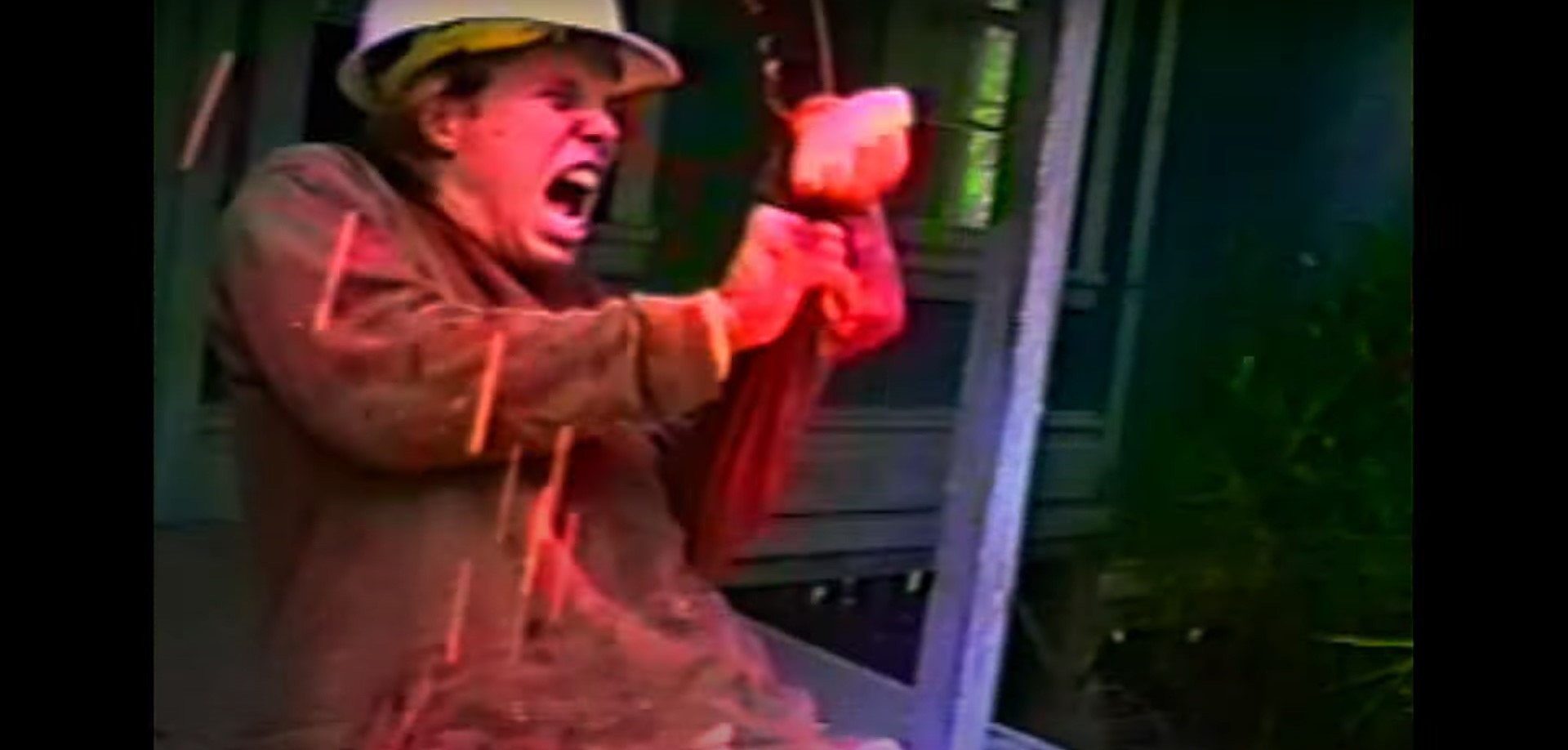
A pair of friends who run a small construction company drive up to an isolated cabin project in the outskirt nooks of Hawaii.  When they arrived, they encounter disgruntled employee John Jones who dabbles in the dark occult.  Having murdered already one of their construction crew members, Jones invokes the evil from the book of the dead, the Necronomicon, to bestow upon himself unnatural powers to seek revenge for years of abuse on the job.  Enslaving two other members of the construction Crew, Jones relentless goes after his former employers who must fight tooth and nail for every minute of their lives.  The fight stretches across the island and spills into the streets, abandoned factories, tropical brush, and even on the side of a mountain. 

“The Evil Dead” meets “Double Dragon!”  A fierce bareknuckle fight against a malevolently possessed construction crew is the not-stop action and gore premise of the Brent Cousins’ “Slaughter Day.”  The heavily influenced Sam Rain and “The Evil Dead” 1991 shot-on-video occult survival horror is co-written by Brent’s twin brother, Blake Cousins.  The twins’ filmic debut concept where a maniacal occult enthusiast goes on the offensive with his vindictive side by conducting dark, Necronomicon evil against the two construction supervisors is pieced together, scene-by-scene, from the various shorts created when they were adolescents.  The four short films from their inspired youth were revisited and remade into a full length feature film financed by a nearly a next-to-nothing zilch budget, but with more than a little can-do attitude, a group of close friends and family, and a willingness to drench the cast in splatter bags fill of fake blood, Brent and Blake’s balls-to-the-wall, commercial grade equipment schlocker never lets up and pays endearment to the legendary video nasties that have stimulated their need for tangible blood-shedding effects.  “Slaughter Day” is a self-funded labor of love under the Cousins Brothers Productions and is made in one of the more tropical places on Earth, the Big Island of Hawai’i, with a few scenes shot in the town of Honokaa.

Aside from being one of the two writers, Blake Cousins jumps in the front seat to become one of the hapless heroes in the suddenly twisted, Hellish ride of that classic story of good versus evil. Blake embodies one of the few aspects that makes the viewing of “Slaughter Day” so infectiously exciting with a high intensity level somewhere around near redline critical. The intensity spreads to each and every actor in front of the camera and with Blake’s breakneck pacing as the film’s post-production editor, there’s a side-scrolling, beat’em-up video game quality about the whole run through. The acting isn’t terribly good with haywire yelling and screaming from start-to finish with a lack of professional training that gives way to under developing a story, but story be damned, the brother Cousins ambitiously puts caution to the wind by balancing out the acidic acting with exceptional camera work that occasionally would involve hazardous to their own health amateur stunt work. The unharnessed and unpadded fight sequence in the back of the pickup truck gets mad props in succeeding instead of squashing someone’s head under the tire. If everyone lives and you get the shot, it’s a win, right? The fight sequences themselves are extensive, as I aforesaid, the breadth of the short feature is like experience a live action “Streets of Rage 2,” and they have the smack of decent choreography with near miss blows and head whips. Some of the bigger fake hits lack sterling results but are nonetheless entertaining and expected. “Slaughter Day’s” cast is made up of essentially a closeknit group of friends with performances from Sam Bluestone, Dave Anderson, John Lambert, Kulaka Branco, Jeremy Couchiardi, Joe Ross, and Lincoln Ross who all have never again seen the gaffer lights of another film production.

“Slaughter Day” has many flaws: bad acting, continuity mistakes, not much of a plot, etc. While honest attempst were made to rectify a handful of those sore points, those very same imperfections are what make “Slaughter Day” ironically perfect in the SOV canon. Some of the gags land relatively smooth, such as being John Jones being bent backwards in half and sucked into a copy of the pop media cultural influencing H.R. Giger’s Necronomicon book, and others kind of flounder in the lukewarm stew of unskilled technical know-hows. Yet, I do firmly believe the brothers achieved a memorable salute to Sam Raimi’s breakthrough 1981 video nasty, “The Evil Dead” in pulling more so the macabre-isms then comedic slapstick elements of the “3 Stooges.” Brent and Blake obviously understood what they wanted to see and how much familiar content they wanted to rework to open the recesses of our memory banks to access and recall “The Evil Dead” playbook, but then the flyby the seat of their pants filmmakers take their committed vision farther by adding certifiably crazy stunts and be big and bloody as all bloody hell! Severed limbs, decapitations, exploding shotgun bursts, and impalings are difficult for even the most seasoned effects artist, taking sometimes years to master a simple effect to perfection. With “Slaughter Day,” the brothers are unafraid to take risks, something the filmmakers proved with audacious stunts, by rendering a practical effect inclined storyboard or script thought to the screen tactic and owned it with a pinch of panache pizzazz!

“Slaughter Day” might be release number five for Visual Vengeance but is clearly the Wild Eye Releasing cult-horror SOV sublabel’s second adulation of “The Evil Dead,” following “Bloody Muscle Body Builder in Hell.” The rough-and-ready S-VHS quality, presented in a full screen 1.33:1 from the original standard definition master tapes, can take on a grueling affect with a below par outcome. Tape lacks the proper color resolutions and that displays here immensely with full of deep and warm purples, reds, and yellows that you’d think the brothers were using gels to tint the picture. Tape wears, static interference, tracking lines… you name it, ‘Slaughter Day” visually had it. Delineation and details are deduced to a softer, overlapping ghost image that barely yokes together resolution pertinent pixels. Like always, Visual Vengeance’s disclaimer warns of the consumer grade equipment issues. These issues extend also into the English Stereo audio mix with a consciously underlay of static shushing, lo-fi dialogue recording, and zero depth and range to add more fuel to the “Slaughter Day’s” chaotic fire. Perhaps that’s why the dialogue is terribly rampant with the hope to invigorate and illicit engrossing captivation. The video game punch throw sound bites are a good touch and a innovative way to keep with the fighting game motif. The special features include a new audio commentary by directors Brent and Blake Cousins, a new audio commentary with Visual Vengeance’s own Matt Desiderio and Rob Hauschild, a quickly paced new interview with the Cousins Brothers regarding the genesis of “Slaughter Day” and they’re excitement about the new Blu-ray release, all four original “Slaughter Day” shorts, an earlier short entitled “Full Metal Platoon,” the “Slaughter Day” theme song, trailers from other Cousins films, such as “Rising Dead,” and the original trailer cut. Physical release features include a mini poster of the Visual Vengeance cover artwork, a three-page colorful essay from long time cinema contributing writer Tony Strauss, retro Visual Vengeance stickers that has graced all the company’s releases so far, a reversible cover art with new artwork as well as the original VHS art, and a cardboard slipcover with a heavily demonic and menacing Thomas “The Dude” Hodge design. The film comes unrated and has a runtime just shy of an hour at 58 minutes. I always get the warm and fuzzies when obscure works of art receive the red-carpet release treatment and “Slaughter Day” is an exemplar of SOV at its best while being innately its technically worst. Lots of ambition, lots of derived creativity, and lots of guts behind and in front of the camera to make a life-long dream of filmmaking come true.

SOV “Slaughter Day” on Bluray for the First Time Ever!

A Sleepover With More Pillow Fight Than EVIL. “Slumber Party Slasherthon” reviewed! (Wild Eye Releasing / DVD)

“Slumber Party Slasherthon” on DVD at Amazon.com

We all know the familiar stages of a slumber party. The pillow fights, the junk food, and the all-nighter horror movie marathon that elicits amongst the room a simmering suspense that boils to bubble-popping action when even just the lightest rap at the front door can make one jump out of their seat in fear that the monster on the screen is also the monster clawing its way inside. These are all classic campout characteristics of a well-organized slumber party for a group of young high school planning a night of fun. Immerse in a string of video thrillers and with their male friends having joined the party, all fells safe during their night of revelry. That is until a manic with a high-powered, industrial drill shows up uninvited and unhinged. A night of fun quickly spirals into a night of unescapable terror just like in the horror movie marathon as they become the lumped together prey of their very own horror movie.

Slumber parties with uninhibited and skimpy-dressed teenage girls and the bedlam brought to the party by the unstoppable and unglued serial killer are a winning combination that go hand-in-hand just as well as vanilla ice cream and chocolate syrup on a classic sundae dessert. For the unofficial king of direct-to-video sequel and the despot of campy, indie horror filmmaker, Dustin Ferguson shares that perspective with his very own unique spin on the slumber party horror subgenre with “Slumber Party Slasherthon” that showcases snippets from Ferguson’s earlier movies, as well as Abel Ferrera’s video nasty “Driller Killer,” spliced into the wraparound story in what could be considered an eclectic compilation of clip anthologies with one common theme – homicidal killers. The 2012 “Slumber Party Slasherthon” is one of a handful of Ferguson’s early feature submissions before he went on a marathon of his own in the DTV market with films including some of his more recognizable titles in “Die Sister, Die!,” “Camp Blood 4 & 5,” “RoboWoman,” “5G Zombies,” and “Ebola Rex.” Under his own production and distribution label of RHR (Retro Home Remix) Home Video, Ferguson self produces the film in Lincoln, Nebraska as a one-man operation who knows showing up to a slumber party with a blood thirsty drill is better than showing up to a slumber party empty handed.

If you’re in the mood for familiar faces or recognizable names in what could be an interesting slasher trope-laden production, well you won’t have that memory jogged I know that actress moment with a cast of unknowns beyond this credit and have securely hitched their body of work to the Dustin Ferguson business model. With a next-to-nothing on the dialogue outside the marathon showreel, the performances of Nina Colgan, Tara Hinkley, Kim Moser, and Jettie Sorensen-Sticka are left to defend their acting credentials with the dual variation of a pillow fight sequence and in which one of the arrangements, intercut with the opening title credits, is shot in negative image. The brief topless nudity of one of the actresses and the frolicking of soft pillow swings are all the girth given to the principal cast, providing no arcs, no substance, and no real chance to do anything but be bit part actors in what seems like a commercial or faux trailer for Ferguson’s other films. In fact, I did read that “Slumber Party Slasherthon” was originally intended to be a fake trailer for a sequel to the “Slumber Party Massacre” line, yet somehow the project became unbuttoned from that franchise and fashioned in a way that’s more Frankenstein’s Monster than feature file, turning “Slumber Party Slasherthon” into a demo reel for Furgeson and RHR Home Video’s DTV catalogue. I couldn’t tell you who Colgan, Hinkley, Moser, or Sorensen-Sticka played in the foursome, but Breana Michell’s is distinct from the others as the girl who arrives late only to get drilled later – offscreen, of course.

A muddied-up potpourri of RHR Home Video produced and distributed enumeration of slasher films, “Slumber Party Slasherthon” isn’t as gorily galvanizing as it sounds. From beginning to end, there’s not a single ounce of a story conveyed to lure in a potentially captivating audience wanting to bestowed upon highly sexualized girls in lingerie being ripped to shreds by a lunatic over a single night sleepover. Instead, Furgeson regurgitates clips of his schlocky direct-to-video titles from years’ past, such as “Terror at Black Tree Forest” and its sequel “Escape to Black Tree Forest,” which look just as cliched and trashy as the intended feature with an over enthusiastic use of primary color filters. Other features not directed by Furgeson but are a part of the RHR Home Video assemblage of titles is “7 Down” directed by Tyler L. Schmid and, perhaps the most buoyantly intelligible and substantial film of the whole grouping, “The Diller Killer” directed by Abel Ferrera, that ironically enough clearly partitions itself from the rest of the films as a completely deranged concept not borrowed from the canon like the rest.

A part of the Raw & Extreme label, “Slumber Party Slasherthon” comes to the masses unrated on a Wild Eye Releasing DVD. The region free releasing is presented in a stretched full screen 1.33:1 aspect ratio with a variety of video problem areas. Aside from the poor, commercial grade filmmaking equipment, likely a shot on a handheld digital camcorder with a max resolution output of 720p, compression artefacts run rampant with a blotchy, and often jittery with swelled pixels, image. Despite a flat hue palette for the main story, an assortment of color filters is placed on the 3rd party films showcased as horror movie marathon fodder, whether or not the “Escape to Black Tree Forest” or “Terror at Black Tree Forest” camp powwows and kill highlights are authentically presented or not in its rehashed integration into “Slumber Party Slasherthon,” I could not definitively know. The English Stereo 2.0 mono has little to offer in shepherding any kind of storytelling design nor is there an attempt at a clean sense of clarity around a dialogue track that’s poorly edited, plagued with electronic interference, and has about the sharpness of a butter knife. Levels vary wildly in the ambient and the soundtracks also. The single redeeming quality of “Slumber Party Slasherthon” is John Altyn’s “High Roller” single that leaned on to way too hard – being used in the opening credits, first act, and in the post-credits, and post-credits music video – to excel save a little change and give Ferguson’s film flashier audio tinsel with 80’s rock-n-rock. Bonus features are about the same as expected with A/V quality with a scene selection and Wild Eye trailers, plus RHR Home Video previews of “Scared Sillies 2,” “The Wanted,” “The Devil Times Five” and an awkward two-girl sway-your-hips-in-place dance party featuring Altyn’s – you guessed it – “High Roller” single (not the official music video by the way). “Slumber Party Slasherthon” is a sleeping bag full of disappointments and is the anti-scary story told that’ll lull teenage girls right to dreamland during the slumber party pajama party.

“Slumber Party Slasherthon” on DVD at Amazon.com

EVIL is Always the Quiet Ones. “Forced Entry” reviewed! (Dark Force Entertainment / Blu-ray)

“Forced Entry” on Blu-ray Available from Amazon.com and MVDShop.com

On the outside, Carl is a mild-mannered and a bit of a simpleton who works as a mechanic at the corner gas station.  On the inside, Carl’s an unstable, sociopathic rapist and murderer with chauvinistic patriarchal tendencies.  His grisly exploits rock the small New Jersey town but as life continues on so does Carl’s misguided perception that the women who cross his path want him.  As a mechanic and a rapist, Carl continues in getting his hands dirty even when the exceptionally beautiful housewife, Nancy Ulman, drops off her husband’s car for repairs.  With Nancy’s husband out of town, Carl creates an unfounded fantasy of being the one and only that can please her right.  As his obsession swells, Carl’s pushed over the edge into a no-turning back captive scenario by holding Nancy bound and hostage in her own home as he attempts irrationally and violently his case for bestowing his flawless companionship to her. 

Throughout nearly the entire history of cinema, the adult industry has remade blockbuster film titles into triple X spoofs.  “Beverly Hills Cox,” “The Penetrator,” “Clockwork Orgy,” and “Forrest Hump” are a few titles that come to mind.  But have you ever heard of a porn remade into an actual movie?  Of course, there’ve been a few biopics surrounding controversial cog players of the adult industry machine, such as with mainstream biopics that expose the lives of starlet Linda Lovelace of “Deep Throat” with Amanda Seyfried as the titular character and the notoriety of porn filmmakers Artie and Jim Mitchell in Showtime’s “Rated-X,” starring real life brothers Charlie Sheen and Emilio Estevez.  Never in my existence on this tectonic plate shifting Earth have I’ve ever bear witness to a porn being remade into a film marketed on retail shelves to the general public.  That’s the backstory behind Jim Sotos’s 1976 debut feature “Forced Entry” based off Shaun Costello’s 1973 stag film of the same name and starred that “Deep Throat” connection with Harry Reems as well as Reems costars Jutta David (“Sensuous Vixens”), Nina Fawcett, and Laura Cannon (“The Altar of Lust”).  Also known more uncommonly as “Mr. Death” and “Rape in the Suburbs to more commonly as“The Last Victim,” Henry Scarpelli adapted the script out of the X-rated context but kept much of the aggressive themes, changing the gas station attendant from a Vietnam shell-shocked maniac to delusional maniac stemmed from abusive mother issues.  Sotos and Scarpelli also serve as producers under the Kodiak Film production company. 

“Forced Entry” stars a then fresh faced Tanya Roberts.  The late “A View to a Kill” Bond girl and “The Beastmaster” actress received her start as the slightly frustrated, but overall pleasant, housewife Nancy Ulman who must fight for her life when Carl, under the wonderfully wild and violent guise of “Heated Vengeance’s” Ron Max, breaks into her home to fulfill his ferocious fictious fantasy.  The contrast Nancy and Carl is extremely key to “Forced Entry’s” modest success as the story plays out in both perspectives with more lean on Carl with a far more interesting mindset, internalizing monologues of desires and anger.  While Tanya Roberts is hardly stimulating on screen as routine wife and mother, concerned a little on her husband’s sudden indifferent behavior, she exhibits a stark normalcy that makes Carl’s actions flagrantly deviant with the anticipation that Nancy will be too submissive or afraid to fight back.  Ron Max is no David Hess but instills a disturbing, looney bin creeper who, most frighteningly of all, could be your neighborhood grease monkey mechanic.  Like Roberts, another yet-to-be-famous actress has her brief moments of screen time as Carl’s hitchhiker victim.  “Robocop” films’ Nancy Allen finds herself riding shotgun with a serial murder-rapist even before going face-to-face with the telekinetic prom queen, “Carrie,” in a blink and you’ll miss her thumb lifting and chitchat-disparaging segment to give Carl more depraved depth.  Billy Longo (“Bloodrage”), Michael Tucci (“Blow”), Vasco Valladeres (“Bad”), Robin Leslie, Frank Verroca, Brian Freilino and Michele Miles.

Color me easily impressed by the novelty of the basis of a porn plot being transposed into a more accessible outlet for audiences.  Pushing that novelty aside, “Forced Entry’s” plot is simply stitched together to make Carl this really bad guy by fashioning situations that indulge his impulses – a stranded woman motorist out in the middle of nowhere, a female hitchhiker talking back to him in his own car, a girl with high cut shorts pumping gas station air into her bike.  Though often disjointed in the story’s framework and for some reason, Carl’s face is initially pointlessly concealed for the broken down motorist attack, helpless moments like these, plus the crazed internal monologuing rationalizing his actions, pushes Carl’s chances of being stopped next to nil with audiences.  How will a happy homemaker, trapped in her own home, be able to survive crazy Carl?  That’s where the story really begins with the first moment he laid eyes on Nancy and as he rolls out the imaginary carpet of playing house with her, we begin to see how attached he becomes to the idea as he strays away form his normal off-the-cuff methods that has served him well until this point.  Much of the shock value comes from the climatic finale that determines Carl and Nancy’s fate with a slow-motion shot full of cacophonous screaming to bring a definitive effect to an unexpected turn of events.  “Forced Entry” is more Spinell “Maniac” than it is Hess “Last House on the Left” but not as well-known and has unformulaic structure that strolls too comfortably between the lines of shocking consternation.

Dark Force Entertainment and MVD Visual distributes this notable unconventional remake onto another Blu-ray home video, but this new and improved version of the film that includes nearly additional ten minutes of footage into the original 73-minute director cuts of the previous 2019 Dark Force Entertainment prints under the Code Red label. This longer version adds back in more of the sexually graphic material and is 1.85:1, anamorphic widescreen, presented in a 2K scanned transfer with a 1080p output from the original 35mm negative material of the US theatrical release. Granted, some of that footage, such as the snatching of the bike girl, is nearly impossible to discern much beyond an unrefined image. The coloring throughout is inconsistent and unstable with clear fluctuations in hue flickers and a few scenes early in the film suffer from conspicuous wear damage. However, I suspect this transfer to be the best of the best to date and is not all a waste of viewing space with much of the image holding up strong. The single audio option is an English LCPM 2.0 mono is not the cleanest with clearly noticeable crackle and static throughout and overtop a muted dialogue track. Tommy Vig’s (“Terror Circus”) score nabs more support than the others in the audio output. Special features include the full-length 88-minute VHS minute version from standard definition video so don’t expect the highest resolution if you’re looking for more sordid footage in an essentially quantity over quality version. The blue snapper case does have a limited edition stark black and yellow/orange cardboard slipcover. The new scan runs at 83 minutes in length in the region free and rated R Blu-ray (updated from the original PG rating when reexamined by the ratings board…go figure). Not just another rape-revenge notched into the controversial subgenre’s hole riddled belt, “Forced Entry” agitates suspicion in the most harmless of unsuspecting, quiet-natured nobodies as it only takes one to be the filthiest troublemaker hidden right under our trusting, naïve noses.

“Forced Entry” on Blu-ray Available from Amazon.com and MVDShop.com