

The Motel Mistress stands tall beside a highway on the outskirts of Bangkok. The adult-oriented love accommodate caters to the freakiest of the freaks under the soft glow of the hotel’s purple-pink neon marquee that’s shimmers on the rooftop during the tantalizingly active nightlife, flickering to a more conspicuous Motel Mist, but during the day, the near vacant hotel sits dormant and has scarce use. That’s all about to change when four visitors and one Hotel Mist front desk man become five strangers entwined into an uncanny affair that begins with illicit sexual desires between an extremely perverted and dangerous middle-aged man and a young school girl with ulterior motives and ends with a former child star’s refuge into, what he believes, is communications from beings not of this Earth. Salacious deviances, revenge, and strange occurrences check into the Hotel Mist, but will the five strangers check out?

From the erotically charged DVD cover from Philadelphia based home video distribution company, Breaking Glass Pictures, the Truevisions Original Pictures in coproduction with the 185 Films and Song Sound Productions produced “Motel Mist, written and directed Prabda Yoon, has the irrefutable markings of an unforeseen science fiction thriller from Thailand. Yoon’s introductory 2016 picture initially dodders on various genre borders that venture into the human complexities of interaction from an alienation or a subversive standpoint and wholeheartedly whips 180 degrees merging into exacting revenge and experiencing unearthly dimensions to an inevitable mesh correcting what’s characteristically abnormal. Though sexual romps in one-night-stand lodges have been marketed as quite the norm in Bangkok, Yoon pushes the creepy factor limits to the max, turning the dial on predatory intentions to an unreal reality.

The focus surrounds five characters with dialogued roles. The characters, with the exception of two of them, are essentially from all walks of life: a young hotel concierge with ambitions to be a fire stick performer, a middle-aged man with duel façade, a child star with unknown psyche complications, and then there are the school-aged girls with relatively the same motivation, but of a diverse personality type. We’re gently introduced to the middle-aged father figure Sopol, played by Surapol Poonpiriya, gazing at a newscast about a missing child celebrity on a car onboard touchscreen. Poonpiriya reels in slowly a conservative, perhaps even old-fashioned, fatherly figure where children shouldn’t swear and nose deep in cell phones isn’t a proper and good thing, but then the actor yanks hard back on the spoke, settling his character into a blurry role between niceties and deviances. Sopol’s an abhorrent wolf in sheep’s clothing, lavished and proud of his alternate life of an older man whose been with many younger women in his prefabbed BDSM motel room. His latest fair object is Laila, a young school girl in a short skirt with fresh innocence splayed from head to toe, performed by Prapamonton Eiamchan. Laila goes with the Tot’s flow by guiding her every move and letting him manipulate her like a doll of his pleasure. Eiamchan’s curious portrayal befalls her character’s with a relationship with masochism because of a more deep rooted motivational factor and the dynamic between Eiamchan and Poonpiriya pulls at the unsettling strings while also teasing visceral fantasies. Yet, oddly enough, Vasuphon Kriangprapakit cerebral performance being an antenna for alien correspondence is more intriguing. Kriangprapakit’s Tul is the crucial focal point that connects each character, playing against their vices that shepherds into a more savior role; in fact, Kriangpapakit could be considered appearing like the Thai version of the Messiah. While Tul requires a force invading into one’s mind bubble, Tot bubble seems to have popped with vague ambitions and being an overall motel lackey. Tot, a role suited for the talented Wissanu Likitsathaporn, sports green hair atop his punk rock outfit, and, like today’s typical millennial, enjoys conversing on the phone, especially with women. His sympathetic qualities aim to grant him amnesty for his cooperative nature, especially assisting covertly alongside Sopol, and being an agent of greed when figuring out his other daytime tenant, Tul, has a reward for his whereabouts. Katareeya Theapchatri rounds out the cast as Laila’s accomplice, Vicky.

As the subtitle insists, “Motel Mist” is a setting where there are no limits. Whereas that’s true for unlimited sexual pleasures and displeasures as well as thematics akin to the “Outer Limits,” “Motel Mist” has some limitations to challenge the experimental engine on which the film is powered. For one, the takeaway message has vague variables and not enough outright exposition to grasp viewers by the balls for that deep-in-thought, chin scratching moment that ekes forward the turning giant wheels in our heads, spinning conclusions and possible theories into plausible themes. For me, the takeaway message borders somewhere along the lines of the mysterious mechanics of the cosmic universe righting the wrongs between inherently misguided human faults and interactions. Whether that notion weighs in with any truth or not is most certainly up for grabs and could possibly way off the marker, but the enigmatic complexities are what make films, like “Motel Mist,” interesting to dig into and explore.

Breaking Glass Pictures calls for room service and has delivered “Motel Mist” onto DVD home video presented on a DVD9 with a widescreen, 2.39:1 aspect ratio and the region 1 Sci-Fi/Thriller runs just under two hours at 117 minutes. Often with a warm resemblance to Bangkok atmosphere, Yoon also seizes every opportunity with a vast color palate to shape the character developments in Room 7 with sultry red and Room 5 with a sterile black and grey. No problematic issues from a nice sharp picture in natural lighting juxtaposed a vivdly colorful. The frame work, by cinematographer Chananun Chotrungroi, captures micro stories with such aggression that it becomes a thing of beauty and with Yoon’s long takes, the sensation, no matter how unpleasant, lasts what seems to be an eternity. The Thai language stereo 2.0 dual channel audio mix has clean range and depth with parameters around mid-to-high levels of output through the variations of dialogue, ambient, soundtrack, and miscellaneous distortion tracks. There are English subtitles available and while seemingly translated okay, the yellow font coloring blend way too much into the background, making reading them difficult. Special features include a pair of behind the scenes with cast & crew and a trailer. Common perceptions of Bangkok could be extracted out entirely from director Prabda Yoon’s “Motel Mist” with a taste of illicit sexual affairs and the super bizarre in this unique science fiction thriller.
Category Archives: Trailers


Make a Deal with EVIL, EVIL Will Come Calling! “The 27 Club” review!

Kurt Cobain. Robert Johnson. Amy Winehouse. Jim Morrison. Jimi Hendrix. All these recording superstars have one tragic thing in common: their fame engrossed lives ending horribly, sometimes violently, at the young age of 27 at the height of their careers. Their deaths are a part of an elite group called the 27 Club that incorporates effervescent celebrities from all walks of fame. When another popular rock star ends up mysterious deceased a night after his concert, the same concert that student journalist Jason attended, the eager academic finds himself at the right place, at the right time while researching and documenting the notoriety of the 27 Club. While hallowing out the club’s infamy, Lily, a wild and struggling musician, enters his life on a connective collision course toward his research that evidently surrounds itself around an ancient Latin-based text. The book is binding to those seeking rock star status in exchange for their souls and with a steep decline in her musical career, Lily provokes satanic rituals with exploiting help from the love struck Jason, but the only thing Lily didn’t count on was her unexpected love for him back.

The actual 27 Club lore continues to be an interesting notion. A curiously notorious concept that flew under the radar for this reviewer up until happening upon and diving into the Patrick Fogarty’s written and directed soul-bargaining tale regarding the idea’s parameters as the film’s foundation. Fogarty, the staple music video director for bands such as Black Veil Brides and The Burning of Rome, tests his hand at satanic, soul-swallowing horror, simply titled “The 27 Club,” for Cleopatra Records cinematic sub-division, Cleopatra Entertainment, and is co-written a mythos script alongside “Clownsploitation’s” Joe Flanders and Michael Lynn. Even if nothing more than a freak coincidence, Fogarty processes an innovative take on the 27 Club that has spanned over century and, perhaps, provides a little education and knowledge to those outside the music industry.

Many iconic rock stars rise from the grave to spit philosophical truths and knowledge, constructed as miniature prologues of a chaptered story, intertwined with a relatively unknown cast beginning with headlining leading lady Maddisyn Carter as the toiled Lilly seeking refuge in any drug or sexual partner her beautiful disaster can ensnare in a world of deaf tone destruction. Her character is intended to be refracted by the introduction of the 27 Club research journalist, Jason (“Mutants'” Derrick Denicola), who just happens to be around when another musician kicks the proverbial bucket, but Carter maunders through the relationship with Jason and unable to materialize compassion, losing any slither of internal conflict Lilly may possess. Todd Rundgren, Cleopatra recording artist and a member of the progressive rock band, Utopia, headlines polar opposite of Carter on the cover of the home media release only and not as a chief player in this possession plot. The role downsizes his long legacy in the music biz and though a small role and acting isn’t Rundgren’s first love, the rocker tops as being one of the film’s better moments as a record store wise-guy patron doing the right thing and a creepy video-chatty music professor. “The 27 Club” tortures the cast of remaining souls with Adam Celantano, Kali Cook (“Victor Crowley”), Zack Kozlow (“Devil’s Domain”), Mr. Chromeskull himself Nick Principe (“Laid to Rest” and “Chromeskull: Laid to Rest 2”), Jason Lasater (“Death Tunnel”), Zach Paul Brown, Emily Dalquist, Eugene Henderson, wrestling superstar John Hinnigan, Gogo Lomo-David, Tasha Tacosa (“Halloween Pussy Trap Kill Kill”), and, my personal favorite, Killjoy’s Victoria de Mare!

Novel backstory might be one thing, but a comprehensively sound one is another and while “The 21 Club” begins like a John Carpenter cask of embolism-depth imagination and beguiling, if not apocalyptic hinting, descent into oblivion, Fogarty’s film collapses when Lilly and Jason seek out a couple of drug dealers to understand the book’s portentous contents. Conveniency and rushed theatrics push a scene-to-scene overhaul that forgets to breathe and come up for air, losing that dramatic, dire consequence associated with a thriller. No consequences steep the pot to forge a luxury of sympathy or any type of relation toward the characters. Jason and Lilly’s dynamic was hot and cold at best and why Lilly kept Jason around after learning of his possession of the book is a complete mystery. The exposition isn’t conveyed properly in this instance and their coupling wipes on a thin wave toward the finale. There’s also the common motif of a sex tape – Jason records his and Lilly’s sexual encounter after a night of clubbing and Lilly’s record producer explicitly states if there’s a sex tape out there that might risk damaging her career – and then that information goes dark, nothing but crickets to line an explanation to why her sex tape would be important to the story. If a stipulation of her fame agreement with the reaper was to not lie or become involved scandalously entangled, the sex tape would be the perfect real world-relating catalyst that fully encompasses the fame-to-fallen storyline.

Cleopatra Entertainment and MVDVisual release a sweet, multi-format package perfect for home entertainment of Patrick Fogarty’s “The 27 Club.” The all region DVD/Blu-ray combo set also includes the compact disc soundtrack to the movie that features music from Todd Rundgren featuring NIN’s Trent Reznor and Atticus Ross, plus Die Klute, Bestial Mouths, The Anix, Jurgen Engler and more. The full HD, 1080p Blu-ray, which was viewed, is presented in a 1.78:1, widescreen, aspect ratio. The 97 minute digitally shot film has a wonderful color palate that often shutters from natural tones to one or two-toned primary color filters with also a desaturated approach to the 27 Club’s most recognizable members conducting a foggy room soliloquy. Banding issues have noticeable effects in various stages of darker scenes, especially surrounding a humanoid figure. The English language Dolby Digital 5.1 surround sound has insignificant bite through the multi channel conduit that denotes continuous issues with Cleopatra Entertainment’s home video releases. With a recording penchant for talent in the music industry, the expectation is high in delivering bombastic results flowing from one through five and presenting a singular comprehensive result, but the range and depth lack beside the powerhouse release and instead, find more solace in the third format of a traditional CD soundtrack content with great musical contents. Bonus features include two interviews with the film’s stars, Maddisyn Carter and Darrick Denicola, slideshow, trailers, and of course, a CD soundtrack all underneath a slipcovered jewel casing. “The 27 Club” spins a concoction of malediction around historical tragedy that’s more heinous hoopla and than harrowing horror and while the release bursts with razor sharp teeth and high pixelating resolution, channelling all the material rudimentary didn’t stay glued together in the end, hurting the character progressional arch and thinning out the hair-raising filament.

Pre-order “The 27 Club” available June 11, 2019!

Going to the Country, Gonna Find Me Some EVIL! “Countrycide” review!
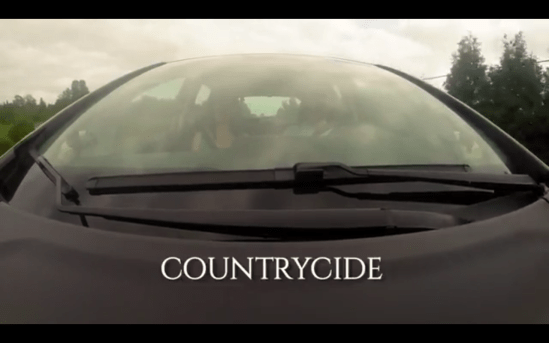
Big sister is getting married and Abby, forking over big money for a bridesmaid dress, can’t scrape together enough dough to afford a flight across country and to scratch off another option, Abby never learned how to drive a car dwindling Abby out of travel possibilities. In steps Mike, Abby’s tall and handsome close friend who does happen to know how to drive and, coincidently, has a car. Mike offers her a trip across the country as her plus one at the wedding. About 1/3 into the drive, exhaustion catches up with them, especially in Mike being behind the wheel 100% of the time, and without much money to spend on a motel room, the traveling duo think it best to set up camp in a stretch of wilderness. After speaking with a local government ranger, they set off to set up camp deep within the woods and as night approaches and the couple finally declare themselves hot for each other, Mike decides to return to the car for some supplies. Abby wakes up next morning realizing Mike has yet to return and in almost the same instance, she forgets where they parked the car. Wandering aimlessly through the thicket, a bear trap sinks its steely teeth into the fleshy siding of her ankle, leaving Abby hobbling alone through the woods with a hungry wolf on her trail to make matters worse. Miraculously, She’s saved by three men on a hunter’s retreat, but as they return with her to their isolated cabin, their suspicious behavior with an unwillingness to take the severely injured Abby straight to the hospital forces her to exit next morning while they stilled slumber and into an adjacent cabin where she discovers horror on a whole new level.

If the word homicide, or maybe even genocide, made sweet, sweet, angry love to the unwilling and scared word countryside, the abdominal “Countrycide” would be birthed into existence on this Earth and our congressional leadership would have legally prohibited it’s understandable abortion. Shepherding as a game foster parent is Canadian born, writer-director Brett Kelly and “Countrycide” will mark filmmaker’s third genre film through the criticism daycare of horror, following the cuddly-campy, Sci-Fi endearing “Ghastlies” and the diaper-shitting disaster that is the “Rise of the Black Cat.” A Gremlins-esques versus a super hero mess have come and gone to deliver “Countrycide” to our chop block that’s totally a horror-survival subgenre with a smidgen of exploitation and a complete lark even if unintentional.

Looking from an outward perspective, Abby is quite useless. Doesn’t know how to drive, doesn’t know where the car is, doesn’t know how to re-trace her steps out of the woods, and, yet, stammers into being a nucleus-downspout of magnetic chaos. Abby finds nothing but pure bad luck and Robin Hodge, inducted into her inaugural credited performance, bounces her saccharine chops off of various personas to become a disenchanted transfiguration character. Along for the ride is Joel Elliott as Abby’s quasi-boyfriend Mike whose emotional connection to Abby becomes decimated in a blink of an eye concluding no conclusive reason to care about his charming mug. He drives a car, cavalierly verbalizes his feelings for Abby, and then is erased from the pages as if a giant erasers literally came down and rubbed him out. Elliott has had roles in other Kelly films and so have these fellow co-stars that round out of the film: Peter Whittaker (“Raiders of the Lost Shark”), Andrew Galligan (“Ghastlies”), Trevor Payer (“My Fair Zombie”), and Lee Cyr (“Jesse James: Lawman”).
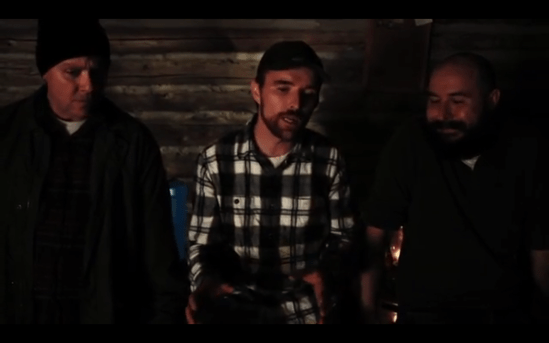
Kelly has a knack for campy-saturation and “Countrycide” splits the proverbial seams so much so that the film implodes into self-destruction, laughing manically at itself all the way to the end – funny, I didn’t initially categorize Kelly’s film was a horror-comedy, but therein lies the rub. Even textbook details, such as Abby sweaty and dirty in a fit of shock when a bear trap snaps onto her ankle, need to be illuminated. Another point to discuss is the overall pacing of the dialogue that drowns in over exposition of each event through the casts’ lips that often has a dubbed sensation. It’s like watching a giallo film from the 1970’s but where the synchronization designates more as a clumsy redneck slasher rather than an attractive murder mystery with a colorfully psychopathic adversary. Granted, swift gratuitous gore make the ushered in cut, a rock repeatedly bashed over a head or an giant log spear impalement, and that will please those gore hounds who sing the blood and violence anthem. As for the rough storytelling, characters, such as supposed hunters who hunt with single six-shooter revolver between the three of them, and the across the board acting by either unknowns or Brett Kelly staples, bad doesn’t quite describe “Countrycide’s” banal and bland vitality and must be watched, with a handle of Wild Turkey and a pack of smokes, to fully comprehend where the filmmaker was heading with his survival horror.

Wild Eye Releasing and MVDVisual go bumpkin hunting with “Countrycide” onto DVD home video. Presented in a widescreen format, “Countrycide’s” image condition is good, par for the course when considering other Wild Eye Releasing. Slight aliasing in more ariel shots, but the coloring is fine that’s perhaps on the denser contrast. The stereo sound mix, again, has that dub-like design that makes the actors sound like they’re in a studio recording their dialogue and thus isolates the vocals. Ambient track has foley written all over it with discernible focus on the twigs cracking and the birds chirping. Lets also no forget to mention to stock audio tracks of a wolf howl. There are no bonus features with this release. “Countrycide” woefully deserves a low end score, reeking up on an exploitation-survival horror by slapping together a poorly written script that cliche and trope-riddled, but being the Devil’s advocate enthusiast, “Countrycide” hit the next level in his carer even though that level might be still on the lower end of a split level, below grade.

Own Countrcide on DVD! Amazon.com

Evil Wants To Profit From Your Death! “Red Room” review!

When Kyra awakes inside an unadorned room of the second floor of an isolated farm house, the woman, who last remembers herself walking to her car from an afterhours night club, finds her wrists and ankles bound together alongside two other women. The women, Lilly and Allison, have been locked inside the room for days, kidnapped the same way, and treated with an inhumane care that more-or-less maintains their physical beauty. Uncertainty questions their fates, but one thing is for sure, when their captors come to remove you from the others, like selected head amongst the cattle, and relocate you to the red room, that’s when the screaming starts and you’re never heard from again. Between the three captives, anger and fear struggle for common ground on a plan of desperate escape and with the iron grip of their abductors honed into their every move, Kyra’s determination to escape breeds sturdier when the possibility of death is more than likely imminent, but before their inevitable snuff, the red room holds sickening world-wide pleasures that anticipates their particular company.

Poised to be callously unsettling and keen to rip apart compassionate souls, “Red Room” hails from Ireland as a ghastly and shocking exploitation thriller from writer-director Stephen Gaffney. A production of Gaffney’s Deep Web Films and co-written with Erica Keegan, “Red Room” slides ever so covertly into the internet’s interlining of unspoken grisliness that exploits people for the darker desires of other people and Gaffney runs through the typical rational of the irrational abductions, such as sex trafficking, and though that’s certainly taboo enough to quench viewers with a powerful story in itself, the director taps a sex and death geyser a few filmmakers have reaped, perhaps more so retrospectively, the machiavellian benefits in finding a home in a rather thin genre with films that are akin to the plot, including works of malevolent personal satisfaction as such as in Dusty Nelson’s “Effects” or the investigated side that encompasses the snuff world in Joel Schumacher’s “8mm” starring Nicholas Cage.

The 2017 film thrills to inflict tortuous anticipation for what lies ahead of the tethered three women. Amy Kelly’s Kyra is the only colleen to be shown physically abducted and while Kelly maintains a fine performance as the strong female protagonist with no-choice-but-to-escape attitude, Kyra’s character arc has a confounding impact where Gaffney involves non-linear scenes into the story, providing the events leading up to her abduction and also other more linear scenes with her mother on the phone with the police irate with her disappearance, but none of those scenes had significant impact to Kyra’s predicament or motivation and felt out of place. Kyra doesn’t necessarily talk about her child much either, which is always a powerful motivator for anyone with a need to live. Instead of carrying on with Kyra’s needless background, Richard, played by John D’Alessandro, could have benefited from the excess framework capacity of how he became groomed by his stern father, a role fit for a cruel king by “Game of Thrones'” Brian Fortune, and how his calm, sensible, and business casual character admixed himself with various complex villainy, roles donned by JP Albuquerque and Rodrigo Ternevoy, and how they became a triad of high end brunette liquidators of sorts. The other two women with Kyra, Alison (Saoirse Doyle) and Lilly (Sohaila Lindheim) spread the reactionary affects in a petrified Alison and a realist in Lilly when contrasted to Kyra’s defiance, but Alison carries the crux of the story, the reason why there is a story, that falls right smack dab in the red room and, frankly, she becomes the star of the gritty show. “Red Room’s” tops out the cast with another “Game of Thrones'” star Eddie Jackson and Fiona Twamley Hewitt.

“Red Room” has been compared to “Hostel” with a plot that does walk a familiar path of a pay-to-die morbidity and that comparison is a fair assessment with the ancillary connotation that “Red Room” could be seen as an extension or a byproduct of Eli Roth’s sadist of a film. However, a microscopic obstacle provides just enough to dispute that claim, to whither back a formidable opponent in the game of who has the most visceral body of work, and that evidence lies in Gaffney’s creative style. The filmmaker, for lack of a better term, pulls punches, not delivering the full on aggression required to provoke and stimulate the masses. The scenes of gore are ghastly to a point and that’s not necessarily the issue that’s more so with the unravelling of their inhuman nature that doesn’t genuinely denote a persuasive emanation of their victims damnation. We see a little of spark with JP Alburquerque’s Andras who is clearly insane with an limitless immoral conscious whereas the others teeter about more of the business margins or struggle with a tough guy image.

From Stephan Gaffney’s Deep Wed Films in association with Sicario Pictures enters “Red Room” onto DVD home video from Breaking Glass Pictures. Presented in a widescreen, 2.35:1 aspect ratio, on a one-sided, doubled layered DVD9, the Canon C300 Mark II digitally shot feature cleanly and sharply provides quality throughout that falters occasionally with some choppy video speed controlling in the more extreme scenes. Color palette isn’t lush with brilliant hues, but with the darker tone of the film, the expectation of vividness lies more so with graphic content and adds to the value. The English language Dolby Digital 5.1 surround mix is meaty and balanced, strong enough to even tune uneducated ears to the Irish accents. The dialogue is rightfully upfront with fine range and depth with no issues on mic placements. Bonus features include a short and sweet radio interview with director Stephen Gaffney, cast interviews, test screen reaction with the finale climax, a director’s audio commentary, a single deleted scene, and a concept promo. Ireland makes a play for extreme horror with Stephen Gaffney’s “Red Room,” a twisted and a humanly fathomable thriller with a cold-hearted gape at the worst of human nature that lingers into the vast virtual and essential disconnect amongst online gawkers that will never face the exploitive repercussions of what wets their appetites as they sit behind computer screens.

“Red Room” DVD available at Amazon!

A Charlatan Who Surrounds Herself With Evil! “Vampz!” Review!

After countless interview screenings, Simone struggles to find a suitable roommate just like herself with an insatiable longing to be one of the undead, specifically, a vampire. As she strikes out applicant-after-applicant, her twin brother Sam persuades her to lock in on Ashlee, a beautiful, yet energetically ditzy cheerleader new to town who shows up late at night looking for a place of her own and with looming rent bills sucking her dry cash, Simone begrudging agrees on the dimwitted and un-vampiric prospect. Unbeknownst to Simone, one of her former screenings turns out to be a coked out vampire hunter and with Simone declaring herself a vampire during the screening, the oblivious and hopped up hunter’s ability to distinguish between the real McCoy and a wannabe has severely disintegrated as he aims to drive a long, wooden stake through her heart, but when the Hunter comes to claim his bounty, he inadvertently teams up with Simone and Ashlee against a tenebrous conspirator with a penchant for control of ghouls and monsters to not only save their lives, but also their friends.

“Vampz!” is the filmic version of a chaptered web series, that found a crowdfunded presence from circa 2012. Much like in the same vain as the “Hell’s Kitty” DVD release, “Vampz!” didn’t partake in any re-imagining, re-shoots, or even a re-cast for the movie; in fact, the so-called 2019 movie, helmed by director Ramsey Attia and scripted by Omar Attia and Lenoard Buccellato, is actually the web series spliced together to construct a 76 minute feature. To maintain comedy integrity that calls for hyperbolic reactions, profanity heavy dialogue, and some really nifty and amusing pop cultural intertwining, like Queen’s Bohemian Rhapsody dialogue rendition had me biting my smirking lip in assurance, Attia and Buccellato’s script never deviates from course. There’s are also other subtle homages that can be easily identified throughout. Between the TV web series and the film, no cast alterations or implementations have been made and so all of the established humor from the web series is still engrained from the actors and having never seen “Vampz!’ the series, gauging what, if any, soul from the original product is lost in the nearly decade old translation cannot be confirmed, but “Vampz!” has resilient comedic bite, going for both canine fangs into the throat in the face of being an independent picture.

Lilly Lumière at the forefront with her character Simone Castillo, an aspiring bloodsucker in all its fashionably formulaic vampire glory without being the recently bastardized Hollywood version a.k.a. “Twilight” trilogy, becomes the eyeliner nucleus of the story. Lumière presents an eye rolling, goth decked out quasi-vampire with a die hard approach to the banal side of the vampire mythos. Simone becomes the BFF target of Ashlee, who from the depths of the night shows up at her doorstep seeking the room for rent. Ashlee doesn’t seem to be Simone’s type, a high-spirited cheerleader tryout who is new to town; in fact, Ashlee represents all that is distasteful to Simone’s undead facade. Christal Renee has the vivacious personality type to pull the give me a S-U-P-E-R hyped Ashlee! Then there is Denis Ark as psychotic vampire hunter Marcus Denning. Ark is not just certifiable on screen, but he’s also certified off screen as a personal fitness trainer. With 20+ years in martial arts and sports training, Ark tackles the moderately physical role with ease and provides some point blank comedy. “Vampz!” remaining cast of misfits include Louis Rocky Bacigalupo, Guy N. Ease, and Cliff Hunter.

Shot in Peterson, New Jersey, “Vampz!” has a very Jersey feel, not to be confused with having an Italian Jersey Shore feel, despite being just a hop, skip, and a jump across the water from New York and even with that chip on the shoulder emanating from off of the screen and on the penny-pinching, crowd funded budget, the web series is without a doubt well done. The humor is touch and go with some misguided antiquation, but the effects capitalizes over that portion of content, especially when a creature or two appear for their grand entrance into the storyline. “Vampz!” has solid special effects working heavily to lead the charge into turning what could have been ho-hum film into a quasi engaging creature feature that deviates from the staggering conventionalism and genre tropes.

MVDVisual and Ruthless Studios sinks their teeth into the A Rear Naked Studios Production of “Vampz!” releasing the Ramsey Attia horror-comedy onto DVD home video in its full web series storyline. Presented in a widescreen, 1.78:1 aspect ration, the region free disc picture doesn’t provide a flavorful presentation. Attia and his team went faux grindhouse approach by adding grain and “missing scenes” on a pseudo-polyester film base, but the film looks washed and uninviting with droll hues. The English language dual-channel stereo track lies above the fray image with ample range of ambient sounds and a prominent dialogue track. Depth hardly comes through with most of the ambient remaining on a level plane that doesn’t resonate elsewhere from between outside and inside the finale factory or in between room-to-room. There are no bonus features included on this DVD that has curious cover art. Front cover pictures a badly photoshopped composition of a short red haired woman wearing an boxy amulet overtop a cutoff top and drinking blood out of a martini glass with a plastic straw. There’s also a white snake wreathed around the V and A of “Vampz!” and the same snake is also wrapped around the shoulders of a silhouette figure on the back cover but there are no snakes in this film, nor is there an high class, red-headed vampires drinking blood out of a martini glass so the cover is misleading. “Vampz!” garnishes heart and soul of the modern classic horror creature while adding a cascading charm of moderate-to-light hearted comedy to mask the rough edges of a home grown brew grindhouse film thats bemusing to perceive from a deceptively cheap DVD cover art.

Click DVD cover to Purchase “Vampz!”


