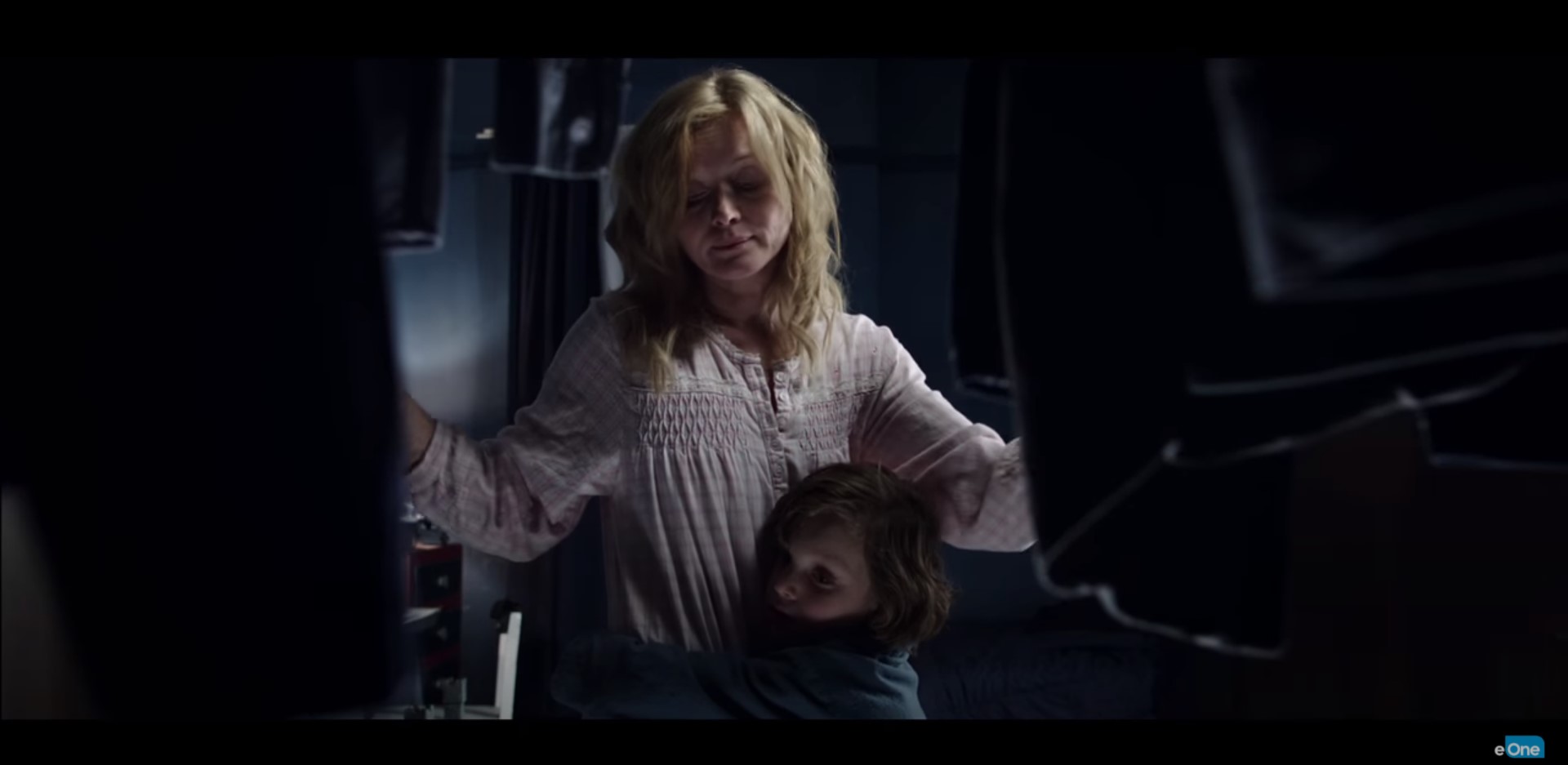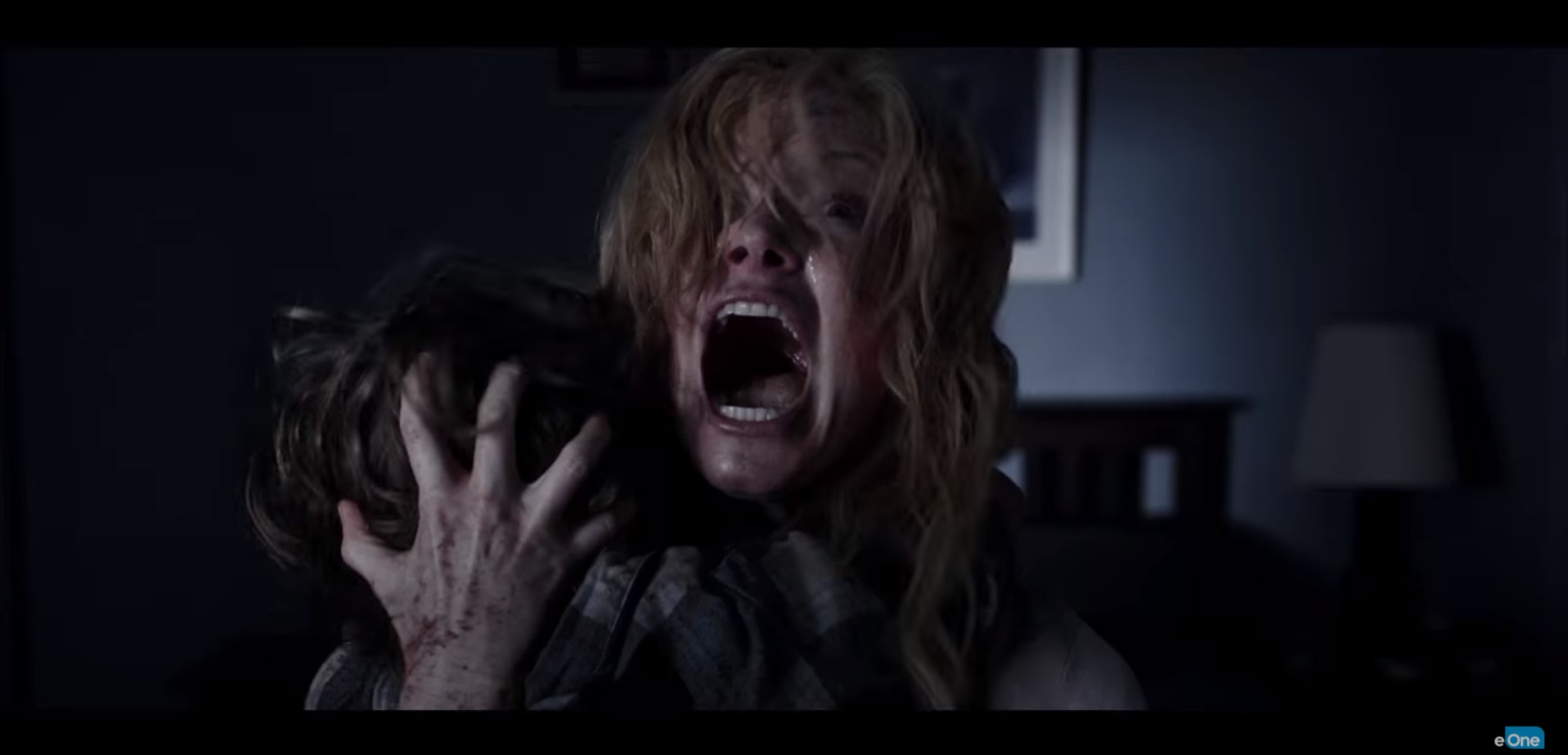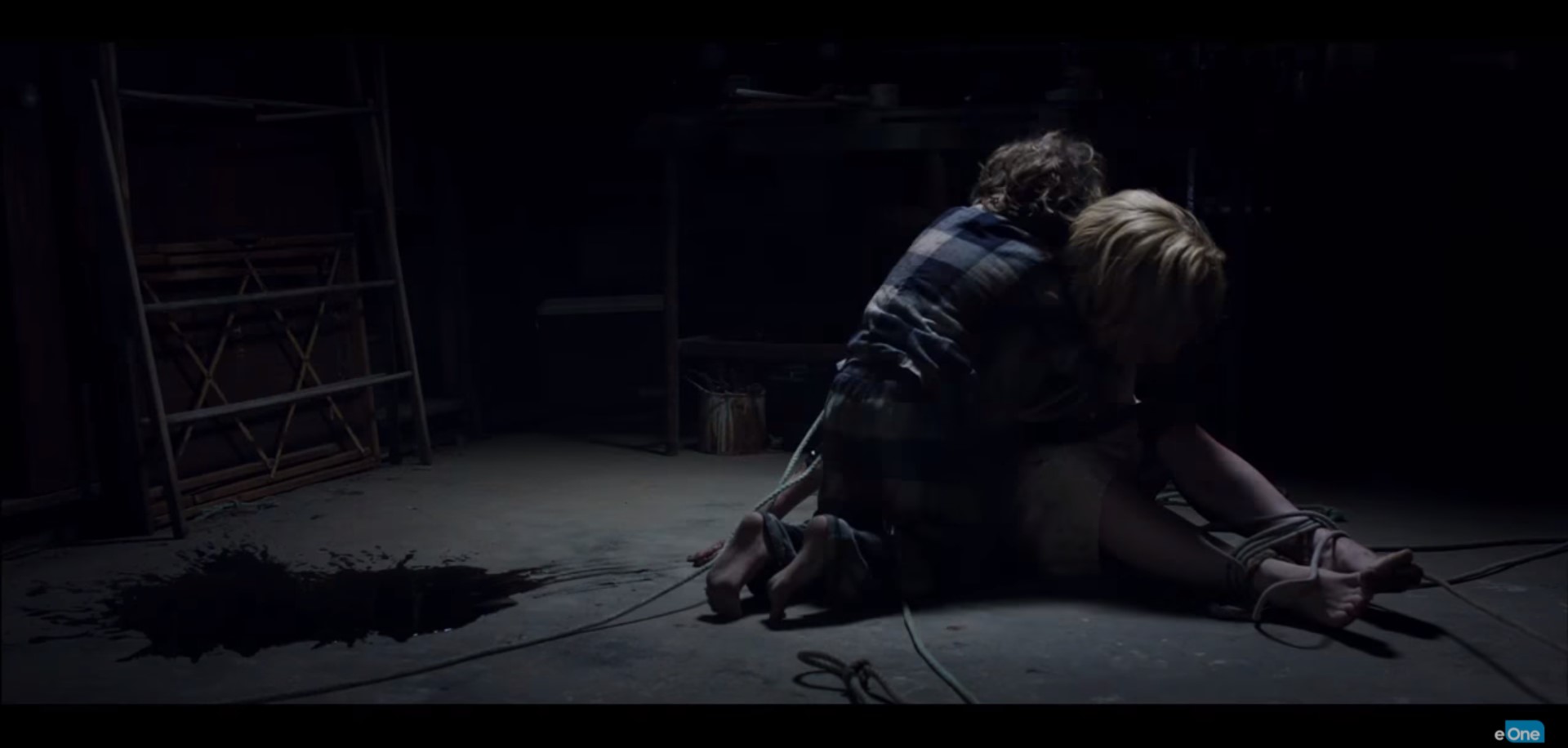
All Hail the EVIL Slumbering One! “Sacrifice” reviewed! (101 Films / Digital Screener)

Years after being quickly whisked away to America as a small child from his remote Norwegian island birthplace, Isaac returns nearly 30-years later with his new, pregnant wife, Emma, after the death of his mother leaves the empty family home in his inheritance.  With their heart set on fixing up and selling the house before the birth of their child, Isaac and Emma learn that marketing the seaside and scenic estate comes with a tragic past when the local sheriff discloses the brutal murder of Isaac’s father inside the home.  The dreadful information and the bizarre locals with their customary traditions doesn’t alarm Isaac who, instead, feels a strong connection and is drawn to staying whereas Emma, plagued by terrifying nightmares ever since stepping onto the island, is eager to sell and return to American as soon as possible, fleeing a community that worships an aquatic deity beneath the water’s surface.   

Based off dark fantasy and science fiction writer Paul Kane’s short story, “Men of the Cloth,” found in the author’s “The Colour of Madness” collective works, “Sacrifice” is an alienating folklore horror bound by the influence of a Lovecraftian core under the direction of a filmmaking due in Andy Collier and Toor Mian.  As their sophomore film as collaborating directors, following their 2017 psychological cop horror “Charismata,” Collier and Mian tackle Kane’s short story head-on by changing only a few details, such as location, family structure, and the title from formally known as Kane’s “The Colour of Madness” to “Sacrifice”, but keep rooted the foremost principles of “Men of the Cloth’s” cultish discomfort that’s greatly inspired with the otherworldly sensation of an amiss atmosphere akin to Robin Hardy’s “The Wicker Man.”  Filmed around the idyllic and mountain enclosed shore town of Bjørk, Norway and in the town of Volda, Norway, the 2020 film seeks to plop strangers into a strange land as a production of the London-based companies, Loose Canon Films and Hydra Films RKM, in association with Dread.

Over two years ago was the last time we reviewed a Barbara Crampton movie with “Death House,” that included a plethoric cast of her all-star genre brethren with Kane Hodder, Bill Moseley, Dee Wallace, and others, and, now, Crampton makes her glorious return to the Lovecraftian turf that nostalgically brings most of us horror fans back to the New York-born actress’s “From Beyond” and “Re-Animator” days.  “Sacrifice’s” Cthulhu spirit finds Crampton playing a small town Norwegian sheriff, Renate Lygard, in which Crampton, under the training of a dialect coach, surprises us with a fair Norway accent as she provides a quasi-warm hospitality set of manners upon island outliers in Isaac (Ludovic Hughes) and Emma (Sophie Stevens) Pinkman. Hughes and Stevens nudge their way into a solid man-and-wife, but their dynamic density becomes crispy at times and pale from their initial arrival soon after rustling with the natives. The lack of vitality doesn’t stem from the wedge being driven between from the lure of Isaac being called by the natural phenomena of the Northern Lights, the drunken friendly benevolence of Gunnar (Lucas Loughran) and Ledvor (Jack Kristiansen), and the full frontal skinny dipping of Renate’s beautiful daughter, Astrid, an eye-opening film introduction from Johanna Adde Dahl; instead, the Pinkman’s bond held together about as tight as using kindergarten grade craft glue that bled into the performances as well that came off stiff and unnatural. Aside from Hughes and Stevens hailing from the United Kingdom and Crampton from the U.S., the remaining cast was curtailed to Norway nationals, as such with Loughran and Kristiansen, rounding out the cast with Erik Lundan, Dag Soerlie, and Ingeborg Mork Håskjold.

“Sacrifice’s” cult mania lays on a thick coating of grass roots that really set the tone for an foreboding outcome.  An idyllic Norway fishing village propped between the eclipsing mountain range and marine inlet intrinsically obscures an already unspoken secret that’s only been rendered on the faces and actions of the residents.  At the center of village’s idiosyncrasies are the two hapless protagonists venturing into unknown territory with only an inherited house in their back pocket and a vague sense of youthful recollection; this sets up for an obvious antagonism theme of locals with a sense of xenophobic nationalism, especially against two Americans.  The initial friction opens the flood gates for cultural customaries to be weaponized against Isaac, who wants to strongly embrace his heritage, and Emma, who can’t seem to grasp the village’s peculiar beliefs and even goes as far as being naïve of and mocking the village’s traditions and deity.  The tension is compounded by the ominous presence of the labeled slumbering one, sleeping beneath the glossy surface of the inlet waves, but conjuring up tangible and intense nightmares that plague the every island inhabitant, a mystery Emma can’t explain, won’t entertain, and ignores exploring that turns Emma floundering more into Isaac’s sudden disinterest in her albeit soon-to-be-parents.  “Sacrifice’s” climatic, tell all scene harbors more secrets regarding Isaac and Emma’s purpose on the island that are to be interpreted by the audience, but don’t connect back to any string along clues leading up to a poignant and sharply-shocking ending.  Instead, “Sacrifice” acutely wraps up not only the story but also the characters like a paper wrapped fish at the fish market ready for sale without any huff about where, why, and how that particular bug-eyed fish became the gutted victim of man’s delicacy.

“Sacrifice” shores folklore horror swelled with Lovecraftian roots and is docking digitally today, March 15th, in the UK courtesy of 101 Films. The film has a runtime of 87 minutes and is presented in a widescreen 2.35:1 aspect ratio, shot on a Sony CineAlta Venice camera. Co-director Andy Collier tackles his first credit director of photography gig with interesting shots looking up through all different angles and vessels that hold water. Whether boiling eggs, taking a bath, or in small cove, Collier, and Mian, put eyes on the bottom surface, promoting all varieties of water within it a lurking presence and the imagery is done extremely well with depth and space to pull off the illusion. A fair amount of soft lighting, moments of bright primary color glow, and the specs of well-placed lighting to barely illuminate a scene is broodingly worthwhile. Tom Linden’s original score is fiercely compliment as a folklore staple, harsh-chord intensity that lingers well after the boiling blood levels drop to a mere tentacle dwelling simmer. There were no extra features or bonus scenes included with the digital screener. While the build up didn’t pay off at the bloody end, the two-tone terror of “Sacrifice” wrecks the nerves and frays warm pleasantries with wicked wallowing, slumbering, nearby in the shallows.

The Greatest Trick EVIL Ever Pulled Was Convincing Couples the Perfect Marriage Ever Existed. “Happily” reviewed! (Saban Films / Digital Screener)

Tom and Janet have been married for 14 years.  By that amount of time elapsed, marriage has moved past the honeymoon stage and settled into routine with the spark having dulled and sex life becoming nearly, if not totally, stale, but for Tom and Janet, their libidos are the equivalent to hormone-driven teenagers.  Their marriage has happily sustained over the years, never veering off course, but when a couples’ retreat invitation is rescinded by their friends because of the envied desire for each other and a mysterious man arrives at their door step next day offering a syringe injection that will cure them into a normal married couple, Tom and Janet believe they’re a part of a sick joke by one of their so-called friends, leading to a dead body, a brief case of unknown substance, and a re-invitation to the couples’ retreat where they must figure out who is and who isn’t of the four other couples are on team Tom and Janet.  Yet, the trip founded on the idea booze and relaxation turns into a disclosure of lies, secrets, and deadly disconnections. 

What’s the secret to a long lasting marriage?  Good sex, obviously.  But can an ostensibly impenetrable marriage be flawless?  That’s one of the themes writer-director BenDavid Grabinski toys with in his inaugural feature film directorial of “Happily” that disparages the unsullied union of Tom and Janet by a quartet of couples, who are also Tom and Janet’s closest friends, who aim to stick it to the happy couple because of their own marriage and life failures.  Grabinksi, creator and writer of revamped “Are You Afraid of the Dark?” television series, incorporates that element of grim tale mystery for allegorical effect into the psychology of envious, mal intent friends projecting their negativity on Tom and Janet’s positivity and love.  “Happily” is a production of the Arizona based Common Wall Media, an indie record and film production labeled owned and operated by Chuckie Duff, and, perhaps, the reason “Happily” has a killer soundtrack that includes Tim Capello “I Still Believe.”  Jack Black (“Tropic Thunder,” “Goosebumps”) also produces the film under his Electric Dynamite Productions, Inc. banner in collaboration with Indy Entertainment (“Nightmare Cinema”). 

I find extreme difficulty seeing Joel McHale in anything remotely with a serious tone for someone who grew up with the comedian during his 12 season days of E!’s spinoff of Talk Soup titled simply, The Soup.  McHale’s range as a funny man is beyond being paramount with great comic timing and able to deliver an unlimited amounts of laughs in just his mere expressions and that has translated well into his filmic career from comedies such as “Ted” to “The Happytime Murders” and even well into his more earnest and darker roles in “Deliver Us From Evil” and, his most recent release which is “Home Alone” for a more mature audiences, “Becky.”  In “Happily,” McHale plays Tom, a loving husband to wife Janet who can’t keep their hands off each other and never fight for more than half a day in what’s staunchly considered a perfectly sickening marriage by their closest friends.  One thing I’ve learned from watching Joel McHale in this role is not only can he bear the weight evenly of an emotional thriller, but the guy is jacked!  Opposite McHale is “Penny Dreadful:  City of Angels” star Kerry Bishé, matching the sexual and profound tone as the wife, Janet. Bishé takes on Janet’s ever benevolent wifedom, elevating it to a whole new level as the working spouse, ready to gratify Tom by any means possible and in any compromising position possible, who’s also served hand and foot by the same man who knows how to reciprocate at the right moment. Bishé’s a favorable compliment to McHale as a power couple daring the odds together on the same page until losing they’re way because, simply, they’re inevitably human. Tom and Janet square off against four other couples under suspicion of a suspected prank-gone-wrong after meeting with a mysterious man played by “Office Space’s” Stephen Root. Could the pranksters be the flamboyantly affluent, but unaffectionate Karen and Val (Natalie Zea of “The Following” and Paul Scheer of “Piranha 3DD”)? Could it be the uptight lesbian couple Carla and Maude (Shannon Woodward of “Westworld” and Kirby Howell-Baptiste of the upcoming “Cruella”)? Or is it the carefree Patricia and her inhospitable husband Donald (Natalie Morales of “The Santa Clara Diet” and “Mastermind’s” John Daly)? Maybe its the anger unmanaging Richard and his newfound fiancé Gretel (Breckin Meyer of “Freddy’s Dead: The Final Nightmare” and Charlyne Yi of ” Puppet Master: The Littlest Reich”)?

Grabinski forcibly shoves the happily in “Happily’s” Tom and Janet’s marriage down our throats with a diabolical lustful half-exposition, half-hanky-panky action before title sequence intro into their infinity spicy life. The couple screw like two teenage rabbits hopped up on an aphrodisiac more than a typical mundane couple of 14-years should ever seen in their union’s lifetime, but, then, Grabinski throws in the proverbial monkey wrench into the gears. The question comes up, and lingers throughout, whether Tom and Janet are inherently broken, a defect in their existential creation, and that begins to snowball down the hill of insidious thoughts as the protagonists have their idyllic marriage tainted by the hair brain idea of a stranger, carrying two syringes of an insta-fix made up of unknown, illuminating material, who beguiles them with bureaucratic niceties to lie his way into their home and tells them he works for a higher power. Is this mysterious man God? Perhaps, the Devil? Grabinski smartly keeps that little detail under wraps and, for the first half of the film, stays a mystery upon itself. In time, each couple begins to unravel cankerous secrets, all of which have been targeted at Tom and Janet for their perfection and that’s perhaps where “Happily” struggles a bit as a story as Grabinski has a rolodex of past events being flipped through a plethora of interaction exposition, leaving morsels to try and puzzle the uneasiness of the morose couples’ retreat together. The long and short of the story is that the audience will need more morsels to chew on, get the creative juices flowing, to understand character motivations because, in the end, “Happily” is one big couples therapy session of divulging secrets to wash away, more or less, soul-deteriorating sin.

Before all hope is lost between two people, an intervention is warranted, even if it’s a divine one in BenDavid Grabinski’s dark comedy “Happily” heading our way to theaters, digital, and on demand come Friday, March 19th from Saban Films. The R-rated film runs for 96 minutes is presented in a widescreen 2.39:1 aspect ratio that gets to showcase more of Adam Bricker’s luridly dreamy style. The “Starry Eyes” cinematographer instills a firm taste of precise, primary coloring tinting that evokes the intensity of the scene rather than pitching an outlined overlay on top of his soft lighting. The red “Predator”-esque vision through CCTV lens is a nice touch of also breaking up the more natural lit scenes for that ominous approach. Since “Happily” is coming to theaters, there is obviously no bonus material, but stick around for scenes during the credits and after credits. Lies, betrayals, murder, and the uncanny are soaked into “Happily’s” absorbent fibers as one of this years best dark comedies that hones in on ascertaining that nothing is perfect but the perfection that you make together.

In EVIL’s Chair and Ready for a Cut. “The Stylist” reviewed! (Arrow Films / Digital Screener)

Excellent at styling hair, but not so much at making friends, Claire lives a solitary life as she’s unable to personally spark connections, even with those who she interacts with on a daily basis.  As a hairstylist, she absorbs a plethora of private information provided willingly by her clients who see her as someone not significant enough to be troublesome or detrimental to hurt them, but, little do her clients know, Claire has a dark secret with obsessively overstepping into their lives and, sometimes, directly into their shoes as murder becomes a conduit for Claire to experience a slither of momentary solidarity and belonging happiness.   Brief in its euphoria, the elated feeling doesn’t last and Claire finds herself back into a vicious cycle beginning with being defeated, but when a regular client, Olivia, begs for wedding hair help, Olivia befriends the stylist who begins to sink deeper into a misinterpreted friendship with Olivia fabricated inside Claire’s disturbed mind. 

Whenever stepping onto the hair clippings of a barbershop, sit on the padded, pump-hydraulic chair, and be asked by a for certain fallible person how I want would like my haircut, my hands nervously clutch each other, the space between my eyebrows fold in and crunch, microscopic beads of sweat go down my hair raised back and the agitation in my mind grows louder than a blow dyer on a high setting.  Why do all these externally stemmed irritants happen to me at the seemingly communal and smile gracing barbershop?  Think about my situation, one driven by introverted behaviors and pessimism for the human race, this way:  your neck is choked tight with a hairdresser body-bag resembling cape, sharp, haircutting sheers clipping swiftly overhead, and the loud buzzing of a motor purring around your ears’ edge before they detailing the side of your face with tiny razors moving hundreds of miles per hour.  Let’s not also forget about the straight-razor across your neck to attack the five o’clock shadow!  No, thank you!  So, there was already an abundance of established anxiety heading into Jill Gevargizian’s written-and-directed hairdresser horror, “The Stylist,” that takes just a little bit more off than just what’s on top.  The “Dark Web” filmmaker reteams with co-writer Eric Havens to extend the profile of the quiet and quaint, Victorian chic hairdresser, Claire and her lonely killer inclinations based off their 2016 short film of the same title and add Los Angeles based copywriter and “Night of the Wolf’s” Eric Stolze into the salon of psychological horrors mix. “The Stylist” is a production of Gevargizian’s Sixx Tape Productions, that also includes Eric Havens and lead star Najarra Townsend, alongside co-productions Claw Productions, Method Media, and The Line Film Company.

Najarra Townsend reprises her role as Claire, the lonely hairstylist bedeviled by a lack of belonging and rapport with no family or friends. Claire spirals into internalized madness that unveils when trying to step inside the lives of others as her own. The “Wolf Mother” star becomes a granular speck of torment plagued severely by social awkwardness to the point of her need for perfecting the imaginary bond between her and Brea Grant’s character, Olivia, goes into destruction level transgressions that’s normal, living rent free, in Claire’s headspace. Grant, writer and director of one of our favorite films of 2020, “12 Hour Shift,” and in the recently released, critically acclaimed, Natasha Kermani thriller, “Lucky,” has to be a larger than life persona whose the center of attention, as soon-to-be-bride going through the throes of wedding planning, that can draw in the wide-eyed and impressionable Claire like a moth to a flame. Townsend’s a specific kind of talent to get inside Claire’s ennui state not once, but twice. The latter precisely nails down Claire’s outlying, exterior behavior, but also smooths out a mustard nuance veneer of vintage chic that becomes a part of the building blocks peculiarly exclusive to her quietly disruptive cause. Starkly contrasted against Claire, Grant relates to who we all see on the outside as Olivia, a shining glow of smiles and worries that most people can digest with ease on a daily bases and while her life, as chaotic as may seem with a wedding near on the horizon and questioning a deep down decision about marriage, is juxtaposed with such distinction that Gervargizian literally puts Claire and Olivia side-by-side in a split screen early in the film to expose one hiding her secrets and the other letting them all hang out. Sarah McGuire (“The House of Forbidden Secrets”), Millie Milan (“Clownado”), Davis DeRock and Laura Kirk round out the supporting cast.

Take a moment and breathe the very essence of women-driven horror that’s as stylish as it is deliciously deranged.  “The Stylist” echoes similar psychopathic traits of William Lustig’s “Manic” and displays self-careening elements soaked in barbicide and Gothicism.  The junior film of Jill Gevargizian narrates through the eyes of Claire’s unraveling humanity from the stylist’s quick fix of bloody hair removal to the potential for climbing out of that deep, dark hole of loneliness only to be suddenly sideswiped by the falters of manufactured delusions. “The Stylist” is wrapped in a sullen hairnet that never shows the jovial side of Claire’s pleasures as she’s embodying someone under their locks after calculatingly cutting more than just their hair; a perspective exclusively held within Claire’s head, leaving viewers entangled in her in seemingly normal beauty shell and her inner demented chaos. You feel sorry for her forlorn life, but creeped out by that same life’s byproduct. One aspect that “The Stylist” lacks, that can be off-putting for some, is the mold that made Claire. Miniscule slips of her upbringing becomes not enough to paint an exact portrait of Claire as a malevolent monster with sociable dysphoria and as the story builds to a climax and Claire tries to imitate her mother, who died in her mid 30’s when Claire was 17, the mimicry fairs to say that her mother also had similar problems that has innately passed and has coped a different way of dealing with mental illness by way of alcoholism, mentioned by Claire in a moment of courting a friendship with an eager bridezilla, Olivia.

What a fitting film to be discussed and celebrated on International Women’s Day 2021 in the Jill Gevargizian directed and Najarra Townsend lead “The Stylist” now released exclusively on Arrow Film’s UK VOD platform ahead of the physical Blu-ray package and digital HD releases come June 2021. Film film clocks in at a 105 minute runtime and is presented in a widescreen 2.39:1 aspect ratio. Behind the camera is Robert Patrick Stern whose composition of imagery is based mainly in natural lighting while dabbling in warm coloring such as reds, the occasional vibrant magenta, and a consistent yellow mustard, a favorite not only in Claire’s wardrobe but also tinged on the lens whenever a part of Claire’s localized disturbia. Stern’s clean and sleek picture palpably elevated John Pata’s editing of montages that were superimposed with transitions and the soul searing music of Nicholas Elert’s melancholic inducing piano-industrial score. There were no bonus features included nor were there any bonus scenes during or after the credits. “The Stylist” honors the past by reinventing the wheel in Jill Gevargizian’s clipping thriller with a hair-raising performance by Najarra Townsend as the maniacal hairdresser lonely next door.

77-Minutes of Nonstop EVIL Combat! “Crazy Samurai: 400 vs 1” reviewed! (Well Go USA Entertainment / Blu-ray)

The Yoshioka clan has been dishonored by the death of two of their samurai warriors in an attack that has left the clan in desperate need for revenge.  Yoshioka clan’s sensei devises a plan to gather the clan’s best 100 samurai and 300 mercenaries and set an ambush for the one they call the crazy samurai, Musashi Miyamoto.  But Miyamoto strikes first, killing two Yoshioka clan members, sparking a torrent of warriors and mercenaries to besiege upon the crazy samurai and bombard him with attack.  The long sword combat stretches for over a hour as Miyamoto defends himself in an impossible task of standing alone while an entire clan’s army of swordsmen come at him from every angle, but Miyamoto is no ordinary master samurai, leaving the 400 to 1 odds in his favor. 

Journey back to Japan’s bushido era when honor and courage reign supreme during times of conflict and unrest with Yûji Shimomura’s nonstop, way of the sword, battle royale skirmish, “Crazy Samurai:  400 Vs 1.”   Originally titled “Crazy Samurai Musashi,” changed only for the home video release and on streaming platforms, the samurai film from Japan sticks out amongst the countless in the genre not for being filmed nearly a decade ago and finally receiving a theatrical and at-home release, but with a one particular, grand feature in being cinema’s first non-stop, one-take action shot for approx. 77-minutes, bookending between a story-functioning epilogue and prologue that clocks the film’s runtime at a total of 92 minutes from start to finish.  Shimomura, who directed the fantasy-action “Death Trance” in 2005 and the covert war drama “Re: Born,” helms a script penned by first timer Atsuki Tomori that bares little dialogue and even less plot to unreservedly place the juggernaut shot into the main spotlight.  The film is a production of the action enrapturing company, Uden Flameworks, based in Tokyo and with the North American streaming rights funded exclusively as a Hi-Yah! original film.

Reteaming with Yûji Shimomura in their third collaboration together following “Death Trance” and “Re: Born” if you follow each film’s sequential release date and if not following the release dates, then, more accurately, “Crazy Samurai:  400 vs 1” would be their second collaboration, Tak Sakaguchi, who cut his teeth in the cult favorite “Versus,” becomes a one-man show as the titular principal samurai, Musashi Miyamoto, slicing-and-dicing his way through a village horde of sword-wielding antagonists.  Kudos must be given to Sakaguchi with the stamina of a workhorse who carries the entire production on his back with a seamless performance without ever breaking stride, or taking a break for that matter, as you can see the sweat beading from his face and weariness in his eyes during the 77-minute long performance that takes a natural exhausting toll on his body, but the actor’s spirit to go on never breaks in any regards.  Sakaguchi fortitude for Musashi is unquestionable, but the backstory quivers at the knees with a character whose unable to be deciphered whether a hero or the villain.  The latter feels like the befitting choice as the plot begins with a Yoshioka clan ploy of arraigning a honorable duel between Musashi and the clan’s child prince after killing two of the dojo’s promising members in an act of defacing, but the ruse is an ambush to swarm Musashi upon arrival and execute him on sight.  Known for being a madman, Musashi comprehends Yoshioka’s deception and penetrates their defenses to immediately strike down the innocent child prince, who is only a pawn following council’s guide to be there, in the first blow that would set off a chain reaction of swordplay events.  Is Musashi that much of a cold-blooded lunatic to kill anyone, even children, and that is why he’s the villain who must be stopped by any means possible?  Or are the Yoshioka so dishonorable that Musashi will take on 400 or more well-armed men, and sacrifice one child, to slaughter them all for the sake of mankind?  Where Musashi motivations lie teeters into well after the credits roll, making the Crazy Samurai an enigmatic means to an unsatisfactory end.  Kento Yamazaki, Yôsuke Saitô, Akihiko Sai, Ben Hiura, and Fuka Hara round out the cast.

The possibilities of something going wrong is extremely high when attempting to film one long scene without breaks that include not only harmless slipups in choreography or dialogue, but also fatigue and risk of injury are likely to be greater.  Luckily for Tak Sakaguchi, and the production’s insurance company, there were enough water bottle and rest breaks strategically placed in between each pocket battle.  On the other side of the katana, the breaks frequent into improbability that there will be a full water bottle and a new sword just laying about in a Japanese village in the exact path of Musashi’s bore.  While most of the wardrobe and scenery feels authentic to the Edo-esque period and each actor puts in the effort to complete the scene, the unthought out choreography cheapens “Crazy Samurai’s” straight-gimmick concept by rotating out Musashi attackers who stumble off screen after being “killed” and rejoining the ranks on the backend.  More than once you’ll see the same faces go toe-to-toe with Musashi.  Rarely do the extras fall and lay dead at Musashi’s feet and only do so when the time at the present scuffle location comes to an end, but when the camera turns in a 360-motion around Sakaguchi, the bodies that had lain fallen previously where the fighting was held have now mysteriously disappeared. And the buck doesn’t stop there as Shimomura’s action film fails to impressive with the swordplay, outlandishly flaunts no blood other the visual effects spray in a blink-and-you-miss-it style, certain samurai have specialized wigs on to absorb Musashi’s signature Three Stooges-style bonk the enemy on the head move, obviously squaring off against more than 400 bodies, and, bluntly, the 77-minute runtime was tediously too long. You can also tell that the opening scene and ending scene were spliced into fold around the story’s trunk, probably shot years later from the original uncut scene, as we’re never able to connect the main characters from the opening and ending to the extended midsection in a slight of misdirection, obscure camera angles, and connecting only a pair of characters in act one and two.

Don’t be remiss to check out Yûji Shimomura’s see-it-to-believe-it “Crazy Samurai: 400 vs 1” on Blu-ray courtesy of Well Go USA Entertainment. Unrated, region A, and presented in a widescreen 16:9 aspect ratio, Well Go USA’s Hi-Yah! original film allures solely by the idea of the stunt, but hones in on two contrasting cinematic styles. The opening and ending scenes are consistent with conventional action flicks with fast edits, slow motion, and purpose with what’s seen in the scene whereas the midriff feels like a third person videogame that dodges and turns around Musashi, rarely taking the focus off him, and “Jaws in Japan’s” Yasutaka Nagano’s near entirely mobile steady-cam is quite an impressive feat considering the amount of moving objects in the frame, even capturing a manufactured lightning storm with rain while the camera then attaches to a boom for an areal shot; however, aside from the post-visual blood and embroidered sound effects, there was little touchup work done to polish the outwardly raw appearance. The Japanese language DTS-HD Master Audio is solid and holds up during the action though having barely much dialogue to play with during the fight. Ambient levels elevate a little louder above norm to put the sounds of a struggle right in your lap, or your ears, while the percussion of traditional Japanese instrumental, in the tune of war, plays erratic at times on the soundtrack. The Blu-ray is encased in a cardboard slipcover of the same illustrations and pictures as the snap case. Bonus material only includes the international and domestic trailers of the film. Yûji Shimomura and Tak Sakaguchi’s ambitious feat deserves a master stroke commendation for pulling off a historical and strenuous deluge of action, but “Crazy Samurai: 400 vs 1: fails to muster much more than that with threadbare editing and tip-toe choreography too dishonorable for the likes of feudal Japan.

Own or Rent “Crazy Samurai: 400 vs 1” on Blu-ray and Other Formats. Click to Poster to go to Amazon.com.

Nab’em, Chop’em, and Feed’em to the EVIL Ox! “Butchers” reviewed! (Breaking Glass Pictures / Digital Screener)

After the death of their firm handed, elderly mother, brothers Owen and Oswald Watson remain isolated in the boondocks, off the beaten path to nowhere, to live in their rundown family home, like the generations before them, to do the one thing they desire and born to do – abduct stranded motorists, kill the men, and imprison away the women for their sadistic and misogynistic pleasures.  After breaking down passing through on a rural bypass, four young friends find themselves fighting for their very lives against a pair of siblings with a deep rooted heritage of experienced violence to show for it, but when one of the brothers starts to become even more unhinged than normal, the remaining survivors seek to take advantage of the situation to escape, but their captors know the woods inside and out.

Everyone believes Canadians are overly nice and well-mannered.  Our considerate neighbors of the North withstand the plethora of static noise from the turbulent South, willing to forget and forgive in a moments notice with nothing more than a smile and slap across the back, but has anyone ever bare witness to Adrian Langley’s dog-gonna-hunt, exploitation film, “Butchers,” hailing from Ottawa, Ontario?  The 2020 survival horror thriller displays the unseen dark side of Canadian’s grinning and friendly façade and, boy, does it familiarize and rival some of the similar backwoods doggedness we’ve seen in the last quarter century.  The film is written and directed by Langley and co-written with Daniel Weissenberger (“Come True”) in the intent of being a gritty, hillbilly-gone-wild hoedown with butcher blade sharpness.  Langley’s cinematic shiplap usually provides hard to swallow and violent themed content set to put one on tenterhooks established from his string of unflinching crime dramas (“A Violent State,” “Crook”) when the director is not moonlighting as a made-for-television PG-rated filmmaker for the holidays (“Candy Cane Christmas,” “Homemade Christmas”).  Christmas is long gone and a long way off and no amount of jovial spirit can guarantee a happy ending in “Butchers,” a production of Langley’s Unit XIX Films and Nicolás Onetti, producer and filmmaker behind retro-manufactured giallo horror “Abrakadabra” and “Francesca,” attached under his production banner, Black Mandala.” 

Principal characters are essentially the entire cast, small in size but pack a punch with their performances.  Starting off with the brothers, Owen and Oswald Watson, whose story begins during the snow and icy-filled heart of the winter months with them standing graveside, freshly filled with the remains of their mother, well before the hapless four protagonists breakdown in the summer’s heat.  The Watson boys story arc from second fiddle to top brass in a brief moment of background with the death of their mother as they quickly set to work pouncing on a young couple and exploiting the chained up and captive wife/girlfriend for carnal pleasure while abiding by a certain set of harshly punishable rules.  Television’s “Age of the Living Dead’s” Simon Phillips and Michael Swatton reteam in their respective roles of Owen and Oswald who are very much human characters with carefully planned and executed uncontrollable urges, callous whims, and fallible actions, sullied by a mixture of mental disease and rotten nurturing.  Philips is terrifying as in the intellectual brother, with his sophisticated word hole, very willing to get his hands dirty as the more perverse of the two brothers, but his relationship is on the rocks with his unstable brother, Oswald, as Swatton channels the internal family quibbling mindset of Leatherface from the “Texas Chainsaw Massacre” franchise with the exception of the crossdressing obsession and the iconic, rip-roaring chainsaw.  Oswald instead wields a custom butcher’s knife with jagged shark life teeth as he manically runs through the forest hunting down the four youngsters played by Julie Mainville (“Ghastlies”), James Gerald Hicks (“Killer Mom”), and “The Nights Before Christmas’s Anne-Carolyne Binette and Frederik Storm.  With these lambs for the slaughter characters, this is where Adrian Langley succumbs to tropes that instill a misplaced sense of courage, uncontrollable and shallow horniness, and a turmoil amongst friends to be the divisive factor leading of their fate.  “Butchers” rounds out the cast with Jonathan Largy, Samantha De Benedet, Blake Canning, and Nick Allan as uncle Willard. 

“Butchers” does have blatant derivative bones underneath a body that echoes the frameworks of pioneered films from the aforementioned “Texas Chains Massacre” to more recently “Wrong Turn,” the original film series formed in 2003 about inbred, cannibalistic mountain people.  These powerhouse of unpretentious and bloodthirsty franchises inspired much of what you’ll experience in Langley’s homage of a cyclical subgenre; yet, the filmmaker’s tale of two brothers with a bloodletting scheme of their own doesn’t lend itself as being a hack work nor does the story render like an atrocious carbon copy but, rather, “Butchers” lives in a moment of simple, matter of fact craziness living in the dark corners of the seemingly innocuous world.  Owen paints a near perfect picture of the one in a million chance that people, like his hapless captives, fall into the position they’re in, sophisticatedly monologuing with intent to his bound prey in a pair of scenes that slice a thinly opened gap of possibility and that, right there, is scary.  “Butchers” builds no momentum, but, instead, goes right for the throat straight from the get-go as Langley reinforces the attitude that this can happen to anyone by not getting too familiar with characters in their backstories.  In order to establish a pattern of action and to lay foundations in who we should and shouldn’t root for when things go to hell, virtue-less unfaithfulness becomes a promising wedge that doesn’t necessarily cause descension in the ranks of survival, but paves a trope-laden path of who will ultimately perish.

Backcountry exploitation might have seem to have run it’s course. I mean, really, how many times can crazy deformed cannibals wreak gut-spilling havoc on the naïve outlanders to their idyllic provinces? For me, as many time as it damn well pleases, especially when fundamentally satisfying as Adrian Langley’s “Butchers,” distributed by Breaking Glass Pictures and now available streaming on Prime Video. “Butchers” will be available on DVD at a to be announced date. Langley, wearing multiple of hats in the spirit of indie productions, dons the director of photography bowler hat…well, I don’t really know what hat the DOP would wear, but we’ll represent the position with a bowler for now due to the deluxe sophistication the bowler implies while still sustaining a classic touch and that’s how I see Langley’s clean and competent cinematography style whose able to frame scenes that force audiences to be a part of the action . As soon as a character turns to speak to another character or when a car hood slams, an effective rush of adrenaline courses through the veins when out of nowhere one of the brothers pop onto the widescreen 2.35:1 aspect ratio presented screen. “Butchers” come with no bonus material after a 92 minute runtime, but a single scene lingers during the credits that, again, harps back to a certain dancing killing machine from the original “Texas Chainsaw Massacre.” May not be an original concept, but “Butchers” can still castrate the soul with an exploitatively merciless family tree sowed with perversion and bloodlust.

Rent or Own “Butchers” on Amazon Prime Video! Click the Poster to Watch!