At California’s Chastity High School, a strict and sadistic far-right facility body abuse and favor a select assembly of pupils, isolating the semi resembling studious teenagers, who wear black trench coats, innocently worship indie horror flicks, and the idea of women, to the whims to not only a rapist principal and a Nazi fascist assistant principal, but also suffer prolonged torment from the school’s popular kids. When one of the regular teachers slips, falls, and dies on a pool of ejaculate, a voluptuous and alluring substitute teacher, Ms. Lizz, fills in, hoping to become a permeant teacher at Chastity High, but Ms. Lizz has a three hundred year old secret being a vampiric succubus who lures in and possesses the popular, sex-crazed, hormone driven high school jocks who will do her bidding in abducting the beautiful high school sluts and for Ms. Lizz to drink their blood to retain immaculate beauty. Its up to three Troma loving and heroine doping geeks and an odd janitor to stop Ms. Lizz before she laps up slut blood and moves on to the next school.
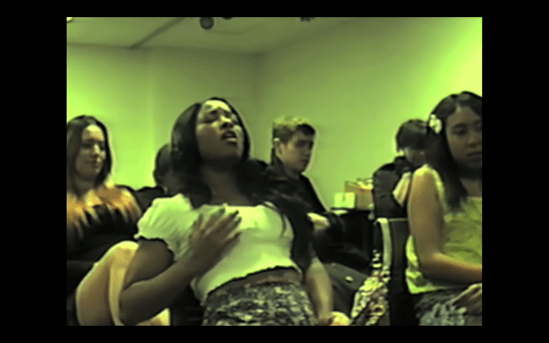
Like a barrel full of doured high school rape jokes bubbling in a stasis of formaldehyde, the farcical cringe-worthy comedy-horror, “Sadistic Eroticism,” is the brain damaged brainchild from writer-director, Alex Powers, as his debut feature film shot entirely on VHS cassette that pays homage to the SOV horror of the early 1980’s, such as “Boarding House” or “Sledgehammer.” Powers, who went on to helm “GrossHouse” and its sequel, congeals on a slapstick of analogue digressions to introduce himself as an auteur filmmaker who, unrestrained, can exceed beyond the distinct hardline of political suitably that’s not only a testament toward the very title of the film, but also, perhaps, securing Powers on a number of studio blacklists unwilling to touch him with a single junk-destined email originating from the other ends of the Earth. Starchild Video serves as production company, which if entering “Starchild” and “Sadistic Eroticism” in the same search engine field, you’ll get a nice little stern warning about your search results involving child sex abuse and any images depicting such should be notified. Yikes.
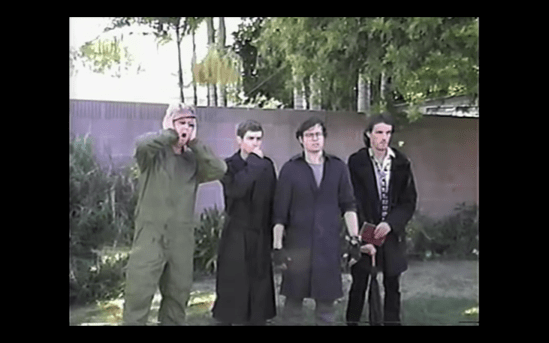
More promising than the infamous history of the Hungarian noble woman, Elizbeth Bathory, to which “Sadistic Eroticism” properly appropriates it’s title and abstract character from, is the colorful, if not disdainfully charged, personalities teeming with a variety of depraved intentions and the entire cast embraces the full blown degenerate toxicity. More than likely, most of the cast list is made up of not household names like JD Fairman, James Coker, Nicholas Adam Clark and T.J. Akins as a black Nazi fascist hard up on Christian values and stern punishment. On the flipside of that coin, genre fans can root through the blurry, sometimes overexposed, tape recordings and find familiar faces of the then scruffy looking filmmaker James Cullen Bressack, writer-director of the popular indie found footage thriller “To Jennifer” and producer to the subsequent franchise films, “2 Jennifer,” “From Jennifer,” and “For Jennifer,” suited up in a shirt-sized Confederate flag as one of four high school bullies to fall under Ms. Lizz’s spell. The prolifically half-naked all the time indie actor, Michael Q. Schmidt (“The Pricks from Pluto Vs. The Vaginas from Venus”), straps on BDSM gear for a little sodomy counseling as Principal Buggary, “2001 Maniacs” Field of Screams” Miles Dougal slaps on a wife beater for some sleazy slumber party slime ball in a high school girl’s father role, and, of course, the lovely pornographic actress who branch out and take a break from oral sex, group sex, three-way kissing, and – oh wait – they do and simulate that in this Powers’ as well. Tori Avano, Imani Rose, and Jayden Starr are the three high school sluts who shameless flaunt their assets for Sophie Dee to snatch up and soul suck her way for anomalous aesthetics as a satanic form of cosmetic surgery. The latter actress, Sophie Dee, is endowed, more ways than one, with the role of the vampire-succubus Bathory, keeping well….well abreast her monotonic acting talents with her adult industry persona. All four ladies show an abundance of above waist skin and engage in some solo girl, boy-girl, boy-boy-girl, girl-girl-girl, boy-boy-boy-girl… and now I must sit down a rest my brain. Dou Waugh, Sto Strouss, Paymon Seyedi, Candis Higgins, Mel Martinez, Aaron Granillo, Matt Johnson, Ian Fisher, Jody Barton, and Yajaira Bardales round out the cast.
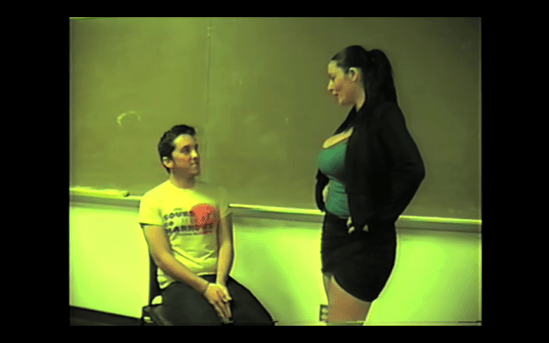
Jokes and slapstick humor disassociated, “Sadistic Eroticism” still relates to the Elizabeth Bathory backstory told on VHS through a tube television presentation of Ms. Lizz’s abnormal history subjects. The succubus creature is nothing less than a buxom beaut that undresses with her feminine wiles zombifying men to do her bidding without her lifting a finger to break a nail against the hypersexualized school girls; yet, to show this century’s old cacodemon as provocatively dressed and to skim around bellying up the tension isn’t quite enough to sell the dominance an ancient evil should be wielding like she owns the whole damn school. There’s more of visceral presence of evil between Principal Buggary and Assistant Principal Defur and though they’re also vaguely under the influence of the succubus, their combined power is the epitome of “Sadistic Eroticism.” The script, characters, and subject material are indicative of Alex Powers attempting to reel in Lloyd Kaufman and his Troma slum-empire to purchase and distribute the filmmaker’s squawking lechery of a film and yet, perhaps, the Troma acquisition team also saw too much of a yawn-fest to bare the Troma brand as the nearly two hour runtime sluggishly relies too hard on being incoherently schlocky to be coalescing competent to make sense. “Sadistic Eroticism” is more masochistic in it’s ostentatiousness to desensitize power and rape and call it comedy, but rocks a mean cast of players from all walks of life to be a mean-spirited take of The Blood Countess.
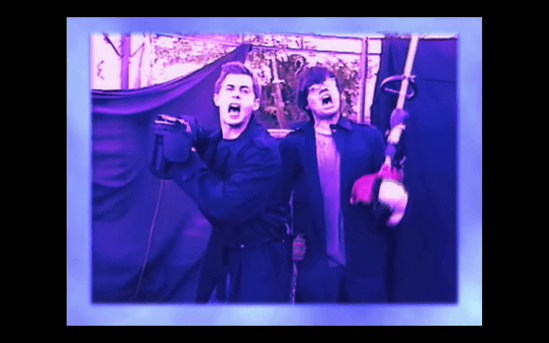
Open your lesson books and get ready to be schooled by the twisted and obscene in Wild Eye Releasing’s re-release of “Sadistic Eroticism” on the label’s Raw and Extreme banner, distributed by MVDVisual. The region free, unrated release is presented in a SOV full frame of 4:3 aspect ratio. Tracking is the least of the problems with this uncouth image presentation rendered from pillar to post quality of warm tinges, severe color corrections required, and gauche details emblematic of cassettes, but all that was Alex Powers intended design to relive in the era of SOV. However, there are some less than stellar, even for SOV, that negate the effort, such as high contrast and poor lighting nearly blanking out darker scenes and the entire climatic end has a neon purple border and the scenes are also recorded in an awful tint of purple, making the entire finale be seen through Grimace vision. To top it off, the jagged opening titles, credits, and crooked visual composites are nearly discernible. The English language mono track is touch and go, mostly go as dialogue wanders into a deaden muffle and is also drowned out by a stock score tracks. There’s not much range or depth as much of the audio is picked up by the poor quality of the VHS handheld mics as exhibited on the special features, which include a director’s commentary and a behind the scenes hosted by that James Coker, who does a pretty good engaging the actors for the in-the-face interviews to explain their characters, scenes, and just overall thoughts with porn starlets and actors milling about or in takes. Sophie Dee’s bosomy eye-catchers, Tori Avano’s star-shaped nipples, Imani Rose’s vivacious sexual appetite and a stockpile of lewd, crude, and nude wets the very foundational whistle of “Sadistic Eroticism” bungled in a sloppy heap of first time filmmaking.
Slavic Folklore EVIL Goes Full Amber Alert in “Baba Yaga: Terror of the Dark Forest” reviewed! (Digital Screener / Shout! Studios)

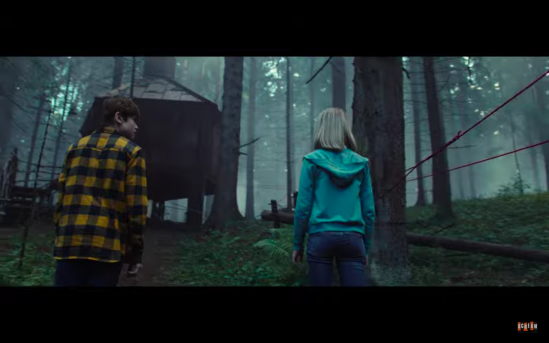
Still reeling over the loss of his mother, a disheartened Egor has moved to a new apartment on the forested outskirts of the city with his father, step mother, and infant half-sister. A nanny is hired for house upkeep and to look after him and his sister, but the nanny’s strange behavior borders hostility toward him while also bewitching his father with her beauty and charm. Since her hire, the nanny cameras alert Egor of movement in the nursey, projecting an unknown and disfigured woman in the room hovering over the baby. When his parents don’t believe him, there’s nothing more the older boy can do until his baby sister goes missing and his parents don’t remember her, as if she never existed. Egor, along with his friends, track down a man living in the woods who seems to have an inkling about the mysterious disappearances of children and why everyone forgets about them as he has experienced the loss of his daughter and can barely remember her. Based off the man’s ramblings, their search for Egor’s baby sister leads them to an old and abandoned power shack that serves as conduit to the world of Baba Yaga, a Slavic witch with the influencing ability in kidnapping and devouring children’s souls for power and Egor’s sister, along with the rest of the nearby children population, have been abducted to lure in the pivotal pure child to set her free into their world.

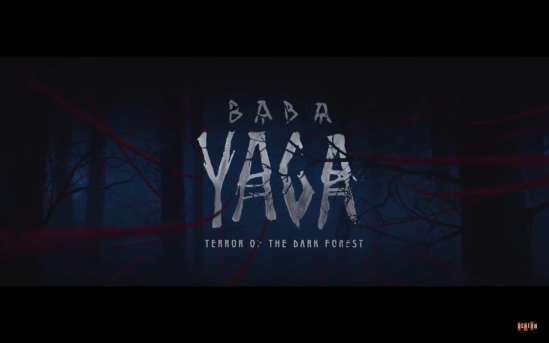
“Baba Yaga: Terror of the Dark Forest” is the second part of this unintentional two part Russian horror film appraisal following our extrospective look into Olga Gorodetskaya’s psyche serrating “Evil Boy” that just happens to have another protagonist by the name of Igor, but in this case, the spelling is Egor and, instead of a middle-aged doctor, Egor is a pre-teen boy with pre-teen issues – just to jazz it up a little. Also originally known as “Yaga. Koshmar tyomongo lesa,” the supernaturally Slavic folklore tale, directed by Snyatoslav Podgaevskiy (“Mermaid: The Lake of the Dead”), was released February in motherland Russia and is making a distributive second coming toward the States on September 1st courtesy of a collaboration between Shout! Studios and Leda Films. Penned by Podgaevskiey as well as Ivan Kapitonov and Natalya Dubovaya, the scribing trio pickup right where the wrote off form the gritty mysticism of fabled creatures beginning with “Mermaid: The Lake of the Dead” and into a classically frightening and morose villain salivating for juvenile souls spurred from one of the numerous variations of one of the more popular, if not grotesque, Russian mythological being. “Baba Yaga” is a production of the Cinema Foundation of Russia, Central Partnership Productions, Non-Stop Productions, and QS Films.

In much of the reverse from “Evil Boy,” Podgaevskiy’s “Baba Yaga” rocks the cradle in a “Goonies” approach with a condiment and courageous group of pre-teen, developmentally spongy, angsty, and hormonal driven children to solve the big bad witch mystery that not only afflicts the very lives of their brethren age group, but also the parental halfwits who have their minds erased like a chalkboard with nothing more than tiny dust particles to cling to to keep their missing children alive in their memories. From the visually powerful alien invasion thriller “The Blackout” (ItsBlogginEvil review here), Oleg Chugunov spearheads a trio of adolescents on the cusp of being witch-fodder. Chugunov plays Egor, a dispirited youth unhappy with his father’s remarriage to another woman and the target of bullies at his new school before becoming the chosen meal plan for Baba Yaga’s unholy escape for an ethereal world. Egor’s experience of an afterthought to a savior of child-kind isn’t represented well through Chugunov and how the character is written as Egor just falls into the “pure” child role without much explanation to why, staying flat on the personal growth scale for 113 minute runtime. Egor’s followed by a love interested in Dasha (Glafira Golubeva) and lead bully Anton (Artyom Zhigulin) who both have bouts with their parental caretakers; Dasha’s mother is a scorned beauty hellbent on controlling Dasha’s life form outside influences while Anton is a parentless brute with a guardian who is equally as callous as him, if not more. Svetlana Ustinova (“Hardcore Henry”) has two roles in this film and both are bad guys: Baba Yaga and Baba Yaga’s half-bird, half-human hench-thing. Ustinova shows immense range by fielding human to hybrid to full out witch qualities, inching the insidious intentions through the storyline that requires varying degrees of discourse with other characters along the way. The cast list rounds out with Aleksey Rozin (“Leviathan”), Maryana Spivak (“The Outbreak” TV series), Igor Khripunov (“The Bride”) and Marta Timofeeva (“Welcome to Mercy”).

Out of the two terror inducers from Russia, “Baba Yaga” inches out “Evil Boy” on the supernatural spectrum. Between Anton Zenkovich’s colorfully prismatic photography, Vlad Ogay’s sleek-straight and modernally tight architectural designs juxtaposed against a vastly rustic and chaotic woodland lore, and topped off with Podgaevskiy’s highly effective misdirection jump scares, “Baba Yaga” inveigles to a palatable lore horror invigorated by a two-timing enchantress with a sweet tooth for kid blood. Despite not being exact to the Baba Yaga’s tale, as the creature’s house is supposed to erected by actual chicken legs, Podgaesvkiy shoots a fear-laden heartstopper where anything can happen in any scene at any moment. Yet, something is indubitably missing from “Baba Yaga.” Perhaps, what’s missing is that meaningful message about rekindling that spark between parent and child, patching up the tears in the relationship that’s been strained by XYZ reason. Perhaps, what’s missing is the unsatisfactory ending of easily dethroning of a powerful and mighty mage. Perhaps, what’s missing is the explanation on why Egor is the key to Baba Yaga’s tyrannical freedom from cursed exile. I’d say all three contribute to the cause and not much, not even a wonderfully animated s storybook prologue depicting the phantasmal enterprise and downfall of Baba Yaga, could save the heartache in wanting more substance from the already loaded story but, then, we would be looking at another hour of runtime though its sorely warranted. In sum, “Baba Yaga: Terror of the Dark Forest” slips in a variant version dispersing a tingling tale of Russian folklore with stunning visuals and dutiful scares that ends deficiently and mediocrely.

Hide your children! “Baba Yaga: Terror of the Dark Forest” will be unleashed on VOD, digital, and on Blu-ray and DVD September 1st from Shout! Studios and Leda Films. You can look for it digitally or on-demand from the following providers: AppleTV, Amazon, VUDU, GooglePlay, PlayStation®, XBOX, hoopla, Fandango Now, DirecTV, Comcast Xfinity, Spectrum, Cox, Charter, and AT&T U-verse. Since the review is based off a digital screener, the A/V aspects will not be examined but the Scream Factory Blu-ray and DVD release will be region A/1, presented in a widescreen 2.35:1 aspect ratio, and will include a powerful Russian language Dolby Digital 5.1 audio mix with English subtitles and will also include a dubbed English Dolby Digital 5.1 mix. Unlucky for me, I had to screen the movie with the dubbed version. Lucky for you, I can confirm that though obvious, the dubbing isn’t horrendously overly-hyperbolized or too asynchronous. There were no bonus features or bonus scenes included nor none announced on the press release. Grab a bottle of Vodka, pop some Zefir candies, turn off the lights, and sink into an Eastern European mythos horror with Svyatoslav Podgaevskiy’s “Baba Yaga: Terror of the Dark Forest” that’ll scare the Ushanka right off your head.
EVIL’s Off the Train and onto the “Peninsula” reviewed! (Well Go USA / Digital Screener)

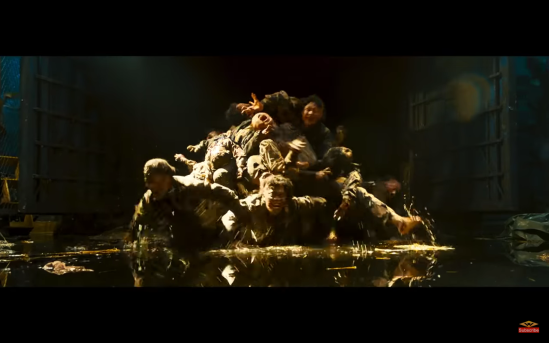
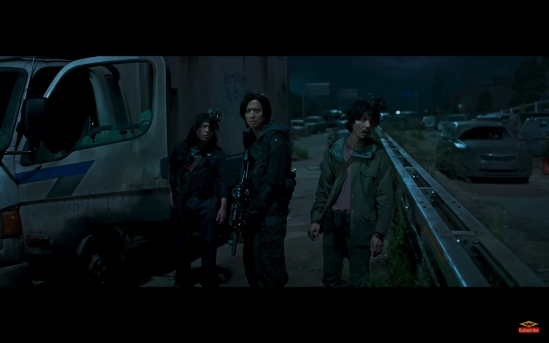
For four years after the initial zombie outbreak, a unified Korean peninsula is completely quarantined from the rest of the world with the remaining survivors having to fend for themselves. A former Korean Captain, Jung Seok, who was one of the last survivors to escape pre-quarantine and now lives in Hong Kong, is hired for a four man team to return to the peninsula and retrieve an unmarked and abandoned truck stowed with $20 million dollars in U.S. currency. With a promise from a Hong Kong mafia boss to keep part of the loot for their recovery services in order to start a new life, the team agrees to the terms and embarks on the seemingly succeed mission only to find survivors who have gone mad, pillaging their mission and conscripting them into a malicious betting game of survival in a watery pit full of zombies.

The highly anticipated sequel to South Korea’s 2016 sleeper zombie hit, “Train to Busan,” docks into U.S. theaters and VOD services on August 21st and is entitled simply, “Peninsula.” From the bullet train rails to the a devastated Korean port, the predecessor film’s director, Yeon Sang-ho, returns with a zombie overrun post-apocalypse that completely metastasized Korean derived from a biological agent quickly spreading throughout the two cinematically unified, North and South Korea. Joo-Suk Park returns as co-writer alongside Yeon to provide heart clenching, brutal action-horror suspense and a human sense of selfless compassion that won the hearts of many genre fans with “Train to Busan.” Zombie hordes rampage down streets, alleyways, and toppling over cars, fences, and other structures as a collective flesh easting unit that specializes in dominating and ravaging for the pure motive of infection and while that sounds all hip and cool that the “War World Z” and “I Am Legend” running zombie pandemonium makes for a glitzy entertainment feedbag, the Next Entertainment World and RedPeter Film production punches down on the gas pedal of gaslighting audiences with more of a “Fast and Furious: Tokyo Drift” with zombies, revving more to the tune of an exasperated exhaust rather than finishing strong with gripping storytelling.

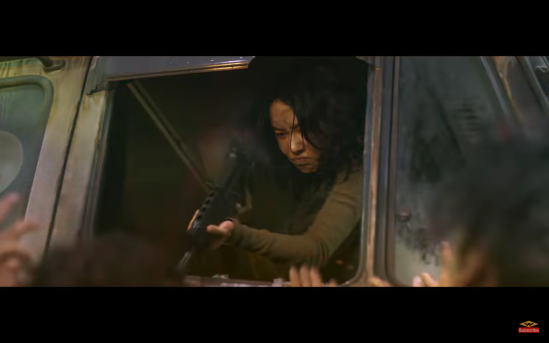
As a standalone film, the story doesn’t return the surviving characters from “Train to Busan.” Instead, a whole new set of characters reset the parameters of expectations, starting with the guilty conscious of the grief-stricken ex-soldier, Jung Seok, played by Dong-won Gang, who will star in Scott Mann’s upcoming disaster film “#tsunami.” Seok’s a reserved and stoic individual whose good a gun play, but isn’t the thinker when a plan is needed in place and while Dong-won Gang gives a par performance, the overall package of the lead character is sorely two-dimensional. This leaves room for other characters flourish, such as the mother and children Seok attempts to save on a second go-around. The mother, played by Lee Jung-hyun, has more grit that clearly defines her underlining hope for not only her salvation, but also her children who’ve known nothing but death, destruction, and meaning of being devoured growing up in the midst of a zombie apocalypse. On the slim change of success, she implements a plan to infiltrate Unit 631, former military turned murderous scavengers, to steal back a satellite phone and a truck full of cash while not becoming zombie chow or get caught in Unit 631’s sadistic survival methods. That brings us to the villains, the real villains, where are not the zombies, but the section 8 soldiers of Unit 631, Captain Seo (Koo Kyo-hwan) and Sergeant Hwang (Kim Min-jae). Though Seo and Hwang bring internal tension to the table, a mental game of cutthroat chess, they’re inevitably soft against the main threat, a combined effort of Jung= Seok and Min-jung, and don’t spill enough blood and craziness onto the screen to make them worthy of the antagonist position. “Peninsula” rounds out the cast with Kim Do-yoon, Lee Re, Lee Ye-won, Moon Woo-jin and Bella Rahim.

As almost methodical as it is with any second film in a series, “Peninsula” failed to be a rejuvenating and transcending sequel to “Train to Busan,” abandoning the first story’s benevolence for CGI flair that extends to not only the zombie hordes, but to the car chases. As excellent as the rendered zombies are slammed against the drifting cars can be represented, in what “Peninsula” can be described as an “Escape from L.A.” meets “Land of the Dead” meets “Mad Max: The Road Warrior,” the cars themselves are a product of computer imagery with little authentic driving happening. While the effects are not bad (they’re pretty good chiefly obscured by dim lit night scenes), the sensation of being scammed can’t be ignored as the vehicles operate unnaturally and maneuver in impossible situations without blowing a tire or upending or just frankly be dead in the water with an overheated and stress tussled engine that frags zombies left and right, becoming a collective character to have the highest kill count. That disingenuous feeling also spreads to the overly long-winded ending that tries really, really hard to capture a courageously defiant and heroic moment of family and personal redemption and much of the blame lies on director Yeon Sang-ho with a drawn out awkwardness and edit that made it seem satirical. In light of some positive words for “Peninsula,” the zombies are a greater, gigantic force that swarm on a colossally epic scale more so than the much more compact “Train to Busan” and, as aforementioned, the structured CGI isn’t of the degraded detail variety so the hordes never look cheap or obviously artificial alongside the more palatable, practical versions. What’s also interesting about “Peninsula” and what makes it separate from “Train to Busan,” which perhaps laid the foundation for, is “Peninsula” has integrated the western counterparts as English speaking actors chime in as U.S. Military, U.N. peacekeepers, or English mafia bosses based in the U.K. This challenges the Korean actors to speak a few different languages, especially English, inclining “Peninsula” as more of a global problem than an isolated Korean one.

The zombie genre isn’t just defined by the ungodly amount of undead bodies reaping the world of every living soul, but is also defined by the diversity of chaos-driven social structures people find themselves confronted with in the action-heavy “Peninsula,” arriving into U.S. theaters on August 31 and distributed by Well Go USA Entertainment. This review will not contain the A/V aspects of the release as it’s a theatrical screening of the feature, but the theater specs will look something like this: projection is in scope lens format at an aspect ratio of a widescreen 2.39:1, a surround sound 5.1 stereo mix, Korean/English/Cantonese language with English subtitles, and has a runtime of just under two hours at 116 minutes. I will note that some scenes are very dark, but this only adds to the complete blackout of a civically desolated Korean peninsula. From fast trains to fast cars, “Peninsula” has retained the adrenaline popping rampant style with weaving, bobbing, and chassis chucking zombie bodies like the ball in a pinball machine despite a facile approach, but is ultimately missing that down-to-Earth social context complexity aimed to provoke thought and shed a few tears as an inferior part two of the “Train to Busan” universe.
They Say There Are No Bad Children, But This is One “EVIL Boy” reviewed! (Well Go USA Entertainment / DVD)

Igor and Polina suffer through every parents’ worst nightmare; their son, Vanya, has gone missing. Three years later, Igor arranges an orphanage visit on the outskirts of Moscow to make Polina happy again by possibly adopting a young child, but their visit is cut short when Polina discovers the gruesome dead body of a basement keeper and a savage child barred away in a dungeon-like room. Polina is instantly imprinted by the child and convinces Igor to adopt him despite the difficult malnourishment and animal like behavior, but over the course of time, the child exhibits signs of behaving like their missing son and even starting to look like Vanya, their missing son’s name Polina has now bestowed upon the child against Igor’s wishes. As the feral child shows more signs of acclimating to his new life, Igor and Polina sense something more sinister from the child whose resembling more and more like Vanya every day and begin investigating into their adopted son’s origins, a well-kept dark secret guarded by the convent orphanage.

From examining horror films from our Northern neighbors in Canada to crossing the oceans and landing in Eastern Europe of the birthplace of Vodka, Russia, we’ll be taking a look at two recently released and storied dissimilar upcoming horror movies from Russia Federation, beginning with the belief that no country is exempt from the creepy kid genre in this Russian 2019 allegory entitled “Evil Boy” as the debut film from writer-director Olga Gorodetskaya. Also known as “Stray” world-wide or “Tvar” in the original dialect, “Evil Boy” is straight-forward, focus group approved, vanilla title of a story from one of Russia’s celebrated modern novelist and screenwriter, Anna Starobinets. Also dubbed as Russia’s “Queen of Horror,” Starobinets is a prolific adolescent thriller writer whose credits includes the compilation of short, chilling stories entitled “The Awkward Age” with the featured tale of a young boy’s life diary expressed through the voice of an ant colony living inside his body and the queen his brain as a conduit for her commands. “Evil Boy” is a production from a conglomeration of companies including Yandex Studio, Cinema Foundation of Russia, Dublab, and Reason 8 Films.

The titular character of Stray or Vanya allows no audience insight and we’re impelled into the perception of the grieved parents, Polina Belova (Elena Lyadova) and more so with the father, Igor Belov (Vladimir Vdovichenkov). While director Olga Gorodetskaya is new to the scene, the chemistry of Lyadova and Vdovichenkov have well been established from a baseline foundation set from their prominent collaborative roles in Andrey Zvyagintsev’s powerful small town corruption film, “Leviathan.” Their dynamic transcends a range of individual performances from crime into the horror realm with parents going through the stripping loss of a child that has compromised their marriage to the point of desperation to the eventual short term passion that has rekindled with the adoption of the Stray, a primal role befitting young Sevastian Bugsev in his introductory feature film. Giving Bugsev credit would be such an underwhelming praise as the eight year old not only nailed the savage child performance, but also endured an aggregation of makeup that gradually transforms his character over time. What’s interesting between the three actors is that they form this family love-triangle of sorts, where Polina embraces the child, but then is frightened of it and in a role reversal, Igor is skeptical of the child, but then tries to love him unconditionally. Just in that square footage, the amount of flux emotions and mindsets can favor one side over the other; yet, the actors pull it off, almost too well, creating a an unrest of feelings, conversations, and approaches to their characters. Key supporting roles include performances another fellow “Leviathan” thespian, Evgenly Tsyganov, as well as Roza Khayrullina, Konstantin Topolaga, Anna Ukolova, and Evgenly Antropov.

“Evil Boy” has some psychology behind it. Hell, even a few of the film’s posters are composited of Rorschach tests and what “Evil Boy” ultimately boils down to is how we interpret our grief of a loved one. Polina and Igor are written to exhibit multiple signs of the clinically coined Complicated Grief that follow the patterns of avoiding the reality of death, persisting nothing has changed, and a bleak numbness to the event. The motif of trying to replace something dear with something else, as a comforting mechanism, is consistently brought to attention and goes as far as leaving a forlorn image of the same motif as a finale twist to drop an atomic loop of melancholic isotopes on you. The psyche portion of the “Evil Boy” is as equally important as the evil boy himself as it’s only a representation of our characters’ will and grief, but whether it’s Starobinets story or Gorodetskaya’s script or both, “Evil Boy” has a yawning plot hole regarding the boy’s origins that’s briefly represented with a dialogue-less scene of cataclysmic and ritualistic images jumbled together for your mind to piece. This sort of passive logic translates equally to the unpalatable editing that plunges the story into a fit of turnaround key moments unable to linger and build upon and stress character developments and form audience relations. Much of the psychology the “Evil Boy” tries to impress is squandered by Gorodetskaya fleeting approach structure that can’t even be tied together by the genuine abstract creature itself when it’s grossly mutilated CGI blunder finally makes a grand entrance.

In the height of the “Sputnik” invasion that’s currently sweeping the Russian horror charts world-wide, explore into the inner space of an anguished mindset melded with conjured up changeling European folklore and you get “Evil Boy” on DVD courtesy of Well Go USA Entertainment come September 8th. The DVD is presented in a widescreen, 16:9 aspect ratio, that renders Ilya Ovsenev’s eerie and shadowy atmospherics, distinct in their own rite, between the sterile urban Moscow and the wooded outlier town where the parenting couple has a home in each to be alien to not only the child but also to the inhabiting parents. Ovsenev’s framing is poignant and harrowing, adding dread much needed to stir into the creature child. The image quality is relatively sharp, but there are moments of obvious color banding, such as around headlights, that suggests a lower bit compression that comes and goes with the nature of the scene. The Russian language Dolby Digital 5.1 surround sound rollicks in an immense range of sounds from the primal animal snarls of the young boy to car wreckage to the soft cries of a whimpering mother despite seemingly having a even-keeled tone storyline that should simmer with tension rather than overflow with nonstop action. The dialogue is clear and forefront available and the soundtrack lulls as a sleepy version of standard genre fare. English subtitles and dub track are available with the former show no sign of asynchronous harmony and no sign of errors in spelling or in timing. The only bonus feature available in the static menu is the trailer amongst trailers for other Well Go USA Entertainment releases. Perhaps, what could be construed as the Russian equivalent to Stephen King’s “Pet Sematary,” “Evil Boy” buries to reanimate suppressed grief through inclinations of folklore and psychosomatic ringers embodied by one creepy as hell kid.
When Music Videos Go EVIL! “The Backlot Murders” reviewed! (Dark Force Entertainment and Code Red / Blu-ray)

After a night of drinking that ends in breaking a bottle over the bar owner’s head, a struggling and internally conflicted rock band kicks out the cancerously unhinged and troublesome member before their rise to stardom. Unfortunately, all the talent went out door along with the excommunicated band member, forcing the band to impress with an extravagant music video shot on Universal’s iconic backlot, sponsored by their agent and the lead singer’s girlfriend’s music mogul father. Instead of intense pyrotechnics and scantily cladded female groupies dancing on their crotch, the band, their girlfriends, and the crew find themselves caught in the gloomy, labyrinth-like movie lot, housing spooky interior and exterior sets, unaware the lurking murderous manic taking them out one-by-one.

By far a polar opposite polished genre film than the sadistically raw brutal rape and murder extravaganza that was “Chaos,” writer and director David “The Demon” DeFalco dabbles in the early 2000’s revival of the slasher genre with his 2002 released feature “The Backlot Murders” in the wake of the widespread success of the “Scream” franchise. In much of the same way “Chaos” came to fruition derived from “Last House on the Left,” DeFalco, once again, finds inspiration in the form of cult horror director Wes Craven. However, DeFalco strays away from the meta-horror and trope-reversal techniques and replaces it with a satirical façade of the music industry where glam is more important than meaningful substance. The slasher-comedy carves up nods to Van Halen, Pearl Jam, Aerosmith, and even Elvis Presley with a horrendously skewed mask version the killer wears. “The Backlot Murders” were co-written by Paul Arensburg and Steven Jay Bernheim with the latter writer serving also as co-producer with DeFalco in association with Dominion Entertainment.

A contributing factor to “Scream’s” success was the diverse in career cast that clicked together as well as twisting archetypical roles into atypical whammy that veered audiences to the edge of their seats. “Scream” shocked audiences with the immediate death of a well-known actress right out of the gate, nabbed “Friends’” star Courteney Cox, “SLC Punk” and “Hackers” actor Matthew Lilliard, teen heartthrob Skeet Urlich, one of the Arquettes with David Arquette, and, perhaps, would have guaranteed Neve Campbell a slab of concrete for the Hollywood Walk of Fame along with an already cemented label as a scream queen and a final girl. The same eclecticism could be transfixed by “The Backlot Murders’” acquisitions but on a more obscure scale with a cast from all walks of life that includes the Roger Rabbit voice actor himself, Charles Fleischer, “Three’s Company” star Priscilla Barnes, 1997’s Playboy Playmate Carrie Stevens, and the late Corey Haim (“The Lost Boys”) as the band’s guitarist in a role that seemed below his fame stature. Most gaps are plugged with interesting characters treated with some backstory buildup that becomes more stagnant than footfall companions in order to get to know them better before their demise, but their persona conductors include Brian Gaskill (“The Bloody Indulgent”), Tom Hallick, Jaime Anstead, Dayton Knoll, Lisa Brucker, Ken Sagoes (“A Nightmare on Elm Street 3: Dream Warriors”), LoriDawn Messuri, Angela Little, and Tracy Dali.

“The Backlot Murders” didn’t set out to revolutionize the slasher genre, but only relished in the after success and donned a more satire effort that purposefully retreated back into the conventional tropes to form an entertaining run of sex, drugs, and rock’n’roll gags, but the one thing missing, and it’s a doozy, is the actual killer presence in the film who is treated as an afterthought of slim importance and chucked into a insignificant plot twist that forces DeFalco’s hand to become a routine hack’n’slash lemming. One positive aspect of “The Backlot Murders” is the extremely high body count that produces a continuous stream of nixing off a slew of characters with their own death scenes inside the renowned confines of a Universal backlot backdrop that’s not only good-humored irony but also a sizeable effort by the Bernheim/DeFalco producing team. Yet, despite the high body count, the kills and gore felt sorely uninspired and underwhelming, rehashing into homage death scenes from “Friday the 13th” and “Scream” with a few forgettable approaches to call its own, until DeFalco breaks the damning goreless streak with a gruesome Columbian necktie effect that goes for the throat. I make “The Backlot Murders” seem unenjoyable and heartless when, in fact, the early 2000 slasher-comedy is immensely funny with a Charles Fleisher gold recorded, laugh track amongst the relentless mocking of the music industry from a far in this true to form slasher accessorized with a high body count kill dozer of a villain.

When things are quiet on set, “The Backlot Murders” evoke the slasher spirit on a new-to-Blu Blu-ray release in the U.S. from Dark Force Entertainment and Code Red with MVDVisual handling distribution. The 1080p, hi-def release is presented in an anamorphic widescreen from a brand new 4K scan of the original 35mm negative. The cool contextual colors render nicely amongst the shadowy gloom and foggy backdrop that’s reminiscent of a softly lit late 90’s and early 2000s slasher. The textures are sharper than the Razor Digital DVD release; the tactile feeling of asphalt when a bluish white glow hits the pavement or the gritty backlot sets vibrant with an ominous glow strike powerful chords of a lively presence from the transfer. There doesn’t seem to be any cropping, edge enhancing, or any other manipulation to the transfer present. The English mono track, which leans away from the LFE, has the opposite, lackluster appeal with a single channel blockade that doesn’t project the bands pyrotechnics, the screams of being chased, and settling for limitations on other wide range of girthy resounding audio. However, the dialogue is clear, unobstructed, and in the forefront. Bonus material includes a new audio commentary with director David DeFalco and Code Red’s Banana Man plus three new and very bizarre interviews with Carrie Stevens lingering from effects of the #MeToo movement to making home fudge, with Charles Fleisher and dissociative disorder or madman genius insight, and ending with a fairly regular interview with Brian Gaskill recollecting the film and his career through a tough industry standard. The Fleisher and Gaskill interviews end with a video op with The Demon himself, David DeFalco. “The Backlot Murders” had forefront potential of systemic slasher films of the time period, but pitter-patters for levity and a sweeping kill count that reconstructs the dread into death and comedy.