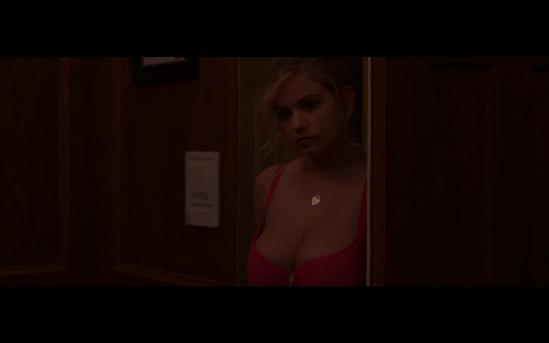
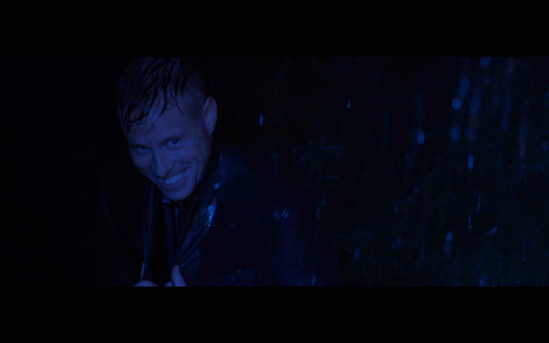
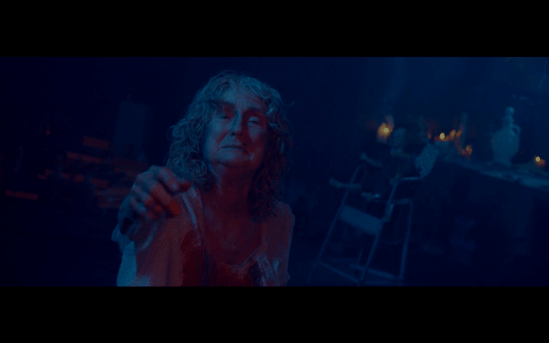
Todd’s birthday starts out fun with a birthday cookout that includes family, friends, and his girlfriend Valerie. Afterwards, his easy going uncle Carl drives Todd, his friends, and cases of beer to an abandoned factory in the woods where Todd has planned a one-night, underaged boozing, camping trip. The infamous factory has a manifold of ghost stories that circle around a single common piece – a cannibalistic maniac. When night falls, Todd suddenly disappears and his friends, including Valerie, believe Todd and his uncle Carl are revving up a good scare after Carl’s creepy campfire story earlier in the day, but when a dead, mutilated body is discovered, something sinister is hunting them and those stories about a cannibal killer no longer seem farfetched in an all-nighter fight for survival.

“What’s Eating Todd?” is a Here and Now production from a duo of women filmmakers with director Renata Green-Gabor making her directorial feature film debut from a story penned by first time screenwriter Brandi Centeno. The 2016 horror-thriller is a spun take on the weary zombie genre without necessarily going the full-fledged slow shuffle and moan zombie route from a story involving an antagonistic infected metamorphosing from an infestation strain of flies. The parasitoid concept is a closely related to a sensationalized man versus nature horror tale seen with a fair amount of anonymity attached and, the film, perhaps, could be an indie homage version of the George Langelaan’s short story, “The Fly.” Almost for certain that Green-Gabor received some sort of influence for “What’s Eating Todd?,” which she shot through the summer of 2013, from her thespian mentor Jeff Goldblum, the face of David Cronenberg’s remake of “The Fly” released 1986, and thus answered the call to chance her first steps into feature films that had this connect to her mentor while providing and retaining her own originality into incubational horror or even a small minute into body horror, releasing the film three years later.
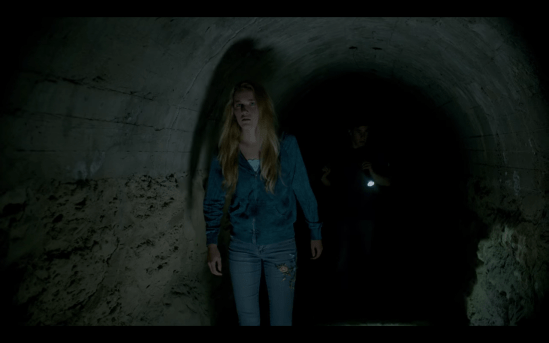
The marketing and selling points for “What’s Eating Todd?” is not the humble acting talent. It’s not a criticism. It’s the truth, as the cast is constructed of unknown names and unrecognizable faces. However, what is also true for a film written by female writer and quarterbacked by a female director is a leading role arising for an aspiring or established female actress. In this case, the role of Valerie goes to a modestly versed Madison Lawlor (“The Axe Murders of Villisca”) who not only becomes the strong and adaptive survivalist protagonist painted against a backdrop of coarse and flawed men who are either exposed of their short comings, involved in illegalities, or anguished to reveal their true nature. Lawlor maintains Valerie’s unwavering love and faithfulness to Todd, being the voice of reason amongst a naïve and obnoxious crowd that are mostly consisted of her cousin Alex (“Mega Shark vs. Mecha Shark’s Phil Biedron) and his friend Duane (“The Zombinator’s” Scott Alin). Alex and Duane are a couple of super frivolous “bros” primarily integrated into the story to raise the body count. Cousins Valerie and Alex do attempt some kind of meaningful connection regarding identity and status in the hierarchy of high school, but was meagerly written and comes to be more a bickering battle of perspectives. Biedron and Alin sufficiently exact the right amount of goofball, oversexed, and dumb-wit to pull off a surface level duo. Todd (“The Z’s” Adam Michael Gold) is certainly the biggest failure out of the group of friends. The birthday boy’s upheaval from being the luckiest guy in the world to the world’s biggest problem goes into squandered territory that floods more questions than answers into Todd’s from baseline growth relationship with Valerie to his revamped mentality and accomplishments from ambiguous, circumstantial backstory of flesh eating and conspiracies. The weight of Todd and Valerie’s connection is only expositional rather than shown and the groundless Todd absorbs the downfall during an anti-climactic finale of internal struggle with Valerie as the source material. The film rounds out with Danny Rio and Carlos Antonio.

Though the cast won’t draw in an audience, the snappy “What’s Eating Todd?” title might turn some heads in it’s direction. However, “What’s Eating Todd?” inherently sounds like a farce and if you’re expecting humor, disappointment will rear its ugly, funny-less head as Green-Gabor had no intentions for a comedy element. Another misleading of marketing is the Indican Pictures’ DVD cover, which I’m assuming is also the film’s actual poster, of a woman in a cutoff sleeve jersey t-shirt with “Zombie Killer” in the name field and holding a sword (katana, maybe?) while blurry silhouettes of lumbering undead move at an unknown pace toward her in the background. Let’s analyze the comparison between cover art and actuality. As mentioned, the story’s female heroine is appropriate to the cover, but isn’t contextually accurate to the film. Valerie, the supposed character on the cover, isn’t holding a sword nor is she dressed in a “Zombie Killer” jersey t-shirt. As for the zombies, the term zombie is only made in jest by one of the bros and there is some undead moments of gore including gnawing and ripping out the jugular, but no tearing out of intestines, no munching on fingers, nor are there any instances where eating people like finger-licking fried chicken is happening here. Plus, there is only one adversarial fiend and not more as the cover suggests.

Indican Pictures distributes a Here and Now Production of “What’s Eating Todd?” onto a not rated DVD home video. The region 1 release has a runtime of 89 minutes and is presented in an anamorphic widescreen, 1.85:1 flat aspect ratio, on a 35mm, hand held camera. The digitally shot image renders brightly and clean with hardly any flaws worth disclosing. The night scenes are slightly tinted blue with a higher contrast to lighten up the image without being overly dark in the middle of the woods without much natural lighting and the digital noise has little intrusiveness despite the budget constraints of an indie production. The English language Dolby Digital surround sound has adequate range and depth and, for the most part, a dominating dialogue presence. Brief moments of Revenge of the Bimbot Zombie Killers’ Andy George’s original score would drown out dialogue during imperative, but happened too far and few in between. Other than a typical static menu and preview trailers from Indican Pictures, no other bonus materials reside on the release. “What’s Eating Todd?” is not a zombie movie despite the hoodwinking cover. What Renata Green-Gabor did direct can be categorized as a branch of the undead, an infestation altering DNA that mounts to destruction on and around of the affected that, technically, no longer makes them a part of the living human race. In short, expect a sheep in wolf’s clothing in this roughly run-of-the-mill horror that aims high, but misses low by offering too little to sanction a good story.
EVIL’s Brush Stroke of Genius in “Art of the Dead” reviewed!

The Wilsons’ are the perfect portrait of a nice family; they’re wealthy but charitable and kind without exploiting the humility of others. However, when Dylan and Gina Wilson bid and win on the SinSational art collection at auction and hang the enchanted paintings strewn through their mansion estate, a strange succumbing to sin overwhelms their moral fiber. The paintings of Dorian Wilde, an eccentric and obsessive 1890’s painter who achieved eternal soul longevity by making a pact with the devil, created the art, depicting primal animals symbolic of the seven deadly sins, by using canvas and paint out of flesh and blood of his victims. The Wilsons’ become corrupted and carry out the sins of Pride, Lust, Gluttony, Sloth, Greed, Envy, and Wrath and the only way to save the family from damnation lies in the hands of a former priest, Father Mendale, and a girlfriend, Kim, of the oldest Wilson boy engulfed by Wrath.

“Art of the Dead” is what people call when art comes to life, or in this case, death. From the selective “Emmanuelle” film series and “There’s Nothing Out There” writer-director, Rolfe Kanefsky comes a story woven with the seven deadly sins theme as a foundation that approximates a 90’s grade thriller of epically gory proportions. With a catchy, yet dead horse beaten “of the Dead” title, “Art of the Dead” uses the seven deadly sin theme and blends it with an obvious homage to the gothic literary novel, “The Picture of Dorian Gray,” by Oscar Wilde. The main antagonist, Dorian Wilde, is the merging of the author and his fictional creation. Oscar Wilde wrote the novel in 1891, the same era the story enlightens in which Dorian Wilde makes a pact with the devil. Unlike another notable film, “Se7en,” where a practical killer exploits the capital vices to thwart a pair of detectives, “Art of the Dead” introduces dark, supernatural forces of Oscar Wilde’s work into the fold that are not only abject in what makes us human, but also biblically condemning, spearheaded by a satanic maniac who will do everything and anything to maintain his precious work and eternal soul, Produced by Michael and Sonny Mahal of Mahal Empire productions, the financial investors have also backed a previous Kanefsky film, another occult gone astray thriller entitled “Party Bus to Hell,” and in association with Nicholas George Productions and Slaughtercore Presentations.

Another pair of producers are also a couple of headlining actors who are household names – “Sharknado’s” Tara Reid and “21 Jump Street” actor and avid painter, Richard Grieco. Reid plays a snooty and shallow art gallery curator who sells willingly the Dorian Wilde set knowing well enough of their malignant history, but Grieco has a personal connection toward a film regarding art more so than the dolled up Reid because of his nearly 20 year passion as an painter of Abstract Emotionalism. His character, Douglas Winter, is obsessed with the SinSational collection to the point where it uses him as an instrument to kill his artistically unappreciative family; a sensation washed over as parallel and broad among all artists alike fore sure. Jessica Morris (“Evil Bong 666”) and Lukas Hassel (“The Black Room”) also headline. Morris provides the sultry and lustful-influenced mother, Gina, and her golden hair and blue eyes has a fitting innocence that’s is tainted and provocatively shields the cruel intentions of lust and power while Hassel, a giant of a man, immediately becomes capitulated to greeds’ warty influence. Each actor renders a version of their paintings and each dons the sinful presence gorgeously with individual personalties and traits; those other actors include Cynthia Aileen Strahan (“Dead End”), Sheila Krause, Jonah Gilkerson, and Zachary Chyz as well as “The Black Room’s” Alex Rinehart and Robert Donovan along with Danny Tesla playing the demonic proxy of Dorian Wilde.

“Art of the Dead” embodies an innovated spin on a classic tale of self-absorption and deferring one’s own detrimental sins upon others to carry the burden. Kanefsky grasps the concept well and visually sustains a contextualized 98 minute feature that carries a straightforward connection to the Gothicism of Oscar Wilde while cascading a family tree (pun intended) of problems that pinpoint each sin’s affecting destruction upon the soul through a wide burst of dispersive poison. While the idea is sound enough, the script and narrative channelling hardly carries the equivalent weight of the idea and comes off clunky, cheap, and sometimes uncharismatic. “The Black Room” was the last Kanefsky film critiqued at ItsBlogginEvil.com and the script was noted with the characters that hardly progress up toward and out of the despondent and deviant muck and it was the filmmaker’s softcore cinema background that attributed to the characters over-saturated girth of lust, which elevated and hindered “The Black Room’s” incubus storyline. With “Art of the Dead,” Kanefsky redresses the lust to quench just the respective sin with the right amount of perversion, represented by the mythical, sex driven Satyr that was created beyond being a nice touch of storytelling, disturbance, and meta kinkiness. Kanefsky continues to proportionally feed each sin the same manner with the exception of Pride that lures in a specific victim; however, the paintings’ insidious nature wonders to a circumstantial level at best with Kanefsky’s tongue-and-cheek dialogue and uncouth playfulness of Dorian Wilde while possessing the flesh of a black-laced, Fredrick’s of Hollywood-cladded Gina.

Umbrella Entertainment and ITN distribution release “Art of the Dead” onto a region 4 DVD home video and is presented in a widescreen, 2.35:1 aspect ratio. The sterile and polished look of the image renders doesn’t invite stimuli to visual senses, but is superbly clean and free of blotchiness that can routinely be a contrast issues with darker, indie productions; however, the digital source is nicely maintained and the darker scenes and colorfully deep portions of the paintings, the viscous blood, the modernized Wilson house, and the anywhere else have quality caliber. Visual and practical effects are necessarily key for “Art of the Dead” to be successful and the film scores a combination of talent to enhance the ho-hum photography with renaissance man Clint Carney, whose visual effects work on his own written and starred in film “Dry Blood” was flawless and who also painted Dorian Wilde’s works of art, and some solid practical and Satyr creature effects work by “Child Play’s 3” Victor Guastini and the VGP Effects team. The English language Dolby 5.1 surround sound audio is clear, precise, and no inkling of issues with the range and depth of ambient sound. Like most standard DVD releases from Umbrella Entertainment, this release comes with no bonus material or even a static menu. To observe his work as a whole, filmmaker Rolfe Kanefsky has nothing to prove with a body of work spanning over nearly three decades, but in reducing “Art of the Dead as a singular film, there in lies a double edged sword. A true sin is to headline a film with actors with brief roles just to draw in investors and an audience, yet “Art of the Dead” also finds innovated modernism out of classical creativity, giving new life by homage, and displaying some maximum carnage fun with plenty oil and water color.
God Hatin’ MMA Fighter Still Has The Power in Him to Fight EVIL! “The Divine Fury” reviewed!

After the sudden and violent death of his police officer father, mixed martial arts champion, Yong-hoo, has a complete disdain for God from a young age now that both his parents have perished. Growing up angry and swarmed with negative thoughts, Yong-hoo goes through life without much of a purpose until he awakes from vivid dream with the wound of stigmata on his hand. Unable to stop the bleeding by means of conventional medicine, he resorts to a shaman who convinces him to seek out Father Ahn, an elder priest experienced at practicing the rite of exorcism, and learns that the wound and Father’s once unwavering benevolence provide a divine weapon against a growing covenant of demons under the black magic of a Dark Bishop. Together, Yong-hoo and Father Ahn combat the forces of evil before the possession runs rampant in the city.

South Korea packs a punch with an action-packed take on possession and exorcism with Kim Joo-hwan’s “The Divine Fury.” The 2019 released film that blends horror with the cinematic formulas of the comic book universe films is written and directed by Joo-hwan and produced by Studio 706, KeyEast, and Lotte Entertainment, the latter being a subsidiary of one of the largest Asia conglomerates and a leader in the Asian film industry. “The Divine Fury” isn’t low-rent horror, providing fans with salt of the earth martial arts, a range of diverse set locations, and a decent grade of special effects that range from stunt men quality to visual monstrosities, including a giant hell worm bristled with millions of arms and hands, and also gives a chance for Joo-hwan to showcase his junior horror-action that succeeds a 2017 buddy-comedy in “Midnight Runners” and a coming to terms drama in his 2013 film, Koala. One motif, and perhaps trademark, that runs through all of Joo-hwan’s written and directed films is the coupling of protagonists element and “The Divine Fury” is not an exception and follows the same coupling, if not slightly altered, mechanism.

A pair of actors from Bong Joon-ho’s award nomination buzzing “Parasite” also have a role “The Divine Fury,” one of them, Seo-joon Park, being the lead star of the Joo-hwan film as the MMA Godsend, Yong-hoo, with hate in his heart for the Lord Almighty. Yong-hoo’s a joy to watch on the screen as a character with an arch’s beginning as a young man, a mindless fighter, being verbally influenced over his shoulders by demon puppeteers to finding his lost father figure in a man who has an unflinching amount of faith. Seo-joon captures the defined struggle Yong-hoo has with God even in the face of pure demonic evil before him. An evil battled by Father Ahn, dolefully portrayed by “Sector 7’s” Sung-Ki Ahn. Sung-Ki fatherly performance places Yong-hoo into a role of humility, not only as a mentor, but with experience and patiences that resigns to trust rather than action. However, the dynamic goes both ways. Seo-joon shows lot of physical strength becoming unwittingly the “divine” warrior to thwart an insidious malevolency when Father Ahn is taken out of action due to Yong-hoo’s haste. Seo-joon had to quickly and naturally grow up his character to be the leading, brute force of experience and physicality and did just that as character faces off with the Dark Bishop, Ji-sin. Ji-sin invokes demons to inhabit those in a weak state of mind. This devilishness wouldn’t have been made possible without Do-Hwan Woo’s stoically sly and slimy confidence behind the character. The remaining cast rounds out with another “Parasite” actor, Woo-sik Choi, and Seung-Joon Lee.

“The Divine Fury” is fundamentally an essential oil extracted from the widely popular comic book universe money-making machines, that are sometimes also called movies from time-to-time, but “The Divine Fury” doesn’t have that monstrous platform of a narrative pulled directly from the illustrated pages of comic book franchise. Yet, the story builds a downtrodden, seeking-answers Seo-Joon with a tragic past and an ability to pulverize people – a winningly similar combination to any pre-defined hero in the Marvel character evolution. There’s also this theme of fatherhood and mentorship, like seen in “X-Men” with Professor X or “Blade” with Abraham Whistler. The latter of those two examples perhaps more closely resembles Father Ahn as the relation to the horror-action genre is similar in nature, but instead of abstaining from blood thirst, Seo-Joon is abstaining from letting God into his heart. Of course, “Blade” was ultra-violent and bloody and “The Divine Fury” is grossly more toned down with the exception of a few key moments of blood regurgitation. Speaking of effects, the visual effects waned from expectation and teetered more toward a rushed and unpolished look. They weren’t terrible, but not the best looking visual effects demons in the industry.

Well Go USA Entertainment brings the action of exorcism to Blu-ray and DVD home video with a dual format, two-disc release of “The Divine Fury.” Presented in a 1080p widescreen, 16:9 aspect ratio and sheathed in a slipcover, “The Divine Fury” feels necessarily gritty in comparison to the subject material with a clean, almost sterile image that defines the blacks and colors, despite a short range of vivid hues the hues that are dominant are profoundly thick and dark. The limited color palette won’t be a problem as demons hide in the shadows and that’s where the story takes domain in scaffolding-laden churches, orphanage basements, and even a swanky neon-glowing club with a well of damnation beneath in the dungeon. The skin tones have a natural feel about them, but going against the grain of naturalism is the visual effects as aforementioned as they don’t render properly to exude the right viewer reaction. The Korean language 5.1 DTS-HD Master Audio has ample weight. Whispering shadows of slithering speak and the bubbling of the, again, well of damnation emit the right kind of range and depth needed to descent into doom and gloom atmospherics. Dialogue is crystal clear and in prominent. An English dub is available, as well as English subtitles that errorless and well synced to the Korean dialogue track. There is some English during a MMA fight on the Korean track. Bonus material includes a rather generally spiced together making of featurette that includes mini segments such as prop commentary, special effects, behind-the-scenes look, and the construction of the antagonist world in “The Divine Fury. There are also a couple of trailer variants and a U.S. trailer for the film. Ultimately, “The Divine Fury” intrigues on the fray, desiring more into the backstory of Father Ahn and delving further into Seo-Joon’s weaponized stigmata and director Joo-hwan Kim teases just that with a taste of things to come with a short pre-credit scene that sets up “The Divine Fury” for more themes, perhaps, on a love-hate relationship with God, more, perhaps, finding suitable father figures, but, of course, there will be for sure more exorcizing ass-kicking of demons.
When Evil Calls, Don’t Pick Up! “Close Calls” reviewed!

Spoiled brat Morgan MacKenzie indulges in the good life under the roof of her wealthy father; perhaps, the party girl indulges a little too much when her father catches her and her boyfriend in a sexual act by the backyard pool. Her continuos snarking, cantankerous attitude, and sexual delights force her father to ground her before going out on a date night. With a box full of miscellaneous hard drugs and a house all to herself, her sole responsibility is to supply her deteriorating grandmother imperative medication, but when obscene phone calls place Morgan on edge, paranoia rocks Morgan’s lucid tate of mind through occurrences with her horny, drug pushing boyfriend, a vile and deranged grandma, and a stranger at the doorstep on a rainy night that instigates nebulous effects, rendering her trapped, scared, and questioning everything about life as she knows it.

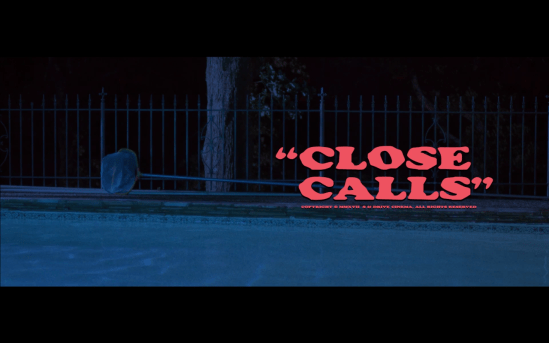
A visually colorful feast of mind-warping fear is Richard Stringham’s psychological horror-thriller, “Close Calls.” The 2017 feature that bares a undeniable resemblance to the 1970’s Italian giallo films with stark, dreamlike color lighting keenly favors an admiring homage of a bygone genre. Writer-director Richard Stringham, contributing product of “10/31” and it’s sequel, shepherds the film through S and Drive Cinema on a production that’s near entirely shot on one set location and in a handful of built sets to purposefully thrust an empathetic viewer trapped alongside, hip-to-hip, the snooty,scared, and smack-tripping Morgan and the script, which has been a work in progress for some time prior to release, finally saw completion when, supposedly, Stringham was tripping on drugs himself – that backstory alone should ensue a viewership.

“Close Calls” introduces horror fans to Jordan Phipps as Morgan MacKenzie, the tortured receptor of the obscene calls and whose nerves are buckling under a bombardment of uppers, downers, and many, many hallucinogens. To really stomp hard on the fact that “Close Calls” is indeed a horror film and to add upon the slight separation of the normal circumstances, the unearthly busty Phipps performs in her underwear and bare feet through the entire film and its comically written against the character to undress Morgan in not a literal sense, but works toward a natural teen prerogative that Phipps courageously pulls off dutifully. Because of the very fact that “Close Calls” is the actress’s debut feature told in her character’s entire point of view, I expect Phipps to be on the casting radar as an array of talent and as one who can go unscathed in the daunting course of leading lady. Morgan has exchanges with a couple of interesting characters to note from “10/31’s” Greg Fallon as Barry Cone, a colleague of Morgan’s father with sexual deviancies and callous intentions, and “The Phone in the Attic’s” Janis Duley portraying Morgan’s mentally unstable grandmother with takes dumps in the closet. Fallon and Duley hone in on their respective roles with uninhibited momentum that viciously contributes to Morgan’s spiraling home alone situation and creepily loom a visceral presence under a disturbing guise. Carmen Patterson (“The Boo”), Kristof Waltermire, and Landen Matt round out the cast.

On a parallel plane with the losing one’s mind from a heavy dose of drugs, trauma, and spoiled entitlement, the psycho-sexual narrative of “Close Calls” shouldn’t be ignored and is fringed with totalitarian perversion. The extremely saturated provocative and mainly lewd discourse calls an uneasiness to the moral senses that undercuts the congenial desires for Morgan. Like aforesaid, Morgan struts in her underwear thoroughly through the story and Stringham elaborately showcases her assets with some fine tuned camera work and angles, but Morgan’s drug use topples her sexual stability, leaving her vulnerable against predators that also include her douchy boyfriend, but it’s co-star Greg Fallon that takes the sexual deviance to misogynistic heights as a blunt force object with a high-level stalker obsession toward Morgan. Fallon exacts a persona that’s explained to have watched Morgan from afar in the shadows and schemed plots to infiltrate her by any means necessary, even if that means killing her when he’s done. As Barry Cone, Fallon manufactures to perfection a middle aged man’s grimy malaise toward young teen women and Cone is so vile that he can even starkly contrast Morgan in a better light despite her explicable flaws.

S and Drive Cinema production of Richard Stringham’s “Close Calls” dials up onto DVD home video from Scream Team Releasing presenting the film in a widescreen, 16:9 aspect ratio, full of colorfully vibrant lighting familiar to the old Italian thriller while sustaining a complimentary cinematography with a flat vintage definition image. The stimulating combinational pops of color and lighting were the collaborative efforts of the director of photography Graig Wynn and the late colorist, Omar Godinez (“I Spit On Your Grave” remake), who died of heart failure before the film was finished. The English language PCM DTS-HD Master Audio mix has little to fear with a robust, slasheresque-score by “The Barn’s” Rocky Gray, but the dialogue track can be soft at times where the score overpowers and nearly drowns out the actors. There are also gag-like foley effects, such as when Morgan rubs cocaine onto her gums and the squeegee sound effect sounds more like something out of a Leslie Nielsen parody. With the exception of a static menu, only a single DVD bonus feature included with an audio commentary by writer, director, and produce, Richard Stringham. Loaded with psycho-sexual themes and psychedelic-contorting deconstructs, “Close Calls” is not only a 128 minutes of rabid affections for Jordan Phipps, but also a trip down the uninviting rabbit hole of collusion, murder, and an endless supply of suspense.
The Lord Examines the Righteous, but the EVIL, Those Who Love Violence, He Hates with a Passion! “Holy Hell” reviewed!

Father Augustus Bane is a go-by-the-book type priest and through his unlimited optimism and passion, grudgingly turns the other cheek when life’s bitterly cold callousness bends him over a barrel and pulls his hair until bruised and raw on that very same turned cheek. When the God dedicated man of the cloth is pushed too far after the merciless slaughter of God worshipping parishioners and he is left for dead by a gang of demented family members, the surviving Father Bane is reborn and becomes destined to a vindictive life path with a six-shooting revolver he baptizes as The Lord. Hell hath no wrath like a priest scorned to obliterate all sinners from every walk of life in a blaze of the almighty glory (and gory) of The Lord and those explicitly responsible for the death of his congregational followers and much of the city’s crime and corruption will have nowhere to hide from their lethal penance.

What could be considered as the pious Punisher on steroids, Ryan LaPlante’s offensive-laden, satirical grindhouse exploitation feature, “Holy Hell,” is a confirmation of that films like LaPlante’s are sorely needed and pleasingly free in speech inside the dominion of today’s sensitive and politically correct cultural society. Surely not a product of the U.S. and will certainly piss some viewers off (especially zealots), this Canadian made production could only exist outside a conservative dome, looking inward for a weakness to seep and taint the sometimes too wholesome American cinema market that’s tiptoeing around what should expressively blunt and in your face. Let’s face it, folks, it’s a movie! LaPlante writes, directs, and stars in this movie of comedy, action, and exploitation that’s even too controversial for some of the supporting cast who used pseudonyms, such as punned Yennifer Lawrence and Zooey Deschansmell, as their stage names because of the deviant material.

The man with many hats, Ryan LaPlante stars as Father Augustus Bane, a cheerful priest with a firm belief of charity instead of violence, and as LaPlante’s first and only feature as a writer and director, “Holy Hell” snuggly fits the filmmaker’s contemning, vindictive, “autistic rage monger,” as another character described accurately. Satirically stoic, Bane reminisces the days of yore when severely slighted protagonist broke and the endured trauma became a journey of eye for an eye, tooth for a tooth. LaPlante, whose career pivoted to the video game world and could so seamlessly, understood the mentality of once was with harden, good men turned relentlessly anti-heroic. Father Bane’s opposition had parallel penchants of aggressive stamina, but in a more deplorable and deviant calling. The MacFarlane family is about as coarse and as ruthless as they come ran unflinchingly by Dokes, the head of the family, with his wild eyes and skull earring atop his fishnet undershirt and open Hawaiian button down. Dokes is truly satanic as a ravishing villain from in co-producer’s Michael Rawley’s in his sardonic performance of the father of three. The “Disco Pigs” actor revels as Dokes in not only being the kingpin, but also a special daddy to his three rotten and just as maniacal kids – Trisha (Rachel Ann Little), Buddy (“Red Spring’s” Reece Presley), and, the more flagrant of the trio, Sissy, a labeled sadistic he/she of boundless perversion and a flair for the theatric played vivaciously by Shane Patrick McClurg and McClurg’s Sissy MacFarlane is difficult to dislike and is favorably one of the best and best portrayed characters alongside Father Bane and Dokes MacFarlane. The entire “Holy Hell” cast amazes as deviant delectation and round out with love interest Amy Bonner played by Alysa King (“Slasher” television series), Luke LaPlante, and Austin Schaefer.

While “Holy Hell” trails the established trope about a vindictive good man, a thrilling theme consisting inside half the grindhouse genre films of 70’s to 80’s, Ryan LaPlante doesn’t really offer much new to audiences whom are well versed; however, since “Holy Hell” is one big punch-to-the-face nod toward grindhouse and the filmmaker constructs a complete caricature picture, the shocking, the disgusting, and the hilarity mold almost an entirely new brand of grindhouse or, as I’ve coined, mockhouse. A mock-grindhouse film have natural degrading quality where filmmakers remain on the fray of getting the right look and feel of a grindhouse film, but LaPlante accomplishes the task, echoing the effect while adding his own brand of comedy. Also LaPlante’s bludgeoning of taboo is no holds barred comedy, especially on surface level narratives such as with Father Bane who has a tremendous arch to hurdle as a priest fueled with guilt and rage against an army of inhuman and derange psychopaths, plus all the other miscellaneous miscreants roaming the streets at all hours of the day, but the script is penned like the Divine retribution as the priest endures, almost in a supernaturally reborn or resurrected kind of way, after being shot six times in the form of a cross by Dokes that, ironically, acts as a blessing for Bane to declare war on evil.

Indican Pictures presents a Rogus Gallery production with “Holy Hell” onto a not rated DVD home video. The widescreen, 16:9 aspect ratio, has a warm toned coloring grading from digital grader Defiant and also embellishes the natural grain and blemishes to assimilate into the grindhouse collective. “Holy Hell” is intent only appealing to a comic book illustration that makes definition fuzzy, but not totally cleared from the playing field. The closes up of the gore is nicely displayed with a drenching and gruesome effect. I couldn’t detect a lot of girth from the Englih language 2.0 stereo track which makes me think LaPlante intended on suppressing much of the ambiance and up the soundtrack quality from composer Adrian Ellis, whose upbeat, synch-rock has killer intentions whenever the MacFarlane’s are rolling heads. DVD extras include a director’s commentary and a blooper reel. Chockfull with affronting one liners, “Holy Hell” is utterly sound being well-rounded with the best intentions paved in hooker blood and indecent exposure, as well as being highly entertaining, in one holy redeemable package of horror exploitation blessed by Ryan LaPlante himself.