EVIL’s Brew Just Needs a Severed Head! “The House of Witchcraft” reviewed! (Cauldron Films / Blu-ray)

“The House of Witchcraft,” a part of The Houses oof Doom series, Now on Blu-ray!

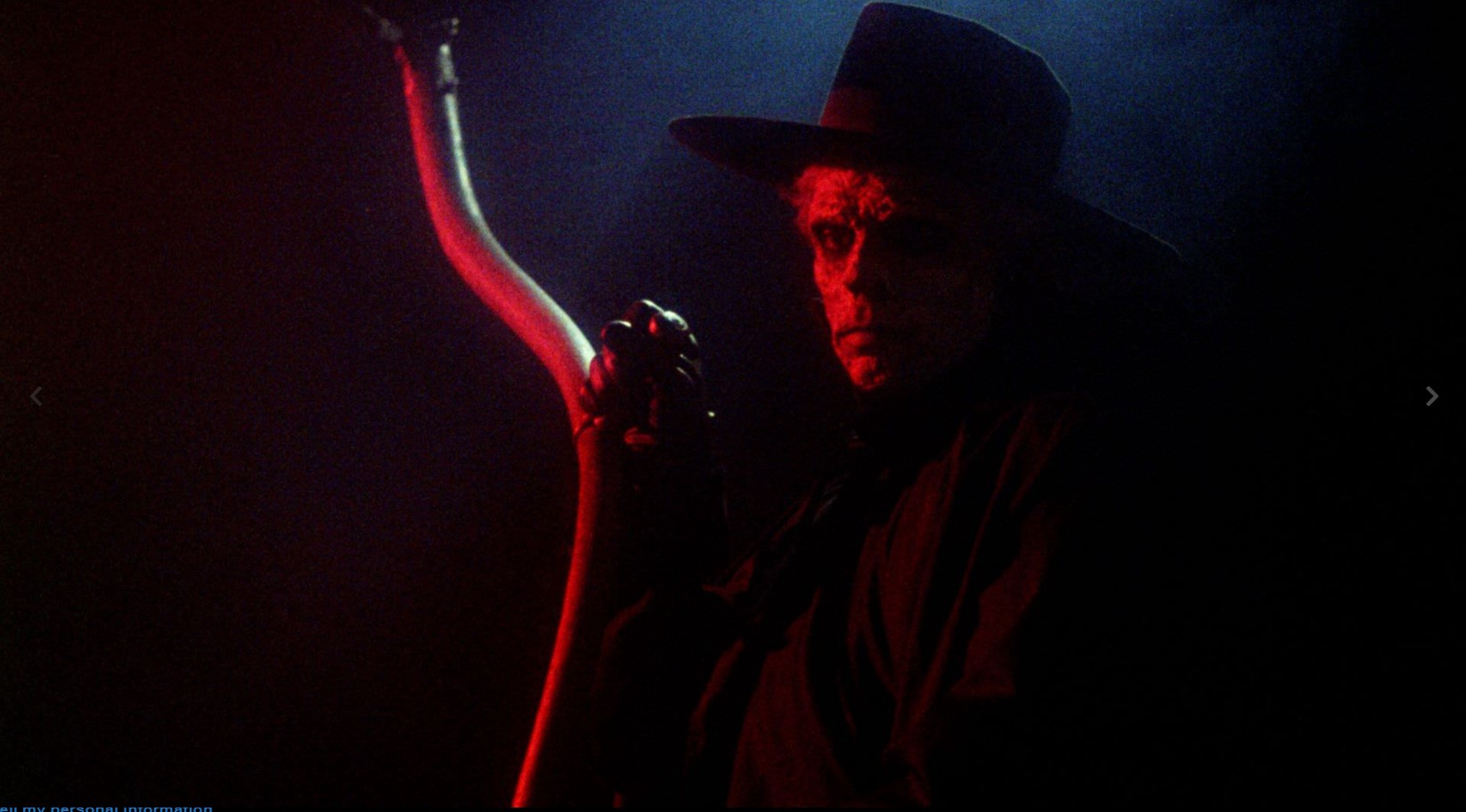
Luca Palmer has experienced the same reoccurring nightmare for months of him finding shelter from being chased inside a large countryside house with an ugly hag boiling his severed head in a large cauldron.  The dreams have required him to find professional help in a psychiatric ward but without any real mental or physical health concerns, he’s released to his incompatible, witchcraft practicing wife Martha who sets up a country house getaway in a last ditch effort to save their dwindling marriage.  When they pull up to the house, Luca immediately recognizes it from his nightmares.  From then on Luca believe he’s seeing the malicious old woman from his dreams around on the estate grounds and urges his psychiatrist, who is also his late brother’s wife, to visit him to assess his state of mind, but the visions keep coming and those around him keep dying a horrible death with his wife being the key suspect of witchcraft related deaths.

“La casa del sortilegio,” aka “The House of Witchcraft” is a made-for-television, witch-centric movie for the four-film series The Houses of Doom concept created under the companies of Dania Films and Reteitalia’s producing team Massimo Manasse and Marco Grillo Spina.  The 1989 witchy-slasher hybrid and the third film of the series is helmed by another notable Italian schlock and shock director, Umberto Lenzi (“Seven Blood-Stained Orchids,” Cannibal Ferox”), as well as Lenzi writing the script from the story of The Houses of Doom envisaging duo Gianfranco Clerici and Daniele Stroppa.  “The House of Witchcraft” speaks the very essence of what to expect in a traditional sense regarding witches while really stepping up with Italian nastiness inside the slasher principles, filmed in the heart of Italy in the popular Chianti wine municipality of Rufina where the landscape is lined with vineyards, churches, and castles.

Luca Palmer is committed to his mental health by committing himself to his sister-in-law’s psychiatric hospital after months of nightmares involving a witch and his severed head as the main ingredient for her boiling stew.  Perhaps, because of his rocky relationship with wife Martha, played by French actress Sonia Petrovna (“Flashing Lights”), Luca just needed a break from her witchcraft obsession and loveless aloofness to clear his head.  Either way, the American-born and ‘Naked Rage” actor Andy J. Forest is one of Umberto Lenzi’s go-to action stars, of such Lenzi’s war films “Bridge to Hell” and “The Kiss of the Cobra”, whose taken off the film battlefield and positioned as the confounded centerpiece of a cackling witch tale, completing his task as a the tall, handsome, and flawed hero of a man haunted and driven by unpleasant night terrors of the long face, broad features of the fittingly named Maria Cumani Qausimodo as the dolled-down witch.  Quasimodo is no stranger to the filth and frights of Italian schlock with roles in “Behind Convent Walls,” “Five Women for the Killer,” and even the notoriously porn augmented “Caligula” and her physical traits, long stare of blue eyes, and pandering of character’s wickedness transform her into an ideal archetype of the original folk-acholic Brewmeisters.  Characters for the slaughter tin this supernatural slasher and to be intertwined into the suspect and innocent pool are played by Paul Muller (“Lady Frankenstein”), as the sixth sense blind homeowner Andrew Mason, Marina Giulia Cavalli (“Alien from the Deep”) as Andrew’s visiting niece Sharon, Susanna Martinkova (“Fracchia Vs. Dracula”) as the psychiatrist sister-in-law Dr. Elsa Palmer, and Maria Stella Musy as the doctor’s daughter Debra tagging along with her mother to visit the barely mentally managing Luca. 

Umberto Lenzi’s rollercoaster career has seen its fair share of misses overtop what are today considered trashy, cult triumphs that lure fans to seek out his even lesser known, poorly critiqued titles more often than required for any more than the casual horror moviegoer. However, “The House of Witchcraft” is not one of those latter, threadbare produced pictures as Lenzi instills more aesthetic style and cinematic substance of searing phantasmic enthrall and danger with an unwavering villainess vile down to her very rotten teeth and scraggly, gray hair.  Offing houseguests left and right is the witch’s supernatural birthright but why exactly Luca Palmer, a stressed out journalist, to be the target of precognitive events is more opaque than it is clairvoyantly evident but we get some great malevolent manipulation and sleight of hand with black cat familiars, bulgy maggot-infested corpses, unusual indoor freezing precipitation, severed heads, and a face transfiguration that’s pretty damn good that has no right to be in a Lenzi film, mostly in part to special f/x and makeup artist Giuseppe Ferranti (“Anthropophagus,” “Nightmare City’), his favorable, collaborative relationship with Lenzi, and the fact he’s locked into the 4-part film series The Houses of Doom provides him creative freedom, flexibility, and fluctuation in diversity.  “The House of Witchcraft” is not the one-all, be-all witch story but does scratch that warty itch in the foulest of cloak-wearing evils without flying a broomstick! 

The second of four Blu-rays for The Houses of Doom lineup produced by Cauldron Films, “The House of Witchcraft” is an AVC encoded, 1080p high-definition, BD50 with a transfer scanned into 2K, uncut and restored, from the original film negative.  Very similar to Lucio Fulci’s “The House of Clocks,” Cauldron Films scan is quite impeccable.  A pristine picture with no wear or tear and age deterioration, “The House of Witchcraft” is deep and rich with immense coloring timing efforts, defining an authentic look without overcorrecting to a fault.  There’s no perfunctory enhancing or extreme variability with contrasting, retaining a smooth, consistent picture quality throughout its European aspect 1.66:1 presentation.  Even in the more stylistic lighting work that creates clear tone of how the indoor snow should feel cold or the lightning strikes and wind brings a chill of ominous doom, there’s plenty of delineation to provide space and demarcations of depth between objects.  There are two DTS-HD 2.0 mono mixes with an ADR Italian and an ADR English dialogue.  Synchronously smooth, a noticeable dialogue separation between audio and video is not easily perceptible, which is kudos to the post work on the post-crew efforts, and Cauldron’s mixes have clarity without a fault in the compression means.  The two channel funneling of the mono output separates the dialogue and ambience/score.  Backing of the boiling cauldron stew or the knife swipes that severe heads and stab fleshy trunks, leaving impacting thuds and thwacks, are good examples of the conveyed foley audio that leaves a lasting impression through component construction in the audio design.  There are optional English subtitles on both language tracks.  Special features include Cauldron Films’ produced interviews with FX artist Elio Terribili Artisan of Mayhem, cinematographer Nino Celeste The House of Professionals, and a commentary track with Eugenio Erolani, Nathaniel Thompson, and Troy Howarth.  Also like “The House of Clocks” release, Matthew Therrien and Eric Lee compose a composition of illustrative graphic artistry of film’s decomposing and maniacally laughing madness and logo design for The Houses of Doom series on the front cover inside the clear Scanavo case.  Reverse cover has a still image of the black cat and the disc is pressed with the same front cover artwork but cropped to focus primarily of the witch with title and company logos at the bottom half.  The region free release has a runtime of 89 minutes.

Last Rites: Umberto Lenzi’s “The House of Witchcraft” casts a spell over the hex canon, beguiling it with mystery, enchanting it with surrealism, and bewitching it with blood. Cauldron Films’ Blu-ray is topnotch for an obscure made-for-TV Lenzi production.
“The House of Witchcraft,” a part of The Houses oof Doom series, Now on Blu-ray!

Do EVIL, Get Dead! “A Day of Judgment” reviewed! (Severin Films / Blu-ray)


1930s rural America – the dejected town priest resigns his congregational duties after failing the local townsfolk who have all but returned to the Church and reclaim their faith in the savior lord Jesus Christ and God.  On his exit of the town’s border, the priest crosses paths with a shadowy figure riding an austere wagon and holding a scythe.  A town full of heartless schemers, adulterers, swindlers, and murders have their unforgiving stories told that leave their fellow townsfolk, their friends, and even their families left suffering in their wake.  The shadowy figure tracks each sinning stray down to face retributing judgment.  The righteous and terrible punishments send the unsavable souls to an eternal existence in Hell.

The Grim Reaper cometh. Screen cap courtesy of Severin.

What was once considered to be a Christian-centric educational project had turned into a Christian-centric damnation of horrors in the quasi-anthology “The Day of Judgment,” where the sinners of sin town deviate from the Godfearing path and into a vat of immorality and ungodly aberration.  “The Day of Judgment,” occasionally under the U.S. bootleg title of “Stormbringer,” is the one and only directorial from C.D.H Reynolds (aka Charles Reynolds), an academic educator turned briefly to film working under the legendary, North Carolina based Earl Owensby Studios that produced the 1981 released film.  The script is penned by Owensby Studios’ regular writer, Thom McIntyre, who inked the film between a pair of genre credits, including the incarcerated grindhouse actioner “Seabo,” also known as “Buckstone County Prison” a few years earlier and a snippy flick of a pack killer Rottweilers terrorizing a mountain resort in “Dogs of Hell” a couple of years later.   Owensby, obviously in regard to his own studio work, took part as the fire and brimstone tale’s producer along with associate producer and longtime “Power Ranger” director Worth Keeter curating the final touches as the creative architect of the script’s grimmest portions or more line as the assistant director of adding the bleaker, bloodier fates of the sinners.

William T. Hicks. Screen cap courtesy of Severin.

“A Day of Judgment” has a non-linear anthology-like structure that swings back and forth between different character scenarios of wickedness.  You may meet one character at the very beginning of the story and don’t meet them again, until you’re already through having sent a good chunk, if not all, of the sinners to Hell in a handbasket.  But McIntyre hones in well on setting up nicely each character’s backstory, those who the priest crosses paths with as he exits the town and delivering their ultimate demise (with an assistant from Worth Keeter’s gloomier approach).  The director himself Charles Reynolds plays the crestfallen Reverend Cage in a classic expository preacher riding out of town and crossing paths with soon-to-be-troublesome townies in William T. Hicks (“Death Screams”) as a greedy and heartless bank owner, Careyanne Sutton and Larry Sprinkle (“Trick or Treat”) as man slaughtering, pretense adulterers. Toby Wallace as the hometown disparaging mechanic scheming to steal the family business out from his parents noses to sell, Helene Tryon (“Dogs of Hell”) as the frettingly kook and paranoid old lady poisoning the local children’s pet goat, and Brownlee Davis (“Wolfman” ’79) as the delusional and disgruntled former employee of his best friend looking for a finality in revenge.  “A Day of Judgment” had this weirdly transitional acting style for an 80’s released horror that resembled the Golden Age of cinema through the 1950s and 1960s where everything is loud and pronounced without much reflection, pause, or change in tone.  Though the style sticks out like a sore thumb, perhaps Reynolds made a shallow attempt to recapture the 1930s as which the narrative period is set.  The acting isn’t terrible but is more staged and reactionary to the course of events.  The cast rounds out with Carlton Bortell, Richard Dedmon, Inga Dennis, Denise Myers, Jerry Rushing, Harris Bloodworth and Fred Roland.

C.D.H. Reynolds as Reverend Cage. Screen cap courtesy of Severin.

Earl Owensby produced films were not known to be big box office hits as they coursed the grindhouse, drive-in theater circuits with relatively unknown talent nearly strict to the back pockets of the Owensby Studios and still meeting profitable margins on low budgets.  “The Day of Judgment,” which doesn’t feel like a grindhouse film, carried meager success by way of production design and wardrobes alone.  Give credit where credit is due with an Owensby film that can dole out a variety of era appropriate automotive roadsters and specific period garments for the illusion.  Some sets are dressed scarcer than others with lots of blank spaces and sparse knickknacks to build upon the 1930’s décor but the overall impression is quite effective, transporting one out of the 80’s and into the depression era the narrative frequently suggests.  I also favored the non-linear anthology of individual hell bound circumstances as that structure rendered “A Day of Judgment” as a whole rather than a pie sliced into six-even segments with a common core connection that, at times with other films, individual stories can feel untethered to the main theme.  In today’s times, “A Day of Judgment” is severely antiquated but the more “bleaker” character demises often landed with underripe special effects and a fair amount of cheesiness that’s a Loony-Toons illustrated representation of Hell that looks more like Wile E. Coyote’s Southwest American desert home.  I was anxiously awaiting the beep-beep of Roadrunner, speeding across the screen, and the drop an ACME anvil on top of the sinners’ melons. 

Helene Tryon being dragged to Hell. Screen cap courtesy of Severin.

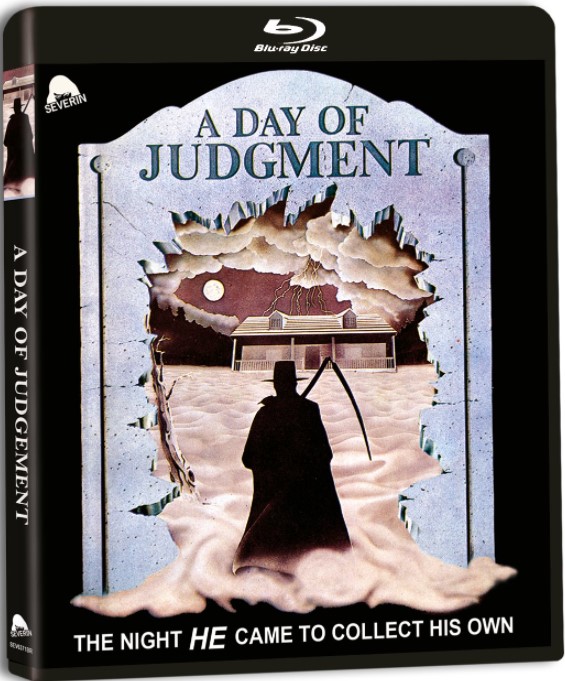
The overall message in “A Day of Judgment” is clear that sin and crime doesn’t pay, and the wrath of God’s retribution will come down hard in the form of a scythe.  Severin Films presents up a new Blu-ray, scanned in 2K of the original interpositive print now in full 1080p HD resolution of the widescreen 1.85:1 aspect ratio. Preserved pristine and having virtually no wear from age, “A Day of Judgment” is an amazing picture to behold for its first Blu-ray release with heightened resolution that extricates more details than possible than any other release can provide, especially when those other releases are the official VHS and DVD bootlegs. Here the color grading excellently pops with deeper hues of prime colors to provide more life into the death that’s onscreen. One thing to note about the release is the immense phosphorescence glow around whites and other lighter colors that can be eye-catchingly distracting when a piece of white paper becomes the main focus due to a conspicuous radiance. Other than that, the picture is clean, the grain is healthy, and no obvious signs of alterations to enhance the visual spectrum. The English language mono audio track, though emitting crystal clarity without any audio blemishes, is not terribly clear on whether Severin went with Dolby Digital or the DTS-HD. Other listings on the web offer up “A Day of Judgment” with a dual channel DTS-HD Master Audio while the back cover displays the Dolby Digital logo with a detached written description as a mono track, which coincides with Severin’s official site. With the film’s outmoded ingrained technology, Dolby Digital would be, to me, the obvious format that produces higher quality sound using a lower bitrate. Special features include a pair of new Severin exclusive interviews with British author Stephen Thrower of “Nightmare USA” in The Atheist’s Sins and snippet interviews from Worth Keeter and Thom McIntyre in Tales of Judgment. Final spec notes on the Blu-ray are a region free coding and has a runtime of 97 minutes. Stuck in stasis of prim and conservatism, “A Day of Judgment” has become this oddball labeled slasher of the 80s era that aimed to explore new and unusual stories and techniques on every avenue, but still leaves this impression of Bible-thumping Christian values that serve as a stern warning for all ye sinners!

“A Day of Judgment” on Blu-ray and DVD from Severin Films.  Click Here to Purchase at Amazon.com

I Think We’re Going To Need Bigger EVIL! “Deep Blood” reviewed! (Severin / Blu-ray)

As kids, four boys were warned with an anecdotal tale of an ancient Native American spirit that took the shape of a killer shark malevolently stalking and killing the native villagers for their overfishing ways.  Now adults, the four friends pursue very different lives as all four return home for the summer with interests in rebuilding family relations, girls, colleges, and avoiding the local punk, Jason, hellbent on making their lives miserable, but when a shark turns up and kills one of them during a solo dive, they recall the ancient tale and sound off to the authorities who take little heed to the incident.  Their small beach community thinks they’ve killed the man-eating shark causing the ruckus, but when more chewed up bodies color the ocean red, the friends must take the task upon themselves to see the shark never devours anyone else again. 

Italian shark-on-a-loose romper helmed by the legendary serial Italia horror and erotica trash filmmaker, Joe D’Amato (“Emanuelle in America,” “Anthropophagus: The Grim Reaper”), cashes in on the monster, man-eating shark celluloid frenzy with an uncredited directorial of the 1990 sharksploitation, “Deep Blood.”  Originally to be Raffaele (Raf) Donato’s directorial debut, the George Nelson Ott script was salvaged by the then producer and cinematographer D’Amato after Donato’s change of heart and professions in the film industry.  “Deep Blood,” that went under working titles “Wakan,” the designation for the Native American evil spirit, and just simply “Sharks,” was shot mostly with an English cast in the sunshine state of Florida with various underwater scenes filmed in Italy.    D’Amato’s production company, Filmirage, supported the film in collaboration with Variety Film Production that has dipped it’s toes into another killer shark flick, Enzo G. Castellan’s “The Last Shark,” which some footage was utilized for D’Amato’s film nearly a decade later.

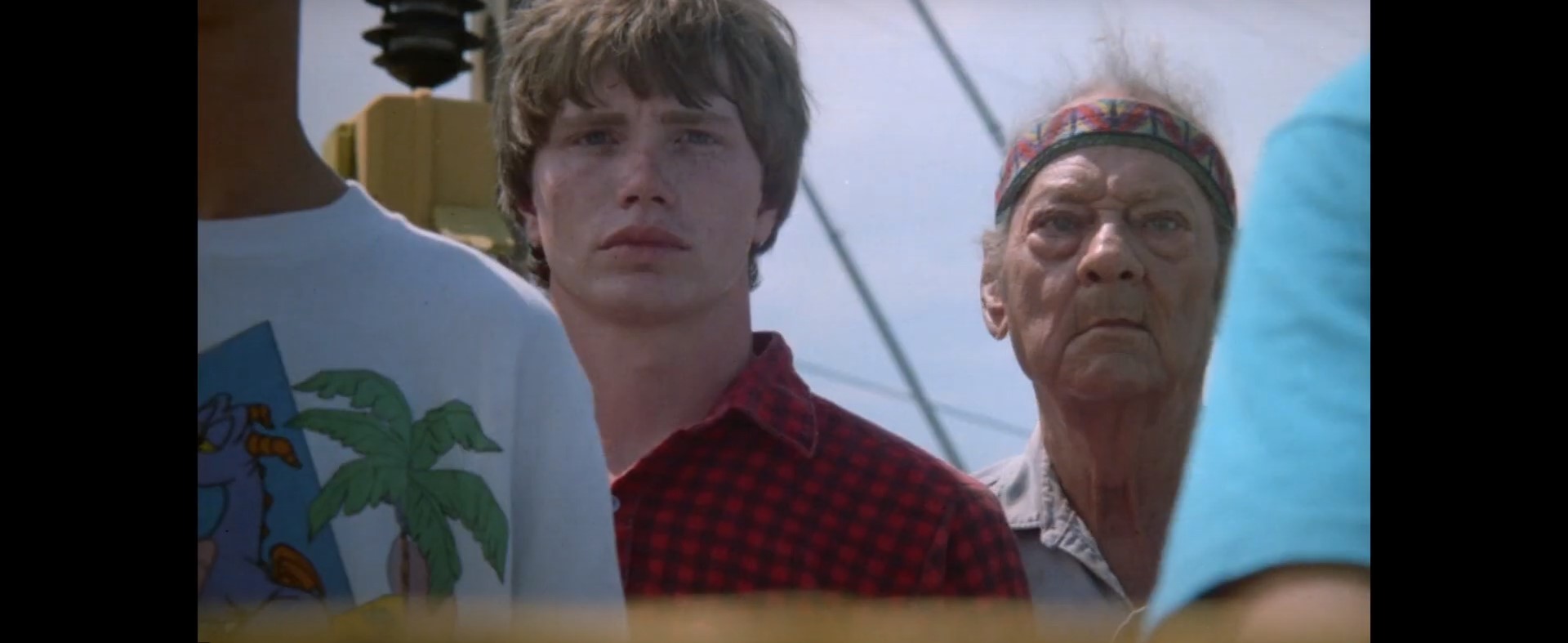
“Deep Blood” circles around the opening of four friends innocently having the time of their lives with a normal ocean side firepit, roasting wieners, being told horrifying campfire stories of the black finned Wakan by a mysterious Native American (Vans Jensens) who hands them a relic piece of oblong driftwood with noteworthy carvings about Wakan and slicing their wrists to make an impromptu blood pact to fight against Wakan whenever the time comes.  You know, the usual stuff you do with your friends.  As grown men, Miki (Frank Baroni), Allan (Cort McCown), Ben (Keith Kelsch), and John (John K. Brune) find themselves back home, reunited to only have their friendship ripped to shreds when John becomes Wakan’s tasty snack on a solo dive.  Ott’s script really, really, and I mean really, tries to add depth to the characters, such as Allan’s spoon-feeding Mayor of a father handing out life advantages to his son every possible moment or with Ben who struggles between fulfilling his parents’ wishes of going to college or starting his professional golf career.  There’s also some backstory about the death of Ben’s sibling at sea that has had some psychological torment on his father, Shelby (Charlie Brill, “Dead Men Don’t Die”).  D’Amato crumples up character development like a piece of scrap paper and shoots a fade away jumper into the waste basket.  My personal favorite in the shallow end moment is the local lout and head of a gang, Jason, who senselessly disparages the four friends, for whatever reason we don’t know, acutely 180’s from I’m-going-to-kill-you to becoming a good friend (out of respect?) and takes an active participation in hunting down the shark.  All the relationship dynamics seem to just culminate right into the big, explosive deep-dive and pursuit for shark blood in the guys’ booty shorts and cut off sleeve shirts.  Talking roles are aplenty but nothing worth the empathy or sympathetic emotional baggage surrounding the remaining cast of characters played by actors James Camp, Margareth Hanks, voice actress Mitzi McCall, and Tom Bernard as Sheriff Brody…I mean, Cody.   

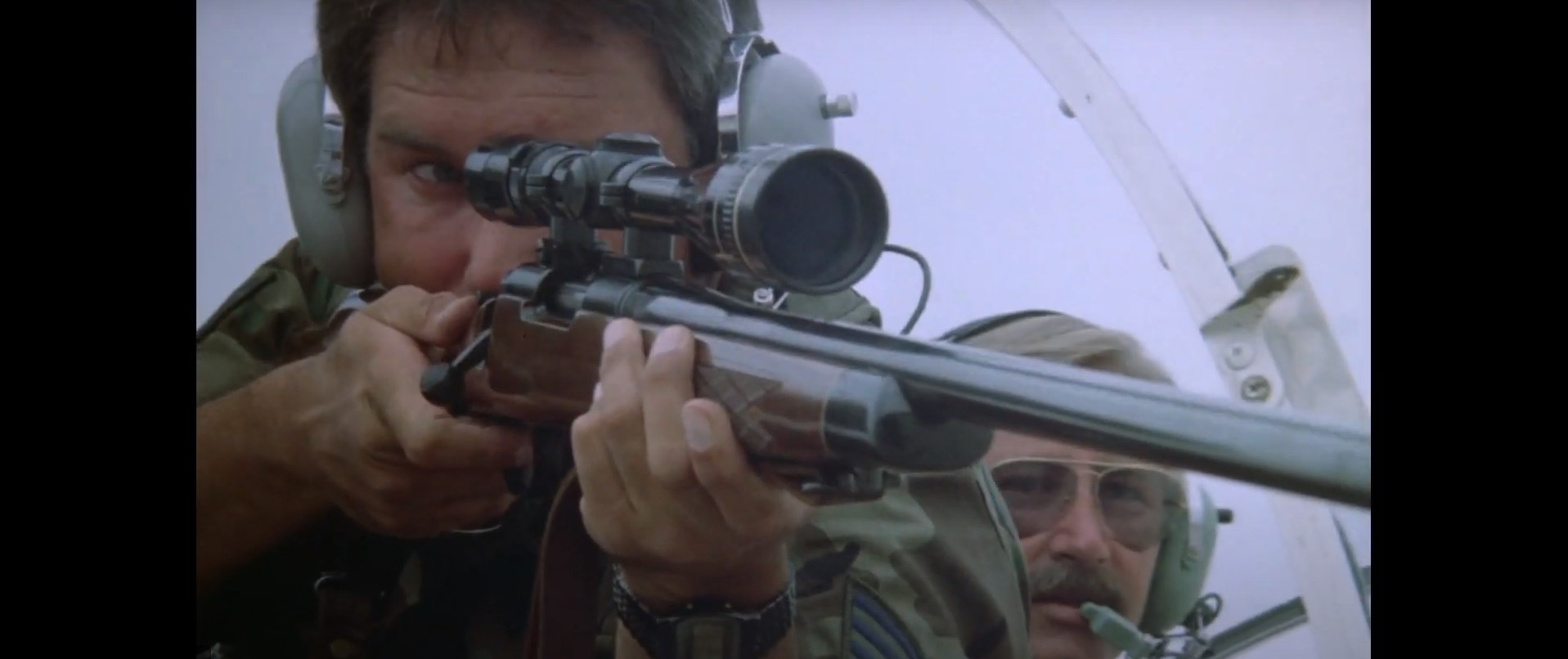
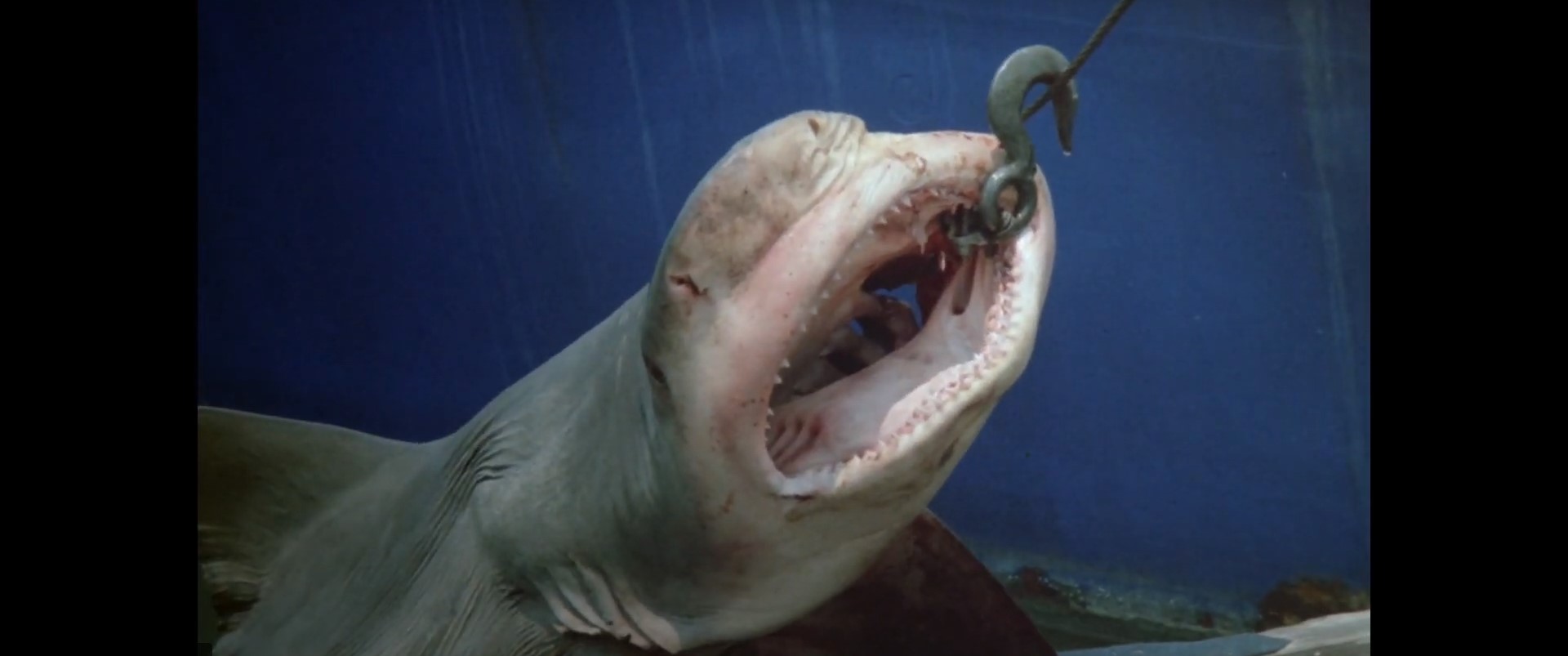
Only slightly echoing acts of Steven Spielberg’s flawless “Jaws,” “Deep Blood” also begs, borrows, and steals scenes to piecemeal together a semi-coherent story.  In the wild Great White shark snippets from National Geographic video clips and shark scenes plucked and reused straight from another Italian schlocker, there lies a nonexistent sliver of thought in creating an original piece of footage that puts the resemblance of a monstrous shark and an actor in the same scene together with D’Amato relying burdensomely on editor Kathleen Stratton to handle the fragmentary bits of different look and feel shots and turn it into single profit linear narrative gold. But honestly, what do you expect? D’Amato was to be the director of photography but ended up in his lap directorial duties, taking on the extra work like any good producer. Many of the shark attack scenes are spliced together with the actors bobbing and turning up and down in the water with the iconic bubble and splash sequences that solidly create the allusion and the illusion of a frenzied blood bath, but some locations are blatantly amiss shots, especially those of the actors snorkeling and scuba diving inside an obvious aquarium vivarium in clearly an exterior beach scene, that are more of a blow toward our intelligence than anything else. When the movie magic shark finally does make an appearance, a rigid, clean cut, my 9-year-old nephew could draw better shark effects sells little amazement, wonder, or pelagic terror of the open water. “Deep Blood” is a see-it-to-believe sharksploitation disaster-piece with the Joe D’Amato Midas touch.

Luckily, seeing every story blighted nook and cranny and experiencing all the dysfunctionalities between characters have never looked better with Severin Films’ worldwide inaugural Blu-ray release of “Deep Blood.” Newly scanned in 2k from the original 35 mm negative and presented in a pillarbox 1.33:1 aspect ratio with a high definition 1080p transfer, the image clarity is about the only thing flawless in the film with natural looking color grading for a richer hue presentation. Aside from the wonkiness of equipment quality differences with Nat Geo’s stock footage, there wasn’t much in the way of image imperfections aside from faint speckle damage and a slight scratch briefly visible in one of the later scenes. Details are phenomenally crisp in the face, as you see every sagging wrinkle on Van Jensens’ mug, and even the slight white capping of the waves renders clearly across. The English language 2.0 mono track features a clean, discernable dialogue albeit some slight hissing. Carlo Maria Cordio’s synthesized score doesn’t invoke fear of the water, but does contribute to the Italiano-charm of D’Amato’s underwater thriller with a seducing melody of lo-fi chords to accompany the shark attack scenes. Optionally, a parallel Italian track provides a dub that isn’t typically as elegant in syncing with American actors. Special features for the 91 minute film include a trailer and a listed multi-region playback; however, I could get the disc to play on the region B setting. If you’re a shark film aficionado like myself, no matter how undeniable cheesy (and I’m looking at you “Bad CGI Sharks”), then “Deep Blood’ is an enjoyable serrated chomp into a chum soaked sandwich good to the last morsel.

Own Deep Blood on Blu-ray from Severin Films!