To Do EVIL or To Do Good? “Men of War” reviewed! (MVD Visual / Blu-ray)

“Men of War” are Men now in High Def! See It Here!

Living like a pauper on the frozen street of a snow Chicago, ex-special forces soldier Nick Gunar has no desire to return to his former life, but when he’s referred a mercenary job to visit an island off the South China sea, he’s assured by the man that referred him, his fatherlike former colonial, that there will be no bloodshed in his all for show and intimidation situation that needs more finesse than firepower.  His mission is to assemble a team and negotiate with armed persuasion to get the unwilling, combative locals to sign over the rights to a mineral rich underground cave system.   Gunar’s expected confrontation turns out to be a small village of unarmed men, women, and children, peacefully refusing to sign over their land for excavational exploitation of their ancestral home.  While Gunar weighs his morality, a second team lead by Gunar’s more ruthless brother-in-arms, Keefer, sets to make sure the job is completed one way or another. 
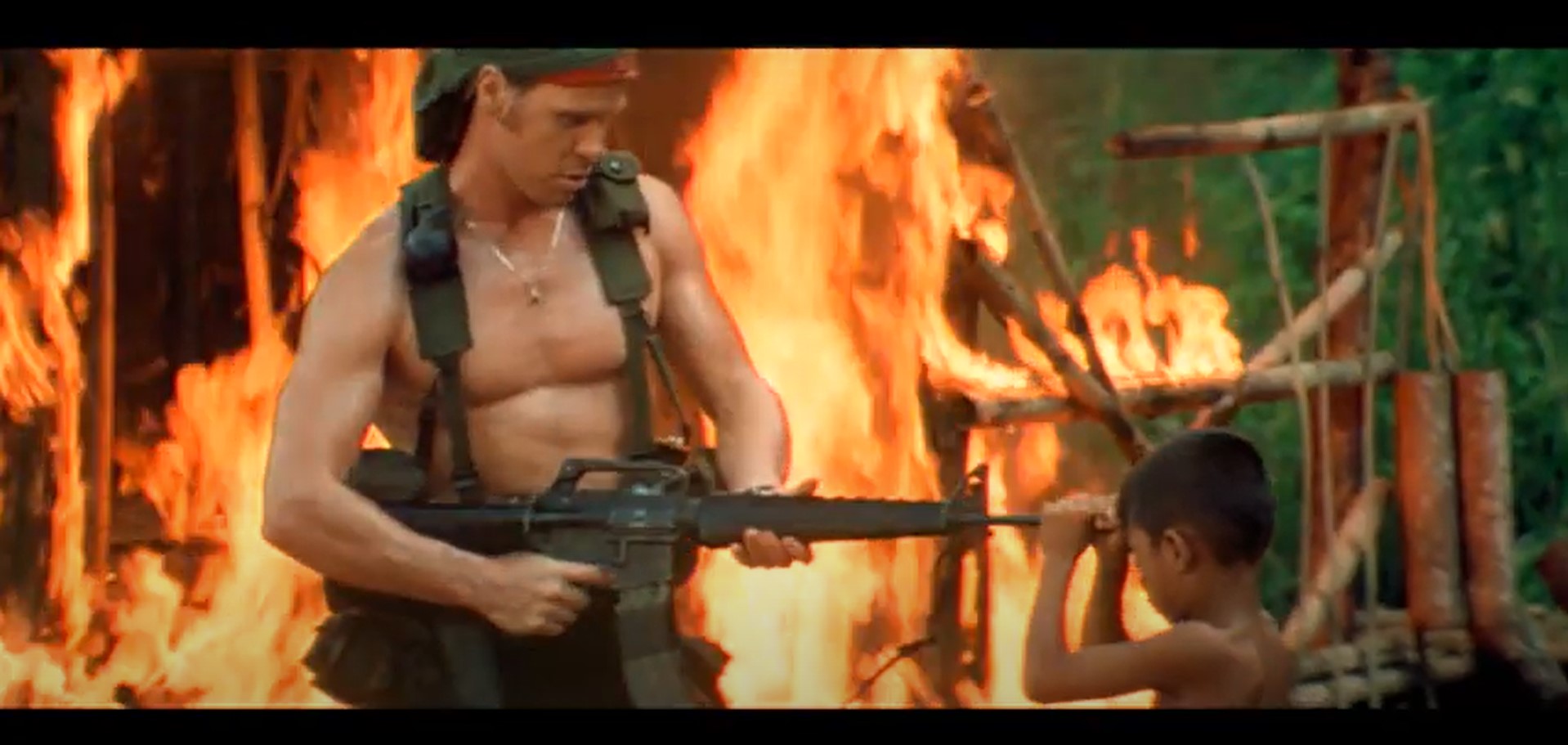
Set off the coast of Thailand, “Men of War” is the 1994 U.S. mercenary action film that induces the ethics and morality question of armed-to-the-teeth hired guns against a small village of mostly helpless residents going to sit with an honorable conscious.  Perry Lang, actor in such films as “Teen Lust,” “The Hearse,” and “Alligator” who then turned director in the early 90s, helmed his sophomore picture after directing Catherine O’Hara in “Little Vegas” four years prior.  “Men of War,” which had a working title of “A Safe Place,” is penned by a trifecta of writers in “The Howling’s” John Sayles, “Demon Knight’s” Ethan Reiff, and Reiff’s longtime screenwriting partner Cyrus Voris.  Seasoned writers and an upcoming director garnered studio funds by Moshe Diamant and Stan Rogow to take a chance on the abroad militant-action subgenre that was dwindling at the time of the mid-90s.  Mark Darmon Productions Worldwide, in association with Grandview Avenue Pictures, served as coproduction studios with Arthur Goldblatt, Andrew Pfeffer, and David C. Anderson producing.

The big name that attracted financial support and give the title a boost was Dolph Lundgren who, at that time, was one of the biggest action stars of the late 80s into the 90s with “Rocky IV,” “Masters of the Universe,” “The Punisher,” and “Universal Soldier” all under his 6’ 3” Swedish, muscular frame topped with blonde haired and gentle blue-eyes.  Lundgren tackles his next role as conflicted mercenary looking to get out of the game all together as former special forces soldier Nick Gunar.  Perhaps one of the more complex roles Lundgren has portrayed in his career, Gunar fights the uphill battle of a pressurized existence that always leads him back to what he does best, being a soldier of fortune.  Yet, the well-trained combatant’s heart has softened and changed to not be an elite killer anymore and his new mission, assigned to him by venture capitalist Lyle (Perry Lang) and Warren (Thomas Gibson, “Eyes Wide Shut”) and referred by Colonial Merrick (a true typecasted bad guy in Kevin Tighe of “K-9”), will put his trained tactics and newfound compassion to the test.  However, for obvious cinematic reasons, things will not go as smooth as Gunar obliviously hopes with nudges from a diversely skilled team of assembled gung-ho comrades, deceived by those he’s trusted, and antagonized vehemently by an unstable, former fellow special forces brother-in-arms Keefer, played by one of my favorite Aussie actors, the late Trevor Goddard (“Mortal Kombat,” “Deep Rising”).  Lundgren usually brings with his large and imposing self to the table with every role he slips into, but Gunar feels different partly because of two very different reasons:  Gunar lacks defining confidence and maintains the fierce façade to keep the assignment afloat under the aforesaid pressures, but Lundgren doesn’t look physically all there as he appears hunched over for a better part of downtime scenes.  “Jurassic Park’s” B.D. Wong plays the village wisecracking’ spokesperson Po who welcome Gunar and his team’s arrival with respect and with a little humor.  Wong’s cavalier style for Po works to cut tension and to showcase the natives as peaceful and unassuming but steadfast in their beliefs.  “Embrace of the Vampire’s” Charlotte Lewis, as Loki the the native island single mother and love interest to Lundgren, is the second credit name of the film yet has perhaps the shortest screen time of all the characters that fill out “Men of War” with Tony Denison (“Wild Things 2”), Tommy “Tiny” Lister Jr. (“The Fifth Element”), Thomas Wright (“Tales from the Hood”), Tim Guinee (“Vampires”), Don Harvey (“The Relic”), and Catherine Bell.
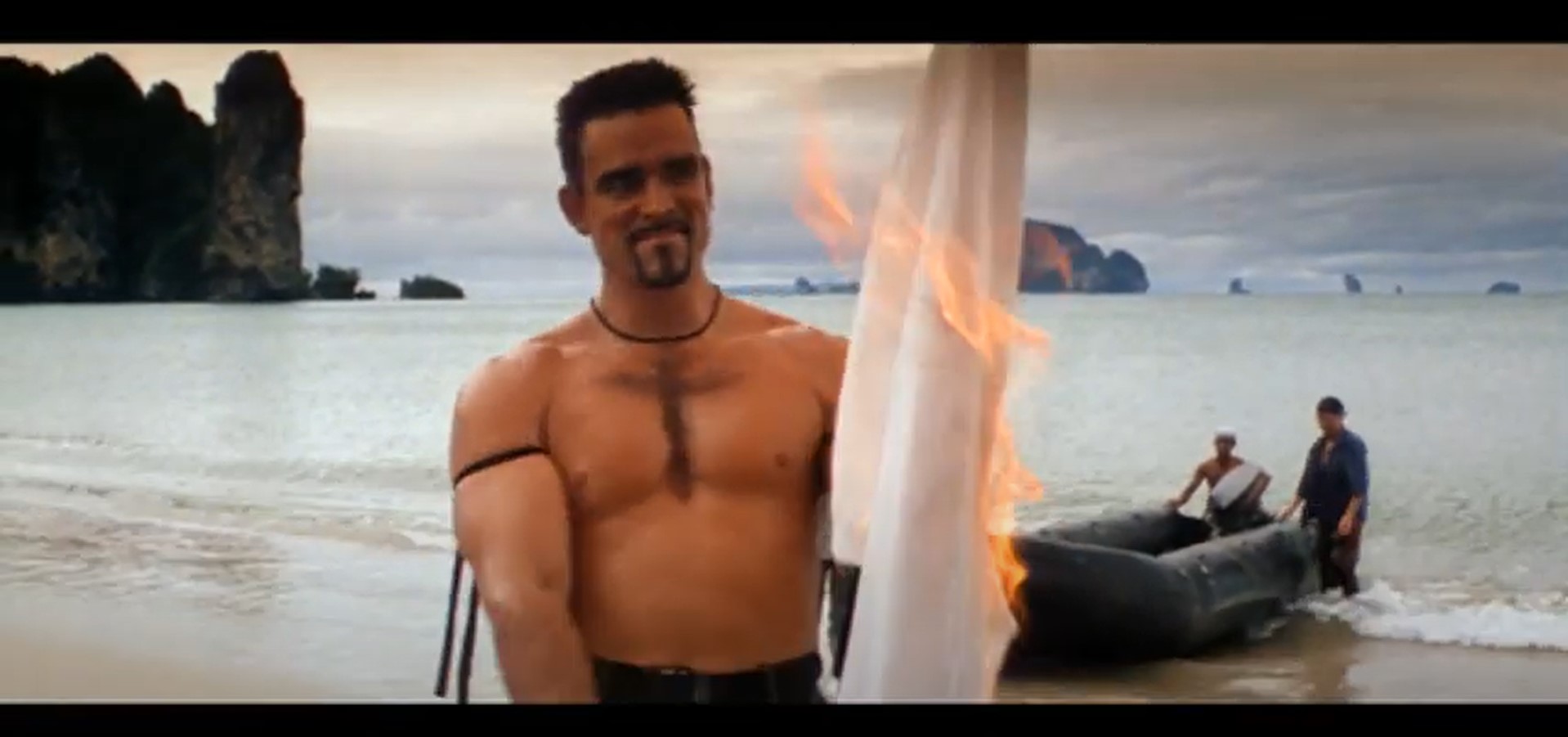
Cast ensemble of familiar faces makes “Men of War” easier to digest when considering the threadbare sensical plot.  If taking the trouble to hire mercenaries to negotiate the signature surrender of property, the company investors might as well have used extreme force instead of finesse as the good Colonial Merrick suggests to Gunar.  “Men of War’s” setup is not very sexy to establish a radical rational to plot against the native denizens, fast-forwarding and skirting through the first act’s purposed goal and recruitment of characters is sullied by that dilution of plot device.  The recruiting montage is what hurts the most that shows Gunar travelling across the globe to handpick past acquaintances for his team, but the history markers are not in place to establish characters behaviors, past or present undercurrents, or anything that really ties them together or tears them apart which eventually happens when a line in the sand is drawn.  Even Keefer’s neglected volatile bad juvenile behavior is crucified by zero backstory substance.  “Men of War” bravely relies on the future to flourish and does so quite well by creating a dichotomy between a paid duty and a moral deed, especially when falling in love with a native girl is involved.  Explosions, bullets, and various kinds of melee skirmishes rock the story’s intended searching for inner peace theme and there’s no shortage or pulled punches with the pyrotechnics or squib-popping gunplay.  Perry Lang and producers make no qualms about the product their peddling by offering a detonating spectacle on a wafer-thin plot to razzle-dazzle on the silver screen and that’s okay. 
Coming in as title number 62 on the MVD Rewind Collection, a boutique banner for MVD Visual, is “Men on War” on a new Blu-ray release that’s an AVC encoded BD50, presented in a widescreen 2.35:1 aspect ratio and high-definition 1080p. This one looks pretty darn good for a 2K scan of a well-kept 35mm film. Picture retention shows just how clean as a whistle it is with no sign of a damaged original print. There also appears to be no issues with compression, such as banding or macroblocking, to gunk of visuals in what is a clean sweep of texturized objects from skin to fabric, even the island jungle setting has a rich green and a variety of sedimentary rock and soil to a real organic coloring that creates the tropical paradise around as seen on vacation brochures. When cinematographer Rohn Schmidt (“The Mist”) does go for more aesthetic, “Men of War” turns into panoramic escapism brilliant with warm colors and a composition too impressive for the likes of a picture teetering between being a B- and A-lister. The English language dialogue comes with two lossless audio options: A DTS-HD 5.1 surround sound and a LPCM 2.0. An explosive film requires free range fidelity and “Men of War” and its sound design package prowls the ambit of discharging and cannonading that hit fast and hard. Dialogue runs through-and-through clean and clear without interrupt or folly against it, as well as being layered properly to have heavy volley suppress the dialogue to a muffled scream. The score of Gerald Gouriet (“Grand Tour: Disaster in Time”) has a pretense of a militaristic stanza that wonders into an idealistic romance choon which downgrades to a pedestrian level at times but there’s also a hint, or even possibly sampling, of Alan Silvestri lurking in the mix from the score of “Predator” when Lundgren stealthily storm the beach with his team. A Spanish 2.0 stereo is available and English and Spanish subtitles are available for toggle. For the MVD release, Perry Lang provides a new, from his living room introduction. The remainder of the special features are archival pieces, such as An Unsafe Place: Making Men of War, a brief doc with Dolph Lungren enthusiast Jérémie Damoiseau going over the genesis of the film, raw footage and dailies from the feature, a photo gallery, and the theatrical trailer. If looking for tangible collectibles, you’re in luck because, like most of the MVD Rewind Collection catalogue, “Men of War” comes with a cardboard O-slipcover with printed faux VHS rental stickers and a mini folded poster of the slipcover image tucked inside. The clear Amaray Blu-ray mirrors of slipcover and has a reversible composition. Region free with a 103-minute runtime, the MVD release is not rated.

Last Rites: An ensemble of colorful characters spearheaded by the towering Dolph Lundgren and shot in the serenity beaches of Thailand lends “Men of War” to be a luxury good of the cinematic armament rhubarb and the presentational transfer by MVD, on their Rewind Collection, breathes fresh and favorable for a solid screening of campy chaos.

“Men of War” are Men now in High Def! See It Here!

Poor Quality Dynamic Effects That Have a Horrendously EVIL Bite! “Bad CGI Gator” reviewed! (Full Moon Features / Blu-ray)

“Bad CGI Gator” is an Amazon Choice item! Order it Here!

Six college students end the schoolyear with a long weekend at a lakeside cabin in rural Georgia.  Looking forward to the youthful debauchery of drinking themselves into a stupor and engaging in lots of sexual hanky-panky, they each throw their school issued laptops into an alligator’s lake habitat for an Instagram moment to go viral and also in a moment of jovial release to be finally done with school and kick off Summer.  When the small gator encounters the laptop’s electrical current, the gator grows into a monstrosity and has the unique ability to float through the air.  Now larger than man, the gator is ravenous for his next meal and the college students are an easy, convenient dish.  Trapped inside the cabin, brawn stupidity won’t save them against the mutated reptilian that circles outside, and they have to use every ounce of their brainpower to outsmart the insatiable beast. 

You’ve (probably) heard of “Bad CGI Sharks!”  Now, get ready to sink your horribly rendered jaws into “Bad CGI Gator,” the latest alligator creature feature comedy-horror from Charles Band’s camp of Full Moon Features.  Helmed by resident Full Moon filmmaker, “Deathbed” and “Dark Walker” director Danny Draven, the 2023 film removes practicality and plausibility for the sake of following in the wake of the badly rendered shark film from brothers Jason and Matthew Ellsworth.  “Bad CGI Gator” is also a family affair with Charles Band’s son, Zalman Band, in his first full-length feature writing credit that, like “Bad CGI Sharks, gives into itself and doesn’t take itself seriously with genre tropes, the gore and nudity one-two punch, and, of course, bad computer-generated imagery.  Shot in the location state of Georgia as well as in Charlie Band’s Full Moon estate in Cleveland Heights, Ohio, “Bad CGI Gator” is produced by the father-son duo of Charlie and Zalman with Nakai Nelson (“Evil Bong 420,” “Don’t Let Her In”) picking up the rest of the producing slack. 

If there was ever a time to root for a visually vexing constructed alligator and not the young people trying to save their lives from its floating ferocity, the time would be now.  The cast is compromised of the very worst caricatures of millennial youth with their “bros,” Instagram virality, and overall toxic behavior.  As a whole it’s all purposefully scripted to be painted like pure putrid of personas that sodomize the very essence of heroic protagonists.  Ben VanderMey (“Malicious”) and Cooper Drippe are impeccable at being gym bro chads, even VanderMey’s character is named Chad, and their on screen slay honeys, in Rebecca Stoughton and Sarah Buchanan, are social media influencing prejudgers with thigh-high skirts and low cut blouses.  The obnoxiously coarse foursome becomes grounded by contrasted counterparts in Sam and Hope, played by Michael Bonini (“#ChadGetstheAxe”) and Maddie Lane (“Monster Mash”), and this clues in audiences of the two more level-headed potential gator bait as the likely, predictable heroes who will either survive with their life or end up destroying the floating gator.  While the Chads and Paisleys are an exaggeration of arrogantly crass people, led with the worst of qualities for easy kill digestion, Sam and Hope are also to the extreme in a polar opposite manner.  Sam’s cautious philosophy makes him the butt of many jokes while the neutral Hope, a rival hottie shoulder-to-shoulder with the other ladies, can whip Chad into place with almost a stare being his stepsister.  The common dislike for tasteless jerks force Sam and Hope together with the gator being a keynote in closing the door on the once ajar flirtations.  Lee Feely rounds out the cast as a fisherman badmouthing the gator’s size, but the opening scene doesn’t do much for the rest of story nor does it come back to bite, literally, with the lack of Feely’s return in his short-lived moment. 

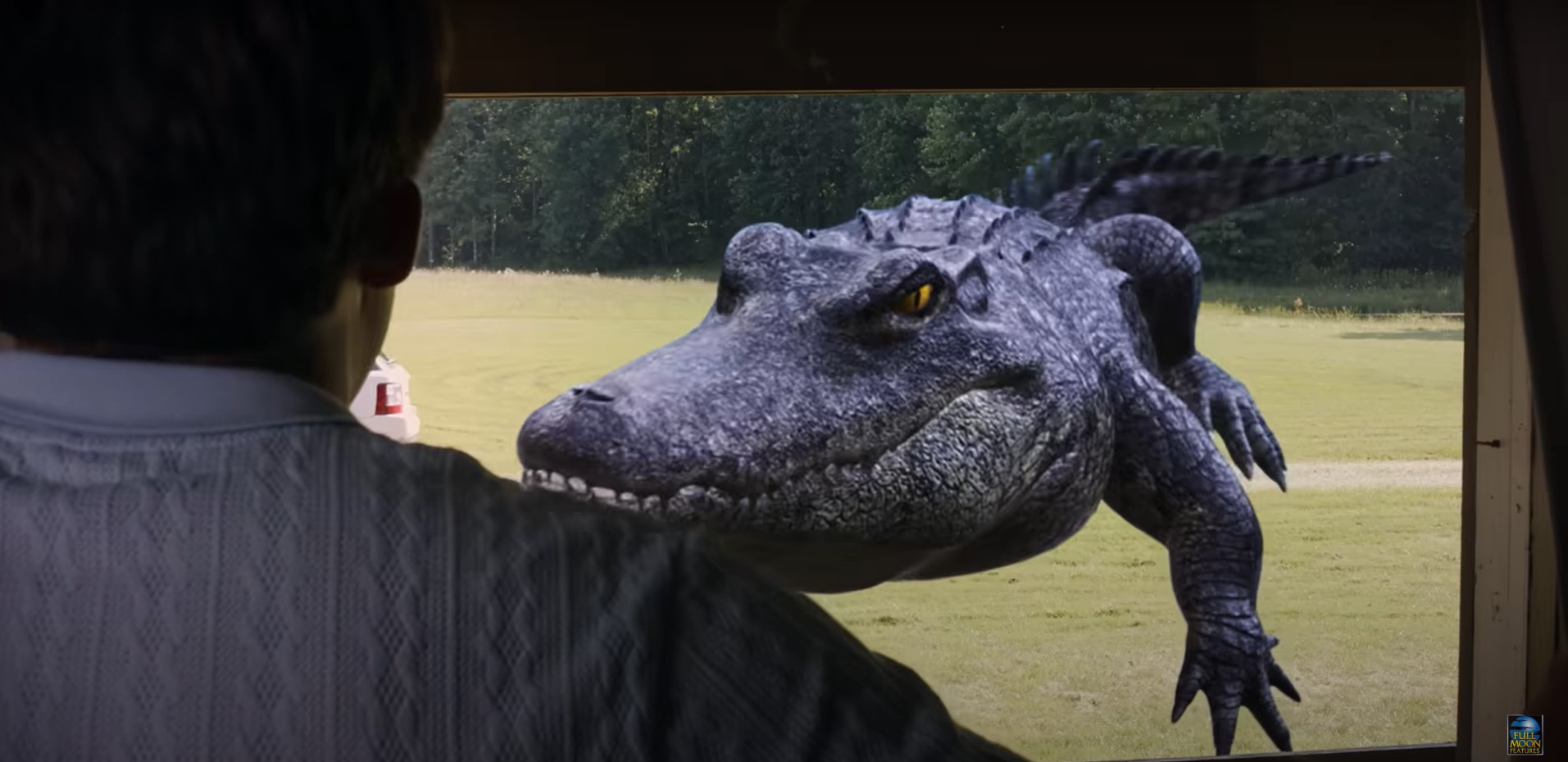
A title like “Bad CGI Gator” doesn’t come with any strings attached; there is no subtext, no character development, or convoluted storyline to really tickle and tease the brain in a sophistication of foreplay.  What you get are dumb, unlikeable characters for a deathroll of laughs and gnarly kills.  What you also get is a badly rendered giant floating alligator that on a one to ten on the badly rendered scale, this poor design is a four, resulting in a not too terribly layered and not the worst we’ve seen to date but obviously stands outs as a cut and pasted fake with animated movements.  Also entailed, in complete Full Moon fashion, is the alligator’s transmogrified size and supplied new abilities that allows it to chomp heads clean off, savagely gnaw on half-naked beauties, and swallow hole it’s biggest, most arrogant opponent.  What castrates the story is the limited locations with much of the cat and mouse play at the house and around the only vehicle for escape.  The adjacent lake is virtually untapped for watery carnage, an area of helplessness for prey, aka people, to float in suspension while something more dangerous lurks below the surface or meets them at eye level.  “Bad CGI Gator” is swampy camp at its best and, at the same time, at its worst but never pretends to be anything more.

Not only an ode to the monster movies of yore and a lampoon hit to the gross, schlocky creature features of more modern times, “Bad CGI Gator” emerges onto an AVC encoded, high-definition Blu-ray from Full Moon Features. The 1080p resolution on the single-layered BD25 of Full Moon’s feature number 395 has no digital discord regarding sharpness around the details. Gator POVs remark good pixel counts under and above water, delineating around the aquatic ecosystem including the plants and lake’s mucky floor. Night sequences bathed in a softer, illuminatingly spreading blue see equal amount of definition where the, what is considered to be, moon light hits and transition into the exterior cabin juxtapositions nicely with a warmer, shadowy outlined tone. The release’s audio mixes include a LPCM 5.1 surround sound and a LPCM Stereo 2.0. Early on, dialogue has a conical sound with reverberations that seemingly bounce back almost immediately. Though not totally free of audio fallibility, the dialogue does come across prominent and clean of distortion. Conical echoing dissipates later in the runtime and is replaced with the impenetrable sounds of a growling gator and its stomping around the cabin property that doesn’t seem to occupy the same space, much like the gator, ridiculing this particular creature feature sub-subgenre even more. English subtitles are optionally available. Special features include an audio commentary from director Danny Draven and screenwriter Zalman Band, a Screams from the Basement Podcast interview with the director, A second director interview on the Dead Talk Live Podcast, an isolated Jojo Draven musical score that sounds just as carnivalesque, humorous horror blend as Richard Band would compose, a blooper reel, a cast table read at the Full Moon mansion in Ohio, and the original trailer. The standard Blu-ray comes a fairly telling illustration of a savage-looking gator mouth agape just below a bitten-ripped Spring Break banner. There are no insert or other tangible bonus content alongside a humorously standing upright gator, slight smirking with the catalogue film number. “Bad CGI Gator” Blu-ray comes region free, has a runtime just under an hour at 58 minutes, and is not rated.

Last Rites: Full Moon’s satirical take on lousy alligator anarchy is spot on and though the cast of characters deserve every rendered tooth ripped into their flesh, the glossy gator pales in comparison to practical effects of its predecessors, and the story stinks as much as gator bait, “Bad CGI Gator” doesn’t false advertise this uncanny predator’s X-factors and that’s brownie points in my book.

“Bad CGI Gator” is an Amazon Choice item! Order it Here!

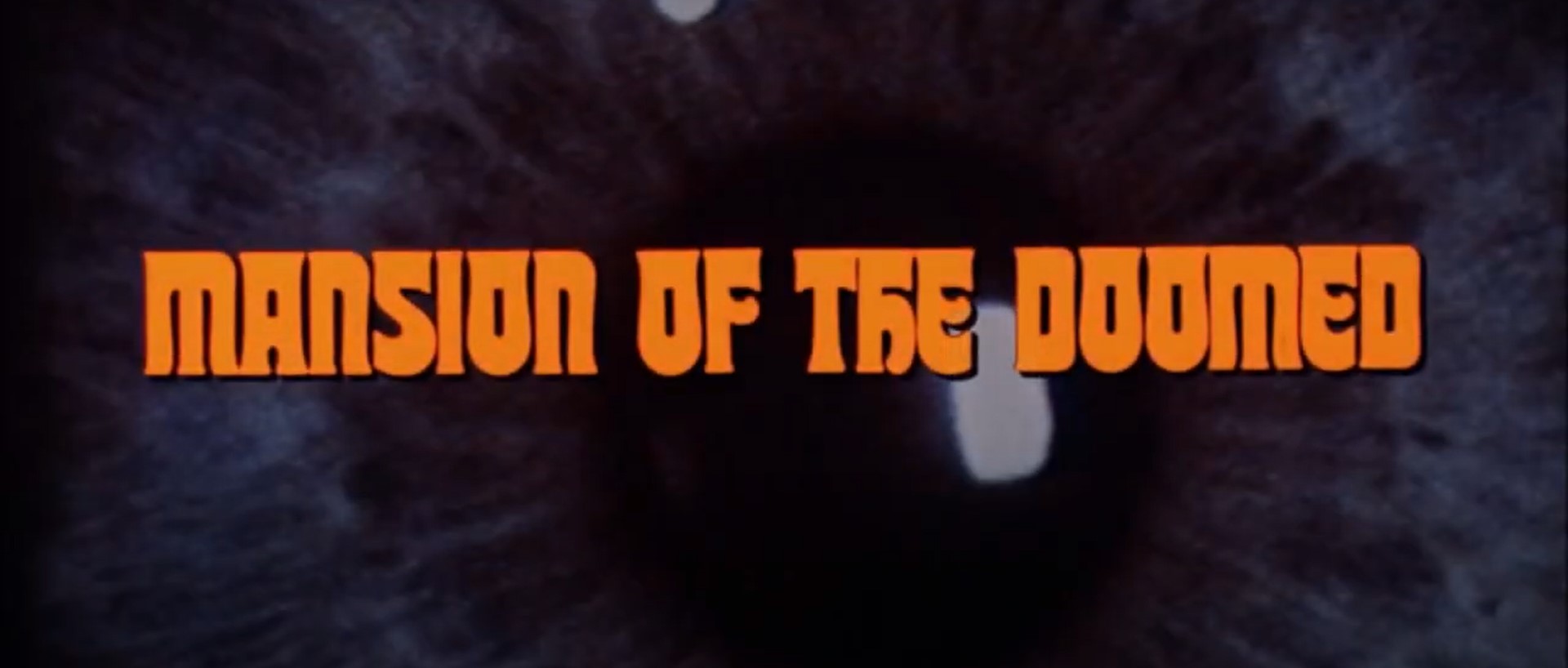
EVIL is in the Eye of the Beholder! “Mansion of the Doomed” reviewed! (Full Moon / Blu-ray)

“Mansion of the Doomed” on Blu-ray.  Hold Onto Your Eyeballs!

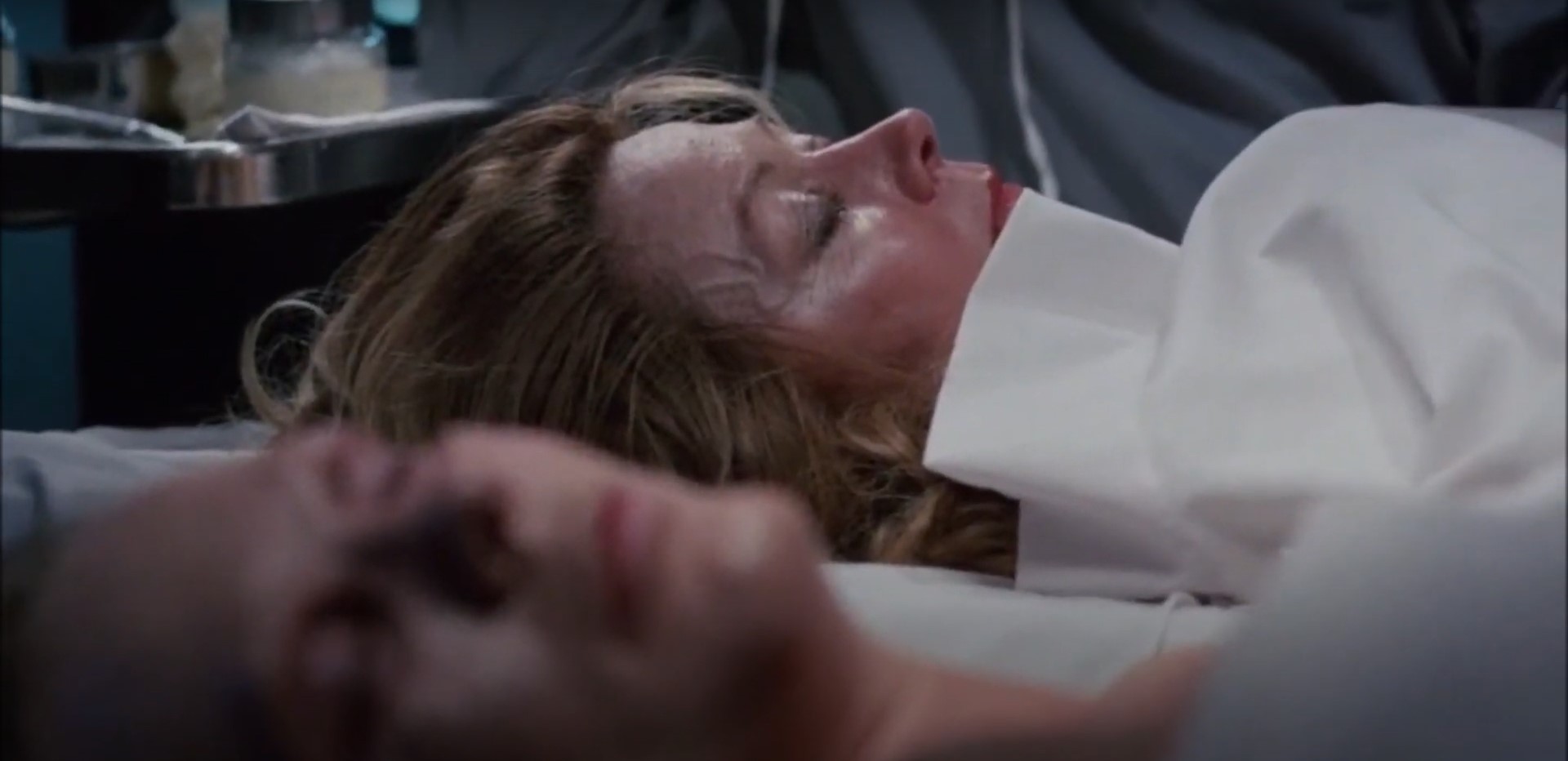
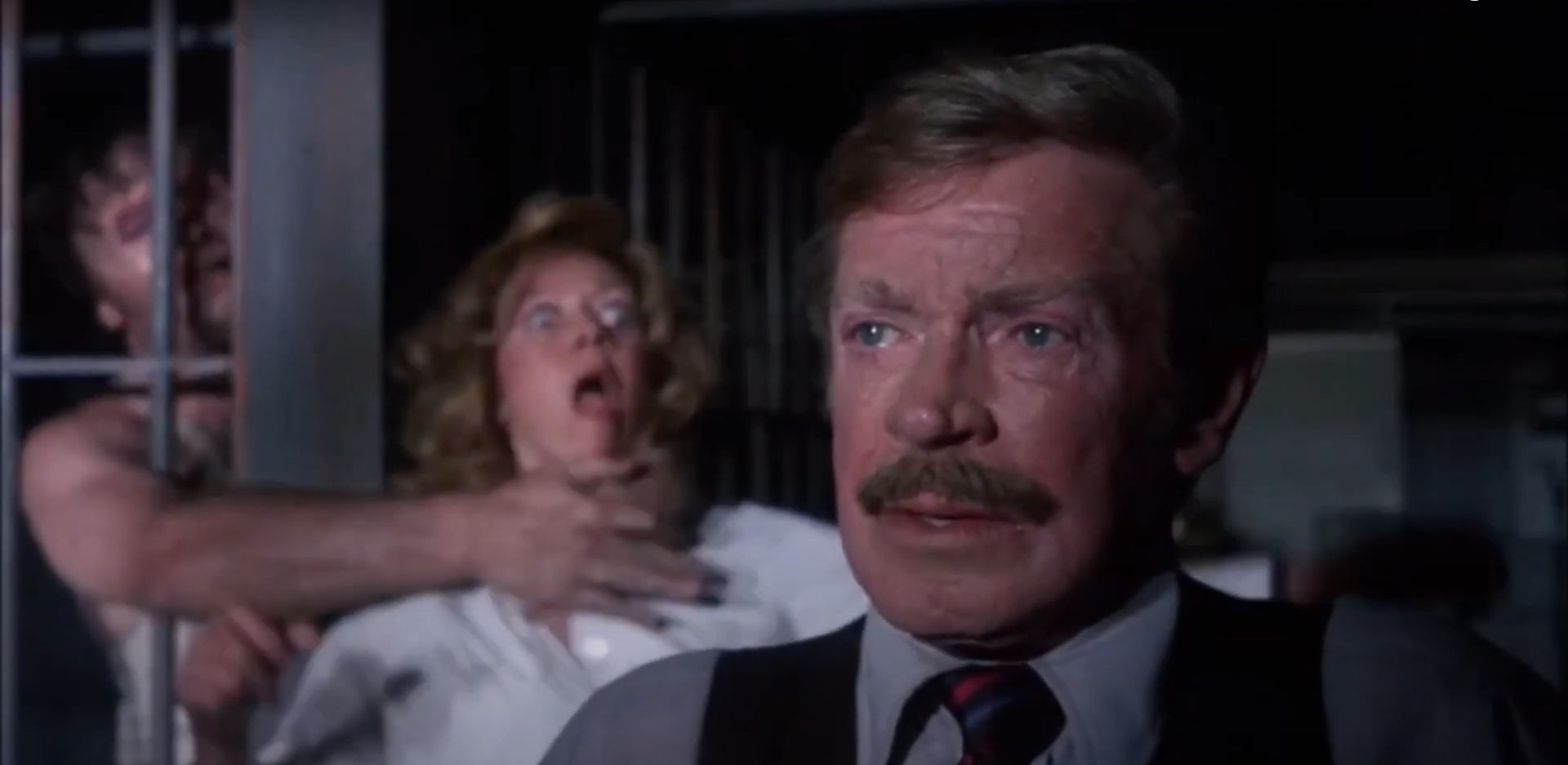
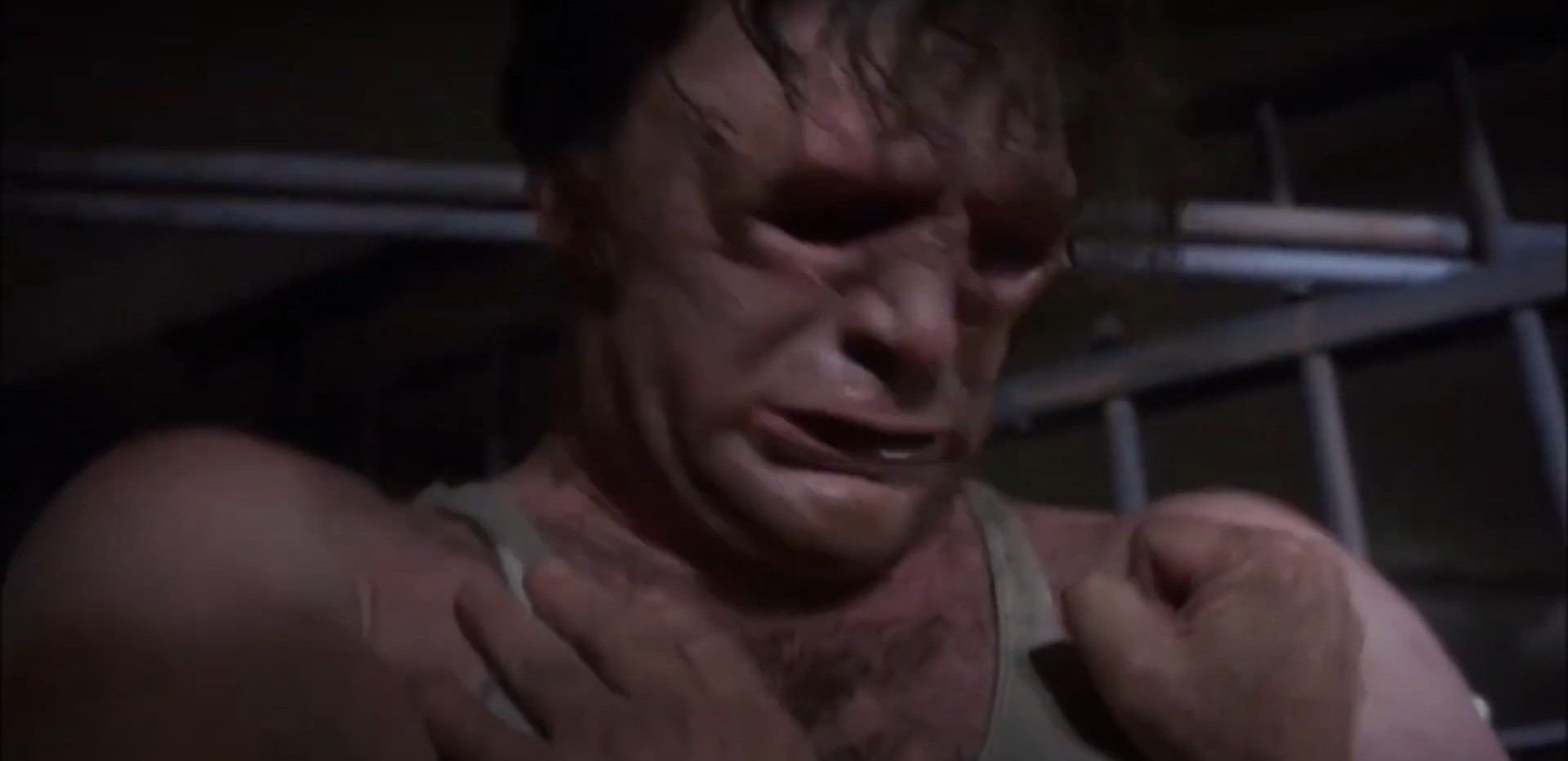
In a stroke of irony, renowned optometrist surgeon Dr. Leonard Chaney had a car accident that accidently causes his young adult daughter permanent blindness.  Obsessed by guilt and determined for her to see again, Chaney moves toward a not only radical procedure but also unethical one of a full eye transplant.  The catch for this type of surgery to be successful is the eye has to be extracted from a living patient.  Unwilling to wait for a donor, Chaney employs every deceptive tactic to lure unwillingly healthy and beautiful globular organ donors into his dark basement where he drugs them unconscious, surgically plucks out their entire eyes, and leaves them locked in a cellar cage, blind and crudely healed with scar tissue but still alive.  With each failed attempt at restoring her eyesight, the reminders of his experiments linger down below, screaming in pain, and pleading for their lives.  Soon, those pleas will ultimately catch up to him. 

Before his fascination with mini-sized maniacs of killer animated toys and malicious experimental oddities, Charles Band used to produce other types of original horror and the “Mansion of the Doomed” was one of them.  The 1976 Frank Ray Perilli (“Dracula’s Dog,” “Alligator”) written and the “Dead & Buried” and “Halloween 4: The Return of Michael Myers” actor Michael Pataki directed mad surgeon “Mansion of the Doomed” was the first feature film Charles Band officially stamped his actual name onto along with father and western screenwriter, Albert Band, as financial executive producer.  While “Mansion of the Doom” is known by various other titles around the world – “Massacre Mansion,” “Eyes,” “Eyes of Dr. Chaney,” “House of Blood,” “Eyes of the Living Dead,” and “The Terror of Dr. Chaney” – the one aspect that the film is firm in is its Hancock Park and estate shooting location in Los Angeles as one of the very first features to come out of Charles Band Productions company.

Lance Henriksen.  You know name, right?  Sounds familiar, yes?  The “Aliens” and “Pumpkinhead” actor, hot off the success of “Dog Day Afternoon” with Al Pacino, begins his tour de force of horror and dark science fiction with the Pataki mad doctor eye opener.  Dr. Chaney uses his misguided experimental expertise first on Dr. Dan Bryan, played by Henriksen, after Dr. Bryan’s recent romantic relationship breakoff with the recently blind daughter of Dr. Chaney, Nancy (Trish Stewart).  Before he became the narrating voice in TV’s “Knight Rider,” the veteran actor Richard Basehart, who also had a role in the 1977 “The Island of Dr. Moreau,” became his own inhumane medical malpractice physician in Dr. Chaney.  Though Basehart makes for the epitome of a professional doctor, his performance was the weakest link in the cast’s locks that didn’t exhibit the stress and desperation of a man continuously exploiting and disfiguring people for his own personal guilt release.  The guilt was not compounding as much as the story wanted to suggest, but we feel more empathetic to Dr. Chaney’s longtime assistant in Gloria Grahame (“Blood and Lace,” “Mama’s Dirty Girls”) who we can see her character dissolve with each abducted patient and affected to the core by their sightless screams.  “Mansion of the Doomed” rounds out the cast with Al Ferrera (“Dracula’s Dog”), Marilyn Joi (“Black Samurai”), Donna Andersen, JoJo D’Amore (“Dracula’s Dog”), and Katherine Stewart.

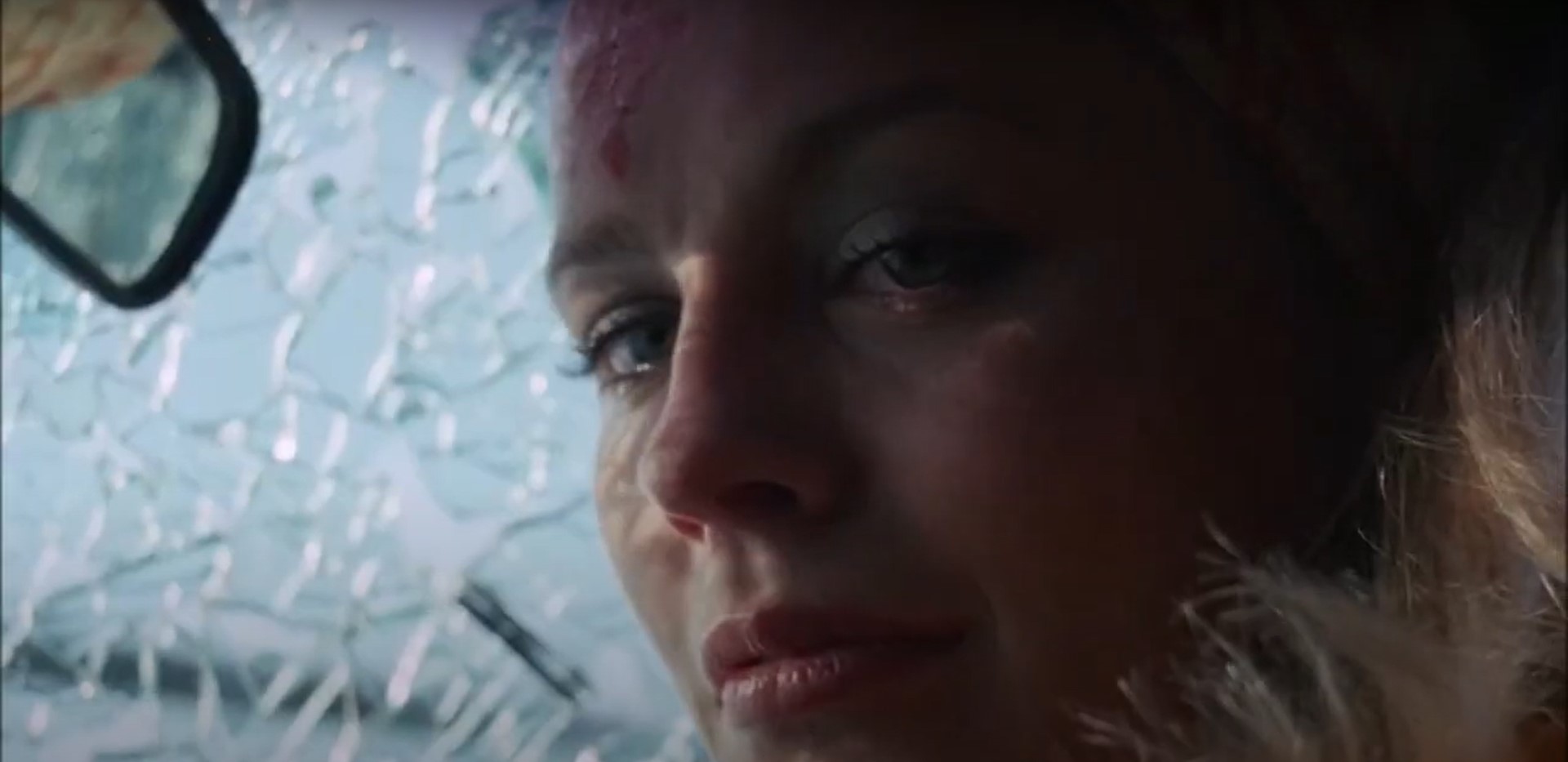
Michael Pataki’s “Mansion of the Doomed” is an eye-peeling shocker that’s dark and grim to the core and has an eye for cynicism. I could keep the eye puns going but that would be too easy to pluck out. Perilli’s story is rather plainly spoken with not a lot of fluff diving into medical or procedural jargon to bore you down into a loss of interest. Instead, the good doctor character goes right to work getting his hands elbows deep into the eye sockets of his victims and that’s how this particular exploitation perfectly crafted the balance by tabling the under stimulating medicalese with caged disfigured patients left to live in agony. Where Pataki and Perilli faltered some is in the preface by skimming the surface of the Dr. Chaney caused accident that rendered Nancy blind when she face-planted right into the doctor’s windshield as he swerves to not runover a mutt. In driver’s ed, you’re supposed to hit the small animal that runs in front of you in order for these kinds of accidents don’t happen! Told in the inner thought of a flashback, the force between the two immovable objects shatters the glass but leaves Nancy unscathed physically yet, somehow, she loses her sight in both of her eyes and while Dr. Chaney is unable to best the blindness with everything the surgical optometrist throws at it, perhaps that’s the unsolvable mystery that beleaguers abashedly an expert at the summit of their excellence. ‘Mansion of the Doomed” is not a feel-good film as not one single character has a positive outcome and having lost more than just their sight but also, to name a couple, their humanity and their hope.

Uncut, restored, and remastered onto a new Blu-ray release, Full Moon Features re-release “Mansion of the Doomed” onto 1080p, full high definition, from the original 35mm negative. Source material held up over father time with a pristine 85-minute uncut transfer to retouch in a pop of color and refine the details in a softer, more airy-soft image, presented in a widescreen 1.85:1 aspect ratio. Full Moon offers two audio options available with an English Dolby Digital 5.1 surround sound and a Dolby Digital 2.0 PCM. Though slightly staticky in the ambient and dialogue tracks, the balance works and is full-bodied around more essential scenes of surgery and the cries of anguish. Dialogue doesn’t sound overly boxy or hissy and the cult composer Robert O. Ragland’s (“Deep Space,” “Q”) classic orchestra score come across with a powerful range that speaks the scene without exposition. The region free Blu-ray has no extra features, leaving this release as a bare bone, feature only. “Mansion of the Doomed’s” harrowing ending induces stupefying blank stare and feels like a brick just walloped you in the face knowing that every pawn in this story loses at the hands of man disillusioned in playing God.

“Mansion of the Doomed” on Blu-ray.  Hold Onto Your Eyeballs!

A Saltwater Croc is Pure EVIL in “Black Water” reviewed! (Umbrella Entertainment / Blu-ray)


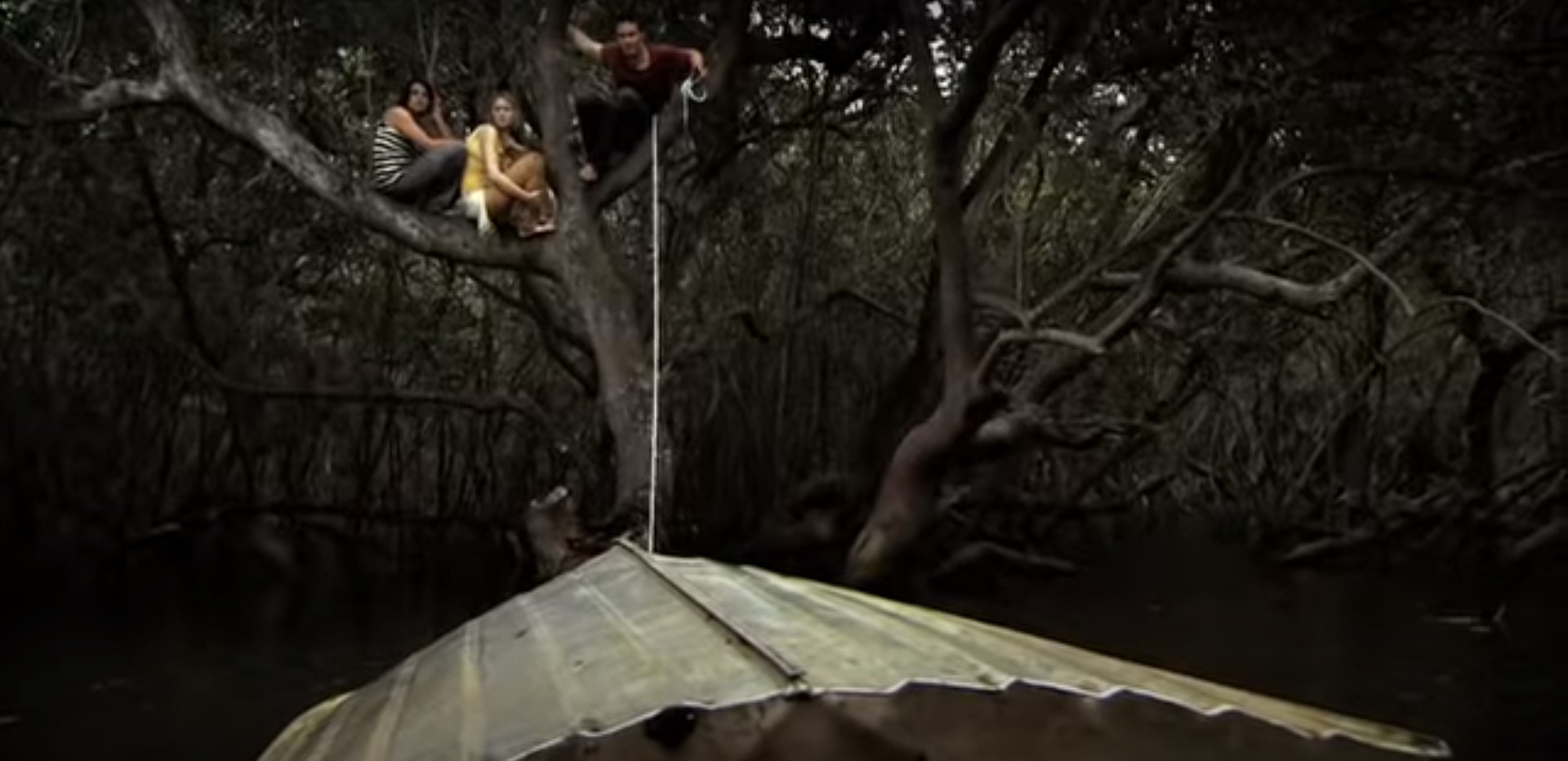
On a two week holiday, Grace, her husband Adam, and her younger sister Lee, embark on a road trip through Northern Australia, stopping at the local bars and roadside attractions all along the way.  Their next ad hoc destination is to fish at the rurally located and rinkadink river tour and fishing guide, Backwater Barry’s.  With Barry himself already out with another tour group, his assistant happily agrees to take them fishing out on a small, metal Jon boat along the mangrove tree dense distributaries.  When their boat is flipped by a large, aggressive crocodile and their guide dead, the water-protruding trees become a lifeline for temporary safety, but being fully encircled by murky water leaves them with no escape route and hidden from the river mainstem where help would like cross.  With a hungry croc lurking below, the only means of survivor is to reach the flipped Jon boat that’s stuck stranded in the middle of water. 

Aside from my personal favorite subgenre, Sharksploitation, the next best would the reptiliansploitation!  If there is even such a scaly subgenre about cold-blooded killers, especially involving the waterproofed skin of alligators and crocodiles lurking and wriggling in murky waters.  I’m a child of the 80’s and grew up on such classics as “Eaten Alive” (technically the late 70’s), “Alligator” and “Alligator 2, and the Australian ozploitation thriller, “Dark Age.”  Even the more modern reptilian ravagers, “Lake Placid” series and Alexandra Aja’s “Crawl,” are hugely exciting, entertaining, and come with a lot of bite!  Another ozploitation crocodile themed film came across my viewing pleasure just recently is the Andrew Traucki and David Nerlich co-written, co-directed “Black Water.”  The 2007 independent production is filmed across multiple locations in the Northern Territories and New South Wales of Australia where much of the butt-clenching terror is filmed in the crocodile-less mangroves of the Georges River.  “Black Water” is presented by The Australian Film Commission and Territorial Film Developments and developed by Michael Robertson’s ProdigyMovies who cater to low-budget ozploitation genre pictures that usually pit man versus nature to the death!

The concise cast provides “Black Water” with an intimacy you wouldn’t get with a bigger, cast-saturated production.  Three principles and two supporters imbues the characters’ fears, tensions, and their rush of adrenaline into the viewers without having to dilute into offshoots with an extensive list of throwaway and expendable roles.  Diana Glenn, Maeve Dermody, and Andy Rodoreda turn from touting tourist to terrorized tenderloins for one of nature’s most ruthless hunters. The dynamic between the three is one that is high on the relationship status; a family consisting of a wife and husband and sisters, leaving zero room for apathy between the characters themselves and between the viewers and the characters as their importance of loss is greater to each other and that extends beyond the screen.  Traucki and Nerlich give little-to-no wiggle room for escape, forcing the survivors to wade the ominous waters.  The fear is prevalent more so in the eyes of Grace (Glenn) who is not only worried about her husband and sister, but also her motherly instinct to protect her newly learned pregnancy.  Lee (Dermody) and Adam (Andy) lack that hesitation, that trembling moment of dipping their toes back into water, in a seemingly inability to feign being affected by the force of flesh-ripping nature lurking just below the surface.  Even with subsequent failed survival attempts, I found difficulty relating to Lee’s fear who, in the latter half of the story, calmly breaststrokes approx. ten yards to reach the boat in a moderate attempt at heart-racing desperation.  Fiona Press (“Out of the Shadows”) and Ben Oxenbould (“Caught Inside”) round out the cast.

“Black Water” is the epitome of ingenuity when placing actors and crocodiles in the same space together.  Real people, real crocodiles.  Yes, the visual effects produced by Nerlich, Traucki, and their team, including of compositor Peter Jeffs, create a frightening cohabitation, stretching the limits of the VFX with the instinctual movements of in captivity crocodiles and laying them over the mangrove scenes that have the actors.  Whenever the croc pops up from the water with just his snout, eyes, and the few ridges of his back breaking the surface, the motionless stare from the beady Devil-eyes can make you hold your breath.  “Black Water” has killer anticipation with a death roll component that no one is safe from a maneater’s hunger. At some instances, the composites are not entirely seamless with the depth or the angles as which the croc moves through the water, but the overall effect is successful and potent. With limited escapes routes come limited plot devices. “Black Water’s” length felt almost painfully reliant on time spent in the mangrove trees with the characters mulling and weighing the options, the option to go for the boat became it’s own motif, and a short lull quickly stiffens the initial boat-flipping tumult. One second, the four fishers have lines in the water and the next second they’re in the water, “crocodile in the water” is being screamed at the very top of Adam’s lungs, and tour guide Jim has instantly disappeared from story in a blink of a crocodile’s snapping smile. No amount of backwater expertise assisted in Jim’s, or any of the patrons’, survival. After the commotion has subdued and the realization that a crocodile has come to feed, survivors stick the trees like monkeys a mere 7 to 10 feet from the surface water, stagnant still in shock and unable to muster a thought about what to do. After the lull, man versus nature gets right back outwitting one another with the croc having a big screening advantage.

Holidaying never looked so terrifying where a day in the office seems like an escape in “Black Water.” The story is a cautionary one of the increasing populations of both humans and crocodiles in Northern Australia and was based off true events as noted by director Andrew Traucki off the account of two teenagers stuck in a tree after the death of their friends by a croc in an interview with MovieWeb.com. A reemergence of the 2007 film, stemmed by the recent sequel, finds itself on a full HD, 1080p Blu-ray from Umbrella Entertainment. The Australian label’s region B release presents the 89 minute feature in a widescreen 1.85:1. More than most of the picture is shot in natural light without being too heavily under the guise of lens manipulation with the steady cam under “Primal’s” John Biggins cinematography. The composited recordings crocs and locations blend almost seamlessly, only rendering a smidge of smear glossiness around the croc’s edges in the tinted blue nighttime scenes. Whenever the croc pops up in the water with a human character sharing the scene, the frame unveils evident cropping but only to sell the effect of the two being in the same moment, removing the outer edges to avoid potential gaffes. The English language and ambiance audio tracks offer two options, a 5.1 and a 2.0, both congenially in a DTS-HD master audio mix. For this particular review, the 5.1 was explored and the dialogue, ambience, depth, range, and run of the mill soundtrack do sound clear, without a hinderance of muddles dialogue, and pertinent to the circumstances happing on screen. Special features include an audio commentary with the directors, a mixture of polished and rough deleted scenes, a making of segment that includes interviews with the directors, actors, and producer Michael Robertson about locations, special effects challenges, and the characters who sell the story, and the theatrical trailer. There’s no pretense with “Black Water” in it doesn’t hawk mutant crocodiles or a behemoth beast thought lost over time; instead, “Black Water” feasts on realism, capturing plausibility and instinctual fear that makes us never want to go into knee high water ever again.

“Black Water” is now available from Umbrella Entertainment on Blu-ray!