A Teacher’s Raunchy Romance is Not the Only EVIL Being Committed! “Amor Bandido” reviewed! (Cinephobia Releasing / DVD)

Forbidden Love and Severe Malefactions in “Amor Bandido” on DVD July 18th!

A remiss 16-year-old Joan is the son of a wealthy magistrate who doesn’t see eye-to-eye with his father’s wishes.  What was supposed to be the last day of school before Easter break turns into Joan’s most anxious day when he learns that his mistress, his teacher Luciana, is exiting her position at the school that very day.  Pleading to Luciana to take him with her, she reluctantly accepts his tagalong despite him being underage and her being more than double his age.  Their unlawful affair leads them to an isolated manor where they can romantically explore themselves in a paramour tour of passion.  A couple of days have past and Joan is completely smitten until Luciana’s brother arrives and the whole getaway has been a trick at Joan’s expense.  Now, the adolescent is being held captive and has to fight for his very life before he’s executed for being nothing more than a wealthy judge’s son and a naïve, jilted lover. 
More by more, news stories are printed of older women, specifically women in education, having intimate relations with a young, student boy – sometimes, another girl as well.  Men have always been the archetype of the infamously ugly term pedophilia, but women can be just as predatory despite the lack of widespread printed and televised attention.  Mostly, these new bites are mostly obscured in the newsfeed of an online aggregated newsreel, hyper-regionalized to the area where the crime was committed, but the story is nearly always the same – young (often good-looking) 20-30 year old teacher abuses young, under 18-year-old boy in the car, at her home, via text with lewd pictures, etc.  Honestly, boys have long been hot for teachers, but there is an inherent sliminess to the idea that has been rooted in steamy fantasy pubescent minds.  Iconic films like 1967 Mike Nichols’s “The Graduate” starring Dustin Hoffman aroused the notion of forbidden lust while others like George Bower’s 1983 “My Tutor” and even the more recent “No Hard Feelings” with Jennifer Lawrence, to an extent, makes light of the subject matter; however, no other filmmaker really captures the act’s grooming nature like director Daniel Werner.  Werner’s “Amor Bandido,” or “Bandit Love” depicts minor exploitation like never before with fellow screenwriter Diego Avalos in their feature film together after the production of their 2019 short, another contentious teacher-student relationship, entitled “Nadador.”  The Argentinian film is a co-production of The National Institute of Cinema and Audiovisual Arts (INCAA) and Werner Cine, produced by Werner and Nicolás Batlle.
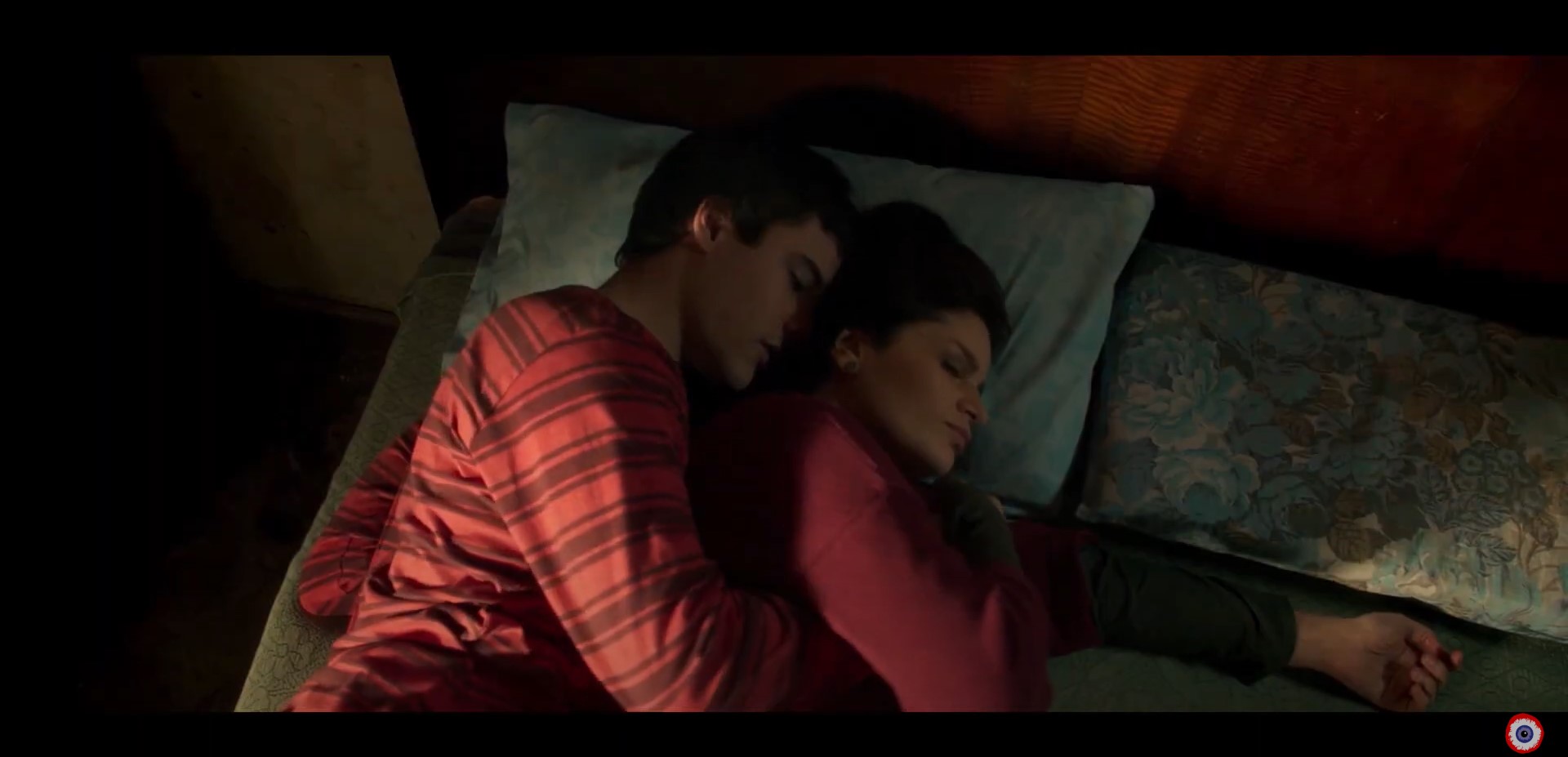
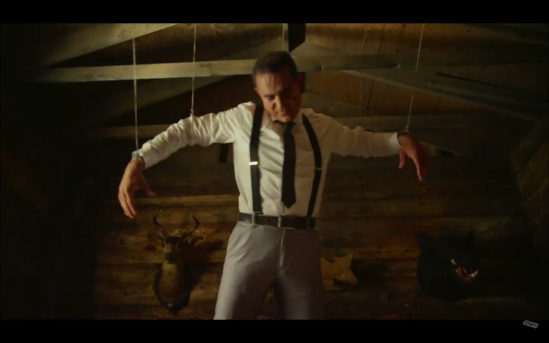
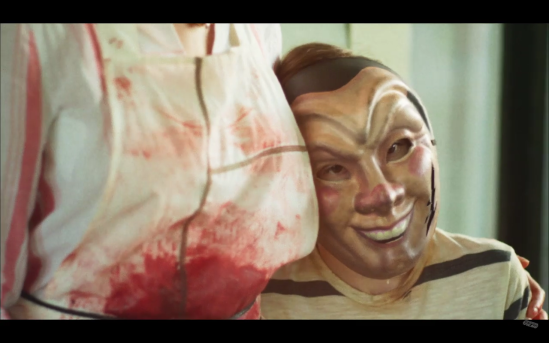
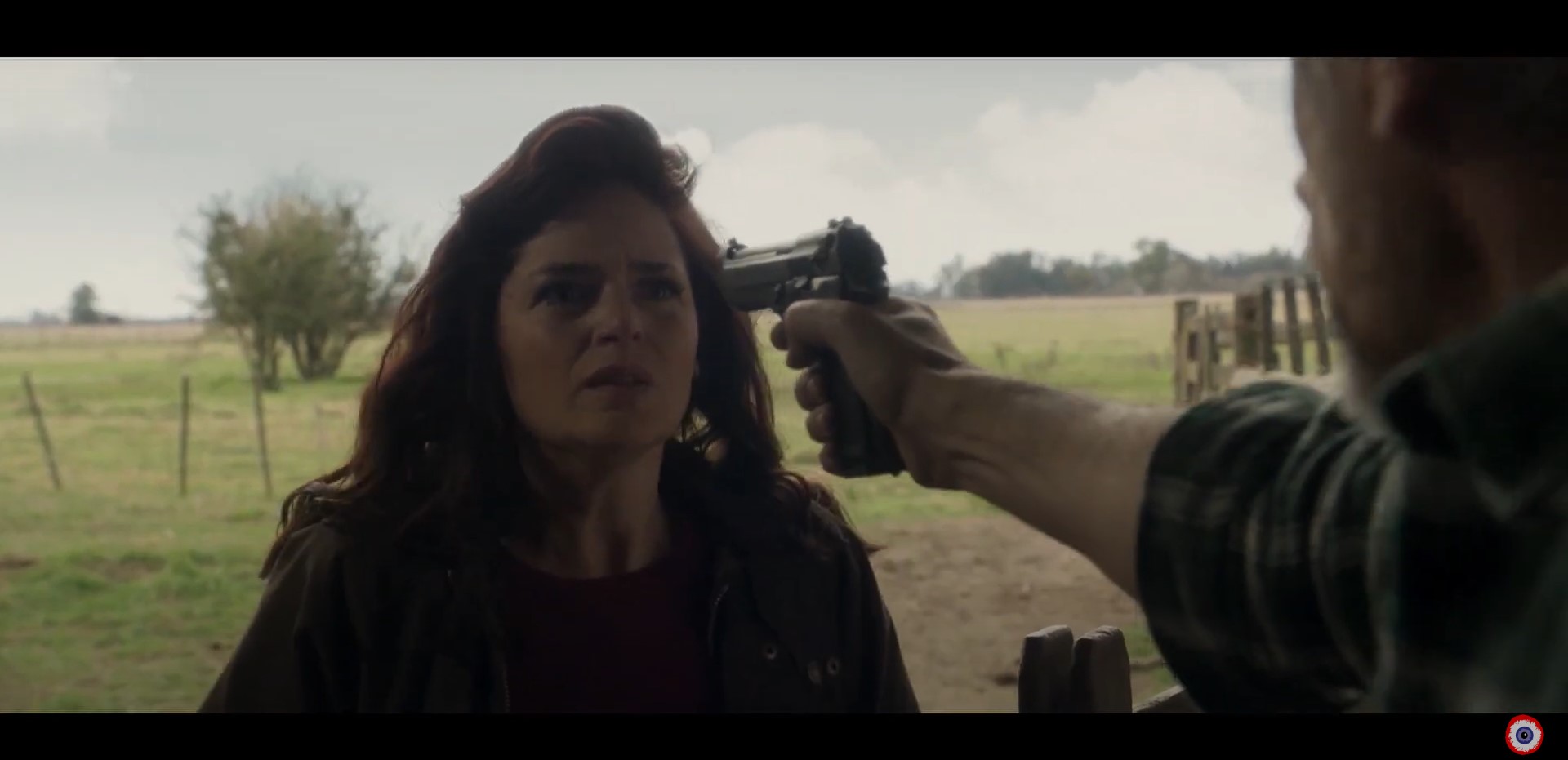
The film opens up to Joan, a 16-year-old student with a bit of a chip on his shoulder as he glues together a volcano-like model in slapdash fashion.  Spoiled further into his innate teenage angst by his own abundance of wealth, Joan is able to get away with essentially disrespecting his empty-threatening father and boozy mother.  The extent of his entitlement spills into the classroom when learns his teacher, Ms. Luciana, is leaving the school at the end of the day and this is where we learn that Luciana and Joan have been in a forbidden affair as they meet in a storage room where she caresses his crotch as they kiss.  Though looking very much like a 16-year-old brat, Renato Quattordio is actually in his early 20s when the Buenos Aires born actor becomes passionately intertwined on screen with early 40’s actress, Romina Ricci.  The noticeable age difference places a stamp of scuzzy approval as the principals really put on a show of sensuality that defies the numerical age gap while also defining the maturity and the experience of individuals.  Quattordio hits the mark as the naïve teen eager to jump at the behest of his older, curvaceous companion.  And, boy, is Romina Ricci curvaceous, luring Joan in as the wanton teacher cautious of their alluring affair.  The erotic thriller quickly turns into a survival thriller when Joan’s eagerness to grow up comes face-to-face with Luciana’s past, embodied by Rafael Ferro (“Terror 5,” “White Coffin”) and Sergio Prina as two money greedy thugs eager to milk Joan for all that he is worth.  “Amor Bandido” rounds out with a few more bandidos in Mónica Gonzaga, Carlos Mena, Jurge Prado, and Santigao Stieben.
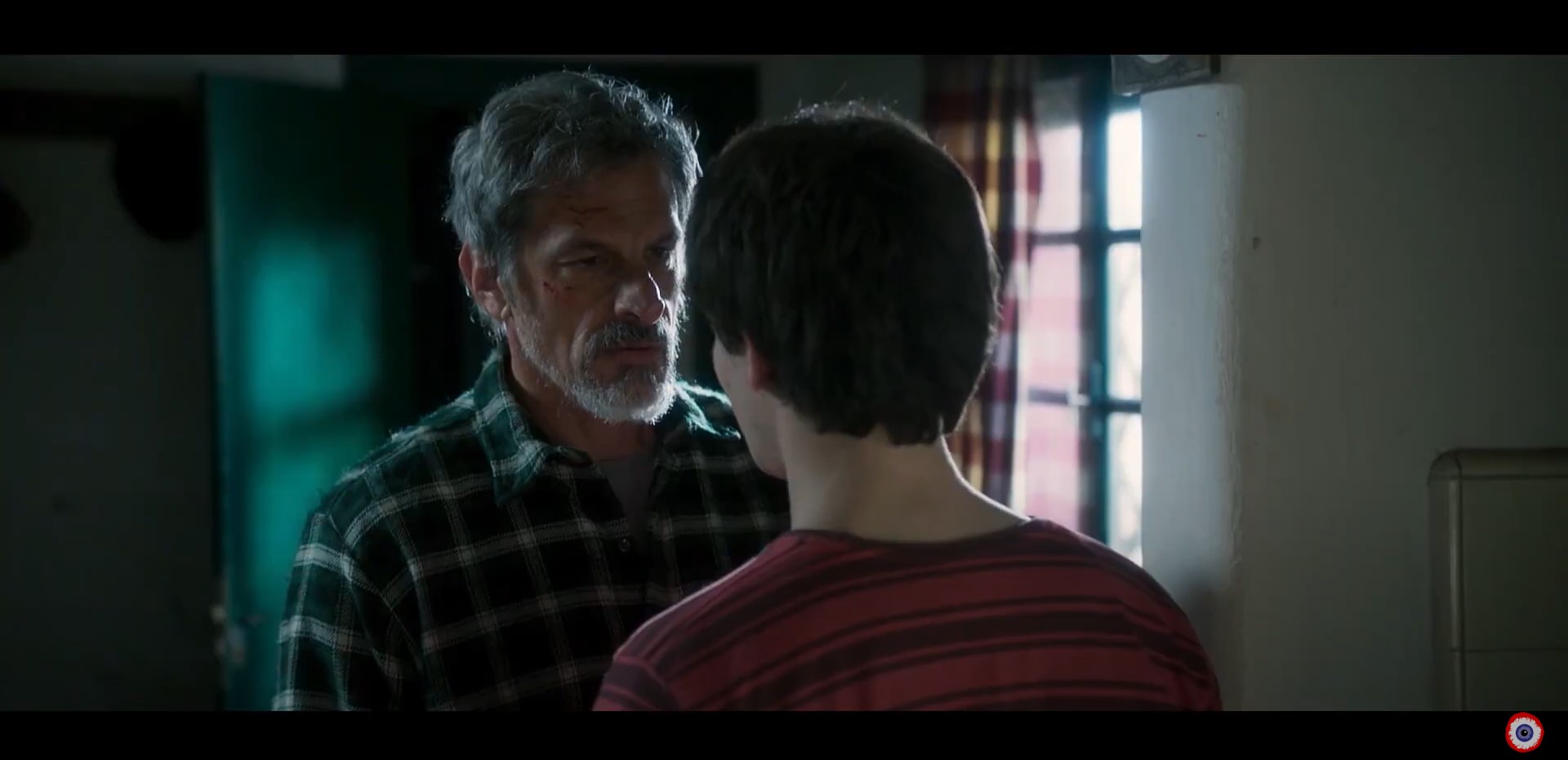
“Amor Bandido” is a coming-of-age tale with a pair of dichotomizing facades strung together by opposing forces in choosing between love or money.  Essentially, those two driving forces boil down to the relationship’s core and that is what director Daniel Werner simmers on, a test of idolatry strength between two people.  Werner pretenses the narrative with a forbidden love escaping to the rurality to make passionate, unjudged lust in a love context, well, at least for one of them.  The absconding is only a diversion for another unlawful act and is palpable in the undertone that something isn’t quite right with Joan and Luciana’s relationship, something that you can’t quite put your finger on and it’s not the surface fact that she’s a mid-30 something-year-old teacher screwing her 16-year-old student.  Werner leaves a breadcrumb trail of concerning clues that make sense when all is exposed but keeps those hints closed to the chest, protected to not giveaway too much until the summiting turning point of the exiting passion and entering perpetration.  Yet, despite our intuitive inklings of the funky air, the pivot still hits hard like a blindsided punch to the jaw that dislodges the mandible and rattles the teeth when the two lovebirds are struck with one payday load.  The only aspect that could be narratively tweaked is the introduction of the wounded stranger whose motives are understood but not quite absolutely clear his connections and how he became wounded in the first place with a gnarly gash on the calf that looks like a Great White shark attack had a snack on.  Digressing to figure out where he fits into it all becomes a distraction and a divergence from the main story that has now snowballed into additional but unwanted molestation, possible incest, and a ransom deal that won’t be faithfully upheld. 
“Amor Bandido” is the first feature to be covered by us courteously supplied by our friends as Cinephobia Releasing, a new distribution label from original world-searching and independent cult worshipping cinephiles of Artsploitation Films.  Coming soon to home video on July 18th, the single-layer DVD is presented in a widescreen 1.85:1 aspect ratio from a digitally recorded print and renders an expected damage and dust/dirt free picture with nature, yet smoothed out detail, skin tones and natural coloring.  There’s not a ton of visual risk here from cinematographer Manuel Rebella (“A Taste of Blood”) with the stimulation coming strictly from performances and the erotic, forbidden spirit.  The DVD5 format falls below par for darker portions within the frame that are seen with splotchy banding as well as the aforementioned smoothness around facial features.  The Spanish Dolby Digital 5.1 surround sound and a Spanish Dolby Digital 2.0 are equally comparable with the focus primarily on the dialogue and less on the sound design to warrant extra channels so both tracks output relatively the same.  There are scenes or sequences all other tracks are muted or receded to make way for a vivacious musical soundtrack to accentuate the moment.  Dialogue comes across clean and clear without any interference in the balance of the little ambience of rustling leaves, water splashing, and gun shots.  Option English subtitles are available, but I did spot a pair of typographical errors.  Bonus features include a 3-minute sale and promotional make-of with director Daniel Werner, the original trailer – separated from the bonus features on the static menu – and trailers for future Cinephobia Releasing films, such as “Sublime,” “Emmanuelle’s Revenge,” “Brightwood,” “The Latent Image,” and “The Goldsmith.”   Pressed with the cropped but same image as the front cover, the DVD comes in a standard tall snapper with the front cover sporting that crotch-fondling moment of intimacy.  The Cinephobia Releasing title comes unrated, runs at 80 minutes, and is has region 1 playback.  The coming-of-age arc prevalently scores into the naïve, angsty adolescent tale but “Amor Bandido” also suggests that maybe maturing too quickly should be left off the table, keeping fantastical temptation at bay and keeping innocence intact for kids to be kids just a few years more.

Forbidden Love and Severe Malefactions in “Amor Bandido” on DVD July 18th!

We Are All Just Playing Characters in an EVIL Movie! “Virtual Reality” reviewed! (Artsploitation Films – Kino Lorber / Blu-ray)

Believe Everything You See.  “Virtual Reality” on Blu-ray at Amazon.com

A horror movie about a supernatural Celtic killer has just wrapped production and goes into post.  The cast and crew what to succeed at all costs, not only in the movie but also in their stagnant careers.  However, the director, Matias, craves fame and legacy to the point of committing his soul to whatever it takes to cement his film in acclaimed success.  Matias and the arcane producer form a pact with a diabolical computer program and artificial intelligence that’ll bind their movie to esteemed infamy as well as bind their cast and crew to their characters.  When Matias invites select cast and crew to a private screening at his home, they realize the movie has scenes of their characters that weren’t shot during principal photography and that whatever happens to their characters in the movie, being chased by the Celtic killer, will happen to them in real life.  The only way to survive the movie is to last the full 90-minute runtime.

Hailing from Argentina, the South American country that brought us “Terrified” and the “Plaga Zombie” films, comes another tale of terror with the metaverse horror “Realidad Virtual,” aka “Virtual Reality.”  The 2006 “Director’s Cut” and 2009 “Breaking Nikki” shot caller Findling continues his traipse through psychotronic land with a story that couldn’t be more relevant today than if artificial intelligence synthesized the narrative itself out of binary ones and zeros.  The script comes from Findling and cowriter Lourdes Prado Méndez, an Argentinian romance novelist.  Having virtually no romance in “Virtual Reality” whatsoever, the 2021 film stretches Méndez’s range into crafting characters with a foot in two planes of existence while under immense fear and pressure to survive a supernatural slashening.  “Virtual Reality” is produced by Gabriel Lahaye under Lahaye Media, who has supported and collaborated on a number of Findling’s previous films, such as “Breaking Nikki” and “Impossible Crimes,” and is also a production of Wit Producciones, Cine Argentino, APIMA, FilmSharks, and INCAA of Argentina.

The story circles around a selectively small and independent film cast and crew finishing up a concluding scene of another to-be-forgotten horror movie by director, Matias (Guillermo Berthold), who has had multiple failed films before now.  Yet, the production team remains positive, hopefully the film with jumpstart careers as desperately expressed through the first act, especially with the film’s final girl star Guadalupe (Vanesa González, “Hypersomnia”), or Guad as she’s called by her friends, and her director’s assistant brother Pablo (Santiago Magariños).  Berthold plays the sneaky-sadistic director about as a well as most with a fervent penchant to do anything for his creative filmic art even if that means colluding with a shady, mysterious producer in César Bordón (“She Wolf”) whose performance’s obscured or lack of purpose is due in part to the character’s flimsy connection to the diabolical computer program.  Bordón can’t help but just be an inhuman human, violent by necessity instead of being violent with a purpose.  The producer seeks success for every single one of his films with a subsequent plotted course for the next idea – whether be a sequel or a brand new story – yet his connection to the network of evil of unexplained runes, sporadic pixilation, and artificial intelligent adaptations that can re-edit recordings into a new and inexplicable account of the story has been sorely severed in regard to understanding his background and his motivation of mortal sacrifice for movie fame.  Other connects that were left on the cutting room for, so to say, were between the siblings Guada and Pablo and their dying mother in what I suspect was an attempt to shove the sister and brother some sympathy, clearing the way for the two to be the unambiguously heroic duo, but the scene with their mother on her deathbed offered little-to-no compassion, producing a gelatinous lasting effect in what was a more visual one-off of two children spending the time they have left with their mother versus an incentive or arc scene that would hopefully rally up character expectations to look after each other.  “Virtual Reality” rounds out the cast with Frederico Bal (“Impossible Crimes”), Francisco González Gil (“El último zombi”), Sofia Del Tuffo (“Luciferina”), and Christian Sancho in a Johnny Depp inspired dressed part of a self-centered actor with a suspected pill addiction. 

As far as plot designs go, “Virtual Reality” has an interesting concept that involves filming two different harrowing situations and joining them into one parallel plight with the actors reacting more to the events happening on the television screen, which in itself becomes living, breathing character of sinisterism, rather than what’s happening outside the box in the present.  Both realities are virtually live and in play for their very being and whatever happens in one, affects the other.  “Virtual Reality’s” state of duality, not only in character, but also in linear lines of an alternate universe with lifeline connections, is smart, fresh, and terrorizing to know that your life depends on an A.I. created character coursing through a maze for their very lives.  This mirror-meta-effect continues to evolve as the story plays out that leave survivors questioning reality and questioning their individuality of some higher force that has used them like some free-thinking avatar for filmdom fame.  This is where “Virtual Reality” starts to become complicatedly crisscrossing as instances of a distorted reality spiral down a rabbit hole of what we thought was true.  Findling is nonapologetic for his layered universes that spins and wraps a narrative around another in what is a show of forced fantasy subsisting in that gray area of reality.  The Celtic slasher storyline is just a sublevel to the story’s higher level view that defines greed and worth amongst people longings for more and also models itself to reflect that thin line some people cross between reality and fantasy, as foreshadowed early on into the film during the shooting of the final girl scene when method actor Julian gets into the headspace of his Celtic killer character and really starts to strangle Guada in a climactic moment.  By the finale, you’re comprehensible pencil might have wandered off the connective dot trail in trying to see the bigger picture of Hindley’s meta-movie but “Virtual Reality” is innovative tech horror that just requires a smidgen of tweaking to be impeccable.

2020.  That was the last time I reviewed an Artsploitation Films title.  The long 3-year hiatus was due in part of King Lorber purchasing the boutique Philadelphia label that specialized in bringing independent global horror to the U.S.  Artsploitation Films and Kino Lorber continue that pursuit with Hernán Findling’s “Virtual Reality” from Argentinian now on a Stateside Blu-ray disc courtesy of the joint label.  The AVC encoded, 1080p High-Definition, BD25 is presented in a widescreen 1.85:1 aspect ratio.  Cinematically, the format storage is able to capture the true quality of the image with hardly any compression artefacts.  There’s not a ton of visual augmenting but what’s presented is a draining of color to a near black-and-white image with pigmented primary color lighting to give the scenes a dash of color that’s in contrast to the moderate-to-heavy in-movie, trope-heavy lack of lighting to create deeper shadows for that gloomy horror movie effect of interior trapped victims running for their lives in the dark.  Two Spanish language audio options are available on the release, a DTS-HD 5.1 Master Audio surround sound and a DTS-HD Master Audio 2.0. The 5.1 track has good balance between the ambient, soundtrack, and dialogue tracks albeit a little heavy on the score to clutter, at times, a clear exchange, especially when everyone’s yelling at the television set.  Other than that, no technical issues throughout the multi-channel output. English subtitles run at startup but can be turned off.  The unrated, region A encoded release has a runtime of 84 minutes but doesn’t come with a menu for special features; however, there is the film’s trailer and, if you stay tuned after the credits, there’s a bonus scene where you, the viewer, becomes the star of your own movie.  Artsploitation Films is back, baby!  Courtesy of Kino Lorber, “Virtual Reality” is barely tapped meta-horror, that has become all the craze nowadays, and Hernán Findling unboxes that fine line between real and unreal to only merge them together to be one and the same in a twisted interpretation of when art imitates life. 

Believe Everything You See.  “Virtual Reality” on Blu-ray at Amazon.com

Money is the Root of All EVIL! “Beasts Clawing at Straws” reviewed! (Blu-ray / Artsploitation Films)

A middle-aged man working a meager job at a gentleman’s bathhouse finds a Louis Vuitton bag full of money when routinely checking the storage lockers at closing.  Unsure about what to do with the money, he stows the bag away in the backroom and continues a moral, yet pauper’s, life while dealing with financial and family troubles at home.  Meanwhile, a border customs agent finds himself in severe debt with an unstable loan shark after his girlfriend skates and disappears with a large borrowed sum.  With a week to come up with the money, plus interest, he calls upon his distant cousin to assist in scamming a scammer who illegally came into some money, but things go awry when an overly friendly and clingy cop begins to snoop around.  Lastly, a prostitute grinds tirelessly to work off a large debt her abusive husband continues to blame her for with night after night beatings.  She jumps into bed with a young, handsome foreigner and her eager to support female boss to off her husband and collect the insurance money.  Yet, these troubled souls find that sticking to their convictions doesn’t always bode well as the unexpected happens in a blink of an eye.

The Asian film machine has mastered the art of the crime thriller from a proven track record that began with Akira Kurosawa films, if not even before that, and has chronically grown stronger, and sometimes more peculiar, with choice stylistic elements, suggestive themes, and extreme violence that has garnered, to much disdain, Westerner attention over the last 20 years with films like Park Chan-wook’s “Oldboy” and Andrew Lau and Alan Mak’s “Internal Affairs” being Americanized with a Hollywood remake.  With that being said in an upward trend of remakes spilling over the edge, there would be no eye-brow raising surprise if the introductory film, the tri-narrative crime drama idiomatically titled “Beasts Clawing at Straws,” from South Korean filmmaker, Kim Yong-hoon, will one day grace the English silver screens in a diluted variation of a Brad Pitt featured carbon copy.  Based of the Keisuke Sone neo-noir novel of the same name, Kim Yong-hoon’s pulpy impression of against-the-wall misdeeds is dog-eat-dog dark comedy gold.  “Beasts Clawing at Straws” is produced by Jang Won-seok (“The Gangster, The Cop, and The Devil”) and is a production of Megabox Plus M films (“Zombie for Sale”) and B.A. Entertainment.

The three prong, greed-catapulting narrative converge characters separately at first and then string them linearly together when the picture becomes clearly what exactly each one of them is chasing, but every story is magnetized to a single focal point, a person under immense pressure, stress, and the malice forces that thirst for their humility, kinetically embarking on the bad choice choo-choo steaming toward the station of vary bad things.  Bae Seong-woo stars as a downtrodden Joong-man, a middle-aged man stuck in the rut of poverty with a geriatric, browbeating mother, a fatigued wife, and busting his rump in a dead end job.  Seong-woo combats himself as a man tight rope walking the thin line of ethic principles when opportunity knocks at his door, but his ill-timed strike to grab life by the balls blows up in his face in a farce of instant karma leaves him less than what he had before.  Then there’s a Tae-young, a comfortably Governmental positioned customs agent facing a different kind of hardship when his ex-girlfriend, Yeon-hee, disappears with a borrowed lump sum of a gangster’s money and he’s left on the fence.  “Illang:  The Wolf Brigade’s” Jung Woo-sung plays into the desperate stench of the superstitious and ambitious customs agent.  Slightly cradling the severity of the situation, Jung amply positions Tae-young’s dilemma that resembles spearfishing in a barrel and he’s the fish.  The last story follows the abused wife Mi-ran, played reservedly by Shin Hyun-bin as a desperate woman looking to bank her soon-to-be dead’s insurance money.  When Mi-ran is abetted by motive-dueling pair of instigators, she finds that paying her debt can be more severe than ever imagined.  While sitting back and basking in the stir-craziness of the leads’ turmoiled chaos, the best characters of the film are the supporting roles of Kim Jun-han as an intestine devouring, fanny-pack wearing henchman, Park Ji-hwan as Tae-young’s bumbling, but begrudgingly loyal distant cousin, and Jung Man-sik as a breezy mobster with a cherry, yet malevolent disposition.  Youn Yuh-jung, Jin Kyung, Jung Ga-ram, Bae Jin-wong, and Heo Dong-won round out the cast.

Non-linear yet interconnected in story, “Beasts Clawing at Straws” hawks a Tarantino layered thriller with colorful deplorables from all walks of life and luxuries.  Kim Yong-hoon nourishes the unbridled, free-for-all nature of diving into the murky, shark-infested waters uncaged and tethered with cuts of raw steaks dangling from the pelvis area in this two wrongs don’t equal a right account of mistrusting desperation and misguided optimism.  Kim’s style echoes the likes of the popular “Pulp Fiction” filmmaker along the lines of shooting techniques and a frank view of violence to tell the frantic clutching of hanging onto what is left of tattered lives and borrowed time while disavowing pure, unadulterated nihilism by at least giving characters a grain of hope.  With any non-linear, multiple moving part films, individual aspects tend to become lost in order for pacing and “Beasts Clawing at Straws” doesn’t fall into the excluded category as factors that play into the main quandary are left hanging, such as in Yeon-hee’s circumstantial results of jetting off with a mobster’s money as the assumption is there, but nothing is fully concrete in her storyline.  The same indiscernible spousal battery stemmed from Mi-ran and her husband’s severe debt that leads to transgressions beyond marital misuse isn’t privy to the audience of how circumstances come about surrounding their predicament and we’re forced to speculate and shoulder an explanation that doesn’t quite feel justified.  However, neither of the slapdash developments hinder “Beast Clawing for Straws’” steamrolling posture to get that desirable bag full of problem-solving, filthy lucre. 

Artsploitation Films delivers a stylish and avaricious South Korea crime drama with “Beasts Clawing for Straws” into the U.S. Blu-ray home video market. The not rated BD25, high-definition 1080p release is presented in a widescreen, 2.39:1 aspect ratio, and nears the epitome of flawless. Aside from the picture slightly flickering, more noticeably on solid colored backdrops, the hue palette is absolutely gorgeous with the neon lights of South Korean cities, the breathtaking silhouettes of the natural mountains adjacent to a lifelessly still lake, and the variety of settings from an airy fish house to a modern, symmetrically designed bordello denote a keen eye by Kim Tao-sung. The South Korean language 5.1 DTS-HD Master Audio surround sound couldn’t be any better with a crystal clear aptitude for strong dialogue balanced in front of a robust soundtrack accompanied by deep range of ambience from fire crackling to the faint hint of rain drops audible from inside a restaurant, solidifying the depth package as well. English subtitles are available along with an English dub track in a dual channel Dolby stereo. What’s lacking with this release is bonus material as there is virtually nothing besides four Artsploitation trailers and the film’s own theatrical trailer. Parlous and deadpan funny, “Beasts Clawing at Straws” amazes as Kim Yong-hoon’s first time effort with the technical grace and the story construction that has been a paradigm for only a handful of notable directors able to execute an impeccable result.

Own “Beasts Clawing at Straws” on Blu-ray! Click the poster to go to Amazon.com

This Dinner Party Dishes the EVIL! “Happy Times” reviewed! (Artsploitation Films / Digital Screener)

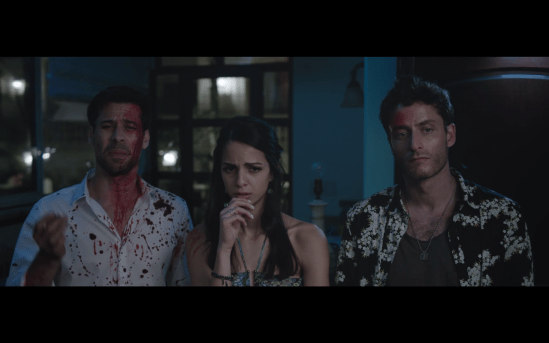
A small, but affluent, Los Angeles Jewish community dine together at a Hollywood mansion in celebration of the Shabbat.  Mixed feelings about each other compounded with mixed drinks stir the emotions of heated topics, including business ventures, religious attitudes, social statuses, marital qualms, and hidden desires.  Lines are being drawn and sides are being taken when one thing leads to another and undisclosed secrets become evident in a clash of suburban violence that pits friend versus friend, colleague versus colleague, and husband versus wife to the death. 

Director Michael Mayer reminds us that you should never mix business with pleasure with a keep your friends close, but your enemies closer black comedy entitled “Happy Times.”  The brawl of survival centered around Israel immigrants living in the U.S. is the second written and directed film from Mayer, following polar oppositely against another Israel themed, 2012 picture, “Out in the Dark,” a gay drama in the backdrop of the two rival and patriarchal sides of the Israeli-Palestinian conflict.  The only conflict in this 2019 thriller-com is of the gravely plentiful and concentrated kind inside a L.A. mansion turned battle arena that sees about as much confrontation as the war-torn Gaza strip.  Co-written with Guy Ayal, “Happy Times” is a collaboration produced by Erri De Luca and Paola Porrini Bisson of OH!PEN and, the Israeli born, Gabrielle and Tomer Almagor’s Urban Tales Productions in association with Michael Mayer’s own company, M7200 Productions.

The Israel-nationality cast can be an immersive experience and a sign of good faith casting from the filmmakers as well as a show of open diversity from the production studios that casting Hebrew speaking, Israel background actors implies a serious interest and respect embroidered into the project. Mayer, born in Haifa, Israel himself, is a breath of a fresh air of non-appropriation in a time where whitewashing can still be prevalent in the movie industry. Israel born actresses Shani Atias, Liraz Chamami, and Iris Bahr command the screen not only as Israeli women in lead roles, but as different personas that interact and keep lively the one night, single dinner party narrative. Chamani especially dazzles in the details as the dinner hosting socialite wife and mother, Sigal, who exacts an assertive Jewish woman with a cooped up attitude and a knack for handling her own while also worried about her social status, an extravagant exhibition of a screen trope that you might experience on shows like “The Marvelous Ms. Maisel” or movies like “The Slums of Beverly Hills,” enacted on point when she’s handing a frightened dinner guest, outside their Jewish circle and fleeing from the scene, tin foil wrapped leftovers with a wide menacingly unsure smile, while holding a medieval crossbow to go frag another party guest, in the plain view driveway. The wives’ counterparts are equally as Jewish and equally as prominent in the fold of the affair with Ido Mor as a unscrupulous businessman co-hosting the dinner, Guy Adler as a construction manager with money problems, and Alon Pdut as an unhappily married Ph.D engineer bothered by his fellow dinner guests’ lack of education and tact. In all, most of the characters are undilutedly snobbish with the exception of Sigal’s struggling actor cousin, Michael, played by Michael Aloni, whose magnified Hollywood liberalism deconstructs the Hebrew bible as racist and inaccurate among other colorful adjectives and becomes the catalyst that begins all hell breaking loose. Stéfi Celma, Mike Burstyn, Daniel Lavid, and Sophie Santi become the filament around the principle leads that strengthen the kill or be killed melee in “Happy Times.”

As if dinner parties weren’t already stressful enough, having to make trivial small talk, possibly acquaint or re-acquaint with unaccustomed faces, or pretend to enjoy the slop being served as food, “Happy Times” turns the internally exasperating dinner party debacle on its head with guests and hosts who are just too terribly comfortable with each other as volatile personalities explode like little active volcanos plumed to reach every corner of the house in a deadly playground for unstable, on-edge adults spewing their strident emotions and Mayer is able to maintain a layered pace with a narrative that’s snowballing quickly.  Where “Happy Times” struggles is the redline occurrences that trigger things to go very badly.  Though hardly trivial episodes between the guests, involving innocent infidelity affections or a slight practical joke stretched beyond devastating consequences, the harried moments afterwards diverge into a blown out result while more nefarious consequential revelations are held back, in after the fact chaos, and these differently graded spurs seem unbalanced, if not flip-flopped, in the story.  The characters themselves adequately course into being delightfully insane and as about as relatable as the internal frustration against our friendly-façade enemies, but there’s a part of me that personally wanted more development.  Military vet Avner, for example, exhibits symptoms of post-traumatic stress disorder (PTSD) as the horror sounds of war play in his head when under stress.  As he stares into oblivion when the rage fills into his face, especially by a nagging, browbeating wife who doesn’t seem to be aware of his condition, the subconscious killing-machine overcomes the mild-manner tech engineer.  There’s also Yossi’s opaque tax evasion scheme, Michael’s thespian struggles, and Mati, the late arriving Rabbi, who pockets money on the side from Yossi and Sigal that factor into an erratic equation that’s a mind field surprise every step of the way.

“Happy Times” relishes in unpredictable violence as a round table of feast or famine hatred in this dog-eat-dog thriller coming to you from the Philadelphia based distributor, Artsploitation Films. Slated for a February 9th, 2021 release, the unrated film will be presented in a widescreen, 2.39:1 aspect ratio, in a gorgeously rich color of a modest, natural color scheme. Kazakhstani cinematographer, Ziv Berkovich, distills a solid, yet uninspiring, photography of mostly still cam mixed with subtle steady cam, rooting firmly to particular rooms without capturing the flow of a big mansion, reducing much of the in clover luxuries of the hosts. The Hebrew, English and some Spanish 5.1 Dolby Digital mix offers well balanced layers of audio tracks with dialogue clarity and establishing good range with depth not really set up because of the close up or medium shot frames. Guy Aya;’s score offers a good blend of a violin-screeching from a murder mystery dinner theater with the inklings of traditional Israel folk sprinkled in to create an anxiety riddled brew of trouble. There were no bonus material included with the digital screener nor were there any bonus scenes during or after the credits. The best of times and the worst of times doesn’t compare to the bloodletting of “Happy Times” in a wildly amusing dark comedy with every impulsive-driven and tension-wrought scene chockfull with bated breath.

Pre-order “Happy Times” on DVD or Blu-ray at Amazom.com (Click the poster)

EVIL Gets Loopy in “Welcome to The Circle” reviewed! (Artsploitation Films / Blu-ray)

Greg and his young daughter Samantha are turning out the lights on a camping trip in the woods.  When a bear attacks in the middle of the night, Greg awakens in the care of a commune-like camp.  Injured but alive, Greg is given the grand tour of the encampment of a cult known as The Circle where he rejoins with his happy-go-lucky daughter and meets a few other strange and unusual members who worship the legacy and the omnipotent existentialism of The Circle’s creator, Percy Stephens.  What the father-daughter combo don’t realize is that The Circle is a demon worshipping cult bidding on the whimsical demands of Percy Stephen’s rancor and malice.  A group of outsiders led by Grady, a former cult member in his youth, are determined to rescue and reprogram one of the followers close to them, but step into an upside-down world, demonized with smoke and mirrors, set on swallowing their souls for the sake of Percy Stephens delight. 

A diabolical drip of disorienting deception, “Welcome to The Circle” is a roundabout from Hell, cordially ostracizing the love and blessings ideology for more sinister, soul-sucking profit of an unconventional demon film.  “Welcome to the Circle” is a Canadian-made debut independent feature from write-director David Fowler and Fowler, better known for his work on documentaries, knocks on the door of insanity with a tailspin narrative that collides John Carpenter’s “In the Mouth of Madness” with Clive Barker’s “Lord of Illusions” with Aaron Moorhead and Justin Benson’s “The Endless” rapping at the door and the results are an enigmatic nightmare full of stone faced mannequins, body inhabiting occupations, a series of blackhole peculiarities, and being eaten alive by crazed acolytes.  The Vancouver, British Columbia based Canadian company, High Deaf Productions, embarks into the feature film bazaar, with Mack Benz and Michael Khazen serving as company producers, with co-production association from Corvid Arts and Upfront Films.

Broken into two parts, the narrative opens the first portion up to familiarize with the cultist sheep in the stark white attire of wolves’ clothing that throws Greg and his daughter Samantha’s kismet into the uncertain pit of a demon’s impish thirst for souls.  When introduced to Greg (“Dragged Against Concrete’s” Matthew MacCaull), much of the character falls below the waist side as a single father detached from his own child and surrounded by conniving zealots that funnels into becoming weak, if not also immaterial when MacCaull is unable to explore Greg more in depth.  Nothing against MacCaull who performs well enough with an unsympathetic character that has a cold shoulder connection with his insubordinate child and no real background fuel a feed into Greg’s worth as one of the mainstay roles.  I also thought a little more on The Circle’s followers would be constructive to The Circle’s reason for fervor and appeal, but instead, Sky (“Supergirl” television series’” Andrea Brooks), Lotus Cloud (“Pacific Rim’s” Heather Doerksen), Rebekah (“The Wrong Daughter’s” Cindy Busby), and Matthew (“The Unspoken’s” Michael J. Rogers) are members developed only inside a crumbling hierarchy structure obtaining cryptic messages from a demon, Percy Stephens, from beyond their plane of existence.  Percy Stephens is perhaps the best complex character in the fold without having a stable foundational actor in his shoes and is played by various faces of the film’s cast able to reach back toward an immense and mysterious backstory that involves a slew of daring and impressive accomplishments and a demonic tiger shark that may or may not be Stephen’s aquatic damnation to Hell.  The second portion moves greatly away from Greg and his daughter and into a rescue operation, led by the unfiltered and unorthodox Grady, a former The Circle youth who landed in a psyche ward only to be hired to infiltrate the cult to extract Rebekah, paralleling his motives to understand the mechanics of the cult that led to the disappearance of his mother.  “Stan Helsing’s” Ben Cotton delivers a performance that is anything but vanilla as the sharp wit and cool as a cucumber Grady, dominating each and every scene in a disheveled and aloof veneer that becomes Grady’s best defense against Percy Stephen’s engaging entanglements.  The cast rounds out with Taylor Dianne Robinson (The Twilight Saga:  Breaking Dawn Part 2), Hilary Jardine (“Teen Lust”), Matt Bellefleur (“In Their Skin”), Christian Tessier (“Night of the Demons III”) and Jordana Largy (“Rememory”). 

It suffices to say that David Fowler’s topsy-turvy and boundless the fake-fake, a descriptor of the story’s in-between existences, is an alternate universe complete with hope chest portals and wraith approaches that will disrupt the audio and visual perceptions, disconnecting the straightforward wiring only to cross the stepping stones of normalized story structures to fissure what we know into a fractured reality.  The foyer to oblivion, the fake-fake, isn’t an easy one to digest and Fowler is very much aware of the real-real consequences of traversing into the world of the fake-fake.  Fowler forces you to pay a penance for crossing the threshold that will cause dizziness and nausea, the same affects the characters sometimes experience through the compressed spaces of time and planes of The Circle, soldering an unintentionally immersive experience with the combination of simple and natural cinematography infused effects that spun, tilted, and corralled acute fear and isolation from under the DP supervision of Sterling Bancroft. In regards to Fowler’s darkly imaginative story, the script a lively progression of diverse ideas and concepts that construct a little world within a bigger world, especially on a modestly tight budget that can’t afford mind-blowing special effects, but the cohesiveness is heavily reliant on the character’s to explain the actions that are occurring to progress an outline and much of that explanation falls into poetic prose and riddles. Characters Percy Stephens and Grady to much of the grunt work in vocalizing the visuals, but the course is a rocky road and with every bump there’s a meaning within a meaning and to know the meaning is to meaning to know. See what I mean? “Welcome to the Circle” chips away the substantial concrete barrier with a bombardment of incorporeal flak that comes in wave-after-wave of full blown auteur creativity.


To get caught in the loop is to loop in getting caught and that’s what Artsploitation Films has done by acquiring and distributing “Welcome to The Circle” on a Blu-ray home entertainment release. Presented in a widescreen 1.85:1 aspect ratio, the digitally recorded picture is about as immaculate as they come nowadays with tactile textures of grainy log of the cabins, the floral of the forest, and the scruff of Matthew’s bristly beard all looking particular sharply detailed albeit some minor fluctuations of softness seeping into the brush and into more dreamlike sequences and though flat, the colors due run unbridled with the forestry green and the eggshell color of mannequin “skin” that renders subtle differences more distinct. Darker scenes render nicely and smoothly without as much of a flicker of interference and Bancroft’s use of depth forces audiences to focus only on what’s extremely close up or what’s faraway by way of adjusting the focal length. The English language 5.1 DTS-HD Master Audio also has little-to-no complains with a well rounded discernible platter of clear, forefront dialogue, depth and range of vocals and ambience, and a combination score and soundtrack by Reid Hendry with original and haunting folk tracks by Jo Krasevich do an insidious one-two punch that bruises the soul. The not rated, 93-minute film comes with only a theatrical trailer in the bonus features. Despite the dense ambiguity that surrounds the film, the demonic ensnaring doom that accompanies “Welcome to The Circle” is, simply put, psychosis in a bottle that director David Fowler just effortlessly uncorked.

Own “Welcome to the Circle” on Blu-ray!