In a wake of fatally striking down a young woman with their vehicle, two errant and drunk men, Goyo and Gordo, are arrested for the gruesome crime at the scene of the accident While handcuffed in the back of a squad car, an unorthodox police chief named Juarez discovers a video tape recorder in the front of their mangled car with a tape revealing the violent torture and killing of a young transvestite hooker. One tape leads to another, and then another, individually exhibiting a trail of cascading blood and merciless torture in the deaths caused by Goyo and his unstable and dysfunctional life. Juarez digs further into Goyo’s ghastly cases going through each horrific tape setting up Goyo for a shocking conclusion from his past he long thought was dead.

“Atroz” will make you never want to tour Mexico! I can fully understand why “Cannibal Holocaust” director Ruggero Deadato fully backs Lex Ortega’s graphic horror film an associate producer and presenter as the two films, separated by decades, are much alike with the majority of their likeness in found footage techniques, frighteningly realistic imitations of murder, and their artistic and austere grandeur of filmmaking narration. Ortega also sustains an effective horror feature through the confines of a problematic ultra micro-budget. Along with aid from a talented roster of actors and crew, no way was Ortega’s film was not being made. “Atroz,” translated to “Atrocious,” opens with the unsavory side of Mexico’s impoverishment that contributes to much of the Central American nation’s disturbing amount of unsolved murders. The montage opening is so powerful and moving that what precedes shocks as a gritty insight of what everyday Mexican residents might experience one way or another in their lifetime and though Ortega goes that extra mile to be obscene and disgusting in every way possible, the director supports his work with seeding a traditionally patriarchal society with gender identity afflictions that evolves organically and is purposefully displayed in reverse order to add more, if it wasn’t possible already, to the shock value of “Atroz.”
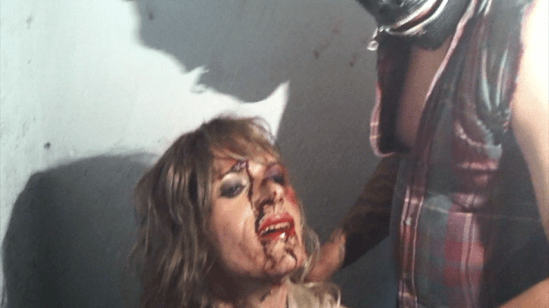
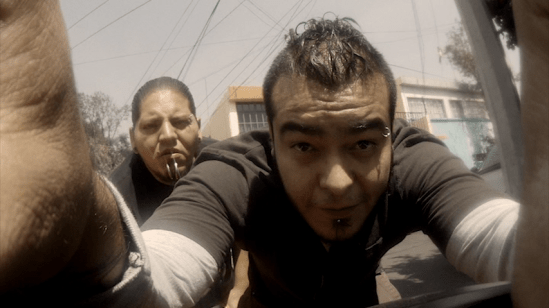
The outer story involving Goyo’s interrogation about his stash of tapes is only the tip of the iceberg, sheltering three background influencing stories about Goyo that set up more familiarly in an anthology manner. Inked with intricate arm sleeve tattoos and perforated with metal facial piercings, Goyo and his larger friend Gordo, which means large man in Spanish fittingly enough, seem nothing more than your typical lowlife gangbangers. However, Goyo and Gordo are more disturbed than any Mexican cholos from the first torture tape of a transvestite prostitute, a punished, bit-part role awarded to actress/singer Dana Karvelas. The next two tapes are just as hard to swallow and stomach from the assorted fluid being consumed, to the explicit varying degrees of rape, to the vivd genitalia multination, and to just the sheer ultra violence depicted makes “Atroz” the gorehound’s holy grail of horror. Never have I’ve witness a film so graphic to come out of Mexico and, by golly, I thought the world needed this Lex Ortega film. In most cases, extreme gore and shock features run a course shortly after hitting the play button on your home entertainment device, but with “Atroz,” a drive to learn more about what motivates Goyo’s unholy acts unravel little-by-little and that quality is usually omitted and uncharacteristic of explicit gore horror.

Performances are firmly established all around with Carlos Valencia and Lex Ortega himself leading the charge as Juarez and Goyo. While Ortega doesn’t necessary have much of dialogue role with Juarez during interrogations, the undiluted carnage he lays down on the tape recordings are a rare and twisted characterization hardly visited by the indie circuit and certainly not given the light of day from Hollywood, being mostly sidelined to an underground context. Rare is it to have one actor who can impersonate malice upon others that when a doppleganger appears in Goyo’s younger years video tape, “Atroz” becomes that much of brighter highlight as a dark film birthed from Mexico. Carlos Padilla truly frightens as the younger version of Goyo staged in an abusive household with an unsympathetic father, an naive mother, and lots of physical and verbal mistreatment. Goyo’s a psychoanalytical unicorn, an epitome of the mind’s deranged wealth, and a testament that his surroundings molded the very fibers of his intentions do commit evil. The sight of blood is all it takes arouse Goyo and “Atroz” provides the character an ocean of sangre ready for lapping.

Practical effects wizards Jamie Lopez and Alfredo Olguín produced unrivaled effects on a budget that didn’t provide a second chance if the effect didn’t spin right the first round. Absolutely flawless did the duo’s work gleam in the blood it was soaked in and firmly how I held on for dear life my testicles when seeing a set being cleaved graphically severed. Lopez and Olguín have a combined 23-years of experience in the special effects game and that surfaced buoyantly at the top of “Atroz’s” shocking content. In the nature versus nurture debate, “Atroz” sides with nurture putting Goyo in the impoverished and traditional meat grinder that is Mexico and spat him out where wades in a chrysalis until bursting out into a state of lust for an endless stream of revenge and blood. Ortega accomplishes nurture’s wickedness by tenfold and Lopez and Olguín exemplifies it even more.
Unearthed Films and MVDVisual’s limited edition 3-disc Blu-ray and DVD set includes a JH5 & Eggun soundtrack. Presented in a widescreen 1.85:1 aspect ratio, the 79 minute runtime feature sports no blemishes and falters on any flaws, baring and setting a fitting desolate tone through a number of camera options. There’s also and English and Spanish language Dolby Digital 5.1 with optional English subtitles intent on properly channeling every port of your surround sound system. A pair of issue lie with the subtitles involving quite a few typos in English and some synchronization problems delaying captioning a full second or two after dialogue has proceeded. Bonus material includes the short film of “Atroz,” a crowd funding video, behind the scenes: music and sound design, behind the scenes: practical effects, behind the scenes: production, Unearthed trailers, a behind the scenes image gallery, and, of course, the aforementioned soundtrack. Whatever you do, don’t consume any food before and during experiencing the gore charged “Atroz,” Mexico’s most deranged cinematic delicacy to date!
Tag Archives: blu-ray
Being Tailored to be President of the United States ist sehr Böse! “Der Bunker” review!

Seeking the luxuries of peace and quiet in order to fulfill the work of an important academic theory, a young student rents out the basement of an old bunker converted into a family home. Surrounded by the solitude of snow and trees, the bunker is the perfect place for the student to concentrate on his work. Until the couple renting the bunker basement decides the student must continue the unorthodox home-schooling of their eight-year-old son to put him on the path of becoming the President of the United States. The student becomes mixed up in a peculiar family’s ambitious affair twisted far from normalcy and teetering on the borderline on insanity.

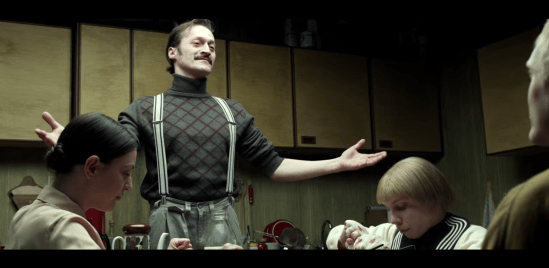
“Der Bunker” is the first feature film from writer-director Nikias Chryssos and Chryssos delivers an artistically abstract film about the modernistic conventional ways of growing up through childhood told through an obsolete perspective. Produced in Germany, the film makes light of how parents raise and shelter their children, especially their sole child. The home setting is literally a bunker, a fallout shelter from the age of war. “Der Bunker” particularly points out the American child raising culture with Klaus, the eight-year-old son of mother and father, going through semi-strict tutoring of memorizing the every nation’s capitals in efforts of becoming, one day, the President of the United States. Chryssos overkills the symbolism column with continuously displaying the staleness of a stuck-in-routine in over-parenting from the outdated 1950’s style of the clothes and retrofitted bunker to the eight-year-old Klaus being depicted by a 30-something actor Daniel Fripan.

Fripan is one of four cast members to star in Chryssos film and the only actor portraying a named character with Klaus, leaving all others generically labeled with father, mother, and the student; however, Klaus and the Student are essentially the same person, a dual presence who start off polar opposites that are trapped inside the bunker and looking to break free from it’s buried confines when their individual identities begin to blur. Fripan’s key to “Der Bunker” working conceptually as the ‘man-child’ with Fripan’s attributed short stature, innocently mature face, and a well-performed immature persona that solidifies the Klaus role as nothing more than child forced to grow externally, but not internally. Pit Bukowski’s more of an automaton when we first meet him wondering through the snowy terrain in search of the bunker. His Student character starts to dwindle as he literally becomes a fixture of the bunker as Klaus starts to shine and thrive in not only his studies but in his maturity, confronting his Mother’s will. Bukowski’s internal switch goes dynamically well with Fripan even though their physical façades remains intact. Mother and Father are portrayed by Oona von Maydell, daughter of “Das Boot’s” Claude-Oliver Rudolph, and David Scheller and both compliment each other by donning an opposite reversal of roles where Mother is the stern, firm hand of the family and Father stays home to clean and be a teacher for Klaus.

Chryssos’ telling of the family and the Student’s psychosexual relationship between the story’s bookends goes above and beyond the Oedipus complex. Oona von Maydell’s Mother has a power fastening all the male characters in an intriguing way despite her minor, yet undesirable, physical deformity plaguing as a patch on her right leg and also despite that her rational stemming from a grave voice, connected to her deformity, comes from beyond their world. As if destined to play the part, Maydell acts the lead as the family’s matriarch while also being subtly coy and provocative to bluntly upfront about her sexuality as a means of control; Maydell seemed very comfortable with her onscreen upper torso nudity in some awkward and uncomfortable scenes. Her onscreen husband, David Scheller, deems himself an academic, an educated man with knowledge more vast than that of the outside world because of this thirst for literature. Yet, Scheller plays a scattered Father whose torn between being a literal mentor, the punisher, and the glue to keep the bunker from being engulfed by giving into Mother’s symbiotic celestial being. Father copes with heavy medication that literally warps his mind when he can’t seem to control everything from the Student’s appetite to his convincing of the Student to take on the tutoring role for Klaus, even if it’s not plainly displayed. Scheller does a remarkable performance breaking down his character to a crumbling lame duck.

“Der Bunker” and the bizarre go hand-in-hand. Only a unique mindset with skewed vision could have pulled together such a twisted dark comedy tale of the mortal coil in holding your children to your hopes and dreams for them. Colorfully unapologetic, “Der Bunker” canisters another world sluggishly revolving through multiple levels of layers of psychosexual and frustrating concepts that flaunts a conventional cinema defiance attitude to establish bold filmmaking possibilities. In short, director Nikias Chryssos shoots high and doesn’t miss with his first run. The Artsploitation Blu-ray release features a vividly clear anamorphic widescreen 2.35:1 presentation of the Kataskop Film Production. Audio options include a Dolby Digital German 5.1 Surround sound with very detailed optional English subtitles. An abundant of bonus material is hard to pass up, especially with a director’s commentary and deleted scenes that expand more about the character’s traits and backgrounds. Rounding the extras are outtakes and trailers from Artsploitation film arsenal. This Blu-ray release is meticulously thought out to deliver a high caliber video and sound quality for such as odd German film concerning one youngish boy’s progressional path of self-reliance from a sheltered life style.
Good. Evil. I’m the Guy with the Gun. “Ash vs Evil Dead” review!

Ash is back! The chainsaw for a hand, fouled mouth, Deadite destroying retail stock boy returns to face Evil with his boomstick once again after the last monstrous incident some 30 years ago. Trying to stay under the radar and not make waves amongst the ignorant living, Ash has sunk low into the drunken and fat state of barely living until he accidentally reads from the pages of the Necronomicon during a night of irresponsible reefer madness. Now, evil forces thrust Ash into an impossible position to which he’s unable to remove himself from and with the help of his enthusiastic co-worker Pablo, a loyal immigrant sidekick, and the pessimistic Kelly, the orphaned daughter of Deadite victims, Ash and his gun-toting, ass-kicking haphazardness crew will take the terrifying show on the road, tracking down a way to destroy this Evil and the Necronomicon before it swallows the world and release a demonic wrath that’s never been seen before!
Many horror fans thought the day would never come. A number of us believed the rumors were a myth, a hoax, or a bamboozling viral campaign set forth to stir up fandom and the water cooler conversation. Then, a trailer was released and Starz! brought “Evil Dead” back to audiences’ who wanted to relive the the havoc Kandarian demons, to an audience who wanted to expand more upon the mythology of Sam Raimi’s epic hero, and delivered to an audience who don’t even know who Bruce Campbell, the legend, is and why he’s important to the horror community.
“Ash vs Evil Dead” blends seamlessly into the series’ saga, pitting once again our chainsaw wielding hero against a body-possessing force that’s more vicious and blood thirsty than ever. Any and every soul is up for the shredding and ripping grabs when Kandarian demons are concerned while also new, unseen variations of Kandarian demons make a fashionably late appearance. This time around is slightly different than before as, unlike Ash and his unlucky bunch caught in evil’s clutches, Ash has willing assistance in Pablo and Kelly to form a battle trio and take on this evil head on. Ray Santiago (Pablo) and Dana DeLorenzo (Kelly) are a fresh contrast to an aging Bruce Campbell, but Campbell pizzaz and rudimentary quick-wit dialogue manages to steal the scenes. Campbell, Staniago, and DeLorenzo are joined by a fourth; an actress reuniting with Bruce Campbell from long ago in her own fantastical series “Xena: Warrior Princess.” None other than Xena herself Lucy Lawless dons a mysterious Ruby Knowby who holds a deeper understanding of Necronomicon.
Sam Raimi also makes his grand and spectaculr return to his rightful spawn. Raimi, Campbell, and long time Evil Dead collaborator Robert Tapert’s production company Renaissance Pictures, along with Starz!, are the chief production companies on the television series that was originally meant to be the third sequel installment of the “Evil Dead” franchise. However, the zany-comical horror writing and directorial style that only Sam Raimi can deliver was reproduced for the first episode of season one to recreate the devilish “Three Stooges” slapstick atmosphere bred for a brooding, yet hysterical, Starz original series. A handful of directors take the helm of nine more episodes after Raimi, with one of the “Xena: Warrior Princess” directors Rick Jacobson being the most recognizable name among the list, and once the story expands further into the season, a loss of slapstick buffoonery that trademarks Raimi so very well is lost, but doesn’t slow down the blood spattering carnage.
Starz! and Anchor Bay Entertainment’s 2-disc Blu-ray edition of “Ash vs Evil Dead” season one is available today at your local or online retailer! Presented in a HD 1080p widescreen 1.78:1 aspect ratio with an English Dolby TrueHD 7.1 and a Spanish Dolby Surround 2.0 mix, the 10-episode, 294 minute runtime, unlimited goriness will soak into your funny bones right before shattering them into axe-cleaved pieces! Special features include an audio commentary on all episodes, Inside the World of Ash featurette, How to Kill a Deadite featurette, and the Best of Ash featurette. Plus, the release comes with a lenticular slip cover. Bring on “Ash vs Evil Dead” season two! Hail to the King, Baby!
A Romantic Getaway Turns Evil! “The Perfect Husband” review!

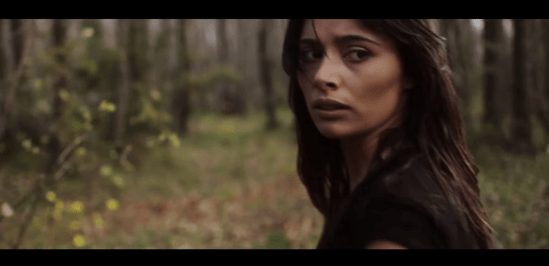
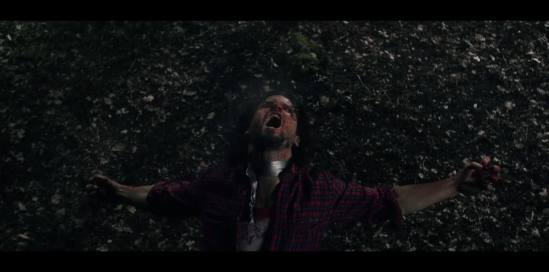
Nicola and Viola attempt to escape their dismal past involving losing their child at birth, traveling to an isolated cabin in the woods to rekindle and reconcile their bitter relationship. Once there, Viola feels a menacing presence lurking amongst the trees ever since arriving. As the strain on their past and present union becomes nearly too much to bare, tensions overflow with jealously and bewilderment that turn the delicate situation into an explosion of violent behavior. A cat and mouse game of carnage and death follows the couple through the dark woods toward a bizarre and psychological ending that reveals the true nature of their disturbing affliction.

Director Lucas Pavetto’s “The Perfect Husband” is an Italian psychological horror film from 2014 starring “Nightmare Code’s” Bret Roberts and Gabriella Wright and based off Pavetto’s short film of the same title. Even though “The Perfect Husband” is an Italian birthed film from Italian production company DEA Films, “Il Marito Perfecto,” the Italian title of “The Perfect Husband, has a crew, aside from Pavetto hailing from Argentina, that maintains the country’s native ethnicity. London born Gabriella Wright, who masks her English accent very well, co-stars alongside the Alaskan-American Bret Roberts; both actors could certainly pass having Italian heritage with their olive skin tone and dark features elsewhere and with filming location set in Catania, Sicily, the actors fit right amongst the rugged and mountainous Sicilian landscape. Roberts has a low-raspy articulation that makes him seem always out of breath that transitions beyond the catalyst, but Roberts plays villainy insanely well. Wright maintains a cryptic temperament from start to near finish. However, the duo’s dynamic is quirky at best as the couple treat themselves more a boyfriend and girlfriend than husband and wife, which might be a product of the writing.

Lucas Pavetto and Massimo Vavassori go fairly formulaic with their script, writing about strife-stricken couple working out their marital issues alone in a remote cabin surrounded by a dense forest. The setup screams horror premise clockwork and attempts to shift gears after lengthy character development that takes some time to build into something concrete, or at least halfway tangible. The shift in disposition is, however, so rapid and so sudden with unwarranted ferocity, that the effect goes from a scale of a tense filled two to a run-for-your-life ten in a matter of microseconds. The series of events portray Bret Robert’s character Nicola as a jealous misogynistic ready to snap at any given moment while Viola’s mysteriousness and her unconscious readiness to break with reality puts an undisclosed strain on her psyche that what she experiences may or may not be real. A twist ending tries to fill in the Nicola and Viola omissions, but misses the mark that still leaves gaps here and there, especially conveying more about the events that took place at the refugee station between Viola and the Ranger, played by “Apocalypse Z’s” Carl Wharton. Perspective becomes surreal; a fantastic journey that terminates toward a twisted unveiling, leaves more questions than answers about Viola and Nicola prior to their weekend getaway.

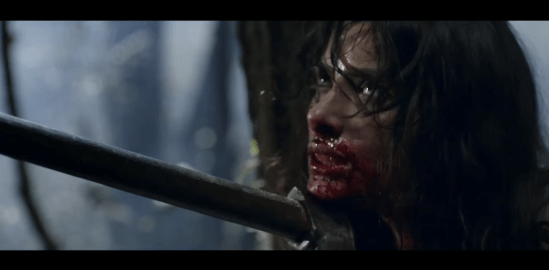
Plausibility. Probably “The Perfect Husband’s” fiercest enemy as the story tries to turn itself upside to throw the audience for a loop. The disillusion feels cheaply thrown together to try and wrap up, what could have been, a thoughtful psychological thriller and that’s where plausibility doesn’t formulate, frustratingly feeling like an square box with only three sides and a gap left carelessly open. I wanted to like “The Perfect Husband” because I thought the mayhem was present at the beginning moment of the snowball effect. Everything went down, fast and furious style, with unforgiving brutality that was surprisingly gory at times.

“The Perfect Husband” has been honored an unrated Blu-ray release in a 1030p transfer presented in a 2.35:1 aspect ratio from the ever bold Artsploitation Films. The video has a slight grayscale imbalance that contrasts scenes a bit heavily, but other than that minor issue, the image looks solid. The English 5.1 surround with optional English subtitles is also solid with a balancing the appropriate tracks. Bonus features include a behind the scenes segment that exhibits the takes of scenes in and outside of the cabin. The original short “Il Marito Perfecto” is included along with trailers for upcoming films from Artsploitation Films. Turns out “The Perfect Husband” wasn’t perfect, but raw, exploitive barbarity is a must see for any violent hound in need of a good scratch.
The Evil Doctor is in! “Doctor Butcher M.D. (Medical Deviant)” review!

New York City hospitals are being terrorized by a crazed maniac or maniacs stealing the body parts of the deceased and local authorities are discovering the half eaten remains of torn apart bodies in the streets. When a medical orderly is caught in the act of cannibalism by nearly devouring a corpse’s heart and then commits suicide by diving out high rise window, the Doctor’s assistant and leading anthropologist Lori Ridgeway recognizes the tattooed symbol of Kito on the orderly chest, a symbol from a long forgotten tribe in the Moluccas Islands. Worshipping a cannibal God, the primitive tribe still practices the form of anthropophagy. Lori’s colleague, Dr. Peter Chandler, has been placed on a research team to root out New York City’s recent cannibal problem and when the Kito symbol clues him and his team of a possible lead, an expedition team forms to travel to the Moluccas Islands in search of the existence of inhabitants. Dr. Chandler rendezvous with a long time acquaintance, Dr. Obrero, whom has lived on the islands for years. When Dr. Obrero arranges a boat and his right hand man to accompany the expedition, Dr. Peter Chandler and team step foot into a hellish nightmare, bloodied with unspeakable and aggressive cannibal acts. Just when nothing could be worse than flesh hungry cannibals, hideously disfigured zombies frighten even the primitive locals. The island holds a dark secret and Dr. Chandler aims to unveil it no matter the cost!

Finally! The definitive 2-disc edition of Aquarius Releasing’s “Doctor Butcher, M.D.” aka the Italian cut “Zombie Holocaust,” from the Flora and Fulva Film production companies, has been released and, oh, how glorious the Severin Films release is with a super sleek Blu-ray reversible cover art – “Doctor Butcher, M.D.” title as the main cover and “Zombie Holocaust” title on the reverse side – and the high definition gore that hasn’t been gooier and oozier than ever and all in thanks to the upscaled 1080p full HD resolution transfer. Uncut with eye-gouging effects, eviscerated and mangled bodies, and packed with a slew of medical terrors and oddities, the Marino Girolami’s directed video nasty from 1980 just might get itself banned once again by the international censorship boards.

The schlock runs thick through a plot that’s eerie similar to Lucio Fulci’s Zombie (aka Zombie 2) with many of the locations and sets repurposed for the Girolami picture involving exotic land cannibalism, a mad scientist, and, you guessed it, zombies. Yet, “Doctor Butcher M.D.” rightfully receives being a detached entity, an “Annabelle” to “The Conjuring” of sorts, even when both films star Scotland-born leading man Ian McCulloch. With uncanny and grisly disemboweling special effects that turn a stomach inside out and give you a reason to make use of that barf bag provided by Severin Films as a bonus insert, some death effects didn’t go quite as planned such as, in example, when the cannibal orderly dives out a multistory window and the stunt-dummy loses an arm when crashing onto the floor. The next scene has the actor, with arm intact, lying in a pool of blood. Another scene involving Doctor Butcher and his cranium saw nearly doesn’t sell the effect when the saw itself isn’t spinning at all during close ups of a cranium cap removal. However, none of these miscues matter as the rest of the special effects trumps any other gore film of this decade.

The American bought rights to “Zombie Holocaust” were destined to be re-edited as the film had to bulk up on Americanized tastes, slightly targeting specific, well versatile audiences of New York City’s infamously sleazy and exploitive 42nd Street, which is now defunct. The additional and pointless scenes that were intercut from a scrapped Roy Frumkes’ horror anthology, “Tales That Will Tear Your Heart Out, at the beginning of the film didn’t transition seamlessly enough to cause an unfavorable reaction, but only added on to the powerful zombie train that spawned from George A. Romero and the Living Dead films. The antics of Terry Levene, an American producer and 42nd Street icon, led to guerilla marketing, an overlapping score from the late “Blood Sisters'” composer Walter Sear, and the superbly cut trailers had guaranteed butts in the seats at Levene’s, amongst others’, circuit theaters. Plus, the T&A from cult Italian actress Alexandra Delli Colli might have had something to do with putting butts in seats as well.

The story hadn’t changed much between the alternate film versions of the Romano Scandariato screenplay and the story itself is wound looser than a turn of a century Gary Busey. Thin motivations drive characters to do the stupidest things possible such as go on an expedition to a cannibal island, go to a cannibal island without state of the art weaponry and more bodies than a modern day NFL football roster, or go straying away from the safety of your group to stroll through the island’s bush alone. The obviousness is aggravating to say at the least, but omit the blatant stupidity of the characters and no one would die a horrible and gruesome death that fastens our morbid tastes to the screen. The story’s spontaneous and adventurous nature appeases thrills of a long-lost culture on an island of hell that’s ready to be explored and re-discovered and ready to taste fresh blood and organs once again.

Severin Films have outdone any previous release of the reconfigured “Doctor Butcher, M.D.” and the original “Zombie Holocaust” when discussing the video presentation. The 1080p performs at a high bitrate with a vibrant display of natural colors that diminish much of the natural grain and negative damage and exhibits finely tuned and leveled darker tones from the original 35 mm negative; a HD presentation that, and this goes without saying, naturally outperforms the the transfer from Shriek Show’s “Zombie Holocaust” DVD release in the early 2000s. The English DTS-HD Master 2.0 audio mix on “Doctor Butcher, M.D.” performs greatly without many given distortions or loss of audio while the “Zombie Holocaust” on disc two has the same DTS-HD Master option, but also gives an alternative with a linear PCM Italian only audio mix without subtitles. Walter Sear’s Stateside score and Nico Fidenco Italiano score tribute their respective nations clearly through the mastered audio mixes with Fidenco’s score surfacing here and there on the Aquarius Releasing edit. Severin Films provides an impressive list of new bonus material on each disc, with the first disc having insightful interviews with Aquarius Releasing’s Terry Levene, editor Jim Markovic, filmmaker and documentarian Roy Frumkes, “Temple of Schlok’s” Chris Poggiali, Gore Gazette editor and Butcher Mobile rider Rick Sullivan, and Gary Hertz all discussing their involvement “Doctor Butcher M.D.” and their ties to 42nd Street. The second disc focuses more on “Zombie Holocaust,” interviewing male lead Ian McCulloch and McCulloch sings “Down by the River” in another segment, FX masters Rosario Prestopino and Maurizio Trani, actress Susan Buchanan, and a look at New York City then and now piece where “Zombie Holocaust” shot certain scenes.